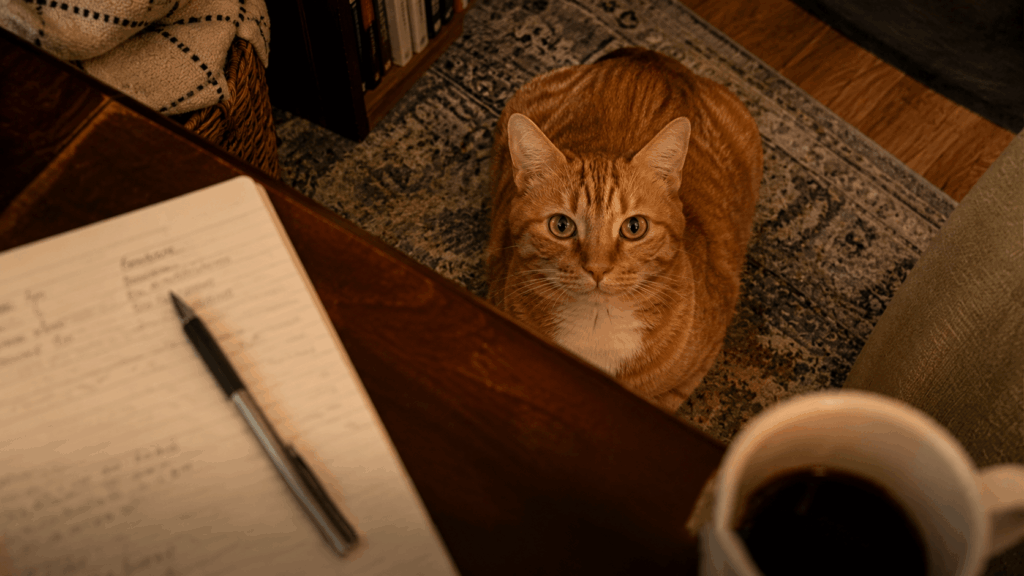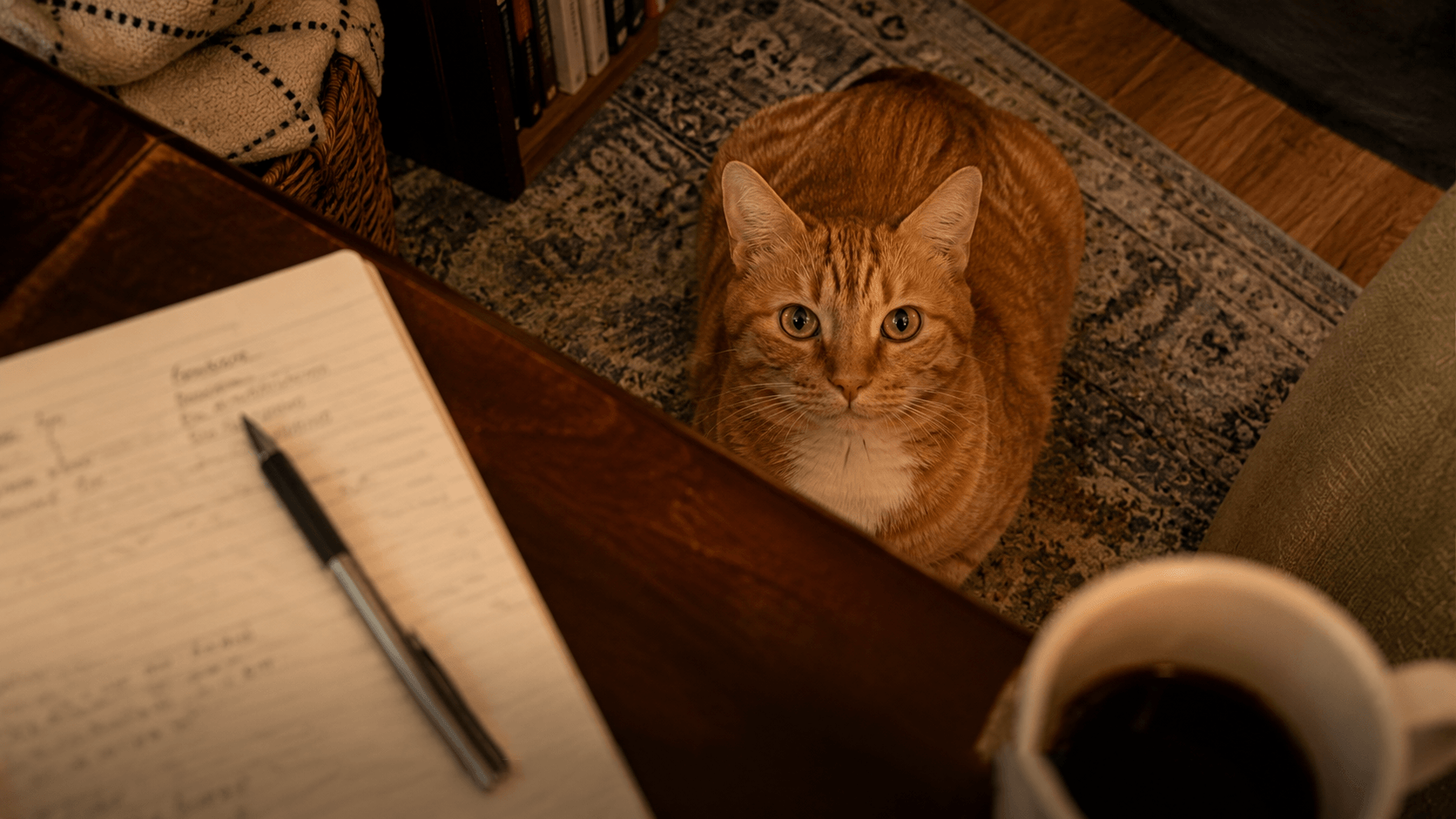
It was a Tuesday evening. I was eating pasta at my desk β€” nothing dramatic, nothing particularly cat-relevant β€” when I felt it. That specific, unmistakable pressure of being watched. I looked up from my laptop, and there was Oliver: sitting perfectly still on the floor three feet away, back straight, paws together, staring at me with the kind of sustained, unblinking intensity usually reserved for criminal interrogations and professional poker tournaments. He didn’t meow.

He didn’t move. He just stared. If you’ve lived with a cat for more than a week, you know this exact experience β€” and you’ve probably asked yourself why does my cat stare at me at least once, possibly while feeling faintly unsettled. As a veterinary technician with years of feline behavior study behind me, I can tell you with confidence: this question is one of communication and connection, not evidence of a plot for world domination. 

Why does my cat stare at me is actually one of the most fascinating questions in feline behavior β€” and the answer reveals far more about your relationship with your cat than you might expect.


Quick Answer: Why Does My Cat Stare at Me?

Cats stare at owners to gather information, express affection (the ‘love stare’), solicit food, or communicate stress. Because cats are visual hunters, they use sustained eye contact to monitor your movements. Context is key: a soft gaze with a Slow Blink means love, while a Hard Stare with Dilated Pupils may signal tension or pain.


The Visual Hunter: Why Cats Use Their Eyes Differently

To understand why does my cat stare at me, we first need to understand the fundamental visual ecology of the domestic cat β€” because cats experience and use vision in ways that are genuinely different from humans, and those differences explain a great deal of their staring behavior.

Built for the Hunt

Cats are obligate predators with visual systems engineered for detecting movement, tracking prey, and operating in low-light conditions. Their eyes are:

  • Disproportionately large relative to skull size β€” if human eyes were scaled the same way, they’d be the size of grapefruits
  • Forward-facing β€” providing approximately 200 degrees of visual field with a large binocular overlap zone (roughly 140 degrees) that enables precise depth perception for calculating pounce distances
  • Extremely motion-sensitive β€” cats can detect movement at speeds and distances that far exceed human capability, but they are comparatively poor at resolving fine stationary detail at close range
  • Low-light optimized β€” the tapetum lucidum (the reflective layer that causes “eyeshine”) amplifies available light, making cats approximately six times more sensitive to light than humans in dim conditions

What This Means for Staring Behavior

A cat’s visual system is primed to monitor β€” to maintain sustained attention on objects and beings of interest, tracking for information-relevant changes in movement, position, or behavior.

When Oliver stares at me from across the room, he is doing what his visual system is perfectly designed to do: maintaining sustained surveillance on the most important and information-rich entity in his environment. That entity is me β€” his primary attachment figure, his food source, his social partner, and the being whose behavior most directly predicts what is going to happen next in his world.

The stare is not aggression. The stare is not manipulation. The stare is information management β€” and understanding this reframes every subsequent secret we’re about to explore.

The eyes, however, are just one channel of communication in a sophisticated feline signaling system. To fully understand what any given stare means, you must assess the ears, tail, and posture simultaneously β€” as we detail comprehensively in our ultimate feline body language guide. [Cat Body Language Meaning: 15 Visual Clues to Master Feline Secrets]


5 Surprising Secrets: Why Does My Cat Stare at Me and What to Do


πŸ” Secret 1: The ‘Love Stare’ β€” Oxytocin and Slow Blinks

This is my favorite secret β€” and the one I most enjoy sharing with clients who have been slightly unnerved by their cat’s intense gaze.

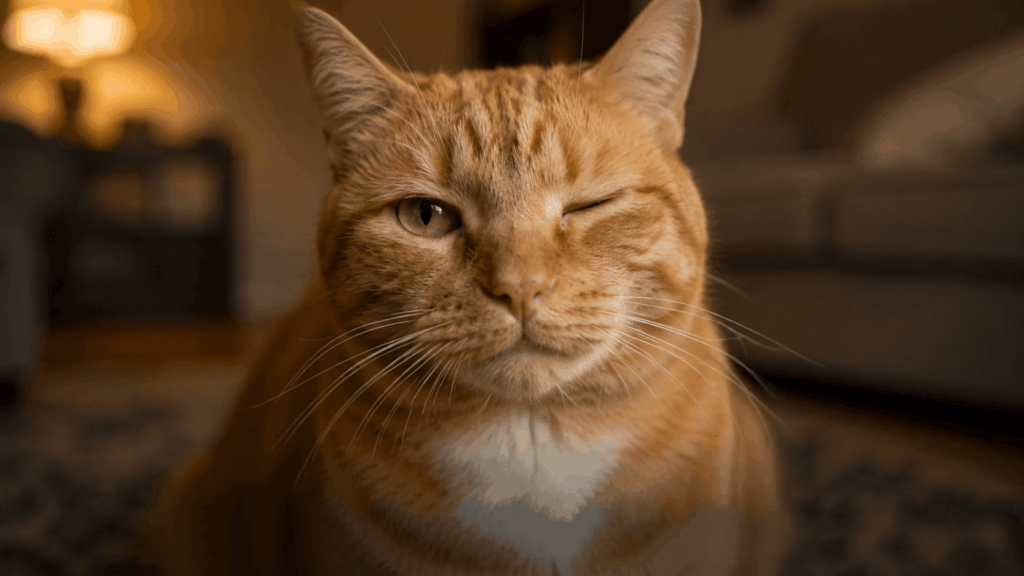
Why does my cat stare at me with soft, half-lidded eyes and then slowly close them? The answer involves one of the most well-known bonding neurochemicals in mammalian biology: oxytocin.

The Science of the Feline Love Gaze

A landmark study by Nagasawa et al. (2015) β€” more commonly associated with dogs and their owners β€” established that mutual gazing between humans and their pets triggers Oxytocin Release in both parties. Subsequent research has extended this framework to cats: when a cat engages in soft, affiliative eye contact with a trusted human, both the human and the cat experience measurable increases in oxytocin levels.

Oxytocin is the neurochemical associated with social bonding, trust, and affection β€” sometimes called the “love hormone” or “bonding hormone.” Its release during mutual gazing creates a positive feedback loop: the gaze itself strengthens the bond that motivates the gaze.

Research by Humphrey et al. (2020) demonstrated something even more remarkable: cats respond to human-initiated Slow Blinks with their own slow blink responses and increased approach behavior. The slow blink β€” that deliberate, gentle closing and reopening of the eyes β€” is a genuine cross-species communication tool that signals trust, comfort, and non-threatening intent.

How to Identify the Love Stare

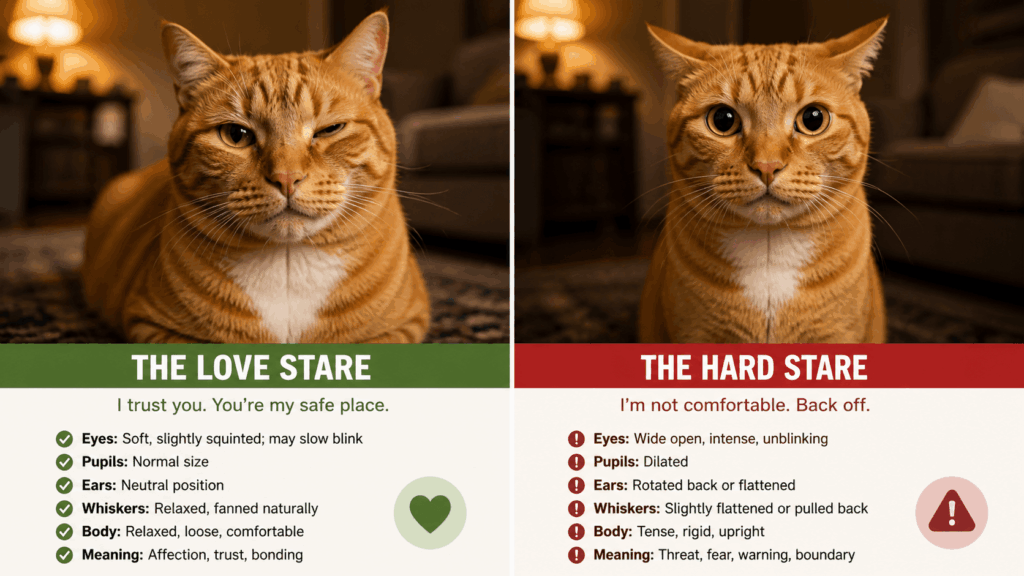
The love stare has a specific visual signature that distinguishes it from other forms of feline staring:

  • Soft, slightly squinted eyes β€” the edges of the eyelids are relaxed, not wide and tense
  • Pupils are normal to slightly constricted β€” not the wide dilation of arousal or fear
  • Slow, voluntary blinks interspersed with sustained soft gaze
  • Relaxed body posture accompanying the gaze β€” meatloaf position, neutral tail, forward-neutral ears
  • The gaze drifts and returns rather than being locked and rigid

When Oliver does this from across the room β€” that soft, drowsy, intermittently blinking stare β€” I know exactly what it means. And I slow-blink back.

How to Respond

The research-backed response to a love stare is simple and deeply satisfying:

  1. Soften your own eyes β€” relax the muscles around your eyes consciously
  2. Look slightly to the side of your cat’s direct gaze rather than into the pupils (direct staring back can register as a mild challenge)
  3. Execute a slow blink: half-close your eyes over 2–3 seconds, hold briefly, reopen slowly
  4. Wait β€” watch for your cat’s reciprocal slow blink response

Oliver typically responds within 30–45 seconds. Sometimes he’ll slow-blink, then look away briefly, then look back and slow-blink again. It is, without question, one of the purest cross-species communication moments I’ve experienced.


πŸ” Secret 2: Information Gathering β€” The ‘What’s Next?’ Look

The second answer to why does my cat stare at me is more pragmatic and deeply rooted in the cognitive sophistication of domestic cats.

Cats are extraordinary pattern learners. They map the behavioral routines of the humans they live with in extraordinary detail β€” and they use sustained visual monitoring to collect and update that behavioral data in real time.

Your Cat is Reading Your Behavioral Script

Oliver knows my morning routine with a precision that would embarrass most scheduling software:

  • When I close my laptop: potential play time
  • When I stand up and move toward the kitchen: possible food event
  • When I pick up my keys: I’m leaving (trigger for mild separation anxiety)
  • When I get out the specific drawer where his treats live: maximum alert

He didn’t learn any of this through explicit teaching. He learned it through sustained visual monitoring β€” watching me, correlating my movements with subsequent events, building a predictive behavioral model of my actions.

The ‘What’s Next?’ Gaze Profile

This type of staring has distinctive characteristics:

  • Highly alert and tracking β€” the cat’s eyes follow your movements rather than resting in a fixed position
  • Anticipatory body language β€” ears forward, body slightly shifted toward likely action zones (kitchen, door, treat drawer)
  • Responsive to your movement β€” any shift in your position immediately updates the cat’s attention direction
  • Often accompanied by a raised or vertical tail when the anticipated event is positive

Why This Matters for Your Relationship

Understanding this information-gathering stare reframes something that might otherwise feel like pressure or scrutiny. Your cat is not judging you. They are investing cognitive resources in understanding you β€” because understanding you is the most important adaptive skill available to them in their environment.

The fact that your cat watches you this carefully is, in its own way, a profound compliment. You are the most important predictive variable in their world. They are paying attention because you matter.


πŸ” Secret 3: The Hunger Pressure β€” Silent Solicitation

Let’s be honest about this one: sometimes the answer to why does my cat stare at me is considerably less poetic than oxytocin and cross-species bonding.

Sometimes they’re just hungry.

But even this functional behavior is more sophisticated than it first appears β€” and research has given it a specific name: the Solicitation Gaze.

The Science of Silent Manipulation

Studies on cat vocalization by McComb et al. (2009) identified a specific “solicitation purr” β€” a purr with an embedded high-frequency cry component β€” that cats use to solicit feeding from owners. The visual equivalent of this behavior is the Solicitation Gaze: a sustained, direct stare used to pressure owners into attending to the cat’s needs without requiring a vocalization.

The Solicitation Gaze is particularly sophisticated because it leverages the human tendency to find sustained eye contact socially uncomfortable β€” we are neurologically primed to respond to being stared at, and cats appear to have learned (through behavioral conditioning of their owners) that the stare reliably produces results.

Identifying the Hunger Stare

  • Timing is the primary diagnostic clue: Does this stare reliably appear at or near regular feeding times? Before or after meals?
  • Location matters: The hunger stare often occurs near food storage areas, the kitchen, or wherever feeding typically happens
  • Escalation pattern: If the stare doesn’t produce results, it often escalates β€” to a small vocalization, a paw tap, or moving toward the food bowl and looking back (the classic “follow me” behavior)
  • Body language is goal-directed: The cat may alternate between staring at you and staring at the food area
  • Posture is alert but relaxed β€” this is anticipatory staring, not stressed staring

The Training Dynamic

Here’s the part cat owners often don’t realize: if you have ever fed your cat in response to the Solicitation Gaze, you have taught your cat that the stare works. The behavior was reinforced. It will happen again, with potentially increasing frequency and duration.

This isn’t manipulation in a cynical sense β€” it’s operant conditioning, and it works on both species. Oliver has trained me as thoroughly as I’ve trained him, and I’ve made my peace with that.


πŸ” Secret 4: Territorial Assessment or Challenge

Not all staring is soft, and not all staring is friendly β€” and understanding why does my cat stare at me requires being honest about the fact that some stares carry a harder edge.

The Hard Stare as Social Communication

In feline social communication, prolonged direct eye contact is fundamentally a challenge or threat signal. Between cats, a sustained, unbroken, hard stare is typically the precursor to either a social dominance display or an aggressive interaction. The cat who looks away first is, in feline social terms, the one who is standing down.

When a cat directs this type of stare at a human, it typically occurs in specific contexts:

  • Territorial boundary assertion: The cat has decided that a specific space β€” a chair, a bed position, a sunbeam β€” belongs to them, and your proximity is being assessed as a potential incursion
  • Resource guarding: Staring near a food bowl, a favored toy, or a sleeping location can be a mild resource-guarding signal
  • Social hierarchy navigation: In multi-cat households, one cat may stare at a human as a component of broader social tension that isn’t really about the human at all
  • Redirected arousal: A cat who is aroused by an external stimulus (a bird outside, a sound, another cat) may redirect their fixed, hard gaze onto the nearest available being

How to Identify the Challenge Stare

The Hard Stare has a distinctly different quality from the love stare:

  • Pupils may be dilated beyond what light conditions explain
  • Eyes are wide and unblinking β€” no soft squinting, no slow blinks
  • Body posture is tense and rigid β€” not the relaxed meatloaf of the love stare
  • Ears may be rotated slightly backward or to the sides
  • Tail may be low or lashing β€” additional arousal signals
  • The gaze does not drift β€” it is locked and sustained without the soft drifting of affiliative staring

What To Do

The appropriate response to a Hard Stare is to look away β€” slowly and deliberately, averting your gaze to the side. This is the feline de-escalation signal: “I’m not challenging you. I’m standing down.” Staring back in a competitive way escalates the dynamic; looking away resolves it.

Never attempt to stare down a cat who is hard-staring at you. You will not win, and the attempt may push the cat past a comfortable threshold.


πŸ” Secret 5: Medical Red Flags β€” Cognitive Decline or Pain

This is the secret that, as a veterinary technician, I feel most strongly about including β€” because why does my cat stare at me sometimes has a medical answer that owners consistently miss.

Staring as a Medical Symptom

Certain types of unusual staring behavior in cats β€” particularly staring that appears confused, unfocused, directed at walls or blank spaces, or accompanied by changes in general responsiveness β€” can indicate:

Cognitive Dysfunction Syndrome (CDS):
Feline CDS is the equivalent of dementia in cats β€” a progressive neurological condition most commonly seen in cats over 10–15 years of age. Staring behavior associated with CDS includes:

  • Staring at walls or blank spaces for prolonged periods with apparent lack of awareness of surroundings
  • Staring at you with a confused or “lost” quality β€” as if they’re trying to recognize you and struggling
  • Prolonged, unfocused staring accompanied by disorientation, vocalization at night, or changes in sleep-wake cycles
  • Getting “stuck” in corners or against walls while staring blankly

Pain-Related Staring:
A cat in chronic pain may exhibit staring behavior as part of a broader hunched, withdrawn presentation. The stare here is typically:

  • Fixed and slightly unfocused
  • Combined with a tense, compressed body posture
  • Accompanied by reduced response to stimuli that would normally provoke a reaction
  • Often directed downward or at the floor rather than at specific objects or people

A hard, unblinking stare combined with a tense meatloaf posture and reduced environmental engagement can be one of the subtle early signs of chronic stress or underlying pain β€” behavioral changes we’ve analyzed in detail in our guide on identifying chronic stress. [Why Does My Cat Always Want Attention? (And Is It Normal?)]

Hypertension (High Blood Pressure):
Hypertension in cats β€” frequently secondary to hyperthyroidism or chronic kidney disease β€” can cause retinal changes including detachment, leading to a wide-eyed, seemingly staring appearance with apparent visual impairment. A cat who suddenly appears to be staring blankly and showing signs of visual difficulty needs urgent veterinary attention.

Hyperthyroidism:
The increased general arousal and restlessness associated with hyperthyroidism can manifest as intensified, almost frantic monitoring behavior β€” the cat seems to be staring at everything with heightened urgency. In older cats, any significant behavioral change including altered staring patterns warrants a thyroid function assessment.

When to Seek Veterinary Attention

Contact your veterinarian if staring behavior is:

  • New-onset and unexplained in a previously normal cat
  • Directed at blank walls or apparently empty spaces with apparent confusion
  • Accompanied by vocalization, particularly at night
  • Combined with changes in appetite, litter box behavior, or mobility
  • Associated with visible eye changes (cloudiness, asymmetric pupils, visible third eyelid)
  • Present in a cat over 10 years of age alongside other behavioral changes


How to Respond: To Stare Back or Look Away?

Now that we’ve covered the five secrets behind why does my cat stare at me, the practical question becomes: what should you actually do when your cat is staring at you?

The answer depends entirely on correctly identifying which type of stare you’re receiving β€” which is why the Composite Signal framework from our body language guide is so important. Here’s a quick decision guide:


🟒 If It’s the Love Stare (Soft Eyes, Relaxed Posture):

Respond with a Slow Blink.

  • Soften your gaze and look slightly to the side of their face rather than directly into their pupils
  • Slowly close your eyes halfway over 2–3 seconds
  • Hold briefly, then reopen slowly
  • Wait for reciprocation β€” most cats will respond within 30–60 seconds
  • You can also add a soft, low vocalization (“hey, buddy” in a gentle tone works beautifully)

This actively strengthens the bond between you. The Oxytocin Release triggered by this exchange benefits both of you neurologically and emotionally. Do it often.


🟑 If It’s the Information-Gathering Stare (Alert, Tracking Your Movements):

Engage predictably.

  • If you’re about to do something cat-relevant (feed, play, interact), proceed and let the cat’s anticipation be validated
  • If you’re not ready to interact, use a calm verbal acknowledgment (“not yet, buddy”) and continue your activity
  • Avoid sudden, unpredictable movements that could spike arousal unnecessarily
  • Consider whether this cat needs more scheduled interactive play β€” an understimulated cat monitors obsessively because there’s nothing else to do

🟑 If It’s the Hunger Stare (Timed, Goal-Directed, Location-Specific):

Be strategic about reinforcement.

  • If it’s genuinely feeding time, feed β€” the behavior is functional and appropriate
  • If it’s not feeding time, avoid reinforcing the stare by feeding in response to it β€” this teaches the cat that staring at non-meal times also works
  • Redirect with play or enrichment at non-meal times to provide an alternative outlet for the energy driving the solicitation
  • Consider puzzle feeders to extend feeding engagement and reduce the focus on you as the exclusive food-delivery mechanism

πŸ”΄ If It’s the Hard Stare (Tense, Unblinking, Rigid Posture):

Look away and give space.

  • Avert your gaze slowly and deliberately to the side β€” do not make it sudden or reactive
  • Reduce your physical presence in the cat’s space β€” step back, lower yourself, or move to a position that feels less confrontational
  • Do not attempt to pet or touch the cat while they are hard-staring β€” this can trigger defensive aggression
  • Identify whether there’s an environmental trigger (another cat visible, a recent change in the home, resource competition) and address the root cause
  • If this type of staring is new, frequent, or accompanied by other behavioral changes, consult your veterinarian

πŸ”΄ If It’s Confused, Blank, or Wall-Directed Staring:

Document and consult your veterinarian.

  • Note when it occurs, how long it lasts, and what else the cat is doing
  • Video the behavior if possible β€” veterinarians find behavioral videos enormously helpful for assessment
  • Note any other behavioral changes: appetite, litter box use, sleep patterns, vocalization
  • Schedule a veterinary appointment, mentioning cognitive function assessment particularly if your cat is over 10 years of age


Frequently Asked Questions

❓ Why does my cat stare at me while I sleep?

This is one of the questions I get most frequently β€” usually delivered with a slightly haunted expression by owners who have woken up to find their cat two inches from their face, staring with absolute focus in the darkness.

Several factors converge to explain this behavior:

Vulnerability monitoring: Sleep is the most vulnerable behavioral state you enter. Your cat, who is strongly bonded to you and monitors you as their primary social attachment, may engage in what researchers describe as affiliative vigilance β€” watching over a bonded companion during their most vulnerable period. Mother cats do this with kittens. Bonded cats do this with each other. Some cats extend this behavior to their human companions.

Predawn arousal: Cats are crepuscular β€” most active at dawn and dusk. In the predawn hours when you’re deeply asleep, your cat may be at peak activity and alertness. They are fully awake, looking for engagement, and the most interesting thing in their environment is you.

Feed-time anticipation: If you feed your cat in the morning, they have likely mapped your waking behavior precisely and are beginning the feeding solicitation process β€” the stare is phase one of the campaign to accelerate your awakening and subsequent breakfast provision.

The simple answer: If your cat stares at you while you sleep and you wake up to find it, they almost certainly waited until you stirred β€” cats are remarkably attuned to the subtle changes in breathing and movement that precede waking. The stare likely began when they detected you were close to consciousness.

It is, when you frame it correctly, rather touching. Whether it feels that way at 4:47 AM is another matter.


❓ Is it a challenge when my cat won’t look away?

Sometimes yes β€” but context determines everything.

In pure feline social communication terms, holding a direct gaze without looking away is a challenge or dominance signal. Between two cats, the one who maintains the stare is asserting social confidence; the one who looks away is de-escalating.

However, why does my cat stare at me without looking away doesn’t automatically mean they’re challenging you. The key differentiator is the quality of the stare:

A sustained soft stare with slow blinks: Not a challenge β€” an affiliative gaze. The soft quality and intermittent blinks signal non-threatening intent. This cat is not challenging you; they are regarding you with affection and trust.

A sustained hard stare with no blinks, tense posture, and dilated pupils: This has challenge characteristics and should be responded to with a deliberate gaze aversion on your part.

The critical thing to understand is that the duration of the stare is less meaningful than its quality. A cat can stare at you for ten minutes in pure love β€” soft eyes, occasional slow blinks, relaxed body β€” and it means something completely different from a cat who stares at you for thirty seconds with locked, tense, unblinking focus.

Read the whole cat, not just the eyes.


❓ What does it mean when a cat stares at a blank wall?

This question warrants a serious and layered answer, because the causes range from completely benign to medically significant.

Benign explanations:

  • Hearing something you can’t: Cats hear frequencies up to approximately 65,000 Hz β€” compared to the human limit of roughly 20,000 Hz. Your cat staring at a wall may be tracking a mouse or insect inside the wall, a pipe vibration, or an ultrasonic sound from an appliance that you simply cannot perceive. This is the most common explanation in young and middle-aged cats.
  • Smelling something within the wall: Cats have approximately 200 million scent receptors compared to our 5–6 million. Prey animals, other cats, or environmental odors passing through wall materials can capture and hold a cat’s olfactory attention β€” and they’ll stare at the source while processing the scent information. The Flehmen Response β€” the lip-curl that draws scent molecules to the vomeronasal organ β€” may accompany this if the scent is particularly interesting.
  • Visual artifact: Dust particles, light reflections from passing cars, or subtle shadows can trigger a cat’s motion-sensitive visual system even when nothing visible-to-humans is present.

Medically significant explanations:

  • Cognitive Dysfunction Syndrome: Prolonged, confused staring at walls β€” particularly in cats over 10 years of age, especially at night β€” is a classic early presentation of feline cognitive decline. The cat appears genuinely bewildered by the wall, as opposed to actively tracking something within it.
  • Focal seizure activity: Some focal seizure patterns in cats manifest as staring episodes β€” periods of apparent absence, fixed gaze, and unresponsiveness that resolve spontaneously. If your cat’s wall-staring is accompanied by any apparent unawareness of their surroundings, twitching, excessive drooling, or post-episode disorientation, this needs urgent veterinary assessment.
  • Hypertensive retinopathy: High blood pressure can cause visual disturbances that manifest as confused staring or apparent tracking of things that aren’t there.

The rule I apply clinically: Young cat staring at a wall while clearly tracking something = probably a pest or sound. Old cat staring at a wall with a confused, disconnected quality = veterinary conversation warranted.


Scientific References

  1. Humphrey, T., Proops, L., Forman, J., Spooner, R., & McComb, K. (2020). The role of cat eye narrowing movements in cat–human communication. Scientific Reports, 10, 16503.
    https://doi.org/10.1038/s41598-020-73426-0
  2. Vitale, K. R., Behnke, A. C., & Udell, M. A. R. (2019). Attachment bonds between domestic cats and humans. Current Biology, 29(18), R864–R865.
    https://doi.org/10.1016/j.cub.2019.08.036

The Bottom Line: Your Cat is Telling You Something

Oliver is staring at me right now. Soft eyes, relaxed meatloaf posture, the left eye just executed a slow blink while I typed that sentence. The answer to why does my cat stare at me in this particular moment is not hunger β€” he was fed an hour ago. It’s not a challenge β€” his body is completely relaxed. It’s not medical confusion β€” he’s eight years old and sharp as a tack.

He’s just watching me. Monitoring the most important variable in his world. Checking in. Being present with me in the way that cats are present β€” quietly, attentively, without drama or demand.

I slow-blinked back.

Understanding why does my cat stare at me transformed what used to feel like mild surveillance into something I now genuinely treasure β€” a window into a continuous, sophisticated, largely silent conversation that Oliver has been trying to have with me since the day I brought him home. The love stare, the information stare, the hunger campaign, the rare hard challenge, and the medical signals that deserve immediate attention β€” they’re all part of the same rich communicative repertoire.

Your cat is not staring at you because they’re plotting anything. They’re staring at you because you matter. Because you are their world, their social partner, their primary attachment figure, and the being whose next move will determine what happens in their environment.

They are paying attention because you are worth paying attention to.

The least we can do is learn to read what they’re saying back.


Caught your cat in a particularly expressive stare lately? Tell me about it in the comments β€” I read every one. And if you found this guide useful, share it with a fellow cat owner who has asked “why does my cat stare at me” while slowly backing away from their very focused feline.


Tags: why does my cat stare at me | cat behavior | feline communication | cat body language | cat eye contact | feline behavior guide | cat staring

Share this post

Subscribe to our newsletter

Keep up with the latest blog posts by staying updated. No spamming: we promise.
By clicking Sign Up you’re confirming that you agree with our Terms and Conditions.

Related posts