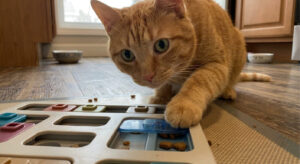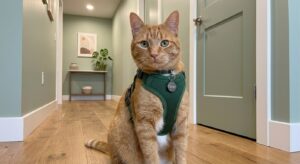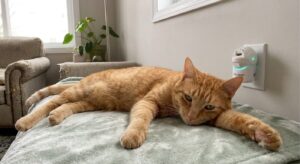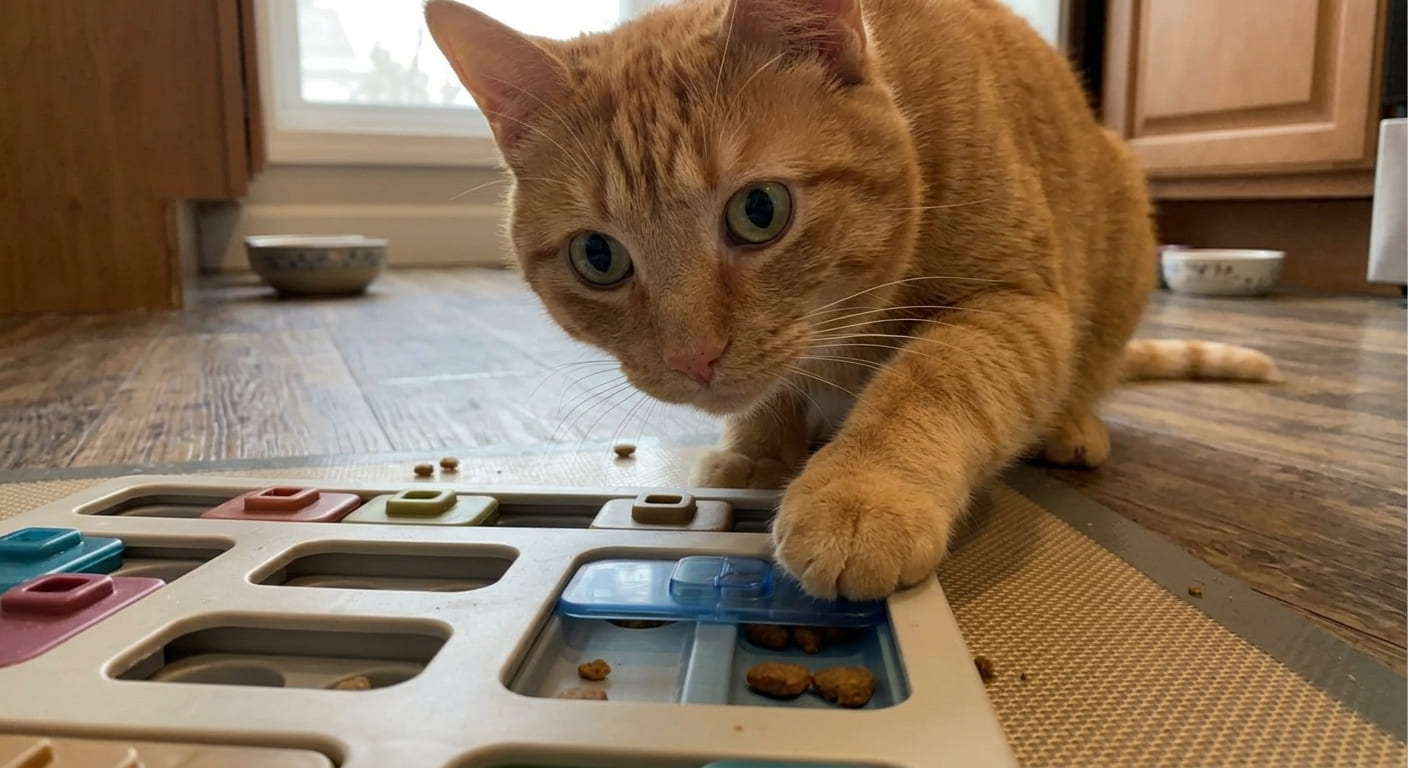
Oliver used to eat like he was competing in a timed event.
Ten seconds. Possibly twelve on a slow day. The kibble would disappear from the bowl with a vacuum-cleaner efficiency that left me genuinely concerned for his esophagus, and then he would spend the next four hours looking for trouble with the focused dedication of someone who had checked “eating” off their agenda and needed a new project.
The curtains were a project. The houseplants were a project. My feet under the blanket at 2 AM were a project.
As a veterinary technician, I was already familiar with the concept of Cognitive Enrichment in clinical settings—we use feeding puzzles in our shelter population specifically to reduce stress-related behaviors. But I hadn’t fully applied the principle to Oliver until I started reading the research on contrafreeloading: the documented phenomenon in which animals, given the choice between free food and food they must work for, consistently prefer to work for it.
This applies to cats. It’s been studied and confirmed. Your cat, neurologically speaking, is not designed to eat from a bowl. The best cat puzzle feeders replace the bowl with an activity that engages the hunting sequence—locate, manipulate, extract, consume—and the behavioral and psychological benefits of that engagement are substantial and well-documented.
Oliver’s curtains have been safe for 18 months.
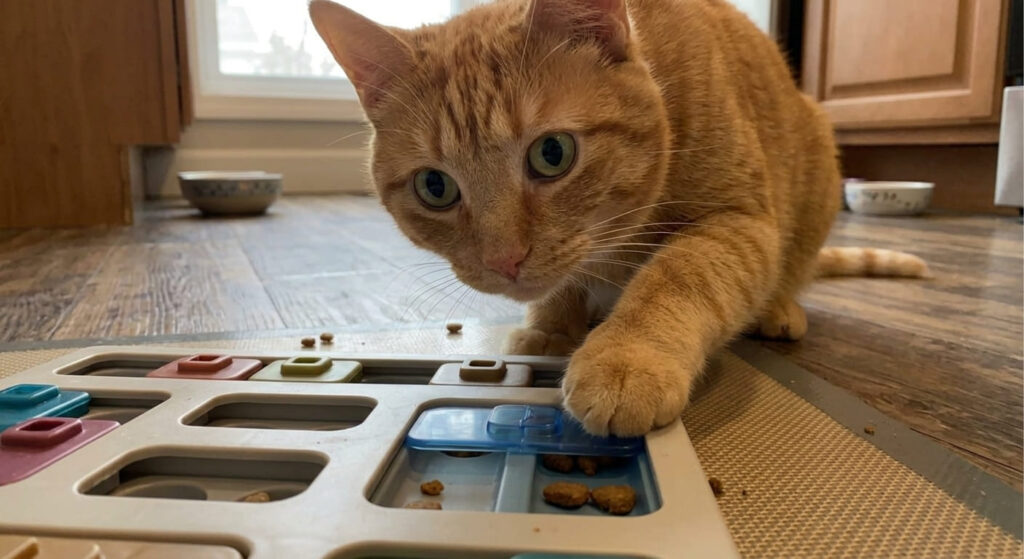
Quick Answer: Why Your High-Energy Cat Needs a Puzzle Feeder?
The best cat puzzle feeders replace traditional bowls to provide mental stimulation, slow down dangerous fast eaters, and incorporate passive physical activity into daily feeding. For high-energy cats, look for adjustable difficulty levels and durable, Dishwasher Safe, BPA-free materials. These tools mimic the natural hunt-forage sequence, significantly reducing boredom-driven destructive behaviors in indoor environments.
The End of the Bowl: Why Feeding Is the Best Enrichment Opportunity
Most cat owners think of enrichment as toys, cat trees, and window perches. These are all valuable. But the single highest-leverage enrichment opportunity in a cat’s day is feeding time—and most owners squander it with a bowl.
The Mathematics of Feeding Frequency
Oliver eats twice a day. Each meal from a bowl takes approximately 10-15 seconds. In a 24-hour period, he was spending roughly 30 seconds engaged in the activity that should be the primary organizing behavioral event of his day.
Wild and feral cats spend 4-6 hours per day in hunting and foraging activity. Their domestic counterparts have the same neurological drive to hunt and forage, compressed into a fraction of a second in front of a bowl.
The behavioral surplus has to go somewhere. For Oliver, it went into the curtains.
Contrafreeloading: The Science of Earned Meals
The term “contrafreeloading” describes the documented preference across multiple species—including cats—for working to obtain food rather than accepting it freely.
Research by Dantas et al. (2016) specifically investigated this in domestic cats and produced a result that surprised even the researchers: cats consistently chose to work for food from puzzle feeders over identical free food available in adjacent bowls. This wasn’t occasional preference—it was consistent, repeated, and statistically significant.
The implication: Your cat is not being difficult when they bat food off the counter rather than eat from their bowl. They are expressing a neurological preference for engaged food acquisition. The best cat puzzle feeders satisfy this preference appropriately.
The Complete Hunt Sequence
The behavioral health benefit of puzzle feeders extends beyond simple caloric delivery. Effective puzzles activate what behaviorists call the complete hunt sequence:
- Search (locate the food source)
- Stalk (approach and orient)
- Manipulate (paw, nose, or extract)
- Capture (successful extraction)
- Consume (eating)
Each stage of this sequence releases dopamine in the reward pathway. A cat who completes the full sequence gets neurological reward that goes well beyond simple satiation.
Environmental enrichment through food puzzles is one of the most effective defenses against common boredom behaviors—counter-surfing, vocalization, and destructive scratching—that I document in my guide to managing indoor cat behavioral issues. [15 DIY Cat Enrichment Ideas for Small Apartments (Under \$20)]
Understanding Difficulty Levels: Don’t Frustrate Your Cat
This is the section that prevents the most common puzzle feeder implementation failure: buying a level-3 puzzle for a cat who has never seen a level-1, watching them fail repeatedly, and concluding that puzzle feeders “don’t work for my cat.”
They don’t fail. The difficulty calibration failed.
The Difficulty Spectrum
Level 1 (Beginner):
- Food is visible and accessible with minimal manipulation
- Single movement required (paw, nose push)
- High success rate from first introduction
- Purpose: Build puzzle-feeder confidence and positive association
Level 2 (Intermediate):
- Food requires multiple sequential movements
- Some spatial reasoning required
- Success rate after brief exploration
- Purpose: Engage problem-solving behavior
Level 3 (Advanced):
- Multiple complex manipulation steps
- Memory and pattern recognition involved
- Significant time investment per meal
- Purpose: Maximum Cognitive Enrichment for highly intelligent cats
The Frustration Threshold
Each cat has an individual frustration threshold—the point at which failed attempts transition from motivating challenge to aversive experience. Pushing a cat past their frustration threshold doesn’t teach them to persist; it teaches them to avoid the puzzle.
Signs you’re above the frustration threshold:
- Cat attempts the puzzle briefly, then walks away
- Cat sits near the puzzle and vocalizes
- Cat knocks the puzzle over and eats from the floor
- Decreasing engagement over multiple sessions
Signs you’re at the right difficulty:
- Cat engages for 5+ minutes without disengaging
- Persistent attempts across sessions
- Increasing efficiency (solving faster over days)
- Seeking out the puzzle before meal delivery
The Progression Protocol
Week 1: Level 1 puzzle with high-value food (not regular kibble—something special)
Week 2-3: Level 1 puzzle with regular food; introduce Level 2 alongside
Week 4+: Transition to Level 2 primary; introduce Level 3 for one meal per week
For cats who love puzzle feeders and cats who resist them with equal energy, the progression protocol—not the puzzle itself—is the variable that determines success.
Top 5 Recommendations: Best Cat Puzzle Feeders (2025)
🥇 The Best for Beginners: LickiMat Classic Soother
Price: $12 – $15
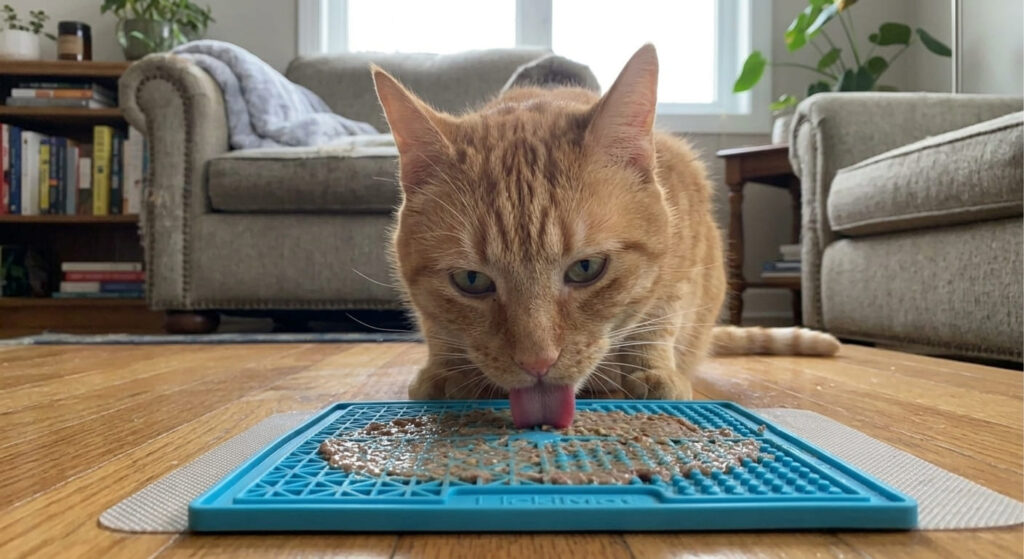
The LickiMat isn’t the most complex puzzle on this list, but it earns the beginner recommendation for reasons that go beyond difficulty level: it’s the puzzle feeder most likely to get a bowl-only cat engaged with food enrichment for the first time.
Technical specifications:
- Material: Dishwasher Safe food-grade rubber (Non-Slip Base)
- Difficulty: Level 1 (licking engagement, no manipulation)
- Food compatibility: Wet food, pâté, Greek yogurt, peanut butter, raw
- BPA-free: Yes
- Size: 8″ × 8″ (Classic) or 12″ × 12″ (Splash)
- Freezer safe: Yes
The neurological case for licking:
Licking activates the parasympathetic nervous system—the “rest and digest” system that opposes the sympathetic stress response. The repetitive licking motion releases serotonin and produces a measurable calming effect that extends beyond the feeding period itself.
For cats with anxiety, stress-related eating issues, or post-stressor recovery, the LickiMat delivers Cognitive Enrichment and physiological calming simultaneously.
The freeze strategy:
Spread wet food across the LickiMat and freeze overnight. The frozen surface extends the feeding session from 3-5 minutes (room temperature) to 15-20 minutes (frozen), dramatically increasing the enrichment duration per serving.
Pros:
- Zero learning curve (all cats can engage immediately)
- Non-Slip Base prevents movement during use
- Dishwasher Safe and BPA-free
- Freezer-safe for extended session duration
- Calming licking behavior has clinical benefit beyond enrichment
- Low price point for daily use investment
Cons:
- Level 1 only—no difficulty progression on this product
- Wet food/soft food only (not for dry kibble)
- Requires daily cleaning to prevent bacterial growth
- Some cats solve it so efficiently it provides minimal extension
Best for: First puzzle feeder introduction, cats transitioning from bowls, cats with anxiety or stress, wet food eaters
🧠 The Advanced Brain-Teaser: Doc & Phoebe’s Indoor Hunting Feeder
Price: $25 – $30 (5-pack)
This is the puzzle system I’ve referenced throughout my enrichment guides, and it earns its repeated mention because it’s the only product I’ve tested that reliably activates all five stages of the complete hunt sequence.
Technical specifications:
- Material: BPA-free polypropylene, Non-Slip Base
- Difficulty: Level 2-3 (adjustable via fill amount)
- Food compatibility: Dry kibble only (no wet food)
- Dishwasher Safe: Yes (top rack)
- Set: 5 feeders per set
- Mechanism: Weighted, tips and rolls to dispense kibble
The five-feeder system:
This product’s design insight is that a single puzzle feeder in one location is still essentially a bowl with extra steps. Five feeders hidden throughout the apartment requires genuine search behavior before manipulation and extraction can begin.
Oliver’s morning routine with these feeders:
- I hide 5 feeders in various locations (under furniture edges, behind plant pots, on different floor levels)
- Oliver spends 10-15 minutes searching for each
- Each found feeder requires manipulation to extract kibble
- Total feeding session: 20-30 minutes
Twenty minutes of engaged hunting behavior twice daily has replaced all of the curtain, bookshelf, and 2 AM foot-attack behavior.
For high-energy breeds like Bengals or Savannahs, puzzle feeders like this system are not optional accessories but genuine necessities for psychological health—and I explain exactly why in my guide to managing high-drive cat breeds in apartment environments. [Why Does My Cat Have the Zoomies at Night? (And How to Stop It)]
Pros:
- Complete hunt sequence activation (search + manipulate + extract)
- Adjustable difficulty through fill volume and hiding complexity
- Dishwasher Safe, BPA-free
- Five-feeder set enables whole-apartment foraging
- Eliminates fast eating completely
- Extends meal engagement to 20+ minutes
Cons:
- Dry kibble only (no wet food compatibility)
- Requires owner setup time (hiding feeders)
- Feeders get lost under furniture
- Level 2-3 difficulty may require introduction protocol for puzzle-naive cats
Best for: High-energy cats, intelligent breeds, owners who want maximum hunt sequence activation, cats who have mastered stationary puzzles
🌊 The Best for Wet Food: Northmate Catch Interactive Feeder
Price: $20 – $25
Most puzzle feeders are designed for kibble—the structural requirements for wet food puzzles are different (no compartments that trap moisture, easy cleaning surfaces, no small gaps that accumulate protein residue). The Northmate Catch addresses all of these.
Technical specifications:
- Material: BPA-free rubber, Non-Slip Base
- Difficulty: Level 1-2 (adjustable via food viscosity)
- Food compatibility: Wet food, raw, kibble (versatile)
- Dishwasher Safe: Yes (top rack)
- Design: Grass-blade structure distributes food among “blades”
- Size: 11.5″ × 8″
The grass-blade mechanism:
The Northmate’s grass-blade design distributes food among rubber “blades” of varying heights, requiring the cat to navigate between blades to extract food. For wet food, the blades prevent simple lapping—the cat must maneuver their tongue between blade structures.
The variable blade height creates what functions as an adjustable difficulty: thin, fluid wet food distributes easily between blades (lower difficulty) while thick pâté or raw food stays between blades (higher difficulty).
Cleaning advantage:
The rubber blade material doesn’t trap food in sealed compartments the way most kibble puzzles do. Food residue sits on the blade surfaces and between them—fully accessible to dishwasher jets or manual cleaning.
Pros:
- Wet food compatible (most puzzles aren’t)
- Dishwasher Safe, BPA-free rubber throughout
- Non-Slip Base prevents movement during use
- Variable difficulty through food consistency
- Easy cleaning (no sealed compartments trapping residue)
- Works for kibble too (versatile)
Cons:
- Level 1-2 maximum (not appropriate for advanced puzzle seekers)
- Rubber blades can retain odor over time (replace annually)
- Less hunt-sequence activation than compartment-based puzzles
- Some cats walk across it rather than eating from it (initial training may be needed)
Best for: Wet food and raw feeders, beginner-to-intermediate puzzle users, households where cleaning convenience is prioritized
🔧 The Rugged Daily Driver: Trixie 5-in-1 Activity Center
Price: $30 – $38
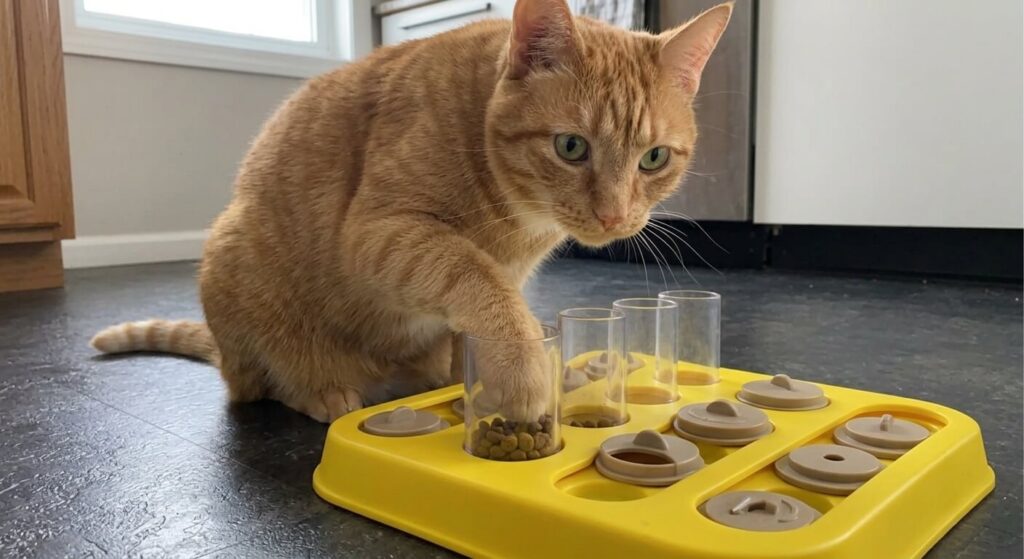
The Trixie 5-in-1 is the puzzle feeder I recommend for owners who want to assess their cat’s puzzle preferences and skill level without buying multiple single-puzzle products. Five different feeding mechanisms on one board means five different types of Cognitive Enrichment in a single mealtime.
Technical specifications:
- Material: BPA-free plastic, rubber Non-Slip Base
- Difficulty: Level 1-3 (varies by section)
- Food compatibility: Dry kibble, treats
- Dishwasher Safe: Yes (top rack, disassembled)
- Mechanisms: Pegs, cylinder, cone, bowl with lid, tunnel
- Size: 14″ × 9″
The five-mechanism design:
Each section of the Trixie challenges a different cognitive skill:
- Pegs section: Food between pegs requires nose/paw navigation (Level 1)
- Cylinder: Rotating cylinder dispenses kibble through holes (Level 2)
- Cone: Spinning cone requires sequential nose contact (Level 2)
- Bowl with cover: Sliding cover removal before access (Level 2)
- Tunnel: Paw insertion and extraction from narrow tube (Level 3)
Using this board reveals which puzzle types engage your cat most—visual information you can use to select future specialized puzzles.
For cats who resist or ignore the exercise wheel, the Trixie 5-in-1 delivers passive physical activity through paw manipulation and body repositioning around the board—a lower-barrier physical engagement option that almost every cat tolerates. [How to Tire Out an Indoor Cat Before Bed (A Routine That Finally Gave Me My Sleep Back)]
Pros:
- Five different mechanisms reveal individual puzzle preferences
- Level 1-3 difficulty range on single board
- Non-Slip Base prevents movement
- Dishwasher Safe when disassembled
- Good durability for daily use
- Competitive price for the feature set
Cons:
- Dry kibble only
- Cleaning between sections requires disassembly
- Larger footprint than single-mechanism puzzles
- Some cats fixate on one section and ignore others
Best for: First-time puzzle feeder owners assessing preferences, cats who need difficulty variety, households wanting a single versatile enrichment tool
💡 The Budget DIY Hack: The Muffin Tin Method
Price: $0 – $12 (materials you likely already have)
I include this not as a commercial recommendation but because the best cat puzzle feeders don’t require a product purchase—and the muffin tin method is clinically equivalent to Level 1-2 commercial puzzles.
What you need:
- Standard 12-cup muffin tin
- 12 tennis balls (or ping pong balls, or crumpled paper balls)
- Your cat’s kibble
Setup:
- Place kibble in varying quantities in the muffin cups (not all cups—random distribution)
- Cover all cups with balls
- Present to cat
The cognitive elements:
- Search: identify which cups have food (olfactory)
- Manipulation: remove covering ball
- Extraction: access kibble in cup
- Memory: remember which cups have been found
Increasing difficulty:
- Use heavier balls (harder to move)
- Stack two balls per cup
- Use a bowl over the entire tin (requiring the tin to be found first)
Pros:
- Zero cost if materials are available
- Equivalent to commercial Level 1-2 puzzles
- Completely safe (no plastic components)
- Easily modified for difficulty
- Familiar-smelling materials (tennis balls often already cat-scented)
Cons:
- Requires manual setup each meal
- Less durable than commercial options
- Balls can become projectiles on hard floors
- Less aesthetically managed than commercial feeders
Best for: Initial puzzle introduction, budget-conscious owners, owners who want to assess puzzle interest before purchasing commercial options
Vet Tech Pro-Tips: Cleaning and Food Safety (Bacteria and Plastic Acne)
This section addresses the clinical concern that most puzzle feeder reviews skip entirely: what happens to your cat’s health when cleaning is inadequate.
The Biofilm Problem in Puzzle Feeders
Puzzle feeders have corners, channels, and compartments that bowls don’t. Biofilm—structured bacterial communities adhering to surfaces—develops more readily in complex surface geometries than on flat bowl surfaces.
A puzzle feeder cleaned inadequately over weeks develops:
- Bacterial colonies in inaccessible corners
- Rancid fat residue from kibble oils
- Protein residue from wet food (if applicable)
- Mold in persistently damp areas
Cleaning protocol by material:
| Material | Cleaning Method | Frequency |
|---|---|---|
| Dishwasher Safe plastic | Full dishwasher cycle | Every 1-2 days |
| Non-Dishwasher Safe plastic | Hot water + dish soap + bottle brush | Daily |
| Rubber (LickiMat, Northmate) | Dishwasher or hot water soak | Daily |
| DIY materials (muffin tin) | Dishwasher | Every use |
The Plastic Acne Connection
Cats who eat from plastic bowls and feeders are at elevated risk for feline chin folliculitis (acne)—a condition driven by the bacterial load on plastic surfaces contacting the chin repeatedly.
Risk reduction:
- Purchase only BPA-free materials with smooth, non-porous surfaces
- Replace plastic feeders showing scratching or cracks (scratches harbor bacteria)
- Consider ceramic or stainless components for cats with acne history
- Never use puzzle feeders past their visible service life
The Drying Protocol
Bacterial growth requires moisture. After washing:
- Air dry completely before the next meal
- Do not stack wet feeders
- For rubber products, ensure no water is trapped in structural recesses
FAQ
Can I use a puzzle feeder for wet food?
Yes, but you need a specifically designed product. Most commercial puzzle feeders use compartments and channels that trap wet food in inaccessible areas, creating both feeding difficulty and cleaning nightmares. The LickiMat, Northmate Catch, and similar flat-surface textured designs are appropriate for wet food.
Compartment-style puzzles like the Trixie 5-in-1 and Doc & Phoebe’s feeders are dry-food-only products. When using wet food puzzles, clean within 30 minutes of the feeding session to prevent bacterial growth in the texture structures.
Will my cat get frustrated and stop eating?
Only if the difficulty level exceeds their current puzzle proficiency. This is the most common implementation error with the best cat puzzle feeders: starting at Level 2-3 with a puzzle-naive cat. Begin at Level 1 (LickiMat, muffin tin, low-fill Doc & Phoebe feeder) and progress only when the cat solves each level with consistent confidence.
If your cat walks away from a puzzle mid-meal, reduce difficulty immediately—hunger doesn’t override frustration aversion, and a frustrated cat will not self-solve to a higher level.
What is the best puzzle feeder for a very smart cat?
For highly intelligent cats—Bengals, Siamese, Savannahs, or simply exceptionally clever individuals—the best cat puzzle feeders are those that require sequential problem-solving rather than simple mechanical manipulation.
The Doc & Phoebe’s system combined with whole-apartment hiding creates the highest cognitive load of any feeding system I’ve tested. Supplement with the Trixie 5-in-1’s Level 3 tunnel element and rotating new puzzle types monthly to prevent mastery-driven disengagement. The rotation of novelty is more important for intelligent cats than the peak difficulty of any single feeder.
Ultimately, the best cat puzzle feeders turn an ordinary meal into an extraordinary adventure for your indoor cat.
Scientific References
- Dantas, L. M. S., Delgado, M. M., Johnson, I., & Buffington, C. A. T. (2016). Food puzzles for cats: Feeding for physical and emotional wellbeing. Journal of Feline Medicine and Surgery, 18(9), 723-732. https://doi.org/10.1177/1098612X16643753. This peer-reviewed study from UC Davis School of Veterinary Medicine documents the clinical outcomes of puzzle feeder implementation in domestic cats, confirming significant reduction in obesity, anxiety-related behaviors, and aggression, with specific documentation of the contrafreeloading preference in domestic cats.
- Greco, M., Notari, L., & Mills, D. S. (2021). Factors affecting the attractiveness of food puzzles in cats. Animals, 11(2), 362. https://doi.org/10.3390/ani11020362. This research investigation examines the variables that predict individual cat engagement with food puzzles, identifying difficulty calibration, food value, and puzzle novelty rotation as the primary determinants of sustained engagement—directly informing the difficulty progression protocol and rotation recommendations in this guide.