By a veterinary technician and cat parent who learned about feline vertical territory the hard way — via a heart-stopping near-miss involving a floor lamp and a refrigerator.
I was in the kitchen making coffee when I heard the scramble. Oliver had apparently decided that the top of the refrigerator was his next destination and that the wobbly floor lamp in the corner was an appropriate launching platform for this ambition. He made the jump, the lamp swayed dramatically, and he caught himself on the refrigerator edge by approximately two claws.
I aged several years in that moment. As a veterinary technician who has treated feline high-rise syndrome injuries — the term we use for trauma from significant falls — I know exactly what a bad landing looks like clinically. That incident reframed how I thought about Oliver’s space entirely. In a 600-square-foot apartment, the floor is genuinely a dead zone for a cat who needs to climb, survey, and patrol territory.
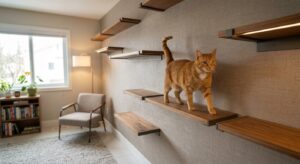
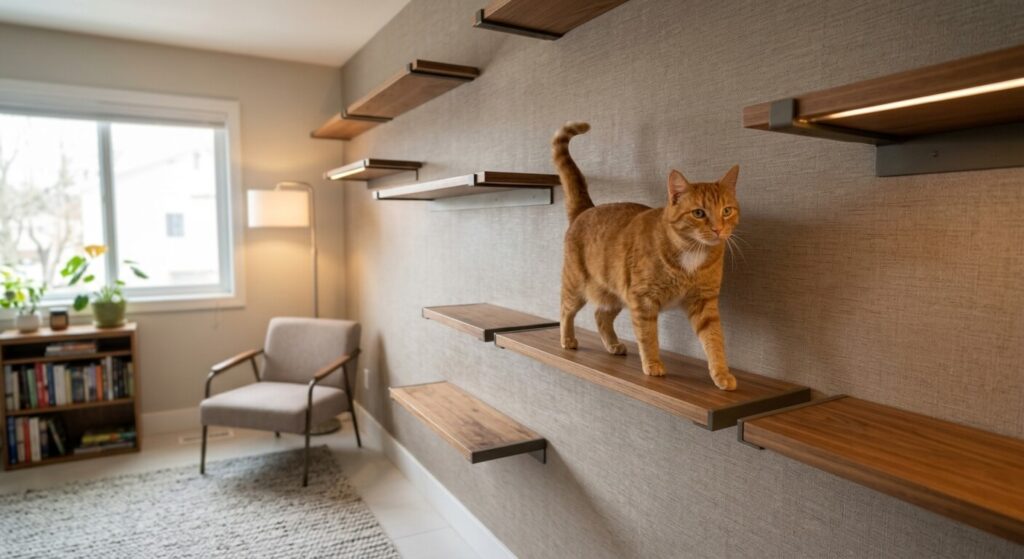
The walls are the real real estate. Finding the best cat wall shelves for a small apartment space became my next project, and I approached it with the same structural and safety criteria I would apply to any weight-bearing clinical equipment. This guide is everything I learned.
Quick Answer: What Are the Best Cat Wall Shelves for Small Spaces?
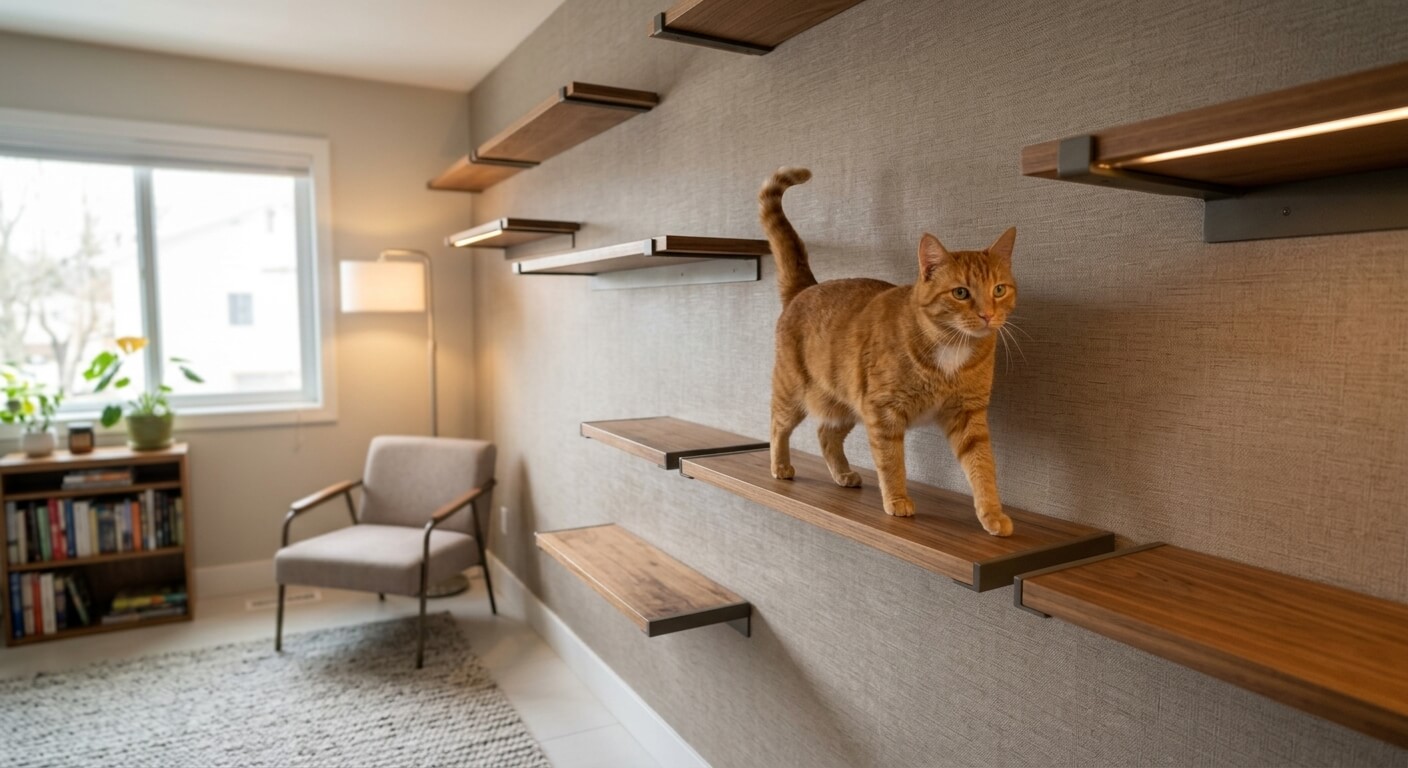
The best cat wall shelves prioritize structural stability (mounting into wall studs), non-slip surfaces (cork, carpet, or felt pads), and modularity that allows you to create a continuous “superhighway” pathway around the room. For 2025, top picks include heavy-duty modular systems for multi-cat households, minimalist floating designs for apartment aesthetics, and corner-bracket renter-friendly options for deposit-conscious owners.
The “Cat Superhighway” Concept: Why Height Equals Security
Before we evaluate any specific cat wall shelves, I want to establish why vertical territory is not an optional comfort feature — it is a fundamental behavioral need with documented effects on feline stress and wellbeing.
The Territorial Neuroscience of Height
In feline behavioral ecology, vertical position correlates directly with perceived territorial security. A cat who controls elevated space in their environment has:
- 360-degree visual monitoring capability — they can observe all entry points and movement in the room simultaneously
- Physical distance from floor-level threats — including unfamiliar visitors, other pets, and startling sounds
- Reduced cortisol baseline — studies on multi-cat households consistently show that cats with access to elevated territory show lower stress indicators than those restricted to floor-level
This is not metaphorical security. It is a measurable neurological state. A cat who owns the high ground in their environment is calmer, less reactive, and more behaviorally stable than one who doesn’t.
The “Superhighway” Design Principle
A single shelf is enrichment. A connected pathway of shelves is territory.
The superhighway concept — continuous, connected elevated pathways that allow a cat to traverse an entire room or multiple rooms without returning to floor level — provides:
- Patrol behavior — cats are territorial patrollers who need to circuit their space regularly; a connected high-level path allows this behavior in the vertical dimension
- Escape routing — in stressful situations, a cat with a high-level escape route can leave a threatening situation (a child, a visitor, a vacuum cleaner) without being cornered
- Exercise — traversing a well-designed shelf system provides the jumping, climbing, and balancing activity that replaces the outdoor movement indoor cats are missing
The design requirement: Every shelf must connect to the next within a cat’s comfortable jumping distance — maximum 18–20 inches of vertical gap for average cats, less for senior or less mobile cats.
Vertical wall systems are the single most effective environmental enrichment tool available for small apartments where floor space is the limiting constraint — and we covered the complete behavioral science behind why this matters so significantly in our indoor enrichment masterclass. [Read our complete guide to indoor cat enrichment and vertical territory here → The Small Apartment Cat Survival Guide: 7 Pillars of Indoor Enrichment]
The Vet Tech Safety Checklist: Studs, Anchors, and Traction
This is the section where my clinical background becomes most directly relevant, because the safety of cat wall shelves is an engineering question as much as a design one.
Understanding Impact Force
When I evaluate cat wall shelf safety, the number I’m looking at is not your cat’s static weight — it’s impact force.
A twelve-pound cat landing on a shelf from a two-foot jump generates significantly more force than twelve pounds of static load. The calculation is basic physics: impact force = mass × acceleration, and a cat landing from height is decelerating from significant velocity. Estimates for a twelve-pound cat landing from a two-foot drop range from 60 to over 100 pounds of instantaneous force on the landing surface and its mounting hardware.
This means a shelf rated for “up to 15 pounds” based on static load testing may not be appropriate for dynamic cat landing loads. Always look for shelves with dynamic load ratings or those marketed specifically for cats with load testing that accounts for landing impact.
The Wall Stud Requirement
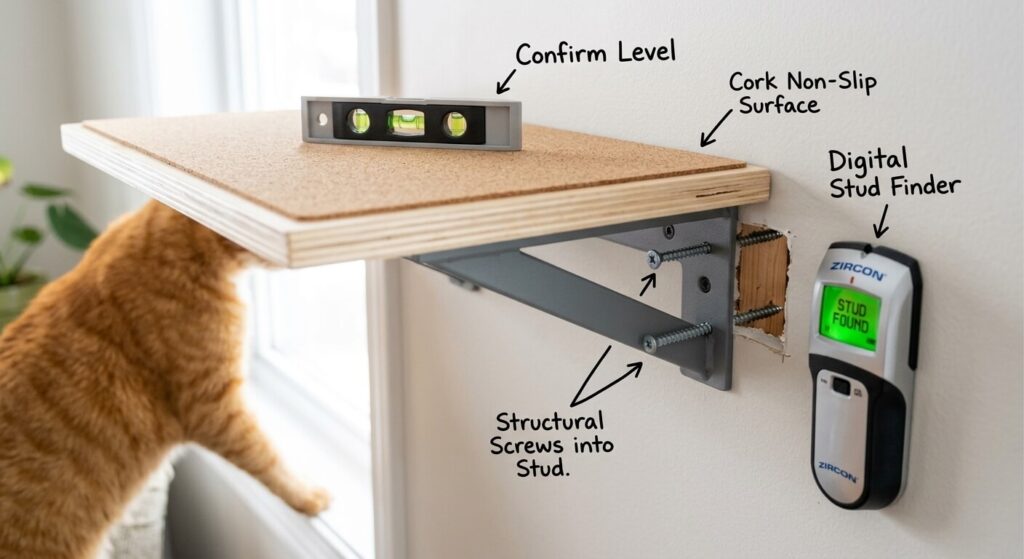
This is non-negotiable. Every cat wall shelf that bears landing impact load must be mounted into wall studs — the structural lumber framing behind drywall — not into drywall alone.
Why drywall-only mounting fails:
- Standard drywall anchors are rated for static loads only
- Dynamic impact force can pull drywall anchors directly through the surrounding material
- A shelf mounted in drywall alone that fails under impact load does not gradually sag — it fails instantly, dropping your cat from height
Finding studs:
- Electronic stud finders are the most reliable method; run along the wall slowly and mark the edges of each stud
- Standard stud spacing is 16 inches center-to-center in US residential construction; 24 inches in some older buildings
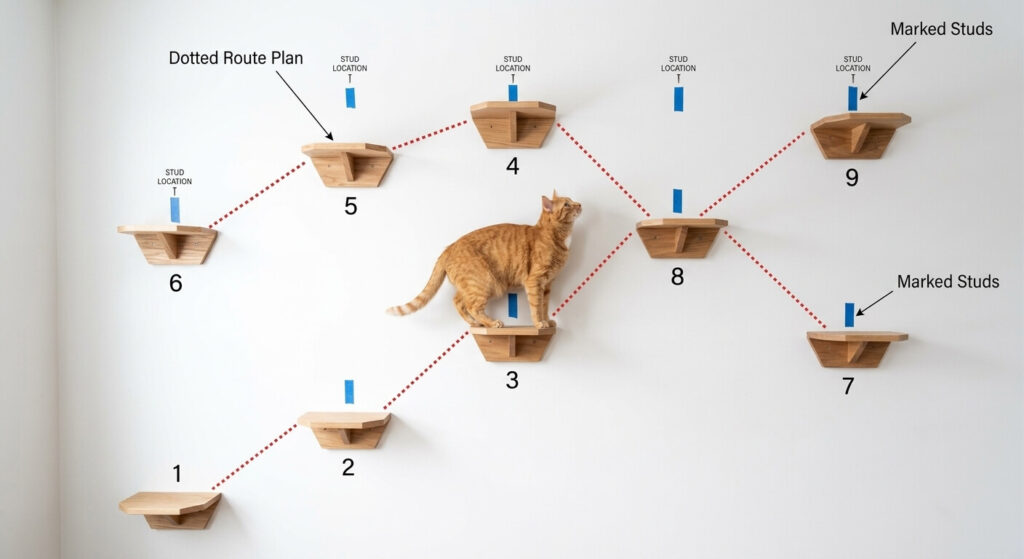
- Once you’ve found one stud, measure 16 inches in each direction to locate adjacent studs
- Always drive a test fastener and verify solid wood resistance before trusting a stud location
Fastener specification:
- Minimum 2.5-inch wood screws for stud mounting — enough thread engagement to resist dynamic load
- Structural wood screws rather than drywall screws — drywall screws are designed to resist pull-through in drywall, not shear force in wood; structural screws handle both
Surface Traction: The Often-Missed Safety Factor
A shelf that doesn’t slip is a shelf that doesn’t become a launch failure. Surface traction on landing platforms determines whether your cat lands in control or skids into an uncontrolled slide that ends in a fall.
Surface materials ranked by traction:
- Cork — excellent grip, cleanable, aesthetically neutral
- Sisal fabric or rope wrap — maximum grip, additional scratching value
- Low-pile carpet — good grip, washable depending on attachment method
- Felt pads — good grip on clean surfaces, compress over time
- Bare wood (finished) — unacceptable; finished wood is smooth and becomes a skid surface, particularly for cats landing at speed
Minimum requirement: Every shelf surface must have a non-slip covering. Bare wood or painted metal surfaces, regardless of their structural integrity, are a fall risk.
The Anti-Jump-Off-the-End Problem
Dead ends — shelves that don’t connect to another surface — force cats to jump back down from height rather than continue along a pathway. This is both an enrichment design problem and a safety problem: every forced jump is an impact event that wouldn’t occur in a connected system.
Evaluate every shelf system you consider for the ability to connect shelves into a pathway without mandatory drops back to floor level.
Top 5 Recommendations: Best Cat Wall Shelves (2025)
Note: I am not affiliated with any of these companies. These recommendations are based on safety criteria, durability assessment, and real-world use in my apartment with Oliver.
1. The Heavy-Duty Modular King
Best for: Multi-cat households, large cats, and anyone who wants maximum structural confidence
This category represents the heavy-gauge steel bracket systems with solid wood platforms — the construction standard I’d recommend for any cat over fifteen pounds or any household with multiple cats creating combined dynamic loads.
What distinguishes the category:
- Steel bracket construction with welded joints rather than bolted
- Platform depth of 14+ inches (sufficient for a cat to lie down fully)
- Load ratings that specifically account for dynamic impact rather than static weight only
- Modular attachment options that allow bridges, tunnels, and sisal poles to connect shelves
Pros:
- ✅ Highest structural integrity available in consumer cat furniture
- ✅ Platform depth allows full resting, not just perching
- ✅ Modular accessories create genuine pathway systems
- ✅ Lifespan measured in years rather than months
- ✅ Replaceable surface pads without replacing the entire shelf
Cons:
- ❌ Higher price point than other categories
- ❌ Requires stud mounting — not renter-flexible
- ❌ Heavier hardware means more complex installation
- ❌ Limited aesthetic customization in most product lines
Safety rating: ⭐⭐⭐⭐⭐
Aesthetic rating: ⭐⭐⭐
Renter friendliness: ⭐⭐
2. The Minimalist Apartment Design Choice
Best for: Design-conscious apartment owners who need shelves that look intentional rather than utilitarian
This category covers the floating shelf aesthetic — clean lines, natural wood finishes, concealed mounting hardware, and an appearance that reads as modern home decor rather than pet furniture to most visitors.
What distinguishes the category:
- Hidden or concealed bracket systems where the mounting hardware is not visible from the front
- Natural wood or powder-coated finishes in neutral tones
- Dimensions and proportions that match standard home decor floating shelves
- Cork or low-profile non-slip surfaces that don’t visually disrupt the clean aesthetic
Pros:
- ✅ Aesthetically integrated into apartment design
- ✅ Cork surfaces provide excellent traction without visual disruption
- ✅ Standard dimensions allow combination with human-use floating shelves
- ✅ Concealed mounting looks intentional to visitors
- ✅ Available in finish options that match major furniture collections
Cons:
- ❌ Platform depth sometimes compromised for aesthetic — verify minimum 10 inches
- ❌ Concealed hardware makes stud alignment more complex
- ❌ Some designs prioritize aesthetics over load capacity — verify ratings carefully
- ❌ Non-modular — creating pathways requires purchasing multiple individual units
Safety rating: ⭐⭐⭐⭐
Aesthetic rating: ⭐⭐⭐⭐⭐
Renter friendliness: ⭐⭐⭐
3. The Renter-Friendly Corner Shelf System
Best for: Renters who need deposit-safe installation without sacrificing structural integrity
Corner mounting is one of the most underutilized strategies in cat shelf design for apartment dwellers. A corner shelf system uses the structural angle where two walls meet — which always contains studs at the corner framing — allowing secure stud mounting without needing to locate studs in the middle of a wall run.
What distinguishes the category:
- L-shaped shelf designs that wrap around wall corners
- Mounting hardware specifically designed for corner installation into corner framing studs
- Smaller installation footprint with higher structural security than equivalent flat-wall designs
- Some designs use removable corner brackets that leave minimal wall damage
Pros:
- ✅ Corner framing always contains studs — no stud-finder uncertainty
- ✅ Uses dead space that has no furniture value
- ✅ L-shape platform provides excellent turning radius for cats navigating the pathway
- ✅ Smaller individual wall penetrations than full flat-wall systems
- ✅ Visually interesting — creates a dimensional pathway rather than a flat run
Cons:
- ❌ Limits pathway direction to corner-to-corner routing
- ❌ Fewer design aesthetic options than flat-wall systems
- ❌ Corner brackets can be more complex to install level
- ❌ May require custom configuration for non-standard corner angles
Safety rating: ⭐⭐⭐⭐⭐
Aesthetic rating: ⭐⭐⭐⭐
Renter friendliness: ⭐⭐⭐⭐
4. The Floating Bridge Specialist
Best for: Owners who want to connect existing shelves or cross longer wall gaps without additional platform installation
Floating bridges — horizontal narrow walkways that span between two shelf platforms without a full-platform footprint — solve the dead-end problem elegantly by providing connection pathways between shelves without requiring a full shelf at every transition point.
What distinguishes the category:
- Narrow (6–8 inch width) walkway planks with non-slip surfaces designed for traversal rather than resting
- Flexible length options that span various gap distances
- End-mounting systems that connect to adjacent shelf brackets
- Sometimes include sisal rope rails for additional grip and scratching value
Pros:
- ✅ Creates connected superhighway without requiring a full shelf at every wall position
- ✅ Narrower mounting footprint allows placement between stud positions more easily
- ✅ Sisal rail variants add scratching enrichment along the pathway
- ✅ Can retrofit an existing shelf collection into a connected system
- ✅ Lower per-unit cost than full-platform shelves
Cons:
- ❌ Too narrow for resting — traversal only, not destination platforms
- ❌ Must be used in combination with destination platforms; not a standalone system
- ❌ Span limitations — longer spans require intermediate support
- ❌ Less structural margin than full bracket shelf systems
Safety rating: ⭐⭐⭐⭐
Aesthetic rating: ⭐⭐⭐⭐
Renter friendliness: ⭐⭐⭐
5. The Budget-Friendly Modern Starter
Best for: First-time cat shelf owners who want to test vertical territory before committing to a complete system
The starter category covers solid single-shelf units in the $25–$60 range that provide genuine enrichment value without the investment of a complete modular system. These are appropriate as initial installations or as additions to existing higher-tier systems.
What distinguishes the category:
- Simple flat bracket or hidden bracket designs in wood or composite
- Single-unit purchase with optional additional units for expansion
- Good stud-mounting hardware included
- Non-slip surface material provided or built in
Pros:
- ✅ Low individual unit cost — test vertical territory response before full investment
- ✅ Most available with included mounting hardware
- ✅ Simple installation process suitable for first-time wall-mounting
- ✅ Easy to add additional units to build out a system
- ✅ Wide availability at major pet and home improvement retailers
Cons:
- ❌ Lower load capacity than premium categories — verify before purchasing for large cats
- ❌ Limited depth in some designs — measure before purchasing
- ❌ May require purchasing additional non-slip surface material separately
- ❌ Non-modular — pathway connectivity requires planning
Safety rating: ⭐⭐⭐
Aesthetic rating: ⭐⭐⭐
Renter friendliness: ⭐⭐⭐⭐
Layout Planning 101: Preventing Dead Ends
Choosing the best cat wall shelves is only half the project. The other half is designing a layout that creates genuine territory rather than a collection of isolated perches.
The Superhighway Design Rules
Rule 1: Maximum 18-inch vertical gaps between connected shelves
This is the comfortable jumping distance for an average adult cat. Senior cats, overweight cats, and cats with joint issues need gaps of 12 inches or less. Measure your specific cat’s comfortable jump height before finalizing layout.
Rule 2: Every pathway needs at least two exits
A pathway with only one entrance and exit is a dead end — a cat cornered on a dead-end shelf by another pet or a startling event has only one option: jump down from height. Design pathways with minimum two access points to floor level or adjacent territory.
Rule 3: Include destination platforms, not just traversal routes
At least one shelf per wall run should be large enough (minimum 14×14 inches) for your cat to lie down fully and rest. Pathways without destinations are exercise routes, not territory.
Rule 4: Connect to existing furniture where possible
The top of a bookcase, a window perch, the top of a refrigerator, or a tall cat tree can serve as intermediate pathway points. Designing the shelf layout to incorporate these existing elevated surfaces reduces the number of installed shelves required for a complete system.
Rule 5: Include a premium destination at maximum height
The highest point in the shelf system should be the most appealing destination — a wider platform, a cushioned surface, positioned near a window if possible. This becomes the territory the cat patrols toward and claims as their primary elevated space.
Once you have the shelves installed and Oliver has had time to explore the layout, you can use basic positive reinforcement and clicker training techniques to encourage him to use specific high-level pathways rather than improvising dangerous routes via floor lamps and refrigerators. [Read our complete guide to clicker training and positive reinforcement for cats here → Best Cat Furniture for Small Apartments (Space-Saving Picks)]
Sample Layout for a 600-Square-Foot Apartment
Entry-to-living room run:
- Entry corner shelf (stud-mounted, uses corner framing) → floating bridge → mid-height destination platform near sofa → bridge → window perch at primary window
Living-to-bedroom run:
- Window perch platform → ascending shelf series to bedroom doorway height → bridge over doorway → descending series into bedroom → destination platform near bed
Bedroom:
- Bed-height access shelf (easy departure to floor level when needed) → mid-height traversal shelf → corner destination platform at window
This creates a complete circuit with multiple access points, two premium destinations (primary window, bedroom window), and no dead ends.
FAQ
Are cat wall shelves safe for heavy cats?
Yes — with specific hardware requirements. For cats over fifteen pounds, the critical factors are: wall studs for all mounting (never drywall-only), minimum 2.5-inch structural wood screws with at least three fasteners per bracket, dynamic load-rated hardware where possible, and platform depth of at least 14 inches to allow a stable landing footprint.
The platform surface traction requirement is even more important for heavy cats — a heavier cat landing at speed generates more lateral force on the surface, making cork or sisal surfaces mandatory rather than recommended. If you have a large-breed cat (Maine Coon, Ragdoll, Norwegian Forest Cat), budget for the heavy-duty modular category specifically — the bracket engineering in starter and minimalist categories may not provide adequate safety margin for cats in the eighteen to twenty-five pound range.
How do I mount the best cat wall shelves without damaging my walls?
The complete renter-friendly approach: first, locate and document stud positions with an electronic stud finder before any installation. Use 2.5-inch structural screws driven into studs — these create a small hole that is trivially patchable with spackling compound on move-out.
Avoid toggle bolt anchors in drywall — the installation hole is significantly larger and harder to patch. On move-out, fill each screw hole with lightweight spackling compound, sand smooth when dry, and touch up with matching paint (keep a small amount of your wall paint in a labeled container from move-in for this purpose).
Small screw holes filled and painted are essentially invisible at normal inspection distance. This approach creates a genuinely structurally sound installation while keeping the wall damage minimal and repairable.
What is the best spacing between cat wall shelves?
Vertical spacing: Maximum 18 inches between connected shelves for average adult cats; 12 inches maximum for senior cats or cats with mobility limitations. This ensures comfortable, confident jumping rather than challenging leaps that create impact force and fall risk.
Horizontal spacing for traversal: Floating bridges or traversal shelves should overlap with destination platforms by a minimum of 4 inches — the cat’s landing zone should be fully supported before the platform edge.
Depth: Minimum 10 inches for traversal shelves, minimum 14 inches for destination/resting platforms.
Height from floor: The lowest shelf in any pathway should be reachable from the floor in a single comfortable jump — typically 24–36 inches from floor level. The highest shelf should not exceed a height from which a fall would cause significant injury — in practice, ceiling height minus 18 inches is the practical maximum, ensuring a fall from the highest point has at least some landing zone below before a second fall to the floor.
Ultimately, choosing the best cat wall shelves transforms your boring walls into a functional, safe feline gym.
References
- Ellis, S. L. H. (2009). Environmental enrichment: Practical strategies for improving feline welfare. Journal of Feline Medicine and Surgery, 11(11), 901–912. https://doi.org/10.1016/j.jfms.2009.09.011
- Bernstein, P. L., & Strack, M. (1996). A game of cat and house: Spatial patterns and behavior of 14 domestic cats (Felis catus) in the home. Anthrozoös, 9(1), 25–39. https://doi.org/10.2752/089279396787001592