By a cat parent who once owned a six-foot carpet-covered monstrosity that blocked the television.
Finding the right cat furniture small apartment layouts can actually accommodate feels impossible at first — especially when every cat tree you find online looks like it was designed for a suburban house with a dedicated “pet room” and approximately zero aesthetic standards.
My first cat tree was enormous, aggressively beige, carpeted in a texture that collected every piece of debris known to exist, and occupied a floor footprint roughly equivalent to a loveseat. Oliver used the top platform occasionally. He ignored the rest. I resented it daily. The turning point came when I moved to a smaller apartment and physically could not fit it through the door — which turned out to be the best thing that ever happened to both of us.
I spent the following month completely rebuilding Oliver’s environment using vertical territory, zero-footprint solutions, and furniture that served double duty. He ended up with more usable territory than he had before. I ended up with my floor back. This guide covers everything I learned in that process.
Quick Answer
The best cat furniture small apartment setups use vertical rather than horizontal space. Replace floor-hungry traditional trees with tension-mounted floor-to-ceiling poles, over-the-door climbing structures, and wall-mounted floating shelf systems that create territory without consuming square footage. Add multi-functional pieces — litter box enclosures that double as end tables or benches — to hide necessary items in plain, stylish sight.
The Floor Space Problem in Cat Furniture Small Apartment Setups
Let me be specific about what went wrong with my first cat tree, because understanding the problem is what makes the solutions make sense.
Traditional carpet-covered cat trees are designed with a wide, heavy base for stability. That base — typically 24 to 36 inches on each side for a tree over five feet tall — has to sit somewhere. In a 650-square-foot apartment, that somewhere is always somewhere you actually needed.
Beyond the footprint problem, traditional trees have several other small-space failures:
- Carpet covering — traps hair, odors, and debris at a rate that requires frequent replacement; looks dated immediately; does not complement any interior design style made after 1987
- Single location value — a tree occupies floor space and provides territory only at that one spot; wall-mounted systems provide territory across an entire wall or room without any floor footprint
- Non-modular design — when a scratching post wears out or a platform tears, you typically replace the entire unit; well-designed modular systems allow component replacement
- Visual bulk — a large carpet structure in a small space dominates the visual field and makes the room feel smaller than it is
The goal of small-space cat furniture is not to find a smaller version of the same thing. It is to fundamentally rethink where cat territory lives — off the floor and onto walls, doors, and windows.
Over-The-Door Climbers: The Zero-Footprint Solution
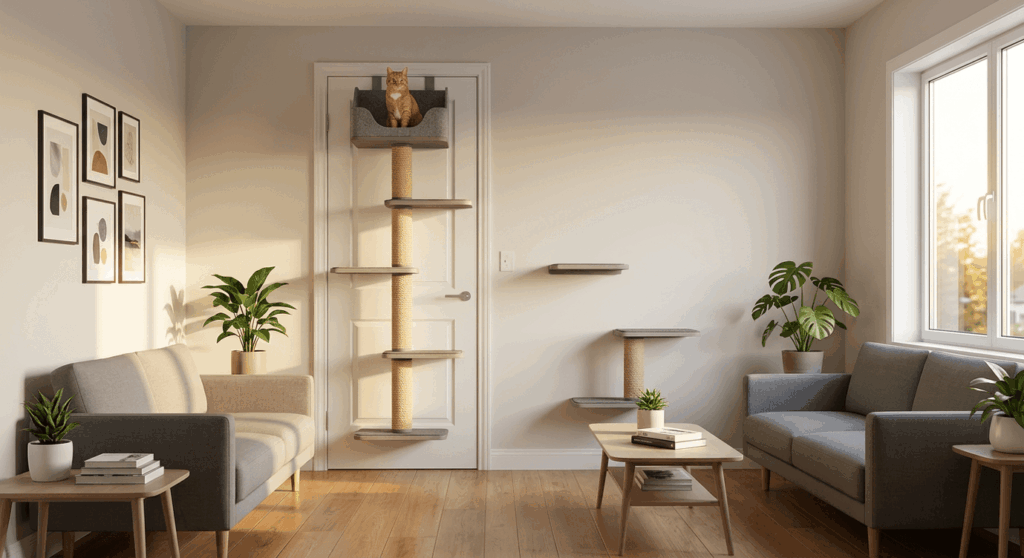
This was the single most transformative addition to Oliver’s small-apartment environment, and it is genuinely the first thing I recommend to every apartment cat owner who tells me they don’t have room for cat furniture.
An over-the-door cat climber hooks over a standard interior door — no drilling, no permanent modification, no floor space consumed — and provides multiple climbing platforms on the door’s face. The door itself becomes a vertical territory structure.
How They Work
The mounting system uses padded hooks or brackets that fit over the top edge of a standard door and grip the door face with padded contact points that prevent scratching or marking the door surface. The structure hangs on the door’s surface and presents platforms at various heights.
For renters: This is one of the few genuinely zero-modification cat furniture options available. No holes, no adhesive, no surface contact other than the padded hook at the top. Your landlord will never know it existed.
What to Look For
Load capacity matters most:
- Check the weight rating of any over-the-door system before purchasing
- For a cat Oliver’s size (eleven pounds), I look for a minimum 25-pound rating — you want significant margin above your cat’s actual weight
- Heavier cats (fifteen pounds plus) should look specifically for reinforced bracket systems with wider door hook spans
Material quality:
- Sisal-wrapped posts over carpet-wrapped — more durable, more appealing to cats for scratching, easier to clean, better looking
- Solid wood or metal frame over particleboard — particleboard flexes under repeated impact and fails at joints within months
- Washable, removable platform pads — cats will nap on these; they need to be cleanable
Platform configuration:
- Graduated heights that allow a cat to move between levels rather than jump directly to the top
- Platforms wide enough for a cat to lie down fully — minimum 12×12 inches, 14×16 preferred
- At least three distinct levels to create meaningful vertical range
Door compatibility:
- Measure your door thickness before purchasing — hollow-core interior doors (common in apartments) have different edge profiles than solid-core doors
- Most systems accommodate standard 1.375-inch hollow-core doors; verify before ordering
Where to Position It
- Bedroom door — gives Oliver elevated sleeping territory adjacent to where you sleep; a cat who can observe from height at the bedroom door has excellent overnight enrichment
- Hallway door — creates a territorial observation point at a corridor junction, which is exactly where cats instinctively want to monitor from height
- Avoid bathroom doors — humidity cycles damage the structure faster
Tension-Mounted Poles: Maximum Height, Minimum Base
Tension-mounted floor-to-ceiling cat poles use the same internal spring mechanism as a tension shower rod — compressed between floor and ceiling with no wall attachment, no floor attachment, and no drilling of any surface.
The base footprint of a tension pole is dramatically smaller than a traditional cat tree — typically a 12×12-inch base plate rather than a 24×36-inch base — while providing equivalent or greater height.
Why They Outperform Traditional Trees for Small Spaces
- Height without footprint — a tension pole reaching an eight-foot ceiling occupies minimal floor area while providing maximum vertical range
- Modular platform attachment — most systems allow platforms, hammocks, and scratching elements to be attached at any height along the pole, fully customizable
- Stability — a properly tensioned pole is extremely stable because it is braced at both floor and ceiling rather than relying on a weighted base alone
- Scalable — add a second pole later to create a multi-pole system with bridge elements between them, building a genuine cat highway across a corner or wall without adding meaningful floor footprint
Installation Notes
Measure your ceiling height precisely — tension pole systems specify height ranges (e.g., 86–116 inches). Purchasing a pole for the wrong height range produces either a pole that won’t reach or one that cannot generate sufficient pressure.
For textured ceilings — popcorn or textured ceilings compress unevenly under tension pressure. Use a small piece of dense foam pad between the ceiling cup and the ceiling surface to distribute pressure evenly and prevent ceiling damage.
For particularly active or large cats — look for poles with a wider diameter main tube (minimum 1.5 inches) and heavier-gauge steel construction. Thinner aluminum poles flex noticeably under a heavy cat’s impact.
Placement Strategy for Small Spaces
- Corner placement uses dead space that has no other furniture value while providing a sightline advantage to your cat (corners allow 270-degree visual monitoring)
- Adjacent to a window maximizes the pole’s enrichment value — height plus bird-watching access is the premium territory combination
- In an entryway or hallway creates a territorial greeting post where your cat can observe arrivals from height
Multi-Functional Hidden Furniture: End Tables and Benches
This category is where aesthetic and functional design intersect most elegantly for small-space cat owners. The principle is simple: furniture your cat needs (litter box enclosure, feeding station) takes up floor space regardless. It might as well take up that space while also functioning as furniture you actually want.
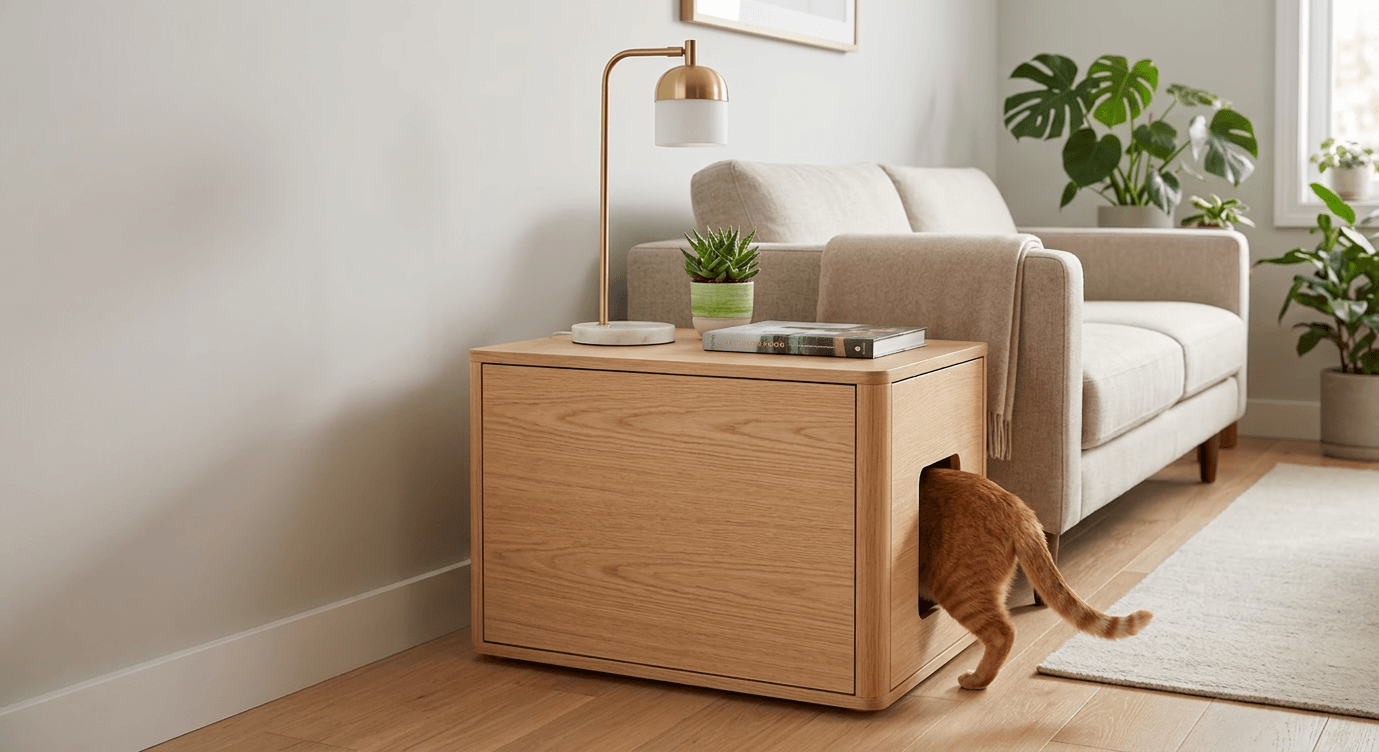
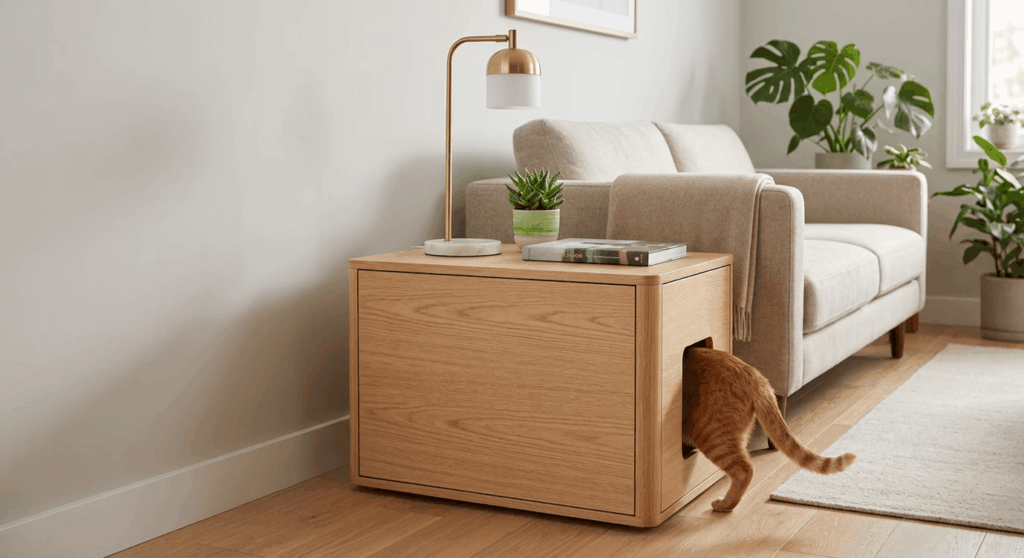
Litter Box Enclosure End Tables
A well-designed litter box enclosure that functions as an end table or side table provides:
- Your cat: A private, semi-enclosed elimination space with appropriate airflow
- Your apartment: A surface for a lamp, books, remote controls, or a plant — functional furniture that visually belongs in the room
- Your nose: Enclosure reduces ambient odor dispersion compared to an open litter box
What to look for in litter box furniture:
- Interior dimensions large enough for your cat to fully turn around — minimum 15×20 inches interior clearance for an average-sized adult cat; larger for big cats
- Adequate ventilation — a sealed enclosure with no airflow creates humidity, ammonia concentration, and bacterial growth; look for ventilation slots or a carbon filter panel
- Removable interior liner — makes cleaning dramatically easier; a fixed interior is a cleaning nightmare
- Entry opening design — a side entry works for most cats; a top-entry design (your cat jumps in from above) virtually eliminates litter tracking but requires that your cat can jump comfortably
- Solid wood or MDF construction over particleboard — particleboard absorbs urine vapor over time and degrades; solid or high-density composite construction is more durable and odor-resistant
Entryway Bench Combinations
An entryway bench with an integrated or adjacent cat space — a cushioned top for you to sit while putting on shoes, a lower enclosed section for a cat bed or small litter box — occupies exactly the floor space an entryway bench already would.
In apartments where the entryway eats directly into the living space, this combination prevents the additional footprint of a separate cat item.
Feeding Station Furniture
A small elevated feeding station — a piece of furniture specifically designed to hold food and water bowls at a raised height — serves several purposes:
- Health benefit: Elevated bowls reduce neck strain for eating, particularly in senior cats or those with arthritis
- Floor protection: Spills land on a contained surface rather than floor or carpet
- Visual tidiness: Contained feeding area rather than two bowls on the floor in the middle of foot traffic
- Functional: Drawers or shelving in the base stores food, treats, and feeding accessories
Wall-Mounted Shelving Systems: Creating the Cat Superhighway
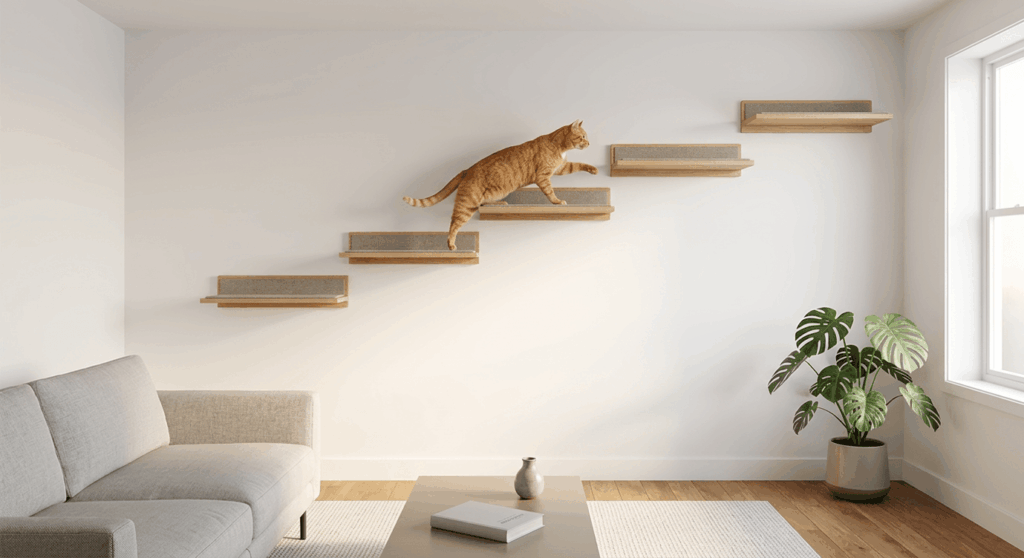
Wall-mounted cat shelving is, from a pure enrichment-per-square-foot perspective, the most efficient cat furniture available for small apartments. It provides territory across an entire wall without occupying any floor space — the territory exists in the vertical dimension that is otherwise completely unused in most apartments.
The golden rule of small-space feline enrichment is building a connected “superhighway” of vertical territory that your cat can traverse from one side of a room to another — and we covered the behavioral science behind why this matters so extensively in our complete indoor enrichment guide. [Read the complete guide to building vertical enrichment for indoor cats here → The Small Apartment Cat Survival Guide: 7 Pillars of Indoor Enrichment]
The System Concept
Individual floating shelves placed in an ascending, staggered pattern create a traversable pathway — your cat can jump from the floor to the first shelf, continue up to the second, third, and beyond, and potentially travel the full length of a wall without touching the floor.
This is not decoration. This is functional territory. A cat who can traverse their environment at height has measurably lower baseline stress, better territorial security, and more daily physical activity than one confined to floor level.
Installation Considerations for Renters
Wall-mounted shelving requires drilling into walls — the unavoidable trade-off of the most space-efficient option. For renters:
- Check your lease — some leases permit small holes with proper patching on move-out; others prohibit any wall modification
- Locate studs — mount into studs wherever possible for maximum load-bearing capacity; toggle bolts into drywall alone have limited weight capacity
- Use small-profile mounting brackets — easier to patch on move-out than large bracket systems
- Patch and paint on move-out — small screw holes patched with spackling compound and touch-up paint are typically invisible at normal inspection distance; keep touch-up paint from your move-in for this purpose
If wall-mounting is not permitted, a tension pole system with bridge platforms between two poles achieves a similar traversable pathway with zero wall contact.
Shelf Specifications That Matter
Depth:
- Minimum 10 inches for a cat to stand comfortably; 12–14 inches for lying down
- Deeper shelves allow resting spots; narrower shelves function only as stepping stones
Spacing:
- Vertical distance between shelves should not exceed 18–20 inches for comfortable jumping — the cat should be able to step or jump between levels without requiring a significant leap
- Consider your cat’s age and mobility — senior cats or those with arthritis need closer spacing
Surface material:
- Bare wood with a non-slip pad — aesthetically clean, easy to wipe, holds sisal or fabric pad overlay
- Carpet-surface shelves — hold hair aggressively, absorb odors, look dated quickly; I avoid these entirely
- Sisal-surfaced sections — integrate scratching behavior into the pathway naturally; place these at junctions where cats naturally pause
Weight capacity:
- Each shelf should be rated for at least 25–30 pounds — overstating the capacity requirement provides safety margin for an energetic landing
Window Perches: Zero-Footprint Enrichment at Its Best
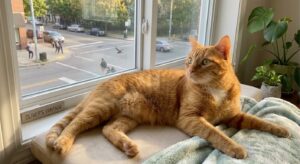
One of the absolute best zero-floor-space investments for a small apartment is a sturdy, well-designed window perch — it gives Oliver hours of enrichment, requires no floor space whatsoever, and positions him exactly where he most wants to be. [Read our complete guide to window perches and why they matter for indoor cat enrichment here → The Best Cat Window Perches for Apartments (And How to Set One Up Safely)]
Window perches mount in two primary ways:
Sill-sitting perches: Rest on the window sill with non-slip padding — no attachment required. Limited to sills wide enough to support the perch base (minimum four inches).
Suction-cup mounted perches: Attach to the window glass itself using heavy-duty suction cups — the perch platform projects from the window glass with no sill contact required. Key specifications:
- Weight rating: Verify the combined weight capacity of all suction cups matches or exceeds your cat’s weight by at least 50%
- Suction cup size: Larger cups distribute weight more effectively and hold more reliably
- Re-check weekly: Suction cup adhesion diminishes gradually; a weekly press to reseat the cups prevents the platform becoming dislodged during use
For maximum safety: Place a soft landing surface (a folded blanket, a floor cushion) directly below any suction-cup mounted perch during the initial use period.
What to Look For When Buying Cat Furniture Small Apartment Solutions
After years of purchasing, testing, and returning cat furniture, these are the material and construction standards I now apply to every purchase before I commit.
Material Hierarchy (Best to Worst)
Scratching surface:
- Natural sisal rope — durable, satisfying texture for cats, holds up to years of use
- Sisal fabric — woven sisal, slightly less durable than rope but cleaner looking
- Corrugated cardboard — excellent for horizontal scratchers, requires replacement but inexpensive
- Carpet — hair magnet, odor absorber, degrades quickly, looks poor; avoid where possible
Frame and structural material:
- Solid hardwood — most durable, most expensive, most attractive, worth it for pieces you’ll use long-term
- Solid softwood (pine) — good durability, more affordable, does show wear over time
- High-density MDF — acceptable for enclosed furniture (litter boxes, feeding stations); not ideal for dynamic load applications
- Particleboard — avoid for anything that receives repeated impact (cat trees, shelves); fails at joints and swells with moisture
Platform surface covering:
- Removable, machine-washable fleece or faux fur pads — practical first choice
- Replaceable sisal panels — excellent for integrated scratching surfaces
- Fixed carpet — acceptable only if the carpet is low-pile and the color choice is deliberate
Stability Indicators
- Heavy base relative to height for freestanding units — if it tips when you push the top with moderate pressure, it will tip when your cat launches off it
- Welded or bolted joints rather than wood-screw-only assembly — screwed joints loosen with dynamic loading
- Wide platform dimensions — narrow platforms are less stable under off-center weight (a cat landing at the edge rather than the center)
The Washability Test
Before purchasing any soft-surface cat furniture, ask one question: can this be washed?
- Removable platform pads that fit in a standard washing machine are a genuine long-term value consideration
- Fixed carpet or fabric that cannot be removed requires steam cleaning or replacement
- For small-apartment living where cat furniture is visible in your primary living space, the ability to keep it clean and odor-free is directly tied to how long you’ll tolerate having it there
FAQ
1. What is the best cat furniture small apartment solution for a cat who refuses to use anything new?
Cat furniture small apartment purchases are most successfully adopted when the new piece is introduced with a deliberate transition approach rather than a cold swap. Place the new item in the same location as the old one your cat already uses, or position it adjacent to an existing territory anchor (a preferred napping spot, a window).
Rub a cloth along your cat’s cheeks and apply it to the new furniture surface — depositing their scent on it before they approach makes it immediately familiar rather than foreign. Sprinkle a small amount of dried catnip on platforms. Do not remove their existing furniture until you observe voluntary, repeated use of the new piece. Most cats need five to fourteen days to fully adopt a new piece when introduced with patience.
2. Are over-the-door cat trees safe for hollow-core apartment doors?
Yes, with appropriate weight limits observed. Most standard interior apartment doors are hollow-core construction, and over-the-door cat furniture is generally designed with this in mind — the padded hook distributes the hanging weight across the door’s top edge and face rather than concentrating it at a single point.
The risks are: exceeding the weight rating (check your cat’s weight against the stated limit with margin), using on a door that is frequently opened and closed rapidly (repeated impact stresses the hook bracket), and using on a door with a hollow edge profile that prevents the hook from sitting level. Inspect the mounting bracket monthly for any loosening or deformation, and ensure the door is kept open or closed during active use rather than swinging freely while your cat is on the structure.
3. How do I get my cat to actually use wall-mounted shelves instead of ignoring them?
The placement and approach sequence matters more than the shelves themselves.
First, ensure the shelf pathway is accessible from the floor — your cat needs a clear, manageable first step (a piece of furniture, a lower shelf, a cat tree adjacent to the wall) that connects the floor to the lowest shelf. A system that starts at four feet with no accessible entry point will be completely ignored.
Second, place shelves near existing territory your cat already values — a wall adjacent to their current favorite window or sleeping spot.
Third, use high-value lures during the introduction period — place treats on each shelf level, add a small piece of your worn clothing to the highest platform, and let your cat discover the pathway naturally over several days.
Most cats who initially ignore wall shelves are responding to an access problem or placement problem rather than a genuine preference against height.
References
- Bernstein, P. L. (2007). The human-cat relationship. In I. Rochlitz (Ed.), The Welfare of Cats (pp. 47–89). Springer. (Documents the importance of spatial territory and vertical access to feline behavioral wellbeing in domestic settings.)
- Ellis, S. L. H. (2009). Environmental enrichment: Practical strategies for improving feline welfare. Journal of Feline Medicine and Surgery, 11(11), 901–912. https://doi.org/10.1016/j.jfms.2009.09.011
Disclaimer: This article reflects the personal experience of a cat owner and draws on published research in feline behavioral science and environmental enrichment. Product category recommendations are based on material science and behavioral principles rather than specific brand endorsement. Always verify weight ratings, installation requirements, and structural integrity of any cat furniture before allowing your cat to use it.