By a cat parent who once threw out $200 worth of plants in a single afternoon.
I thought I was doing everything right. The Pothos was trailing beautifully from my bookshelf, the Monstera was making my living room look like a Pinterest board, and I had just added a Golden Pothos to the bathroom counter for that spa-aesthetic everyone seemed to be going for. Then I came home one Tuesday to find Oliver on the bookshelf, a leaf with fresh bite marks hanging at a guilty angle, and my cat drooling in a way I had never seen before. The vet call that followed was one of the most frightening fifteen minutes of my life.
Oliver was fortunate — he had only ingested a small amount, and with monitoring and supportive care he recovered fully — but I spent the rest of that evening researching every plant in my apartment against the ASPCA database and throwing out anything I couldn’t verify as safe. Finding the right cat safe plants apartment aesthetics can support, without poisoning the cat living in that aesthetic, turns out to require research that the plant industry does not make particularly easy. This guide is everything I learned, organized so you don’t have to have your own Pothos incident to get there.
Quick Answer
The best cat safe plants apartment owners can confidently grow include Spider Plants, Calatheas, Parlor Palms, Boston Ferns, Peperomias, and Money Trees. You must strictly avoid Lilies (which cause fatal kidney failure), Pothos, Monsteras, and Aloe Vera. Always cross-reference every new plant with the official ASPCA Toxic and Non-Toxic Plants database before it enters your home — no exceptions.
The Toxic Jungle: Trendy Plants You Must Avoid
Let me start here, because this is the section that could save your cat’s life. The plants listed below are not obscure rarities — they are among the most popular, most widely sold, most aesthetically celebrated houseplants available right now. They are in every plant shop, every home decor store, and countless apartment living room photographs on social media.
They are also genuinely dangerous to cats.
Lilies: The Category That Kills
Lilies deserve their own paragraph because their toxicity profile is in a completely different category from other toxic plants.
True lilies in the Lilium and Hemerocallis genera — including Easter Lily, Tiger Lily, Asiatic Lily, Daylily, and Stargazer Lily — cause acute kidney failure in cats with exposure to even tiny amounts. We are not talking about significant ingestion. We are talking about:
- A cat brushing against a lily flower and then grooming the pollen from their fur
- A cat drinking water from a vase containing cut lily stems
- Ingesting a single petal or leaf fragment
The timeline is terrifying: Vomiting begins within two hours. Kidney failure develops within 24–72 hours. Without aggressive veterinary intervention — IV fluids, monitoring, potentially dialysis — cats die.
There is no safe lily for a home with cats. If someone sends you cut flowers containing lilies, they need to be kept out of your home or removed from the arrangement entirely. No exceptions, no “I’ll keep it on a high shelf.” Pollen falls. Cats groom.
Other lily-family plants to avoid, which have different but still significant toxicity profiles:
- Peace Lily (Spathiphyllum) — not a true lily, but causes oral burning, excessive drooling, and gastrointestinal distress
- Lily of the Valley — cardiac glycoside toxicity; can cause heart arrhythmias
Pothos and Epipremnum: Beautiful and Toxic
Pothos — the trailing vine that appears in every aesthetically pleasing apartment photograph — contains insoluble calcium oxalate crystals throughout all of its tissue. When a cat bites into a leaf, these microscopic crystals embed in the soft tissue of the mouth, throat, and gastrointestinal tract.
Symptoms: Immediate oral pain, excessive drooling, pawing at the mouth, vomiting, difficulty swallowing. Severe ingestion can cause significant gastrointestinal inflammation.
This was Oliver’s plant. He survived because it was a small bite, but the drooling I observed was the calcium oxalate crystals doing exactly what I’ve just described.
All Pothos varieties are toxic: Golden Pothos, Marble Queen Pothos, Neon Pothos, Satin Pothos — the variety doesn’t change the toxicity.
Monstera Deliciosa
The Monstera — the large, dramatic split-leaf plant that defined apartment aesthetics for several years — contains the same insoluble calcium oxalate crystals as Pothos. The leaves are larger and the bite potential is higher, but the toxicity mechanism and symptom profile are the same.
This was the hardest plant for me to give up aesthetically. I replaced it with a Parlor Palm (covered below) and honestly stopped missing it within a month.
Additional High-Priority Plants to Remove
| Plant | Toxicity Mechanism | Severity |
|---|---|---|
| Aloe Vera | Saponins and anthraquinones | Moderate — GI distress, lethargy |
| Snake Plant (Sansevieria) | Saponins | Moderate — nausea, vomiting |
| ZZ Plant | Calcium oxalate crystals | Moderate |
| Jade Plant | Unknown compounds | Moderate — vomiting, ataxia |
| Dieffenbachia | Calcium oxalate crystals | Moderate-severe |
| Sago Palm | Cycasin | Severe — liver failure, potentially fatal |
| Azalea / Rhododendron | Grayanotoxins | Severe — cardiovascular effects |
| Oleander | Cardiac glycosides | Severe — potentially fatal |
The rule I follow: Any plant I cannot find on the ASPCA’s Non-Toxic list gets treated as toxic until proven otherwise. The burden of proof is always on safety confirmation, never on toxicity confirmation.
Top Cat Safe Plants Apartment Owners Can Grow in Low Light
These are the plants that now fill my apartment — every single one verified safe, most of them thriving in the indirect light conditions that apartment windows typically provide.
Calathea (Prayer Plant Family)
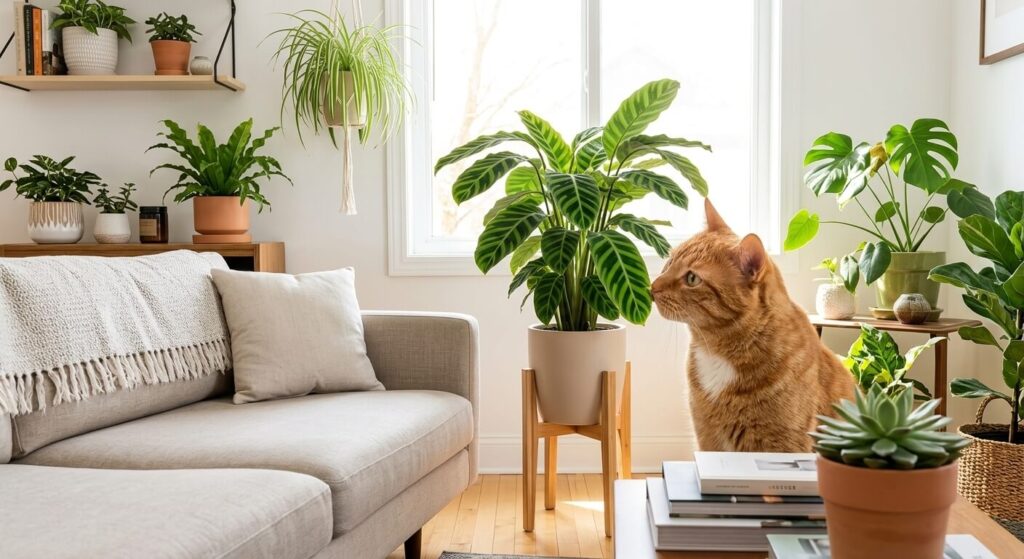
Calatheas have become my favorite plant since the great toxic purge, and not just because they’re safe. They are genuinely stunning — dramatic patterned leaves in deep greens, purples, and creamy whites that fold upward at night and open in the morning (the movement that gives them the “Prayer Plant” common name).
Safety status: Non-toxic to cats and dogs (ASPCA verified)
Care profile:
- Light: Indirect, medium light; will fade in direct sun, tolerate lower light reasonably well
- Water: Keep soil consistently moist but never waterlogged; sensitive to fluoride in tap water — filtered or distilled water prevents brown leaf tips
- Humidity: Appreciates higher humidity; bathrooms and kitchens suit them well
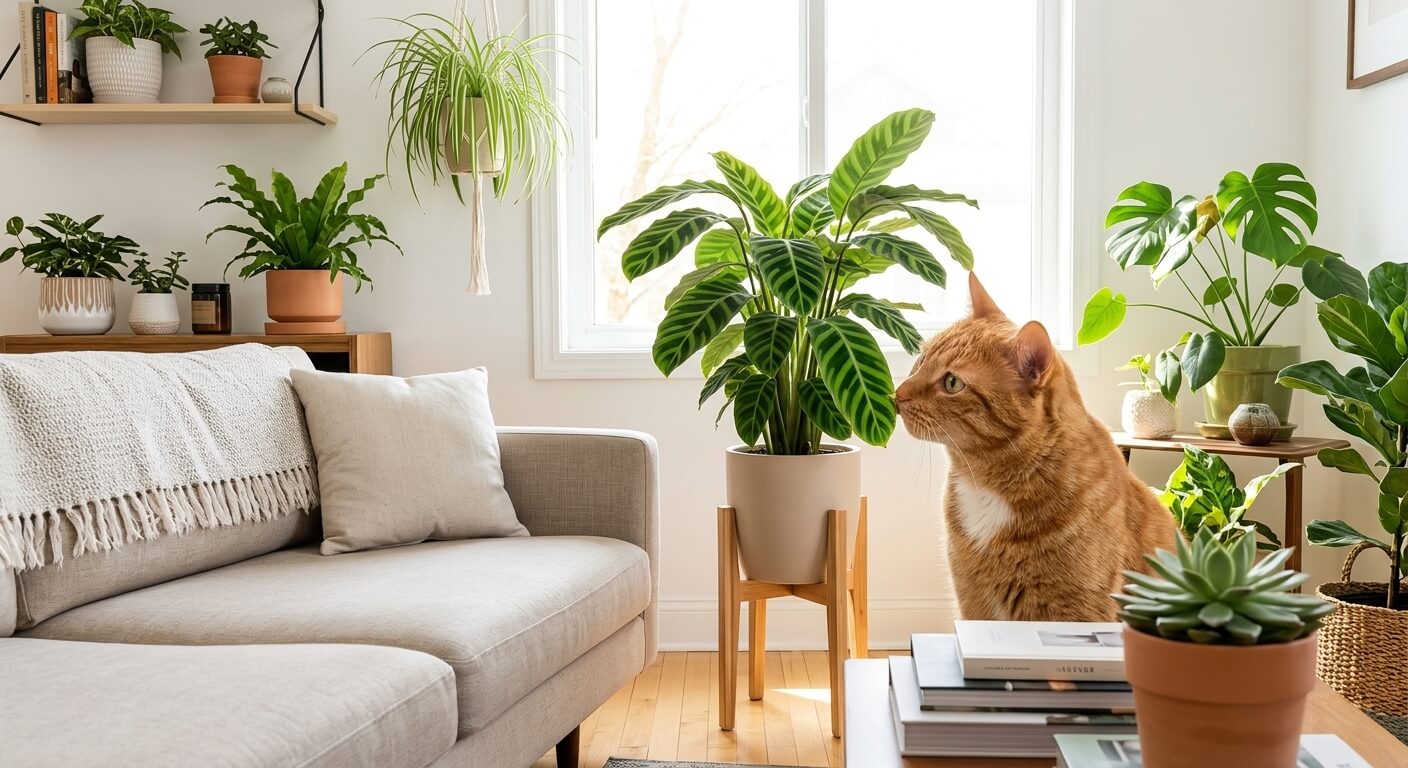
Oliver’s relationship with my Calathea: He sniffs it. He has never eaten it. I suspect the leaf texture doesn’t appeal to him, but even if it did — safe.
Calathea varieties worth seeking:
- Calathea orbifolia — large, silver-striped round leaves; dramatic and statement-making
- Calathea medallion — deep burgundy undersides, green and cream tops
- Calathea lancifolia (Rattlesnake Plant) — long, wavy-edged leaves with dark spots
Spider Plant (Chlorophytum comosum)
The Spider Plant is the recommendation that appears on every “cat-safe plants” list, and it earns that reputation honestly.
Safety status: Non-toxic to cats (ASPCA verified)
One nuance worth knowing: Spider Plants contain compounds mildly related to opium that can produce a very mild euphoric or hallucinogenic response in some cats — not dangerous, but it explains why some cats are unusually attracted to them and may chew on them persistently. If your cat becomes obsessed with your Spider Plant, relocating it to a hanging planter (more on this below) is advisable simply to prevent the plant from being destroyed.
Care profile:
- Light: Adaptable — thrives in bright indirect light, tolerates lower light better than most
- Water: Drought-tolerant; allow soil to dry partially between watering
- Growth: Produces trailing “spiderettes” on long runners that are visually lovely in hanging planters
Best display for cat households: Hanging macramé planters that position the trailing runners out of easy reach, while the plant itself remains visible and decorative.
Boston Fern (Nephrolepis exaltata)
One of the most lush, full houseplants available — and completely safe for cats.
Safety status: Non-toxic to cats (ASPCA verified)
Care profile:
- Light: Indirect light, no direct sun
- Water: Consistently moist soil; does not tolerate drying out
- Humidity: High humidity requirement; bathroom environments or regular misting
The aesthetic payoff of a full Boston Fern in a hanging planter is significant — dense, cascading fronds that read as genuinely lush and tropical. They are also one of the most effective indoor air-quality plants available.
Cat interaction note: The feathery frond texture attracts some cats for batting and chewing. Boston Ferns are safe if eaten, but a cat who takes a significant interest in yours will require the hanging planter approach to preserve the plant’s integrity.
Peperomia (Multiple Species)
Peperomias are perhaps the most diverse genus on the safe list — hundreds of varieties, enormous range of textures and appearances, universally safe.
Safety status: Non-toxic to cats (ASPCA verified — applies to the genus broadly)
Notable safe varieties:
- Peperomia obtusifolia (Baby Rubber Plant) — thick, glossy leaves; tolerates neglect well
- Peperomia caperata (Ripple Peperomia) — deeply textured corrugated leaves in deep green or burgundy
- Peperomia argyreia (Watermelon Peperomia) — striped pattern resembling watermelon rind; extremely popular aesthetically
Care profile:
- Light: Low to medium indirect light
- Water: Allow soil to dry between waterings; succulent-like water storage in leaves makes them drought-tolerant
- Size: Most remain compact and desktop-appropriate
Large Cat-Safe Plants for Floor Spaces
For the dramatic floor-standing plants that anchor a room visually — the category where I missed my Monstera most — these are the safe alternatives that actually work.
Parlor Palm (Chamaedorea elegans)
This was my Monstera replacement, and it has fully won me over.
Safety status: Non-toxic to cats and dogs (ASPCA verified)
The Parlor Palm grows as a compact, elegant multi-stemmed palm with arching fronds that create genuine visual drama in a floor planter without the sprawling horizontal spread of a Monstera. In a large ceramic pot, it fills a corner with the same statement-making presence.
Care profile:
- Light: Low to medium indirect light; one of the most shade-tolerant palms available
- Water: Allow the top inch of soil to dry between watering; avoid overwatering
- Growth rate: Slow — this is not a rapidly expanding plant, which makes it manageable in apartment spaces
- Height: Can reach four to six feet over several years, which is exactly the scale needed for a floor statement plant
Oliver’s relationship with it: He ignores it completely, which is either a testament to its non-appealing texture or evidence that cats have better taste than I give them credit for.
Money Tree (Pachira aquatica)
The braided-trunk Money Tree has become a reliable aesthetic staple in minimalist and Japandi-influenced apartment interiors, and it earns its place on the safe list.
Safety status: Non-toxic to cats (ASPCA verified)
Care profile:
- Light: Bright indirect light; some direct morning light is tolerated
- Water: Allow soil to dry significantly between waterings; prefers deep, infrequent watering
- The braided trunk is a cultivated aesthetic feature, not natural; multiple young plants are braided together during growth and maintain that structure permanently
Pot recommendation for cat households: A heavy ceramic or stone pot with significant base weight. Money Trees grow with some top-heaviness, and a cat who leans against or attempts to climb a lightweight plastic pot creates a tipping hazard. A wide, heavy ceramic pot eliminates this risk entirely.
Areca Palm (Dypsis lutescens)
For apartments with good light, the Areca Palm provides the most dramatic, tropical visual presence of any safe floor plant.
Safety status: Non-toxic to cats (ASPCA verified)
Care profile:
- Light: Bright indirect light; will decline in low light
- Water: Consistent moisture; sensitive to fluoride — filtered water preferred
- Humidity: Appreciates higher humidity; occasional misting or a nearby humidifier
Scale: Areca Palms can grow substantially — up to seven or eight feet in ideal conditions. In an apartment, they typically stabilize around four to five feet with consistent care.
How to Stop Your Cat from Digging in Plant Dirt
Even with completely safe plants, there is a second problem that most plant guides don’t address: cats treat exposed potting soil as an invitation — to dig, to eliminate, and to use as a substrate for burying things.
This is not malice. It is instinct. Loose, friable soil smells like the outdoors and has exactly the texture that feline paw-pad excavation behavior is designed for.
Solutions that actually work:
Physical Barriers Over Soil
- River stones or decorative pebbles placed over the soil surface — heavy enough that digging becomes unrewarding, and attractive enough to be a design element in their own right. Use stones large enough that they cannot be easily scattered but not so large they prevent water drainage.
- Pine cones pressed into the soil surface — the texture is deeply unappealing to cat paws and creates an effective deterrent
- Mesh fabric cut to the pot diameter and pressed over the soil surface with a hole for the plant stem — less visually attractive but highly effective
- Cactus stones or decorative mulch over the soil top — prevents both digging and soil scatter
Pot Selection Strategy
Heavy, wide-base ceramic pots serve two protective functions simultaneously:
- They cannot be tipped by a cat leaning against, jumping onto, or attempting to dig around the plant
- Their weight and base diameter make them stable under the dynamic forces of a cat actively digging
Avoid: Lightweight plastic nursery pots left in decorative sleeves — the sleeve prevents tipping but the inner pot itself can be lifted by determined digging. Repot into the ceramic container directly.
Hanging Planters for Persistent Offenders
For cats who remain determined about a specific plant despite barrier deterrents, the most reliable solution is simply removing the plant from accessible height.
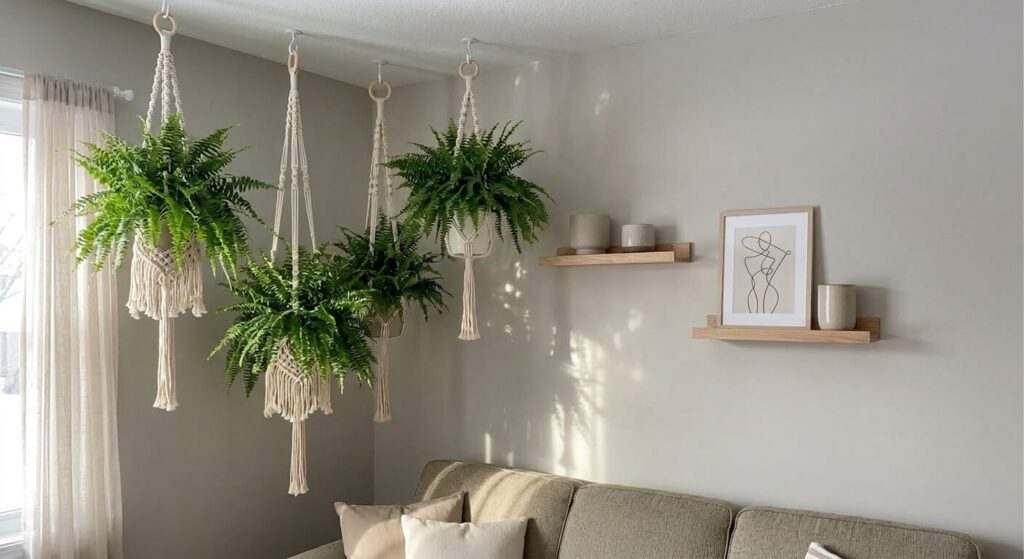
Ceiling-mounted macramé or rope hanging planters:
- Position the plant base at a minimum of five to six feet above floor level — above confident jumping height for most cats
- Ensure the ceiling hook is rated for the combined weight of pot, soil, and plant (wet soil is surprisingly heavy)
- Trailing plants like Spider Plants and Boston Ferns look genuinely beautiful in hanging planters and gain an aesthetic dimension they don’t have at floor level
Wall-mounted planters:
- Bracket-mounted planters at height provide a similar solution for non-trailing plants
- Position above any nearby furniture that could serve as a launch pad
The “Decoy” Strategy: Growing Cat Grass
This is the intervention that protected my plants more effectively than any barrier or placement change, and it addresses the biological reason behind most plant-related cat behavior.
Cats eat grass and plant material in the wild for several documented reasons — to aid in hairball expulsion, to supplement fiber intake, and as an instinctive behavior with deep evolutionary roots. An indoor cat who chews on your houseplants is not being destructive — they are following a biological directive with no appropriate outlet.
Cat grass provides that outlet.
Providing dedicated, safe cat grass is genuinely a form of dietary and behavioral enrichment — not just a way to save your houseplants from being eaten. We covered the full nutritional and environmental case for cat grass in our indoor cat enrichment guide. [Read our complete guide to indoor cat enrichment and what your cat actually needs here → The Small Apartment Cat Survival Guide: 7 Pillars of Indoor Enrichment]
What Cat Grass Actually Is
“Cat grass” refers to several grass varieties that are safe for cats to eat and fast-growing enough to maintain as a rotating indoor crop:
- Wheatgrass — the most common; fast-growing, highly palatable to most cats, nutritionally dense
- Oat grass — slightly slower growing, softer texture, also well-accepted
- Barley grass — similar profile to oat grass
- Rye grass — fine texture, grows quickly
All of these are safe. They are not Dactylis (orchard grass) or lawn grass species that have been treated with pesticides or herbicides — they are food-grade grain grasses grown specifically for this purpose.
Growing Cat Grass at Home
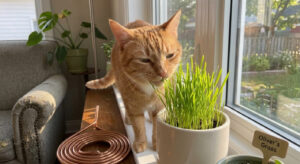
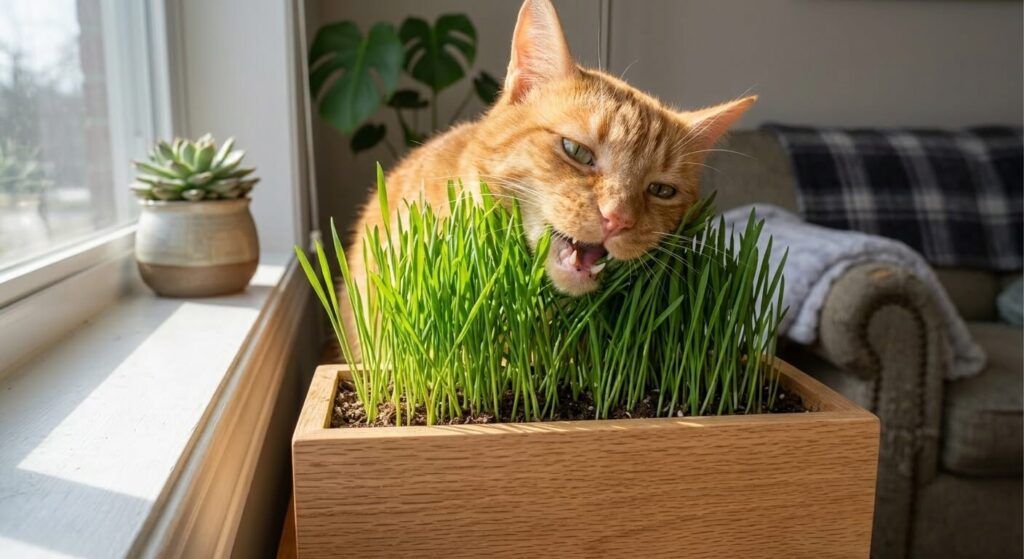
Indoor cat grass growing kits — typically including a container, growing medium, and seeds — are widely available and represent one of the most reliably used cat enrichment purchases I’ve made. Oliver visits his cat grass every single morning, chews for a few minutes, and has almost entirely stopped showing interest in my other plants since it became a consistent part of his environment.
The growing cycle:
- Seeds germinate in three to five days in warm conditions
- Grass reaches harvestable height (three to four inches) in approximately one to two weeks
- A single pot of cat grass provides roughly one to two weeks of regular use before it begins to yellow or thin
- Rotating two pots — one in use, one at varying stages of growth — ensures continuous availability
Placement: Position the cat grass pot at floor level or on a low surface your cat can access easily and comfortably. The accessibility is the point — you want this to be the easiest plant option, so it becomes the preferred one.
If you are also setting up a balcony plant space, these same safety rules and the cat grass strategy apply there too — and we covered the full balcony safety setup in our dedicated guide. [Read our complete guide to cat-proofing your apartment balcony here → How to Cat Proof an Apartment Balcony (Renter-Friendly Guide)]
The ASPCA Database: Your Non-Negotiable Reference
Every plant mentioned in this article was cross-referenced with the ASPCA’s Toxic and Non-Toxic Plants database. This is the reference I use for every single plant purchase, without exception, and it is the only list I trust because it is:
- Maintained by veterinary toxicologists
- Searchable by both common name and botanical name (important because common names are frequently shared between toxic and non-toxic species)
- Regularly updated as new toxicity information becomes available
- Free to access at any time
My purchasing rule: If I cannot find a plant on the ASPCA non-toxic list within two minutes of searching, it does not come home. I do not give it the benefit of the doubt. I do not assume that “probably safe” is sufficient when the consequence of being wrong is a veterinary emergency.
The database also has a 24-hour poison control hotline — (888) 426-4435 — that charges a consultation fee but provides immediate expert guidance for suspected ingestion situations. Program this number into your phone today, not after an incident.
FAQ
1. What are the best cat safe plants apartment owners with low light can actually grow successfully?
The best cat safe plants apartment dwellers with low-light conditions can reliably grow are Calatheas (which actively prefer indirect light and decline in direct sun), Peperomias (particularly the rubber-leafed varieties that store water and tolerate shade), Spider Plants (which adapt to lower light while growing more slowly), and Parlor Palms (one of the most shade-tolerant palms available).
For extremely low light — north-facing windows or rooms with limited natural light — Calathea orbifolia and most Peperomia varieties are the most forgiving options. Avoid expecting any plant to thrive in a room with no natural light at all; even shade-tolerant plants require some ambient daylight for photosynthesis.
2. Are succulents safe for cats?
This is the question I get most frequently, and the answer is: it depends entirely on the species, which is why the genus-level answer you’ll find in many articles is insufficient and potentially dangerous. Safe succulents: Haworthia species (zebra plant, haworthia fasciata), Echeveria species, and most Sempervivum (hens and chicks) are verified safe by the ASPCA.
Toxic succulents: Aloe Vera — extremely popular, widely considered a “beneficial” plant — is toxic to cats, causing vomiting, diarrhea, lethargy, and in significant ingestion, tremors. Jade Plant (Crassula) is also toxic. The visual similarity between safe and unsafe succulents makes species-level verification against the ASPCA database non-negotiable before purchasing any succulent for a cat-inhabited home.
When the holidays roll around, this safety mindset is more important than ever. Read our seasonal survival guide on how to cat proof christmas tree setups to avoid toxic needles and emergency vet bills.
3. My cat seems obsessed with eating my plants even with cat grass available. What else can I do?
A cat who persists in eating houseplants despite cat grass availability is usually communicating one of a few things: the cat grass isn’t fresh enough (cats strongly prefer actively growing, vibrant grass to older yellowing grass — increase your rotation frequency), the houseplant in question has a specific texture or scent that the cat finds particularly appealing independent of the grass-eating drive, or the behavior has a stress or anxiety component that is driving oral stimulation seeking.
For the middle case — a specific plant obsession — the hanging planter solution is your most reliable physical intervention. For the anxiety-driven case, revisiting your cat’s enrichment environment and baseline stress level is more productive than plant management alone. If your cat is eating non-food items compulsively (fabric, plastic, paper), that warrants a conversation with your vet about pica, which has both behavioral and potential nutritional components.
References
- ASPCA. (n.d.). Toxic and Non-Toxic Plants List. https://www.aspca.org/pet-care/animal-poison-control/toxic-and-non-toxic-plants
- Fitzgerald, K. T. (2010). Lily toxicity in the cat. Topics in Companion Animal Medicine, 25(4), 213–217. https://pubmed.ncbi.nlm.nih.gov/21147474/
Disclaimer: This article reflects the personal experience of a cat owner and references the ASPCA Toxic and Non-Toxic Plants database for safety verification. It is not a substitute for professional veterinary advice. If you suspect your cat has ingested any plant material and is showing symptoms including drooling, vomiting, lethargy, or behavioral changes, contact your veterinarian or the ASPCA Animal Poison Control Center at (888) 426-4435 immediately.