By a cat parent who learned the hard way that “out of sight” absolutely does not mean “out of danger.”
I have to be honest with you about something I’m not particularly proud of. For the first three years of Oliver’s life, I never once looked inside his mouth with any real intention. I knew cats had teeth. I assumed they were fine. He was eating, he wasn’t crying, nothing seemed wrong — and so dental care simply never entered my thinking as something that required my active participation.
Then came the routine wellness visit where our vet, Dr. Chen, lifted Oliver’s lip, looked at his gumline, and said the words that still make me wince: “Early gingivitis on the upper left molars. If we don’t change course, we’re probably looking at an extraction in the next two to three years.” She handed me a printed estimate. I don’t need to tell you the number was uncomfortable.
That afternoon, I started researching indoor cat dental health with the same panicked intensity I bring to everything I’ve ever learned too late. What I found was both alarming and, ultimately, deeply actionable — and I want to share all of it with you before your vet hands you a similar piece of paper.
Quick Answer
Proper indoor cat dental health requires brushing with a feline-specific toothbrush and enzymatic toothpaste daily, or at minimum every other day. Begin with a four-week desensitization process — starting with face touching and working gradually to bristle contact — before attempting a full brush. Supplement with VOHC-approved dental treats, water additives, and annual professional veterinary cleanings to prevent irreversible periodontal disease.
The Silent Danger of Feline Periodontal Disease
Here is the statistic that genuinely stopped me cold when I first encountered it.
An estimated 70–80% of cats over three years of age have some form of active dental disease. Not “might develop it someday.” Have it, right now, progressing silently behind closed lips in the majority of adult cats in domestic care.
Periodontal disease in cats advances through four distinct stages:
| Stage | What’s Happening | Reversible? |
|---|---|---|
| Stage 1 | Gingivitis — gum inflammation, no bone loss | ✅ Yes, with cleaning and home care |
| Stage 2 | Early periodontitis — less than 25% attachment loss | ⚠️ Partially, with treatment |
| Stage 3 | Moderate periodontitis — 25–50% attachment loss | ❌ No — management only |
| Stage 4 | Advanced periodontitis — greater than 50% loss, tooth loss | ❌ No — extractions required |
Oliver was caught at Stage 1. We had a genuine window. Many cats are not found until Stage 3 or 4 — because the disease causes chronic, progressive pain that cats suppress and owners cannot see.
Why Cats Hide Dental Pain So Effectively
Cats are evolutionary masters of pain concealment. Displaying vulnerability in the wild invites predation, so they continue eating, grooming, and behaving relatively normally through levels of oral pain that would send a human directly to an emergency dentist.
Signs of dental disease you can actually notice — if you know what to look for:
- Halitosis — bad breath that persists beyond normal post-meal odor
- Dropping food while eating, or chewing exclusively on one side
- Pawing at the mouth or rubbing the face along surfaces
- Reduced interest in hard food without apparent nausea
- Excessive drooling beyond normal grooming behavior
- Blood-tinged saliva on toys or water bowl
- Behavioral changes — increased irritability, withdrawal, reduced interaction
Many of these are easy to miss or attribute to other causes. Which is exactly why dental disease progresses so far before most owners recognize it.
The Systemic Damage Nobody Talks About Enough
This is the piece that transformed dental care from a “nice to do” into a non-negotiable in my mind.
Periodontal disease is not confined to the mouth. The bacteria colonizing infected gum tissue — particularly Porphyromonas and Treponema species — enter the bloodstream continuously through inflamed, compromised gum tissue. From there, they travel to and damage distant organs.
Documented systemic effects of feline periodontal disease:
- Kidney damage — bacteremia increases glomerular filtration stress and accelerates CKD progression
- Heart disease — bacterial endocarditis and myocardial inflammation linked to oral pathogens
- Liver inflammation — hepatic changes detected in cats with severe dental disease
- Immune system suppression — chronic low-grade infection continuously taxes immune resources
Periodontal disease is genuinely not just a mouth problem — the bacteria from infected gums enter the bloodstream and damage the kidneys and heart, meaningfully shortening your cat’s life. [Read our complete guide to how oral health connects to feline longevity here → How Long Do Indoor Cats Live? Tips to Maximize Their Lifespan]
The Dry Food Myth: Setting the Record Straight
Before we move into the practical brushing guide, I want to address the misconception I encounter most frequently when talking to other cat owners.
“My cat eats dry kibble, so their teeth are getting cleaned.”
This is one of the most persistent and consequential myths in cat care, and it is not supported by dental science. Feeding dry kibble does not clean a cat’s teeth any more than eating crackers cleans human teeth — and we covered the complete science behind why this myth persists in the pet food industry in our earlier wet vs. dry food comparison. [Read the full breakdown of the dry food dental myth here → Wet Food vs Dry Food for Indoor Cats: What Science Says]
The reality: most cats do not chew kibble with the sustained lateral grinding motion that would create meaningful mechanical cleaning. They puncture and swallow. The kibble-teeth contact is brief, occurs at the tip of the tooth rather than at the gumline where disease forms, and the carbohydrate residue left behind actually feeds oral bacteria rather than eliminating them.
The VOHC (Veterinary Oral Health Council) — the independent body that evaluates and certifies pet dental products — does not endorse the general category of “dry food” as a dental health intervention. Specific products may earn VOHC certification based on controlled clinical data, but the food format alone does not.
Why Human Toothpaste Is Toxic to Cats: The Fluoride Problem
This needs its own clear statement before we discuss any product specifics.
Never use human toothpaste on your cat. Not a small amount. Not diluted. Not “just this once.”
The reason is fluoride.
Fluoride — present in virtually all human toothpastes, including “natural” formulations — is beneficial to human enamel because we spit after brushing. Cats do not spit. They swallow. And fluoride, when ingested in the quantities present in a brushing session, is acutely toxic to cats, causing:
- Gastrointestinal distress — immediate vomiting, drooling, diarrhea
- Salivation and restlessness
- In higher doses: seizures, cardiac arrhythmia, and systemic toxicity
Xylitol — an artificial sweetener present in many “natural” human toothpastes — is additionally toxic to cats and causes dangerous hypoglycemia.
Use only toothpaste formulated specifically for cats. Enzymatic cat toothpastes work through a different mechanism — they contain glucose oxidase and lactoperoxidase, enzymes that produce hydrogen peroxide when they contact saliva, which disrupts bacterial cell walls and reduces plaque formation. They do not require rinsing. They are safe to swallow. And they come in flavors (poultry, fish, malt) that significantly increase cat cooperation.
The 4-Week Toothbrushing Desensitization Plan
This is the section I wish someone had given me three years ago. The reason most cat owners fail at tooth brushing — and most do fail initially — is that they attempt too much too fast.
Oliver tolerated exactly thirty seconds of my first attempt before removing himself from the situation with dignified finality. What I needed was not better technique. I needed a proper desensitization protocol that respected his pace and built genuine acceptance rather than demanding tolerance.
Here is the four-week plan that actually worked for us.
Ground rules before you begin:
- Always work during a calm, post-meal or post-play period when your cat is already relaxed
- Sessions should be thirty to sixty seconds maximum — end on a positive moment, not at the point of resistance
- Use high-value positive reinforcement immediately after each session (a small treat, a play session, a slow blink and chin scratch — whatever your cat values most)
- Never restrain forcibly — the goal is voluntary cooperation, not submission
- If your cat shows distress at any stage, drop back one step and hold there for an additional week before progressing
Week 1: Face and Mouth Touching
The goal this week is simple: your hands near Oliver’s face feel normal and safe.
Daily practice:
- Sit at your cat’s level — on the floor if they’re floor-based, beside them if they’re on a surface
- Begin with petting they already enjoy — back, behind the ears, under the chin
- Gradually move one hand toward the side of the face, resting it lightly on the cheek
- If relaxed, gently lift the lip for one to two seconds with a single finger, then release
- Immediate reward — treat, praise, or preferred affection
Success marker for Week 1: Your cat accepts lip lifting without pulling away, vocalizing, or leaving.
If they resist: Spend an additional three to five days at the pre-lip-lift stage before progressing.
Week 2: Introducing Enzymatic Toothpaste as a Treat
The goal this week is building a positive association with the toothpaste itself before it goes anywhere near teeth.
Daily practice:
- Complete the Week 1 face-touching sequence first
- Put a pea-sized amount of enzymatic toothpaste on your fingertip
- Offer it to your cat to sniff and lick directly from your finger — this is the entire session
- Most cats accept poultry or fish-flavored paste readily; if yours doesn’t, try a different flavor
- Immediate reward afterward
Success marker for Week 2: Your cat actively licks the toothpaste from your finger without hesitation.
This week also: Begin running a clean finger along the outer gumline (no paste yet) for two to three seconds after the taste offering. You are mapping the territory and building tactile tolerance.
Week 3: Finger Brush or Gauze Introduction
The goal this week is something textured touching the teeth and gumline.
Daily practice:
- Complete the face-touching and toothpaste-tasting sequence
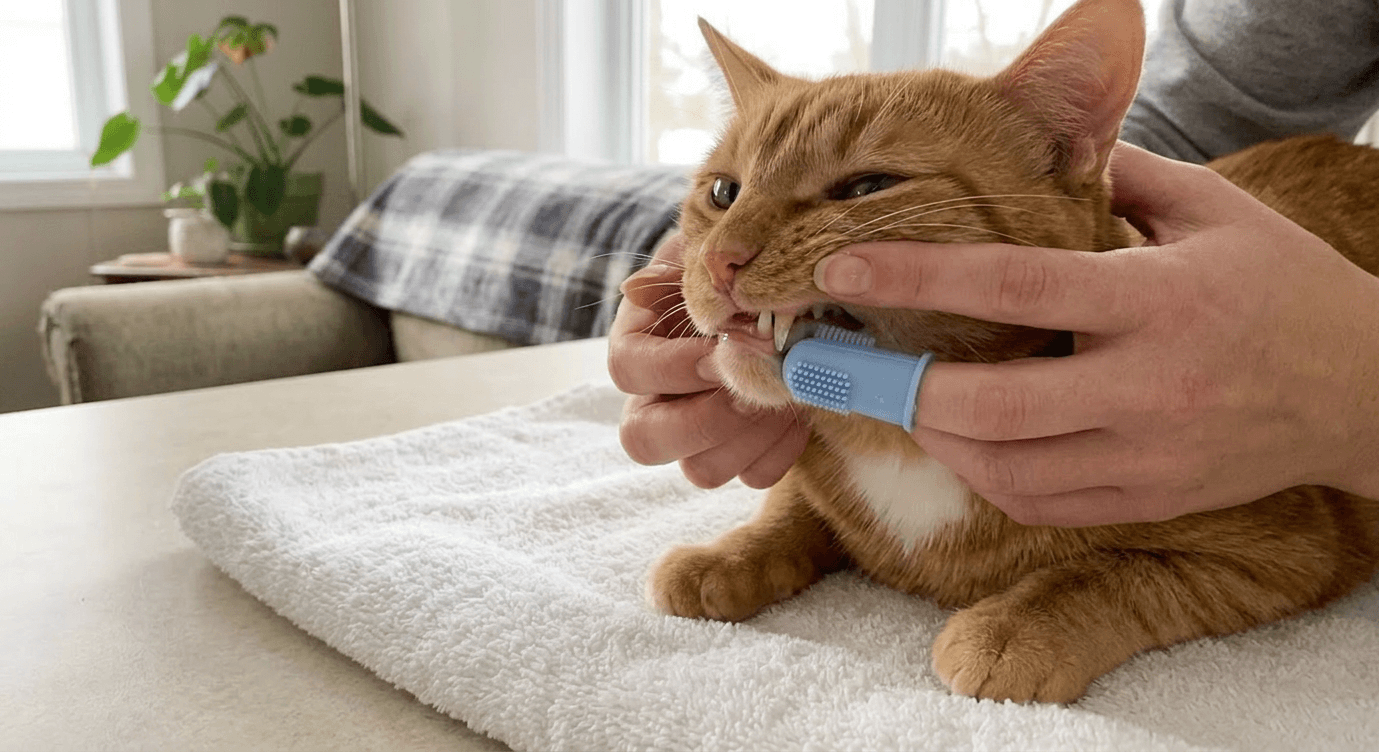
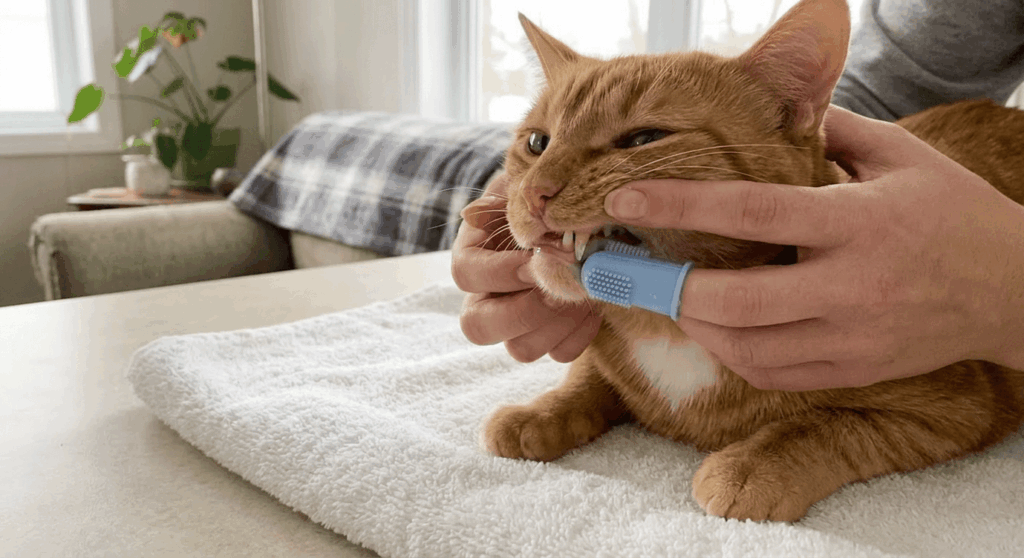
- Apply a small amount of enzymatic toothpaste to a silicone finger brush or a small square of gauze wrapped around your finger
- With your other hand, gently lift the upper lip on one side
- Make two to three gentle circular motions along the outer surface of the upper teeth and gumline on that side only
- Release, reward immediately, end the session
Important: Focus on the outer (buccal) surfaces only — the side facing the cheek. This is where the vast majority of periodontal disease develops. The tongue’s natural movement manages the inner surfaces reasonably well.
Success marker for Week 3: Your cat tolerates the finger brush on one side without significant resistance for three to four strokes.
Week 4: Transitioning to a Toothbrush
The goal this week is introducing the proper bristled toothbrush in place of the finger brush.
Choose the right brush:
- Angled-head cat-specific toothbrushes allow access to the back molars
- Ultra-soft bristles — cat enamel is thinner than human enamel; medium or firm bristles cause damage
- Dual-headed brushes (small brush on one end, larger on the other) offer flexibility
- Alternatively, a child’s ultra-soft toothbrush with a small head works well
Daily practice:
- Complete the full desensitization sequence from the previous weeks
- Apply enzymatic toothpaste to the brush
- Brush the outer surfaces of the upper teeth on both sides — two to three gentle circular motions per section
- If well-tolerated, add the lower teeth in the same session
- The entire brushing component should take thirty to sixty seconds once established
- Immediate reward
Success marker for Week 4: A complete outer-surface brush of all four quadrants accepted without significant resistance.
Maintenance from Week 5 onward: Daily brushing is ideal. Every other day is the minimum effective frequency — the bacterial plaque that leads to tartar calcification takes approximately 36–48 hours to mineralize. Brushing less frequently than every other day does not disrupt this cycle effectively.
Alternatives and Supplements to Brushing That Actually Work
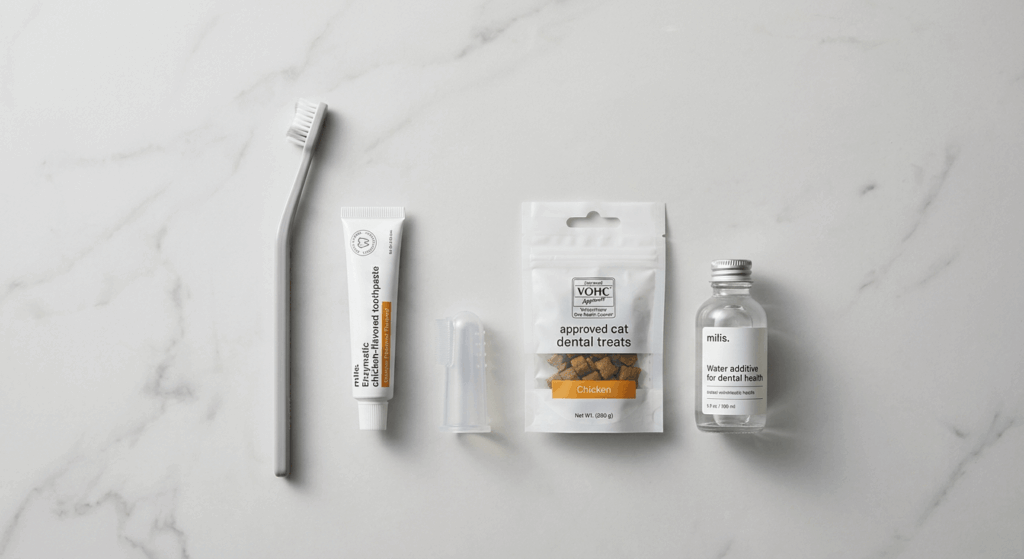
Brushing is the gold standard. But it is not the only tool available, and for cats who remain genuinely resistant after a patient desensitization process, a multi-modal approach using proven alternatives can still provide meaningful protection.
Critical clarification: The following are supplements to brushing, ranked by evidence quality. None fully replaces mechanical plaque removal — but several have genuine, VOHC-reviewed clinical data behind them.
VOHC-Approved Dental Treats
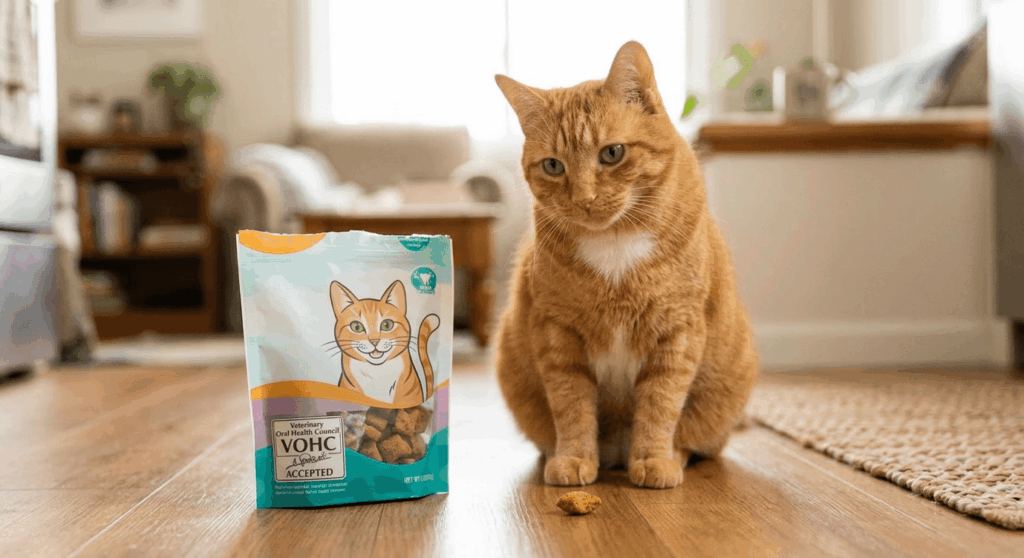
The Veterinary Oral Health Council evaluates dental products against controlled clinical data and awards its seal to products that demonstrably reduce plaque or tartar. The VOHC seal is not purchased — it requires submitted study data meeting defined efficacy thresholds.
Currently VOHC-approved treats for cats include:
- Purina Pro Plan Veterinary Diets Dental Chewz
- Greenies Feline Dental Treats (specific varieties — check the VOHC website for current approved list, as formulations change)
How to use them effectively:
- Feed as directed — usually one treat daily
- They must be chewed, not swallowed whole, to provide mechanical benefit
- They are treats with caloric content; account for this in your cat’s daily caloric budget
Water Additives
VOHC-approved water additives work through enzymatic or antiseptic mechanisms that reduce oral bacterial load without requiring physical contact with teeth.
- Healthymouth and Vetri Science Perio-Plus are among the more evidence-supported options
- Add to fresh water daily at the directed concentration
- Do not use with a fountain without verifying additive compatibility — some additives affect fountain pump components
Compliance challenge: Some cats detect additives by taste or smell and refuse treated water. If water intake drops after introducing an additive, discontinue immediately — hydration is more important than the additive’s dental benefit.
Dental Diets
Unlike general dry food, specific therapeutic dental diets are formulated with enlarged kibble size, modified texture, or enzymatic additives that create genuine mechanical or chemical cleaning action.
- Hill’s Prescription Diet t/d and Royal Canin Dental are the primary VOHC-approved therapeutic dental diet options for cats
- These require a veterinary recommendation and are intended as complete diets, not supplements
- They are meaningfully different from “dental” labeled over-the-counter foods that have not earned VOHC certification
Dental Wipes and Gels
For cats who tolerate face touching but reject any brush, dental wipes (pre-moistened gauze pads with enzymatic solutions) and oral gels applied with a finger provide a middle ground.
- Less effective than brushing at reaching the gumline precisely
- More effective than no intervention
- Can serve as a bridge during a prolonged desensitization process
What Doesn’t Work (Despite Marketing Claims)
- Raw bones: Risk of fractured teeth (slab fractures), bacterial contamination, and gastrointestinal obstruction. Not recommended by veterinary dental specialists.
- Dental toys alone: Insufficient contact time and pressure to meaningfully reduce plaque
- Regular dry kibble: As discussed above — not supported by independent evidence
The Annual Professional Dental Cleaning: Why It’s Not Optional
Even with exemplary home care, professional veterinary dental cleanings are a necessary component of comprehensive dental health. And I want to address the concern that holds many owners back from scheduling them.
Why Home Care Alone Isn’t Enough
Home brushing removes supragingival plaque — the biofilm on the visible tooth surface. It cannot address:
- Subgingival calculus — mineralized tartar below the gumline where periodontal disease actually originates
- Tooth resorption lesions — painful structural defects invisible to visual examination
- Periodontal pocket depth — requires probing under anesthesia to accurately assess
- Root surface disease — only visible on dental radiographs
A complete professional feline dental cleaning includes full-mouth dental radiographs, subgingival scaling, irrigation, and individual tooth assessment — none of which can be replicated at home.
The Anesthesia Concern
The most common reason owners decline recommended cleanings is fear of anesthetic risk. This is a legitimate concern that deserves a direct answer.
The honest answer: Anesthetic risk in a healthy cat undergoing a routine procedure, at a practice with proper pre-anesthetic bloodwork, IV catheter placement, fluid support, and monitoring, is very low. The American Veterinary Dental College explicitly opposes anesthesia-free dental cleanings — the procedures marketed as a “safe” alternative — because they cannot achieve subgingival cleaning, cannot allow radiographs, and cause significant stress to the restrained animal. A cosmetically cleaner-looking tooth with active subgingival disease is not a health outcome.
Pre-anesthetic bloodwork (kidney values, liver enzymes, complete blood count) identifies the cats who genuinely are elevated risk before they’re on the table. For the vast majority of cats with normal bloodwork, the risk of the anesthetic is meaningfully smaller than the risk of allowing active dental disease to progress untreated.
Recommended cleaning frequency:
- Every 1–2 years for most adult cats with good home care
- Annually for cats with history of dental disease or rapid tartar accumulation
- As recommended by your vet based on individual assessment — never based on general population averages alone
Building a Complete Dental Care Routine: The Weekly Framework
Here is how I currently structure Oliver’s dental care, for practical reference:
| Frequency | Activity |
|---|---|
| Daily | Enzymatic toothbrush — outer surfaces, all four quadrants |
| Daily | Water additive in fountain (VOHC-approved) |
| Daily | One VOHC-approved dental treat (accounted for in caloric budget) |
| Monthly | Visual lip-lift check — noting gum color, any swelling, breath changes |
| Annually | Professional veterinary dental examination and cleaning as recommended |
This took approximately eight weeks to fully establish from scratch. The desensitization phase was the hardest part. The maintenance is now a ninety-second routine that Oliver accepts with varying degrees of enthusiasm depending on whether he’s in the mood.
The most important thing I can tell you: Start today, wherever you are. An older cat who has never been brushed is harder to desensitize than a kitten, but it is not impossible — it simply requires more patience and smaller incremental steps.
FAQ
1. How do I know if my indoor cat dental health routine is actually working?
The most reliable indicators that your indoor cat dental health routine is effective are: gum color (healthy gums are salmon-pink, not red or swollen at the margin), absence of visible tartar (the yellow-brown calcified deposits most visible on the outer surfaces of the upper back teeth), neutral breath (some odor is normal post-meal; persistent halitosis is not), and your vet’s assessment at annual examinations.
At-home visual monitoring is supportive but limited — you cannot assess subgingival health or early resorption lesions with the naked eye. Annual professional evaluation remains the only reliable way to confirm that your home care is preventing disease below the gumline.
2. Is it too late to start brushing an older cat’s teeth?
It is almost never too late to start, but the starting point matters. Before beginning any home brushing routine with a cat over five years old who has not had a recent dental examination, schedule a professional assessment first. If active infection, painful lesions, or tooth resorption are present, brushing over those areas causes pain and makes future desensitization dramatically harder.
Once a professional cleaning has addressed existing disease and brought the mouth to a stable baseline, home care can begin on a clean foundation. The desensitization process with an older cat typically takes six to eight weeks rather than four — move at their pace, not yours, and the cooperation you build will be genuine and durable.
3. My cat absolutely will not tolerate brushing. What’s my next best option?
If a thorough four-to-six-week desensitization protocol has genuinely not produced any tolerance for toothbrush contact, build the strongest possible multi-modal alternative routine: daily VOHC-approved dental treats + daily VOHC-approved water additive + annual professional cleanings. This combination provides meaningful — though not equivalent — protection against periodontal disease progression.
Also consider discussing dental prescription diets (Hill’s t/d or Royal Canin Dental) with your vet as a complete diet option that provides daily mechanical cleaning. And revisit the brushing question annually — some cats become more tolerant as they age and their baseline anxiety decreases, particularly if you maintain regular gentle face-touching as part of your normal interaction.
References
- Lommer, M. J., & Verstraete, F. J. M. (2000). Prevalence of odontoclastic resorption lesions and periapical radiographic lucencies in cats: 265 cases (1995–1998). Journal of the American Veterinary Medical Association, 217(12), 1866–1869. https://doi.org/10.2460/javma.2000.217.1866
- Veterinary Oral Health Council (VOHC). (2023). VOHC Accepted Products for Cats. Retrieved from http://www.vohc.org — (The VOHC evaluates and publishes accepted products based on controlled clinical trial data demonstrating plaque or tartar reduction meeting defined efficacy thresholds.)
Disclaimer: This article reflects the personal experience of a cat owner and draws on published veterinary dental medicine research and Veterinary Oral Health Council guidelines. It does not replace individualized veterinary dental assessment. If your cat shows signs of oral pain, swelling, bleeding gums, or significant halitosis, please schedule a veterinary examination before beginning any home brushing program.