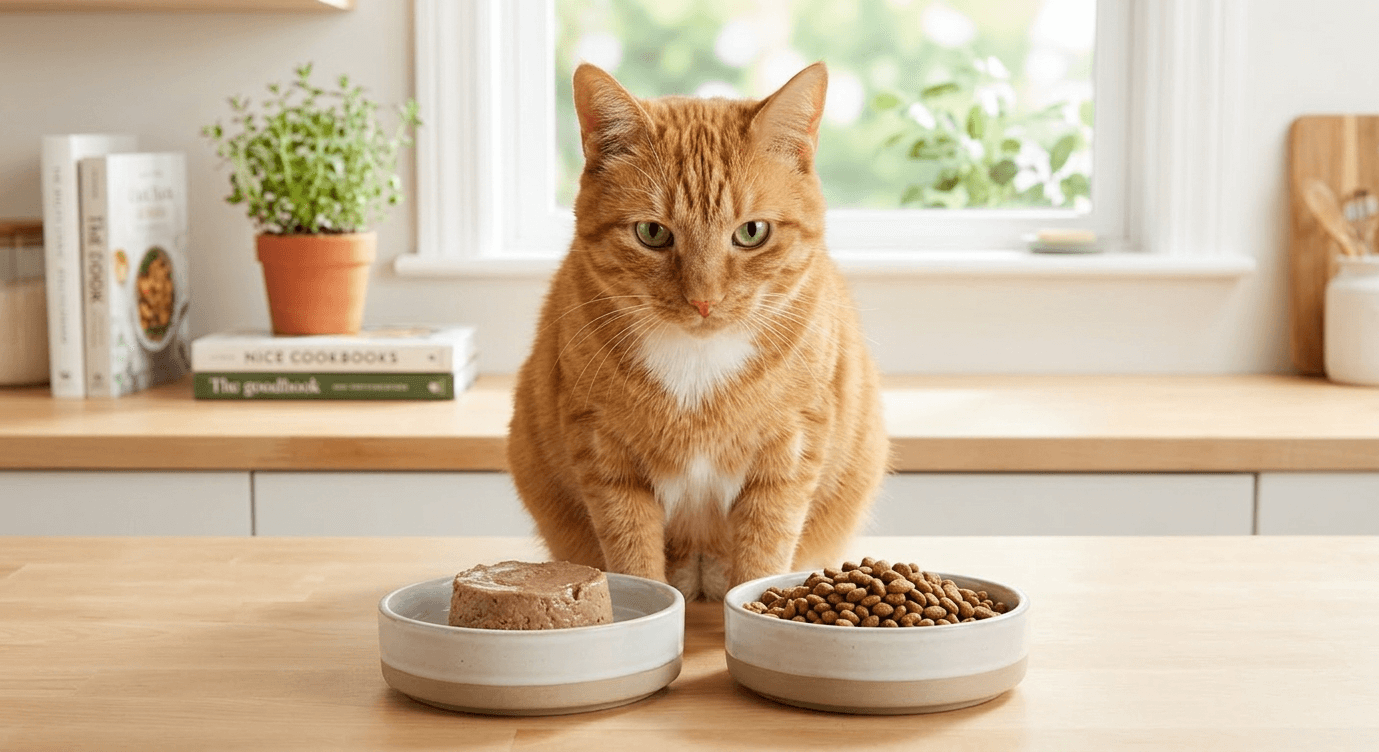
Wet food vs dry food for indoor cats is not a contest with one universal winner. Wet food supplies substantially more moisture and is often less calorie-dense by weight, while dry food is usually easier to store, measure into puzzle feeders, and fit into a limited budget. Either format can provide complete nutrition when the label says it is complete and balanced for your cat’s life stage.
The best choice depends on the individual cat: age, body condition, medical history, food preferences, household schedule, and total daily calorie intake. Some cats thrive on wet food, some do well on measured dry food, and many can eat a carefully portioned combination. Cats with kidney disease, urinary disease, diabetes, food allergies, chronic digestive signs, or a prescription diet need an individualized plan from their veterinarian before their food is changed.
Quick Answer
For a healthy adult indoor cat, start by choosing a food that is complete and balanced for adult maintenance, then compare the practical differences:
- Choose wet food for more dietary moisture. Canned food commonly contains at least 75% water, while dry food generally contains about 6%–10% water.
- Choose measured dry food for convenience and food puzzles. It is shelf-stable before serving and easier to use in timed feeders, but free-feeding can make calories difficult to track.
- Consider mixed feeding when both formats solve useful problems. Count the calories from both foods together so that a full wet allowance is not accidentally added to a full dry allowance.
- Do not judge a food by the first ingredient alone. Nutritional adequacy, life-stage suitability, manufacturer expertise, quality control, calorie content, and your cat’s response matter more than a marketing-friendly ingredient list.
- Do not use ordinary kibble as dental care. Only products that have demonstrated a dental benefit, such as diets carrying an appropriate Veterinary Oral Health Council claim, should be chosen for that purpose.
If your cat suddenly eats much less, stops eating, loses weight, vomits repeatedly, strains to urinate, produces little or no urine, or becomes lethargic, contact a veterinarian instead of trying to solve the problem by switching between wet and dry food.
Wet Food vs Dry Food for Indoor Cats at a Glance
| Factor | Wet food | Dry food |
|---|---|---|
| Moisture | Commonly at least 75% | Commonly about 6%–10% |
| Calorie density | Often lower per gram because water adds weight and volume | Often higher per gram, so small measuring errors can add meaningful calories |
| Storage after serving | Opened portions require refrigeration; served food should not sit out indefinitely | Easier to portion into feeders, but the bag still needs cool, dry, sealed storage |
| Palatability | Often appealing to cats because of aroma and texture | Familiar and convenient for cats accustomed to kibble |
| Enrichment | Can be used in lick mats and some washable wet-food puzzles | Easy to use in puzzle feeders, timed feeders, and supervised foraging games |
| Dental benefit | Ordinary wet food is not a substitute for dental care | Ordinary kibble should not be assumed to clean teeth; look for a specific evidence-based dental claim |
| Cost | Usually costs more per calorie | Usually costs less per calorie |
| Best use | Increasing dietary moisture and offering larger food volume for a given number of calories | Convenience, measured enrichment, and budget management |
The table describes common differences, not guarantees. Products vary widely, so compare the calorie statement, nutritional adequacy statement, feeding directions, and moisture content on the actual labels.
Table of Contents
1. Moisture Is the Clearest Difference
The strongest practical argument for wet food is its water content. Cornell University’s Feline Health Center describes canned food as containing at least 75% moisture and dry food as containing roughly 6%–10% water. A cat eating wet food therefore receives part of its daily water intake with each meal.
This does not mean every dry-fed cat is dehydrated or that wet food prevents kidney and urinary diseases. Cats can drink water separately, and urinary health is influenced by more than food format. Medical history, urine concentration, mineral balance, body weight, stress, water access, and underlying disease can all matter.
For a healthy cat, you can support hydration regardless of diet by:
- providing fresh water every day;
- placing water in more than one quiet location;
- keeping bowls away from dirty litter areas;
- washing bowls and fountains regularly;
- noticing changes in drinking and urination; and
- asking a veterinarian before adding water to a therapeutic diet or changing a medically prescribed feeding plan.
Wet food may be especially useful when a veterinarian wants to increase a cat’s water intake. However, a cat that strains in the litter box, repeatedly visits the box, cries while urinating, passes blood, or produces little or no urine needs urgent veterinary assessment. A food change is not an appropriate substitute for diagnosis, and inability to pass urine can be an emergency.
For more prevention and warning-sign information, read the indoor cat urinary health guide.
2. Calories and Portion Control Matter More Than Format Alone
Dry food is usually more calorie-dense per gram because most of its water has been removed. That means a visually small extra scoop can represent a significant number of calories. Wet food often provides more weight and volume for the same number of calories, which can make portions look more substantial.
Neither format automatically causes weight gain or guarantees weight loss. Cats can overeat wet food as well as dry food, and an inappropriate calorie target can cause problems regardless of the package. The important number is the cat’s total daily calorie intake from all sources, including meals, treats, toppers, dental products, and food used for training or enrichment.
A safe portioning routine looks like this:
- Find the calorie statement on every food package. Look for kilocalories per can, pouch, cup, or kilogram.
- Ask your veterinarian for an initial daily target based on the cat’s current weight, ideal weight, body condition, age, neuter status, activity, and health.
- Divide that target between meals and formats.
- Weigh or measure each day’s food instead of repeatedly topping up the bowl.
- Monitor body weight and body condition, then adjust the plan with veterinary guidance.
Package feeding directions are starting estimates for an average animal; they are not a personalized prescription. An inactive neutered indoor cat may need a different amount from the number printed on the bag, while a growing kitten, pregnant cat, highly active cat, or underweight senior may need a very different plan.
Use the how much to feed an indoor cat guide to organize portions, and use a consistent indoor cat feeding schedule to make appetite changes easier to notice.
3. “Complete and Balanced” Comes Before Wet or Dry
Food format tells you how much moisture a product contains; it does not tell you whether the diet supplies all required nutrients. The most important label check is the nutritional adequacy statement.
For food sold in the United States, look for wording indicating that the product is complete and balanced for the appropriate life stage, based on an AAFCO nutrient profile or an AAFCO feeding trial. Adult-maintenance food is designed for adult cats. Kittens, pregnant cats, and nursing cats have different requirements and need food labeled for growth, reproduction, or the applicable life stage.
Treats, toppers, broths, and some complementary or supplemental foods are not intended to be the sole diet. A product can look like a normal can of cat food while still lacking the nutritional adequacy statement required for long-term exclusive feeding. Check the small print rather than relying on the front of the package.
The following checks are more useful than searching for a fashionable first ingredient:
- Is the food complete and balanced for this cat’s life stage?
- How many calories does it contain per can, pouch, cup, or gram?
- Does the manufacturer employ qualified nutrition experts?
- Who formulates the food, and what are that person’s qualifications?
- Does the company have finished-product testing and quality-control procedures?
- Can the manufacturer provide typical nutrient analysis rather than only minimum and maximum guarantees?
- Is there contact information for nutrition questions?
- Does the company conduct or publish relevant product research?
The WSAVA Global Nutrition Committee cautions that an ingredient list does not reveal ingredient quality and can be misleading when used as the main measure of a food. Ingredients must also be listed by weight before processing, which can make water-rich ingredients appear more prominent. Grains and properly processed animal by-products are not automatically evidence of poor nutrition, while a package covered in attractive meat imagery is not proof of a balanced formulation.
4. Compare Nutrients on the Same Basis
The guaranteed analysis on a wet-food label includes the product’s water, while the analysis on dry food includes far less moisture. Directly comparing the printed protein percentages can therefore produce the wrong conclusion.
For example, a wet food showing 10% crude protein may contain a higher proportion of protein after moisture is removed than a dry food showing 32%. To compare products with very different water content, nutrients must be converted to a dry-matter basis.
The calculation is:
Dry matter percentage = 100 − moisture percentage
Nutrient on a dry-matter basis = as-fed nutrient percentage ÷ dry matter percentage × 100
If a canned food lists 78% moisture and 10% crude protein:
- Dry matter = 100 − 78 = 22%
- Protein on a dry-matter basis = 10 ÷ 22 × 100 = approximately 45.5%
This calculation helps compare nutrient concentration, but it still does not measure protein digestibility, amino-acid balance, manufacturing quality, or whether the food is appropriate for an individual medical condition. Ask the manufacturer or veterinarian for more complete nutrient information when those details matter.
5. Wet Food and Dry Food Have Different Practical Strengths
Where Wet Food Often Helps
Wet food can be useful when you want to:
- add water through meals;
- offer a strong aroma to a cat with normal but selective food preferences;
- provide greater food volume for a measured number of calories;
- divide daily intake into several moisture-rich meals; or
- follow a veterinarian’s recommendation for a particular health condition.
Opened canned food needs refrigeration, and leftovers should be handled according to the product label. Serve an amount your cat can finish in a reasonable meal period, discard food that is contaminated or has been left out too long, and wash dishes after use. Do not repeatedly return warmed leftovers to the refrigerator.
Where Dry Food Often Helps
Dry food can be useful when you want to:
- control costs;
- use a compatible timed feeder;
- place measured food in a puzzle feeder;
- carry a portion during travel; or
- feed a cat that reliably prefers a dry texture.
Dry does not mean indestructible. Store it in a cool, dry place, keep the original packaging information and expiration date, close the bag securely, and avoid buying more than your household can use while it remains fresh. Wash food bowls and puzzle feeders instead of continually adding new kibble over old crumbs and oils.
If you use dry food as enrichment, subtract every piece from the cat’s daily allowance. Our guide to the best cat puzzle feeders explains how to introduce different difficulty levels without creating frustration.
6. Ordinary Dry Food Is Not a Dental-Care Plan
It is tempting to assume that crunchy food cleans a cat’s teeth, but ordinary kibble should not be selected for an unverified dental benefit. Kibble size, shape, texture, and the way the cat bites it all affect whether a product contacts the tooth surface in a useful way.
The Veterinary Oral Health Council awards its Seal of Acceptance to products that meet its standards for controlling plaque, tartar, or both. Its accepted cat-product list includes certain specifically formulated dental diets, not every dry food. If dental benefit is part of your purchasing decision, confirm the exact product and claim on the current VOHC list.
Food also does not replace routine oral assessment or home dental care. Ask your veterinarian how often your cat needs an oral examination and whether toothbrushing, an accepted dental product, or professional treatment is appropriate. See the complete indoor cat dental health guide for a safer dental routine.
7. Cost and Convenience Should Be Part of the Decision
A feeding plan only works when the household can follow it consistently. Wet food commonly costs more per calorie and requires refrigerator space after opening. Dry food is commonly less expensive, easier to store, and easier to use when someone is away during a scheduled meal.
Budget-conscious options include:
- feeding a nutritionally complete wet food for one meal and measured dry food for another;
- comparing cost per 100 calories instead of cost per package;
- using dry food from the daily allowance in enrichment rather than buying extra treats;
- purchasing package sizes that can be used while the food remains fresh; and
- discussing realistic alternatives with a veterinarian if a therapeutic diet becomes unaffordable.
“Premium,” “natural,” “holistic,” and “indoor formula” are not substitutes for checking nutritional adequacy and calorie content. A reasonably priced food from a manufacturer with appropriate expertise and quality control may be a sounder choice than an expensive product selected mainly for its marketing language.
Is Mixed Feeding Better?
Mixed feeding can be a practical option, but it is not automatically superior and there is no universal wet-to-dry ratio. Its main advantage is flexibility: wet meals can contribute moisture while measured dry portions can support timed feeding, food puzzles, or budget control.
The most common mixed-feeding mistake is double counting. If a cat’s daily target were divided between two products, each product would supply only part of the total—not its full standalone feeding recommendation.
Use this method:
- Establish the cat’s total daily calorie target with your veterinarian.
- Decide which practical purpose each format will serve.
- Assign a specific calorie amount to wet meals.
- Assign the remaining calories to dry food.
- Measure the entire dry allowance once daily, including food used in puzzles or treats.
- Reassess weight, body condition, stool quality, appetite, and food acceptance.
Do not improvise a mixed plan for a cat receiving a prescription urinary, kidney, diabetic, gastrointestinal, allergy, or weight-loss diet. Adding an over-the-counter food can dilute the therapeutic formulation or disrupt a treatment schedule.
How to Transition Between Wet and Dry Food Safely
Sudden diet changes can cause digestive upset or food refusal. AAHA/AAFP guidance supports a gradual transition, commonly over about 7–10 days, but cats with strong texture preferences may need more time.
A flexible transition for a healthy cat can begin like this:
- Days 1–3: Offer a small amount of the new food beside the familiar food.
- Days 4–6: Increase the new food only if appetite and stool remain normal.
- Days 7–10: Continue gradually replacing the old food while preserving the planned total calories.
- After day 10: Slow down if the cat is hesitant; do not force a rigid deadline.
Useful techniques include offering different textures, serving wet food near room or body temperature rather than very cold, using a small amount of the familiar food as a topper, and feeding in a quiet location. Introduce only one major change at a time so that you can identify what the cat accepts.
Never try to “wait out” a cat by withholding familiar food until hunger forces acceptance. Cats must continue consuming adequate calories. Cornell notes that sustained appetite loss can seriously affect a mature cat in as little as 24 hours and can precede hepatic lipidosis. Contact your veterinary clinic promptly if your cat stops eating, eats markedly less, or develops vomiting, lethargy, pain, jaundice, or another concerning sign. Kittens and cats with diabetes or other medical conditions may require even faster attention.
How to Choose Between Wet and Dry Food
Choose More Wet Food When
- your veterinarian recommends increasing dietary moisture;
- your cat reliably eats wet food and maintains an appropriate body condition;
- the larger food volume helps you follow a controlled-calorie plan;
- refrigerated storage and scheduled meals are practical; or
- a prescribed or veterinarian-recommended diet is supplied in wet form.
Choose Measured Dry Food When
- your cat strongly prefers dry texture and remains healthy on an appropriate food;
- cost or storage makes an all-wet plan unrealistic;
- a timed feeder is needed;
- measured kibble will be used for safe enrichment; or
- your veterinarian recommends a specific dry therapeutic or dental diet.
Consider Mixed Feeding When
- your cat accepts both textures;
- you can calculate and measure the combined calories;
- wet meals improve hydration opportunities;
- dry portions solve a genuine scheduling or enrichment need; and
- no prescription-diet restriction makes mixing inappropriate.
Ask Your Veterinarian Before Changing Food When
- your cat is a kitten, pregnant, nursing, underweight, obese, or a frail senior;
- your cat has kidney, urinary, heart, liver, pancreatic, gastrointestinal, endocrine, or dental disease;
- your cat has diabetes or receives medication tied to meals;
- your cat has suspected food allergy or is undergoing an elimination trial;
- your cat eats a prescription diet;
- appetite, thirst, urination, stool, vomiting pattern, or body weight has changed; or
- you are unsure how many calories the cat should receive.

Frequently Asked Questions
Is wet food better than dry food for indoor cats?
Wet food provides substantially more dietary moisture and is often less calorie-dense by weight, but it is not automatically the best food for every cat. Dry food can also be complete and balanced and may fit a household’s budget, storage, and enrichment needs better. The best option is nutritionally adequate, appropriate for the cat’s health and life stage, correctly portioned, and reliably eaten.
Can indoor cats eat only dry food?
Many healthy cats eat complete and balanced dry food, maintain good body condition, and drink adequately. They should always have fresh water available, and their portions, weight, urinary habits, and overall health should be monitored. Cats with certain medical conditions may benefit from or require a different plan recommended by a veterinarian.
Can indoor cats eat only wet food?
Yes, if the wet food is labeled complete and balanced for the cat’s life stage, supplies an appropriate number of calories, and suits the cat’s health. Some canned products are intended only for intermittent or supplemental feeding, so verify the nutritional adequacy statement.
Can I feed wet food and dry food on the same day?
Yes. They can be served in separate meals or, when the cat accepts it, together. Calculate the combined daily calories and follow safe handling rules for the wet portion. Separate serving often makes it easier to track how much of each food the cat consumed.
Does dry food clean a cat’s teeth?
Do not assume ordinary kibble provides dental protection. If you want a dental diet, look for the exact product on the current VOHC accepted-products list and discuss oral care with your veterinarian. Toothbrushing and professional veterinary assessment may still be needed.
Is grain-free food better for indoor cats?
Grain-free is a formulation description, not proof of superior nutrition. Cats need specific nutrients, not a fashionable ingredient list. Evaluate nutritional adequacy, manufacturer expertise, quality control, calorie content, and suitability for the individual cat.
How much wet and dry food should I combine?
There is no universal 50/50 or 70/30 ratio. First establish the cat’s total daily calorie target, then divide those calories between products. Use the calorie statements on the packages and reassess the cat’s weight and body condition.
What if my cat refuses wet food?
Try a small amount beside the familiar food, experiment with pâté, minced, shredded, or gravy textures, and offer it at a comfortable temperature in a quiet feeding area. Continue providing enough accepted food to meet the cat’s needs. Contact your veterinarian promptly if intake drops markedly or the cat stops eating.
Is dry food bad for urinary health?
Dry food supplies less water through the meal, but urinary disease is not determined by food format alone. Cats with urinary signs require veterinary evaluation. A veterinarian may recommend increased water intake or a specific therapeutic diet based on the diagnosis.
Final Thoughts
The wet food vs dry food for indoor cats decision should be based on nutrition, health, calories, moisture, and daily practicality—not guilt or internet absolutes. Wet food is a valuable source of dietary water. Dry food is convenient, economical, and useful for measured enrichment. Mixed feeding can combine those advantages when total calories are controlled.
Whichever format you choose, prioritize a complete and balanced food for the correct life stage, verify calories, monitor body condition and appetite, maintain fresh water access, and involve your veterinarian when medical needs or unexplained changes are present. For the broader framework, continue with the indoor cat diet guide and the apartment cat feeding and weight-control guide.
References
- U.S. Food and Drug Administration. “Complete and Balanced” Pet Food.
- World Small Animal Veterinary Association Global Nutrition Committee. Nutrition Guidelines and Global Nutrition Toolkit.
- World Small Animal Veterinary Association Global Nutrition Committee. Guidelines on Selecting Pet Foods.
- Cornell University College of Veterinary Medicine, Feline Health Center. Feeding Your Cat.
- Cornell University College of Veterinary Medicine, Feline Health Center. How Often Should You Feed Your Cat?.
- Cornell University College of Veterinary Medicine, Feline Health Center. Hydration.
- Cornell University College of Veterinary Medicine, Feline Health Center. Anorexia.
- American Animal Hospital Association and American Association of Feline Practitioners. Nutrition and Weight Management.
- American Animal Hospital Association. 2021 AAHA Nutrition and Weight Management Guidelines for Dogs and Cats.
- Veterinary Oral Health Council. Accepted Products for Cats.