By a cat parent whose pen collection has been systematically destroyed, one deliberate push at a time.
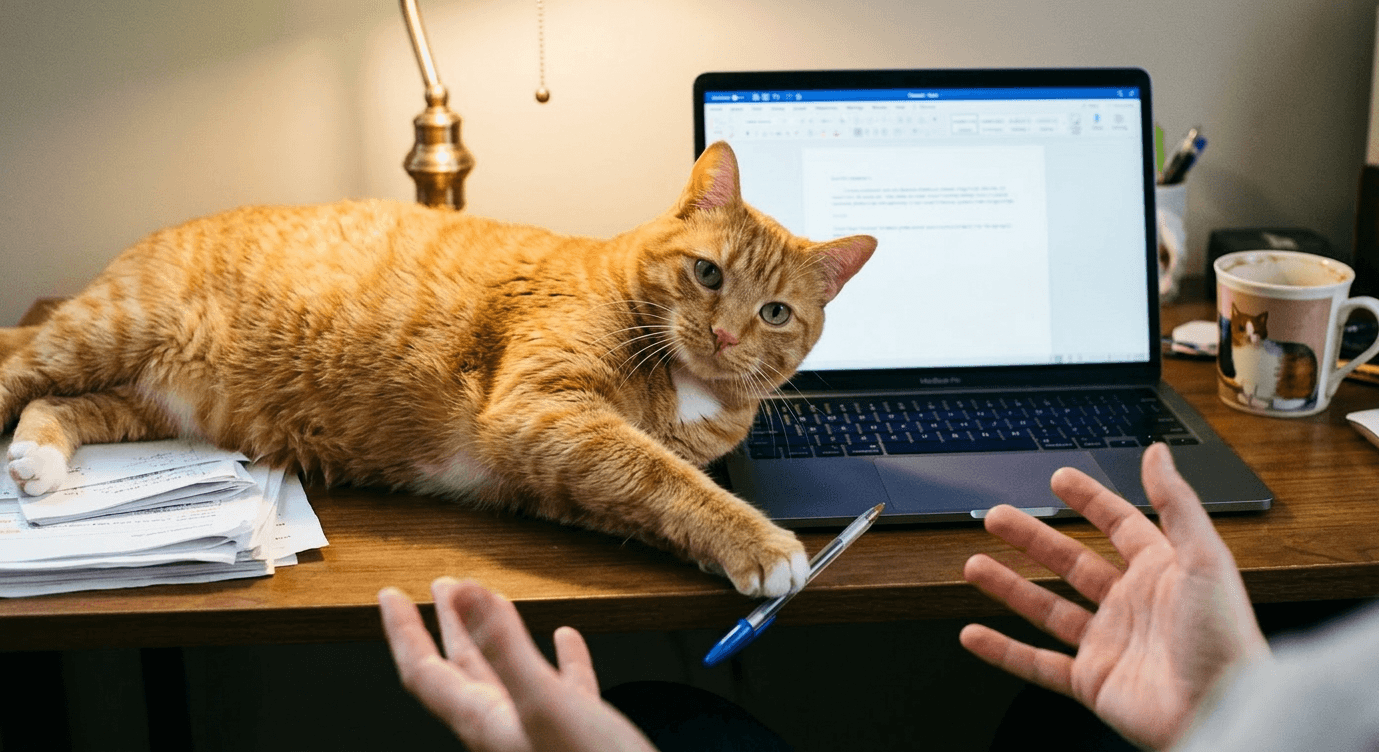
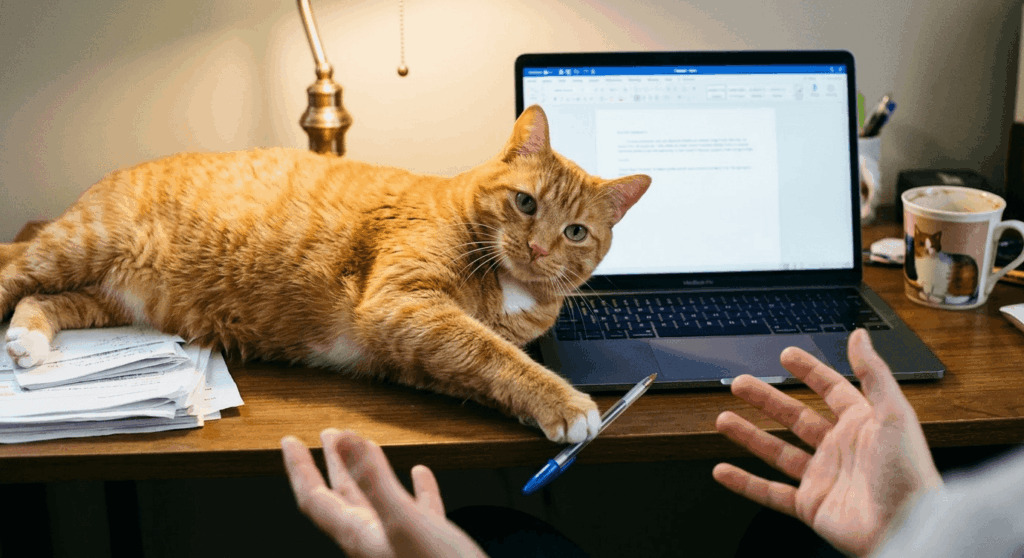
It happened in slow motion, as the most infuriating things always do. I was sitting at my desk, fully present and watching, when Oliver locked eyes with me from across the surface. He held my gaze with the calm, unblinking confidence of someone who has absolutely nothing to lose. Then, one orange paw extended — slowly, deliberately, almost ceremonially — made contact with my favorite pen, and pushed it off the edge.
He watched it fall. He looked back at me. He walked away. If you have ever sat across from your cat and thought “why does my cat knock things over while looking directly at me like a tiny furry sociopath” — welcome. You are in the right place, and the answer, as it turns out, is genuinely fascinating.
Quick Answer
If you’re wondering why does my cat knock things over, the behavior is rooted in hardwired predatory instinct — cats use their extraordinarily sensitive paws to test whether an object might be alive and worth pursuing. They also knock things over due to boredom, environmental exploration, and — critically — because you reacted last time, which trained them to do it again for attention.
The Science of the “Gravity Experiment”
The internet calls it the “cat gravity experiment” and frames it as proof that cats are tiny chaotic scientists, gleefully testing the laws of physics for their own amusement.
The reality is both more interesting and more grounded in biology.
Your cat is not actually testing gravity. Gravity is, from a cat’s operational perspective, not the point. The object is the point. Specifically: is it alive? Is it prey? Is it worth committing to a full predatory sequence? And if it isn’t — what happens when it moves?
Cats evolved as obligate carnivore ambush predators. Every sensory system they have — their vision, their hearing, their extraordinary paw sensitivity — is calibrated around one primary function: detecting, assessing, and capturing prey. An object sitting still on your desk is, neurologically speaking, an unresolved question. The paw tap is how they resolve it.
This behavior is not random. It is not malicious. It is ancient, efficient, and deeply wired into the animal sharing your home.
Reason 1: Predatory Instincts (The Paw Tap Is a Hunting Move)
Let’s start at the evolutionary root.
In the wild, a cat approaching potential prey does not simply lunge. That would be energetically wasteful and potentially dangerous — prey animals bite back. Instead, cats use a testing behavior: a quick, light paw contact to assess whether the target is alive, responsive, and worth the full commitment of a predatory strike.
The paw tap serves three specific purposes:
- Movement detection — live prey moves away from contact; an inanimate object doesn’t
- Threat assessment — if the “prey” retaliates, the cat needs that information before fully committing
- Energy calculation — a cat’s predatory decision-making is deeply tied to caloric efficiency; they need to know if this is worth it
When Oliver taps your pen, he is running this ancient subroutine. The pen doesn’t move on its own — but then, interestingly, it does move, because his paw pushes it. And then it falls, which produces movement, sound, and an unpredictable trajectory.
From a predatory instinct standpoint, that falling pen just gave Oliver exactly the sensory feedback that signals live prey.
This is why knocking things over so often leads immediately to a pounce at the fallen object. The drop isn’t the end of the behavior — it’s the beginning of the hunt sequence.
The hardwired predatory behavior cycle in cats runs: stalk → tap/test → strike → catch → kill → eat. Your desk objects are involuntary participants in steps one through three.
Reason 2: You Trained Them (Operant Conditioning at Its Finest)
I need to say something uncomfortable.
Oliver didn’t teach himself that knocking things off surfaces gets my attention. I taught him that.
The first time he pushed something off my desk, I said “Oliver, NO.” Loudly. While making direct eye contact. While getting up from my chair. From Oliver’s perspective, that sequence of events was extraordinarily rewarding — he produced a dramatic reaction from the largest creature in his territory by performing one simple, low-effort behavior.
This is operant conditioning in its purest form, and cats are astonishingly good at running these experiments and remembering the results.
Here is the reinforcement cycle that most cat owners accidentally build:
- Cat taps object → object moves (intrinsically interesting)
- Cat pushes object off surface → loud noise + human reaction (jackpot)
- Cat learns: this specific behavior produces reliable, dramatic responses
- Cat repeats behavior whenever they want attention, entertainment, or to express general feelings about your life choices
The tragic irony is that even negative reactions — shouting, rushing over, frantically saving your water glass — are rewarding to an attention-seeking cat. You moved. You engaged. You became interactive. Mission accomplished.
The behavior that gets a reaction gets repeated. This is not manipulation. This is learning, operating exactly as it should.
What You’re Actually Rewarding
- Intermittent reinforcement is the most powerful reinforcement schedule in behavioral psychology — meaning that a behavior which sometimes produces a reward is more persistent than one that always does.
- If you sometimes react dramatically and sometimes ignore the knock-off behavior, you are accidentally running the most effective reinforcement schedule possible.
- Slot machines work on the same principle. You are Oliver’s slot machine.
Reason 3: Paw Pad Sensitivity (Their Paws Are Sensory Instruments)
This one genuinely surprised me when I first learned it.
A cat’s paw pads contain one of the highest concentrations of mechanoreceptors in their entire body. Mechanoreceptors are sensory nerve endings that detect:
- Pressure and texture
- Vibration
- Temperature
- Subtle movement
Cats use their paws to gather sensory data about objects the same way we use our fingertips. Running a paw along the edge of your desk, tapping a glass, pushing a pen — these are all active sensory investigation behaviors, not random chaos.
The paw pad sensitivity is so refined that cats can detect the heartbeat vibrations of prey animals through light contact. In a domestic context, that same sensitivity is mapping the weight, texture, solidity, and stability of every object on your desk.
This is also why cats:
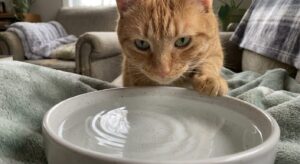
- Pat water before drinking (testing for movement/safety)
- Knead soft surfaces (pressure feedback is neurologically satisfying)
- Tap you on the face at 3 AM with surprising precision (they know exactly what they’re doing)
When Oliver investigates your desk with his paws, he is not being destructive. He is reading the environment with the most sensitive tools he has.
The knock-off that follows is just a natural conclusion of that investigation — the object reached the edge, the push became a push-over, and gravity handled the rest.
Reason 4: Boredom and Under-Stimulation (The Real Culprit)
Here is the reason that ties all the others together.
A cat testing gravity with your coffee mug is, more often than not, a cat with nowhere better to direct their predatory energy. Redirecting that focus requires an indoor environment designed specifically around feline behavioral needs. [Explore our complete guide to apartment enrichment for indoor cats here → The Small Apartment Cat Survival Guide: 7 Pillars of Indoor Enrichment]
Indoor cats have the same neurological hardware as their wild counterparts. They need to stalk, chase, pounce, and capture. They need mental engagement, sensory novelty, and the satisfaction of completing a predatory sequence.
When those needs go unmet, cats do not simply accept a quiet life of napping and window-watching. They redirect their energy toward whatever is available — and your desk, with its array of tappable, pushable, knockable objects of varying weight and trajectory, is essentially a bespoke entertainment center.
Signs your cat’s knocking behavior is boredom-driven:
- It escalates at specific times — late afternoon, early evening (peak predatory drive hours)
- It intensifies when you’re clearly busy and not engaging with them
- They don’t seem particularly interested in the fallen object afterward — the dropping was the point, not the chase
- It’s a relatively new behavior that emerged alongside a lifestyle change (you started working from home, their play sessions decreased)
The solution here is not to remove all objects from elevated surfaces (though that helps short-term). The solution is to give the predatory energy a legitimate outlet.
Reason 5: Environmental Exploration and Spatial Mapping
Cats are compulsive environmental auditors.
They do not simply exist in a space — they actively and continuously map it in three dimensions, tracking which objects are present, where they are positioned, whether anything has changed, and what the physical properties of each surface element are.
This is why your cat investigates every grocery bag you bring home, why Oliver appears the moment a new box arrives, and why a single moved piece of furniture can send a cat into a visible state of territorial confusion.
Knocking objects off surfaces is, in part, a spatial mapping behavior. Your cat is learning:
- How much force this object requires to move
- Which direction it travels when displaced
- What sound it makes on impact
- Whether it bounces, rolls, shatters, or disappears under furniture
This is genuine environmental learning, and it serves real adaptive purposes. A cat who deeply understands their physical environment is a more effective hunter and a more secure territory-holder.
The problem is that your environment — with its fragile ceramics, open water glasses, and irreplaceable objects positioned near edges — is not designed with any of this in mind.

How to Stop the Madness
Good news: this behavior is entirely manageable. It just requires you to address all the actual drivers simultaneously rather than just yelling “Oliver, no” and waiting for him to absorb the lesson. (He will not absorb the lesson. I have tested this extensively.)
H3: Stop Rewarding the Behavior
This is the non-negotiable first step and also the hardest one.
When your cat knocks something over: do nothing. No eye contact, no vocalization, no dramatic saving of objects. Get up and leave the room if necessary. Remove yourself as the reward entirely.
- No reaction = no reinforcement = behavior becomes less interesting over time
- This takes two to three weeks of genuine consistency
- It will get worse before it gets better (the “extinction burst” — they try harder when a previously rewarding behavior stops paying off)
- Consistency across all household members is mandatory — one person reacting undoes everyone else’s work
H3: Remove the Opportunity
Environmental management is not admitting defeat. It is working with your cat’s nature rather than against it.
Desk and surface management:
- Move objects away from edges — cats can only push what’s within paw reach
- Use lidded water bottles instead of open glasses on your desk
- Clear your desk surface when you’re not actively using it
- Store the most tempting items (pens, small objects, phone) in a drawer or container when you leave the room
To stop the behavior at its root, you need to limit their access to the drop zone altogether. We covered the exact training steps to keep cats off counters and tables in a previous guide. [Read that step-by-step training approach here → How to Keep Cat Off Kitchen Counters: A 5-Step Training Guide]
H3: Redirect with Appropriate Predatory Outlets
Replace the behavior, don’t just eliminate it. A predatory drive that has no outlet will find one — and you may not like what it finds.
Effective replacements:
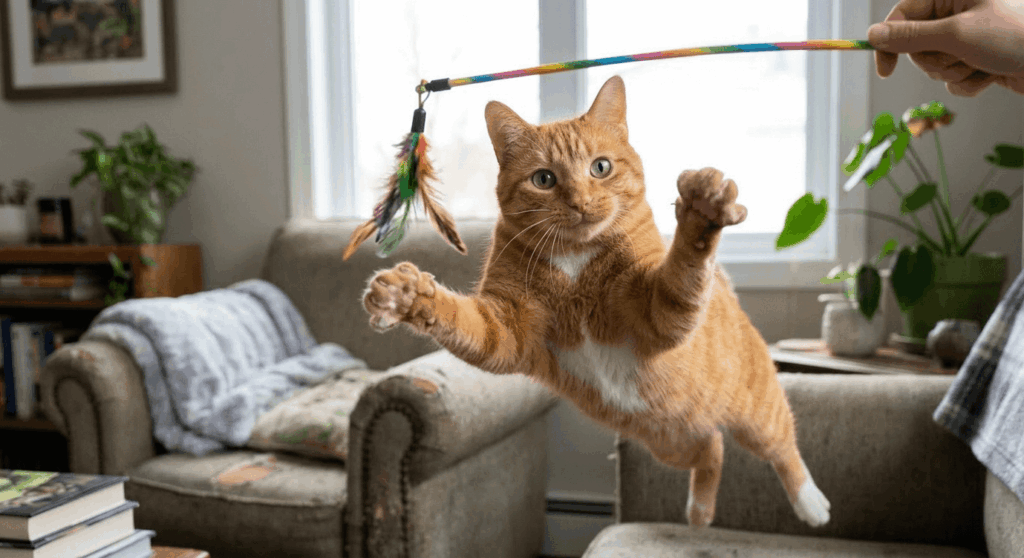
- Wand toy sessions (15 minutes, twice daily) that complete the full predatory sequence — stalk, chase, pounce, catch
- Puzzle feeders that require paw work to access food — redirects the paw-tapping behavior toward a productive activity
- Crinkle balls and small mice toys left on the floor, not on elevated surfaces, so the “hunt” happens at ground level
- Robotic or automated toys for periods when you’re busy — the Potaroma Flopping Fish and similar motion toys maintain engagement without your participation
H3: Add Novelty to Their Environment
A well-enriched cat is a cat who has better things to do than audit your desk.
Practical additions:
- Rotate toys every few days so familiar items feel novel again
- Introduce a new cardboard box or paper bag weekly — absurdly effective
- Add a bird feeder outside the primary window — outdoor wildlife viewing can occupy hours
- Try different textures of scratching surfaces — horizontal cardboard, vertical rope, angled carpet
FAQ
1. Why does my cat knock things over specifically when I’m watching?
Because your watching is part of the reward. Cats are acutely aware of human attention and gaze direction — research on cat-human communication confirms that cats modify their behavior based on whether their owner is visually attending to them. Oliver doesn’t knock the pen off when I’m out of the room because there’s no audience, no reaction, no social consequence.
The moment I make eye contact, I become an active participant in the interaction, and the behavior that follows is partially directed at me. The direct eye contact during the push is not accidental. Your cat knows you’re watching. That’s precisely the point.
2. Are cats doing it out of spite?
No — and this matters more than it might seem. Cats are neurologically incapable of spite, which requires the capacity to plan a behavior specifically to cause emotional distress to another individual as revenge for a perceived slight. That level of theory-of-mind cognitive processing is not something the feline brain is built for. When Oliver knocks my plant over after I’ve been away for a weekend, it feels personal. It is not personal.
It is a bored, under-stimulated, slightly anxious cat redirecting their energy toward the most available environmental interaction. The anthropomorphic reading of spite leads cat owners to respond with punishment, which damages trust, increases anxiety, and makes all associated behaviors worse. It is always behavior with a reason, never behavior with a grudge.
3. Does the question ‘why does my cat knock things over’ have a different answer for kittens versus adult cats?
Broadly, the same five drivers apply — predatory instinct, paw sensitivity, learned reinforcement, boredom, and spatial mapping — but the relative weights shift significantly. Kittens knock things over primarily for pure exploratory and developmental reasons; they are literally learning the physical properties of their world and developing predatory motor skills. Almost everything a kitten does with their paws is developmental play.
Adult cats, particularly those who have been doing it for years, are more likely to have a strongly reinforced learned component — meaning the behavior has been so consistently rewarded by human reaction that it has become a stable, intentional attention-seeking tool. The intervention strategies are similar, but with kittens you have a shorter window to establish better habits before the behavior becomes deeply ingrained. Start the “no reaction” protocol early, provide wand toy outlets from the beginning, and save yourself years of pen losses.
References
- Bradshaw, J. W. S., Healey, L. M., Thorne, C. J., Macdonald, D. W., & Arden-Clark, C. (2000). Differences in food preferences between individuals and populations of domestic cats Felis silvestris catus. Applied Animal Behaviour Science, 68(3), 257–268. https://doi.org/10.1016/S0168-1591(99)00121-9
- Skinner, B. F. (1938). The Behavior of Organisms: An Experimental Analysis. Appleton-Century-Crofts. (Foundational operant conditioning framework applied across species, including felids in subsequent behavioral research.)
Disclaimer: This article reflects the personal experience of a cat owner and draws on published behavioral science and feline ethology. It is intended for informational purposes and does not replace professional veterinary behavioral assessment. If knocking behavior is sudden, compulsive, or accompanied by other behavioral changes, please consult your veterinarian to rule out underlying medical causes.