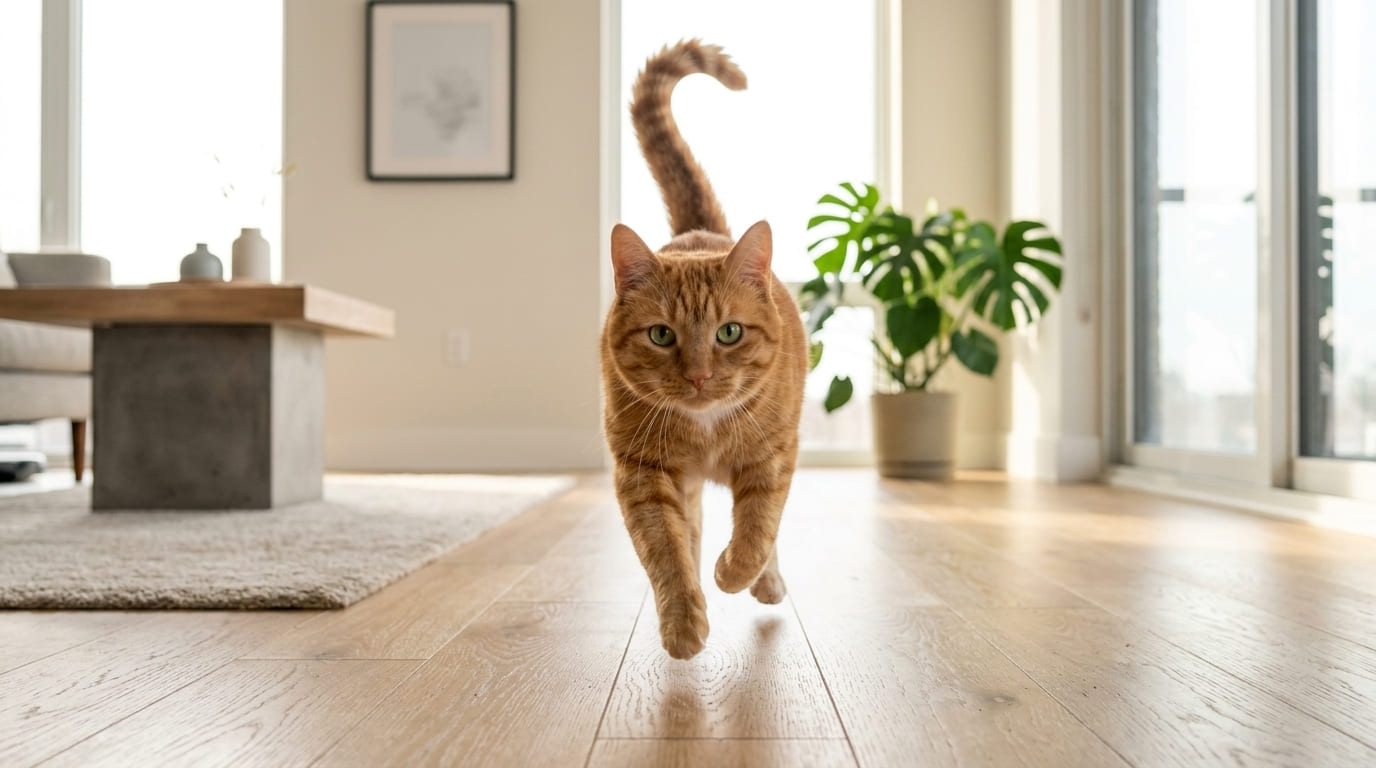
How to train a cat to come is one of the most useful safety skills an indoor cat can learn. It is not about turning your cat into a dog. It is about teaching one clear cue that means, “come to me now and something good will happen.”
I learned this during a building fire alarm with Oliver. He was somewhere in the apartment, the alarm was loud, and I needed him in his carrier quickly without chasing him under furniture.
A reliable recall can help during door escapes, carrier loading, apartment emergencies, medication routines, and everyday check-ins. The goal is not perfect obedience. The goal is a calm, positive response your cat has practiced many times before you need it.
How to Train a Cat to Come (Quick Answer)
To learn how to train a cat to come, choose one clear recall cue, pair it with a high-value reward, and practice in short, easy sessions. Start close, reward every approach, then slowly add distance and mild distractions.
Use positive reinforcement only. Do not call your cat for punishment, forced handling, nail trims, medication, or a stressful carrier trip unless you also protect the cue with rewards and separate training. A recall works because your cat trusts what happens after they come.
Why Recall Training Helps Indoor Cats Stay Safer
Most cat training advice frames recall as a quality-of-life enrichment — a fun skill that deepens the human-cat bond. That framing is accurate but incomplete. In a high-rise urban living context, recall is emergency infrastructure.
The Scenarios Where Recall Saves Lives
Building evacuation: Fire alarms, gas leaks, and structural emergencies require rapid evacuation. A cat who hides under the bed in fear — which is the default feline response to a sudden, alarming stimulus — cannot be retrieved quickly without a trained recall. The carrier cannot be forced if the cat cannot be found.For a complete emergency setup, pair recall training with an apartment cat emergency evacuation plan so the carrier, documents, and exit routine are ready before an alarm happens.
Accidental door escape: A cat who bolts through an open door during a delivery or maintenance visit may end up in a building corridor, a stairwell, or an elevator — all of which are dangerous and disorienting for a cat who has never been outside your apartment.Recall should also be paired with door management. If your cat waits near the entryway or bolts during deliveries, use this training with our guide on how to stop a cat from running out the door.
Medical emergency: A cat who needs to be caught quickly for medication administration, injury assessment, or veterinary transport cannot always be cornered or chased without causing additional stress — which elevates heart rate, blood pressure, and cortisol in ways that can complicate a medical situation.
The hidden cost of no recall: Without a trained recall, your only option in each of these scenarios is physical pursuit — which triggers the flight response, which causes hiding, which makes retrieval slower and more stressful for both of you. A reliable recall short-circuits this entire chain.
A reliable recall also serves as the ultimate emergency backup for our protocols on how to stop cat from running out door during deliveries or guest arrivals — because a cat who comes to you on cue can be called away from a dangerous threshold before the impulse to bolt becomes action.
Choosing the High-Value ‘Jackpot’ Reward
Recall is one of the most useful behaviors you can train for an indoor cat, so it deserves a reward your cat truly values. For many cats, that means a tiny piece of freeze-dried chicken, salmon, tuna, or another high-value protein used only for training. It therefore requires the most valuable currency in your cat’s reinforcement economy.
Why Standard Treats Are Not Sufficient
The recall cue must work in competition with fear, with the irresistible smell of another animal, with the alarm sound that is overloading your cat’s auditory system. A kibble piece or a standard commercial treat that your cat receives three times a day in their bowl is not motivationally powerful enough to override these competing stimuli. You need a jackpot — something so unusual and so intensely rewarding that it interrupts even a moderate stress response.
The Freeze-Dried Protein Hierarchy
Freeze-dried proteins often work well for recall training because:
- They are aromatic — the scent carries across a room and cuts through other environmental smells
- They have a different texture and flavor profile from daily food — they register as categorically special
- They are shelf-stable and can be stored in a designated recall training pouch that is opened only for recall sessions
High-value treat ranking for cat recall training:
- Freeze-dried beef liver — the highest palatability in my clinical experience; the smell is intense and carries remarkably well
- Freeze-dried wild salmon — extremely aromatic, high protein, universally palatable across breed types
- Freeze-dried chicken breast — slightly milder than liver but universally accepted; good for cats with beef sensitivity
- Freeze-dried shrimp — the surprise highest-value option for many cats; the marine protein scent is compelling
Critical rule: The recall reward is never used for anything else. Not for general training. Not for getting off the counter. Not as an evening snack. The freeze-dried jackpot is exclusively paired with the recall cue — its singularity is what makes it powerful.
Commercial Options
- Stella & Chewy’s Freeze-Dried Cat Treats (Wild-Caught Salmon or Chicken)
- Primal Freeze-Dried Cat Treats (Beef Liver or Sardine)
- PureBites Freeze-Dried Cat Treats (the simplest ingredient list — single protein, nothing added)
Break these into pieces no larger than a grain of rice for recall training — small enough to be consumed instantly so the training rhythm isn’t interrupted, large enough that the reward registers neurologically as meaningful.
5 Safe Steps for How to Train a Cat to Come
When mastering how to train a cat to come, your timing determines your success. These five steps are sequential — do not skip ahead. Each step builds the neurological foundation for the next.
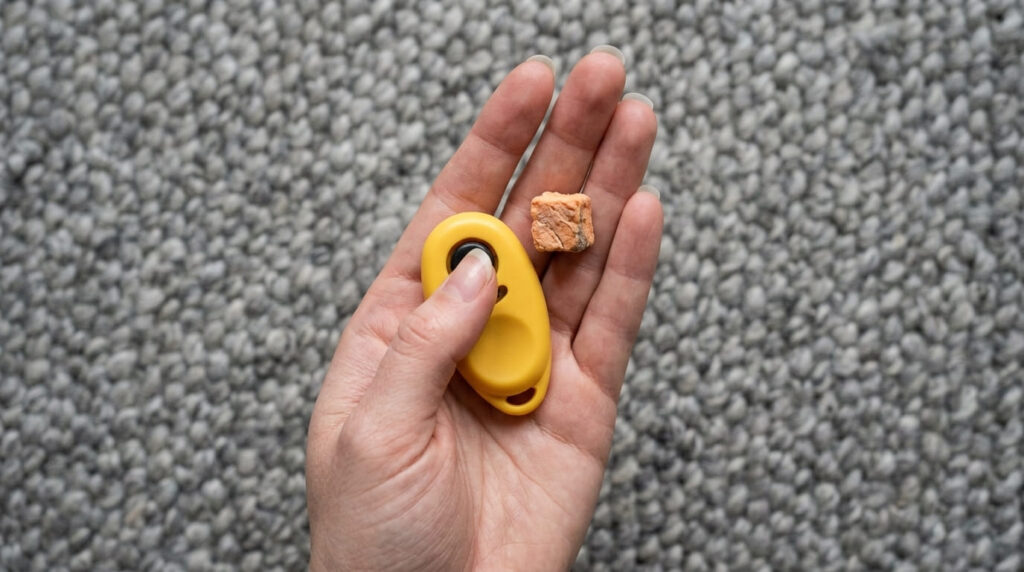
Step 1: The ‘Charging’ Phase — Teaching the Clicker Means ‘Good’
Before you introduce any recall cue, your cat needs to understand what the clicker means. This is called charging the clicker — establishing that the click sound is a reliable predictor of reward, not just a random noise.
Protocol:
- Sit on the floor with your cat at close range (within 2–3 feet) in a quiet room
- Click once → immediately deliver a tiny piece of freeze-dried treat
- Pause 5–10 seconds → click once → immediately deliver a treat
- Repeat 8–10 times per session
- Do not ask for any behavior — the cat doesn’t need to do anything yet. Click → treat. That’s it.
The test: After 2–3 sessions, click when your cat is looking away from you. If they turn toward you with a visible anticipatory response (ears forward, eyes moving toward you, possibly standing up), the clicker is charged. You can proceed to Step 2.
Session length: 3–5 minutes maximum. Cats habituate quickly — short, frequent sessions produce faster results than long ones.
Using a clicker to mark the exact second your cat turns toward you can make recall training clearer. If your cat is new to marker training, start with our guide to clicker training a cat before adding distance or distractions.
Step 2: The Short-Distance Lure — The First Actual Recall
Now that the clicker predicts reward, you are going to use it to mark the first version of the recall: a small cat moving a short distance toward you.
Protocol:
- Sit or crouch on the floor, 3–4 feet from your cat
- Show the treat at nose level (allow your cat to smell it without giving it)
- Slowly move the treat toward your body — luring the cat to follow it
- The moment your cat takes 2–3 steps toward you: click
- Immediately deliver the treat from your hand as your cat arrives at you
- Praise briefly in a warm, quiet voice
- Allow 10–15 seconds of processing time before the next trial
What you are building: The physical experience of moving toward you and finding something profoundly rewarding at the destination. You are writing this association in your cat’s neurological pathways through repetition.
Critical technical note: Click during the movement toward you, not when they arrive. The click marks the behavior you want (approaching), not the end position (standing in front of you). This precision is what the clicker technology exists to provide.
Progress indicator: By session 3–4, your cat should be moving toward you when they see the treat appear — without needing to follow it as a continuous lure.
Step 3: Adding the Vocal Cue — The Named Recall
Once your cat is reliably moving toward you for the treat lure, you add the verbal cue. The sequence is critically important: cue first, then lure. Never lure and then name afterward — you want the cue to predict the reward, not follow it.
Choosing your cue:
- It must be distinct from any word you use regularly (avoid “come” if you say it in daily conversation, “here” if you use it casually)
- Suggested cues: “Here!” — “This way!” — a specific whistle pattern — a lip smack
- It must be deliverable at volume in an emergency without sounding panicked — practice saying it calmly and brightly
Protocol:
- Say your cue once in a clear, upbeat tone: “Here!”
- Immediately show the treat lure
- Click the moment your cat moves toward you
- Deliver the jackpot treat on arrival
- Repeat 8–10 times per session
Over 2–3 sessions, your cat will begin to move before the treat appears — responding to the cue word itself. This is the trained recall beginning to form.
What to avoid:
- Do not repeat the cue if your cat doesn’t respond immediately — one cue, then wait 3 seconds, then try again after a break
- Do not use a pleading or anxious tone — your vocal tone communicates your emotional state, and an anxious cue creates hesitation in the cat
Step 4: Building Distance and Distractions — Making It Reliable
A recall that works in a quiet room with no distractions is not an emergency recall. To develop reliability, you must systematically increase the challenge while keeping your cat below their stress threshold.
Distance progression:
- Week 1: 3–5 feet (same room, no barriers)
- Week 2: 5–10 feet (same room, cat may be facing away)
- Week 3: 10–20 feet (different area of the apartment, single room separation)
- Week 4+: Different rooms, cat out of sight when cue is delivered
Distraction progression:
- Phase A: No distractions (training setup environment)
- Phase B: Mild background noise (TV at low volume)
- Phase C: Moderate activity in environment (you moving around beforehand)
- Phase D: Low-level novel stimulation (another person present)
The cardinal rule of distance/distraction training: If your cat fails to respond to the cue, you moved too fast. Go back to the previous successful distance or distraction level and build more repetitions before progressing. Success rate should be 80% or higher at any given level before you advance.
Session structure:
- 3–5 minutes maximum
- 8–12 trials per session
- 1–3 sessions daily
- Always end on a successful trial — never end with a failure
Step 5: Add an Emergency Backup Cue Carefully
This is the step that the 2:47 AM fire alarm taught me to include. The verbal recall cue you’ve built in Steps 1–4 is highly reliable under normal conditions. But in a genuine emergency — alarm sounds, disorienting smells, extreme fear — a cat’s stress response can override even a well-trained verbal cue.
The emergency whistle is a secondary, extremely high-value cue that you build specifically for high-arousal situations.
The emergency whistle protocol:
Use a specific, consistent whistle pattern — I use three short whistles in quick succession. This is your emergency override cue, used only when:
- The standard verbal cue has failed
- The situation is genuinely urgent (evacuation, medical emergency)
- You need maximum behavioral disruption of a hiding or frozen state
Building the emergency whistle association:
- During your regular training sessions, occasionally replace the verbal cue with the three-whistle pattern
- When you use the whistle, deliver the absolute highest-value jackpot you have — not just a piece of freeze-dried chicken, but 5–6 pieces in rapid succession, verbal excitement, and enthusiastic physical praise simultaneously
- The whistle becomes associated with the most intensely rewarding experience in your cat’s behavioral repertoire
Why a whistle outperforms voice in emergencies:
- Whistle sound cuts through ambient noise more effectively than speech
- Consistent acoustic pattern is recognizable even under auditory overload
- You can deliver it even if your voice is stressed or your vocal tone is panicked — the whistle pattern remains consistent
Practice the full emergency recall sequence — whistle, run toward you, jackpot reward — at least once weekly. Reliability in genuine emergencies is only achievable through regular practice in simulated high-arousal conditions.
The Most Important Rule: Never Poison the Recall Cue
This section is the most important behavioral principle in this entire guide. If you follow every other step correctly but violate this one, you will destroy the recall you have built.
The golden rule: Every single time your cat comes to you on the recall cue — regardless of what happens afterward — the experience must end with a reward.
This rule is violated constantly and innocently. It happens when:
- You call your cat to come → they come → you put them in their carrier for a vet visit.If carrier trips are the reason your cat avoids coming, separate recall from carrier work and build a calmer routine with our cat carrier training guide.
- You call your cat to come → they come → you administer medication
- You call your cat to come → they come → you’re angry at them for something and your voice or body language communicates that anger
From your cat’s perspective, the recall cue now has an unpredictable reward history — sometimes it produces freeze-dried salmon, sometimes it produces a car ride to a stressful clinic. The cat is not stupid. They learn to evaluate the probability of reward before deciding whether to respond. The recall becomes unreliable precisely when you need it to be completely reliable.
The practical solution:
- If you must do something your cat finds aversive (nail trim, medication, veterinary carrier), do not use the recall cue. Go and get your cat physically.
- Reserve the recall cue exclusively for positive outcomes — always followed by jackpot reward
- The recall cue is the most protected cue in your training vocabulary
The neurological reason this matters: Classical conditioning — the pairing of a stimulus with an outcome — can be conditioned and counter-conditioned. Every recall followed by a negative experience contributes to counter-conditioning the cue toward avoidance. The more aversive experiences are paired with the recall, the harder the counter-conditioning becomes to reverse.
When to Seek a Professional Behaviorist
Most healthy cats will develop a reliable recall within 4–8 weeks of consistent daily training using this protocol. However, certain presentations indicate that professional behavioral support would improve outcomes:
Consult a certified cat behavior consultant (CCBC) or veterinary behaviorist when:
- Your cat shows no food motivation whatsoever — not even for freeze-dried proteins — as this can indicate nausea, dental pain, stress, or another health issue. If chewing, drooling, bad breath, or one-sided eating is also present, compare the signs with our indoor cat dental health guide and ask your veterinarian. — not even for freeze-dried proteins — as this can indicate underlying medical issues (nausea, dental pain, systemic illness) rather than behavioral preference
- Your cat has a history of severe trauma or feral background that creates a hand-approach aversion incompatible with lure-based training
- Your cat is displaying fear-based aggression when approached — attempting to train recall in a cat with active fear aggression without professional guidance can escalate the behavior
- After 8 weeks of consistent protocol implementation with no reliable recall developing
- Your cat has a diagnosed anxiety disorder for which pharmacological support alongside training may be appropriate
A veterinary behaviorist (Diplomate ACVB) represents the highest level of specialist support — they can assess whether anxiety medication would support the training process in a cat whose stress response is inhibiting learning.
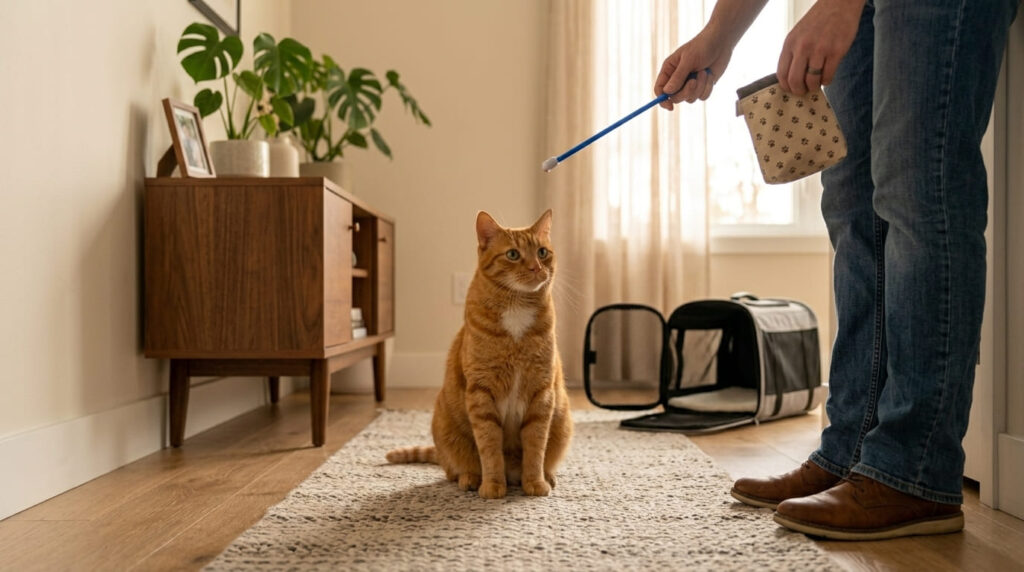
Frequently Asked Questions
Can I use my cat’s name as the recall cue?
I recommend against it — and the behavioral reason is important. Your cat’s name is the most frequently used word in your daily interaction with them: you say it when you’re talking to them casually, when you’re asking them to stop something, when you’re calling them to dinner, when you’re addressing them in the presence of guests. A word that is used this frequently in this many different contexts loses its discriminative stimulus value — it becomes background noise rather than a reliable signal.
A dedicated recall cue — a specific word or sound used exclusively for the recall behavior and always followed by jackpot reward — has a clean, uncontaminated reinforcement history. Your cat’s name, by the time you begin recall training, already has hundreds of associations, some positive, some neutral, some mildly negative. The clean slate of a new cue produces faster and more reliable recall conditioning.
That said: if you have used your cat’s name consistently and exclusively in positive contexts, and your cat reliably orients to you when you say it, you can use it as the recall cue. The underlying principle — consistent positive association — is what matters, not the specific word.
What if my cat is not food-motivated?
When learning how to train a cat to come, food motivation is the default assumption — but it is not universal. Some cats genuinely do not respond to even high-value food reinforcers, particularly cats who are chronically free-fed (and therefore never experience the motivational state of mild hunger) or cats with underlying medical conditions affecting appetite and nausea.
First step: Rule out medical causes. A cat with dental pain, nausea, inflammatory bowel disease, or hyperthyroidism may refuse food rewards for physiological rather than motivational reasons. Veterinary assessment before assuming behavioral food disinterest is the appropriate sequence.
If food motivation is genuinely low:
- Try training 30–45 minutes before a scheduled meal, when the cat has been without food for 4–5 hours — mild hunger restores food motivation in many “disinterested” cats
- Experiment with different protein sources — a cat who ignores chicken may have a strong response to freeze-dried shrimp or salmon
- Consider wand toy play as a reinforcer — some cats find predatory play more reinforcing than food and a brief 30-second play session can function as the jackpot reward
How long does it take to train a cat to come?
Many cats can learn the basic recall cue within a few days, but reliable recall usually takes several weeks of short, consistent practice. Start with 3-5 minute sessions in a quiet room, then slowly add distance, different rooms, mild distractions, and carrier-adjacent situations. Do not rush to emergency-level practice until your cat responds reliably in easy settings.
Should I use recall to catch my cat for medicine or vet visits?
Avoid using your main recall cue only for medicine, nail trims, or stressful carrier trips. If your cat learns that coming to you predicts something unpleasant, the cue can become unreliable. Instead, practice recall many times for easy rewards, train carrier entry separately, and give a jackpot reward after any necessary handling.
How often should I practice the recall?
For initial skill building (Steps 1–3), daily practice produces the fastest reliable acquisition — 1–3 sessions per day of 3–5 minutes each. For most owners in the building phase, two brief sessions daily (morning and evening) is a sustainable and effective schedule.
For maintenance once the recall is reliably established (Step 4 level performance), the critical minimum is five recalls per week with jackpot reward. A trained recall that is not regularly practiced and rewarded begins to extinguish — the association weakens when it is no longer regularly reinforced.
The emergency whistle (Step 5) specifically needs practice at a minimum of once weekly — the high-arousal simulation component of the whistle training requires regular repetition to remain neurologically accessible during genuine emergency conditions.
Practical advice: pair your recall training sessions with existing routines — morning coffee, evening meal preparation — so the sessions become habitual rather than something you remember to do irregularly. Five daily recalls that are genuinely consistent will outperform twenty recalls that happen sporadically.
Final Thoughts
How to train a cat to come is not about control. It is about building one positive, reliable signal your cat understands before you need it.
Oliver’s recall took weeks of short sessions, high-value rewards, and careful practice. The biggest lesson was not that cats obey commands like dogs. It was that cats learn patterns extremely well when the pattern is clear, rewarding, and never used to trick them.
Start close. Reward generously. Keep sessions short. Protect the cue from punishment or stressful surprises. A calm recall may one day help you load a carrier, interrupt a door escape, or simply find your cat faster in a noisy apartment.
Scientific References
- Saito, A., & Shinozuka, K. (2013). Vocal recognition of owners by domestic cats (Felis catus). Animal Cognition, 16(4), 685–690.
- Ellis, S. L. H., Rodan, I., Carney, H. C., Heath, S., Rochlitz, I., Shearburn, L. D., Sundahl, E., & Westropp, J. L. (2013). AAFP and ISFM feline environmental needs guidelines. Journal of Feline Medicine and Surgery, 15(3), 219–230.
- VCA Animal Hospitals. Behavior Modification: Clicker and Target Training. https://vcahospitals.com/know-your-pet/behavior-modification—clicker-and-target-training
- VCA Animal Hospitals. Using Reinforcement and Rewards to Train Your Pet. https://vcahospitals.com/tlc/know-your-pet/using-reinforcement-and-rewards-to-train-your-pet
- PetMD. How To Clicker Train a Cat. https://www.petmd.com/cat/behavior/clicker-training-cats
-300x169.png)
-300x169.png)