.png)
The Serenade That Nearly Ended My Social Life
We moved into the new apartment on a Saturday. By the following Wednesday at 2 AM, Oliver had introduced himself to the entire floor.
Not with a polite chirp. Not with a brief, exploratory vocalization. With what I can only describe as a sustained, operatic, multi-movement composition performed at full volume directly in front of my paper-thin bedroom wall — the one that shares approximately 14 feet of surface area with my neighbor’s living room.
The next morning, I stepped into the elevator and came face to face with the man from 4B. He looked at me. I looked at him. He said, very carefully, “New cat?” I said “Working on it” and stared at the floor numbers until I reached the lobby.
Here is what I knew, as a certified veterinary technician, standing in that elevator: apartment cat meowing too much is not a discipline problem, a spite problem, or a character flaw. It is a communication puzzle.
Cats do not vocalize excessively because they are difficult. They vocalize because something in their environment — physiological, psychological, or social — is generating a need that is not being met, and meowing at a human is the only tool their domesticated neurology has provided them for expressing it.
The neighbor in 4B and I have since developed what I would describe as a cautiously cordial relationship. Oliver has not performed his 2 AM concert in four months. This guide is exactly how we got there.
Quick Answer: How to Stop an Apartment Cat Meowing Too Much?
To help an apartment cat meowing too much, first check for pain, illness, fear, hunger, and problems accessing essential resources. For an established attention-seeking pattern in an otherwise comfortable cat, use predictable meals, short voluntary play sessions, and rewards for calm behavior. Do not ignore distress or withhold needed care. Stop play if breathing becomes abnormal; breathing difficulty needs prompt veterinary attention.
-1024x576.png)
Table of Contents
The Feline Dialects: Why Is Your Cat ‘Talking’?
Before any behavioral intervention can work, you need to identify which of your cat’s vocal dialects is presenting at 2 AM — because the solution to hunger-meowing is categorically different from the solution to anxiety-meowing, and conflating them produces interventions that don’t work.
Research by Nicastro and Owren (2003) established that domestic cat vocalizations directed at humans are acoustically distinct from those directed at other cats — they have been selectively shaped over thousands of years of human cohabitation into sounds that humans find particularly difficult to ignore. ¹
The cats who were best at getting human attention through vocalization were the ones who reproduced. You are, in a very real sense, the evolutionary product of a 10,000-year selective breeding program for the exact meow that is keeping your neighbors awake.
Understanding which dialect is running is your first clinical task.
Hunger Vocalization
Timing: Predictable — occurs at established feeding times or in anticipation of them. Character: Insistent, repetitive, rhythmic. Often combined with weaving around legs or leading toward the food station. Trigger: Learned association between human waking/presence and food delivery.
Boredom and Attention Vocalization
Timing: Peaks during the Crepuscular Peak — dawn and dusk — and during owner transitions (arriving home, preparing for bed). Character: Escalating in intensity when ignored, highly responsive to any human reaction (eye contact, verbal response, movement). Trigger: Insufficient cognitive and physical stimulation relative to the cat’s baseline arousal requirements.
Separation Anxiety Vocalization
Timing: Begins immediately or shortly after owner departure or bedroom door closure. Character: Distressed quality, often accompanied by door-scratching, pacing sounds, and frantic behavior. Trigger: Attachment disruption — particularly common in single-cat households where the owner is the cat’s sole social resource.
Territorial Alarm Vocalization
Timing: Sporadic and unpredictable — triggered by specific stimuli (outdoor cats visible through windows, neighbor sounds through walls, building hallway activity). Character: Chattering, chirping, or low-pitched warning vocalizations that escalate to full yowling. Trigger: Perceived territorial intrusion by stimuli the cat cannot physically address.
The diagnostic tool I use with Oliver: Keep a three-night vocal log before beginning any intervention. Note the exact time, duration, apparent trigger, and what (if anything) stopped the vocalization. This log transforms apartment cat meowing too much from a vague problem into a specific behavioral pattern with identifiable solutions.
7 Pro Tips: How to Manage an Apartment Cat Meowing Too Much
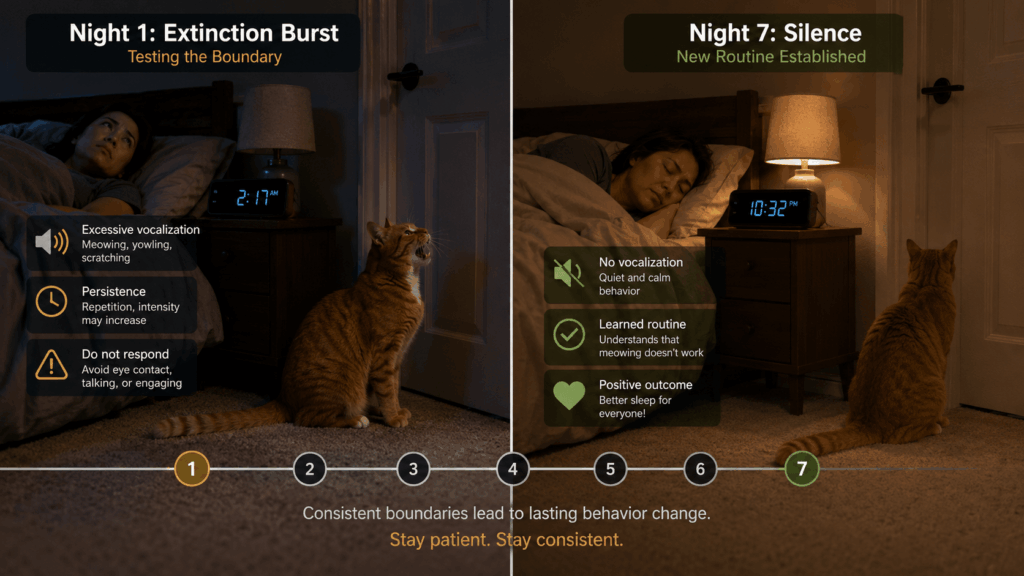
Tip 1: The ‘Boring Door’ Response (Extinction Training)
This approach applies only to a pattern already identified as attention-seeking after health, fear, and access to food, water, and litter have been considered. Ignoring a cat in pain or separation distress is not an appropriate training plan.
Attention or food given immediately after a repeated demand can reinforce that demand. When this is the identified cause, meet the cat’s needs predictably and reward quiet, relaxed behavior. Normal caregiving, checking possible illness, and responding to danger must not be withheld for the sake of training.
The Boring Door Protocol:
- Choose in advance which mild, familiar attention-seeking behaviors can safely go unrewarded; do not apply this to all vocalization.
- Avoid adding attention to the identified demand when the cat is comfortable and its needs are met. Check promptly if the sound, context, or behavior changes.
- Use a shared household plan. An occasional response may make learning less consistent, but it does not erase all progress.
- A familiar demand may temporarily increase when the usual reward changes. Escalation is not proof that the plan is suitable or safe.
An increase in vocalization can reflect several causes, including distress. Review the context rather than assuming that worsening behavior confirms success.
Track the time, trigger, intensity, and duration of vocalization alongside appetite, activity, and litter-box use. Individual changes are more useful than expecting a fixed nightly reduction.
Use the following review points without assigning a guaranteed deadline:
- Before starting: address health concerns, essential resources, and likely triggers.
- During practice: reward calm behavior and keep meals and interaction predictable.
- Review: compare the pattern with your notes rather than judging one noisy night.
- Reassess: seek veterinary or qualified behavior support if distress increases or the cause remains unclear.
Do not continue a plan simply to outlast louder behavior. New symptoms, panic, reduced eating, or disrupted resource use are reasons to stop and reassess.
Tip 2: Pre-Sleep Metabolic Burn
The Crepuscular Peak — the natural dawn-and-dusk activity surge driven by ancestral hunting rhythms — is the physiological engine behind most nighttime apartment cat meowing too much episodes. A cat who reaches bedtime with unspent physical and cognitive energy will spend that energy on something, and in an apartment at 2 AM, the options are limited.
The Pre-Sleep Protocol I run with Oliver every night:
7:00 PM — Enrichment activation:
Puzzle feeder introduction, hiding kibble portions around the apartment, rotating novel toy introduction
Evening play: offer brief, voluntary interactive sessions suited to the cat’s health and mobility. Let the cat pause or stop. Do not aim for panting or exhaustion; stop activity if breathing becomes abnormal and seek veterinary help for breathing difficulty.
Let the cat catch the toy during play when practical, then put the toy away safely. A catch can make play satisfying, but it does not guarantee sleep.
After play, offer a scheduled portion of the normal daily food allowance if appropriate. This can form a predictable wind-down routine, but it is not an automatic sleep switch.
9:45 PM — Human withdrawal:
Begin your pre-sleep routine consistently. Cats are exquisite routine readers — they learn your behavioral cues with remarkable speed. A consistent sequence of human activities signals bedtime and allows the cat’s nervous system to begin its own wind-down process.
Tip 3: Automated Breakfast (Breaking the Human-Food Link)
If vocalization often occurs before breakfast, food expectation may contribute. Check the full feeding plan and health first; timing alone does not establish the cause.
The Human-Food Link is one of the most common and most correctable causes of morning vocalization. Every morning that you have woken up and fed your cat, you have reinforced the association: human wakes up → food appears. Your cat’s logical behavioral response is to ensure you wake up. The solution is to remove yourself from the food delivery equation entirely.
The Automatic Feeder Protocol:
- Purchase a programmable automatic feeder with a sealed food compartment (prevents the cat from learning to paw the mechanism open prematurely)
- Set the feeder to deliver breakfast 30 minutes before your cat’s typical morning vocalization onset — if Oliver starts at 5:30 AM, set delivery for 5:00 AM
- The feeder’s mechanical sound becomes the new breakfast cue, replacing your presence entirely
- Observe whether the cat begins waiting near the feeder rather than the bedroom. Response varies, and the feeder may not address the main cause.
The critical implementation detail: Stop hand-delivering any meal that follows the feeder schedule. If the feeder delivers breakfast at 5 AM and you then add to the bowl at 7 AM when you wake up, you have recreated the human-food link alongside the feeder, not instead of it.
For multi-meal households: Use the automatic feeder for the first and last meals of the day — the two highest-risk vocalization trigger meals — and manage one midday meal manually if desired. This removes the bookend reinforcement events without requiring complete feeder dependency.
Tip 4: Acoustic Scaffolding (Rugs, Curtains, and Panels)
Acoustic Buffering does not solve the behavioral cause of apartment cat meowing too much, but it is an essential harm-reduction strategy for the weeks during which behavioral training is taking effect — and it is a permanent quality-of-life improvement for both your neighbors and yourself.
Sound transmission through apartment walls is governed by the Sound Transmission Class (STC) of the wall assembly. Standard drywall partitions have an STC of approximately 33–38, meaning significant voice-level sound transmission. Cat vocalizations in the 500–1500 Hz range (the primary frequency range of domestic cat meows) transmit with particular efficiency through these assemblies. ²
The Acoustic Scaffolding Strategy:
Layer 1 — Floor coverage:
- Add area rugs to all hard floor surfaces — minimum 8mm pile depth for meaningful sound absorption
- Use rug pads beneath all rugs — the rubber-foam combination adds both sound absorption and impact dampening
- Target the areas adjacent to shared walls first
Layer 2 — Window and door treatment:
- Install floor-to-ceiling blackout curtains on all exterior windows — the fabric mass significantly absorbs mid-frequency sound
- Seal all door gaps with draft stopper seals — sound travels most efficiently through gaps and penetrations. Sealing these gaps, much like the methods we used for managing litter box odors covered in our guide to eliminating apartment litter odor , serves the dual purpose of keeping cat noises inside your apartment while also containing odors.
Layer 3 — Wall treatment:
- Install acoustic panels on shared wall surfaces — fabric-wrapped fiberglass panels (2-inch depth, minimum) placed at cat-vocalization height (floor to 4 feet) provide meaningful mid-frequency absorption
- Bookshelves filled with books on shared walls provide surprisingly effective mass-based sound reduction
- Heavy wall art (canvas prints, fabric tapestries) on shared wall surfaces adds additional absorption
Rugs, curtains, gap treatment, and furnishings may reduce some noise or reverberation, but the result depends on the building and installation. Do not promise a particular reduction in transmitted sound without measurements.
Tip 5: Pheromone Saturation
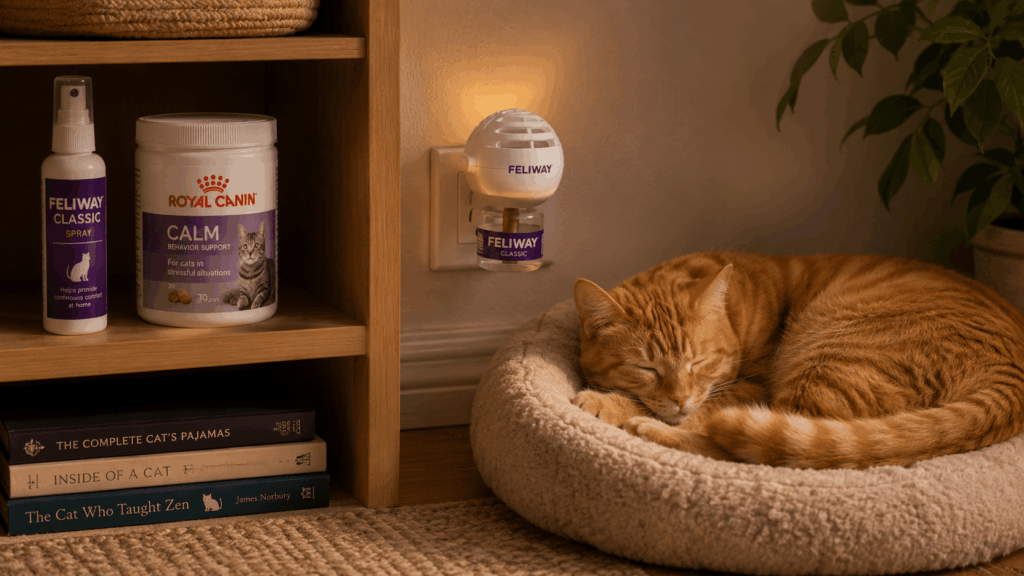
A synthetic feline pheromone product may be an optional support for some stress-related situations. Effects vary; it does not replace identifying the trigger, improving the environment, or assessing illness.
The Two-Product Pheromone Protocol:
Feliway Classic Diffuser:
- Plug-in diffuser format, replaces every 30 days
- Covers approximately 700 square feet per unit — in a studio or one-bedroom apartment, one unit is typically sufficient
- Position in the room where vocalization is most concentrated
- Follow the product instructions and track the response. There is no guaranteed time to full benefit; seek help sooner if welfare or health is affected.
Feliway Multicat (for multi-cat households):
- Addresses inter-cat tension that drives territorial vocalization
- Uses a different pheromone fraction (feline appeasing pheromone) than Classic
- Can be used simultaneously with Classic in different rooms
Supplementary pheromone options:
- Feliway Spray: follow the specific label for application and drying time. Do not apply it to the cat or assume that application produces a predictable calming effect.
- Zylkene and other calming supplements: discuss suitability with the veterinarian before use, especially when the cat has illness, takes medication, or is not eating normally.
- Veterinary calming diets: discuss whether a dietary change is appropriate for the individual cat; do not change a prescribed diet without guidance.
What pheromones cannot do: They cannot address vocalization that is driven by an unmet physical need (hunger, pain, medical condition) or by deeply ingrained learned behavior patterns. Pheromones are most effective as part of a multi-intervention protocol, not as a standalone solution.
Tip 6: Nightlight and Visual Security
This tip addresses a specific and frequently overlooked driver of nighttime apartment cat meowing too much — the anxiety produced by sudden darkness and the acoustic environment of an apartment building at night.
Cats see significantly better in low light than humans but are not true night-vision animals — they require some ambient light for visual navigation. More relevantly, the nighttime acoustic environment of an apartment building (elevator sounds, hallway footsteps, neighbor activity through shared walls) is a continuous stream of potential territorial alarm triggers for a cat whose visual system is simultaneously compromised by darkness.
The Nightlight Protocol:
- Install small LED nightlights (warm white, 2700K color temperature — blue-spectrum light disrupts melatonin production in both cats and humans) in the hallway and any room where your cat sleeps
- Position one nightlight adjacent to your cat’s primary nighttime resting area — it provides visual reassurance and orients the cat in space during building noise events
- Background sound: use a comfortable low volume only if it appears helpful, and allow access to a quiet resting area. Do not use sound to conceal signs that the cat needs attention.
- Television timer: Setting a television on a sleep timer (off at midnight, for example) provides ambient visual and audio stimulation during the early night Crepuscular Peak window and then removes it naturally as your cat’s activity drive decreases
The sensory environment audit:
Walk through your apartment at 11 PM and listen carefully for 10 minutes. Note every sound source: hallway activity, building HVAC, neighbor noise, outdoor traffic, elevator sounds. Each one is a potential trigger for territorial alarm vocalization. Your white noise machine should be positioned and calibrated to mask the highest-frequency occurrence sources.
Tip 7: The ‘Clicker for Silence’ Method
Rewarding brief periods of relaxed quiet can be part of a plan for learned attention-seeking. It is not a treatment for pain, fear, or an unmet physical need.
Classical Conditioning can be used not just to extinguish unwanted vocalization (Tip 1) but to actively train and reinforce silence as a behavioral choice. The clicker-for-silence method does exactly this.
If using a clicker, first pair a quiet marker with a small food reward in short sessions. Count rewards within the normal food allowance and stop before frustration or loss of interest. There is no required daily repetition quota.
The silence-marking protocol:
- During a period when your cat is naturally quiet, click and treat immediately. You are marking the absence of vocalization as a reinforced behavioral state.
- Gradually increase the duration of silence required before the click — begin at 3 seconds of quiet, advance to 10 seconds, then 30 seconds, then 1 minute.
- Begin applying the protocol in proximity to the situations that typically trigger vocalization — near the bedroom door, near the feeding station, near the front door.
- When your cat begins to meow in a triggering context, wait for any 3-second silence, click-treat immediately, and gradually build duration.
The critical distinction: You are never clicking to stop a meow mid-vocalization — you are clicking the silence that follows. Clicking during vocalization would inadvertently mark the meow itself as the reinforced behavior.
The long-term result: A cat who has been click-trained for silence begins to offer silence as an active behavioral choice in situations where they previously offered vocalization — because silence has become the behavior most reliably associated with reward. This is Classical Conditioning engineering a new behavioral association at the neurological level.
Medical Red Flags: When the Meow Is a Cry for Help
I have spent this entire guide addressing apartment cat meowing too much as a behavioral and environmental problem. I would be professionally irresponsible if I did not also tell you when it isn’t.
There is a category of feline excessive vocalization that is not behavioral at all — it is a clinical symptom, and treating it with behavioral protocols while the underlying medical cause progresses is genuinely harmful.
The medical conditions most commonly presenting as excessive vocalization:
Hyperthyroidism:
The most common endocrine disorder in senior cats (over 10 years), hyperthyroidism causes elevated thyroid hormone production that produces a characteristic constellation of symptoms including weight loss despite increased appetite, hyperactivity, a poor coat condition, and dramatically increased — often frantic — vocalization.
A cat who begins excessive meowing in middle or senior age without a clear behavioral trigger should have a thyroid panel run before any behavioral protocol is initiated. Treatment (methimazole, radioactive iodine, or dietary management) resolves the vocalization completely in most cases.
Pain and Cognitive Dysfunction:
Cats in pain vocalize — arthritic pain is particularly common in senior cats and frequently produces nighttime vocalization as the cat shifts position during sleep and encounters discomfort. Feline cognitive dysfunction syndrome (the feline equivalent of dementia) produces nocturnal disorientation, confusion, and associated distress vocalization in cats typically over 15 years. These cats cry because they are genuinely distressed, not behaviorally dysregulated.
Hypertension:
Secondary hypertension (often associated with chronic kidney disease or hyperthyroidism) can produce neurological symptoms including apparent confusion, visual disturbance, and associated vocalization. Blood pressure measurement is a routine part of senior cat wellness examinations and should be performed in any cat with new-onset excessive vocalization.
Arrange veterinary assessment when excessive vocalization has any of the following features:
- New onset in a cat over 8 years of age
- Accompanied by weight change, appetite change, or litter box changes
- Associated with apparent disorientation or confusion
- Not responding to a well-implemented behavioral protocol after 3 weeks
…requires a complete veterinary workup before continuing behavioral intervention. The meow may not be a communication puzzle. It may be a medical history.
Vocal intensity and behavioral presentation also vary significantly by breed — Siamese, Bengals, and other highly communicative breeds have baseline vocalization levels that require specifically calibrated cognitive and environmental outlets to prevent them from becoming a chronic noise concern for apartment neighbors. We cover breed-specific behavioral management in depth in our guide to managing high-energy and talkative cat breeds.
Frequently Asked Questions
1. Will my neighbors hear my cat through the walls?
In most standard apartment construction, yes — particularly during peak vocalization events. Standard drywall partition walls have an STC rating of 33–38, which allows clear transmission of sounds in the 500–1500 Hz range that encompasses most domestic cat meowing.
Rugs, curtains, gap treatment, and furnishings may reduce some noise or reverberation, but the result depends on the building and installation. Do not promise a particular reduction in transmitted sound without measurements.
If your building has concrete or masonry party walls (common in older buildings), sound transmission is significantly lower than in lightweight frame construction. Knock on your shared wall — a hollow sound indicates frame construction and higher transmission; a dense, solid sound indicates masonry with lower transmission.
2. Is there a calming spray for meowing cats?
Yes — and the most evidence-supported option is Feliway Classic Spray, a synthetic analogue of the feline facial pheromone that cats deposit when they rub their cheeks against surfaces they consider safe. Applied to your cat’s bedding, sleeping area, or carrier 15 minutes before a stressful period, it provides meaningful anxiety reduction for stress-driven vocalization.
For ongoing management, the plug-in diffuser format is more practical than spray for continuous environmental coverage. Additionally, Zylkene (alpha-casozepine) is an oral supplement with clinical evidence for feline anxiolytic effect that can be added to food daily.
Neither product is appropriate as the sole intervention for apartment cat meowing too much — they work most effectively as components of a multi-strategy behavioral protocol. Products marketed as “calming sprays” containing lavender, chamomile, or other essential oils are not evidence-supported for cats and some essential oils are genuinely toxic to felines — avoid these entirely.
3. How long does it take for a cat to stop excessive meowing?
The timeline depends entirely on the vocalization’s cause and the intervention’s consistency. For learned behavioral vocalization (hunger meowing, attention meowing) addressed with the Extinction Protocol and automatic feeder, most owners see a meaningful behavioral shift within 10–14 days of completely consistent implementation — meaning zero responses to vocalization during that period.
The Extinction Burst typically peaks at days 2–4 before declining. For anxiety-driven vocalization, pheromone diffusers require 7–14 days to reach full effect, and the complete behavioral protocol (play session, feeder, pheromones, acoustic environment) typically produces its maximum combined effect at the 3–4 week mark.
For medical causes (hyperthyroidism, pain, cognitive dysfunction), timeline is determined by treatment response — hyperthyroid vocalization typically resolves within 2–4 weeks of thyroid hormone normalization. Inconsistent implementation — particularly any occasional response to vocalization — resets the behavioral extinction timeline and can extend the process by weeks.
Final Thoughts
The Night 4B Stopped Knocking
The last time my neighbor from 4B mentioned Oliver was approximately four months ago, when he said — without any apparent irony — “Your cat has been really quiet lately. Did you get a new one?”
I did not get a new cat. I got a behavioral protocol.
Oliver still talks. He is a communicative, opinionated, fully-voiced individual who expresses preferences about dinner timing, window access, and the quality of his play sessions with what I would describe as forthright clarity.
But apartment cat meowing too much at 2 AM to an entire residential floor is not something that has happened in this building since the automatic feeder arrived, the acoustic panels went up on the shared wall, and the Boring Door became, reliably and completely, boring.
The intervention that mattered most was also the hardest one: I stopped responding. Every other tip in this guide works better because that one foundation is solid.
Your neighbors deserve sleep. Your cat deserves to be understood rather than punished. And you deserve to ride the elevator in the morning without rehearsing your apology.
All of those things are achievable. Oliver and 4B are both proof.
References
¹ Nicastro, N., & Owren, M. J. (2003). Classification of domestic cat (Felis catus) vocalizations by naive and experienced human listeners. Journal of Comparative Psychology, 117(1), 44–52. https://doi.org/10.1037/0735-7036.117.1.44
² Schötz, S., van Mechelen, J. C., & Gustafsson, E. (2019). Melody matters: An acoustic study of domestic cat meows in six contexts and four mental states. PeerJ, 7, e6786. https://doi.org/10.7717/peerj.6786