By IndoorCatExpert.com | Indoor Cat Behavior & Apartment Living
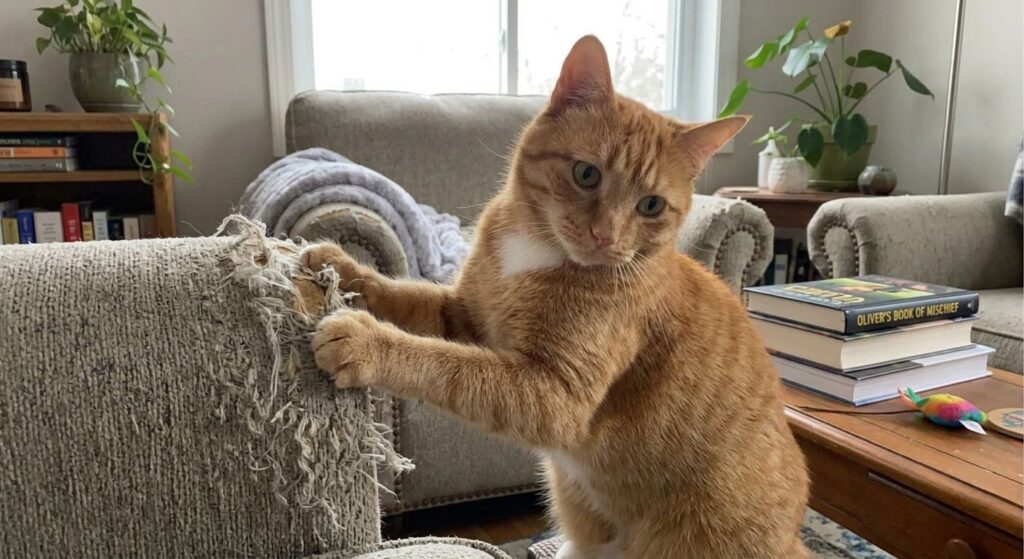
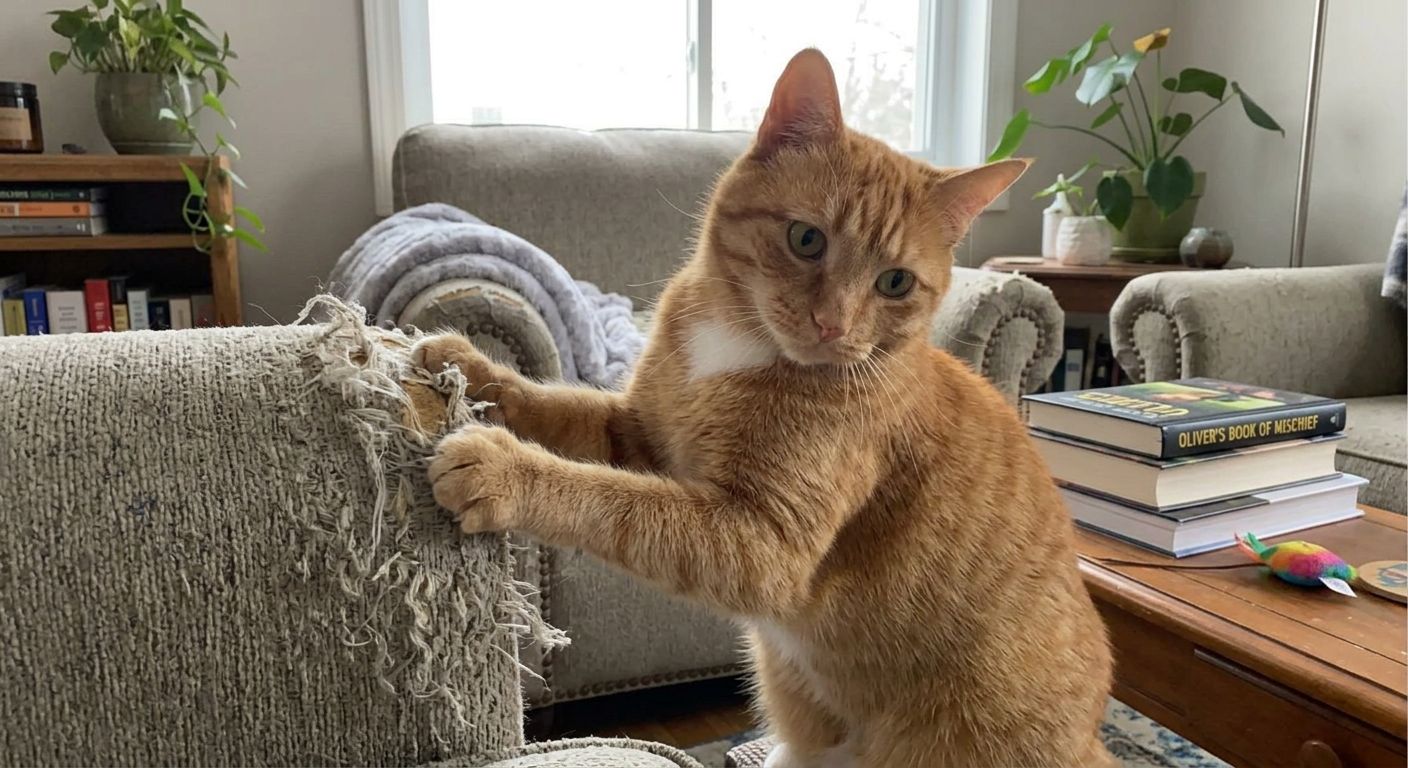
The couch arrived on a Tuesday. By Thursday evening, Oliver had already found the armrest.
I heard it before I saw it — that distinctive, rhythmic tearing sound that every cat owner learns to dread. I walked into the living room to find my brand-new sofa looking like it had survived a minor industrial accident, and Oliver looking extremely satisfied with himself. My first thought was not about cat behavior or enrichment science. My first thought was about my security deposit.
If you’re here because you’re living that exact moment right now, I want to tell you two things: this is completely fixable, and it is not your cat being malicious. Figuring out how to stop cat from scratching couch fabrics is one of the most common challenges apartment cat owners face — and it has a real, reliable solution that doesn’t require yelling, spray bottles, or covering your furniture in tinfoil for the rest of your lease.
Here’s the four-step system that worked for Oliver and has worked for thousands of cats whose owners just needed to understand why the scratching happens before they could address it.
Quick Answer
To stop a cat from scratching your couch, place a tall, sturdy sisal rope scratching post directly next to the damaged area immediately. Apply double-sided cat tape to the couch corners as a temporary deterrent, reward your cat with treats every time they use the post, and trim their claws every two to three weeks. Redirection works. Punishment doesn’t.
Why Cats Scratch — And Why “Bad Behavior” Is the Wrong Frame
Before the four steps, one minute on the science — because understanding why Oliver was shredding my armrest changed everything about how I approached the fix.
Cats scratch for three distinct biological reasons, none of which involve spite or a personal vendetta against your furniture:
- Claw maintenance. Scratching removes the dead outer sheath of the claw, keeping the underlying claw sharp and healthy. It’s the equivalent of filing your nails — a grooming behavior, not a destructive one.
- Muscle conditioning. The full-body stretching involved in a good scratch session works the muscles of the back, shoulders, and forelimbs. Watch Oliver next time — he elongates his entire body and leans into it. It’s a physical workout.
- Territorial marking. Cats have scent glands in their paw pads. When they scratch a surface, they deposit both a visual mark and a chemical signal that communicates their presence to other cats (and, on some level, to themselves). Scratching is how cats claim ownership of their space.
That last point is important. In a small apartment, your couch is likely one of the most prominent, centrally located objects in the room — which makes it, from Oliver’s perspective, the single most important thing to mark. He wasn’t destroying your furniture. He was announcing that this territory belongs to him.
This is also why vertical space and territory matter so much to indoor cats more broadly — scratching behavior is one expression of a much deeper need to feel secure and established in their environment: indoor cat enrichment in small apartments.

Step 1: The “Yes and No” Strategy — Redirect, Don’t Just Restrict
The most common mistake people make is focusing entirely on stopping the couch scratching without providing an equally compelling alternative. You cannot train a cat to stop scratching. You can only train a cat to scratch somewhere else.
Every deterrent you apply to the couch needs a corresponding “yes” to replace it. Remove the couch as an option and simultaneously make the scratching post the most appealing, accessible, obvious option in the room. Without the “yes,” you’ll just have a frustrated cat who finds a different piece of furniture.
This exact same redirection method is also the secret to how to keep cat off kitchen counters, because cats need alternative places to climb.
Applying Deterrents to the Couch
The goal of couch deterrents is to make the surface temporarily unappealing — not to punish, startle, or distress your cat. Temporary is the operative word here; once the scratching post habit is established (usually four to six weeks), most deterrents can be removed.
Effective temporary deterrents:
- Double-sided cat tape applied to the corners and armrests. Cats strongly dislike the sticky sensation on their paws and will avoid the surface. Use tape specifically designed for this purpose — it’s gentler on upholstery and peels off cleanly.
- Furniture protector panels — clear plastic or vinyl panels that cover the vulnerable areas. No adhesive on fabric, easy to remove, and don’t alter the room’s appearance significantly.
- Aluminum foil temporarily draped over the scratched areas. Cheap, effective, and looks absolutely ridiculous, but it works during the initial transition period.
What not to use: spray bottles, loud noises, or any startle-based deterrent. These create anxiety and fear without communicating anything useful to your cat. Oliver doesn’t learn “don’t scratch the couch” from being sprayed with water. He learns “the couch is dangerous when my human is nearby,” which means he’ll scratch it when you’re not home — or not at work, specifically, which is already the higher-risk period: how to entertain an indoor cat while at work.
Rewarding the Right Choice
Every single time Oliver approaches or uses the scratching post, he gets a treat and verbal praise. Every time. In the first few weeks, I made this a near-immediate response — treat delivery within three seconds of post use. This direct positive association is what builds the habit.
Step 2: Choose the Right Scratcher — Most Are Too Small
Here is the reason most scratching posts fail: they are too short, too wobbly, and covered in the wrong material.
Walk into most pet stores and you’ll find carpet-covered posts that are 18 inches tall and tip slightly when a full-grown cat leans into them. Oliver weighs nearly 6 kilograms. A tippy 18-inch post doesn’t give him the full-body stretch he needs, and the slight instability makes it feel unsafe. He used it twice and went back to the couch.
What Makes a Scratching Post Actually Work
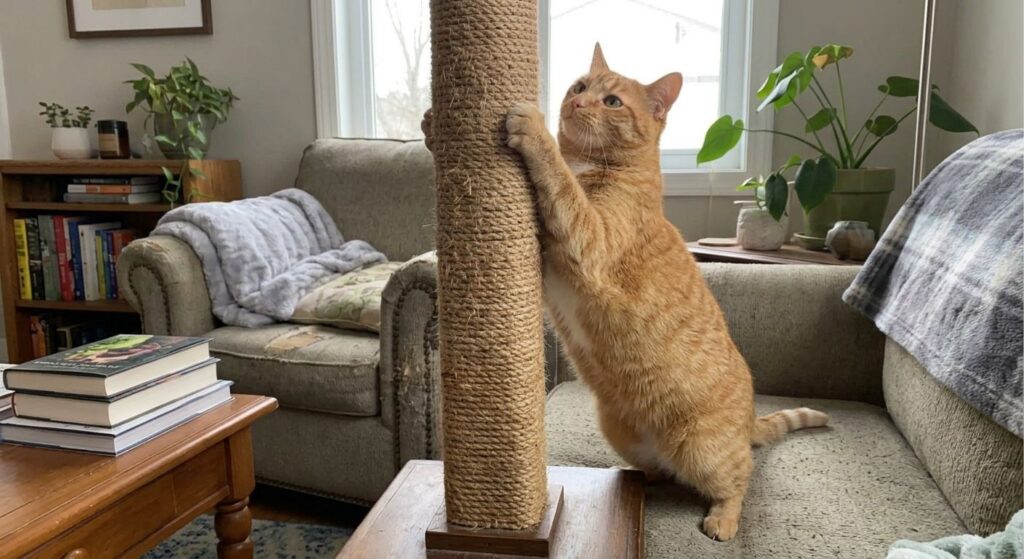
Height: The post needs to be tall enough for your cat to fully extend their body while scratching — for most adult cats, this means a minimum of 32 inches, ideally taller. Oliver uses a 36-inch post and still barely has room to stretch.
Stability: The base needs to be wide and heavy enough that the post does not wobble or tip when your cat puts their full weight into it. If it moves, they won’t trust it. Test this by pressing on the post yourself with moderate force — if it shifts, it’s not stable enough.
Material: Sisal rope or sisal fabric is the gold standard for scratching post material. It shreds satisfyingly, provides good resistance for claw conditioning, and is texturally distinct from upholstery — which matters for teaching your cat to discriminate between “scratch this” and “not that.” Carpet-covered posts are less effective because carpet is too similar in texture to many fabric sofas.
If you don’t own your home, saving your furniture is only half the battle. Learn how to protect your landlord’s property with our complete guide to cat proof rental apartment solutions.
Types to consider:
- Vertical sisal rope post — the classic, most versatile option for cats who scratch high on furniture
- Angled sisal scratcher — good for cats who like to scratch while leaning forward at low angles
- Horizontal sisal or corrugated cardboard scratcher — useful as a secondary option; some cats prefer scratching flat surfaces

Step 3: Placement Is Everything — Location Determines Success
You can buy the best scratching post in existence and it will be ignored if you put it in the wrong place.
Cats scratch where they scratch for reasons — visibility, territory, proximity to resting spots. The scratching post must go directly next to the couch, initially. Not in the corner of a spare bedroom, not behind a door, not in a spot you’ve chosen because it’s tidy. Right next to the damaged area.
Why Location Matters So Much
Your cat has already decided that the couch location is where scratching happens. The post needs to intercept that behavior at the exact location where the urge arises — it’s not enough to simply have a post elsewhere in the apartment. You’re not moving the behavior to a new location yet; you’re first replacing the surface at the existing location.
Once Oliver was using the post reliably for about six weeks, I moved it six inches away from the couch. A week later, another six inches. Over the course of two months, I gradually relocated it to a permanent spot nearby — close enough to remain appealing, far enough that it wasn’t pressed against the sofa.
Additional Placement Principles
- Prominent, not hidden. Cats scratch visible surfaces partly for territorial signaling. A post tucked in an inconspicuous corner misses this motivation entirely.
- Near sleeping areas. Cats frequently scratch immediately after waking up — it’s a stretching and activation ritual. A post near a favorite napping spot captures this high-frequency behavior window.
- Multiple posts for larger spaces. One post for a multi-room apartment may not be sufficient. A secondary post in a second room — particularly near any other furniture that’s been targeted — is worth adding.
Step 4: Trim the Claws — The Overlooked Half of the Equation
Scratching behavior is partly about claw maintenance. If you trim your cat’s claws regularly, the urgency and frequency of scratching sessions decreases noticeably — not because you’ve addressed the territorial or stretch motivations, but because the claw-shedding need is already managed.
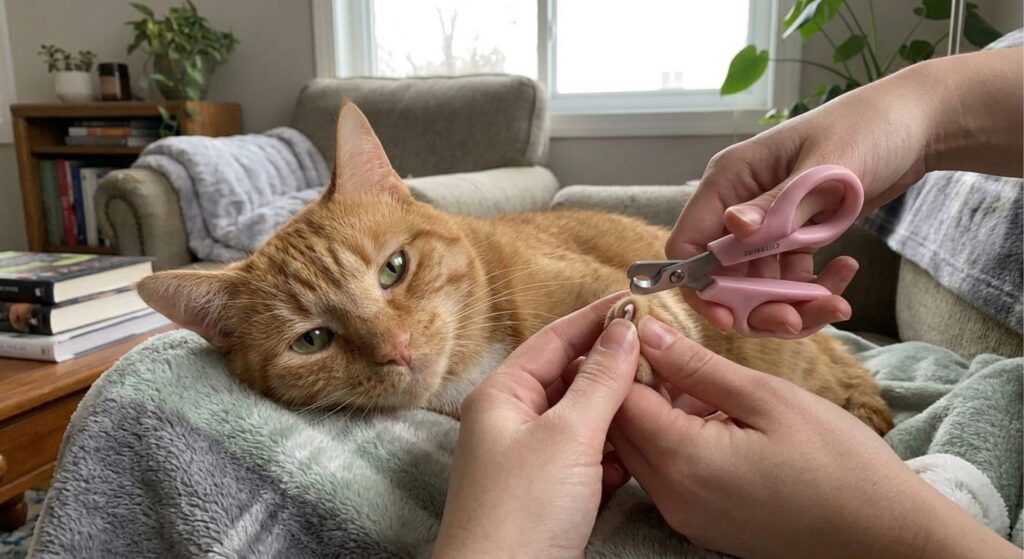
Clipping once every two to three weeks is the standard recommendation for indoor cats. The goal isn’t to cut the claws short — just to remove the sharp tip, which is where the most damage to furniture (and human skin) comes from.
How to Make Claw Trimming Non-Traumatic
Oliver was not a cooperative patient for his first several claw-trimming sessions. He is now fine with it, and the difference was desensitization done slowly:
- Week 1–2: Handle his paws daily during calm cuddle time. No clippers. Just touching his paws, pressing gently to extend the claws, releasing. Treats after every session.
- Week 3: Introduce the clippers while he’s relaxed. Let him sniff them. Don’t clip anything. Treats.
- Week 4 onward: Clip one or two nails per session, not all at once. End before he gets restless. Treat immediately after.
What to avoid when trimming:
- Cutting into the pink “quick” — this is the blood vessel running through the nail and causes pain and bleeding if nicked. Only trim the clear tip.
- Trimming when your cat is already agitated or aroused
- Trying to do all nails in one sitting if your cat is still adjusting
If your cat is genuinely resistant, a vet or groomer can handle claw trims at very low cost until you’ve built up the desensitization routine at home.
A Note on Nail Caps
Soft vinyl nail caps — small covers that fit over the claw tip — are a legitimate option if trimming isn’t working and couch damage is severe. They require application every four to six weeks as the outer claw sheds and the cap comes off with it. They don’t prevent scratching behavior, but they eliminate surface damage entirely during the training period. Most cats tolerate them well after a brief adjustment period.

Putting the 4 Steps Together: Oliver’s Timeline
Here’s how this actually played out with a real cat who had a two-year couch-scratching habit:
| Week | What I Did | Oliver’s Response |
|---|---|---|
| 1 | Double-sided tape on armrests; tall sisal post placed directly next to couch | Investigated the post suspiciously; still tried the couch twice |
| 2 | Treats every time he touched the post; ignored any couch attempts | Started using the post once or twice daily |
| 3–4 | Began daily claw-trimming desensitization | Post use became consistent; couch attempts almost zero |
| 5–6 | Removed tape from couch; began slowly moving post | Used post reliably; no return to couch |
| 8+ | Post in permanent position two feet from couch | Couch untouched; scratching post showing heavy, happy wear |
The total investment was one good tall sisal post, one roll of double-sided cat tape, and some patience during weeks one and two. The couch has been unmarked for over a year.
FAQ
Will a spray deterrent stop my cat from scratching the couch?
Commercial spray deterrents — typically citrus or herbal-based formulas — can provide a modest short-term reduction in scratching at a specific location. They work because many cats dislike those scents on contact. However, their effectiveness is inconsistent (some cats are entirely unbothered by them), they need to be reapplied frequently, and — most importantly — they address only the “no” half of the equation without providing the “yes.”
Used alone, they rarely produce lasting behavior change. As a supplement to a scratching post and positive reinforcement system, they can be a useful bridging tool during the transition period.
My cat has multiple posts but still prefers the couch. Why?
Usually this comes down to one or more of three issues: the post is too short or too unstable to provide a satisfying scratch, it’s made of carpet or fabric that doesn’t meet your cat’s texture preference, or it’s located in a spot your cat hasn’t connected with the scratching urge.
Start by testing post height — your cat should be able to fully extend upward — and swap the material to sisal rope or sisal fabric if you haven’t already. Then move the post directly next to the couch surface they’re targeting and restart the treat-reinforcement process from scratch. Cats are not being stubborn; they just have specific requirements that most standard posts don’t meet.
👉 Is it ever too late to learn how to stop cat from scratching couch surfaces?
No. Older cats with long-established furniture scratching habits take longer to redirect — expect six to eight weeks of consistent effort rather than two to four — but the underlying mechanism works regardless of age. The key is patience and consistency during the transition period. If Oliver, a set-in-his-ways adult tabby with two years of couch scratching behind him, could be fully redirected to a scratching post within eight weeks, the method works. The biology doesn’t change with age; only the timeline adjusts.
Don’t just buy any post; if your cat is over 10 lbs, you need the best tall scratching posts for large cats to ensure they can fully stretch without the post tipping over.
References: Beaver, B.V. (2003). Feline Behavior: A Guide for Veterinarians. Saunders. | Ellis, S.L.H. et al. (2013). AAFP and ISFM Feline Environmental Needs Guidelines. Journal of Feline Medicine and Surgery, 15(3), 219–230. | Herron, M.E. (2010). Advances in understanding and treatment of feline inappropriate elimination. Topics in Companion Animal Medicine.
IndoorCatExpert.com — For the cats who redecorate without asking, and the humans who love them anyway.