Catio ideas apartment owners can use safely should start with one question: how can your cat enjoy fresh air, bird watching, and outdoor sounds without balcony falls, window escapes, lease damage, or unsafe DIY shortcuts? For renters, the safest catio is usually removable, inspectable, no-drill, and easy to supervise.
This guide compares renter-friendly catio ideas for apartments, including window box catios, portable pop-up catios, balcony netting, tension pole frames, acrylic railing guards, window perch setups, harness balcony time, and indoor catio corners for homes where outdoor access is not safe.
Use this guide as a decision framework. Start with the lowest-risk option your apartment actually allows, then check lease rules, balcony height, window safety, supervision needs, and your cat’s personality before buying or building anything.
Quick Answer
The safest catio ideas apartment renters can use are portable pop-up catios, secure window catio setups, no-drill tension pole frames, supervised balcony enclosures, and indoor window-corner alternatives. The right choice depends on your lease, balcony height, window type, cat personality, and whether you can supervise every session.
If you have a balcony, start with fall prevention and railing gaps before buying a catio. If you do not have a balcony, a renter-friendly window catio or indoor catio corner is usually safer than forcing an outdoor setup.
Important Apartment Safety Note
Safety comes before convenience. Avoid punishment, fear-based tools, essential oils, unsafe adhesives, unstable furniture, loose strings, small chewable parts, and any setup that blocks access to food, water, litter, hiding, or rest. Apartment solutions should make your cat’s environment clearer and safer, not more stressful or harder to navigate.
Table of Contents
Why Apartment Catios Need a Different Safety Plan
Catio ideas apartment owners can actually use are different from backyard catios. In a house, a catio can often be anchored to a deck, yard, patio, or permanent exterior wall. In an apartment, the plan has to work around lease rules, balcony height, window limits, shared exterior appearance, neighbor noise, fire exits, and the fact that many renters cannot drill into exterior structures.
That means the best apartment catio is not always the biggest one. It is the safest one you can repeat, inspect, clean, and remove if your lease requires it.
A good apartment catio setup should answer five questions before your cat ever uses it:
- Can the cat escape?
- Can the cat fall?
- Can the structure tip, collapse, or shift?
- Can the cat overheat, panic, or get trapped?
- Can the setup violate lease, balcony, or building rules?
If the answer to any of those is unclear, treat the catio as unfinished.
For cats who already rush balcony doors, start with door safety before outdoor access. Use our how to stop cat from running out door guide before adding catio access.
Apartment Catio Safety Checklist
Before choosing a catio style, inspect the apartment itself. The safest idea depends less on the product name and more on where the catio will sit.
| Safety Question | Why It Matters | What to Check |
|---|---|---|
| Is the setup fully enclosed? | Prevents falls and escape | Gaps, zippers, seams, rail edges |
| Is it renter-friendly? | Avoids lease damage | Drilling, exterior changes, adhesives |
| Can it handle wind? | Balcony setups can shift | Weight, anchors, panel tension |
| Can the cat overheat? | Small enclosures warm quickly | Shade, airflow, session length |
| Can the cat panic? | Noise and height can trigger bolting | Door routine, hiding space, supervision |
| Is it easy to clean? | Dirt, hair, insects, and litter track in | Removable mats, washable fabric |
| Is it easy to inspect? | Small failures become big risks | Mesh, clips, zippers, fasteners |
A catio should never depend on perfect cat behavior. It should still be safe if your cat jumps, paws, leans, scratches, rubs, or gets startled.
10 Catio Ideas Apartment Renters Can Use Safely
1. Window Box Catio
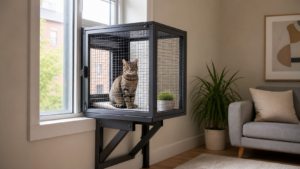
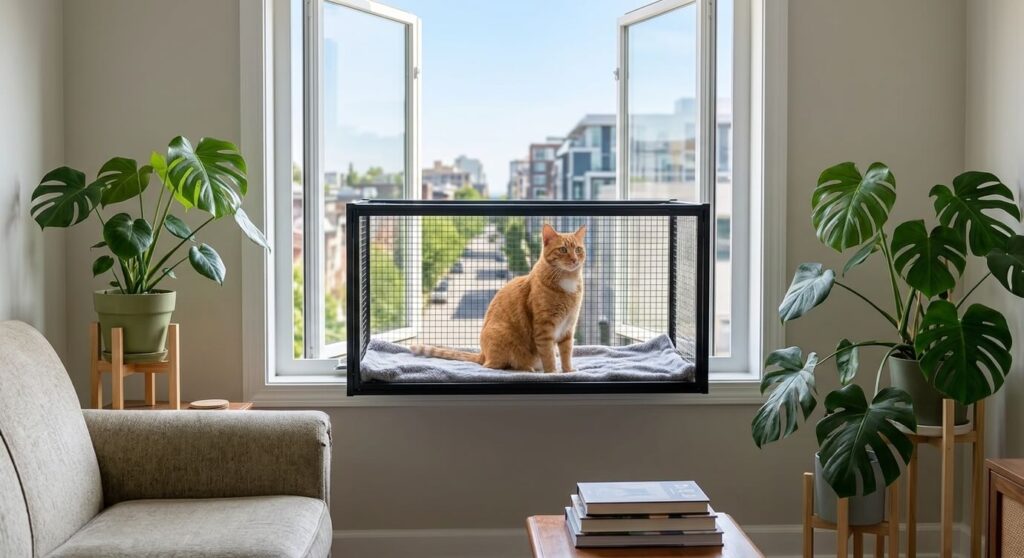
A window box catio attaches outside or inside a window area and gives your cat a small enclosed perch with fresh air and outdoor views. For apartments, this can be one of the most space-efficient options, but it is also one of the setups that requires the most careful installation.
Best for:
- apartments with sturdy windows
- cats who enjoy watching outside
- owners who want outdoor stimulation without balcony access
- cats who do not chew screens or push hard against barriers
Watch out for:
- lease restrictions
- window frame strength
- screen security
- poor weather sealing
- unsafe exterior mounting
A window catio should never rely on a normal insect screen. Standard window screens are not designed to hold a cat’s weight or resist repeated pawing. If the catio sits outside the window, the frame, enclosure, and access point all need to be secure.
If you are not allowed to install anything outside the window, use an indoor window perch instead. For product-style options, see our best cat window perches guide.
Before choosing an exterior box, use our renter friendly window catio safety guide to check window compatibility, structural support, transition gaps, landlord approval, and emergency access.
2. Portable Pop-Up Catio
A portable pop-up catio is usually a mesh tent or foldable enclosure that can be placed on a balcony, patio, or indoor floor near an open window. It is one of the easiest renter-friendly options because it usually requires no drilling.
Why it works for renters: This is one of the easiest catio ideas for renters because it can be folded, moved, stored, and tested indoors before your cat ever uses it near a balcony or open window.
Best for:
- renters
- supervised balcony time
- cats new to outdoor sounds
- owners who need a removable setup
Watch out for:
- weak zippers
- thin mesh
- wind movement
- cats who chew fabric
- cats who panic in enclosed spaces
A pop-up catio should be supervised. Do not leave it outside permanently unless the product is designed for weather exposure and can be anchored safely. Many pop-up enclosures are better for short sessions than all-day balcony use.
Start indoors first. Let your cat explore the tent in the apartment before placing it near outdoor sounds. Add familiar bedding, treats, and a short session length so the enclosure feels safe rather than like a trap.
3. Balcony Netting Catio
A balcony netting catio turns part or all of a balcony into a secured viewing area. This can work well, but it is one of the setups where small mistakes become serious.
Best for:
- balconies with stable railings
- cats who do not chew or climb netting
- owners who can supervise access
- renters whose buildings allow visible netting
Watch out for:
- loose bottom gaps
- weak zip ties
- netting cats can climb
- building rules
- wind and weather exposure
Balcony netting must be tight, secured at the edges, and checked often. A loose bottom edge is one of the most dangerous failure points because a cat may push under it.
Best for apartment balconies: Use this only when the balcony can be physically secured on every side, including rail gaps, bottom edges, furniture launch points, and the door route back into the apartment.
If your balcony has open rail gaps, glass panel gaps, furniture near the edge, or plant stands by the railing, fix those issues first. Use our cat proof balcony apartment guide before treating the balcony as catio space.
4. Tension Pole Catio Frame
A tension pole frame uses vertical pressure-mounted poles to hold mesh or panels without drilling. This can be useful for renters, especially when drilling into exterior walls or balcony ceilings is not allowed.
Best for:
- no-drill balcony setups
- renters with strict lease rules
- temporary or seasonal catios
- owners who want a cleaner-looking frame
Watch out for:
- ceiling and floor surface strength
- pole slippage
- uneven balcony floors
- wind pressure
- cats climbing the mesh
Tension systems need regular inspection. Temperature changes, humidity, vibration, and movement can loosen pressure-mounted parts over time. Check the frame before every session, especially after storms, heat, or building maintenance.
Do not assume “no-drill” means “safe.” It only means the setup avoids permanent holes. The structure still needs to resist pushing, leaning, scratching, and sudden movement.
5. Acrylic Railing Guard
An acrylic railing guard uses clear panels to block gaps in balcony railings while preserving the view. It is not a full catio by itself, but it can be part of a safer balcony-catio system.
Best for:
- balconies with vertical railings
- cats who mostly sit and watch
- owners who want a less visible barrier
- renters whose buildings restrict netting appearance
Watch out for:
- bottom gaps
- side gaps
- panels that flex
- heat buildup
- cats jumping onto ledges
Acrylic panels should be securely attached and tall enough to prevent squeezing through railing gaps. They do not replace supervision, and they do not stop a cat from jumping over the top if furniture is placed near the railing.
Keep chairs, storage bins, planters, and stools away from the edge. If the cat can use furniture as a step, the railing guard loses much of its safety value.
6. Window Perch Plus Open-Air Screen Setup
A window perch with a reinforced screen or secure window opening can be a low-risk alternative to a full outdoor catio. It gives your cat outdoor sights, sounds, and fresh air while keeping the setup inside the apartment footprint.
Best for:
- apartments without balconies
- cats who mostly want to watch birds or people
- renters who cannot install exterior structures
- owners who want a low-cost starting point
Watch out for:
- weak window screens
- unsecured windows
- overheating in direct sun
- unstable suction-cup perches
- cats pushing against the screen
This setup should not rely on a normal insect screen. Use secure window locks, reinforced pet-safe screening where appropriate, and a stable perch. If you need a product-style comparison, start with our guide to the best cat window perches before adding open-air access.
This is often the best first step for a cat who wants “outside” but does not actually need balcony access. It can reduce door fixation by giving the cat a legal watching station indoors.
Best for renter-friendly window catio searches: If your lease does not allow exterior structures, this indoor window setup gives many cats the main benefits of a catio without drilling, balcony risk, or visible outdoor changes.
7. Indoor-Outdoor Tunnel Connection
A tunnel connection links an indoor window or door area to a small enclosed catio space. In a house, this may connect to a yard. In an apartment, it is usually more limited, but some renters can use a short tunnel to connect an indoor window area to a balcony enclosure or pop-up catio.
Best for:
- supervised balcony catios
- cats who like tunnels and hiding
- owners who want controlled entry and exit
- apartments with a safe transition point
Watch out for:
- weak tunnel seams
- zipper failures
- tunnel collapse
- cats hiding inside during emergencies
- complicated setups that are hard to inspect
The tunnel should not become a blind spot. You need to be able to see where your cat is, close the access point quickly, and remove the tunnel if weather or building maintenance changes the risk.
For many apartment owners, a tunnel is optional. It can make the setup more fun, but it also adds another failure point. If your cat is nervous, start with a simple enclosed area before adding tunnels.
8. Cat-Safe Balcony Garden
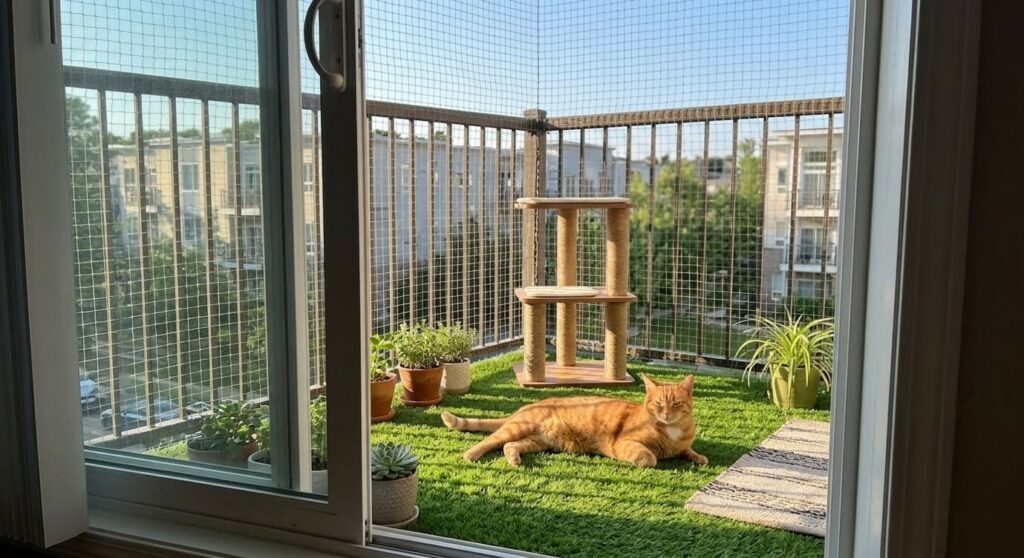
A cat-safe balcony garden combines safe plants with a secured balcony or catio area. This can be enriching because cats enjoy scent, texture, and plant movement. However, balcony gardens can also create risk if the plants are toxic, unstable, or positioned near the railing.
Best for:
- cats who enjoy sniffing plants
- owners who want natural enrichment
- balconies with safe barriers
- renters who can use removable planters
Watch out for:
- toxic plants
- fertilizer
- insect sprays
- standing water
- plant stands near railings
- soil digging
Keep planters low and stable. Do not place tall plant stands near the edge, and do not use plants to hide unsafe railing gaps. A garden is enrichment, not a safety barrier.
Before adding plants, check every species. Use our cat safe plants apartment guide before building a balcony garden around your cat.
9. Supervised Harness Balcony Time
Harness balcony time is not a true catio, but it can work as a controlled outdoor-access substitute when a building does not allow enclosures, netting, or exterior panels. The cat wears a properly fitted harness and stays with the owner on the balcony.
Before using this option, choose a secure setup from our guide to the best cat harness and leash for indoor cats and train indoors first.
Best for:
- buildings that restrict catio structures
- calm cats who tolerate harnesses
- short supervised sessions
- owners who want a no-install option
Watch out for:
- harness escape
- leash tangling
- sudden panic
- birds or insects
- cats backing out of the harness
Never put a cat in a harness for the first time on a balcony. Harness training should begin indoors, slowly, with short sessions. Your cat should be able to wear the harness calmly before the balcony becomes part of the routine.
A harness is a management tool, not a fall-prevention system. Keep the leash short enough to prevent edge access, and do not attach the leash to balcony furniture while leaving your cat alone.
10. Hybrid Indoor Catio Corner
A hybrid indoor catio corner creates a “catio feeling” inside the apartment. It may combine a window perch, cat grass, a stable cat tree, a scratching surface, bird-view access, and safe airflow near a window. This is often the best option when the real balcony cannot be secured.
Best for:
- apartments without safe balcony access
- renters with strict exterior rules
- nervous cats
- high-rise apartments
- cats who need stimulation but not outdoor risk
Watch out for:
- unstable furniture
- toxic plants
- direct sun overheating
- windows that open too far
- placing the setup near a door escape route
This setup is easy to underestimate because it is not a dramatic outdoor enclosure. But for many indoor cats, a well-designed window corner gives most of the benefit with far less risk.
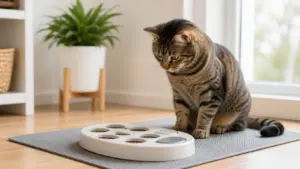
If your cat is bored indoors, pair this with a broader enrichment plan. A catio corner works best when the rest of the apartment also offers climbing, scratching, play, and food-puzzle opportunities.
Common Apartment Catio Mistakes
Mistake 1: Choosing the Prettiest Setup Before Checking Safety
A catio that looks beautiful but has loose mesh, weak zippers, unstable panels, or unsafe gaps is not a good catio. Start with safety, then style.
The safest apartment catio should be boring in the best way: stable, inspectable, washable, removable if needed, and difficult for your cat to defeat.
Mistake 2: Treating Balcony Netting as a Complete Solution
Netting can help, but it is not the whole plan. Cats can chew, climb, push, or test weak edges. Netting also does not solve overheating, door rushing, unsafe plants, balcony furniture, or lease restrictions.
Use netting as one layer, not the entire system.
Mistake 3: Leaving the Cat Unsupervised Too Soon
Even a good setup should be observed at first. Watch how your cat interacts with every seam, zipper, gap, plant, perch, and edge. Some cats simply sit and watch. Others immediately test the weakest point.
Supervision teaches you whether the setup is actually safe for your specific cat.
Mistake 4: Forgetting Heat, Sun, and Airflow
A small enclosure can warm quickly, especially on a balcony with glass panels or direct sun. Cats may not leave early enough on their own, especially if they are excited, sleepy, elderly, or overweight.
Use shade, airflow, short sessions, and water access. Do not use the catio during extreme heat, storms, high wind, fireworks, or loud construction.
Mistake 5: Creating a New Door-Rushing Problem
If balcony or catio access becomes the most exciting part of the day, your cat may start waiting at the door, pawing, vocalizing, or trying to slip outside.
Use a calm door routine. Open the catio only when your cat waits calmly, and close it before the cat becomes overstimulated.
Best Catio Idea by Apartment Type
| Apartment Type | Best Catio Idea | Why It Fits | Watch Out For |
|---|---|---|---|
| Studio apartment | Indoor catio corner or window perch setup | Saves floor space and avoids balcony risk | Too much furniture near windows |
| High-rise apartment | Fully secured balcony enclosure or indoor alternative | Fall prevention matters most | Wind, gaps, furniture near railings |
| Strict rental | Portable pop-up catio or indoor window setup | No drilling or exterior changes | Weak mesh and zipper quality |
| Balcony with railings | Balcony netting plus railing guards | Blocks common escape gaps | Loose bottom edges |
| Balcony with glass panels | Acrylic gap checks plus supervised access | Already has partial visual barrier | Bottom gaps and overheating |
| No balcony | Window perch plus reinforced screen | Gives outdoor stimulation indoors | Weak screens |
| Nervous cat | Indoor hybrid catio corner | Lower stress and more control | Forcing outdoor exposure |
| High-energy cat | Fully enclosed, supervised setup only | Reduces climbing and jumping risk | Launch points near edges |
If you are ready to compare actual balcony products instead of idea types, use our guide to the best catio for apartment balcony setups for renter-friendly, no-drill, and portable options.
How to Introduce a Cat to an Apartment Catio
Start indoors if possible. Let your cat investigate the enclosure, mat, tunnel, or perch before adding outdoor sounds and wind. Cats feel safer when a new object smells familiar before the environment becomes exciting.
Use this progression:
- Place the catio item indoors.
- Let your cat sniff and explore without closing doors or zippers.
- Add treats, bedding, or a favorite blanket.
- Practice short sessions with the door or zipper open.
- Close the enclosure briefly while staying nearby.
- Move the setup to the window or balcony only after indoor comfort is clear.
- Keep the first outdoor sessions short.
Do not force entry. If your cat refuses the catio, leave it available indoors and try again later. Forced access can turn a safe enclosure into a scary object.
Signs Your Apartment Catio Setup Is Working
A good catio should make your cat calmer, not more frantic. Watch the behavior before, during, and after each session.
Signs the setup is working include:
- your cat enters willingly
- your cat relaxes instead of pacing
- your cat watches outside without lunging
- your cat can leave calmly
- your cat does not chew mesh or zippers
- your cat does not obsess over the balcony door all day
- the structure stays stable after repeated use
- you can inspect and clean it easily
Signs the plan needs to change include:
- climbing the mesh
- chewing the enclosure
- pawing at weak seams
- hiding and refusing to move
- panting or overheating
- trying to bolt through the access point
- crying at the door for long periods
- refusing food, water, or litter after sessions
If catio access increases stress, stop and simplify. Some cats do better with a safe window perch than an outdoor enclosure.
Apartment Catio Maintenance Checklist
Check the setup regularly. Catios are not “install once and forget” items.
Before each session, check:
- zippers
- clips
- mesh tension
- bottom gaps
- railing edges
- plant safety
- shade and airflow
- surface temperature
- furniture placement
- leash or harness condition if used
Weekly, clean hair, dust, soil, and debris. Wash bedding or mats. Check for chewing, claw marks, loose ties, cracked panels, or stretched mesh.
Monthly, reassess whether the setup still fits your cat. A kitten may become a stronger climber. A senior cat may need a lower-entry option. A nervous cat may need shorter sessions. A bold cat may need stronger barriers.
Frequently Asked Questions
1. What are the safest catio ideas apartment renters can use?
The safest renter-friendly catio ideas are usually portable pop-up catios, indoor window catio corners, reinforced window perch setups, removable balcony mesh systems, and supervised harness balcony sessions.
The best choice depends on your lease, balcony structure, window safety, and your cat’s personality. If the setup requires drilling, exterior changes, or permanent fixtures, check your rental agreement and building rules first.
2. What is the best catio idea for an apartment balcony?
The best balcony catio is a fully secured, supervised setup with no rail gaps, no loose mesh, no furniture near the edge, shade, airflow, and a controlled door routine.
For many renters, this means a removable mesh system, acrylic railing guards, or a supervised pop-up enclosure. If the balcony cannot be physically secured, use an indoor window catio corner instead.
3. Can I build a catio in an apartment without drilling?
Yes, but the setup still has to be safe. No-drill options include pop-up catios, tension pole frames, freestanding enclosures, indoor window corners, and some removable railing guards.
No-drill does not automatically mean secure. Check whether the structure can shift, tip, loosen, or create gaps. If the cat can push through it, climb it, or get underneath it, it is not ready.
4. Are balcony catios safe for high-rise apartments?
They can be, but only if the enclosure physically prevents falls and escape. High-rise balcony setups need stronger safety standards because even a small failure can be serious.
Do not rely on supervision alone. Use secure barriers, remove launch points, check mesh and gaps, and avoid balcony access during wind, storms, construction noise, or fireworks.
5. What can I use if my apartment does not allow a catio?
Use indoor alternatives: a secure window perch, indoor catio corner, cat tree near a safe window, food puzzles, cat grass, bird-view enrichment, or vertical shelves away from open doors.
A catio is not the only way to enrich an indoor cat. If your building rules make outdoor enclosures risky or forbidden, an indoor setup is safer and easier to maintain.
6. How long should my cat stay in a catio?
Start with short sessions of 5 to 10 minutes. Increase gradually only if your cat stays calm, the weather is safe, and the structure remains secure.
Longer sessions are not automatically better. Heat, overstimulation, noise, and boredom can build over time. It is better to end while your cat is calm than to wait until they become restless.
7. Can a catio help a bored indoor cat?
Yes, a catio can help some bored indoor cats by adding scent, sound, airflow, sunlight, and visual stimulation. But it should not be the only enrichment plan.
Indoor cats still need play, scratching surfaces, climbing space, food puzzles, and predictable routines. A catio is one enrichment layer, not a replacement for the whole apartment setup.
8. Should I leave my catio open all day?
For most apartment cats, no. Catio access should be supervised, especially when the setup is new, outdoors, attached to a balcony, or exposed to weather.
If the catio is an indoor corner with no open window or outdoor risk, longer access may be fine. If it involves a balcony, window opening, mesh, netting, or harness, supervise every session.
9. What plants are safe for an apartment catio?
Only use plants confirmed safe for cats, and avoid fertilizers, pesticides, sharp stakes, and unstable pots. Cat grass, some herbs, and cat-safe greenery can work, but every plant should be checked before access.
Use our cat safe plants apartment guide before building a plant-based catio setup.
10. What is the biggest apartment catio mistake?
The biggest mistake is assuming “enclosed” means safe. A catio is only safe if the seams, gaps, frame, access point, airflow, and surrounding apartment setup are safe too.
A weak zipper, loose mesh edge, open balcony gap, or chair near the railing can defeat an otherwise good idea.
Final Thoughts
The best catio ideas apartment owners can use are safe, removable, inspectable, and realistic for daily life. A good apartment catio does not have to be huge. It has to prevent escape, reduce fall risk, respect rental rules, and give your cat controlled outdoor stimulation without depending on luck.
If your balcony can be secured, start with barriers, furniture placement, and supervision. If your balcony cannot be secured, choose an indoor window setup or hybrid catio corner instead. For many indoor cats, a safe indoor alternative is better than a risky outdoor enclosure.
Build slowly, inspect often, and let your cat’s behavior guide the plan. The right catio should make apartment life calmer, not more stressful.
References
American Veterinary Medical Association: Household Hazards — household and apartment hazard guidance for pet owners.
International Cat Care: Indoor Cats — indoor cat welfare and enrichment guidance.
Cornell Feline Health Center: Cat Behavior — background on cat behavior and environmental needs.
ASPCA Animal Poison Control: Toxic and Non-Toxic Plants — plant safety reference for catio and balcony plants.