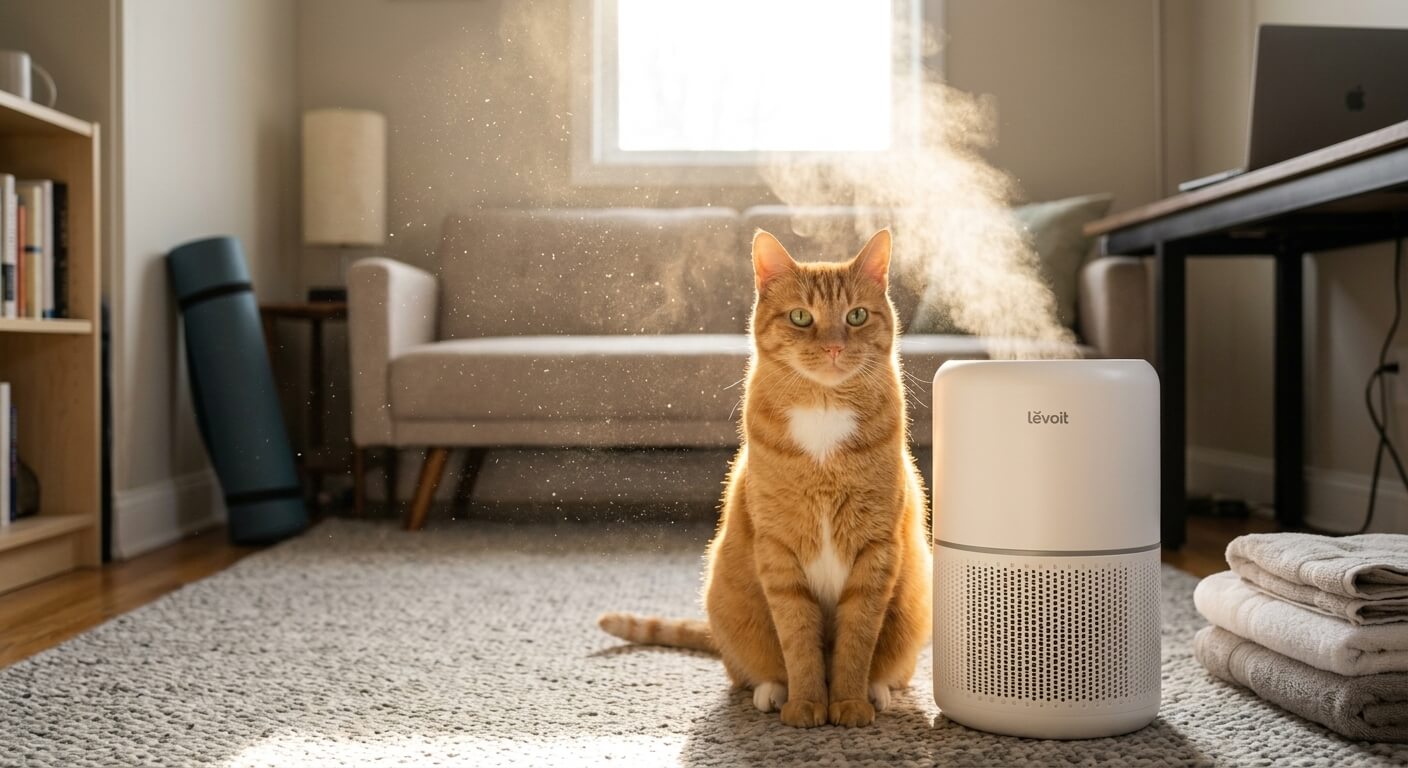
The best air purifier for cat hair is one with enough CADR for the room, an accessible pre-filter for airborne fur, and effective particle filtration for dander. The Levoit Vital 200S-P has the strongest pet-hair design in this comparison when it is available; the Coway Airmega Mighty AP-1512HH is the more practical alternative when current availability and published pollutant-specific airflow matter most.
An air purifier captures only hair and particles that become airborne and reach the intake. It will not remove fur from sofas, carpet, bedding, cat trees, or floors, so brushing, vacuuming, and washable fabrics remain essential.
Odor requires a different filter. Particle filters capture fur and dander; activated carbon adsorbs some gases and odors. If litter-box smell is the main problem, carbon quantity and source cleaning matter more than a “pet” label.
This guide compares five current air purifiers by verified clean-air delivery, useful room size, pre-filter design, particle filtration, carbon capacity, noise, maintenance, and whether they use electronic ionization.
Quick answer: Choose the Levoit Vital 200S-P when it is available and a washable pet-hair pre-filter is the priority. Choose the Coway Airmega Mighty AP-1512HH when current availability, published pollutant-specific CADR, and a washable pre-filter matter more. The Core 300-P suits a small room and lower budget; the Blueair 311i Max suits a larger room if electrostatic filtration is acceptable; the Austin Air Pet Machine is the odor-focused option for buyers who specifically want a large carbon-and-zeolite bed.
Best Air Purifiers for Cat Hair at a Glance
| Air purifier | Best for | CADR / practical room rating | Hair-catching pre-filter | Odor filter | Important limitation |
|---|---|---|---|---|---|
| Levoit Vital 200S-P | Best overall for cat hair | 250 CFM; 388 ft² at 4.8 ACH | Washable; extra U-shaped inlet | Activated carbon | Carbon layer is not intended for severe odor loads |
| Coway Airmega Mighty AP-1512HH | Reliable medium-room performance | Smoke 233, dust 246, pollen 240 CFM; 361 ft² at 4.8 ACH | Washable | Deodorization filter | Includes optional bipolar device; leave it off if avoiding ionization |
| Levoit Core 300-P | Budget small-room pick | 143 CFM; 222 ft² at 4.8 ACH | Integrated pre-filter; clean per manual | Activated carbon layer | Smaller airflow and less convenient hair maintenance |
| Blueair Blue Pure 311i Max | Larger room and high airflow | Smoke 283, dust 314, pollen 365 CFM; 439 ft² at 4.8 ACH | Washable fabric | Particle-and-carbon filter | Uses electrostatic plus mechanical filtration, not mechanical-only HEPA |
| Austin Air Pet Machine | Heavy odor and gas filtration | Manufacturer claims up to 1,500 ft²; no AHAM CADR shown on product page | Large- and medium-particle pre-filters | About 15 lb carbon/zeolite | Expensive, large, heavy, and harder to compare without CADR |
Room ratings in this table use approximately 4.8 air changes per hour when the manufacturer supplies that figure. Ignore much larger “one air change per hour” marketing numbers when comparing units for continuous particle control.
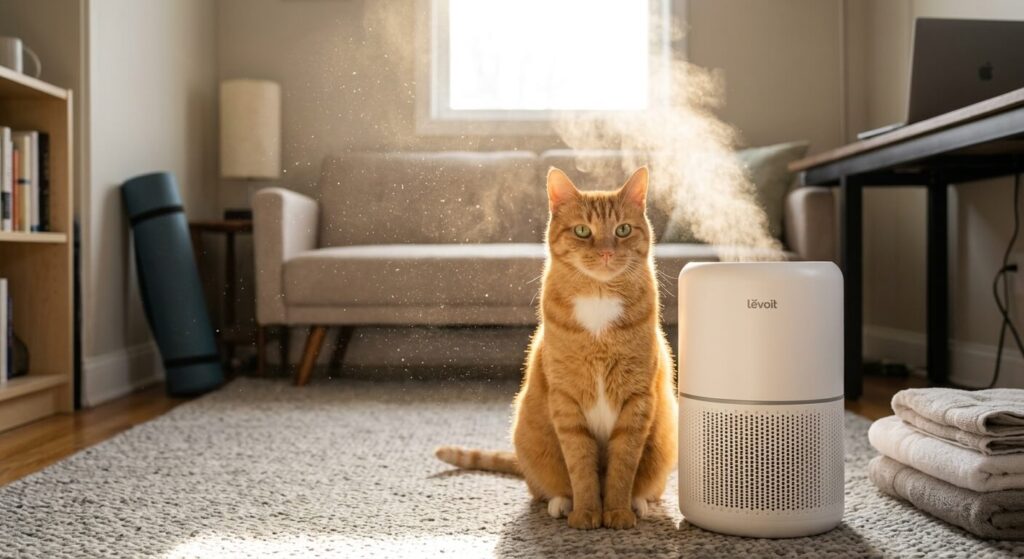
Table of Contents
How We Chose These Air Purifiers
The selections are based on current manufacturer specifications, AHAM-verified data where available, filter design, maintainability, room-size suitability, and published government guidance. They are not presented as products personally laboratory-tested by Indoor Cat Expert.
For a cat home, we prioritized:
- CADR and realistic room size: Airflow matters because a highly efficient filter is useful only when enough room air passes through it.
- A serviceable pre-filter: Large airborne fur should be stopped before it clogs the main filter.
- Particle filtration: Dander and other fine particles require efficient mechanical or combined filtration.
- Activated carbon: Carbon helps with some airborne gases and odors, while a particle filter alone does not.
- No intentional ozone generation: Ozone generators should not be used in occupied homes.
- Clear disclosure of electronic filtration: Ionizing or electrostatic technology is identified rather than described as ordinary HEPA.
- Replacement-filter availability: A purifier is a recurring-maintenance product, not a one-time purchase.
- Honest limits: No purifier removes settled fur, cleans a litter box, eliminates an allergen source, or treats asthma.
We did not rank a purifier based on app features, fragrance functions, or the largest advertised coverage number. Those details do not compensate for insufficient airflow or an impractical filter.
1. Levoit Vital 200S-P — Best Overall for Cat Hair
The Levoit Vital 200S-P is the strongest match for the exact problem behind the search “best air purifier for cat hair.” It combines a washable pre-filter with a conventional front intake and an additional U-shaped inlet designed to catch airborne pet fur and reduce clogging. Availability note (checked August 18, 2026): Levoit’s official U.S. product page currently lists this model as sold out. Check current stock and replacement-filter availability before choosing it; if it is unavailable, the Coway Airmega Mighty AP-1512HH is the most practical alternative in this comparison.
The official specifications list a CADR of 250 CFM and an ideal room size of 388 square feet at 4.8 air changes per hour. That is enough airflow for a bedroom, office, or moderate open living area when the unit has unobstructed intake and outlet space.
Why it stands out
- Washable pre-filter makes frequent fur removal practical.
- U-shaped secondary intake gives larger fibers another entry path.
- 250 CFM CADR is strong for its footprint.
- Main filter is independently described as achieving HEPA-grade performance in Sleep Mode.
- Activated carbon layer provides light-to-moderate odor support.
- Manufacturer describes the unit as ozone-free.
- Particle sensor, automatic mode, scheduling, and filter-life tracking are included.
What it can and cannot do
The pre-filter can catch hair that floats close enough to the intake. The main filter handles smaller airborne particles that pass the pre-filter. The carbon layer may reduce ordinary household and pet odors, but it does not contain the very large mass of carbon found in a specialty gas-filtering machine.
Do not expect it to remove fur already woven into upholstery. Place it near—but not pressed against—the cat’s main sleeping, grooming, or climbing area, and continue vacuuming.
Maintenance
Follow the exact manual for cleaning the pre-filter and replacing the main filter. The manufacturer estimates the replacement filter can last six to twelve months, but use, fan speed, dust, smoke, and cat-hair load affect the real interval. A visible mat of fur on the pre-filter is a reason to clean it; it is not a reason to wash the non-washable main filter.
Best for
Most one- or two-cat households that want a washable first stage, useful medium-room airflow, and mechanical ozone-free operation.
2. Coway Airmega Mighty AP-1512HH — Best Established Medium-Room Pick
The Coway Airmega Mighty AP-1512HH is a compact, high-airflow model with published individual CADR values: 233 CFM for smoke, 246 for dust, and 240 for pollen. Coway lists 361 square feet at 4.8 air changes per hour.
Its front pre-filter is removable and washable, which is useful in a shedding household. Behind it sit a deodorization filter and HEPA filter. The purifier also includes a bipolar device. The manual allows the electronic function to be controlled, so users who prefer mechanical filtration can leave that feature off.
Why it stands out
- Strong, independently comparable CADR values
- Washable pre-filter that is easy to reach
- Separate deodorization and particle filters
- Automatic fan adjustment based on a particle sensor
- Eco mode can reduce power use when the sensor detects clean air
- Relatively shallow rectangular footprint
Limitations
The deodorization sheet is not comparable with the approximately 15 pounds of carbon and zeolite in the Austin Air Pet Machine. Choose the Coway primarily for particle removal and airflow, not for a severe urine or litter odor problem.
The air-quality sensor responds to particles, not every odor gas. A “clean” indicator therefore does not prove the litter-box air has no odor or gaseous contaminant.
Because the unit contains optional bipolar technology, people who want to avoid ionization should confirm that the function is off after power interruptions or setting changes and follow the current manual.
Best for
A medium room where verified airflow, a washable hair-catching pre-filter, and straightforward controls are more important than an app.
3. Levoit Core 300-P — Best Budget Pick for a Small Room
The Levoit Core 300-P is a compact, ozone-free purifier with a CADR of 143 CFM. The manufacturer rates it for 222 square feet at 4.8 air changes per hour. That makes it a reasonable budget choice for a closed bedroom, small office, or compact studio zone—not an entire multi-room apartment.
The cylindrical filter includes a pre-filter, main particle filter, and activated carbon layer. Unlike the washable pre-filter in the Vital 200S-P, its integrated filter format makes frequent hair maintenance less convenient. Follow the manual and use a soft brush or vacuum method only if instructed; do not wash the main filter.
Why it stands out
- Lower purchase cost than the medium-room picks
- 143 CFM CADR is appropriate for a genuinely small room
- Compact 8.7 × 8.7-inch footprint
- Ozone-free operation
- Sleep mode and timer
- Several compatible replacement-filter types
Limitations
The Core 300-P has less airflow than the other mainstream picks and lacks an external washable pet-hair pre-filter. In a high-shedding home, hair reaching the intake may make maintenance more frequent.
The standard carbon layer is intended for ordinary odor support, not a persistent urine source. If the box or flooring smells, correct the source instead of buying a stronger fragrance or running the purifier on high.
Best for
One cat in a small closed room, buyers with limited floor space, and people who need particle filtration more than heavy odor adsorption.
4. Blueair Blue Pure 311i Max — Best for a Larger Room
The Blue Pure 311i Max has the highest published CADR values among the broadly comparable products in this list: smoke 283 CFM, dust 314 CFM, and pollen 365 CFM. Blueair recommends approximately 439 square feet at 4.8 air changes per hour.
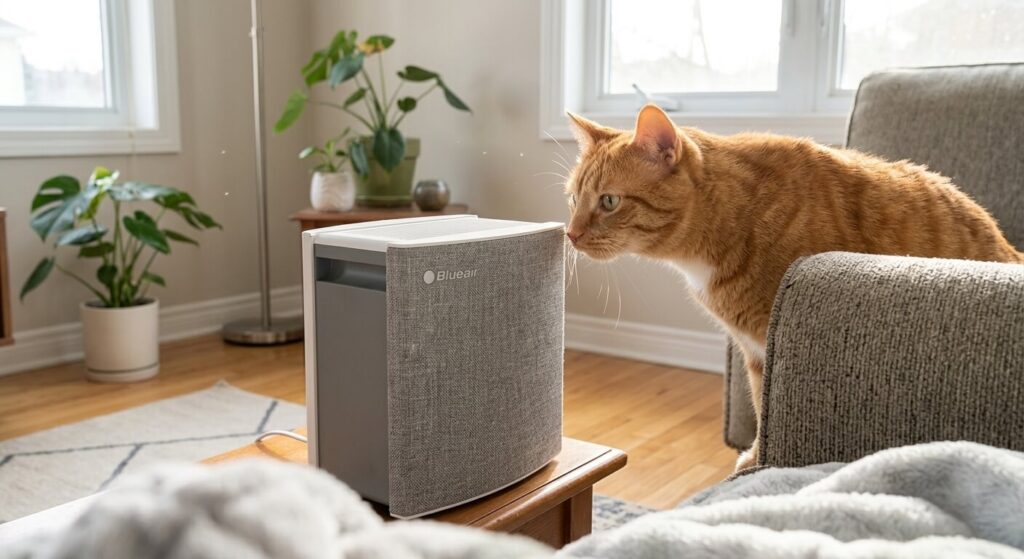
The colored outer fabric is a washable pre-filter that catches larger airborne material, including pet hair, before it reaches the main particle-and-carbon filter. This design makes accumulated fur easy to see and remove.
Understanding HEPASilent
Blueair does not describe this as a conventional mechanical-only True HEPA machine. Its HEPASilent technology combines mechanical filtration with electrostatic charging. That approach helps it produce high CADR with relatively low noise and energy use, but buyers looking specifically for non-electronic filtration should choose another model.
The distinction matters because “captures 99.97%” is a filter-efficiency claim, while CADR describes how quickly the complete appliance delivers cleaned air. In room use, a high CADR can be more informative than relying on an H13 label alone.
Why it stands out
- High smoke, dust, and pollen CADR
- Washable fabric pre-filter for visible cat hair
- Suitable for a larger bedroom or living space
- Particle-and-carbon replacement filter
- Low published operating-noise range
- Automatic mode and app controls
Limitations
The standard carbon filter is for light household odors. Blueair sells other filter variants, but replacement price and availability should be checked before purchase.
Because the system uses electrostatic filtration, verify current emissions certifications and decide whether that technology fits your household. The U.S. EPA notes that ionizing and other electronic air-cleaning technologies can potentially produce ozone unless designed and certified to prevent it.
Best for
A larger room where high clean-air delivery and a washable outer hair filter are priorities, and where the buyer accepts combined electrostatic and mechanical filtration.
5. Austin Air Pet Machine — Best for Heavy Odor Filtration
The Austin Air Pet Machine is a different type of purchase. Its four-stage filter includes large- and medium-particle pre-filters, certified HEPA media, and approximately 15 pounds of activated carbon and zeolite. The manufacturer states that the gas filter is intended to address pet-related chemicals, gases, and odors, including ammonia.
That carbon mass is substantially more than the thin carbon layer found in many compact purifiers. It therefore makes more sense for a buyer whose priority is gas and odor adsorption rather than smart controls or a small footprint.
Why it stands out
- Approximately 15 pounds of activated carbon and zeolite
- Dedicated large- and medium-particle pre-filter stages
- HEPA stage rated for 99.97% of particles larger than 0.3 micron
- 360-degree intake
- Long manufacturer-estimated filter life
- No app or sensor dependency
Important comparison limitation
The current product page promotes coverage up to 1,500 square feet but does not provide an AHAM-verified CADR beside that claim. Without CADR, it cannot be compared directly with the airflow performance of the Levoit, Coway, or Blueair models.
It is also expensive, large, heavy, and costly to re-filter. A large carbon bed creates airflow resistance, so do not assume the highest purchase price means the fastest particle removal.
Even this machine cannot repair a urine-soaked floor, replace litter-box cleaning, or make unsafe ammonia levels acceptable. Source control comes first.
Best for
Buyers who specifically want a large carbon-and-zeolite bed for pet-related odors and accept the cost, footprint, and lack of directly comparable CADR.
Does an Air Purifier Really Help With Cat Hair?
Yes, but only with the airborne fraction.
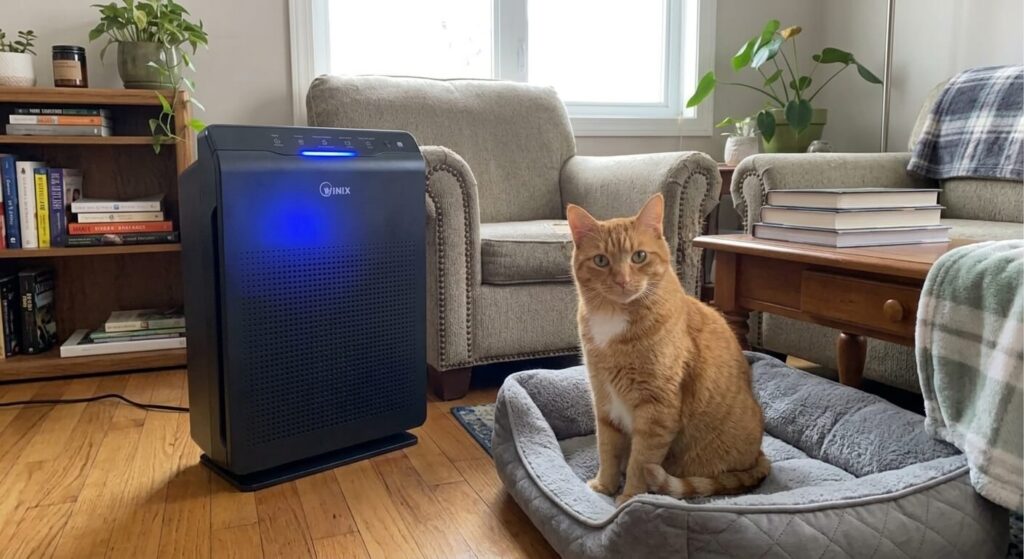
Cat hair is relatively large and heavy compared with fine airborne particles. Some strands float after grooming, running, brushing, or disturbing bedding. A purifier can capture strands while they are suspended and moving through the intake. Once hair settles or becomes embedded in fabric, the purifier has no mechanism to collect it.
For visible hair, use three layers of control:
- Reduce loose hair at the source: Brush the cat appropriately for its coat and health.
- Remove settled hair: Vacuum floors and furniture and wash bedding.
- Filter airborne material: Run a correctly sized purifier continuously at a tolerable speed.
A purifier with a removable pre-filter is preferable for cat hair because fur can be removed before it mats the more expensive main filter.
Air filtration should never be marketed as hairball prevention. Hairballs relate mainly to hair swallowed during grooming, and an air purifier has not been established as a treatment.
Cat Hair, Dander, and Fel d 1 Are Not the Same
“Cat hair” is often used as shorthand for several different concerns:
- Hair or fur: Visible strands shed from the coat
- Dander: Small flakes and biological material shed from skin
- Fel d 1: A major cat allergen protein that can travel on particles
- Litter dust: Mineral, plant, or clay particles disturbed around the box
- Odor: Airborne gases and volatile compounds, not particles
A pre-filter handles larger hair and lint. A high-efficiency main filter handles much smaller particles. Activated carbon or other sorbent media is used for gases and odors.
Do not rely on the old claim that every airborne Fel d 1 particle has one fixed size. Allergen-bearing particles occur across a range of sizes and may remain airborne or become resuspended. The practical response is adequate clean-air delivery plus source reduction—not chasing a single micron number.
If someone in the home has allergy or asthma symptoms, an air purifier is only one possible control. EPA reports that portable HEPA cleaners may improve some allergy or asthma symptoms, but improvements are not universal or necessarily large. Discuss diagnosis and treatment with a qualified clinician, and use our small-apartment cat allergy guide for additional environmental steps.
How to Choose the Best Air Purifier for Cat Hair
Start with CADR, not the largest coverage claim
CADR is the volume of filtered air delivered by the complete appliance. AHAM publishes separate values for smoke, dust, and pollen.
AHAM’s simple sizing rule is to choose a tobacco-smoke CADR at least two-thirds of the room’s square footage when ceilings are approximately eight feet. For example:
| Room area | Minimum smoke CADR using AHAM’s 2/3 rule |
|---|---|
| 150 ft² | 100 CFM |
| 225 ft² | 150 CFM |
| 300 ft² | 200 CFM |
| 375 ft² | 250 CFM |
| 450 ft² | 300 CFM |
Choose a larger model for higher ceilings, open doorways, heavy particle loads, wildfire smoke, or operation at quieter medium speeds. A unit achieves its advertised maximum CADR only at a high setting.
Compare room ratings at the same air-change rate
A purifier may be advertised for 1,500 square feet at one air change per hour and 300 square feet at roughly five air changes per hour. Both numbers can describe the same machine.
For continuous particle control in a room, compare ratings at about 4.8 air changes per hour or use verified CADR. Do not compare one brand’s one-ACH number with another brand’s 4.8-ACH number.
Look for a removable pre-filter
The pre-filter is the first defense against hair. It should be accessible without dismantling the machine. “Washable” is useful, but only wash a component when the manual specifically permits it. Reinstall it only after it is completely dry.
Treat HEPA labels carefully
HEPA is a filter-efficiency classification, while CADR represents the full appliance’s clean-air delivery. A very restrictive filter paired with weak airflow can clean a room more slowly than a well-designed high-CADR system.
Do not use the inaccurate table from the previous version of this article that called H11 “True HEPA” at 95% and H13 99.97% at exactly 0.3 micron. U.S. consumer “True HEPA” marketing, European EN 1822 filter classes, test particle size, and complete-appliance performance are not interchangeable.
Look for:
- AHAM Verifide CADR
- Clear manufacturer particle-efficiency testing
- Realistic room sizing
- Available replacement filters
- A pre-filter suited to hair
Evaluate carbon by mass and construction
A thin carbon-coated sheet may help with light odors but saturates sooner than a deep bed of granular carbon. Many manufacturers do not disclose carbon weight, making direct comparison difficult.
If odor is the priority:
- Prefer disclosed granular carbon or carbon/zeolite mass.
- Budget for replacement media.
- Keep the litter box and surrounding surfaces clean.
- Ventilate safely when outdoor conditions allow.
- Investigate persistent urine or ammonia smell.
An air purifier can reduce some odor compounds after source control; it cannot make a dirty litter area hygienic. Use our litter-box odor control guide to address the source.
Avoid ozone generators
The U.S. EPA states that ozone is a lung irritant and that concentrations within public-health standards are generally ineffective for controlling indoor pollution. Do not use an ozone generator in an occupied home.
Some ionizers, plasma devices, electrostatic systems, and poorly designed UV products can also emit ozone as a byproduct. For electronic filtration:
- Check whether the feature can be disabled.
- Look for current CARB certification.
- EPA recommends UL 2998 certification when choosing bipolar-ionization technology.
- Do not interpret an EPA establishment number as federal approval or endorsement.
Mechanical-only, ozone-free filtration is the simplest choice for owners who do not want to evaluate electronic technologies.
Account for noise
The best purifier is one you will run. Published low-speed noise can sound impressive, but room cleaning depends on airflow. A nearly silent setting may deliver much less clean air than the maximum CADR.
Size the purifier generously so it can provide useful airflow at a medium setting. Avoid positioning it where a cat can block the intake, sit on the outlet, or chew the cord.
Price the replacement filters before buying
Check:
- Current replacement-filter price
- Number of filters included
- Recommended replacement interval
- Whether the pre-filter is reusable
- Whether genuine filters are readily available
- Warranty requirements
Do not rely on fixed annual costs copied from an old article. Prices and intervals change, and filter life depends on actual use.
Where to Put an Air Purifier in a Cat Home
Place the purifier in the room where the relevant pollutant is generated and where people spend time. A closed bedroom purifier does little for a litter box in another closed room.
For cat hair:
- Position it near a favorite bed, cat tree, or grooming area.
- Keep the manufacturer’s required clearance around every intake and outlet.
- Do not hide it behind a sofa or curtain.
- Avoid a location where loose toys or fabric can cover the intake.
For litter-box particles and odor:
- Place it in the same general room when safe and practical.
- Keep it far enough away that litter cannot be kicked directly into the intake.
- Do not blow outlet air across the litter box into the living area.
- Never let the purifier substitute for scooping and residue removal.
For allergies:
- Prioritize the bedroom or primary occupied room.
- Keep the cat out of the bedroom if that is part of the clinician’s plan.
- Wash bedding and clean settled dust.
- Run the purifier continuously at an effective setting.
Do not place a unit in a wet bathroom unless its manual permits that environment. Protect cords from chewing and prevent the cat from tipping the machine.
Maintenance in a Shedding Household
There is no universal “vacuum weekly, wash monthly, replace every six months” schedule for every model. Follow the manual and adjust inspection frequency to the actual fur and dust load.
Pre-filter
Inspect it frequently during shedding seasons. Vacuum, brush, rinse, or replace it only as directed. A washable pre-filter must be completely dry before reinstallation.
Main particle filter
Do not wash or aggressively vacuum a HEPA or main filter unless the manufacturer explicitly instructs you to do so. Cleaning can damage filter media or seals. Replace it according to the indicator, manual, and observed loading.
Activated carbon
Carbon can become saturated without looking dirty. If odor control declines after source cleaning has been confirmed, replacement may be due. Carbon life changes with gas concentration, humidity, airflow, and carbon mass.
Intake, sensor, and outlet
Unplug the unit before maintenance. Remove hair from intake grilles and clean the particle sensor according to the manual. Keep the outlet clear.
Common Buying Mistakes
Buying for the whole apartment instead of one room
Walls and closed doors interrupt airflow. Size for the actual room and add another purifier if two separated zones require filtration.
Choosing by “99.97%” alone
Filter efficiency does not reveal how quickly the appliance cleans the room. Compare CADR.
Expecting HEPA to remove odor
HEPA is for particles. Odor requires source control, ventilation when appropriate, and enough gas-adsorbing media.
Expecting the purifier to vacuum
Settled cat hair stays where it lands until it is brushed, washed, wiped, or vacuumed.
Placing the purifier against a wall
Follow clearance requirements. Restricted intake reduces performance and can increase noise.
Washing the wrong filter
“Washable pre-filter” does not mean the entire filter is washable.
Buying an ozone generator for smell
Ozone is not a safe shortcut for an occupied cat home. Remove the odor source.
Frequently Asked Questions
What is the best air purifier for cat hair?
The Levoit Vital 200S-P remains the strongest pet-hair design in this comparison when it is in stock, combining a washable pre-filter, pet-focused U-shaped inlet, and 250 CFM CADR. When availability is limited, the Coway Airmega Mighty AP-1512HH is the safer default recommendation because it has a washable pre-filter and published pollutant-specific CADR.
Will an air purifier remove cat hair from the room?
It can capture hair that becomes airborne and reaches the intake. It cannot remove fur from floors, bedding, clothing, carpet, or upholstery. Use brushing, laundering, and vacuuming for settled hair.
Is a washable pre-filter important for cats?
Yes. It makes frequent removal of accumulated fur easier and helps protect the main filter. Wash it only when the manufacturer permits it and let it dry completely.
Does an air purifier help with cat dander?
A correctly sized particle air cleaner can reduce airborne particles carrying cat allergens. It does not remove the cat or every settled allergen source, and it is not a cure for allergy or asthma.
Will an air purifier remove litter-box odor?
Activated carbon may reduce some airborne odor compounds, but results depend on carbon quantity, airflow, and odor load. Clean the box, floor, walls, mat, and any urine contamination first. Persistent ammonia or urine odor indicates a source problem.
What size air purifier do I need for cat hair?
For an eight-foot ceiling, AHAM recommends a smoke CADR at least two-thirds of the room area. A 300-square-foot room therefore needs at least about 200 CFM. Choose additional capacity if you plan to run the unit below its highest setting.
Is H13 required for cat dander?
No single H13 label guarantees the best room performance. Efficient particle filtration plus enough airflow matters. Compare verified CADR, test claims, room size, and filter availability instead of using H13 as the only requirement.
Are ionizers safe around cats?
Electronic air cleaners vary. Some ionizing technologies can produce ozone or other byproducts. Mechanical ozone-free filtration avoids that concern. If considering bipolar ionization, EPA recommends choosing a product certified to UL 2998; follow current product and veterinary guidance.
Should the purifier sit beside the litter box?
It can be in the same room if the location is dry, stable, and does not draw loose litter directly into the intake. Maintain the required clearances and avoid directing outlet air across the box.
Should I run the air purifier all day?
Continuous operation generally provides more consistent particle removal than occasional use. Choose a speed that supplies useful airflow without unacceptable noise, and follow the manufacturer’s safety instructions.
Final Thoughts
The Levoit Vital 200S-P remains the strongest pet-hair design in this comparison when it is in stock, while the Coway Airmega Mighty AP-1512HH is the safer default recommendation when current availability and independently comparable airflow matter most.
For a small closed room, the Levoit Core 300-P offers adequate verified airflow at a lower price, though its filter is less convenient for frequent hair cleaning. The Blueair 311i Max provides the highest CADR for a larger room but uses electrostatic plus mechanical filtration. The Austin Air Pet Machine is the specialized odor choice because of its large carbon-and-zeolite bed, not because it offers the clearest airflow value.
Whichever purifier you select, treat it as the airborne part of a complete plan. Brush appropriately, vacuum settled fur, wash cat bedding, clean the litter box at the source, choose a unit with enough CADR, and maintain every filter according to its manual.
For the source-control side of the problem, see our guides to indoor cat grooming, apartment litter-box odor control, and living with cat allergies in a small apartment.
References
- U.S. Environmental Protection Agency. Guide to Air Cleaners in the Home.
- U.S. Environmental Protection Agency. What Are Ionizers and Other Ozone-Generating Air Cleaners?.
- Association of Home Appliance Manufacturers. Air Filtration Standards and the CADR 2/3 Rule.
- Levoit. Vital 200S-P Smart Air Purifier: Official Specifications.
- Coway. Airmega Mighty AP-1512HH: Official Specifications.
- Levoit. Core 300-P Air Purifier: Official Specifications.
- Blueair. Blue Pure 311i Max: Official Specifications.
- Austin Air. Pet Machine: Official Filter Specifications.