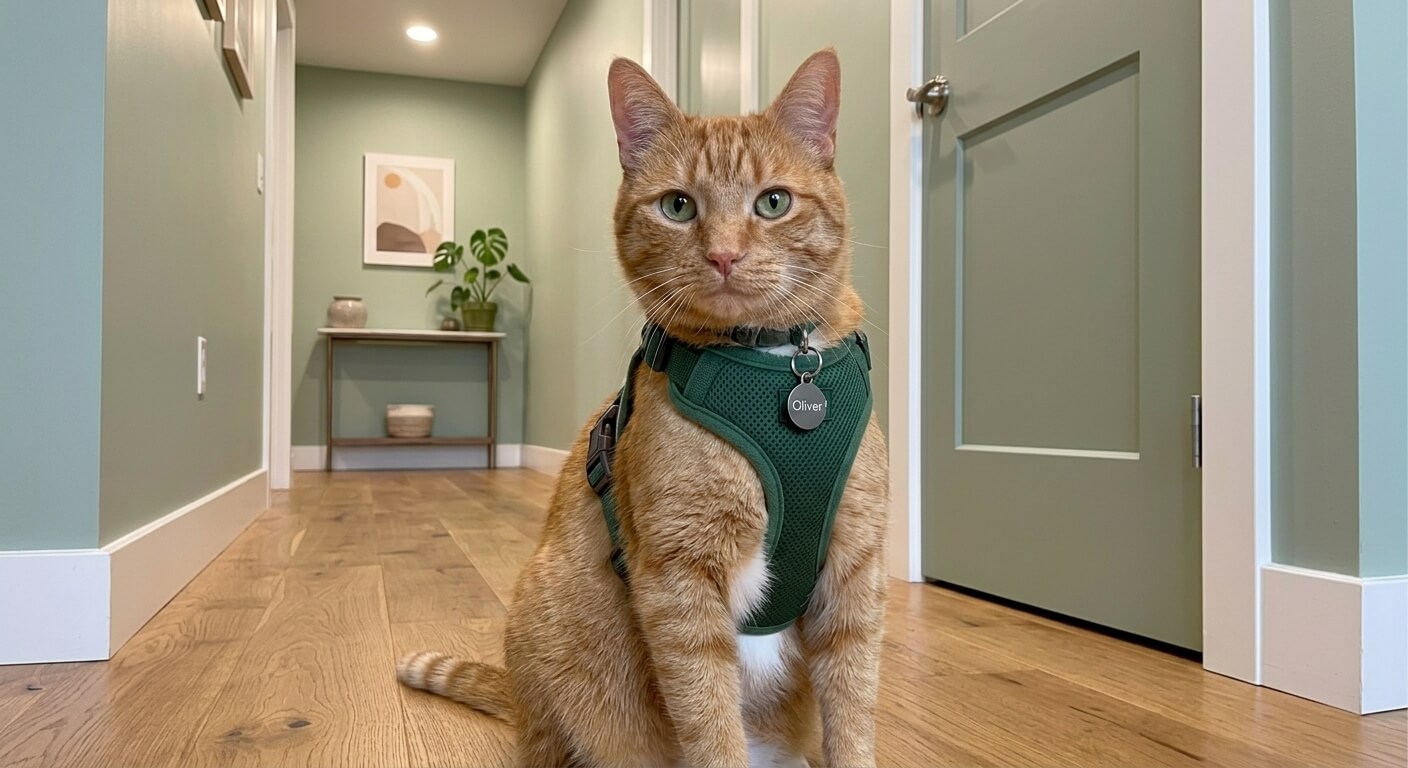
Best cat harness and leash for indoor cats should make supervised exploration safer, not give owners a false sense of security.
Oliver taught me that lesson in one fast hallway moment. I was bringing groceries in when he spotted movement near the apartment door and lunged forward in a cheap harness that fit “well enough.” Within seconds, he had twisted backward, loosened one side, and nearly slipped out before I could pick him up.
No harness is truly escape-resistant for every cat. Cats can compress their shoulders, back out of loose straps, panic at sudden noise, and twist in ways that most dog-style harnesses are not built to handle. The goal is to choose an escape-resistant harness that fits correctly, avoids neck pressure, uses secure closures, and gives you better control during apartment hallway, balcony, courtyard, or supervised outdoor training.
Disclosure: This article may contain affiliate links. If you buy through these links, Indoor Cat Expert may earn a commission at no extra cost to you. We only recommend cat harnesses based on fit security, neck safety, escape resistance, training use, apartment practicality, and supervised outdoor safety.
Quick Answer: What Is the Safest Harness Style for Indoor Cats?
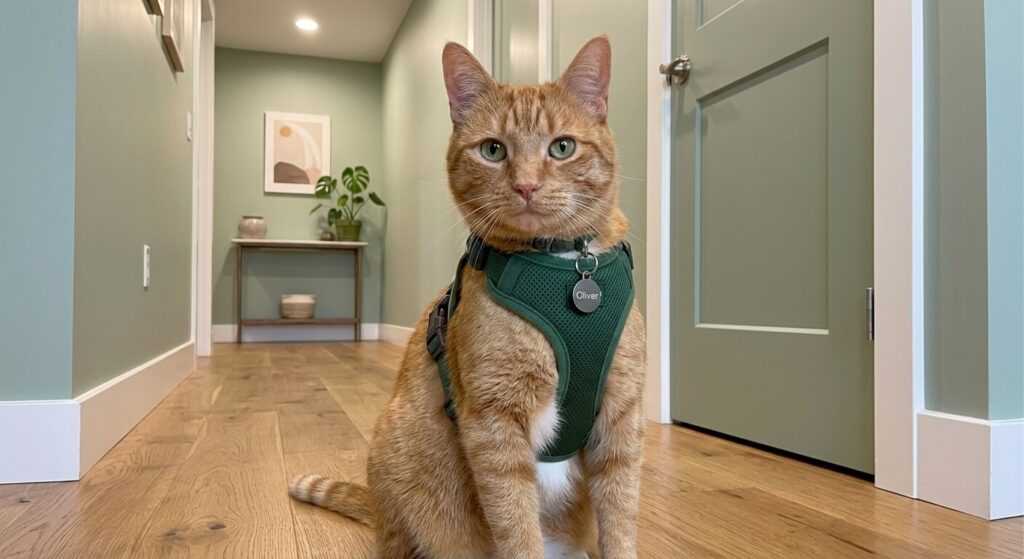
The safest cat harness for most indoor cats is a well-fitted vest-style harness with secure buckles, broad chest coverage, and no direct pressure on the throat. It should pass the two-finger rule: snug enough that your cat cannot back out, but loose enough that two fingers fit comfortably under each contact point.
For calm, trained cats, a lightweight H-style harness can work for short supervised sessions. For nervous cats, balcony practice, hallway training, or cats with a history of backing out, I would start with a vest-style harness and several days of indoor desensitization before opening the apartment door.
Safety Note Before You Start
No cat harness is completely escape-proof. Always train indoors first, check the fit before every session, avoid busy streets and off-leash dogs, and never leave a cat tied outside or unattended in a harness. If your cat panics, freezes, pants, drools, or tries to roll out of the harness, end the session and return to indoor desensitization.
Table of Contents
| Harness Type | Best For | Main Benefit | Watch Out For |
|---|---|---|---|
| Vest-style harness | Beginners, nervous cats, apartment walks | Better chest coverage and escape resistance | Some cats dislike the full-body feel |
| H-style harness | Calm trained cats | Lightweight and less bulky | Easier to back out of if loose |
| Tactical harness | Outdoor exploration and courtyards | Stronger material and grab handle | Too heavy for some cats |
| Budget starter harness | Indoor desensitization only | Low-cost way to test tolerance | Not ideal for high-risk environments |
| Complete harness and leash kit | Owners who want one matched setup | Convenient and beginner-friendly | Still needs careful fitting |
Why Cats Can Slip Out of Poorly Fitted Harnesses
The internet has long noted that cats appear to be liquid—able to fit into containers and spaces that seem geometrically impossible for their body size. This isn’t a quirky personality trait. It’s functional anatomy with direct implications for harness design.
The Floating Clavicle
Cats possess a vestigial clavicle that is:
- Small relative to body size
- Not articulated directly to the sternum
- Embedded in the brachiocephalic muscle
- Functionally free-floating
In dogs and humans, the clavicle forms a rigid strut between shoulder and sternum, setting the width of the shoulder girdle. In cats, the absence of this rigid connection means the shoulder width is not fixed—it can compress significantly when the cat chooses to narrow themselves.
What this means for harnesses:
A harness that fits correctly around a relaxed cat’s thorax may not prevent escape when the cat actively compresses their shoulders and backs up simultaneously. This backward escape maneuver—the “reverse”—is the failure mode that defeats most budget harnesses.
The Panic Response Physics
The pigeon incident illustrated the second escape mechanism: explosive directional change at end-of-leash tension.
When a cat reaches the end of a leash at speed and the harness is attached at a single point (typically the back), the force vectors concentrate at that attachment point. If the harness attachment is insufficiently secured, the jerk force of hitting the leash extension can cause the harness to ride up the neck—which presents both an escape opportunity and a serious Trachea Safety risk.
The physics solution: Harnesses with chest-point leash attachment (rather than back-only) distribute the forward force across the chest panel rather than concentrating it at a single rear attachment point.
The Two-Finger Rule
The “two-finger rule” is the clinical fitting standard I use for every cat harness evaluation:
Insert two fingers between the harness and the cat’s body at every point of contact. The fit should allow this—two fingers, snugly, not loosely.
- Too tight (less than two fingers): Restricts breathing and movement; creates pressure points
- Correct (exactly two fingers, snug): Secure against escape, comfortable for the cat
- Too loose (more than two fingers, or easy sliding): Escape risk; the cat can back out with shoulder compression
Check this at: the neck band (if present), behind the front legs (axilla), and across the chest panel.
H-Style vs. Vest-Style Cat Harnesses
Both harness architectures have legitimate applications. The distinction matters for Trachea Safety, escape resistance, and the specific activities you’re planning.
H-Style Harnesses
What they are:
H-style (also called “figure-8”) harnesses consist of two loops connected by a strap: one loop around the neck/shoulders, one around the torso behind the front legs, with a connecting bridge along the back.
Advantages:
- Lightweight and minimal
- Less material contact (good for heat-sensitive cats)
- Easy to put on once the cat is accustomed
Clinical concerns:
The neck loop of most H-style harnesses, when the leash attachment is at the back and the cat pulls forward, creates a mechanical lever that can apply pressure to the trachea. Trachea safety in forward-pulling situations requires either a chest-attachment leash or a harness design that eliminates direct neck-loop pressure.
H-style harnesses also have lower escape resistance than vest designs because the two separate loops can be defeated by shoulder compression—particularly the neck loop, which a cat can back their head out of.
Best for: Calm, leash-trained cats with low escape-risk behavior; cats who resist the coverage of vest harnesses.
Vest-Style Harnesses
What they are:
Vest harnesses cover the chest and torso with a panel of fabric secured by closures at the back and/or sides. The leash attachment is typically at the back between the shoulder blades.
Advantages:
- Distributes pressure across chest and shoulder area (superior Trachea Safety)
- Significantly greater escape resistance (can’t back out of a panel covering the full chest)
- More material contact means the cat feels the harness as a consistent presence (reduces panic response)
- Reflective Stitching options are more commonly available in vest designs
The escape-resistant argument:
A well-fitted vest harness with Dual-Buckle closures requires the cat to both compress their shoulders AND defeat two independent closures simultaneously to escape. This is mechanically much more difficult than defeating the two separate loops of an H-style harness.
Clinical recommendation:
For apartment cats who are new to harnesses, who have shown any escape behavior previously, or who will be taken into stimulating environments (building hallways, outdoor spaces), vest-style with Dual-Buckle closure is my clinical recommendation.
Top 5 Cat Harness and Leash Picks for Indoor Cats
Best Overall Vest Harness: Rabbitgoo Cat Harness
Price: $16 – $22
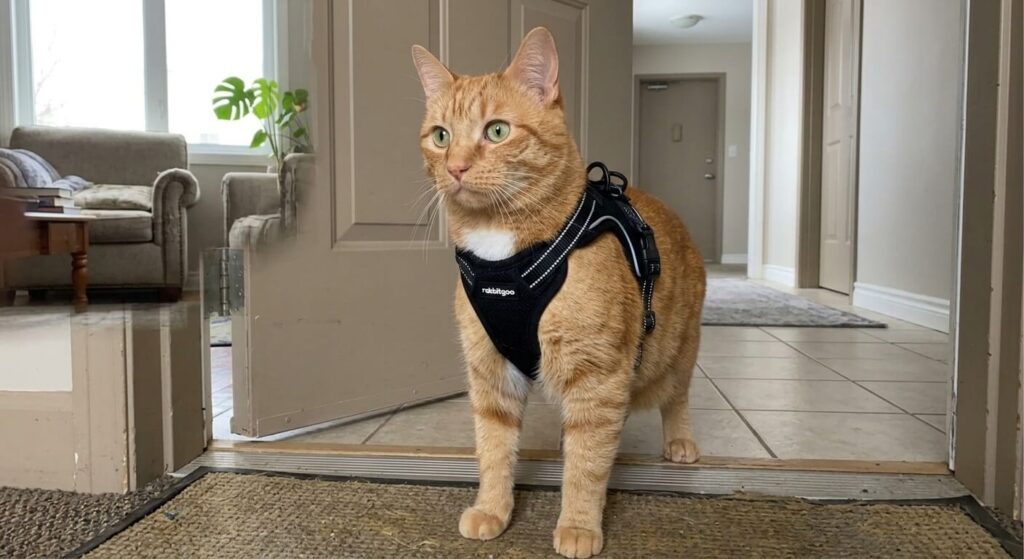
The Rabbitgoo has become the standard recommendation among veterinary professionals and cat behavior specialists for a reason that becomes obvious when you examine its closure system: it has more security redundancy built into a sub-$20 product than most premium-priced competitors.
Technical specifications:
- Style: Vest (full chest panel coverage)
- Closure system: Dual-Buckle (chest + back) + Velcro chest flap (triple closure)
- Leash attachment: Back D-ring (reinforced)
- Materials: High-density nylon mesh, Reflective Stitching on edges
- Sizes: XS through XL (with chest circumference guide)
- Weight: 2.8 oz
- Trachea Safety: Full neck-free design (no neck loop)
Why triple closure matters:
The Rabbitgoo requires a cat to defeat: the chest Velcro, the chest buckle, AND the back buckle simultaneously—while the vest panel is preventing the shoulder compression maneuver. In two years of using this harness on Oliver, including multiple hallway encounters with building dogs and one memorable pigeon situation, it has never come close to failing.
This is the harness I would choose first for most beginners because it gives you a little margin for real-life mistakes: a loud hallway, a dog around the corner, or a cat who suddenly decides backward is the only acceptable direction. It is not magic, but the extra closure points matter when your hands are already full.
The neck-free design:
The Rabbitgoo sits below the neck entirely, eliminating the Trachea Safety concern at the root level. There is no neck band to apply pressure. The chest panel distributes load across the sternum and rib cage—anatomically appropriate structures for load-bearing.
Harness training is also the single most effective method for preventing door-bolting behavior, since a cat in a secure harness cannot successfully execute an escape even if they attempt one during entry and exit. If you plan to use a harness near an apartment balcony, first read our guide on cat proof balcony apartment guide.
Pros:
- Triple closure system (Velcro + dual buckle)
- Complete neck-free design (Trachea Safety)
- Reflective Stitching for low-light visibility
- Correct price-to-security ratio
- Multiple size options with accurate sizing guide
- Machine washable
Cons:
- Velcro can collect cat fur and lose adhesion over time (clean monthly)
- Mesh material isn’t ideal for extreme cold
- Back D-ring is single attachment point (no chest clip option)
- Some cats resist the full-coverage vest feel initially
Best for: Primary recommendation for all indoor cats beginning harness training, escape-prone cats, apartment hallway and building exploration
Best Lightweight Harness: Kitty Holster Cat Harness
Price: $24 – $30
For cats who have completed harness desensitization and demonstrated reliable leash manners—who are not escape risks—the Kitty Holster offers the lightweight comfort that makes extended wear more pleasant for the cat.
Technical specifications:
- Style: Modified H-style with wide chest band
- Closure system: Single Velcro closure (wide, high-strength)
- Leash attachment: Back D-ring
- Materials: 100% cotton (breathable)
- Sizes: XS through XL
- Weight: 1.6 oz
- Trachea Safety: Wide neck band distributes rather than concentrates pressure
The cotton advantage:
For cats who will wear the harness for extended periods—apartment lounging while supervised, extended outdoor sessions—cotton breathability significantly outperforms nylon mesh in temperature regulation. A cat wearing a nylon vest in a warm apartment becomes uncomfortable within 30-40 minutes. Cotton remains comfortable for multi-hour supervised wear.
The single-closure limitation:
The Kitty Holster’s wide Velcro closure is strong and well-engineered. It is also a single-closure system, which means a cat who discovers the Velcro release mechanism (some cats do learn to manipulate Velcro by rubbing against surfaces) has one security layer rather than two.
I would not use this as the first harness for a panicky cat. Where it shines is comfort: cats who already understand harness walks may tolerate this better for longer calm sessions, especially in warm apartments or quiet courtyards.
My clinical position: The Kitty Holster is appropriate for calm, trained cats in low-stimulation environments. It is not my recommendation for first-time harness use, high-stimulation exposures, or any cat who has previously shown escape behavior.
Pros:
- 100% cotton for breathability and comfort
- Lightweight (1.6 oz) for extended wear tolerance
- Machine washable
- Wide Velcro closure is strong and secure for compliant cats
- Good size range
Cons:
- Single closure system (lower escape resistance than dual-buckle)
- Velcro can collect fur and lose adhesion
- Not appropriate for high-stimulation escape-risk situations
- Neck band pressure present (less ideal than neck-free design)
Best for: Trained, calm cats for extended supervised wear; hot climates where breathability is priority
Best Outdoor-Ready Harness: Bingpet Tactical Cat Harness
Price: $22 – $28
For cats who have graduated from apartment hallways to genuine outdoor exploration—building courtyards, parks, urban green spaces—the Bingpet Tactical provides the structural integrity that adventure settings require.
Technical specifications:
- Style: Tactical vest with handle
- Closure system: Dual-Buckle + side-release buckles
- Leash attachment: Back D-ring + front chest clip (dual attachment points)
- Materials: Military-grade nylon with padding
- Handle: Top-mounted grab handle for quick lifting
- Sizes: S through XL
- Reflective Stitching: Full perimeter
- Trachea Safety: Neck-free chest panel design
The dual leash attachment advantage:
The Bingpet’s chest clip attachment changes the load mechanics significantly. When a cat pulls forward and the leash is attached to the chest clip, the force redirects the cat’s momentum sideways rather than allowing them to continue forward—the same mechanical principle used in front-clip dog harnesses for leash manners training.
For cats in stimulating outdoor environments who are not yet fully leash-conditioned, chest-clip attachment provides greater directional control than back-clip alone.
This is more harness than many indoor cats need. I would reserve this style for cats who have already passed basic indoor training and are moving into courtyards, controlled outdoor areas, or more stimulating apartment-building environments.
The grab handle:
This is the feature I didn’t expect to value until I needed it. When Oliver encountered an off-leash dog during our first courtyard exploration, the grab handle allowed me to lift him immediately and securely—from the harness structure rather than trying to grab a wriggling cat by the scruff or body.
Outdoor exploration on a leash provides some of the highest-level sensory and cognitive enrichment available to indoor cats, engaging their olfactory system, visual tracking, and territorial assessment behaviors in ways that indoor enrichment cannot fully replicate. For cats who enjoy outdoor smells and sunshine but are not ready for walks, a small apartment catio can be a safer alternative.
Pros:
- Dual leash attachment (back D-ring + front chest clip)
- Top-mounted grab handle for emergency lifting
- Military-grade nylon for durability in outdoor use
- Full-perimeter Reflective Stitching
- Dual-Buckle closure for security
- Neck-free design (Trachea Safety)
Cons:
- Heavier than basic vest designs (not ideal for short indoor sessions)
- Premium feel may be overkill for hallway-only use
- Some cats find the additional structure restrictive initially
- More components require more patience during fitting
Best for: Cats who regularly explore outdoor environments, adventure cats, situations requiring quick-lift capability
Best Budget Starter Harness: Pupteck Cat Harness
Price: $10 – $14
For owners who aren’t certain their cat will tolerate harness training—who want to assess basic acceptance before investing in premium hardware—the Pupteck provides adequate security for initial desensitization sessions at minimal cost.
Technical specifications:
- Style: Adjustable figure-8 / modified H-style
- Closure system: Side-release buckles (two points)
- Leash attachment: Back D-ring
- Materials: Nylon webbing
- Sizes: S through L
- Weight: 1.2 oz
Clinical caveats for the budget category:
The Pupteck is appropriate for supervised indoor desensitization sessions in a controlled environment—on the living room floor, in the apartment, in low-stimulation contexts. It is not my recommendation for building hallways, elevator rides, or any environment where an escape would have serious consequences.
Think of this as a tolerance test, not your final safety setup. If your cat freezes, rolls, bites at the straps, or backs up hard, you learned something useful without spending much. But do not let the low price tempt you into using it before your cat is ready.
The nylon webbing construction and two-buckle (not dual-buckle with Velcro redundancy) closure system provides adequate security for an indoor cat sitting still but has lower escape resistance than vest designs under dynamic load.
How I use it in practice:
I recommend the Pupteck for the first two weeks of desensitization (see the protocol below)—when the harness is being worn indoors on a drag leash and the cat is simply learning to tolerate the hardware. Once the cat demonstrates tolerance and the owner is ready to move to supervised walking, upgrading to the Rabbitgoo or Bingpet for security is appropriate.
Pros:
- Very accessible price point for initial assessment
- Lightweight for indoor tolerance building
- Simple design reduces initial overwhelm
- Good starting point before investing in premium hardware
Cons:
- Lower escape resistance than vest designs
- Not appropriate for high-stimulation environments
- Limited Reflective Stitching (basic visibility)
- Should be considered a training tool, not a permanent solution
Best for: Initial harness introduction, assessing cat tolerance before premium investment, supervised indoor sessions only
Best Complete Kit: Paws & Pals H-Harness and Leash Set
Price: $28 – $35
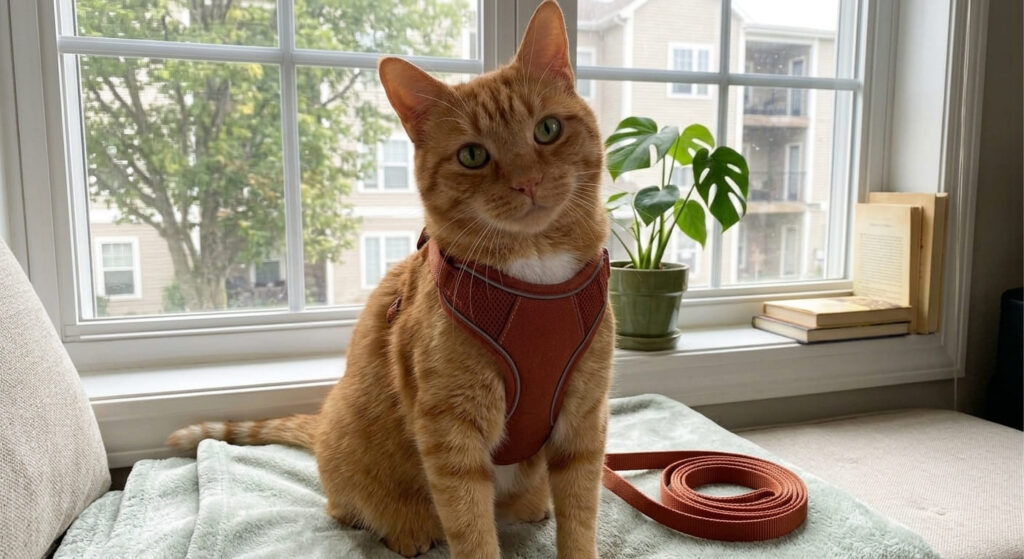
For owners who want a complete, matched harness-and-leash system with premium materials and the convenience of knowing the hardware is designed to work together, the Paws & Pals kit provides all components in a single purchase.
Technical specifications:
- Style: Escape-resistant modified H-harness with wide straps
- Closure system: Dual-Buckle + locking slide adjusters
- Leash: 4-foot bungee leash with swivel clip
- Materials: Padded nylon (chest contact points are fleece-lined)
- Sizes: XS through L
- Reflective Stitching: Strategic placement on straps
- Trachea Safety: Wide neck strap distributes pressure (not neck-free, but neck-safe)
The bungee leash advantage:
Standard fixed leashes transmit the full force of a sudden directional change directly to the harness attachment point. A bungee leash absorbs 30-40% of that sudden load through elastic extension—reducing the peak force on the harness attachment and on the cat’s body.
The appeal here is convenience. You get a matched leash and harness without guessing whether the clip, leash length, and harness hardware belong together. I would still check every adjustment point before each session, because a complete kit is only as safe as its fit.
For cats who are still developing leash tolerance and who may make sudden directional changes frequently, bungee leash absorption reduces the jarring experience that makes some cats associate leash walking with physical discomfort.
Pros:
- Complete matched set (harness + appropriate leash)
- Fleece-lined chest contact for comfort
- Dual-Buckle + locking slide (double security)
- Bungee leash reduces sudden-change impact
- Reflective Stitching on straps
- Premium feel at moderate price
Cons:
- Wide neck strap (not neck-free—monitor Trachea Safety during forward pulling)
- Bungee component has limited lifespan (replace when stretch becomes permanent)
- Modified H-style has lower escape resistance than full vest designs
- Less appropriate for confirmed escape artists
Best for: Owners who want a complete premium kit, cats with good baseline tolerance, leash walking in moderate-stimulation environments
4-Week Harness Training Plan for Indoor Cats
The best cat harness and leash for indoor cats becomes completely ineffective if the cat is so stressed by wearing it that every outing is a trauma event. Harness desensitization is not optional—it’s the foundation that makes everything else work.
Week 1: Harness as Furniture
Goal: Neutral association with harness presence
- Place the harness near Oliver’s food bowl, sleeping area, and favorite spots
- Do nothing with it except ensure it’s always present and accessible
- Rub it gently with your hands (transfers your scent) and leave it near his bed
Success criterion: Cat investigates or ignores harness; no avoidance behavior.
Week 2: Contact Without Fastening
Goal: Physical contact tolerance
Day 1-2: Drape the harness over the cat’s back during feeding (no fastening, remove immediately)
Day 3-4: Rest the harness on the cat’s back for 30-60 seconds, paired with high-value treats
Day 5-7: Practice the fitting motion (going through the harness motions without fastening)
Success criterion: Cat tolerates 60 seconds of harness contact without attempting to remove it.
Week 3: Fastened Indoor Wear
Goal: Harness tolerance under the “drag leash” condition
- Fasten the harness according to the two-finger rule
- Attach a short lightweight leash (drag leash—not held by you)
- Allow the cat to move freely around the apartment with the harness and drag leash on
- Supervise continuously; remove harness after 10-15 minutes
- Pair the harness-on period with play sessions and treat delivery
Success criterion: Cat moves normally and engages in play while wearing the harness.
Week 4: Held Leash and Environmental Expansion
Goal: Leash awareness and environmental introduction
Days 1-3: Hold the leash loosely while the cat explores the apartment; do not direct or restrict
Days 4-5: Brief apartment doorway sessions—open the door while harness/leash are on, allow the cat to look out (don’t push forward)
Days 6-7: Short hallway exploration (30-60 seconds), immediate return to apartment, enthusiastic reward
Success criterion: Cat willingly exits apartment doorway and explores hallway without panic response.
Harness training can also support door-safety practice. If your cat tries to rush the entryway, read our guide on how to stop a cat from running out the door.
FAQ
What is the most escape-resistant cat harness?
Among the best cat harness and leash for indoor cats in terms of escape resistance, the Rabbitgoo vest-style with triple closure (Velcro + two buckles) provides the highest security redundancy. The full chest panel prevents the shoulder-compression escape maneuver, the triple closure requires defeating three independent security points simultaneously, and the neck-free design eliminates the neck-loop escape pathway. No harness is completely escape-resistant against every situation—the two-finger rule fitting and proper desensitization training are the other essential components.
Is a harness better than a collar for walking?
Yes, categorically and on every relevant metric. Collars apply all leash tension directly to the trachea and cervical vertebrae—structures not designed for load bearing. Cats who pull, make sudden movements, or reach end-of-leash at speed while on a collar risk tracheal compression and cervical injury.
The best cat harness and leash for indoor cats distribute load across the chest and shoulders—appropriate load-bearing structures with significantly more tissue mass and no critical airway proximity. I do not recommend collars as a walking apparatus for any cat.
Can an indoor cat wear a harness every day?
An indoor cat can wear a harness during supervised training sessions, but it should not be left on all day. Harnesses can rub the skin, catch on furniture, or become stressful if your cat cannot move normally. Start with short sessions and remove the harness when training is over.
How tight should a cat harness be?
A cat harness should be snug but not restrictive. Use the two-finger rule at the neck, chest, and belly contact points. If you can fit more than two fingers easily, the harness may be too loose. If you cannot fit two fingers or your cat’s movement looks restricted, it is too tight.
How do I measure my cat for a harness?
Take three measurements with a flexible tape measure: neck circumference (where a collar would sit), chest circumference (the widest point of the rib cage, typically just behind the front legs), and the distance between neck and chest measurement points.
Compare these to the manufacturer’s sizing chart—not just weight recommendations, which are too imprecise for harness fitting. Always size up if between sizes (the two-finger rule can be achieved through adjustment, but a too-small harness cannot be adjusted safely). Recheck the two-finger rule at every contact point after fitting before your first use.
Ultimately, choosing the best cat harness and leash for indoor cats means balancing anatomical safety with the excitement of exploration.
Final Thoughts
The best cat harness and leash for indoor cats is the one that fits your cat’s body, matches their confidence level, and gives you control without putting pressure on the throat.
For most beginners, a vest-style harness with secure buckles is the safest starting point. For calm, trained cats, a lighter H-style harness may be comfortable for short sessions. For courtyards, balconies, and outdoor exploration, prioritize fit checks, slow training, and environments you can control.
A harness should never replace supervision. Used carefully, though, it can give an indoor cat a safe way to experience new smells, sunshine, hallway practice, and controlled outdoor enrichment.
References
- Ellis, S. L. H., & Wells, D. L. (2010). The influence of olfactory stimulation on the behaviour of cats housed in a rescue shelter. Applied Animal Behaviour Science, 123(1-2), 56-63. This peer-reviewed study documents the behavioral benefits of controlled environmental enrichment for indoor cats, supporting supervised outdoor leash exploration as a legitimate and welfare-improving enrichment intervention that engages olfactory, visual, and territorial behavioral systems unavailable in fully indoor environments.
- Bernstein, P. L., & Friedmann, E. (2014). Social behaviour of domestic cats in the human home. In S. Turner & P. Bateson (Eds.), The Domestic Cat: The Biology of its Behaviour (3rd ed., pp. 71-80). Cambridge University Press. This behavioral science reference documents feline territorial exploration behavior and the welfare benefits of controlled environmental access, providing the research foundation for harness-based outdoor enrichment as a supplement to indoor-only cat management.
-300x169.png)