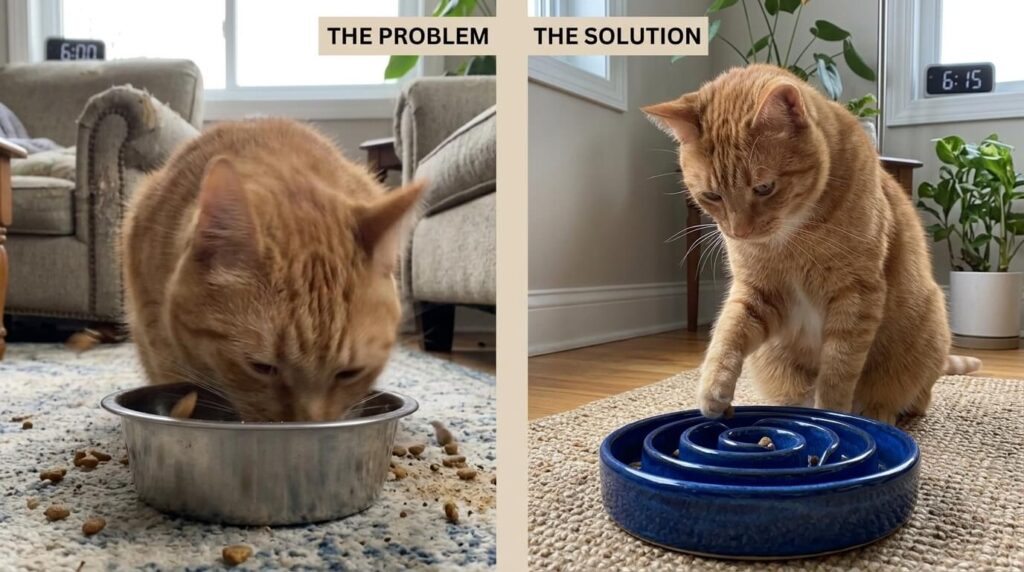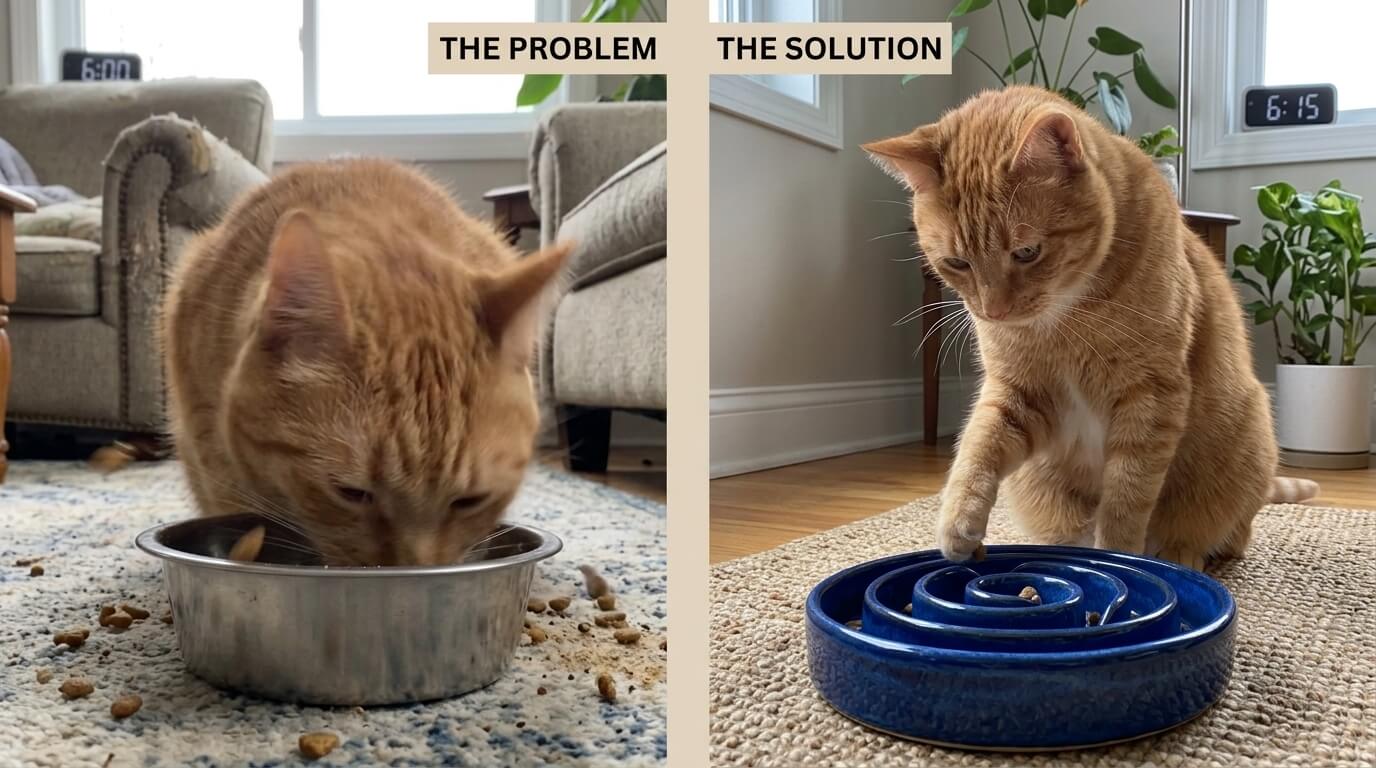
Oliver used to eat like he was attempting a world record. Fifteen seconds — I timed it — from first kibble to empty bowl, followed by a brief pause that I came to recognize as the calm before the storm, and then the specific sounds of a cat about to ruin something expensive.

My favorite rug became the primary victim of what I, as a veterinary technician, clinically refer to as Regurgitation secondary to rapid food ingestion — and what every cat owner who has experienced it calls, with complete accuracy, “Scarf and Barf” syndrome.

The search for the best slow feeder cat bowl that would actually slow Oliver down, that he would actually use, and that wouldn’t become a petri dish of bacterial biofilm within a week consumed several months of professional research and personal trial. This guide is everything I learned.

The “Scarf and Barf” pattern is one of the most common complaints I hear from cat owners at the veterinary clinic, and it’s one of the most immediately solvable — once you understand the mechanism and choose the right tool.

The best slow feeder cat bowl doesn’t just create an obstacle course for your cat’s food. It engages their predatory feeding instincts, extends mealtime to a duration that allows proper gastric processing, and turns a fifteen-second anxiety-eating event into a five-to-ten-minute behavioral enrichment session.


Quick Answer: What Is the Best Slow Feeder Cat Bowl?

The best slow feeder cat bowl features complex maze patterns that require a cat to use their tongue or paws to extract individual kibble pieces, extending mealtime from seconds to several minutes. Prioritize non-porous materials like ceramic or stainless steel to prevent Feline Acne and bacterial biofilm. These bowls effectively prevent Regurgitation, support digestion, and contribute meaningfully to weight management goals.


The Science of “Scarf and Barf”: Why Speed Kills (Digestion)

Understanding the physiology behind rapid eating and subsequent regurgitation makes the slow feeder solution feel less like a novelty product and more like the clinical intervention it actually is.

The gastric anatomy of a cat:

A cat’s esophagus connects to a stomach that, in proportion to body size, is relatively small — designed for multiple small meals of prey-sized portions rather than large bolus volumes consumed rapidly. The esophageal sphincter — the muscular valve between the esophagus and stomach — opens to allow food passage and then closes to prevent retrograde movement of stomach contents.

When a cat eats extremely rapidly, several physiological problems compound:

1. Aerophagia (Air Swallowing)
Rapid eating causes cats to swallow significant volumes of air alongside their food. This air expands in the stomach, increasing intragastric pressure. The esophageal sphincter, overwhelmed by the pressure combined with a rapidly distended stomach, relaxes — and the undigested food bolus returns up the esophagus. This is the classic “Scarf and Barf” event: regurgitation of undigested, tube-shaped food that appears within minutes of eating.

2. Gastric Distension
The stomach requires time to accommodate food through a process of mechanical relaxation — the stomach walls gradually accommodate increasing volume. Rapid ingestion outpaces this accommodation, producing sudden distension that triggers the vomiting reflex before digestion has meaningfully begun.

3. Insufficient Saliva Mixing
Feline saliva contains lubricating compounds and digestive initiation factors. Extremely rapid eating doesn’t allow adequate saliva coating of kibble pieces, meaning the food arrives in the stomach with less digestive preparation than properly chewed, coated food.

4. The Satiety Signal Lag
The neurohormonal signals that communicate “fullness” to the brain — leptin, cholecystokinin, and gastric stretch receptor signals — require approximately 20 minutes to complete their feedback loop from the gut to the hypothalamus. A cat who consumes their entire daily ration in fifteen seconds has bypassed this system entirely; because it takes 20 minutes for the brain to register fullness, a slow feeder is a critical tool in our guide to [indoor cat weight management][Best Indoor Cat Feeding Schedule (Vet-Backed Routines)], and the behavioral effect on portion perception is as significant as any dietary change.

Why some cats are more prone to Scarf and Barf:

  • Competitive eating history — cats who were raised with littermates competing for resources often develop rapid-eating patterns that persist into adulthood even in single-cat households
  • Anxiety around food access — any history of food insecurity, irregular feeding schedules, or perceived competition drives urgency
  • High-palatability food transitions — cats switching from less palatable to highly palatable food sometimes eat with enthusiasm that outpaces their capacity
  • Free-feeding elimination — cats transitioned from free-feeding (where there’s no urgency) to meal-feeding sometimes develop competitive eating behavior toward their own bowl

Material Matters: Why I Avoid Plastic Slow Feeders (Biofilm and Acne)

This is the section most slow feeder reviews skip entirely, and it’s the one with the most significant long-term health implications. The material of your cat’s feeding bowl — including slow feeder bowls — affects your cat’s health in ways that extend far beyond ease of cleaning.

The plastic biofilm problem:

Plastic, at the microscopic level, is not smooth. Even high-quality food-grade plastic develops microscopic scratches and surface irregularities from normal use — the contact of kibble pieces, the cat’s rough tongue, utensils used for portion measurement, and dishwasher cycles all contribute to a progressively more scratched surface. These microscopic scratches provide surface area and shelter for bacterial biofilm — communities of bacteria enclosed in a self-produced matrix that adhere to surfaces and resist removal by standard cleaning.

Bacterial biofilm on plastic food bowls:

  • Is not removed by rinsing or wiping — biofilm is specifically adherent to surfaces
  • Resists standard dish soap when established — enzymatic cleaners or high-heat sanitization are required
  • Continues to harbor bacteria between meals, reintroducing bacterial loads to fresh food
  • Produces the characteristic greasy, slightly tacky feel of a “clean” plastic bowl that has been in use for several months

The Feline Acne connection:

Feline Acne — technically feline chin folliculitis and furunculosis — presents as black comedones, papules, and sometimes pustules on the chin and lower lip. It is the most chronically underdiagnosed and undertreated skin condition in domestic cats, and plastic food bowls are the single most consistently implicated environmental factor in its development and persistence.

The mechanism: bacteria from the biofilm-coated bowl surface contact the chin and lip skin during eating, disrupting the normal follicular environment and contributing to the blocked follicles and secondary bacterial infection that characterize feline acne. Cats eating from plastic bowls develop feline acne at significantly higher rates than those eating from ceramic or stainless steel bowls in clinical observation.

Why this matters specifically for slow feeders:

Slow feeder bowls have significantly more surface area than flat bowls — every maze wall, ridge, and channel is additional surface area where biofilm can establish. A plastic slow feeder has vastly more biofilm-prone surface than a standard flat plastic bowl. If you are going to use a slow feeder — and you should — the material choice is more important than it would be for a simple flat bowl.

The materials that actually prevent this:

  • Ceramic (glazed): The glass glaze on food-safe ceramic creates a genuinely smooth, non-porous surface that does not develop biofilm-harboring scratches under normal use. Chip the glaze and replace the bowl — a chipped ceramic surface is no longer non-porous.
  • Stainless steel (food-grade): True food-grade stainless steel (304 or 316 grade) is non-porous and can be sanitized at temperatures that eliminate bacterial loads. It does not harbor biofilm at the material level, though it should still be cleaned daily.
  • Silicone (food-grade): An acceptable middle option. Higher quality food-grade silicone has good biofilm resistance and flexibility that makes it suitable for certain lick mat applications.

Top 5 Recommendations: Best Slow Feeder Cat Bowl (2025)

These recommendations reflect personal testing with Oliver, clinical observation in a veterinary practice setting, and evaluation against the material and design criteria outlined above. Each represents the best slow feeder cat bowl option in its specific category.


1. 🥇 The Ceramic Maze Master

Category: Premium, best overall best slow feeder cat bowl
Material: Glazed ceramic
Maze Complexity: High (multiple channels, varied widths)
Price Range: $28–$45
Dishwasher Safe: Yes (top rack)

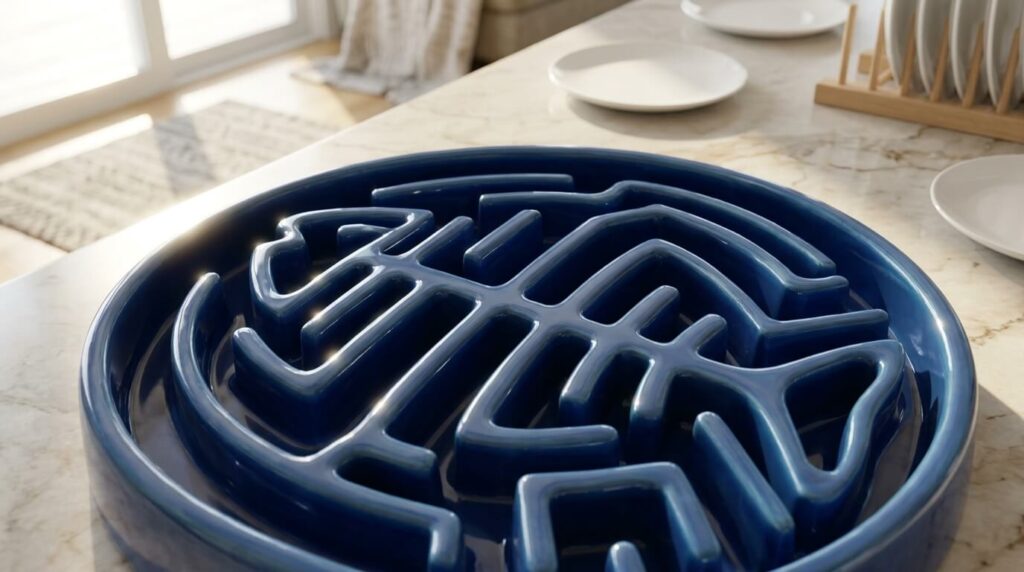
The ceramic maze slow feeder represents the best slow feeder cat bowl option for owners who prioritize hygiene, durability, and genuine effectiveness in equal measure. Glazed ceramic’s non-porous surface provides the biofilm resistance that plastic categorically cannot, and the weight of ceramic (typically 1.5–2.5 lbs for a cat bowl) prevents sliding on hard floors — one of the most common frustration triggers for cats using slow feeders.

The best ceramic maze feeders feature channels of varying widths — some narrow enough to require tongue extraction, others wide enough for paw use — which forces cats to use multiple foraging strategies. This variability extends mealtime more effectively than a uniform maze pattern and provides better behavioral enrichment value.

Pros:

  • ✅ Non-porous glazed surface prevents bacterial biofilm and Feline Acne
  • ✅ Heavy weight prevents sliding during use
  • ✅ Dishwasher Safe on top rack — genuine sanitization capability
  • ✅ Aesthetically appropriate for design-conscious households
  • ✅ Extends mealtime effectively — Oliver went from 15 seconds to 6–8 minutes
  • ✅ Long lifespan — ceramic does not degrade with cleaning over time
  • ✅ Prevents Regurgitation reliably in most Scarf and Barf cases

Cons:

  • ❌ Breakable — dropping a ceramic bowl typically ends its useful life
  • ❌ Higher upfront cost than plastic alternatives
  • ❌ Heavier to handle during cleaning
  • ❌ Maze channels may be too narrow for very large kibble sizes — check manufacturer’s kibble size compatibility
  • ❌ Limited size options — may not suit very large breeds

Best for: Adult cats of any size, households where Feline Acne is a known issue, design-conscious apartment owners, cats with established Scarf and Barf patterns.


2. 🥈 The Stainless Steel Pavement

Category: Premium hygiene, most durable best slow feeder cat bowl
Material: Food-grade stainless steel (304 grade)
Maze Complexity: Moderate (ridge and channel pattern)
Price Range: $35–$60
Dishwasher Safe: Yes (full cycle)

Stainless steel slow feeders take the hygiene advantages of the material — genuine non-porosity, dishwasher compatibility at full temperature cycles, resistance to scratching at the material level — and apply them to the slow feeder format. The result is the most hygienic option available and the one I recommend without hesitation in clinical contexts where a cat has concurrent Feline Acne or is immunocompromised.

The best stainless steel options feature a stamped or pressed pattern — ridges, channels, or a cobblestone-style surface — that requires cats to work around obstacles to access kibble. The surface of stainless steel is slightly different in texture from ceramic against a cat’s tongue, which some cats find less immediately intuitive, but most adapt within three to five feeding sessions.

Pros:

  • ✅ Most hygienic option — true non-porous material
  • ✅ Dishwasher Safe at full temperature — complete bacterial load elimination
  • ✅ Effectively unbreakable under normal use
  • ✅ No surface degradation over time — same biofilm resistance after five years as day one
  • ✅ Rust-resistant in food-grade grades
  • ✅ Prevents Regurgitation effectively through meaningful feeding time extension

Cons:

  • ❌ Highest price point of any category
  • ❌ Can slide on smooth floors — look for versions with non-slip rubber base rings
  • ❌ Some cats initially hesitant at the cool surface temperature
  • ❌ Maze complexity generally lower than ceramic options
  • ❌ Less aesthetically varied than ceramic — primarily industrial appearance

Best for: Cats with active Feline Acne, multi-cat households where bowls need full sanitization between uses, owners who want a permanent solution they’ll never replace.


3. The Interactive Licking Mat

Category: Wet food specialist, best slow feeder cat bowl for wet/raw diets
Material: Food-grade silicone
Maze Complexity: Surface texture (not channel-based)
Price Range: $12–$28
Dishwasher Safe: Yes (most models)

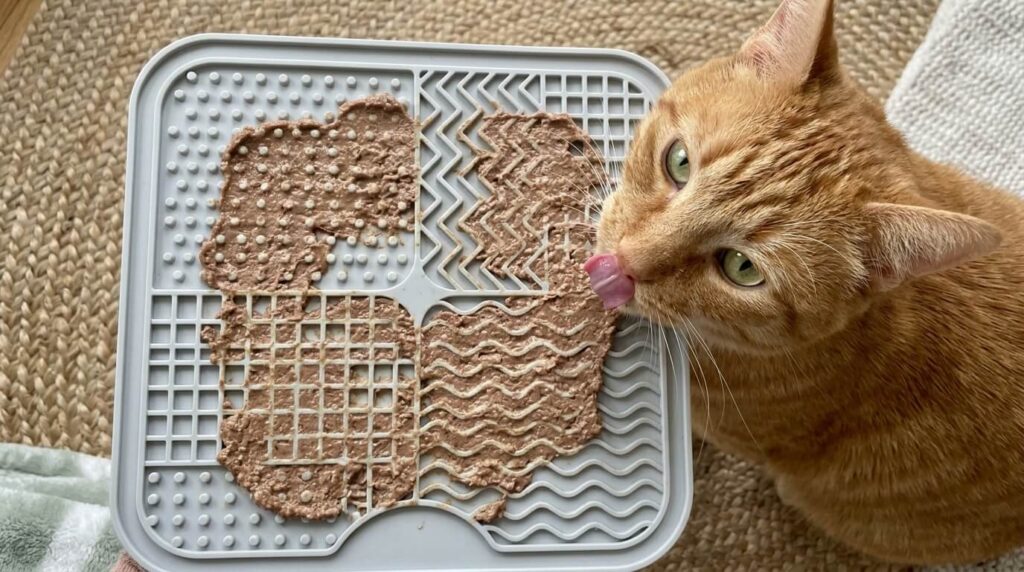
The licking mat occupies a specific niche in the slow feeder category — it’s the best slow feeder cat bowl solution for wet food, raw food, or any diet that doesn’t function in a channel-maze design. Standard maze slow feeders work with dry kibble; licking mats work with any consistency.

The mechanism is different from a maze feeder: instead of requiring navigation around physical obstacles, a licking mat requires repetitive licking across a textured silicone surface to extract food spread into the texture pattern. This licking action has an independently documented calming effect through repetitive rhythmic behavior — the neurological mechanism is similar to the self-soothing function of repetitive behaviors, and it measurably reduces mealtime anxiety in cats with food-related stress.

Pros:

  • ✅ Only slow feeder format suitable for wet food, raw, or purée diets
  • ✅ Licking action is independently calming — behavioral enrichment beyond feeding
  • ✅ Dishwasher Safe in most quality versions
  • ✅ Flat profile stores easily
  • ✅ Lower price point than ceramic or stainless options
  • ✅ Can be frozen (food loaded and frozen) for extended mealtime in hot weather

Cons:

  • ❌ Not effective for dry kibble — kibble doesn’t adhere to texture pattern
  • ❌ Food-grade silicone has higher biofilm resistance than plastic but lower than ceramic or stainless
  • ❌ Texture pattern can be difficult to clean thoroughly without dishwasher
  • ❌ Some cats reject the silicone surface texture initially
  • ❌ Less stimulating for cats who have mastered the lick pattern

Best for: Cats on wet, raw, or mixed diets, cats with dental issues who cannot work a maze feeder effectively, cats with high mealtime anxiety where the calming effect of licking is valuable.


4. The Budget-Friendly Silicone Option

Category: Accessible entry-level best slow feeder cat bowl
Material: Food-grade silicone
Maze Complexity: Simple to moderate
Price Range: $8–$18
Dishwasher Safe: Yes

The budget silicone slow feeder category has improved considerably — quality food-grade silicone at accessible price points now provides a meaningful upgrade from plastic in terms of biofilm resistance and cleaning ease, while remaining significantly less expensive than ceramic or stainless steel.

The key evaluation criteria at this price point: confirm food-grade silicone designation (not generic silicone rubber), verify Dishwasher Safe status for proper cleaning, and choose a design with meaningful maze complexity rather than shallow surface texturing that cats can work around immediately.

Pros:

  • ✅ Lowest price point for a non-plastic option
  • ✅ Better biofilm resistance than plastic
  • ✅ Dishwasher Safe for proper cleaning
  • ✅ Flexible — can be manipulated during cleaning to ensure maze channels are cleared
  • ✅ Non-sliding in most designs — silicone grips counter surfaces well
  • ✅ Suitable for initial trialing before investing in premium

Cons:

  • ❌ Lower biofilm resistance than ceramic or stainless — not suitable for cats with active Feline Acne
  • ❌ Can absorb food odors over time despite cleaning
  • ❌ Maze complexity limited in budget versions
  • ❌ Less durable than ceramic or stainless — may degrade with repeated high-heat dishwasher cycles
  • ❌ Color options limited and may fade

Best for: Budget-conscious owners, owners wanting to trial slow feeders before committing to premium options, households where Feline Acne is not a current concern.


5. The Heavy-Duty Large Breed Pick

Category: Large cats and multi-cat households
Material: Thick ceramic or heavy stainless steel
Maze Complexity: Wide channels suitable for large paws
Price Range: $40–$75
Dishwasher Safe: Yes

Maine Coons, Norwegian Forest Cats, Ragdolls, and other large domestic breeds present a specific slow feeder challenge: standard cat bowl dimensions are too small for comfortable use, standard maze channels are too narrow for large paws, and the sliding problem is more acute because large cats eat with more force. The best slow feeder cat bowl for large breeds addresses all three specifically.

Look for interior dimensions of at least 7×7 inches, maze channels wide enough to accommodate a large paw (minimum 1.5 inch channel width), and substantial weight or a non-slip base system that can withstand the feeding force of a 15–20 pound cat.

Pros:

  • ✅ Appropriately sized for large breeds — no cramped positioning during use
  • ✅ Wide channels accommodate large paws without frustration
  • ✅ Heavy construction prevents sliding under force
  • ✅ Dishwasher Safe in ceramic and stainless versions
  • ✅ Suitable for multi-cat households where one bowl serves a larger cat
  • ✅ Prevents Regurgitation in large breeds who are particularly prone due to eating volume

Cons:

  • ❌ Takes up significant counter or floor space
  • ❌ Heavier to handle for cleaning
  • ❌ Higher cost due to material volume
  • ❌ May be too large for small cats — check dimensions against your specific cat’s size
  • ❌ Fewer design options than standard-size versions

Best for: Large breed cats (Maine Coon, Ragdoll, Norwegian Forest Cat), multi-cat feeding situations, cats whose current standard-sized slow feeder is producing frustration-based food bowl aggression.


Vet Tech Pro-Tips: How to Transition a Frustrated Eater

The most common reason slow feeder trials fail is an introduction that goes too fast, producing a cat who is frustrated by the obstacle rather than engaged with it. Here is the clinical transition protocol I use.

Phase 1: Introduction Without Obstacles (Days 1–3)

Present the slow feeder bowl with the full kibble portion spread loosely across the surface — not packed into the maze channels. Your cat learns that this new object is a food source before encountering its challenge level. Reward any positive interaction with the bowl.

Phase 2: Partial Loading (Days 4–7)

Fill the maze channels to approximately 50% capacity — enough food that channels are partially accessible but not so full that the maze provides no challenge. Most cats successfully navigate this level within the first session.

Phase 3: Full Loading (Day 8+)

Load the bowl to the manufacturer’s recommended capacity. At this point, most cats have learned the navigation strategy for your specific bowl design and engage with it readily rather than with frustration.

Managing Frustration During Transition

Signs of frustration (back off one phase):

  • Pawing at the bowl repeatedly without attempting food extraction
  • Walking away from the bowl leaving significant food
  • Vocalizing at the bowl
  • Attempting to flip or tip the bowl

Signs of engagement (proceed as planned):

  • Using paws or tongue to extract individual pieces
  • Extended time at the bowl relative to baseline
  • Returning to the bowl if interrupted mid-meal
  • Showing interest in the bowl before feeding time

The Multi-Cat Complication

In multi-cat households, each cat needs their own slow feeder, and feeding should occur in separate locations simultaneously. A slow-feeding cat next to a normally-feeding cat will experience the competitive eating anxiety that drove the rapid eating pattern in the first place — creating Regurgitation despite using the correct equipment.

When Slow Feeders Aren’t Enough

If your cat continues to vomit despite consistent slow feeder use over two to three weeks — or if the vomiting includes digested food, occurs hours after eating, or is accompanied by other symptoms — the cause may be something other than eating speed.

It may be time to investigate the clinical causes of [cat vomiting we’ve detailed previously][The Complete Indoor Cat Diet Guide: Nutrition Made Simple], as chronic vomiting can indicate inflammatory bowel disease, hyperthyroidism, food intolerance, or other conditions that require veterinary diagnosis rather than behavioral management.


Frequently Asked Questions

Will a slow feeder frustrate my cat?

Some initial frustration is normal and expected — you’re asking your cat to work for food that previously required no effort. The critical distinction is between productive frustration (the cat tries different strategies, eventually succeeds, and returns to the bowl) and counterproductive frustration (the cat gives up, vocalizes excessively, or develops negative associations with the bowl).

The transition protocol above — starting with an easy loading level and gradually increasing difficulty — prevents counterproductive frustration in the vast majority of cats. If your cat is consistently walking away from a loaded slow feeder, reduce the difficulty level and extend Phase 1 and Phase 2 before proceeding. Most cats adapt fully within one to two weeks.

A small percentage of cats — particularly those with anxiety disorders or a history of food insecurity — may require a longer transition or a simpler maze design.

Can I use a slow feeder for wet food?

Standard channel-maze slow feeders are designed for dry kibble and do not function effectively with wet food — the food’s consistency doesn’t allow it to be individually extracted from channels in the way kibble can be.

For wet food, raw food, or any moist diet, a licking mat is the appropriate slow feeder format. Wet food spread across a licking mat’s texture pattern requires repetitive licking to extract, extending mealtime by several minutes and providing the same Regurgitation-prevention benefit as a maze feeder does for dry food.

Some owners use a hybrid approach — a licking mat as a slow feeder for wet food meals, and a maze bowl for any dry kibble portions — which addresses both feeding formats in the same household.

Is a ceramic or plastic slow feeder better?

Ceramic is categorically better than plastic for slow feeder applications, and the advantage is more significant for slow feeders than for flat bowls specifically. The glazed ceramic surface is non-porous, resistant to the biofilm formation that plastic develops through surface scratching, and associated with significantly lower rates of Feline Acne in clinical observation.

Plastic slow feeders have dramatically more surface area than flat plastic bowls — every maze wall and channel ridge is additional biofilm-prone surface — which makes the material disadvantage of plastic more significant in slow feeder format.

The cost difference between a quality plastic slow feeder and a quality ceramic slow feeder is typically $15–$25 — a one-time cost difference that, against the potential cost of treating chronic Feline Acne or the ongoing frustration of a persistently biologically contaminated bowl, makes the ceramic option the financially rational choice over any meaningful time horizon.

Ultimately, switching to the best slow feeder cat bowl turns a stressful mealtime into a calm, enriched experience for Oliver.


References

  1. Dantas, L. M. S., Delgado, M. M., Johnson, I., & Buffington, C. A. T. (2016). “Food puzzles for cats: Feeding for physical and emotional wellbeing.” Journal of Feline Medicine and Surgery, 18(9), 723–732. https://doi.org/10.1177/1098612X16643753
  2. Buffington, C. A. T., Westropp, J. L., Chew, D. J., & Bolus, R. R. (2006). “Clinical evaluation of multimodal environmental modification (MEMO) in the management of cats with idiopathic cystitis.” Journal of Feline Medicine and Surgery, 8(4), 261–268. Referenced for the behavioral and physiological effects of feeding enrichment and stress reduction on feline gastrointestinal and urinary health. https://doi.org/10.1016/j.jfms.2006.02.002

Oliver took four days to master his ceramic maze feeder. On day five, he sat next to it fifteen minutes before his scheduled feeding time, which told me two things: he had associated it with food, and he was developing something resembling anticipation rather than anxiety about mealtimes. The rug has been safe for eighteen months. The Scarf and Barf cycle, for our household, is over.

Share this post

Subscribe to our newsletter

Keep up with the latest blog posts by staying updated. No spamming: we promise.
By clicking Sign Up you’re confirming that you agree with our Terms and Conditions.

Related posts