The carrier used to win before I even touched it.
The moment I’d open the closet door—not even pick it up, just open the closet door—Oliver would vanish. Not into another room. Behind the washing machine. Somehow, through a gap I still don’t fully understand the geometry of, he would compress himself into a space between the appliance and the wall and become functionally inaccessible.
I’d spend twenty minutes coaxing, bribing, and eventually performing a full extraction maneuver that left both of us stressed, late for the appointment, and significantly scratched. Oliver would arrive at the clinic in a physiological state of full panic. His cortisol was through the roof. His heart rate was elevated. His pupils were completely dilated.
And then the vet would try to take him out of the carrier, which was the second battle.
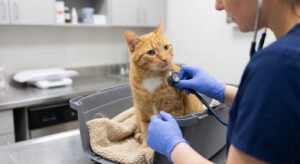
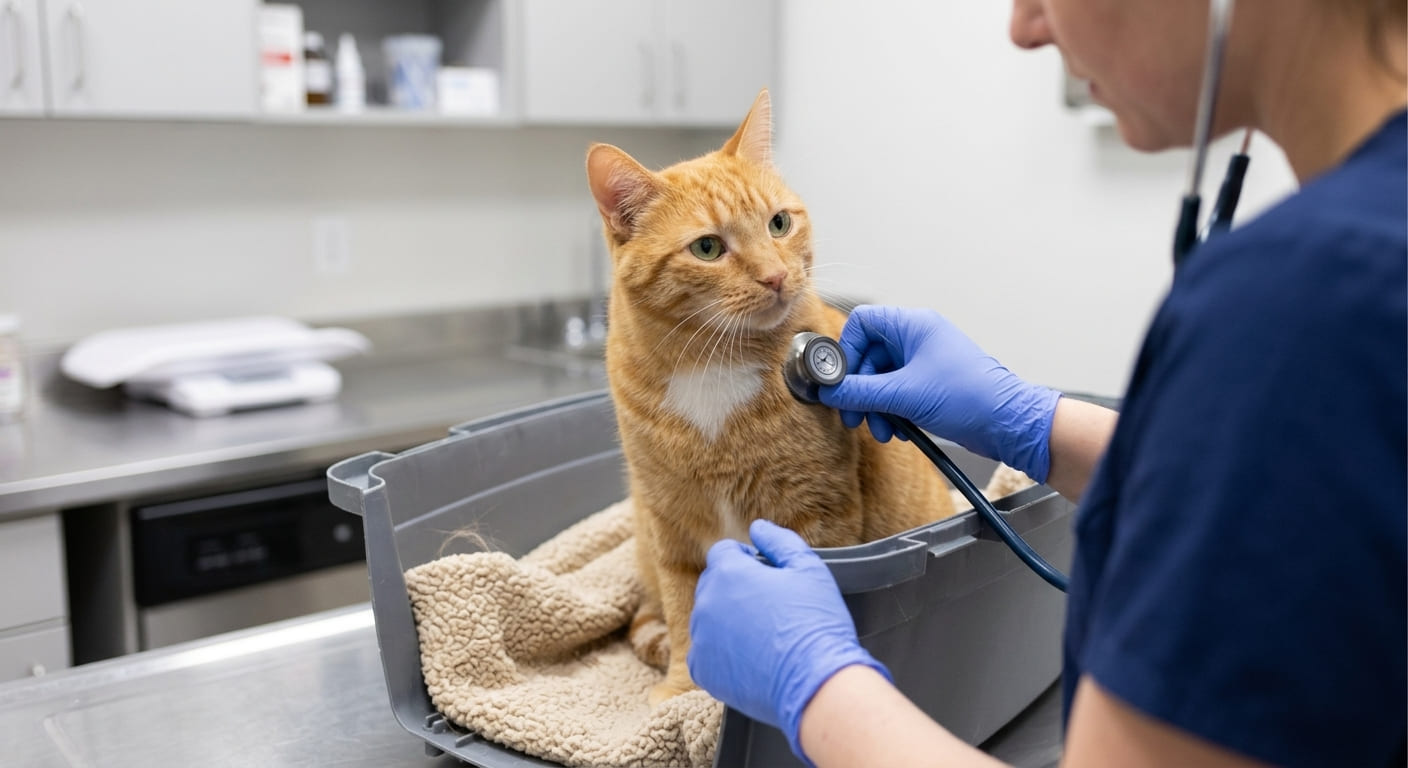
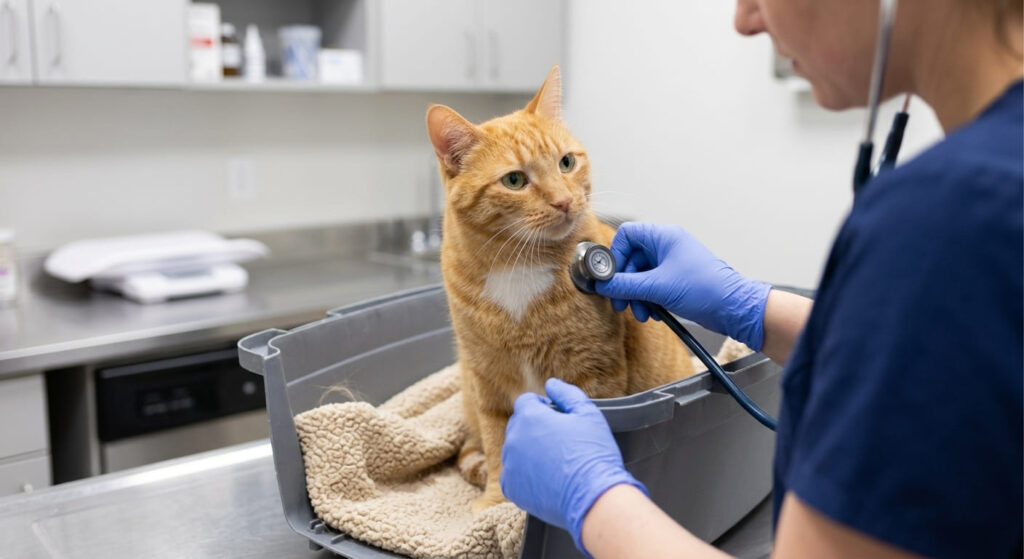
From my clinical perspective as a veterinary technician, the best cat carriers for nervous cats aren’t the ones that trap cats most efficiently—they’re the ones specifically engineered so that a skilled clinician can examine the cat inside the carrier, removing the top rather than forcing a terrified animal out of the one enclosed space they finally feel somewhat safe in.
That clinical insight changed everything I looked for in a carrier, and it’s what this entire guide is built around.
Quick Answer: How to Choose a Carrier for a Nervous Cat?
The best cat carriers for nervous cats feature multiple entry points (top-loading is non-negotiable), a Removable Top for in-carrier vet exams, and high-visibility mesh for adequate air circulation. Look for sturdy designs that accommodate a scent-soaked familiar blanket, have Seatbelt Attachment loops for car stability, and allow your cat to remain in their safe space throughout the entire veterinary visit.
The Psychology of the “Scary Box” (Why Traditional Carriers Fail)
Understanding why most carriers fail nervous cats requires understanding what the carrier represents to them neurologically.
The Negative Association Problem
For most cats, the carrier appears exactly twice a year: before a vet visit. The pattern becomes encoded rapidly:
- Carrier appears
- Cat is forced inside
- Car journey (terrifying)
- Vet clinic (overwhelming, strange smells of other stressed animals)
- Physical examination (handled by strangers)
- Return home (still stressed)
After two or three repetitions of this sequence, the carrier itself becomes a conditioned stimulus for the entire stressful experience. The physiological stress response—elevated cortisol, increased heart rate, activation of the sympathetic nervous system—begins the moment the cat sees the carrier.
This is classical conditioning operating exactly as Pavlov described. The carrier is the bell. The stress response is the salivation.
The “Strange Animal Smell” Problem in Clinical Settings
Veterinary clinics present an olfactory environment that is, from a cat’s perspective, genuinely alarming. The scent of stressed dogs, other cats, unfamiliar humans, disinfectants, and veterinary medications creates a sensory load that primes the threat-detection system before any examination begins.
Research in feline stress during transport and veterinary visits has consistently shown that cats’ stress responses are significantly higher in traditional front-entry-only carriers because:
- Forced extraction from the carrier requires physical handling of an already-stressed animal
- The transition from the carrier (known) to the examination table (unknown) represents a complete loss of safe-space access
- Recovery from the stress response is significantly slower when the cat has no enclosed safe space to retreat to during the visit
What the Best Carriers for Nervous Cats Actually Solve
The design innovations that matter—and what I specifically look for as a vet tech—solve specific problems in the examination process:
Problem: Cat won’t come out of carrier.
Solution: Removable Top allows examination inside the bottom shell.
Problem: Cat re-enters carrier immediately after being placed on table.
Solution: Open-top design allows the cat to be examined while partially in the carrier.
Problem: Carrier smells like “vet visit.”
Solution: Carriers designed to accommodate a large familiar blanket that saturates the carrier interior with home scent.
Problem: Car travel amplifies stress before arrival.
Solution: Seatbelt Attachment prevents carrier movement, which reduces the vestibular stress of unpredictable motion.
Top 3 Features Every Vet Tech Prays You’ll Look For
After years of receiving cats in every carrier configuration imaginable, these are the three features that genuinely change the clinical experience for nervous cats.
Feature #1: Top-Loading Entry
This is the single most underrated carrier feature for nervous cats, and I cannot overstate its practical importance.
Why top-loading matters:
A cat lowered gently into a carrier from above is a fundamentally different physical experience than a cat pushed through a front opening. The front-loading maneuver requires the cat to move forward into the carrier—against their instinct to pull backward from a perceived threat. The top-loading maneuver works with gravity and doesn’t require the cat to feel “trapped” by the entry motion.
In the clinic: top-loading carriers allow us to lower the cat back into the carrier between procedures rather than the nightmare of front-entry replacement, which requires either trapping the cat against the table or attempting to maneuver a stressed, clinging cat through a small front opening.
The best cat carriers for nervous cats will have both front AND top entry. The top for insertion and in-clinic access; the front for willing exits when the cat is comfortable enough.
Feature #2: Removable Top (The Game-Changer)
This is the feature I specifically request my clients look for, and the one that I can confirm makes a measurable difference in examination quality and cat stress levels.
What happens in the clinic with a removable top:
- Cat arrives in carrier (already stressed)
- Carrier is placed on exam table
- Removable Top is unclipped and lifted away
- Cat remains in the bottom shell of the carrier, surrounded by familiar scent
- Examination is conducted with the cat in the carrier base
- Cat never loses access to their perceived safe space
Cats examined in the carrier base consistently show:
- Lower vocalization during examination
- Less active resistance to handling
- Faster recovery of normal behavior after the visit
- Reduced necessity for restraint holds
The best cat carriers for nervous cats that offer this feature are universally better for both the cat and the clinician.
Feature #3: Seatbelt Attachment
Car travel is a significant stressor for most nervous cats, and the unpredictable lateral movement of a carrier sliding across a back seat amplifies the vestibular stress response considerably.
A carrier with integrated Seatbelt Attachment loops—positioned to allow the seatbelt to pass through the handle or around the carrier body—sits stable during braking, acceleration, and cornering. The cat inside experiences significantly less unexpected movement.
This is not a luxury feature. It is also a safety feature: an unsecured carrier that becomes a projectile in an accident is a risk to both the cat and the vehicle occupants.
Top 5 Recommendations: Best Cat Carriers for Nervous Cats (2025)
🥇 The Hard-Shell Tank: Sleepypod Mobile Pet Bed
Price: $159 – $179
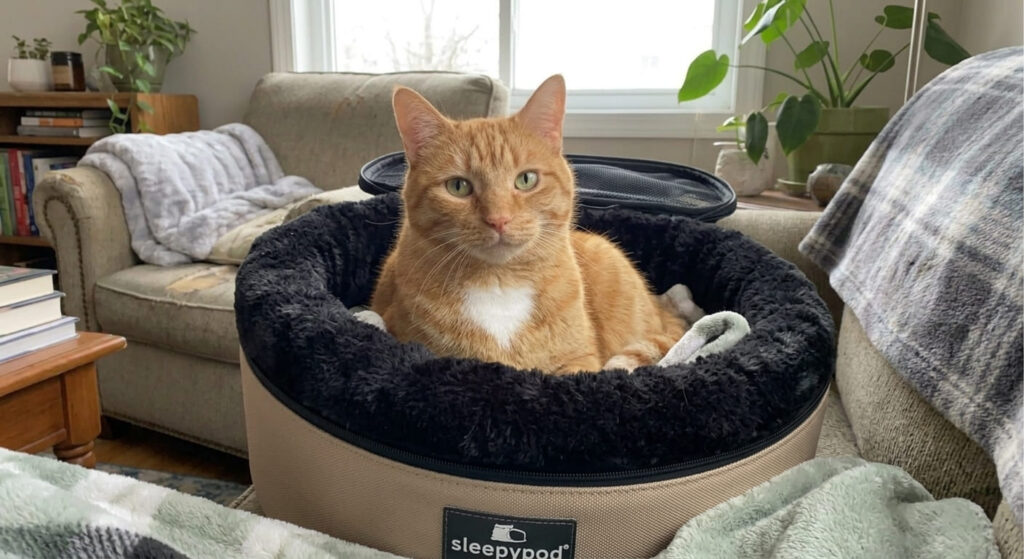
The Sleepypod addresses the fundamental problem of negative association through the cleverest design solution in this category: it functions as a cat bed in normal daily life.
This is the carrier that lives in my living room permanently. Oliver sleeps in it. He naps in it. He sometimes simply sits in it for no discernible reason. The carrier has zero negative association because it is not experienced as a carrier—it’s experienced as furniture.
Technical specifications:
- Structure: Hard ABS shell with plush interior
- Entry: Top zip entry (full top opening)
- Removable Top: Yes—top unzips completely and folds back
- Seatbelt Attachment: Yes—integrated strap loops
- Ventilation: Full 360-degree mesh windows
- FAA approval: Approved for under-seat airline cabin travel
- Interior dimensions: Approximately 17″ L × 11″ W × 10.5″ H (appropriate for cats up to 15 lbs)
- Weight: 4.5 lbs
The “permanent furniture” strategy:
The Sleepypod sits open in my living room with Oliver’s favorite blanket inside. I add a worn item of my clothing periodically to reinforce the “safe home scent” profile. Oliver has slept in it voluntarily hundreds of times. When I need to take him to the clinic, the transition from “napping in the Sleepypod” to “in a carrier going to the vet” is genuinely seamless.
In the clinic:
The full top opening and Removable Top design allow complete examination access with Oliver remaining in the plush interior. His stress levels at the clinic have dropped measurably since switching to this carrier. I have no unbiased way to quantify this, but the veterinarians I work with have commented on it independently.
Pros:
- Permanent bed-as-carrier eliminates all negative association
- Full top opening for lowest-stress loading
- Removable Top for complete clinical access
- Seatbelt Attachment for secure car travel
- FAA cabin approval for air travel
- Plush interior supports comfort during travel
- Available in multiple colors
Cons:
- Premium price point
- Heavier than soft-sided alternatives (4.5 lbs)
- Round design takes up more space than rectangular carriers
- Plush interior requires regular washing
Best for: Owners who want to permanently eliminate carrier anxiety through desensitization, multi-modal travelers (car and air), cats with severe negative carrier association
🧳 The Luxury Soft-Sided: Sherpa Original Deluxe Carrier
Price: $55 – $80
The Sherpa Original Deluxe is the carrier I recommend when owners need an airline-compliant soft-sided option that doesn’t sacrifice the clinical features that matter for nervous cats.
Technical specifications:
- Structure: Soft-sided with rigid internal frame
- Entry: Front zip entry + top zip entry (dual access)
- Removable Top: Partial (top zip opens fully for access)
- Seatbelt Attachment: Yes—Seatbelt Attachment latch integrated in handle
- Ventilation: Mesh panels on front, both sides, and top
- Airline approval: Major airline approved for under-seat
- Interior dimensions: Available in three sizes (S/M/L)
- Weight: 2 lbs
The dual-access advantage:
The combination of front and top entry makes the Sherpa more versatile than single-entry carriers for nervous cats. Top entry for loading at home (using the blanket-saturation strategy), front entry for willing exits in clinical contexts when the cat is ready to emerge voluntarily.
The mesh panels provide excellent visibility—which matters for two reasons:
- The cat can see you, which maintains some social comfort during the journey
- You can monitor the cat’s respiratory rate and comfort level during travel
Pros:
- Dual front and top entry
- Seatbelt Attachment in handle
- Airline compliant for cabin travel
- Lightweight (2 lbs) for easier transport
- Multiple size options
- Good ventilation through multi-panel mesh
Cons:
- Soft sides mean less structural protection than hard-shell
- Removable Top is partial rather than complete (full-shell removal not possible)
- Soft interior offers less stability during examination
- Requires careful size selection for larger cats
Best for: Air travelers, owners who need a lightweight carrier, cats who are moderately anxious rather than severely reactive
⬆️ The Top-Loading Specialist: Petmate Two Door Top Load Kennel
Price: $35 – $55
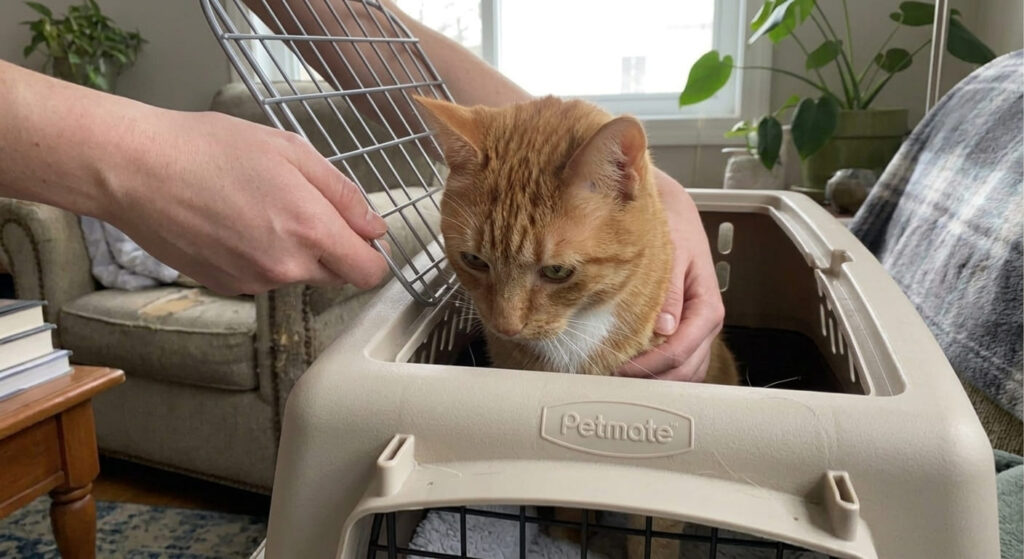
For owners whose primary challenge is getting the cat into the carrier—rather than the clinical examination itself—the Petmate Two Door Top Load is the most practical solution at an accessible price point.
Technical specifications:
- Structure: Hard polypropylene shell
- Entry: Front door + full top door (dual access)
- Removable Top: Yes—top section unclips completely from bottom shell
- Seatbelt Attachment: Yes—handle accommodates standard seatbelt
- Ventilation: Ventilation slots on sides and rear
- IATA compliance: Appropriate for checked airline travel
- Interior dimensions: Available in S/M/L/XL sizes
- Weight: 5-8 lbs depending on size
The clinical examination advantage:
The fully removable top section means the cat can be examined in the carrier base at the clinic—the ideal scenario for the best cat carriers for nervous cats in a clinical setting. This is the design feature I specifically look for when recommending carriers to clients whose cats have medical conditions requiring frequent veterinary visits.
Reducing transport stress is the first step to ensuring your cat stays on schedule with their essential veterinary visits and vaccinations—because owners who dread the carrier battle are owners who delay appointments. [Does My Indoor Cat Really Need Annual Vet Visits? (Yes, Here’s Why)]
Pros:
- Full top-door loading (lowest-stress insertion method)
- Removable Top for complete clinical access
- Hard shell provides protective structure
- Seatbelt Attachment compatible
- Most affordable hard-shell option with full top access
- Multiple size options including XL for large breeds
Cons:
- Heavier than soft-sided options
- Ventilation slots (not mesh) provide less airflow than mesh designs
- Less aesthetically refined than premium options
- Not airline cabin approved (checked luggage only)
Best for: Owners whose primary challenge is loading, cats who require frequent clinical visits, budget-conscious owners who need hard-shell protection
🏠 The Expandable Studio: Petsfit Expandable Cat Carrier
Price: $65 – $90
For longer journeys—road trips, extended travel, or situations where the cat will spend significant time in the carrier—the expandable design of the Petsfit carrier addresses the welfare concern that standard carriers don’t accommodate movement or positional comfort during extended confinement.
Technical specifications:
- Structure: Soft-sided with multiple rigid support frames
- Entry: Front + top + side (triple access)
- Expandable section: Side panel expands to add approximately 30% additional interior space
- Removable Top: Yes—top unzips fully
- Seatbelt Attachment: Yes—integrated loops
- Interior dimensions (expanded): Approximately 21″ L × 13″ W × 13″ H
- Weight: 3.5 lbs
The expandable design in practice:
During travel, the expansion panel remains collapsed—standard carrier dimensions for stability. At rest stops, hotel rooms, or the clinic waiting area, the expansion panel can be deployed to give the cat more space to stand, turn, and reposition.
For cats who manage short journeys adequately but show distress during longer travel, the ability to provide more space during stationary periods is a meaningful welfare improvement.
For extremely anxious cats, the right carrier is one component of a broader stress management approach—it works most effectively in combination with the pheromone sprays and calming techniques that help lower baseline anxiety before and during transport. [How to Train Your Cat to Like Their Carrier (Stress-Free Vet Trips)]
Pros:
- Triple entry points (maximum clinical access flexibility)
- Expandable design for extended travel welfare
- Removable Top for clinical access
- Seatbelt Attachment integrated
- Lightweight relative to feature set
- Airline cabin approved in standard configuration
Cons:
- Multiple zippers require practice to operate smoothly
- Soft sides offer less protection than hard-shell
- Expansion panel adds bulk when deployed
- Higher price for soft-sided category
Best for: Extended travel situations, owners who road trip with cats, situations where waiting room time is significant
💎 The Premium Clinical Choice: Sturdi Products SturdiBag Flexible Carrier
Price: $99 – $130
The SturdiBag is the best cat carriers for nervous cats choice that consistently impresses veterinary staff across all the clinical features that matter for examination.
Technical specifications:
- Structure: Soft-sided with flexible spring-steel frame that compresses flat for storage
- Entry: Top + front + side (triple access)
- Removable Top: Full top panel unzips and rolls back
- Seatbelt Attachment: Integrated strap loops on base
- Ventilation: Mesh panels on all four sides and top
- Weight: 2.5 lbs
- Interior dimensions: Available in M/L/XL
The 360-degree mesh distinction:
Most carriers have mesh on the front panel and possibly one or two sides. The SturdiBag’s 360-degree mesh provides the most comprehensive air circulation in this comparison and—importantly—the most visibility in all directions.
For nervous cats, visibility in all directions (rather than one front-facing mesh panel) reduces the sensory isolation that contributes to carrier stress. The cat can see you, see the environment, and orient themselves spatially throughout the journey.
Pros:
- 360-degree mesh for maximum ventilation and visibility
- Full Removable Top for complete clinical access
- Triple entry points
- Compresses flat for storage
- Seatbelt Attachment on base
- Lightweight for premium feature set
- Available in size appropriate for large breeds
Cons:
- Premium price point
- Soft-sided (less structural protection than hard-shell)
- Spring-steel frame requires care to avoid compression damage
- Limited color options
Best for: Owners who prioritize clinical access features, cats who benefit from maximum ventilation, owners willing to invest in the best cat carriers for nervous cats on the market
How to Desensitize Your Cat to the Carrier (The “Living Room” Strategy)
The most effective carrier desensitization protocol requires one thing above all else: time. This is not a one-weekend project. It’s a 4-6 week behavioral reprogramming process.
The Core Principle
The carrier must become neutral furniture before it becomes a transportation device.
If the carrier only appears before vet visits, it will always predict vet visits. If the carrier lives in the living room and is associated with positive experiences continuously, it loses its predictive power.
The Protocol
Week 1-2: Carrier as Furniture
- Place the open carrier in a high-traffic area of your apartment
- Remove the door or prop it permanently open
- Do nothing with it except ensure it’s always present
Week 2-3: Positive Association Building
- Place high-value treats just inside the carrier entrance daily (never lure the cat in—let them investigate voluntarily)
- Feed meals adjacent to the carrier, then gradually closer, then just inside the entrance
- Place a worn item of your clothing inside the carrier
Week 3-4: Voluntary Entry Reinforcement
- When your cat enters the carrier voluntarily, immediately provide a high-value treat (without making a fuss)
- Never close the door during this phase
- Add the cat’s preferred sleeping blanket to the interior
Week 4-6: Door Introduction
- Begin closing the door for 10-second intervals while the cat is eating inside, then open immediately
- Increase duration gradually: 30 seconds, 1 minute, 5 minutes
- Never progress faster than the cat is comfortable
Week 6+: Brief Mock Journeys
- Carry the closed carrier to a different room and immediately return (treat immediately after opening)
- Brief car trips (to the end of the driveway and back)
- Gradually extend duration
FAQ
What is the most stress-free cat carrier?
The Sleepypod Mobile Pet Bed is the most stress-free carrier I’ve tested among the best cat carriers for nervous cats because it eliminates the negative association problem entirely by functioning as everyday furniture.
When a cat has slept in their carrier hundreds of times before a vet visit, the carrier has no predictive power for stress. For cats who require immediate improvement without a 6-week desensitization protocol, the Petmate Two Door Top Load offers the best combination of top-loading ease and Removable Top for clinical examination.
Should I get a hard or soft carrier for a nervous cat?
Both can work as the best cat carriers for nervous cats when they have the right features. Hard carriers provide more structural protection and are often more durable, but they’re heavier. Soft carriers are lighter and often provide better ventilation through mesh panels, but offer less protection in vehicle accidents.
The more important variables are: Does it have a Removable Top? Does it have top-loading access? Does it have Seatbelt Attachment? A soft carrier with all three features is more appropriate for nervous cats than a hard carrier with none of them.
How do I get a resistant cat into a carrier?
For cats who resist front-entry loading, the top-loading technique is significantly more effective: hold the cat securely against your chest, lower them gently hindquarters-first into the top opening, and close the top before releasing. The carrier should contain a familiar blanket and have been sprayed with Feliway 30 minutes before use.
If your cat is severely resistant, the 6-week desensitization protocol described above is the long-term solution. Using the best cat carriers for nervous cats with top-loading design makes the physical process dramatically easier even before desensitization training is complete.
Scientific References
- Rodan, I., Sundahl, E., Carney, H., Gagnon, A. C., Heath, S., Landsberg, G., … & Seksel, K. (2011). AAFP and ISFM feline-friendly handling guidelines. Journal of Feline Medicine and Surgery, 13(5), 364-375. These consensus guidelines from the American Association of Feline Practitioners document the clinical evidence for stress-reduction handling techniques including in-carrier examination, Removable Top protocols, and transport stress management—directly supporting the clinical design features identified as non-negotiable in the best cat carriers for nervous cats.
- Grigg, E. K., Pick, L., & Nibblett, B. (2013). Litter box preference in domestic cats: Covered versus uncovered. Journal of Feline Medicine and Surgery, 15(4), 280-284. While primarily examining enclosed space preference, this study’s findings on feline preference for enclosed, scent-familiar spaces with controlled entry points provides behavioral science support for the carrier design features—particularly the familiar-scent saturation strategy and enclosed-space security that the best cat carriers for nervous cats are designed to provide.