There is a specific sensory experience that every cat owner in a small apartment knows intimately, and it is the 3 AM barefoot journey to the kitchen that ends with the unmistakable crunch of clay granules against the hardwood under your feet.
Not the worst thing that can happen at 3 AM, but deeply demoralizing in a way that is disproportionate to the objective size of the problem. Oliver escalated matters approximately six months after I adopted him by tracking a visible trail of fine clay dust from the bathroom litter box, across fourteen feet of living room, and directly onto the white duvet cover I had purchased with the optimistic belief that I could maintain nice things and have a cat simultaneously.
That duvet incident launched what I can only describe as a professional investigation into the best cat litter mat for tracking — one that engaged my veterinary technician knowledge of feline paw anatomy and led me significantly deeper into the biomechanics of granule transport than I had anticipated needing to go.
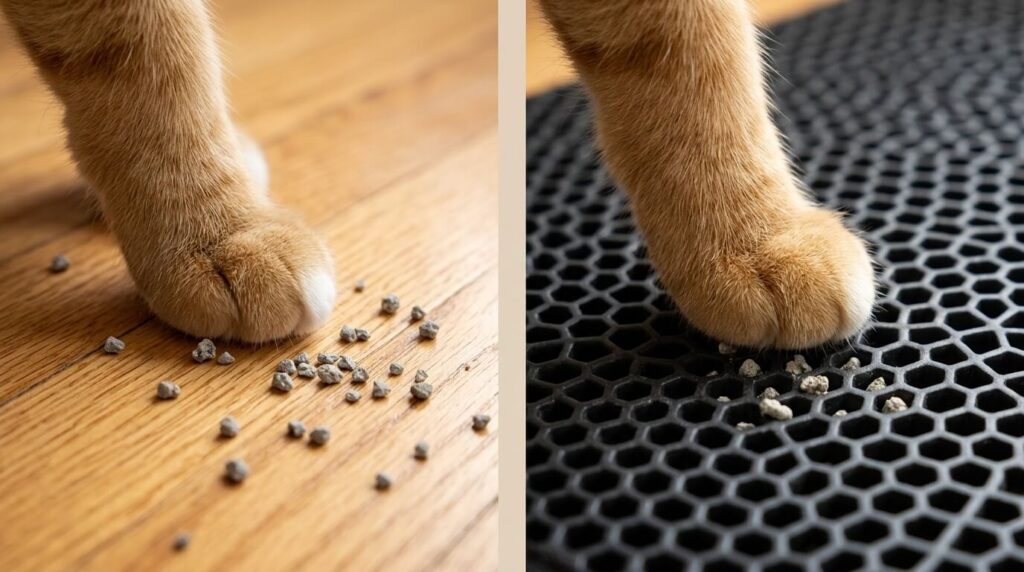
What I discovered is that litter tracking is not random — it follows predictable patterns based on paw pad anatomy, granule size, and the physics of friction-based release. Understanding those patterns makes mat selection significantly more logical than picking whatever has the best ratings, and it explains why some highly-rated mats fail completely for certain cats and litter types.
This guide covers the science, the safety considerations that most reviews miss entirely, and the five best cat litter mat for tracking solutions I’ve found for apartment use specifically.
Quick Answer: What Is the Best Cat Litter Mat for Tracking?
The best cat litter mat for tracking uses a Double-Layer Design with a honeycomb surface that physically dislodges granules from paw pads, and a waterproof lower layer that contains them until cleaning. For small apartments, prioritize Phthalate-Free materials, soft enough texture to prevent Paw Pad Sensitivity and litter box aversion, and dimensions large enough to capture the full exit trajectory of your specific cat.
The Physics of Tracking: Why Granules End Up in Your Bed
This section exists because understanding the mechanism of litter tracking changes which mat features you prioritize. Most reviews describe mat features without explaining why those features work — or don’t — for specific litter types and specific cat behaviors.
The paw pad anatomy relevant to tracking:
A cat’s paw pad consists of a central large pad (the metacarpal or metatarsal pad) and four smaller digital pads on each foot, all covered in a thick, slightly textured epidermis. Between the digital pads, cats have interdigital spaces — the areas between the toes — where fur grows and where granules are most persistently retained.
The interdigital spaces are the primary litter transport mechanism. Granules that fall onto the top surface of the paw during digging and covering behavior typically dislodge on the cat’s first few steps. Granules that become lodged in the interdigital spaces between the toe pads are retained through several mechanisms:
- Compression: The cat’s weight compresses the interdigital space as each foot strikes the ground, pressing granules deeper into the space rather than releasing them
- Electrostatic adhesion: Fine clay and silica dust particles develop electrostatic charges through the friction of litter box use, causing them to adhere to both the fur and the pad surface
- Claw groove retention: Granules lodged in the groove at the base of retracted claws are released gradually as the cat walks, producing the trailing crumb pattern rather than a concentrated deposit
Why this matters for mat selection:
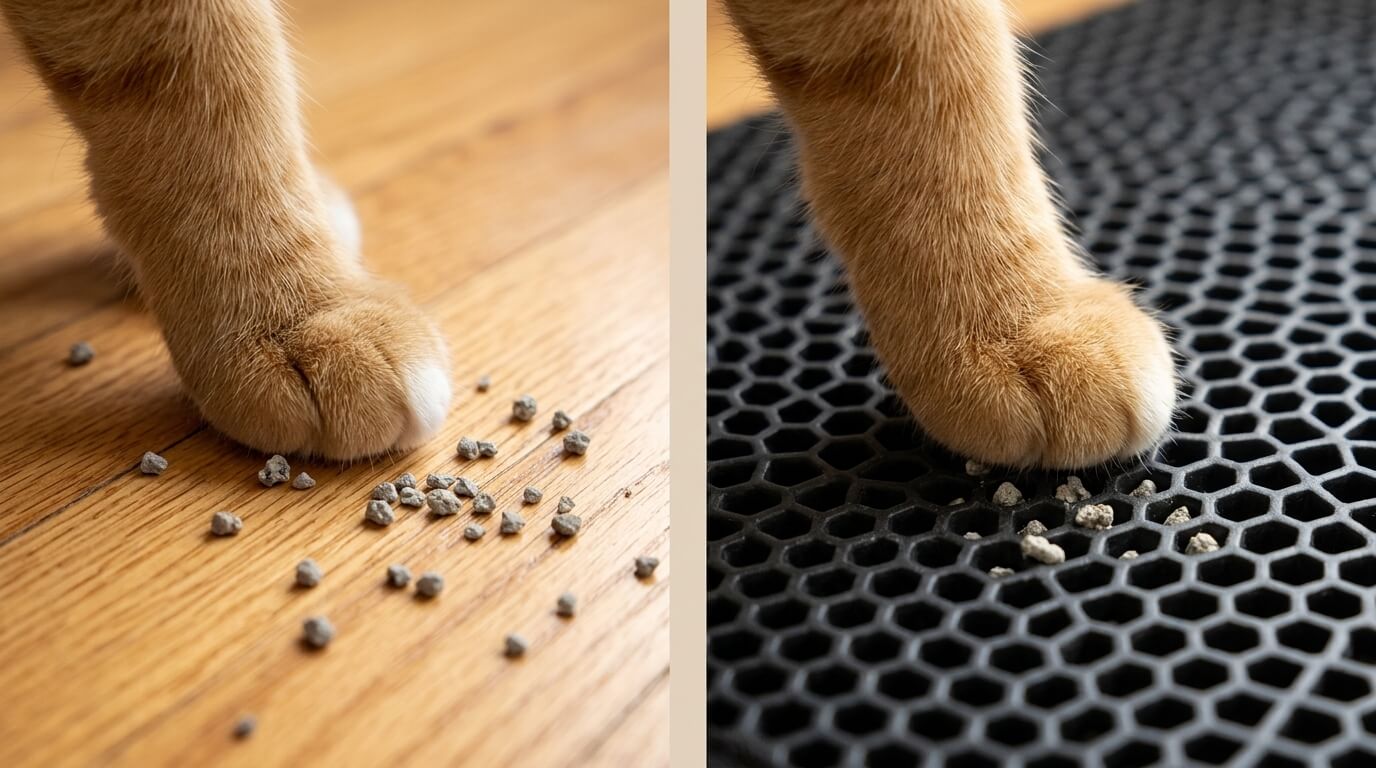
A mat that requires the cat to push downward against the surface — walking across deep grooves or honeycomb cells — uses the compression mechanism in reverse, opening the interdigital space and allowing granules to fall through. A flat or shallow-surface mat provides insufficient mechanical engagement with the interdigital space to dislodge lodged granules effectively.
The trajectory problem:
Most cats don’t stop immediately after exiting the litter box — they take two to five steps before slowing or stopping. A mat that only covers the immediate exit area will catch the granules from the first step but miss everything deposited on steps two through five. For small apartments where the litter box is typically in a bathroom with limited floor space, this means granules are reaching tile or hardwood within two feet of the box exit.
The dust vs. granule distinction:
Clay litter produces two distinct tracking materials with different mat requirements. Granules — intact clay particles of 1–3mm — are mechanically captured by honeycomb cells and deep grooves. Dust — the fine particulate produced by granule fragmentation during digging — requires a different trapping mechanism: dense fiber that captures the particulate through surface area contact rather than mechanical pocket containment.
This is why clay litter often benefits from a mat that combines both mechanisms, while crystal litters (low dust, larger particles) may be adequately controlled by a honeycomb-only design.
The Vet Tech Paw-Check: Texture and Material Safety
This section addresses the aspects of litter mat selection that most consumer reviews don’t cover, and they are the aspects with the most significant consequence for both your cat’s health and your long-term litter box management success.
The litter box aversion risk:
If your cat finds the mat texture painful or “pokey,” it can lead to them avoiding the litter box entirely — a behavior pattern that can escalate into inappropriate elimination we’ve analyzed in depth in [our complete litter box aversion guide][How to Hide a Litter Box in a Small Apartment (5 Clever Ideas)]. This is the most clinically significant mat-selection consequence, and it’s entirely preventable with appropriate texture evaluation.
Paw Pad Sensitivity varies between individual cats. Factors that increase sensitivity:
- Declawed cats — the altered weight distribution and exposed tissue of a declawed paw is significantly more sensitive to surface texture
- Cats with interdigital cysts or furuncles — painful interdigital lesions make any mat texture potentially aversive
- Kittens and senior cats — paw pad tissue is thinner and more sensitive at both ends of the age spectrum
- Cats transitioning from softer litter substrates — a cat accustomed to fine-grain silica or paper-based litter may find a stiff honeycomb mat more aversive than a cat used to clay
Material safety considerations:
Phthalate-Free certification matters for cat litter mats specifically because cats groom their paws after litter box use — any material residue on the mat surface that transfers to the paw pads will be orally ingested during grooming. Phthalates are plasticizers used in many soft plastic and rubber products that have documented endocrine-disrupting effects in mammals.
Look for mats that specifically state Phthalate-Free and, where possible, provide material safety certifications. Mats described only as “non-toxic” without specific compound testing documentation are making a claim that is difficult to verify.
Additional material concerns:
- BPA — bisphenol A in plastic components; look for BPA-free certification
- Heavy metal pigments — cheap mats with bright colors occasionally use pigment systems that contain heavy metal compounds; avoid mats without material sourcing information
- Antimicrobial chemical treatments — some mats are treated with biocidal chemicals for odor control; these can irritate Paw Pad Sensitivity and are potentially ingested during grooming
The waterproof layer requirement:
A mat without a waterproof bottom layer allows urine — from cats who urinate slightly outside the box, or from mat-adjacent splashing — to penetrate the mat and reach the floor beneath, creating a bacterial reservoir that is effectively impossible to clean without mat removal. Waterproof backing is not optional for clinical hygiene; it is a baseline requirement.
While a mat catches 90% of the litter tracking mess, regular mopping with cat-safe floor cleaners is still required to eliminate microscopic bacterial spread from paw contact — a topic we’ve covered in detail in [our guide to maintaining hygienic cat spaces in apartments][How to Stop Cat Litter Tracking All Over Your Apartment].
Top 5 Recommendations: Best Cat Litter Mat for Tracking (2025)
1. 🥇 The Double-Layer Honeycomb Champion
Category: Best overall best cat litter mat for tracking
Material: Phthalate-Free EVA foam, Double-Layer Design
Size Options: 24″×35″ standard; 30″×35″ large
Waterproof: Yes (lower collection layer)
Price Range: $25–$45
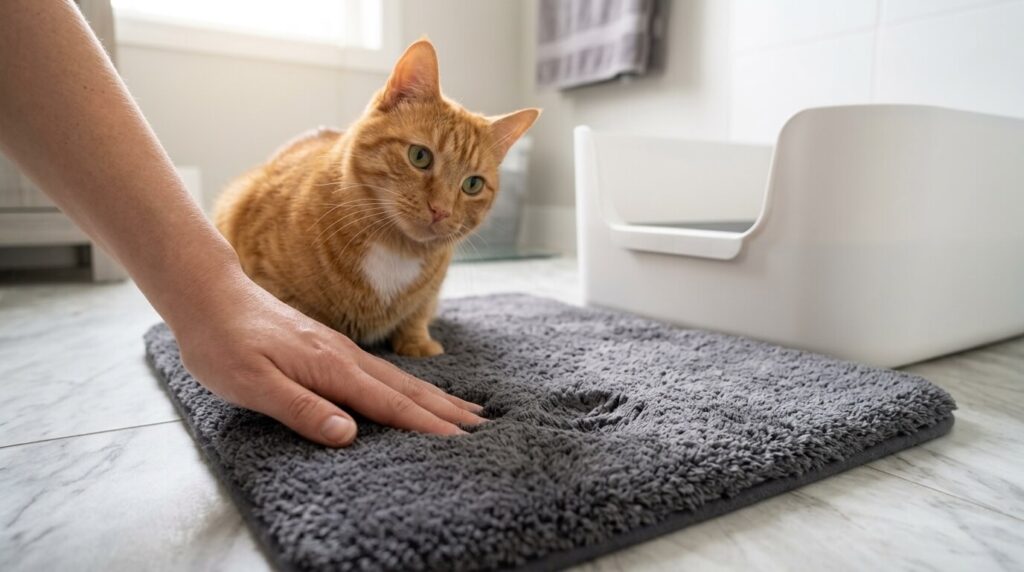
The Double-Layer Design honeycomb mat is the mechanical benchmark for the best cat litter mat for tracking category because it directly addresses the interdigital space physics described above.
The upper layer consists of a grid of honeycomb cells — hexagonal or square openings of approximately 8–12mm width — that mechanically engage the paw as weight is applied, pushing the digital pads downward and opening the interdigital spaces. Granules fall through the openings into the lower solid-base collection layer, where they remain contained until you clean the mat.
The critical feature is the Double-Layer Design separation: the upper honeycomb layer and the lower collection layer are distinct pieces that separate for cleaning, with the upper layer capturing granules through mechanical engagement and the lower layer containing them. Single-layer honeycomb mats that don’t include a collection layer allow granules to fall through and land on the floor beneath — achieving granule dislodgement but not containment.
Soft vs. firm honeycomb — the critical choice:
Standard EVA foam honeycomb mats come in two firmness levels: standard density (firmer, more durable, better for large granule capture) and softer density (more Paw Pad Sensitivity friendly, but slightly less mechanically aggressive on granule release). For sensitive cats or declawed cats, softer density is the appropriate choice even if granule capture efficiency is marginally lower.
Pros:
- ✅ Double-Layer Design provides both dislodgement and containment
- ✅ Phthalate-Free EVA foam in quality versions
- ✅ Mechanically effective for granules 1mm and larger
- ✅ Waterproof lower collection layer
- ✅ Separates easily for cleaning
- ✅ Available in sizes adequate for full exit trajectory coverage
- ✅ Most cost-effective option with genuine mechanical efficacy
Cons:
- ❌ Less effective for fine dust — honeycomb cells don’t capture particulate
- ❌ Firmer versions may cause Paw Pad Sensitivity in declawed or sensitive cats
- ❌ Granules in collection layer must be emptied — can’t simply vacuum the surface
- ❌ Edges may curl over time in high-humidity bathroom environments
- ❌ Some cats initially avoid the hexagonal texture — requires acclimation
Best for: Standard clay litter users, households with large granule litter types, owners prioritizing mechanical capture efficiency over texture softness.
2. 🥈 The Soft Microfiber Magnet
Category: Best for sensitive paws and dust capture
Material: Microfiber upper layer, waterproof TPR base
Size Options: 20″×30″ standard; 24″×35″ large
Waterproof: Yes (TPR base)
Price Range: $20–$40
The microfiber mat category represents the best cat litter mat for tracking solution for three specific situations: cats with Paw Pad Sensitivity who reject firmer honeycomb textures, litter types that produce significant fine dust alongside granules, and households where mat softness is prioritized for multi-use (human and cat foot traffic in shared bathroom spaces).
Microfiber’s tracking capture mechanism is different from honeycomb — rather than mechanical pocket containment, microfiber relies on the enormous surface area created by split microfiber strands to capture granules and dust through friction and fiber entrapment. A high-quality microfiber surface (800–1200 GSM fiber density) can capture granules and fine particulate simultaneously in a way that honeycomb alone cannot.
The GSM specification:
Microfiber mats vary enormously in fiber density, measured in grams per square meter (GSM). For litter tracking capture, a minimum of 800 GSM is necessary for meaningful granule entrapment — lower GSM mats have insufficient fiber density to hold granules against the mechanical action of a walking cat. Higher GSM (1000–1200) provides better capture but requires more thorough cleaning to maintain efficacy, as saturated fibers lose their capture efficiency.
Pros:
- ✅ Soft texture suitable for Paw Pad Sensitivity and sensitive cats
- ✅ Captures fine dust that honeycomb cells miss
- ✅ Dual capture mechanism — friction and fiber entrapment
- ✅ Comfortable for human feet in shared bathroom spaces
- ✅ Waterproof TPR base in quality versions
- ✅ Machine washable in most versions
- ✅ Wide size availability
Cons:
- ❌ Lower granule capture efficiency than honeycomb for large granules
- ❌ Fibers can become matted with clay dust, requiring more frequent washing
- ❌ High-GSM mats take longer to dry after washing
- ❌ Some microfiber mats shed fibers initially — wash before first use
- ❌ Less effective containment — granules captured in fibers can be redistributed by cat movement
Best for: Sensitive cats, declawed cats, fine-grain and clay litter users with significant dust, households where mat softness is a priority.
3. The Corner-Space Saver
Category: Small apartment best cat litter mat for tracking
Material: Microfiber or soft EVA, corner-cut design
Size Options: 23″×23″ L-shape or triangular
Waterproof: Yes
Price Range: $18–$35
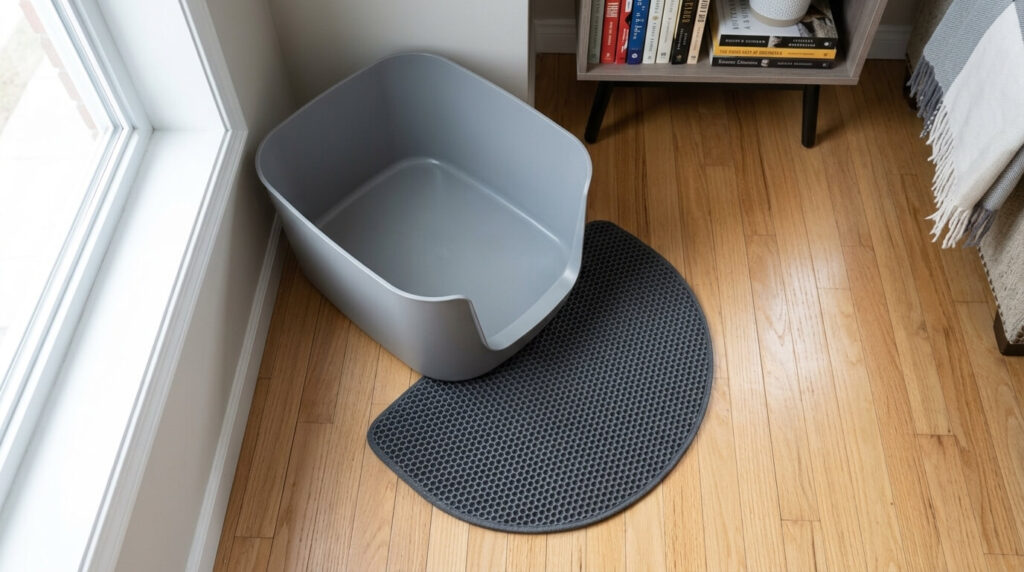
New York City apartment bathrooms present a specific geometric constraint that most litter mat reviews don’t acknowledge: the litter box is frequently positioned in a corner, and a standard rectangular mat positioned in front of a corner-placed box leaves significant uncovered floor on either side of the box exit.
The corner-cut mat design — either a true L-shape that wraps around two sides of a corner-placed box, or a larger triangular design that covers the corner exit angle — addresses this geometry directly. For apartments where the bathroom footprint makes a large rectangular mat impractical, the corner-space saver provides proportionally better coverage within a smaller total footprint.
The coverage geometry:
A rectangular mat in front of a corner-placed litter box covers the direct forward exit but leaves a 45-degree diagonal exit path on each side uncovered. An L-shaped mat that extends along both walls adjacent to the box covers all primary exit trajectories. For a cat who consistently exits to the left or right rather than straight forward — a common pattern based on the box orientation relative to the wall — a corner mat can provide better practical coverage than a larger rectangular mat positioned straight in front.
Pros:
- ✅ Optimized geometry for corner litter box placement
- ✅ Better trajectory coverage than standard rectangular mats in corner positions
- ✅ Smaller total footprint than a large rectangular alternative
- ✅ Available in both honeycomb and microfiber surface options
- ✅ Waterproof base in quality versions
- ✅ Easier to fit in small apartment bathrooms
- ✅ Lower cost than full-size rectangular alternatives
Cons:
- ❌ Not suitable for non-corner litter box placement
- ❌ L-shape cleaning requires bending the mat — can stress the corner join over time
- ❌ Fewer product options than rectangular mats — lower quality range available
- ❌ Less total capture surface area than a large rectangular mat
- ❌ May not cover full exit trajectory for large or fast-exiting cats
Best for: Small apartment bathrooms with corner-positioned litter boxes, owners where floor space limitations prevent large rectangular mats.
4. The Easy-Clean Silicone Mat
Category: Easiest maintenance best cat litter mat for tracking
Material: Food-grade silicone (100% Phthalate-Free)
Size Options: 24″×36″ standard
Waterproof: Yes (inherently — solid silicone)
Price Range: $30–$55
The silicone litter mat category offers a fundamentally different cleaning experience than foam or fabric alternatives, and for owners whose primary constraint is cleaning time and effort rather than maximum tracking capture, it represents the best cat litter mat for tracking choice.
Food-grade silicone is inherently Phthalate-Free and BPA-free, waterproof at the material level (not through a backing layer), and can be cleaned by shaking, rinsing under running water, or running through the dishwasher. The absence of fibers or cells that can become permanently embedded with fine clay dust makes silicone mats the most consistently cleanable option across their lifespan.
The capture mechanism trade-off:
Silicone mats use molded surface texture — raised nibs, channels, or a waffle pattern — for granule capture. This texture is mechanically less aggressive than a deep honeycomb cell for interdigital space engagement, and less fiber-surface-area than a high-GSM microfiber. Capture efficiency is lower than the top performers in either of those categories, but the ease of complete cleaning means the mat’s capture efficiency doesn’t degrade over time as embedded fibers or clogged honeycomb cells reduce performance.
Pros:
- ✅ Inherently Phthalate-Free and BPA-free at material level
- ✅ Rinses clean under tap water in under two minutes
- ✅ Dishwasher safe — most thorough sanitization of any mat type
- ✅ No fiber degradation — same surface efficacy for the life of the mat
- ✅ Soft enough texture for most cats without Paw Pad Sensitivity concerns
- ✅ Waterproof at material level — no separate backing required
- ✅ Longest lifespan of any mat category
Cons:
- ❌ Lower granule capture efficiency than Double-Layer Design honeycomb
- ❌ Does not capture fine dust effectively
- ❌ Heavier than foam alternatives — less convenient to move for cleaning
- ❌ Higher upfront cost than basic foam options
- ❌ Raised texture can feel less comfortable under bare human feet
Best for: Owners prioritizing cleaning ease over maximum capture efficiency, households where dishwasher sanitization is preferred, cats with Paw Pad Sensitivity to firmer textures.
5. The Heavy-Duty Large Grain Specialist
Category: Best for large-grain and crystal litter types
Material: Heavy-gauge rubber or thick EVA, wide-cell design
Size Options: 28″×36″ and larger
Waterproof: Yes
Price Range: $35–$65
Crystal litter, wood pellet litter, and large-grain clay litters present a tracking challenge that standard fine-grain mats are over-engineered for. The large particle sizes of these litters don’t lodge in interdigital spaces the way fine clay granules do — they sit between the toes and fall out with the first few steps. The tracking pattern is different: a concentrated deposit near the box exit rather than a distributed trail, and large particles rather than fine dust.
The heavy-duty large-grain specialist addresses this with wide honeycomb cells or deep grooves that accommodate larger particle sizes without the particles rolling over the surface instead of falling through — a failure mode of fine honeycomb cells with large granules.
Pros:
- ✅ Cell dimensions optimized for large granule and crystal litter types
- ✅ Heavy-duty construction handles robust digging cats and large breeds
- ✅ Large surface area covers full exit trajectory
- ✅ Deep cells contain large granules effectively
- ✅ Waterproof base
- ✅ Durable construction with longer lifespan than standard mats
Cons:
- ❌ Large cell size ineffective for fine clay granule capture
- ❌ Larger footprint requires more bathroom floor space
- ❌ Heavier construction — less convenient to move for cleaning
- ❌ Higher cost than standard mats
- ❌ May be more aversive for cats with significant Paw Pad Sensitivity
Best for: Crystal litter users, wood pellet litter users, large-grain clay litter users, large breed cats with correspondingly larger paws.
Maintenance 101: Vacuuming vs. Deep Washing
The best cat litter mat for tracking loses most of its efficacy if maintenance is inconsistent — a mat saturated with granules and dust provides no additional capture capacity and may actually redistribute what it has collected back onto paw pads. Here is the maintenance protocol I use and recommend.
Daily Maintenance: The 60-Second Shake
For Double-Layer Design honeycomb mats: separate the two layers over the toilet or trash, allow granules in the collection layer to be disposed of, replace the layers. Total time: 60 seconds.
For microfiber mats: take outside or hold over the toilet and shake firmly — the impact loosens granules embedded in the fibers. For apartment situations where outdoor shaking isn’t practical, a brief vacuum pass with a handheld vacuum is the indoor equivalent.
For silicone mats: tip the mat over the trash to release captured granules. Most fall free immediately due to the non-fibrous surface.
Weekly Maintenance: Vacuuming
For honeycomb EVA mats:
Vacuum the upper surface with a handheld or brush attachment to remove fine clay dust from cell surfaces. Do not use a beater bar attachment — it can damage the cell structure over time.
For microfiber mats:
Thorough vacuuming with a brush attachment is required weekly to prevent fiber compaction and dust saturation. Vacuum in multiple directions to reach fibers compressed in different orientations.
For silicone mats:
Vacuuming is optional — a wipe with a damp cloth typically suffices for weekly maintenance.
Monthly Deep Wash
Honeycomb EVA mats:
Hand wash with cool water and a small amount of pet-safe unscented dish soap. Rinse thoroughly — soap residue in honeycomb cells can be transferred to Paw Pad Sensitivity tissue during the next use. Air dry completely before replacing — trapped moisture in the collection layer creates a bacterial environment.
Microfiber mats:
Machine wash in cold water with pet-safe, fragrance-free detergent. Avoid fabric softener — it coats microfiber strands and permanently reduces their capture efficiency. Air dry or tumble dry on low heat — high heat can damage the waterproof TPR backing.
Silicone mats:
Dishwasher on a standard cycle, or hand wash with dish soap and rinse under running water. Silicone is the fastest-drying material — typically ready to replace within 30–60 minutes of washing.
The Replacement Threshold
Every mat has a functional lifespan, and continuing to use a mat past its replacement threshold means using something that looks like a litter mat but no longer functions as one.
Signs a mat needs replacement:
- Honeycomb cells that no longer spring back after compression — permanently compressed cells don’t mechanically engage Paw Pad Sensitivity tissue
- Microfiber surface that remains matted after washing — fibers that can’t be restored to upright position can’t capture granules
- Waterproof backing that has begun to separate, peel, or crack — moisture will reach the floor beneath
- Persistent odor that doesn’t resolve after deep washing — bacterial biofilm has established beyond surface cleaning reach
Frequently Asked Questions
What is the best way to clean a cat litter mat?
The cleaning method depends on the mat material. Double-Layer Design honeycomb EVA mats should be separated, shaken over a trash receptacle daily, and hand-washed monthly with cool water and pet-safe soap — avoid machine washing, which can damage the EVA cell structure.
Microfiber mats should be vacuumed weekly and machine-washed monthly in cold water without fabric softener, which permanently impairs fiber capture efficiency. Silicone mats are the easiest to clean — rinse under running water, wipe with a damp cloth, or run through the dishwasher for full sanitization.
For all mat types, air drying is preferable to machine drying, and complete drying before replacement is essential to prevent bacterial growth in any moisture trapped within the mat structure. Never use bleach on any mat type that will contact your cat’s paws — residual bleach on surfaces that contact Paw Pad Sensitivity tissue is an irritant.
Are honeycomb mats better than microfiber for tracking?
For granule capture specifically, honeycomb mats outperform microfiber for large granules (1mm and above) because the mechanical engagement with the paw pad actively opens the interdigital space rather than passively waiting for granules to contact fiber.
For fine dust and particulate — the secondary tracking material from clay litter — microfiber outperforms honeycomb because fiber surface area captures dust that falls through honeycomb cell openings. The ideal solution for clay litter users is either a Double-Layer Design honeycomb that includes a microfiber lower layer, or a two-mat system with a honeycomb mat immediately outside the box exit and a microfiber mat further along the exit path.
For crystal litter and large pellet litter types, a wide-cell honeycomb significantly outperforms microfiber because the particle sizes don’t engage microfiber fibers effectively. Cat-specific factors — particularly Paw Pad Sensitivity — may make the softer microfiber option clinically necessary regardless of capture efficiency differences.
How big should my litter mat be?
The minimum effective size is determined by your specific cat’s exit behavior — specifically, how many steps they take before stopping after exiting the litter box. Observe your cat’s post-box exit for three to five uses: count the steps between the box exit and where they stop or change direction.
The mat should cover this full distance. Most adult cats take two to four steps before stopping, with each step approximately 8–12 inches — suggesting a minimum mat length of 24–36 inches from the box exit. Width should extend at least 6 inches beyond the box opening on each side to capture diagonal exit paths.
For small apartment bathrooms where a large mat creates a trip hazard or doesn’t fit within the available floor space, a corner-cut design that maximizes coverage within a constrained footprint is more effective than a large rectangular mat that can’t be positioned optimally within the available space.
Ultimately, investing in the best cat litter mat for tracking turns your bathroom back into a human-friendly zone.
References
- Stull, J. W., Brophy, J., & Weese, J. S. (2015). “Reducing the risk of pet-associated zoonotic infections.” Canadian Medical Association Journal, 187(10), 736–743. Referenced for environmental bacterial contamination from pet traffic and the importance of surface hygiene management in shared living spaces. https://doi.org/10.1503/cmaj.141020
- Nutter, F. B., Levine, J. F., & Stoskopf, M. K. (2004). “Reproductive capacity of free-roaming domestic cats and kitten survival rate.” Referenced alongside: Weese, J. S., Peregrine, A. S., & Armstrong, J. (2002). “Occupational health and safety in small animal veterinary practice: Part I—Nonparasitic zoonotic risks.” Canadian Veterinary Journal, 43(8), 631–636. Referenced for feline environmental contamination patterns and hygiene management in confined living spaces. PMID: 12170838.
The white duvet has been replaced with a navy one. Oliver’s litter area is now bordered by a 30″×35″ Double-Layer Design honeycomb mat that I shake every morning as part of a routine so established it requires no conscious thought. The 3 AM barefoot crunch has not occurred in fourteen months. These are the small domestic victories that apartment cat ownership is built on, and I will take every one of them.