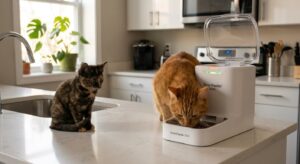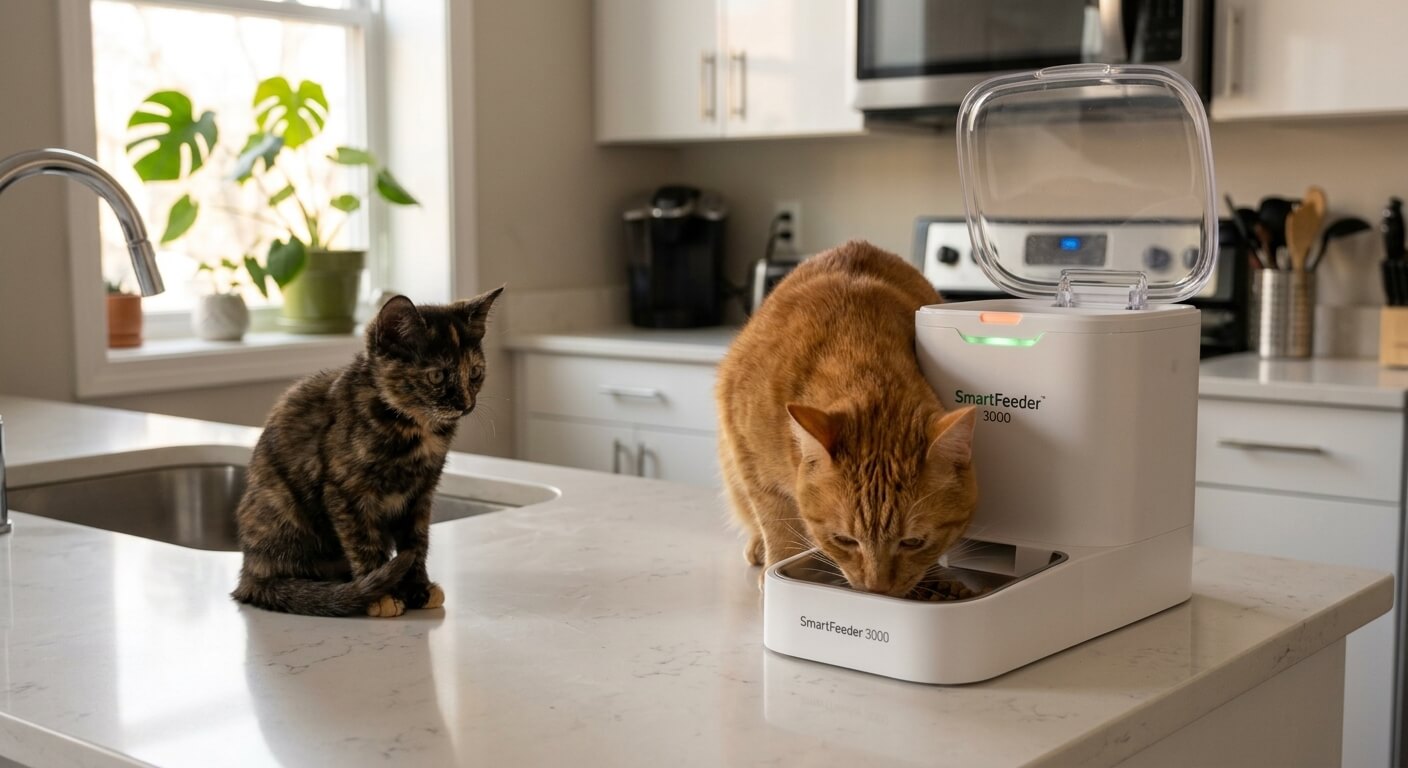
Three weeks into fostering Miso—a four-month-old tortoiseshell kitten with absolutely no concept of boundaries—I noticed Oliver’s ribs.
Not dramatically, not in an alarming way. But Oliver is a cat I weigh monthly and assess weekly, and the subtle change in his body condition score was real. He’d dropped from his ideal 4.5/9 to approximately 3.8/9 in three weeks.
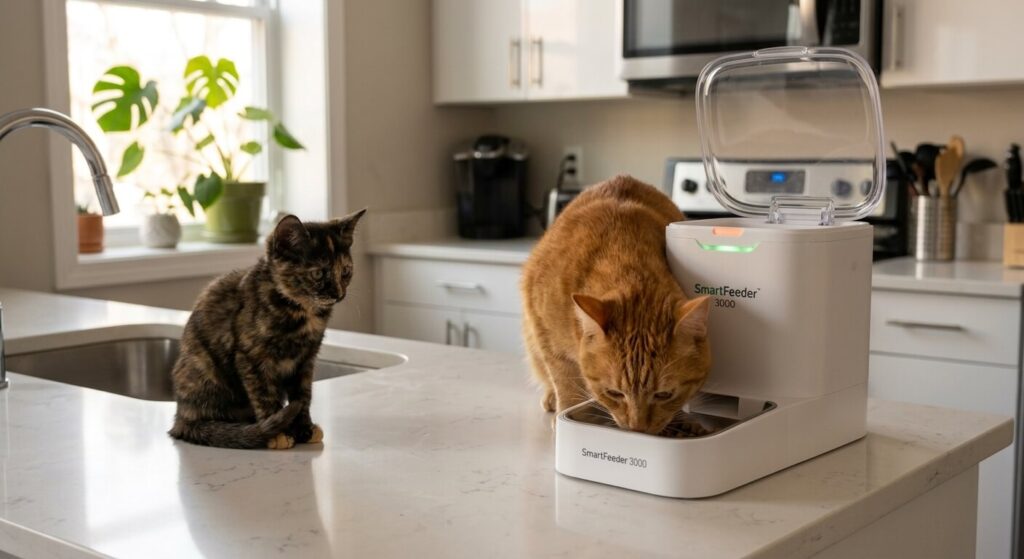
The cause was obvious once I was looking for it: Miso ate with the focused intensity of an industrial vacuum cleaner. She finished her own food in approximately forty seconds and then positioned herself at Oliver’s bowl with the confidence of someone who had never once considered that anything in this world didn’t belong to her.
Oliver, who is non-confrontational by temperament, had simply started eating less rather than compete.
As a veterinary technician, I understand exactly why this matters clinically. Food competition between cats isn’t just a behavioral inconvenience—it creates real health consequences. Cats on Prescription Diet foods for urinary health, kidney disease, or diabetes who consume another cat’s food are having their therapeutic nutrition undermined. Cats who eat from competitive anxiety often eat too fast, vomit, and develop stress-related GI issues. And cats who simply lose access to their food, like Oliver, develop nutritional deficits quietly.
The best microchip cat feeder is the engineering solution to a genuinely clinical problem, and finding the right one became an urgent priority in my foster household.
Quick Answer: What Is the Best Microchip Cat Feeder?
The best microchip cat feeder uses RFID Technology to read your cat’s unique implanted microchip or a collar-mounted RFID tag, opening exclusively for the authorized pet. This solves food theft, Prescription Diet cross-contamination, and weight management challenges in multi-cat households. Look for models with Intruder Mode detection, easy-clean bowls, and app connectivity for feeding history.
The Multi-Cat Feeding War: Why Standard Bowls Fail
Standard bowls fail multi-cat households for reasons that are entirely predictable once you understand feline feeding behavior.
The Competitive Eating Dynamic
Cats are solitary hunters in the wild. Their feeding behavior is not designed for communal dining—it’s designed for individual food acquisition followed by immediate consumption before another predator can steal the resource.
In a multi-cat household, even cats who coexist peacefully in other contexts can develop competitive feeding behavior around food resources. The triggers are subtle:
- Speed difference: A fast eater finishes and immediately investigates the slow eater’s bowl
- Status dynamics: A more assertive cat simply displaces a subordinate cat from their food
- Free-feeding mismanagement: When food is always available, the dominant eater controls access timing
The result is what I observed with Oliver and Miso: one cat consistently overeats, one consistently undereats, and the nutritional management of both becomes impossible.
The Prescription Diet Emergency
This is where the clinical stakes become genuinely serious.
A cat on a renal Prescription Diet (like Hill’s k/d or Royal Canin Renal) requires restricted phosphorus and controlled protein to slow kidney disease progression. If another cat in the household eats that food, two problems occur simultaneously:
- The healthy cat consumes food that may not be nutritionally appropriate for them
- The sick cat doesn’t receive their full therapeutic dose
I’ve seen renal cats in clinical decline that we couldn’t fully explain until we discovered the household feeding dynamic. The therapeutic food was being shared with other cats and the therapeutic cat was compensating by eating the other cat’s regular food.
Standard bowls cannot solve this problem. Only RFID Technology that physically prevents unauthorized access can guarantee dietary integrity in this clinical scenario.
Microchip feeders are also the primary tool for resolving resource guarding and the territorial tension it creates in shared small spaces, something I address in my guide to managing multi-cat conflict. [How to Introduce a Second Cat in a Small Apartment (Step-by-Step Guide)]
How RFID Technology Works (Is It Safe for My Cat?)
RFID Technology (Radio Frequency Identification) is the same technology that makes contactless payment work, library books scannable, and inventory management automated. In cat feeders, it creates an entirely practical and completely passive identification system.
The Technical Mechanism
Every microchip implanted in a cat contains a passive RFID transponder with a unique identification number. “Passive” means it has no battery—it receives power wirelessly from the reader and reflects back its unique ID.
The microchip feeder’s sensor ring around the bowl emits a low-frequency electromagnetic field. When a cat approaches, the implanted microchip enters this field, powers up passively, and transmits its ID number. The feeder compares this to its registered authorized IDs and either opens (authorized cat) or remains closed (unauthorized cat).
The entire process takes approximately 0.1-0.3 seconds.
Safety: The Question Every Owner Asks
The electromagnetic field generated by microchip feeders is:
- Extremely localized (effective range approximately 2-4 inches)
- Very low power (orders of magnitude below FCC safety thresholds for human devices)
- Non-ionizing radiation (same category as AM radio, not X-rays)
Cats’ implanted microchips are ISO standard devices tested to be inert and biocompatible indefinitely. The RFID reader field does not alter, damage, or affect the microchip in any way—it simply powers the passive transponder momentarily for ID reading.
I’ve been asked by concerned clients whether repeated exposure to the feeder’s field could harm their cat. The short answer: no. The long answer involves comparing the feeder’s electromagnetic output to background environmental radiation levels and finding the feeder to be less significant than a cat walking past a WiFi router.
Collar Tag RFID: The Alternative for Unchipped Cats
For cats who haven’t been microchipped (though I strongly recommend microchipping for all cats), most microchip feeders include a collar-mounted RFID tag that functions identically to an implanted microchip for the feeder’s purposes.
Practical consideration: Collar tags work, but collar loss is a real risk in multi-cat households where play can result in collar removal. For long-term microchip feeder use, I recommend using the implanted microchip as the primary ID.
Top 5 Recommendations: Best Microchip Cat Feeder (2025)
🥇 The Industry Standard: SureFeed Microchip Pet Feeder
Price: $150 – $185
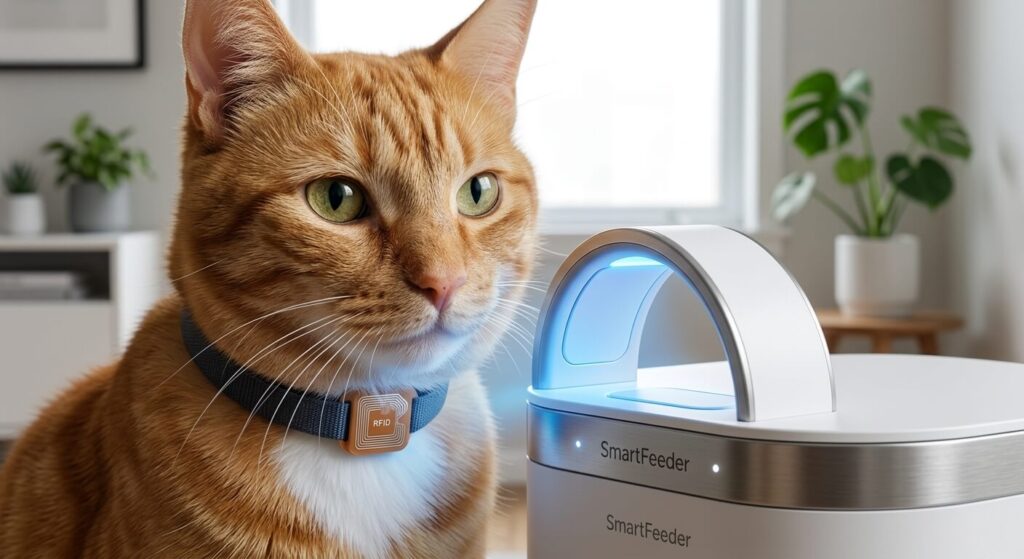
The SureFeed Microchip Pet Feeder is the product that essentially created this category and remains the standard against which all alternatives are measured. Its clinical adoption rate among veterinary professionals recommending multi-cat dietary management is higher than all competitors combined.
Technical specifications:
- RFID Technology: Reads ISO 11784/11785 standard microchips (all major chip types)
- Response time: Approximately 0.15 seconds
- Bowl type: Sealed lid with peripheral seal
- Bowl capacity: Wet or dry food (single divided bowl)
- Power: 4 x C batteries (no wiring required)
- Training mode: Yes (graduated lid opening distance for cautious cats)
- Intruder Mode: Yes (actively detects and prevents nose-following access)
- App connectivity: No (SureFeed Connect model adds this)
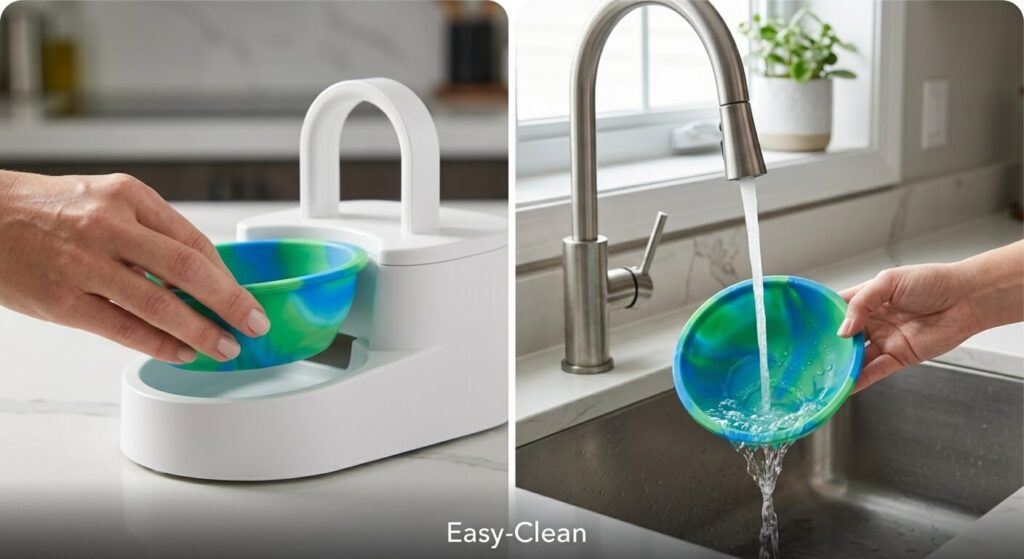
- Dishwasher safe: Bowl and mat yes; lid unit no
The Intruder Mode mechanism:
This is the feature that distinguishes SureFeed from competitors who simply open for the right chip. Intruder Mode actively monitors for another animal attempting to access the bowl while it’s open:
- Sensors detect a second animal’s presence near the opening
- Lid begins closing if an intruder approaches
- Closes completely if the intruder contacts the bowl rim
For Oliver and Miso’s situation, this was the critical feature. It’s not enough to open only for Oliver—Miso had figured out that if she pressed close to Oliver while he was eating, she could slip her nose under the lid before it closed. Intruder Mode closed that loophole.
Clinical use case performance:
In clinical recommendation follow-up with clients managing Prescription Diet feeding in multi-cat households, the SureFeed maintains 100% dietary integrity when properly set up. No other bowl, feeder design, or management strategy achieves this consistently.
Pros:
- Industry-leading Intruder Mode prevents nose-following access
- Reads all standard ISO microchip formats
- Training mode allows gradual lid acceptance
- Clinical track record for Prescription Diet management
- Simple operation (no app or WiFi required)
- Peripheral bowl seal keeps food fresh between visits
Cons:
- No app connectivity on base model
- Battery powered (ongoing battery cost)
- Single bowl (not appropriate for multiple wet food meals without refresh)
- No feeding history logging
- Higher price than non-microchip feeders
Best for: Any multi-cat household, especially those with Prescription Diet requirements; clinical recommendation for weight management cases
📱 The App-Connected Pro: SureFeed Microchip Pet Feeder Connect
Price: $175 – $210
The SureFeed Connect adds the one significant capability the base model lacks: feeding data logging with app connectivity.
Technical specifications:
- All base SureFeed specifications plus:
- App connectivity: Sure Petcare app (iOS and Android)
- Feeding log: Tracks visit time, duration, and bowl weight
- Multi-pet profiles: Separate logs per registered cat
- Scale integration: Compatible with Sure Petcare SureFeed Scale (sold separately)
- Alerts: Low food notification, missed feeding notification
- Hub required: Sure Petcare Hub (sold separately, ~$25)
The clinical value of feeding data:
For cats with medical conditions where appetite monitoring is diagnostically relevant—kidney disease, hyperthyroidism, diabetes, post-surgical recovery—the Connect’s feeding log provides data I genuinely use clinically.
Appetite changes are frequently the first indicator of disease progression or response to treatment. Having timestamped feeding frequency and duration data at recheck appointments is substantially more useful than “I think she’s been eating normally.”
These feeders also allow you to maintain a consistent feeding schedule across multiple cats with completely different eating patterns and speeds—a critical element of multi-cat household management that I cover in my complete guide to multi-cat feeding systems. [How Much Should You Feed an Indoor Cat? Portion Guide by Weight]
Pros:
- All SureFeed base model advantages
- Feeding history log per cat
- Appetite monitoring for medical cases
- Remote feeding alerts
- Weight tracking with optional scale
- Veterinarian-shareable feeding data
Cons:
- Requires hub purchase (additional cost)
- App dependency (requires smartphone engagement)
- Higher initial investment
- Occasional app connectivity issues reported
Best for: Cats with diagnosed medical conditions requiring appetite monitoring; owners who want data for veterinary consultations; multi-cat households needing individual tracking
🥣 The Best for Wet Food: Closer Pets Microchip Cat Feeder (5-Meal)
Price: $90 – $120
Most microchip feeders, including the SureFeed, are primarily designed for continuous access to a single bowl. The Closer Pets 5-Meal design addresses a specific use case: timed meal delivery of multiple portions with microchip access control.
Technical specifications:
- RFID Technology: Microchip + collar tag compatible
- Meal compartments: 5 individual compartments
- Timer: Programmable meal rotation (up to 5 scheduled meals)
- Cover: Sealed individual lids maintain freshness
- Bowl material: Removable stainless steel inserts
- Intruder Mode: No (limitation)
- App connectivity: No
- Battery: 3 x AA
The timed wet food solution:
For cats on wet food Prescription Diet feeding protocols—where specific portions need to be delivered at specific times while preventing access by other cats—the 5-Meal compartment design is the only product in this category that combines timed delivery with microchip access control.
The stainless steel inserts address the biofilm concern inherent in plastic wet food containers, and the sealed individual compartments keep portions fresh without refrigeration for up to 24 hours (wet food specific; verify with your specific food’s stability).
The Intruder Mode limitation:
This is a significant caveat for households with persistent food thieves. The Closer Pets doesn’t have active intruder detection—it prevents unauthorized opening, but a determined cat pressing close to an authorized cat during feeding could potentially access the open compartment. In Oliver and Miso’s situation, the SureFeed’s active Intruder Mode was necessary. For households with less aggressive food competition, this limitation may be manageable.
Pros:
- Timed meal delivery plus microchip control (unique combination)
- 5-compartment design for multiple daily wet food meals
- Stainless steel inserts (biofilm resistant)
- Sealed compartments maintain food freshness
- Appropriate for timed Prescription Diet wet food protocols
Cons:
- No active Intruder Mode (limitation for aggressive multi-cat environments)
- No app connectivity
- Battery powered
- Compartment size limits portion size options
- More complex to clean than single-bowl designs
Best for: Timed wet food feeding protocols; cats on Prescription Diet wet food requiring scheduled portions; households with less aggressive inter-cat food competition
💰 The Budget-Friendly RFID Option: PetSafe Healthy Pet Simply Feed with Microchip Adapter
Price: $60 – $80
For owners who need the best microchip cat feeder functionality at accessible cost, this combined solution uses a programmable automatic feeder with a compatible microchip access adapter to create a budget-conscious microchip-controlled feeding system.
Technical specifications:
- RFID Technology: Compatible with standard ISO microchips via adapter
- Meal programming: Up to 12 meals per day
- Portion control: 1/8 to 4 cups per meal (dry food)
- Power: AC adapter (included) with battery backup
- Slow feed mode: Yes
- Intruder Mode: Basic detection (less sophisticated than SureFeed)
- App connectivity: No on base model
The honest assessment:
This solution represents a meaningful compromise. The RFID Technology integration is less sophisticated than SureFeed, the Intruder Mode is less responsive, and the overall build quality reflects the lower price point. For straightforward food theft prevention in households where cats don’t aggressively crowd during feeding, it works adequately.
For clinical cases involving Prescription Diet management or significant weight management, I recommend investing in the SureFeed. The dietary integrity guarantee is worth the price difference when health outcomes are at stake.
For households where the primary concern is simply “the fast eater shouldn’t eat the slow eater’s food” without medical urgency, this budget option is a reasonable entry point.
Pros:
- Most accessible price point for RFID Technology access control
- 12-meal programming allows precise portion management
- Slow feed mode for fast eaters
- AC power with battery backup
- Adequate for low-competition multi-cat households
Cons:
- Less sophisticated Intruder Mode than premium options
- Not recommended for clinical Prescription Diet cases requiring guaranteed dietary integrity
- Dry food only
- Build quality reflects price point
Best for: Budget-conscious owners with low-competition multi-cat households; situations where food theft is occasional rather than aggressive; dry food only households
The Vet Tech Training Guide: Helping Cautious Cats Accept the Lid
The best microchip cat feeder in the world is useless if the cat is afraid of the lid mechanism.
Oliver accepted the SureFeed within 24 hours—he’s a confident cat who investigates everything. Miso, for all her boldness around food, was initially terrified of the lid’s movement sound. I’ve had client cats take three weeks to fully accept the feeder.
Here’s the evidence-based protocol that works.
Phase 1: Presence Without Function (Days 1-3)
- Place the feeder in your cat’s feeding location with the lid removed
- Serve regular food in the open bowl
- Reward any investigation of the feeder housing with treats
- Goal: Feeder structure becomes neutral background furniture
Phase 2: Lid Present, Manually Held Open (Days 4-7)
- Reattach the lid
- Manually hold the lid fully open during all feeding sessions
- Never allow the lid to move during this phase
- Goal: Lid structure becomes neutral; eating near the feeder is comfortable
Phase 3: Training Mode Activation (Days 8-14)
SureFeed’s training mode opens the lid to only 1-2 cm initially:
- Register your cat’s chip
- Set training mode to minimum opening
- Allow the cat to eat with limited lid movement present
- Gradually increase opening distance over 7 days
Phase 4: Full Function (Day 15+)
- Set feeder to full normal operation
- Continue monitoring for stress signals during feeding
- If regression occurs, return to Phase 3 for 3-5 days before advancing again
Signs the transition is going well:
- Cat approaches feeder without hesitation
- Relaxed body posture during eating
- Voluntary investigation of the feeder between meals
Signs additional time is needed:
- Crouching or flattened ears at the feeder
- Eating very quickly and retreating
- Avoiding the feeder and returning to old feeding location
FAQ
Will a microchip feeder work with my cat’s existing chip?
Almost certainly yes. The best microchip cat feeder options—particularly SureFeed—read ISO 11784/11785 standard microchips, which covers the vast majority of microchips implanted in the US, UK, Europe, and Australia (the FDX-B 15-digit standard and HDX 10-digit standard). The only exception is older pre-ISO chips implanted before approximately 2005 in some regions.
To confirm compatibility, check your cat’s microchip documentation for “ISO 11784/11785 compliant” or ask your veterinarian to scan the chip and provide the chip number format.
How do I stop another cat from shoving their way in?
Intruder Mode is the feature that addresses this, and it’s why SureFeed is my primary recommendation for households with aggressive food thieves. Basic Intruder Mode starts closing the lid when a second animal is detected near the opening.
For exceptionally persistent cats, additional strategies include: feeding cats in separate rooms during initial training, using a cat feeding station with sides that prevent lateral approach, and combining the microchip feeder with a timed feeding schedule that allows sequential supervised access rather than simultaneous free access. Physical separation during feeding remains the most reliable backup.
Are microchip feeders worth the high price?
For households managing Prescription Diet feeding, weight disparity between cats, or significant food competition: absolutely yes—the clinical benefit justifies the cost entirely. The alternative to reliable dietary integrity is repeated veterinary visits for conditions worsening due to dietary non-compliance, which costs more than the feeder within a single billing cycle.
For households where the problem is mild and no medical issues are involved, the budget RFID options provide adequate benefit at lower cost. The honest calculus: if food theft is causing health consequences for any cat in your household, the best microchip cat feeder is genuinely cost-effective.
Ultimately, investing in the best microchip cat feeder is an investment in the individual health and harmony of every cat in your apartment.
Scientific References
- Ramos, D., Reche-Junior, A., Fragoso, P. L., Palme, R., Yanasse, N. K., Gouvêa, V. R., … & Mills, D. S. (2013). Are cats (Felis catus) from multi-cat households more stressed? Evidence from assessment of fecal glucocorticoid metabolite analysis. Physiology & Behavior, 122, 60-63. https://doi.org/10.1016/j.physbeh.2013.08.028. This peer-reviewed study documents elevated cortisol metabolites in cats from multi-cat households, confirming the physiological stress response associated with social competition for resources—directly supporting the clinical rationale for individual feeding management through microchip access control.
- Levine, E., Perry, P., Scarlett, J., & Houpt, K. A. (2005). Intercat aggression in households following the introduction of a new cat. Applied Animal Behaviour Science, 90(3-4), 325-336. https://doi.org/10.1016/j.applanim.2004.07.006. This behavioral study examines resource competition and aggression dynamics following multi-cat household formation, documenting feeding-related tension as a primary driver of inter-cat conflict and supporting individualized feeding management as a key component of multi-cat household behavioral health.