Oliver had a minor dental procedure eight months ago — a routine extraction under anesthesia that went smoothly — and I spent the six hours between dropping him at home post-recovery and arriving back from my clinic shift in a state of low-grade, professional-grade anxiety that I am not entirely proud of.
I knew what to watch for: ataxia from residual anesthetic, excessive hiding indicating pain, panting suggesting nausea, or the specific chin-rubbing behavior that sometimes follows oral discomfort. I also knew I was completely unable to observe any of it from a treatment room forty blocks away.
That experience — a veterinary technician unable to apply her clinical training to her own recovering cat because the monitoring tools weren’t in place — is what made finding the best pet camera for cats a professional priority rather than a consumer curiosity.
What I discovered in researching this guide fundamentally changed how I think about remote cat monitoring, not as entertainment, but as clinical practice.
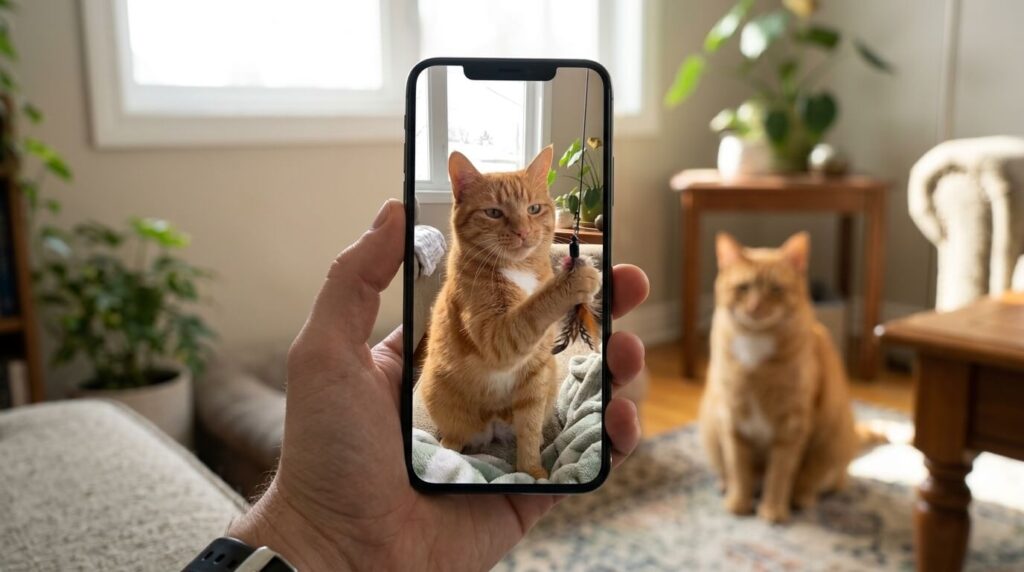
As a vet tech, what I look for on a camera feed is not whether Oliver is doing something cute. I’m looking for Diagnostic Clues — the behavioral signals that precede or accompany clinical problems before they become apparent on physical examination.
Altered gait (limping, reluctance to jump, stiff movement) suggesting musculoskeletal pain. Prolonged hiding suggesting systemic illness or pain. Excessive grooming suggesting skin irritation, allergic response, or anxiety.
Reduced or absent food and water interaction suggesting nausea or anorexia. These are observable behaviors, and the right best pet camera for cats makes them observable from anywhere.
Quick Answer: What Is the Best Pet Camera for Cats?
The best pet camera for cats provides 1080p minimum (2K preferred) resolution, superior night vision for monitoring nocturnal behavior, and Two-Way Audio for remote comfort delivery. For cat-specific monitoring, AI-driven meow detection alerts and motion tracking are essential Diagnostic Clues tools. Top picks like Furbo and Petcube add treat dispensing or laser interaction for behavioral enrichment during monitoring sessions.
Beyond the “Cute” Factor: The Clinical Case for Pet Cameras
I want to establish the clinical argument for pet cameras before discussing specific products, because the framing changes how you evaluate features. A camera selected for entertainment purposes prioritizes video quality and treat-tossing range. A camera selected for clinical monitoring prioritizes night vision quality, motion sensitivity, alert specificity, and the ability to observe behavioral detail that constitutes Diagnostic Clues.
The behavioral patterns that cameras reveal:
Altered Activity Patterns
Research in feline behavioral medicine has established that changes in activity levels — both increased and decreased — are among the earliest observable indicators of systemic illness in cats. A cat who is significantly less active than their normal baseline may be experiencing pain, nausea, fever, or the generalized malaise of early illness. A cat who is more active than normal at night may be experiencing hyperthyroid restlessness or neurological changes.
Without a camera, owners observe their cat’s behavior during the hours they’re home — typically a fraction of the cat’s actual activity window, since cats are crepuscular and most active during early morning and late evening hours when owners are often asleep or absent.
Elimination Behavior Monitoring
Increased frequency of litter box visits, prolonged time in the litter box without production, or complete avoidance of the litter box are all significant clinical signals. A camera positioned with a view of the litter box area — not inside it, but showing approach and departure behavior — can reveal these patterns days before an owner would observe them through other means.
Water Intake Observation
Polydipsia (excessive water consumption) is a cardinal sign of hyperthyroidism, diabetes mellitus, and chronic kidney disease in cats — three of the most common conditions in middle-aged to senior felines. Remotely monitoring how often your cat visits their water fountain can provide early Diagnostic Clues for conditions like hyperthyroidism or kidney disease that we’ve detailed in [our guide to monitoring senior cat health indicators][How to Leave a Cat Alone for the Weekend (Safe 48-Hour Guide)].
Separation Anxiety Behavioral Markers
Separation Anxiety in cats is significantly underdiagnosed — partly because cats don’t produce the dramatic vocalizations associated with canine separation anxiety, and partly because owners aren’t present to observe the behaviors that occur after departure.
Camera footage consistently reveals behaviors in cats during owner absence that owners had no idea were occurring: excessive vocalization, destructive behavior, elimination outside the litter box, and pacing — all of which are observable on camera and constitute Diagnostic Clues for anxiety disorders requiring behavioral or pharmacological intervention.
Key Features to Look For
Evaluating the best pet camera for cats requires weighing several technical specifications against your specific monitoring needs. Here is what actually matters from a clinical monitoring perspective.
Resolution: 1080p Minimum, 2K Preferred
The ability to observe behavioral detail — a subtle head tilt, a slight limp, the specific pattern of grooming that distinguishes normal maintenance from anxiety-driven overgrooming — requires sufficient resolution to see what you’re looking at. At 1080p, a cat-sized subject fills a meaningful portion of the frame with adequate detail for behavioral assessment. At 2K or 4K, the digital zoom capability becomes clinically useful — you can zoom into a behavior in progress without pixelation that obscures detail.
For casual check-ins, 1080p is adequate. For post-procedural monitoring, senior cat health observation, or any situation where behavioral detail matters clinically, 2K is the meaningful threshold.
Night Vision: Infrared vs. Color Night Vision
Most pet cameras use infrared (IR) night vision, which produces a monochrome image in low light. This is adequate for activity monitoring — you can see that your cat is moving, where they’re moving, and their gait pattern.
Color night vision — a newer technology that uses light amplification rather than infrared projection — produces a full-color low-light image that is significantly more diagnostically informative. The ability to observe whether a cat’s gum color appears normal, whether there is discharge from the eyes or nose, or whether a wound site shows changes, requires color representation.
AI Motion and Sound Alerts
For clinical monitoring specifically, alert quality matters more than alert quantity. A camera that sends motion alerts for every environmental change — a shadow, a change in ambient light, a vibration — is not useful for selective monitoring.
Cameras with AI-trained cat-specific detection that distinguish cat movement from environmental motion, and that offer sound alerts specifically calibrated for cat vocalizations (meowing, hissing, the specific sound pattern of vomiting), provide the selective notification that makes clinical monitoring practical.
Two-Way Audio and Voice Activation
Two-Way Audio serves two functions for cat owners. First, it allows remote comfort delivery — speaking to a cat who is showing Separation Anxiety behaviors. Second, it allows observation of the cat’s response to an audio stimulus, which can provide information about neurological status (is the cat responding normally to sound?)
And anxiety level (does the owner’s voice calm the cat or increase vocalizing?). Voice-activation capability — where the camera’s microphone activates based on sound detection — allows passive monitoring without manual stream access.
Cloud Storage vs. Local Storage
For clinical monitoring purposes, recorded footage is more valuable than live-stream-only cameras because behavioral patterns often emerge from review of footage rather than real-time observation. Cloud storage (subscription-based, typically $3–$15/month) provides access to footage from any device and typically offers event-based video snippets rather than continuous recording.
Local storage (microSD card) provides continuous recording without subscription costs but limits access to footage retrieval when at home. For post-procedural monitoring or senior cat health surveillance, a 24-hour cloud storage option that retains footage of flagged events is the most clinically useful configuration.
Top 5 Recommendations: Best Pet Camera for Cats (2025)
1. 🥇 The All-In-One Treat Tosser (Furbo 360° Cat Camera)
Category: Best overall best pet camera for cats
Resolution: 1080p HD
Night Vision: Infrared (color upgrade available)
Two-Way Audio: Yes
AI Alerts: Yes — cat activity, barking/meowing, person detection
Cloud Storage: Yes (subscription; 90-day free trial)
Price Range: $149–$199
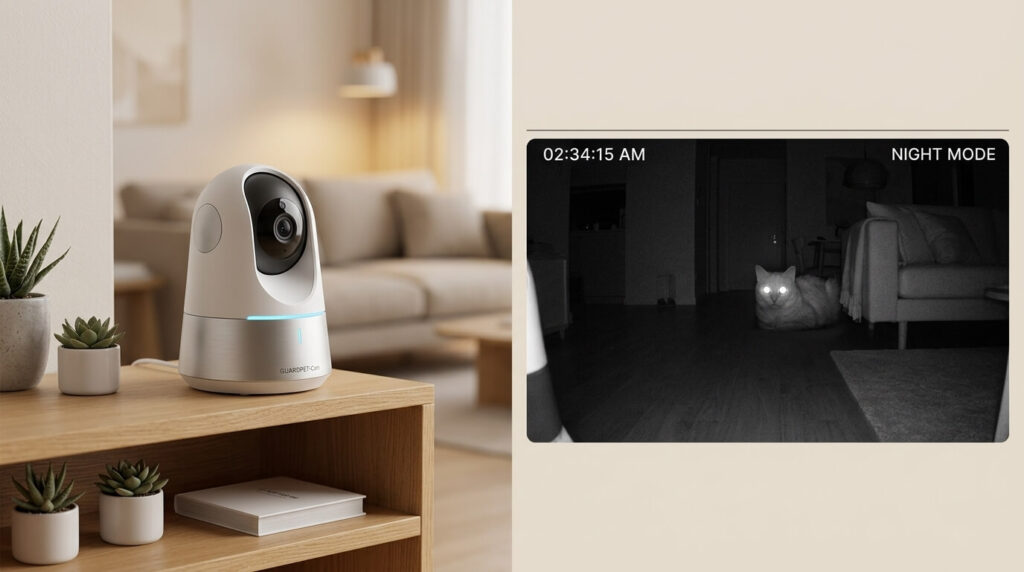
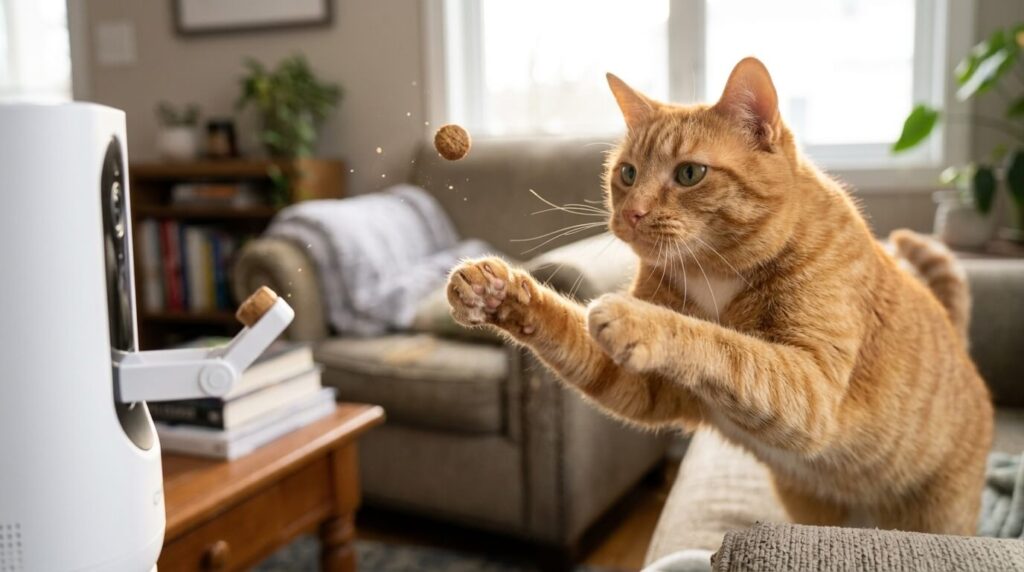
The Furbo 360° has established itself as the best pet camera for cats in the all-in-one category through a combination of AI-driven alert quality, the 360-degree rotation capability that tracks a moving cat through a room, and the treat-dispensing function that provides a remote behavioral intervention tool — not just entertainment.
From a clinical monitoring perspective, the AI activity detection has been trained on cat-specific movement patterns, reducing false-positive alerts from environmental motion. The Two-Way Audio quality is among the clearest in the category, which matters for assessing a cat’s vocalization quality remotely — the distinction between normal meowing and the specific vocalization patterns associated with pain or respiratory distress requires audio clarity to detect.
Pros:
- ✅ 360-degree auto-rotation tracks cats through a room — no fixed angle limitations
- ✅ AI-trained cat activity detection reduces false alerts
- ✅ Treat tossing provides remote behavioral intervention capability
- ✅ Two-Way Audio quality sufficient for vocalization assessment
- ✅ App interface intuitive and reliable
- ✅ Night vision adequate for activity-level monitoring
- ✅ Cloud storage captures flagged events for later review
Cons:
- ❌ Subscription required for full cloud storage feature set after trial period
- ❌ 1080p resolution — not 2K; digital zoom becomes pixelated at maximum
- ❌ Infrared night vision only — no color night vision option
- ❌ Treat tossing mechanism requires compatible treat size — not all treats work
- ❌ Motor sound during rotation can startle some cats initially
Best for: Owners wanting the most complete interaction and monitoring package, cats with Separation Anxiety who benefit from treat-delivery remote comfort, multi-room apartments where angle flexibility matters.
2. 🥈 The 360-Degree Patrol Monitor (Tapo C225 or equivalent 2K Pan/Tilt)
Category: Best clinical monitoring best pet camera for cats
Resolution: 2K (2560×1440)
Night Vision: Color night vision
Two-Way Audio: Yes
AI Alerts: Yes — person, pet, motion zone-specific
Cloud Storage: Yes (local microSD option available)
Price Range: $45–$85
For owners whose primary use case is clinical or behavioral monitoring rather than interaction, the 2K pan/tilt camera category provides the best diagnostic image quality at a price point that doesn’t include features (treat tosser, brand app ecosystem) that aren’t needed for observation purposes.
The 2K resolution provides sufficient detail for meaningful behavioral assessment — including zoom-in observation of individual behaviors — and color night vision is the feature that elevates this category above standard IR cameras for clinical purposes. Observing a cat’s face, wound site, or coat condition in color at night requires this technology.
Pros:
- ✅ 2K resolution provides the best diagnostic image detail of any category
- ✅ Color night vision — full color in low light for clinical detail observation
- ✅ Pan and tilt covers entire room without motor sound of some rotating cameras
- ✅ Local microSD storage option — no subscription required for basic recording
- ✅ Motion zone specification reduces irrelevant alerts
- ✅ Most affordable access to 2K color night vision quality
- ✅ Two-Way Audio functional for basic remote communication
Cons:
- ❌ No treat-dispensing capability — observation only
- ❌ App ecosystem less polished than brand-specific pet camera apps
- ❌ No cat-specific AI training — motion alerts are general rather than cat-specific
- ❌ Two-Way Audio quality adequate but not premium
- ❌ Less aesthetically designed for visible apartment placement
Best for: Post-procedural monitoring, senior cat health surveillance, owners whose primary need is image quality over interaction features, budget-conscious clinical monitoring.
3. The Budget High-Definition Pick (Wyze Cam v3 or equivalent)
Category: Best value best pet camera for cats
Resolution: 1080p HD
Night Vision: Color night vision (Wyze Cam v3 specifically)
Two-Way Audio: Yes
AI Alerts: Yes (with Cam Plus subscription)
Cloud Storage: Yes (free tier available; Cam Plus for AI features)
Price Range: $25–$40
The budget category for the best pet camera for cats has been transformed by the Wyze Cam v3’s inclusion of color night vision at a price point previously occupied only by infrared-only cameras. For the cost, it provides monitoring capability that was significantly more expensive two product generations ago.
The free cloud storage tier — 14 days of event clips without subscription — is a meaningful differentiator in the budget category, and the Cam Plus subscription at approximately $2/month unlocks AI-trained motion detection that improves alert relevance for cat monitoring.
Pros:
- ✅ Color night vision at the lowest price point of any camera on this list
- ✅ Free cloud storage tier available — no mandatory subscription
- ✅ 1080p resolution adequate for general monitoring
- ✅ Two-Way Audio functional
- ✅ IP65 weather resistance — suitable for covered outdoor areas if needed
- ✅ Smallest footprint — least intrusive placement options
- ✅ No ongoing cost required for basic functionality
Cons:
- ❌ AI features require Cam Plus subscription — limited without
- ❌ No pet-specific alert training — higher false-positive rate
- ❌ No pan/tilt — fixed angle only
- ❌ No treat-dispensing or interactive features
- ❌ App can be inconsistent — firmware updates occasionally affect reliability
- ❌ No dedicated cat-specific features
Best for: Budget-conscious owners, renters wanting a temporary monitoring solution, secondary camera for specific monitoring angles (litter box area, food and water station), owners wanting to trial camera monitoring before premium investment.
4. The Privacy-Focused Specialist (Eufy IndoorCam or equivalent local-storage model)
Category: Privacy-first best pet camera for cats
Resolution: 2K
Night Vision: Infrared (some models offer color)
Two-Way Audio: Yes
AI Alerts: Yes — on-device processing (no cloud required)
Cloud Storage: Local only (microSD + HomeBase option)
Price Range: $35–$80
Privacy concerns about pet cameras are legitimate and worth addressing seriously. Cloud-connected cameras transmit video data through manufacturer servers, and the security of that data depends entirely on the manufacturer’s infrastructure and practices.
For owners with data privacy concerns — or those in apartment buildings where a camera’s potential compromise could reveal sensitive home information — local-storage cameras with on-device AI processing represent the appropriate category.
The best privacy-focused cameras perform AI motion and pet detection processing on the device itself rather than in the cloud, meaning video data never leaves your local network unless you explicitly choose to access it remotely through an encrypted connection.
Pros:
- ✅ On-device AI processing — no cloud data transmission required
- ✅ 2K resolution in quality versions
- ✅ No subscription fees for any feature — one-time purchase
- ✅ Local storage on microSD or dedicated hub provides continuous recording
- ✅ Two-Way Audio functional
- ✅ No dependence on manufacturer server infrastructure — camera works if company closes
- ✅ Appropriate for HIPAA-aware or data-security-conscious households
Cons:
- ❌ Remote access requires more technical setup than cloud cameras
- ❌ Local storage has finite capacity — requires management
- ❌ No treat-dispensing or advanced interaction features
- ❌ App experience typically less polished than cloud-native cameras
- ❌ On-device processing less sophisticated than cloud AI in some models
Best for: Privacy-conscious owners, apartment buildings with shared network infrastructure concerns, owners who want continuous recording without ongoing subscription costs, technically capable owners comfortable with local network setup.
5. The Interactive Laser Camera (Petcube Play 2 or equivalent)
Category: Behavioral enrichment best pet camera for cats
Resolution: 1080p HD
Night Vision: Infrared
Two-Way Audio: Yes
AI Alerts: Yes — sound and motion
Cloud Storage: Yes (subscription; free tier available)
Price Range: $149–$179
The interactive laser camera category addresses a specific gap that standard monitoring cameras cannot fill: the ability to actively engage a cat’s predatory drive remotely, rather than simply observing it. Cameras with integrated laser toys can be a useful tool for maintaining your indoor cat’s exercise routine when you have a late night at the office, as we discuss in [our complete guide to indoor cat exercise strategies][How to Entertain an Indoor Cat While at Work: 9 Ideas That Actually Help].
The Petcube Play 2 allows manual laser control through the app — you direct the laser dot across the floor and wall in real-time — as well as an automatic laser mode that runs a randomized pattern. From a behavioral enrichment standpoint, this provides a remote tool for interrupting Separation Anxiety behaviors that you observe on camera and redirecting the cat’s attention to an appropriate predatory engagement.
Pros:
- ✅ Remote laser control provides genuine behavioral intervention capability
- ✅ Automatic laser mode provides enrichment during your absence without manual control
- ✅ Two-Way Audio quality sufficient for remote interaction
- ✅ AI sound alerts include cat vocalization detection
- ✅ 1080p resolution adequate for monitoring and interaction purposes
- ✅ Addresses Separation Anxiety through active engagement rather than passive observation
- ✅ 160-degree wide-angle lens provides broad room coverage without pan/tilt motor
Cons:
- ❌ Laser toy must never be used unsupervised for extended periods — frustration without physical catch can increase anxiety in some cats
- ❌ Subscription required for full cloud storage feature access
- ❌ 1080p resolution — not 2K
- ❌ Infrared night vision only
- ❌ Laser mechanism adds mechanical complexity — potential failure point over time
Best for: Cats with Separation Anxiety who benefit from remote engagement, highly active cats who need enrichment during owner absence, owners who can actively monitor and control interaction remotely.
Vet Tech Privacy Tip: Securing Your Camera from Hacks
A connected camera in your home is, without proper security measures, a potential entry point for unauthorized access. This is not a theoretical concern — documented cases of pet camera compromises have involved strangers accessing live feeds and Two-Way Audio to speak through home cameras. Here is the security protocol I use and recommend.
Mandatory Security Steps
1. Change the Default Password Immediately
Every camera ships with a default username and password — often “admin/admin” or a model-specific default that is publicly documented. Change this to a unique, strong password (minimum 12 characters, combination of letters, numbers, and symbols) before connecting the camera to your network.
2. Enable Two-Factor Authentication
Any camera app that offers two-factor authentication (2FA) — requiring both a password and a verification code sent to your phone to log in — should have this enabled. This prevents unauthorized access even if your password is compromised.
3. Keep Firmware Updated
Camera firmware updates frequently contain security patches for vulnerabilities discovered after manufacture. Enable automatic firmware updates in your camera’s settings, or check for updates manually monthly.
4. Use a Separate IoT Network
If your router supports guest networks or VLAN configuration, place all connected home devices — cameras, smart speakers, connected appliances — on a network segment separate from your primary computers and phones. This limits the damage of a camera compromise to the IoT network segment.
5. Audit App Permissions
Review what permissions your camera’s companion app requests on your smartphone. A camera app should not require access to your contacts, messages, or location beyond what’s necessary for geofencing features. Revoke any permissions that aren’t functionally necessary.
6. Consider Local-Storage Cameras for High-Privacy Areas
For rooms containing sensitive information or where privacy is particularly important, local-storage cameras with on-device processing (category 4 above) eliminate the cloud data transmission vulnerability entirely.
Frequently Asked Questions
Do cats like hearing their owner’s voice on camera?
The response is highly individual and, importantly, can go either way — which is why testing before relying on Two-Way Audio as a comfort intervention is important. Some cats respond to their owner’s voice through a camera by approaching the camera and showing reduced anxiety behaviors — the familiar vocal stimulus provides genuine comfort.
Other cats respond to a disembodied voice with increased anxiety or confusion, searching for a source that isn’t present and becoming more distressed than before the audio interaction. A third category simply ignores the audio entirely.
The clinical recommendation: test your specific cat’s response to camera audio while you are home and can observe the reaction in person, before using it as a remote comfort tool when you’re absent and cannot monitor the response. If your cat’s response to your voice through the camera is neutral or negative, observational-only monitoring without audio interaction is the appropriate approach.
Can a pet camera help with separation anxiety?
Yes, in two distinct ways. First, it confirms or rules out the diagnosis — Separation Anxiety in cats is significantly underdiagnosed because owners don’t observe the behaviors that occur after departure. Camera footage that reveals vocalization, destructive behavior, or elimination outside the litter box during owner absence provides the behavioral evidence that supports a clinical diagnosis and an appropriate treatment plan.
Second, for cats with mild Separation Anxiety, the interactive features of the best pet camera for cats — Two-Way Audio, treat dispensing, and laser engagement — provide remote intervention tools that can reduce anxiety behaviors during the owner’s absence. For cats with moderate to severe Separation Anxiety, cameras provide the monitoring capability to assess treatment response to behavioral modification or pharmacological intervention prescribed by a veterinary behaviorist.
Where is the best place to mount a camera for a cat?
The optimal placement for the best pet camera for cats depends on your monitoring priority. For general behavioral monitoring — activity levels, eating and drinking, litter box visits — a position that captures the main areas of feline activity in your apartment is most useful.
This is typically a corner or elevated position that provides a wide-angle view of the primary living space, positioned at a height of 5–7 feet to capture both floor-level activity and elevated surface behavior. For specific clinical monitoring — post-procedural recovery, senior cat health surveillance — position the camera with a direct view of the cat’s primary resting location and the food and water station. For Separation Anxiety monitoring, position for maximum coverage of the areas where anxiety behaviors (pacing, vocalization, scratching at doors) are most likely to occur.
Avoid positioning cameras where direct sunlight will create overexposed frames during daylight hours, and ensure the night vision field of view covers the primary activity areas rather than ambient areas where presence is less likely.
Ultimately, the best pet camera for cats provides something money can’t normally buy: a window into your cat’s health when you aren’t there.
References
- Grigg, E. K., Pick, L., & Nibblett, B. (2021). “Boredom in shelter cats: A review of the evidence and consideration of implications for cat welfare.” Animals, 11(5), 1343. https://doi.org/10.3390/ani11051343
- Amat, M., Camps, T., & Manteca, X. (2016). “Stress in owned cats: Behavioural changes and welfare implications.” Journal of Feline Medicine and Surgery, 18(8), 577–586. https://doi.org/10.1177/1098612X15590867
Oliver’s post-dental-procedure monitoring setup now includes a 2K pan/tilt positioned to cover his recovery bed and his water fountain simultaneously. I reviewed the footage from that first day home and saw exactly what I needed to see: consistent water drinking at two-hour intervals, normal gait when moving to the litter box, and the specific quality of deep sleep that indicates comfortable recovery rather than sedated distress. The clinical peace of mind that camera provided is not quantifiable against a price point. It simply changed what was possible to know from forty blocks away.