I have a confession that my veterinary colleagues would find both professionally ironic and entirely relatable.
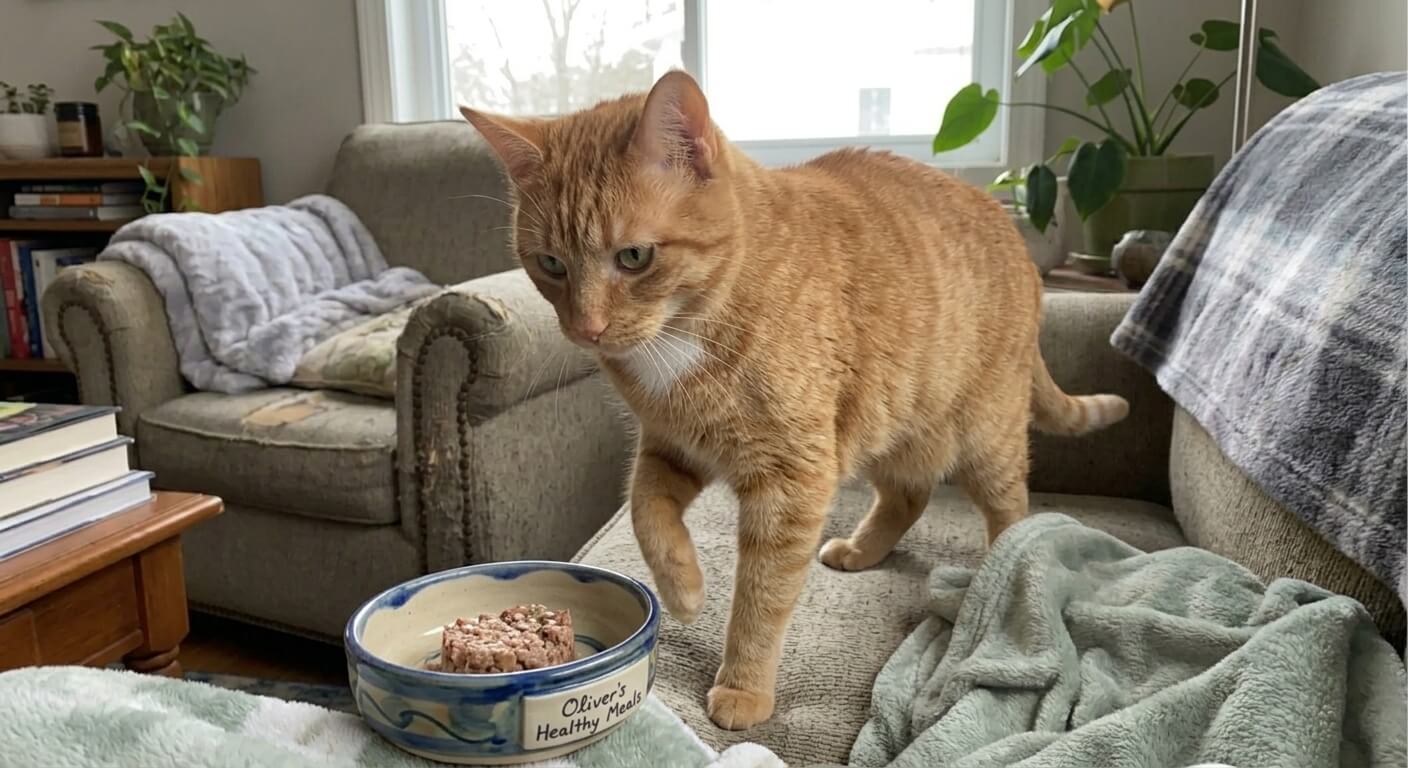
Oliver got fat.
Not dramatically, not dangerously, but definitively. After we moved to a smaller apartment with less vertical space, and after I’d gone through a particularly busy work quarter where his enrichment schedule had slipped, the evidence became undeniable: Oliver could no longer jump to his favorite window perch in a single fluid motion. He’d make the attempt, fail, and look at me with an expression that I interpreted as accusatory and probably was.
As a veterinary technician, I spend considerable time counseling clients on feline obesity—one of the most prevalent and preventable health conditions in domestic cats. I know that reading a pet food bag label is insufficient. I know that “light” or “weight management” on packaging means almost nothing without examining the Dry Matter Basis protein, fat, and carbohydrate percentages and the actual Metabolizable Energy per calorie. And I know that finding the best wet cat food for weight loss requires understanding the nutrition science rather than the marketing language.
Oliver’s chunky phase lasted four months. What ended it was a systematic approach to food selection, portion calculation, and feeding structure that I’m sharing in full detail here.
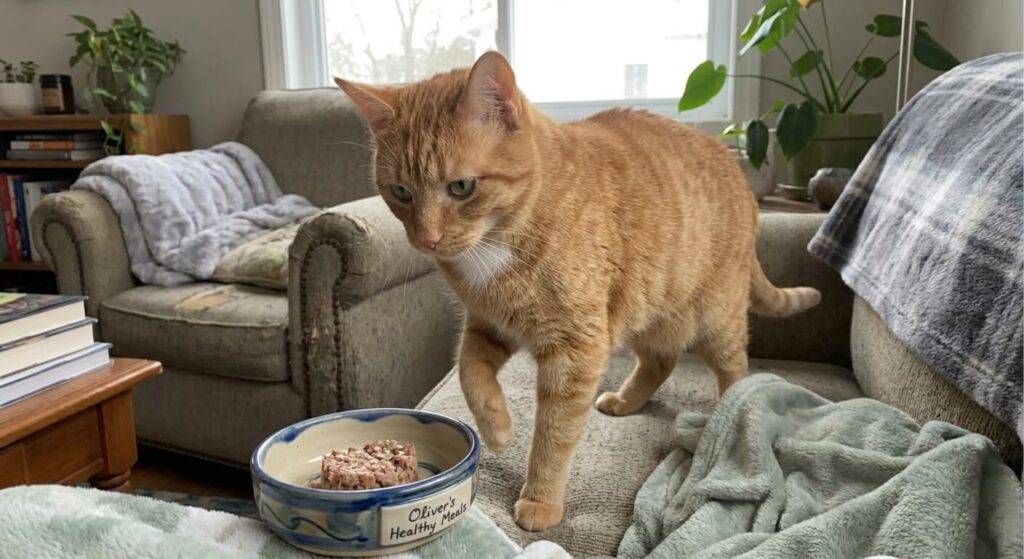
Quick Answer: What Is the Best Wet Cat Food for Weight Loss?
The best wet cat food for weight loss features high protein (45%+ on Dry Matter Basis), low carbohydrates (under 10% DMB), and high moisture content to promote satiety through volume. Look for brands like Weruva, Tiki Cat, and Royal Canin Satiety that prioritize lean muscle maintenance while reducing Metabolizable Energy intake without triggering hunger-driven behavioral problems.
The Apartment Weight Trap: Why Indoor Cats Struggle
Oliver’s weight gain wasn’t a mystery when I analyzed the contributing factors honestly. It was a predictable outcome of an environment that hadn’t adequately compensated for the reduction in natural physical activity.
The Indoor Caloric Math
Outdoor cats—or cats with genuine hunting opportunities—expend energy through:
- Active territory patrol (cardiovascular)
- Hunting sequences (explosive anaerobic effort)
- Climbing and jumping (strength and power)
- Thermoregulation in variable outdoor temperatures
Indoor apartment cats, particularly in smaller spaces, lack all four of these significant energy expenditure categories. What remains is:
- Voluntary play (owner-dependent)
- Climbing cat trees (if provided)
- Short room-to-room movement
- Digestive metabolism
The Metabolizable Energy requirement for a typical indoor cat is significantly lower than for an outdoor cat of the same body weight. Most commercial feeding guidelines on packaging are calibrated for average activity levels—not the genuinely sedentary reality of a single-cat apartment environment.
The Caloric Density Problem
Most dry kibble contains 300-450 calories per 100 grams. Most wet food contains 70-120 calories per 100 grams (the remainder being moisture weight). The volume difference matters enormously for satiety:
A cat consuming 200 calories per day from kibble eats approximately 55-65 grams of food. The same 200 calories from wet food represents 170-280 grams of food by weight—3-4x the physical volume, with proportionally higher satiety.
In our previous analysis comparing wet and dry food, we found that wet food’s high hydration and low carbohydrate profile make it naturally superior for weight management—and the satiety advantage is one of the primary mechanisms. [Wet Food vs Dry Food for Indoor Cats: What Science Says]
The Carbohydrate Complication
Cats are obligate carnivores with no evolutionary requirement for dietary carbohydrates. Their metabolic machinery for processing carbohydrates is significantly less efficient than in omnivores:
- Limited amylase production (the enzyme that digests starch)
- Insulin response poorly calibrated to high-carbohydrate meals
- Carbohydrate calories stored preferentially as fat rather than used for energy
Dry kibble typically contains 30-50% carbohydrates (Dry Matter Basis)—not because cats need them, but because carbohydrates are structurally necessary for kibble extrusion manufacturing. Wet food typically contains 1-10% carbohydrates DMB because the manufacturing process doesn’t require them.
This is why the best wet cat food for weight loss recommendations are almost universally wet rather than dry: the manufacturing process naturally produces a more appropriate macronutrient profile.
The Satiety Science: Protein vs. Fillers
The single most important macronutrient for feline weight loss is protein—and this is counterintuitive to owners who assume that lower-fat or lower-calorie simply means “better for weight loss.”
Why Protein Drives Feline Satiety
Cats have a unique metabolic relationship with protein called a “protein-specific appetite”: they continue seeking food until they’ve met their minimum protein requirement, regardless of total calorie intake.
What this means practically:
A cat eating a low-protein food will eat more total volume trying to meet their protein requirement. The excess carbohydrates and fat they consume in the process drive weight gain even when total calories appear controlled.
A cat eating a high-protein food meets their protein threshold more quickly, reaches satiety sooner, and consumes less total caloric load.
The best wet cat food for weight loss leverages this mechanism: high protein percentage (45%+ on Dry Matter Basis) meets the protein threshold quickly, terminates hunger signals, and reduces total caloric intake without requiring significant portion restriction.
The Dry Matter Basis Calculation
This is the nutrition analysis methodology that I use clinically, and it’s the reason I evaluate cat food on Dry Matter Basis rather than “as fed” percentages.
“As fed” percentages include the moisture weight. A wet food that is 10% protein “as fed” with 78% moisture actually contains much more protein once moisture is removed from the calculation.
The formula:
DMB % = (As Fed %) ÷ (1 – Moisture %)
Example:
A wet food with 10% protein as fed and 78% moisture:
- DMB protein = 10 ÷ (1 – 0.78) = 10 ÷ 0.22 = 45.5% protein DMB
This is why as-fed comparisons between wet and dry food are meaningless—they’re comparing different amounts of water, not different amounts of nutrition.
Minimum targets for weight loss:
- Protein: 45%+ DMB
- Fat: 20-35% DMB
- Carbohydrates: Under 10% DMB
AAFCO Standards and What They Actually Tell You
The AAFCO Standards (Association of American Feed Control Officials) establish minimum nutrient requirements for cat food. A food that meets AAFCO Standards is nutritionally complete—but minimum requirements are not the same as optimal formulation for weight loss.
Look for foods that:
- Meet or exceed AAFCO Standards for adult maintenance
- Exceed the protein minimums significantly (35% as fed minimum; 45%+ DMB target)
- Specify “complete and balanced” rather than “complementary” or “topper” (which are not nutritionally complete)
Maintaining a healthy body weight is one of the most significant factors in extending an indoor cat’s healthy lifespan and preventing chronic joint degeneration—something I explore in depth in my guide to indoor cat longevity. [Is My Cat Overweight? How to Tell (And What to Do About It)]
Top 5 Recommendations: Best Wet Cat Food for Weight Loss (2025)
🥇 The Low-Carb Leader: Tiki Cat After Dark Variety Pack
Price: $38 – $45 (12-can variety pack)
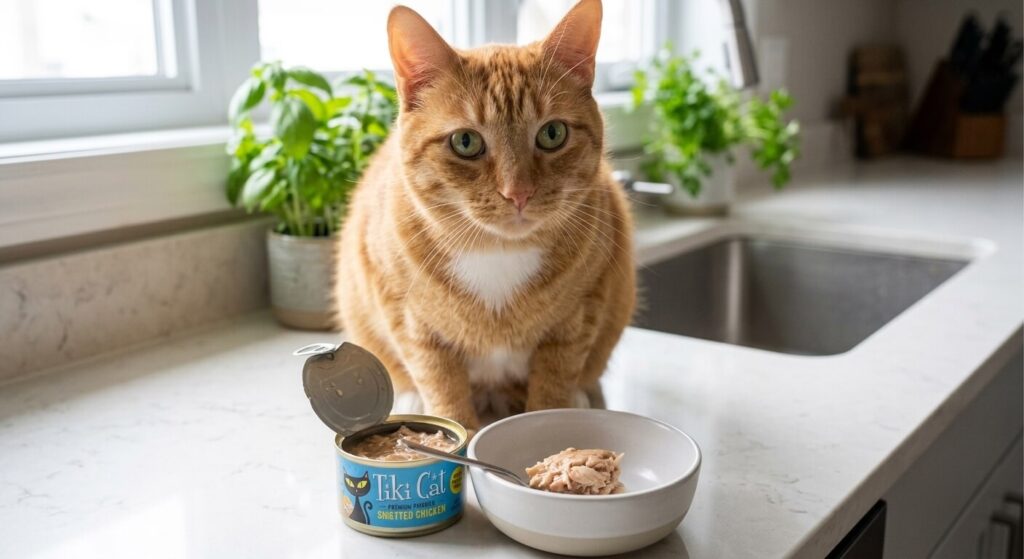
Tiki Cat After Dark consistently produces some of the lowest carbohydrate percentages in the commercial cat food market—a function of their whole-prey inspired formulation philosophy that uses animal proteins as the primary ingredient with minimal plant-based fillers.
Nutritional analysis (representative variety, DMB):
- Protein: 52-58% DMB (varies by variety)
- Fat: 28-35% DMB
- Carbohydrates: 3-8% DMB
- Moisture: 82-84%
- Calories: Approximately 90-110 kcal per 2.8 oz can
- AAFCO Standards: Complete and balanced for adult maintenance
Why it leads the weight loss category:
The carbohydrate percentage of 3-8% DMB is genuinely exceptional. Most commercial wet foods, even those marketed as weight management, contain 10-20% carbohydrates DMB due to thickeners and starch-based gelling agents. Tiki Cat After Dark uses agar (seaweed-based) rather than starch as a setting agent, which dramatically reduces the carbohydrate load.
The 52-58% protein DMB exceeds the weight loss threshold significantly, ensuring satiety signal is met before the caloric target is reached.
Clinical caveat:
The high protein content makes Tiki Cat After Dark inappropriate for cats with chronic kidney disease, where protein restriction is typically indicated. For healthy overweight cats, it’s the best wet cat food for weight loss in the standard commercial category.
Pros:
- Lowest carbohydrate percentages in commercial wet food category
- Highest protein DMB on this list
- High moisture (82-84%) for maximum satiety volume
- Whole prey inspired ingredient quality
- Variety pack reduces palatability fatigue
- AAFCO Standards complete and balanced
Cons:
- Premium price point
- High protein inappropriate for cats with kidney disease
- Not appropriate for growing kittens (protein ratio calibration)
- Some cats dislike the texture variety within the pack
Best for: Healthy overweight adult cats without kidney disease, cats who have not responded to moderate-protein weight loss foods, owners who prioritize minimal carbohydrate intake
🏥 The Satiety Specialist: Royal Canin Satiety Support Wet Cat Food
Price: $45 – $55 (24-pouch case)
For cats requiring clinically supervised weight loss—particularly those who are significantly overweight (body condition score 7-9/9) or who have weight-related health complications—the Royal Canin Satiety Support is the prescription-adjacent formulation I recommend most frequently in clinical contexts.
Nutritional analysis (DMB):
- Protein: 46% DMB
- Fat: 18% DMB
- Carbohydrates: 14% DMB (higher than Tiki Cat but with specific fiber strategy)
- Moisture: 80%
- Calories: Approximately 69 kcal per 3 oz pouch (notably lower than most)
- AAFCO Standards: Complete and balanced
- Special feature: High-fiber satiety matrix (psyllium + beet pulp)
The satiety matrix mechanism:
Royal Canin Satiety Support uses a dual-mechanism approach: moderate protein (46% DMB) combined with a specific high-fiber satiety matrix that expands in the stomach to increase volume-based satiety signals. The psyllium and beet pulp combination slows gastric emptying, extending the time between hunger signals.
This fiber strategy compensates for the lower protein percentage—the caloric density at 69 kcal per 3 oz pouch is the lowest on this list, allowing meaningful volume feeding while maintaining significant caloric restriction.
Pros:
- Lowest caloric density on this list (69 kcal/3 oz)
- Clinically formulated satiety matrix
- Moderate protein with high-volume satiety approach
- Veterinary community research backing
- Consistent palatability (most cats accept it readily)
- AAFCO Standards complete and balanced
Cons:
- Higher carbohydrate than low-carb alternatives
- Prescription or vet-recommendation required at some retailers
- Higher price point
- Fiber matrix can cause temporary loose stools during transition
Best for: Clinically significant obesity (BCS 7-9), cats with weight-related health complications, owners working under veterinary supervision
😺 The Picky Eater’s Choice: Weruva Cats in the Kitchen Variety Pack
Price: $32 – $40 (12-can variety)
The best wet cat food for weight loss achieves nothing if a picky cat refuses to eat it. Weruva’s Cats in the Kitchen line resolves the palatability problem through premium ingredient quality and texture variety that maintains cat interest across multiple flavors.
Nutritional analysis (representative variety, DMB):
- Protein: 48-55% DMB
- Fat: 22-28% DMB
- Carbohydrates: 5-12% DMB
- Moisture: 80-84%
- Calories: Approximately 80-100 kcal per 6 oz can
- AAFCO Standards: Complete and balanced
The palatability architecture:
Weruva uses human-grade protein sources (specific named species: chicken breast, salmon, tuna, mackerel) in identifiable textures—shredded, chunked, and pâté configurations across the variety pack. This variety prevents the habituation and food boredom that causes cats to reject a weight loss food after 2-3 weeks.
In clinical practice, the most common reason weight loss food programs fail is food refusal—the cat becomes bored with a single food and begins hunger-striking until more palatable food is offered. The variety rotation strategy Weruva enables directly addresses this failure mode.
Pros:
- Exceptional palatability across varieties (resolves food refusal)
- High protein DMB (48-55%)
- Low carbohydrates (5-12% DMB)
- Human-grade protein sources
- Texture variety maintains interest over extended programs
- AAFCO Standards complete and balanced
Cons:
- Texture variety makes consistent portion calculation slightly more complex (different textures have different caloric densities)
- Premium price
- Some varieties have higher carbohydrate content than others (read labels individually)
Best for: Picky eaters who have rejected other weight loss foods, cats with food boredom patterns, multi-cat households where palatability is a common factor
💰 The Best Budget Option: Fancy Feast Classic Pâté
Price: $18 – $22 (24-can case)
I include Fancy Feast Classic Pâté in this guide because the nutritional evidence genuinely supports it, and I won’t withhold a cost-effective clinical recommendation because it doesn’t carry a premium brand name.
Nutritional analysis (chicken pâté variety, DMB):
- Protein: 44-48% DMB
- Fat: 28-33% DMB
- Carbohydrates: 8-12% DMB
- Moisture: 78%
- Calories: Approximately 80-90 kcal per 3 oz can
- AAFCO Standards: Complete and balanced
The clinical case for Fancy Feast Classic:
This recommendation carries an important distinction: Classic pâté varieties only—not the “Fancy Feast” line with gravies, sauces, or “gourmet” preparations. The gravy and sauce varieties contain thickeners (modified food starch, guar gum) that significantly increase the carbohydrate percentage.
The Classic pâté line consistently produces 44-48% protein DMB, 8-12% carbohydrate DMB, and complete and balanced AAFCO Standards nutrition at approximately $0.75-0.90 per can—roughly one-third the cost of premium alternatives with comparable macronutrient profiles.
These high-protein, more digestible formulas also tend to produce smaller, less odorous stools—a practical benefit in small apartment living that I discuss in my guide to managing litter box odor in compact spaces. [How to Help Indoor Cat Lose Weight Without the Constant Meowing]
Pros:
- Most cost-effective option with acceptable macronutrient profile
- Widely available (grocery stores, not just specialty pet retailers)
- Consistent palatability across most cats
- AAFCO Standards complete and balanced
- Pâté texture is easy to portion accurately
Cons:
- Lower protein DMB than premium options (44-48% vs 52-58%)
- Gravy varieties (avoid these) in the same product line create confusion
- Not grain-free (contains by-product meal in some varieties)
- Ingredient quality lower than premium options
Best for: Budget-conscious owners, cats with reliable protein appetite who don’t require maximum protein loading, initial dietary transition when cost is a limiting factor
🌟 The Prescription-Grade Option: Hill’s Prescription Diet w/d Feline
Price: $55 – $70 (24-can case; requires veterinary prescription)
For cats with concurrent diabetes mellitus and obesity—a common and clinically complex combination—Hill’s w/d provides the specific low-carbohydrate, high-fiber formulation that addresses both conditions simultaneously.
Nutritional analysis (DMB):
- Protein: 41% DMB
- Fat: 24% DMB
- Carbohydrates: 18% DMB (higher, but with specific fiber strategy)
- Moisture: 78%
- Calories: 73 kcal per 156g can
- AAFCO Standards: Complete and balanced
- Requires: Veterinary prescription
Clinical note:
Hill’s w/d is not my first recommendation for straightforward overweight management without concurrent disease. The protein percentage is lower than ideal for pure weight loss, and the carbohydrate percentage is higher than alternatives. However, for diabetic cats specifically, the specific fiber composition of w/d has clinical evidence for improving glycemic control while managing weight—a dual-benefit that the other products on this list don’t provide.
Consult your veterinarian before using this product. It’s included for completeness and to guide owners whose cats have been diagnosed with diabetes toward the appropriate clinical option.
How to Calculate Portions: The Resting Energy Requirement Formula for Cats
This is the section that makes the food selection meaningful—because even the best wet cat food for weight loss is ineffective if portions aren’t calculated appropriately.
Step 1: Determine Current and Target Weight
Body Condition Scoring (BCS):
The 9-point BCS scale is the clinical tool for objective body weight assessment:
| BCS | Description |
|---|---|
| 1-3 | Underweight (ribs, spine, hip bones visible) |
| 4-5 | Ideal (ribs palpable, waist visible from above) |
| 6-7 | Overweight (ribs difficult to palpate, no waist) |
| 8-9 | Obese (ribs not palpable, significant fat deposits) |
For Oliver at his heaviest, I assessed him at BCS 7. Target: BCS 5.
Target weight estimation:
For a cat at BCS 7 who should be BCS 5, a reasonable target is 10-15% body weight reduction. For Oliver at 11.5 lbs (BCS 7), target weight: approximately 10 lbs.
Step 2: Calculate Resting Energy Requirement
The Resting Energy Requirement (RER) formula:
RER (kcal/day) = 70 × (body weight in kg)^0.75
For Oliver’s target weight of 10 lbs (4.54 kg):
RER = 70 × (4.54)^0.75 = 70 × 3.14 = 219.8 kcal/day
Step 3: Apply the Weight Loss Factor
For safe, sustainable weight loss, feed at 80% of the RER for the target body weight:
Weight loss caloric target = 219.8 × 0.80 = 175.8 kcal/day
Step 4: Calculate Food Volume
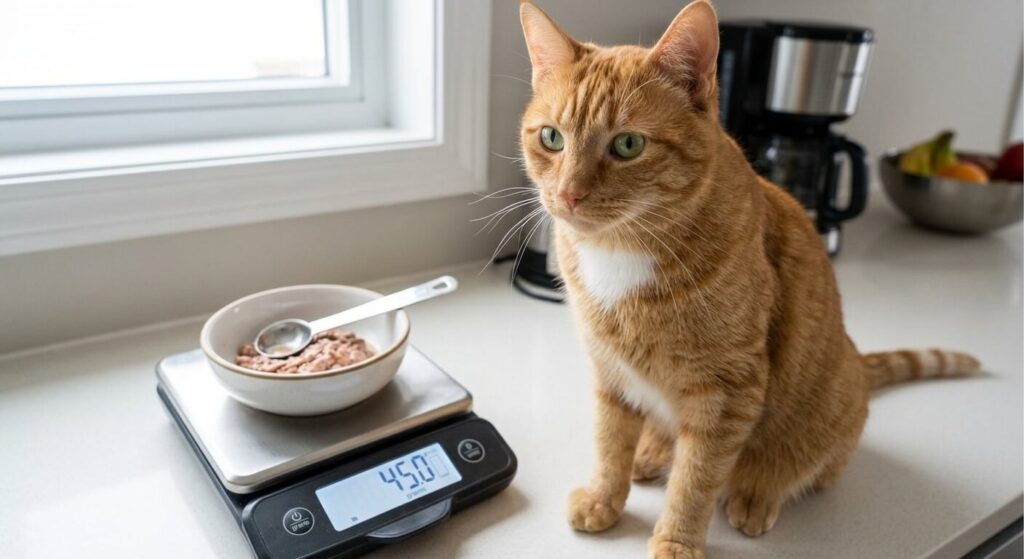
Using Tiki Cat After Dark (100 kcal per 2.8 oz can):
Daily food volume = 175.8 ÷ 100 × 2.8 oz = 4.9 oz per day
Divided between two meals: approximately 2.5 oz per meal
The Critical Monitoring Protocol
Weekly weight checks are essential during a weight loss program:
- Safe weight loss rate: 0.5-1% of body weight per week
- Maximum safe rate: 2% per week
- Never exceed 2% weekly loss: Rapid weight loss in cats risks hepatic lipidosis (fatty liver disease), a potentially fatal condition that requires immediate veterinary intervention
If weight loss exceeds 2% per week: increase food by 10% and consult your veterinarian immediately.
FAQ
How fast should a cat lose weight?
Safe feline weight loss is 0.5-1% of body weight per week, with an absolute maximum of 2% per week. For a 12-lb cat, this means 0.06-0.24 lbs per week—progress that appears slow but is medically appropriate.
Rapid weight loss in cats is genuinely dangerous: when fat is mobilized faster than the liver can process it, hepatic lipidosis can develop, which is a life-threatening condition requiring hospitalization. If your cat seems to be losing weight faster than the safe rate, reduce portion restriction and consult your veterinarian. Always monitor weight loss programs in cats with your vet’s involvement.
Is grain-free wet food better for weight loss?
Grain-free labeling is not synonymous with low-carbohydrate or low-calorie. Many grain-free wet foods replace grain-based carbohydrates with starchy vegetables (sweet potato, peas, lentils) that have similar carbohydrate profiles. The relevant metric is the Dry Matter Basis carbohydrate percentage—not the grain-free marketing label.
Tiki Cat After Dark is grain-free and genuinely low-carbohydrate; many other grain-free foods are not. Always calculate the Dry Matter Basis rather than relying on labeling language. The best wet cat food for weight loss is evaluated by nutritional analysis, not marketing categories.
Can I mix weight loss wet food with dry kibble?
I recommend against it for cats in an active weight loss program, for two clinical reasons. First, caloric calculation becomes significantly more complex when mixing two foods with different caloric densities—most owners underestimate the kibble contribution and inadvertently exceed the caloric target. Second, dry kibble’s carbohydrate content partially undermines the low-carbohydrate strategy of the wet food selection.
If a pure wet food transition causes significant resistance, a transitional mix is better than food refusal—but the target should be wet-food-only feeding for the weight loss period. Once target weight is achieved, a small amount of kibble (no more than 25% of daily calories) can be reintroduced with careful monitoring.
Ultimately, finding the best wet cat food for weight loss is about respecting your cat’s carnivore biology while managing the sedentary reality of apartment life.
Scientific References
- Laflamme, D. P. (2006). Understanding and managing obesity in dogs and cats. Veterinary Clinics of North America: Small Animal Practice, 36(6), 1283-1295. https://doi.org/10.1016/j.cvsm.2006.08.005. This foundational review documents the epidemiology and clinical management of feline obesity, establishing the evidence base for high-protein, low-carbohydrate dietary intervention and the Resting Energy Requirement calculation methodology for safe weight loss programming.
- Backus, R. C., Cave, N. J., & Keisler, D. H. (2007). Gonadectomy and high dietary fat but not high dietary carbohydrate induce gains in body weight and fat of domestic cats. British Journal of Nutrition, 98(3), 641-650. https://doi.org/10.1017/S000711450769295X. This controlled dietary study demonstrates that dietary fat content and neuter status are primary predictors of weight gain in domestic cats, with carbohydrate content playing a secondary but significant modulatory role—directly informing the macronutrient prioritization strategy in the best wet cat food for weight loss recommendations.