By a cat parent whose charcoal sofa has been losing a war with an orange tabby since 2019.
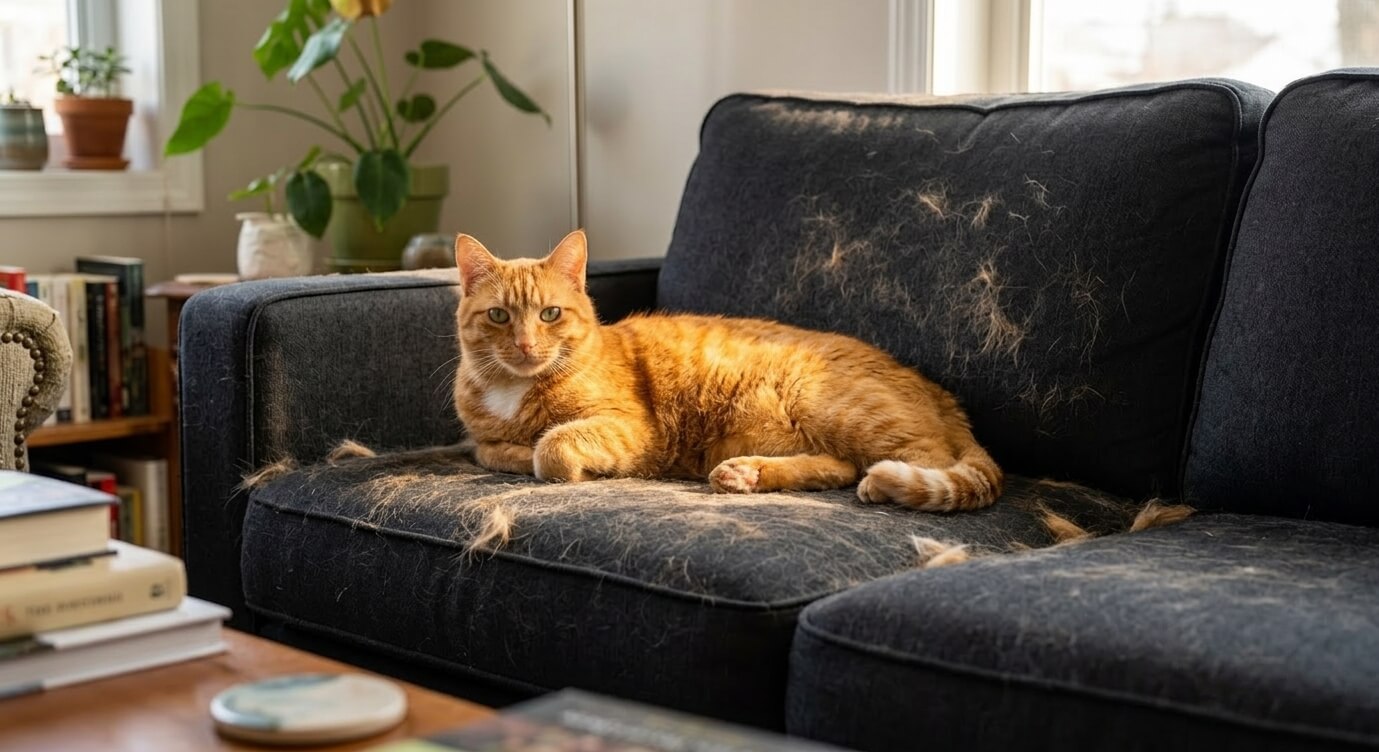
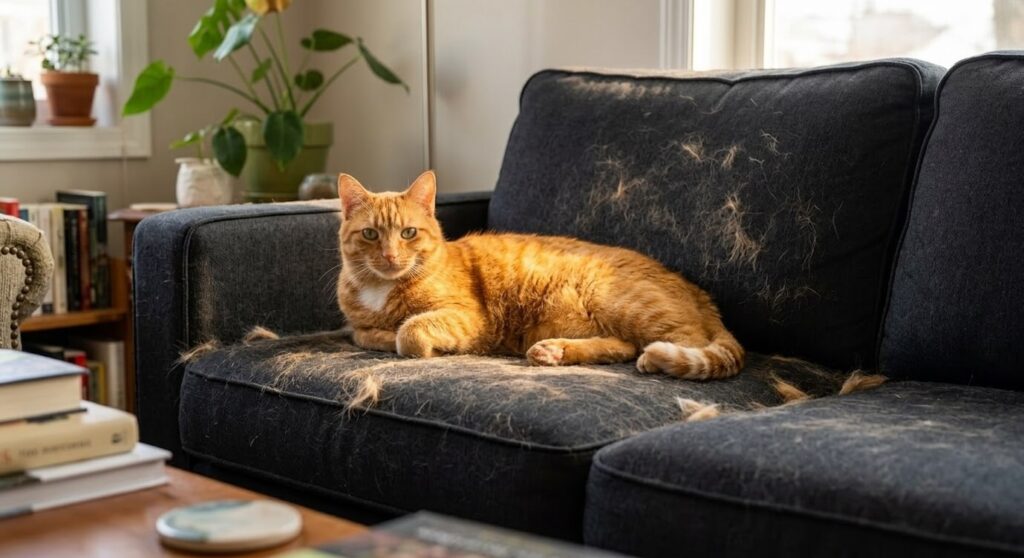
I made a decorating decision before I fully understood what I was committing to. My living room sofa is a deep charcoal grey fabric sectional — beautiful, moody, exactly the aesthetic I wanted. Oliver is a bright, gloriously fluffy orange tabby who sheds with the generosity of someone who has fur to spare and absolutely no concept of where it lands.
The combination is, visually, a disaster. For the first two years, my strategy was lint rollers — the sticky tape kind — which I went through at a rate that felt genuinely embarrassing at the register. I would spend ten minutes rolling the couch before guests arrived, feel briefly victorious, and then watch Oliver walk across the cushions thirty seconds later and undo everything.
Learning how to actually get cat hair off furniture — fast, completely, and without bankrupting myself in lint tape — required understanding why the standard approach doesn’t work, and replacing it with methods that address the actual physics of the problem. Here’s everything that changed my life.
Quick Answer
The fastest way to get cat hair off furniture is to break the static bond first. Run a slightly damp rubber dishwashing glove across the fabric surface in long strokes to gather fur into rollable clumps. For ongoing maintenance, a reusable electrostatic push-pull roller outperforms sticky tape every time. A diluted fabric softener spray neutralizes static cling before you begin for deeply embedded fur.
Why Is Cat Hair So Hard to Remove? (The Science Behind the Struggle)
Before the hacks, a brief explanation — because once you understand why cat hair behaves the way it does, every removal method makes intuitive sense.
The Static Electricity Problem
Cat fur generates and holds static electrical charge through friction. Every time Oliver moves across my sofa cushions — sitting, shifting, kneading, dramatically flopping down — his fur creates triboelectric charge against the fabric surface.
This static charge creates a genuine electrostatic bond between individual hair strands and fabric fibers. The bond is not strong individually, but across hundreds of hairs distributed across a cushion surface, it creates significant aggregate adhesion. Running a dry lint roller over a statically charged surface picks up some hair but simultaneously generates more static — sometimes making the problem worse at a microscopic level before it gets better.
This is why your sticky lint tape approach feels like you’re fighting the couch itself. You are, in a sense — the fabric is actively holding the hair.
The Barbed Hair Structure Problem
Cat hair is not smooth. Under magnification, individual cat hairs have a scaled, directional surface structure — similar to fish scales — that causes them to grip fabric fibers mechanically, independent of static charge.
This directional gripping means cat hair works its way into fabric weaves over time rather than sitting on the surface. Hair that has been there for days is more deeply embedded than hair from this morning. Standard surface-contact methods (sticky tape, a cursory pass with your hand) cannot reach embedded hair — you need methods that interact with the fabric structure more aggressively.
Why Certain Fabrics Are Worse
- Velvet, velour, and microfiber — the tight pile structure grabs hair at multiple anchor points simultaneously; nightmare territory
- Wool and textured weaves — the surface irregularity provides mechanical anchor points for the scaled hair structure
- Charcoal and dark solids — no static or adhesion advantage, just maximum visibility of every orange strand
- Leather and faux leather — actually the most cat-hair-resistant fabric option; static doesn’t build, hair sits on the surface and wipes clean
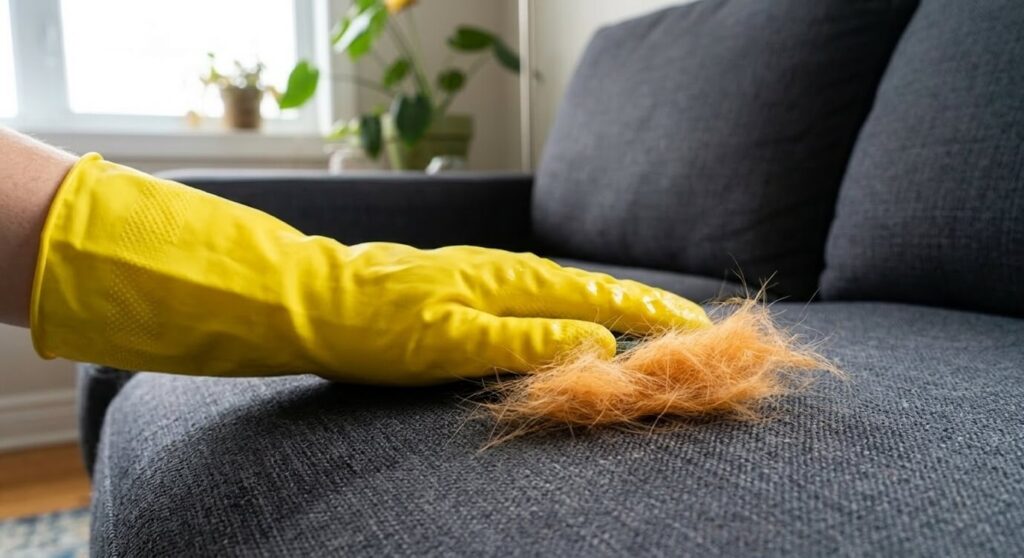
The Rubber Glove Hack: The Cheapest, Fastest Method
This is the method I use most frequently, and it costs approximately nothing because you almost certainly already own the tool.
What you need: A standard yellow rubber dishwashing glove. That’s it.
Why it works: Rubber has two properties that make it ideal for cat hair removal. First, rubber generates opposite static charge to most fabric-hair combinations, which neutralizes the electrostatic bond holding hair to the fabric. Second, the texture of rubber creates a tacky surface that physically grips hair strands and pulls them away from fabric fibers.
The Technique
- Dampen the glove slightly — run it under water and shake off the excess. The glove should be damp, not wet. A wet glove will dampen your fabric; a damp glove creates the right level of surface tension.
- Work in long, firm strokes in a single direction — not circular, not back and forth. Pick a direction (typically toward you) and maintain it. This prevents the directional hair scales from re-anchoring.
- Watch the fur clump — this is the satisfying part. The rubber glove aggregates individual hairs into visible clumps that roll up in front of your stroke, rather than just redistributing them.
- Collect the clumps by hand as they form, or sweep them to the edge of the cushion and collect them at the end.
- Rinse the glove under running water to clear the hair, wring, and continue.
Full cushion time: Approximately 90 seconds per seat cushion. Oliver’s entire sofa side in under eight minutes.
Cost: $2–4 for a pair of rubber gloves, reusable indefinitely. The math compared to weekly lint tape purchases is not subtle.
The Fabric Softener Static-Breaker Trick
This method works best as a pre-treatment step before using any mechanical removal method, and it is particularly effective on deeply embedded fur that has been there for days.
The mixture: Two parts water, one part liquid fabric softener, in a small spray bottle. Shake gently before each use.
Why it works: Fabric softener contains cationic surfactants — positively charged compounds that coat fabric fibers and neutralize the static charge holding hair to the surface. Once the electrostatic bond is broken, hair releases from the fabric significantly more easily.
How to Use It
- Lightly mist the affected surface — you want a fine, even coat of the mixture, not saturation. The fabric should feel barely damp to the touch.
- Allow 30–60 seconds for the surfactant to work into the fabric fibers before attempting removal.
- Follow with your preferred mechanical method — the rubber glove, a squeegee, or a roller. You’ll notice the hair comes away in much larger clumps with significantly less effort.
- Allow the fabric to fully dry before putting cushion covers back or allowing your cat back onto the surface — a damp surface will collect new hair aggressively.
For ongoing prevention: A light mist of the fabric softener mixture on your sofa surfaces once or twice a week creates a light anti-static coating that meaningfully reduces the rate at which new hair bonds to the fabric. This is the closest thing to a passive maintenance system I’ve found.
Fabric compatibility note: Test on a hidden area of your specific fabric first. Most fabric types are safe, but some delicate upholstery fabrics are sensitive to certain fabric softener compounds.
Reusable Electrostatic Rollers vs. Sticky Tape: Why Sticky Tape Is Wasting Your Money
Let me make this direct: sticky tape lint rollers are a consumable product, not a cleaning tool. You buy them, you use them, you throw them away, you buy more. The pet care industry sells an enormous quantity of them annually precisely because they have to be replaced constantly.
Reusable electrostatic pet hair rollers operate on an entirely different principle — and they are objectively more effective.
How Electrostatic Rollers Work
The best reusable rollers use a bi-directional push-pull mechanism — the roller surface generates electrostatic charge in both stroke directions, picking up hair on both the forward and backward pass. The collected hair is removed by opening a chamber and discarding the aggregated fur, then the roller is ready for immediate reuse.
Comparison:
| Feature | Sticky Tape Roller | Reusable Electrostatic Roller |
|---|---|---|
| Cost over one year | $40–80+ | $15–25 one-time |
| Effectiveness on embedded fur | Surface only | Penetrates deeper into pile |
| Generates additional static? | Sometimes | No — neutralizes static |
| Works on all fabric types | Limited | Broad compatibility |
| Environmental waste | High (weekly disposal) | Minimal |
| Best use case | Travel, quick spot | Daily home maintenance |
When Sticky Tape Is Still Worth Having
I keep one travel-sized sticky roller for clothing — jacket fronts, black trousers before leaving the house — where the electrostatic roller’s size is impractical. For any furniture surface, the reusable electrostatic roller wins every time.
What to look for when purchasing:
- Bi-directional rolling mechanism — unidirectional rollers are less efficient
- Easy-open hair collection chamber — you’ll be emptying it regularly; a fiddly mechanism gets old quickly
- Firm roller pressure — softer rollers glide over embedded hair; firmer ones make better fabric contact
- Handle length — a longer handle reaches sofa backs and seat bases without awkward positioning
The Window Squeegee Method for Deep Embedded Fur
This is the method that surprises people the most — and produces the most dramatic results on heavily embedded, long-term fur deposits.
A standard rubber-blade window squeegee drags through fabric surface pile with significantly more contact pressure and surface area than any roller or glove, pulling embedded hair upward and aggregating it into removable clumps.
Why it works so well: The rigid rubber blade contacts the fabric at consistent pressure across its full width simultaneously, and the dragging motion works against the directional scales of embedded hair strands, pulling them outward rather than pushing them deeper.
Technique
- Use a clean, dry squeegee — a squeegee with any cleaning solution residue may stain upholstery fabric
- Apply firm, consistent downward pressure and pull toward you in one continuous stroke
- A line of aggregated hair will form in front of the blade — like a tiny hay bale of fur
- Lift and dispose of the clump, reposition, repeat
- Work systematically across the surface in parallel strips rather than random passes
Best fabric types for squeegee use: Microfiber, velvet, velour, and any tight-pile fabric where embedded hair is the primary problem. The squeegee is less necessary on loose-weave fabrics where fur sits on the surface.
One caution: On very delicate or loosely woven upholstery, test a hidden area first — firm squeegee pressure can potentially snag or pull at fragile fabric structures.
The Squeegee + Static-Breaker Combination
For deeply embedded fur that has been building for weeks (no judgment — we’ve all been there), combine methods:
- Spray the fabric softener mixture lightly and wait 60 seconds
- Use the squeegee to aggregate and remove the bulk of the fur
- Follow with the rubber glove for finer remaining strands
- Finish with the electrostatic roller for surface-level remnants
This three-step sequence handles even the most aggressively embedded cat fur completely.
Vacuum Attachments That Actually Work
Not all vacuum attachments are created equal for cat hair, and using the wrong one on upholstery can actually make the problem worse by pushing hair deeper into the fabric.
The Motorized Upholstery Tool
This is the attachment worth purchasing if you don’t already have it. A motorized upholstery tool (also called a mini motorized brush or turbo brush) contains a small rotating brush head driven by the vacuum’s airflow — similar in principle to the main floor brush, but scaled for furniture surfaces.
Why it outperforms standard upholstery attachments:
- The rotating brush mechanically lifts embedded hair from fabric fibers before suction removes it — standard suction-only tools can’t reach embedded hair
- The brushing action works against the directional grain of cat hair, defeating the scaled anchoring structure
- Suction removes the dislodged hair simultaneously, rather than aggregating it on the surface for secondary removal
What to look for:
- Compatible with your existing vacuum’s attachment port diameter
- Brush roll designed for upholstery (softer bristles than floor brush rolls)
- Easy-access brush roll for cleaning — cat hair wraps around rotating brush rolls aggressively and needs regular removal
The Crevice Tool: Underrated for Cushion Lines
The sofa cushion seams — the gaps between cushions and between cushions and the sofa back — accumulate hair at a rate disproportionate to their size. Hair falls into these gaps continuously and builds into dense deposits that no roller or glove reaches.
A narrow crevice tool run along every cushion seam before any surface cleaning dramatically reduces the total hair you’re managing, because it removes the reservoir that would otherwise migrate back to the surface.
Make cushion seams your first vacuum step, not an afterthought.
Technique Matters as Much as Tools
- Vacuum in multiple directions — first with the fabric nap, then against it; the against-nap pass dislodges embedded hair that the with-nap pass missed
- Don’t rush — slow, deliberate passes with the motorized tool are more effective than fast passes; the brush roll needs contact time to work
- Vacuum before other methods for heavy deposits — removing the top layer of loose hair first makes the rubber glove and squeegee methods dramatically more efficient
Building a Passive Hair Management System
The fastest way to manage cat hair on your furniture is to reduce how much gets there in the first place. While removing hair from the couch is essential for quick cleanups and visitor-ready tidiness, a holistic grooming and shedding management strategy is what truly controls the volume of hair entering your environment. [Read our complete guide to managing the indoor cat shedding cycle here → How to Control Cat Hair in a Small Apartment (A Clean-Freak’s Guide)]
One of the most effective passive strategies is making your cat’s dedicated spaces genuinely more appealing than your sofa. When Oliver has a window perch with an excellent sightline, a cat tree at height near the main activity of the room, and a bed that is warm, soft, and positioned where he can monitor his territory — he chooses those spaces over the sofa significantly more often. Providing truly enriching dedicated spaces that Oliver actively prefers to use means less fur deposited on the furniture you care about. [See our guide to building an enriching indoor cat environment here → The Small Apartment Cat Survival Guide: 7 Pillars of Indoor Enrichment]
Additional passive reduction strategies:
- Washable furniture throws over your highest-traffic sofa areas — Oliver’s preferred cushion has a washable throw that catches the bulk of daily fur, and washing it weekly is faster than deep-cleaning the sofa fabric
- Regular brushing schedule — every grooming session removes loose fur before it becomes airborne and redistributed across your furniture; a five-minute daily brush on Oliver during shedding season makes a measurable difference to sofa hair volume within a week
- HEPA air purifier — captures airborne fur and dander before it settles on surfaces; not a replacement for surface cleaning, but meaningfully reduces the settlement rate
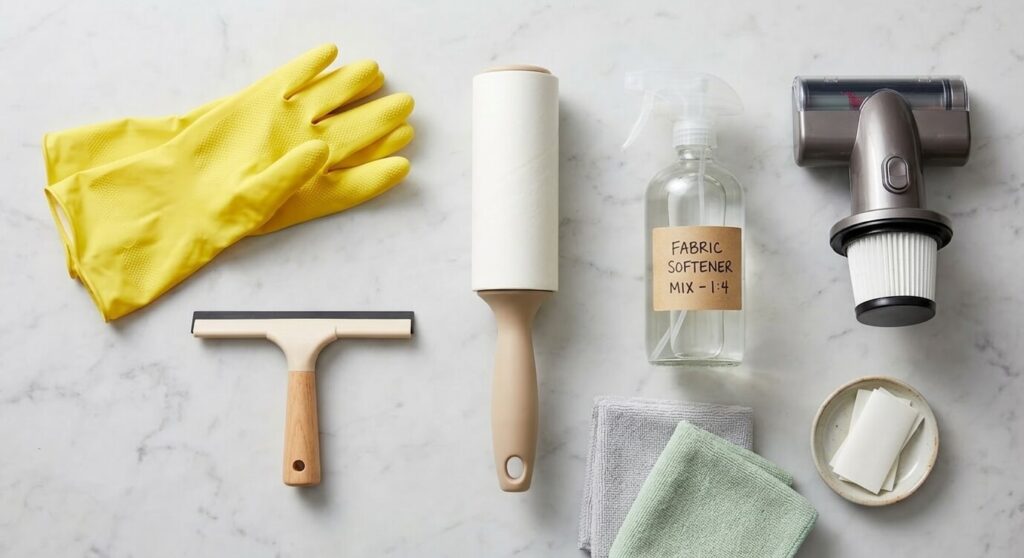
Quick Reference: How to Get Cat Hair Off Furniture
| Situation | Best Method |
|---|---|
| Quick tidy before guests arrive | Damp rubber glove |
| Daily light maintenance | Reusable electrostatic roller |
| Fur embedded for days or weeks | Fabric softener spray + squeegee |
| Cushion seams and crevices | Vacuum crevice tool |
| Full deep clean | Motorized vacuum attachment + rubber glove finish |
| Preventing buildup | Washable throw + regular brushing |
FAQ
1. What is the fastest way to get cat hair off furniture before unexpected guests arrive?
The fastest single method to get cat hair off furniture with no setup and no products is the damp rubber glove technique — most people already own rubber dishwashing gloves, and a damp glove completes a standard sofa cushion in under two minutes.
If you don’t have rubber gloves, your next fastest option is a slightly damp hand (your own palm generates similar rubber-like friction against fabric) in firm long strokes. Keep a reusable electrostatic roller in a visible location — a drawer near the sofa, a hook by the door — for the thirty-second touch-up pass before anyone arrives.
2. Does velvet furniture attract more cat hair than other fabrics?
Yes, significantly more — and it’s both harder to remove. Velvet’s dense, upright pile structure creates a maximum surface area of fabric fibers that individual cat hairs can mechanically anchor to. The directional nature of velvet pile also means that hair pressed into the pile in one direction becomes deeply anchored rather than sitting on the surface.
If you have a velvet sofa and a shedding cat, the squeegee method is your best friend — always stroke in the direction that works with the velvet nap rather than against it to avoid crushing the pile permanently. The fabric softener pre-treatment is particularly effective on velvet before mechanical removal.
If you’re choosing new furniture and you have a heavily shedding cat, leather, faux leather, or a tightly woven synthetic weave with a smooth surface will reduce your maintenance burden substantially compared to velvet or microfiber.
3. How often should I be removing cat hair from my furniture?
The honest answer depends on your cat’s shedding level and your tolerance threshold, but for a heavy shedder like Oliver, daily light maintenance with a reusable electrostatic roller (two minutes maximum) prevents the accumulation that makes weekly deep cleaning necessary.
If daily maintenance doesn’t happen and hair is allowed to build for a week or more, the static bonding and mechanical embedding both increase — making the eventual cleaning proportionally harder. Think of it the same way as dish management: a daily two-minute pass prevents the hour-long weekend session.
During peak shedding seasons (spring and autumn, when many cats shed their seasonal coat), increasing maintenance frequency by one additional session per week and adding a five-minute grooming session to your daily routine with Oliver will measurably reduce the furniture hair volume within ten days.
References
- Custovic, A., Simpson, A., Pahdi, H., Green, R. M., Chapman, M. D., & Woodcock, A. (1998). Distribution and spatial variability of cat allergen Fel d 1 in British homes. Journal of Allergy and Clinical Immunology, 101(2), 187–192. https://doi.org/10.1016/S0091-6749(98)70382-3
- Lopatecki, L., & Bailey, W. (1994). Static electricity generation and its role in textile fiber adhesion. Journal of the Textile Institute, 85(3), 425–437. https://doi.org/10.1080/00405009408631270
Disclaimer: This article reflects the personal experience of a cat owner and applies general principles of textile science and static electricity to practical home cleaning solutions. Always test any cleaning solution or method on a hidden area of your specific upholstery fabric before applying to visible surfaces. For delicate or antique upholstery, consult a professional upholstery cleaner.