By IndoorCatExpert.com | Indoor Cat Care & Apartment Living
Six people. A dinner party. Good food, decent wine, the kind of evening where you want your apartment to look like a functioning adult lives there.
Oliver waited until the table went quiet — one of those natural conversational pauses where everyone briefly runs out of things to say — and then walked directly to his litter box in the corner of the open-plan living area, made extended, unblinking eye contact with my most important dinner guest, and used it. Thoroughly. With great confidence.
The smell followed approximately fifteen seconds later.
If you’ve ever hosted anyone in a small apartment with a cat, you understand the specific social anxiety that comes with litter box visibility. Finding a practical solution to how to hide a litter box in a small apartment is not vanity — it’s the difference between a home that reads as “person who happens to have a cat” and one that reads as “the cat’s territory that a person also sleeps in.” I’ve tested every approach over three years of city apartment living. Here are the five that genuinely work.
Quick Answer
To hide a litter box in a small apartment, the most effective solutions are: litter box enclosure furniture (benches, end tables, cabinets with interior cutouts), a decorative folding screen positioned around an open box, the dead space under a pedestal bathroom sink, a top-entry box that eliminates sightlines entirely, or a discreet closet floor modification. Every solution must maintain adequate ventilation or your cat will refuse to use it.
The Golden Rule Before You Start: Visual Hiding Is Only Half the Problem
Before choosing an approach, one principle matters more than aesthetics: a hidden litter box that smells is not actually hidden. The visual concealment you achieve with beautiful enclosure furniture is entirely undermined if the enclosed space traps ammonia and sends a wave of odor into the room every time the door swings open or your cat exits.
Hiding the litter box is step two of a two-step problem. Step one is maintaining a cleaning routine rigorous enough that the box doesn’t produce ambient odor in the first place — otherwise you’ve spent money on furniture to hide a smell rather than a visual: how to keep litter box from smelling in small apartment.
With that foundation in place, everything below becomes significantly more effective.
The Ventilation Principle — Why This Matters for Your Cat
Every hiding solution in this article has one non-negotiable requirement: the enclosed space must have adequate airflow. This matters both for you (odor management) and, more importantly, for your cat.
Cats are sensitive to ammonia accumulation. An enclosed box with poor ventilation becomes unpleasant enough for your cat to avoid — which means you’ve created beautiful furniture around a litter box your cat no longer uses, and a new problem on your living room floor. The standard recommendation from feline behaviorists is that any enclosed litter solution should have ventilation openings equivalent to at least 20% of the total enclosure surface area.
For any furniture piece that doesn’t come with built-in ventilation, drilling a series of 1-inch holes in the back or top panel, or adding a small clip-on computer fan to create active air circulation, solves the problem permanently.
Idea 1: Dual-Purpose Enclosure Furniture — The Gold Standard
This is the solution I landed on after two years of trying everything else, and it remains the best overall approach for most small apartments. Litter box enclosure furniture looks like a piece of normal home furnishing and functions as a concealed litter station simultaneously — the box disappears entirely into the living environment.
What’s Available and What Works Best
The market for litter box furniture has matured considerably in the last few years. The main formats:
Bench-style enclosures: A narrow storage bench with an entry hole on one end and the litter box inside. From any normal angle, it looks like a hallway bench or entryway storage piece. These work particularly well positioned near the apartment entrance, where a bench is expected to exist anyway. Depth needs to be sufficient for your specific litter box — measure before buying.
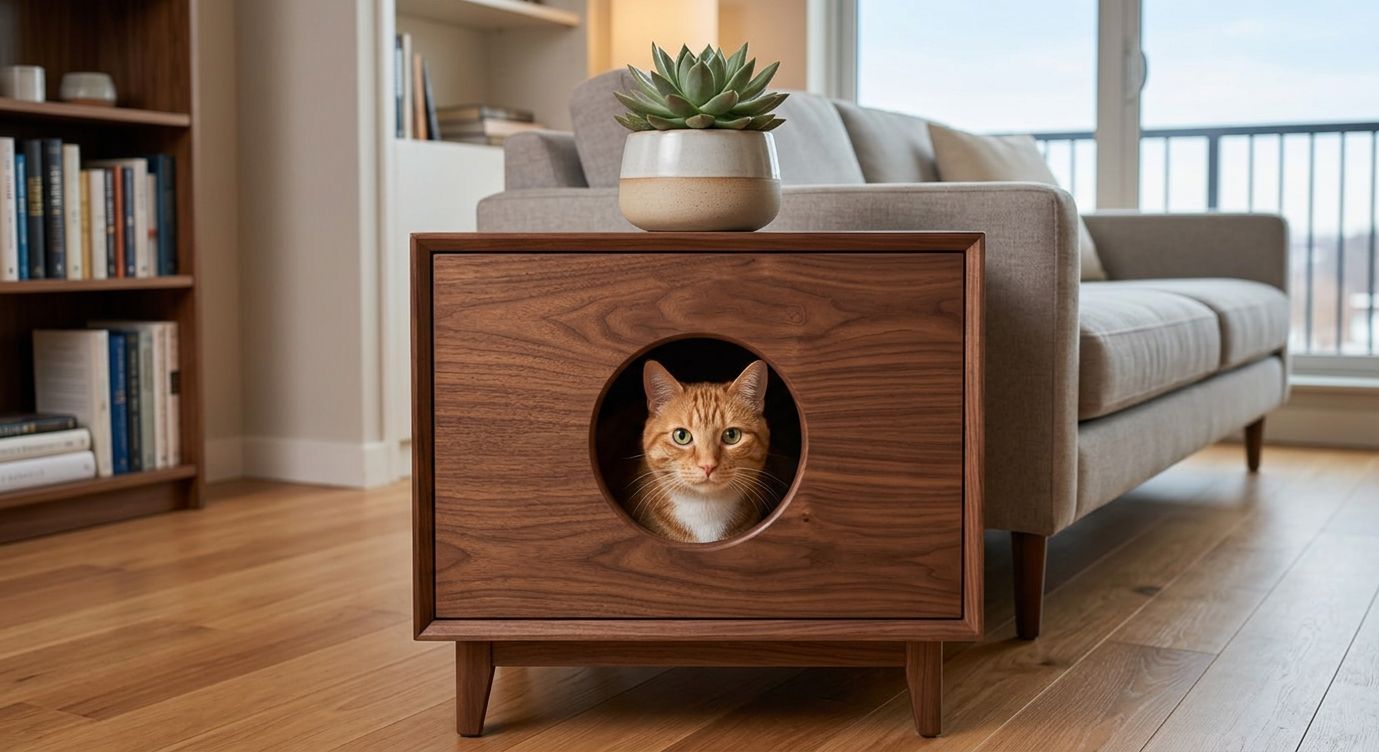
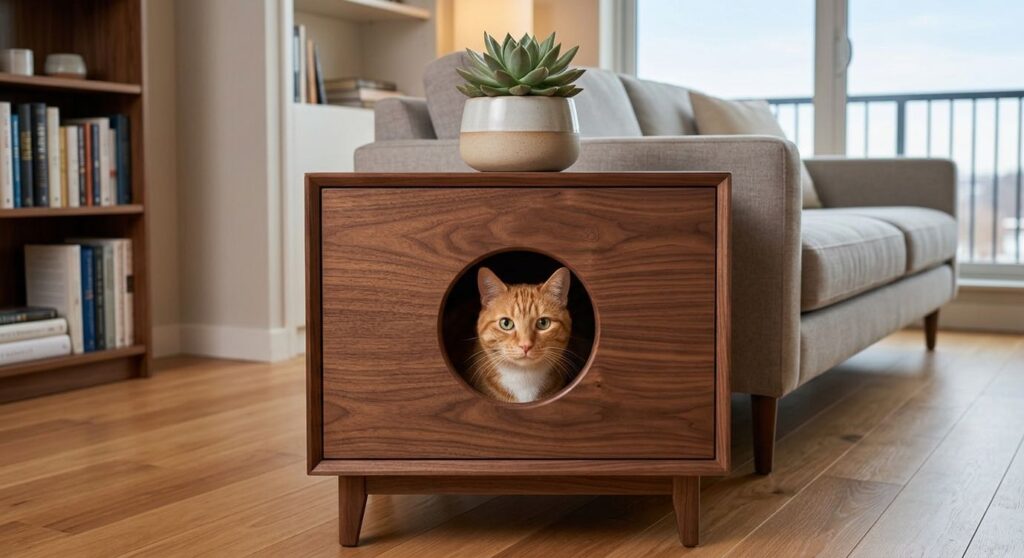
End table enclosures: A side table with an entry cutout at the lower front or side, the litter box positioned inside. This is Oliver’s current setup — it sits beside the sofa and reads as a standard mid-century side table with a lamp on top. Guests sit three feet from it and have no idea.
Storage cabinet conversions: A standard IKEA-style narrow cabinet modified with a cat entry hole cut into the lower panel. This is the most cost-effective route and allows you to match existing furniture finishes exactly. A 3-inch hole saw attachment and a drill is all the modification required.
Critical Checklist for Any Enclosure Furniture
Before finalizing a furniture choice:
- Internal dimensions: the box inside needs at least 2–3 inches of clearance on all sides beyond the litter box dimensions — cats won’t use a space they can’t comfortably turn around in
- Entry hole size: minimum 6 inches diameter for an average adult cat; 7–8 inches for a large cat like Oliver
- Ventilation openings: present in the design, or plan to add them
- Easy top or front access for you: the box needs scooping daily; the access panel should open without moving the entire piece
The additional benefit of this approach: reclaiming that floor space with furniture rather than empty floor around a litter box actually helps with apartment organization. What used to be “the litter box corner” becomes functional square footage, leaving more open floor area for the things that genuinely improve your cat’s environment — like a tall cat tree positioned where the extra space now allows it: indoor cat enrichment in small apartments.
Idea 2: The Decorative Room Divider — Zero Investment, Immediate Result
If you need a solution today and don’t want to spend money on furniture, a folding decorative screen positioned around an existing litter box is the fastest and most flexible approach. This works particularly well in open-plan apartments where a screen can serve a genuine room-dividing function while also concealing the litter area.
A three-panel folding screen positioned in an L-shape around the litter box creates a contained visual pocket visible only if someone walks directly into the corner. From normal living and dining positions, the box disappears behind it.
Making This Work Well
- Choose a screen tall enough — the litter box should be completely below the screen’s sightline from seated eye level. A 5-foot screen works for most configurations.
- Leave a gap at the floor — the entry side should have at least 12 inches of clearance at floor level for your cat to walk in and out. Most folding screens, positioned a foot from the wall on one side, naturally create this.
- Ventilation is automatic — an open-bottom, open-top screen doesn’t trap air, which is one of its genuine advantages over fully enclosed furniture.
- Coordinate with your decor — rattan and wicker screens, wooden slat designs, and fabric-panel folding screens all integrate cleanly into most apartment aesthetics. A decorative screen that matches your existing furniture reads as an intentional design choice, not a cat box camouflage operation.
The limitation: this doesn’t fully conceal the litter box if guests are standing in the kitchen area with a direct sightline over the screen’s top edge. It’s an excellent solution for litter boxes positioned in corners of rooms where the sightline geometry works; less effective in wide-open central positions.
Idea 3: The Bathroom Vanity Hack — The Neatest Small-Space Solution
This is the approach I used in my first apartment and still recommend unreservedly for any bathroom with a pedestal sink or a vanity cabinet with dead space beneath it. The bathroom is the only room in most apartments where a litter box exists in contextually appropriate company — other hygiene-related fixtures — which means concealing it there requires the least effort and produces the most natural result.
Under-Pedestal-Sink Setup
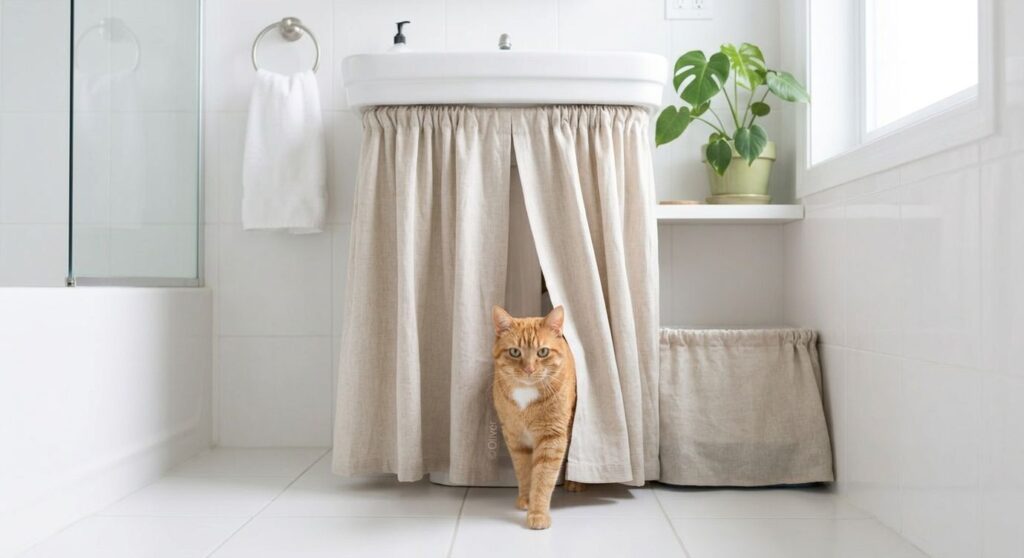
A pedestal sink in a small bathroom typically creates a triangular dead space beneath it that is exactly the right size for a standard litter box. Position the box here, add a simple clip-on half-curtain (tension rod, fabric panel) at sink height, and the litter box is completely invisible from the doorway and during normal bathroom use.
The bathroom door itself provides full visual concealment when closed, and the existing ventilation — bathroom exhaust fan, often a small window — handles odor management automatically.
Converting Vanity Cabinet Dead Space
Many bathroom vanity cabinets have a false-front lower panel that conceals plumbing — this panel often isn’t functional storage but could be. Removing it (usually held by small clips or screws) creates an alcove that fits a compact litter box perfectly. Add a small magnetic cabinet door over the opening, cut a cat entry hole in the door panel, and the result is a completely concealed, perfectly ventilated litter solution that uses space that was doing nothing anyway.
Key consideration: ensure the bathroom door can stay open or ajar when you’re not using the bathroom — a fully closed bathroom door means a fully inaccessible litter box, which is a behavioral problem waiting to happen.
Idea 4: Top-Entry Litter Boxes — Hide in Plain Sight
A top-entry litter box doesn’t conceal the box behind anything — instead, it redesigns the box itself so that it reads as a neutral home object rather than an obvious litter station. The entry is on the top rather than the side, which eliminates the visual signal of a litter box entirely from most angles. From across the room, it looks like a plain storage container or a side table without a visible opening.
The additional practical benefits for apartment life are meaningful:
- Litter tracking reduction — cats exit through the top rather than walking directly off a side entry onto the floor, which dramatically reduces the radius of scattered litter around the box
- Sightline elimination — because the interior is only visible looking directly down from above, the litter itself and any contents are invisible from standing or seated human eye level
- Odor direction — the small top opening concentrates odor upward rather than outward, which means it diffuses into ceiling-level air rather than across the room at nose height for seated guests
The Trade-Offs to Know Upfront
Top-entry boxes are not suitable for all cats. Senior cats with arthritis or joint pain may struggle to jump up and lower themselves through the entry — the movement requires more flexibility than a standard side-entry approach. Kittens under six months also sometimes have difficulty with the step up. Oliver, at a solidly middle-aged six years and slightly heavier than ideal, navigates his top-entry box without issue — but it’s worth observing your cat’s ease of access before committing.
Also ensure the entry opening is sized for your specific cat. Standard top-entry boxes are designed for average adult cats; large breeds or cats Oliver’s size benefit from boxes with wider openings.
Idea 5: The Closet Floor Modification — The Most Invisible Solution
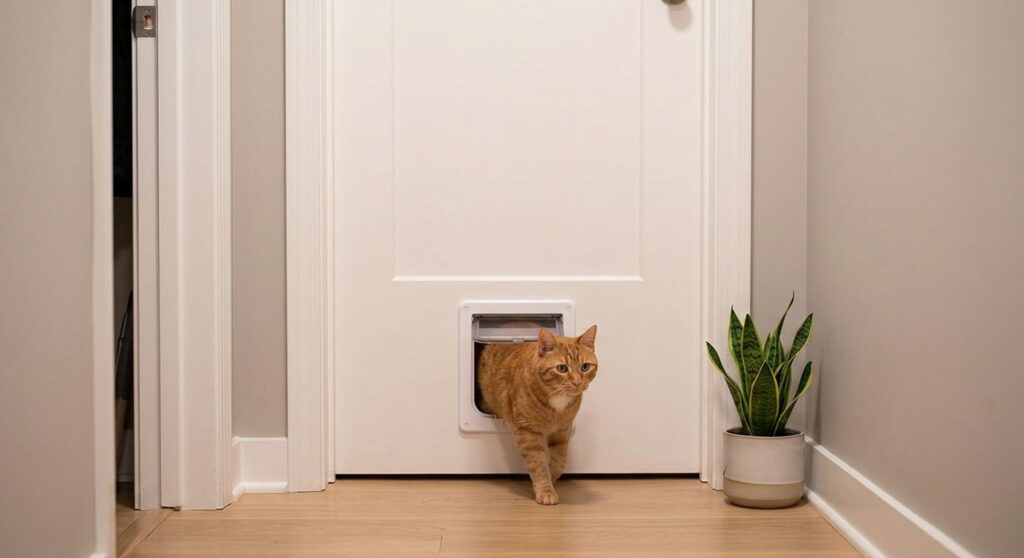
If your apartment has a closet with floor space to spare — even a small hallway coat closet — a permanent, completely invisible litter station is possible with one small modification: a cat door installed in the closet door panel at floor level.
A standard cat door insert requires a rectangular cutout in the door panel (the dimensions come with the cat door hardware) and snaps in without professional installation. Once installed, your cat can access the litter box inside the closet at any time; humans never see, hear, or smell it from the room.
Making the Closet Setup Work
- Dedicate the closet floor area — the box needs to remain accessible and cleanable; don’t stack items directly around it
- Leave a gap at the top or back of the closet for ventilation — propping the closet door slightly open with a door stop keeps air circulating when the closet isn’t needed for storage access
- Use a battery-powered motion-activated LED light inside the closet so your cat has visibility in the dark interior — a cat who goes in and can’t see will stop going in
- Check your lease before cutting a cat door — this is a physical modification to the door. Some landlords approve it readily; others require permission. A cat door can typically be reversed by patching and painting the panel, which may satisfy most landlords, but get written approval first.
The closet modification is the most invisible of all five solutions — when the closet door is closed, there is genuinely no visible indication of a litter box anywhere in the apartment. For anyone who frequently entertains or has a strong preference for a completely cat-object-free visual environment, it’s worth the extra step.
Choosing the Right Idea for Your Apartment
A quick reference to match each solution to your specific situation:
| Idea | Best For | Ventilation | Cat Accessibility | Renter-Friendly |
|---|---|---|---|---|
| Enclosure furniture | Open-plan living rooms | Add holes or fan | High | Yes |
| Decorative screen | Corners and alcoves | Automatic | High | Yes |
| Bathroom vanity hack | Bathrooms with dead space | Automatic (exhaust fan) | High | Yes |
| Top-entry box | Any location, tracking control | Good — upward direction | Medium (age-dependent) | Yes |
| Closet modification | Hallway or bedroom closets | Needs active management | High | Check lease |
FAQ
👉 Are enclosed spaces safe when figuring out how to hide a litter box in a small apartment?
Cats don’t object to the hiding itself — they object to two specific things that hidden setups sometimes cause: poor ventilation (ammonia accumulation makes the enclosed space aversive) and restricted escape routes (cats instinctively prefer elimination spots with multiple exit options, meaning a box with only one entrance in a very confined enclosure can feel like a trap). Both issues are manageable. Ensure your chosen solution has adequate airflow, that the entry hole is large enough for your cat to exit quickly without squeezing, and that the box interior is large enough for your cat to turn around and move comfortably. A well-ventilated enclosure with a generously sized opening is typically accepted without hesitation.
👉 Will my cat stop using the box if I suddenly move it inside furniture?
Possibly, briefly. Cats are creatures of established habit, and a sudden change in litter box location or format can cause a few days of hesitation or even avoidance while they adjust. The transition is smoother if you move the litter box incrementally — a few inches per day toward the new location over the course of a week — rather than relocating it across the room overnight. When introducing a new enclosure piece, leave the door or access panel open for the first week so the cat can explore and use the box without the added step of navigating an unfamiliar entry. Once they’re consistently using it in the open configuration, close the panel gradually.
👉 Can I use scented liners or sprays inside the enclosure furniture to keep it smelling fresh?
Avoid scented products inside any enclosed litter space. Cats have a sense of smell approximately 14 times more sensitive than ours, and the concentrated fragrance in a small enclosed area is aversive to many cats — it can cause avoidance of the box entirely, which creates a far worse problem than mild ambient odor.
If you’re managing odor inside an enclosure, the effective approaches are: an unscented clumping litter with strong natural odor absorption, a thin layer of activated charcoal powder on the bottom of the box before adding litter, a small activated charcoal odor absorber placed inside the enclosure away from the box itself, and above all — daily scooping and periodic full box washing. Fresh litter in a clean box in a ventilated enclosure should not produce noticeable ambient odor.
References: Ellis, S.L.H. et al. (2013). AAFP and ISFM Feline Environmental Needs Guidelines. Journal of Feline Medicine and Surgery, 15(3), 219–230. | Neilson, J.C. (2004). Feline house soiling: Elimination and marking behaviors. Veterinary Clinics of North America: Small Animal Practice, 33(2). | Sung, W. & Crowell-Davis, S.L. (2006). Elimination behavior patterns of domestic cats in homes with and without other cats. Journal of the American Veterinary Medical Association.
IndoorCatExpert.com — For the cats who will use the litter box at the exact worst possible moment, and the humans building a more elegant life around them anyway.