By IndoorCatExpert.com | Indoor Cat Behavior & Wellness
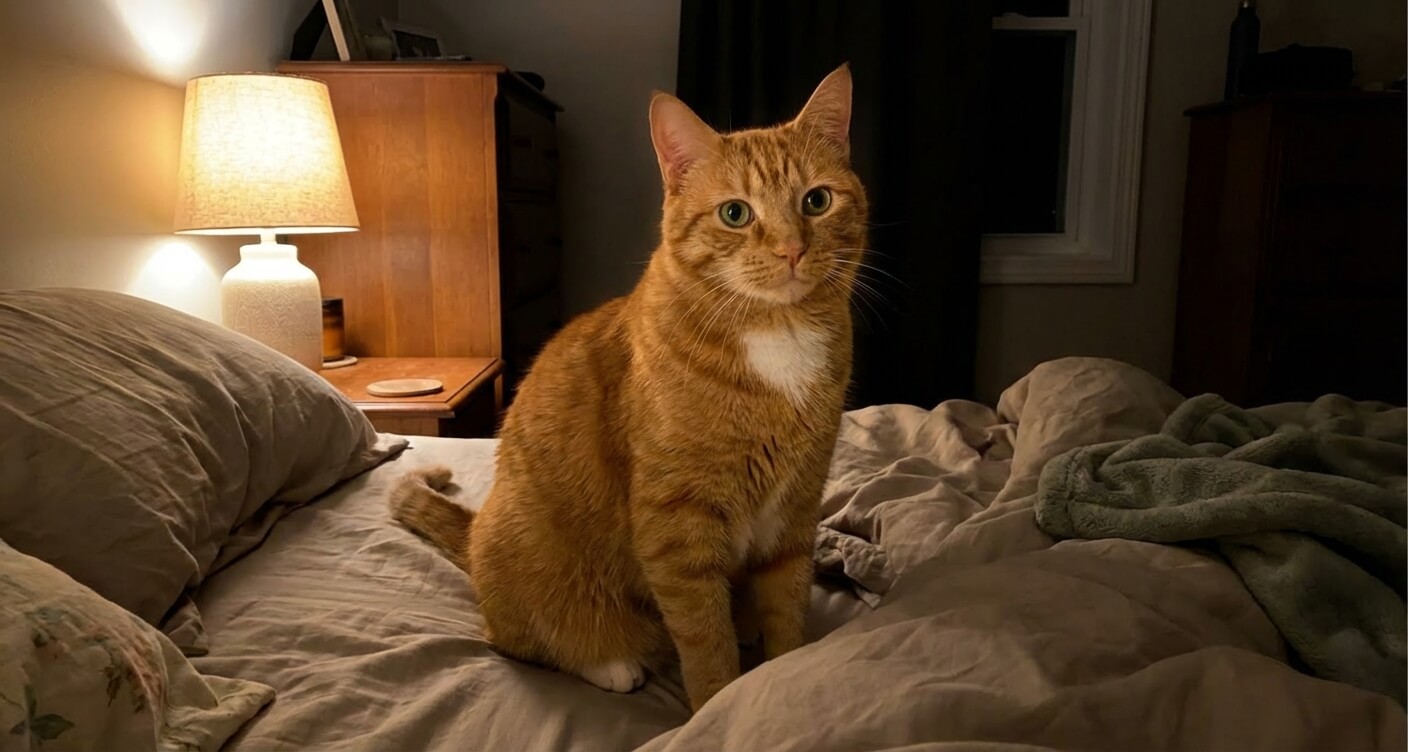
I used to dread 3 AM. Not because of work stress or a bad dream — but because I didn’t know how to tire out an indoor cat before bed. Oliver is my orange tabby. He’s a little round, deeply opinionated, and for the first two years of his life, he treated my sleeping hours as his personal athletics competition. I’d wake up to the sound of him thundering down the hallway, launching himself off the bed frame, and batting a toy mouse directly into my face. Every. Single. Night.
I tried ignoring it. I tried closing the bedroom door (he screamed). I tried exhausting him with a five-minute play session before I brushed my teeth. Nothing worked — until I understood why it wasn’t working and built a proper pre-bed routine around his biology, not my convenience.
This is that routine. It takes 15 minutes. It works.
Quick Answer
The best way to tire out an indoor cat before bed is to replicate their natural hunting cycle. Engage them in 10–15 minutes of active, wand-toy play that mimics real prey movement, then immediately offer a small meal. This triggers the hunt → catch → eat → sleep sequence hardwired into every cat’s nervous system, signaling that the night is over.
Why Your Cat Gets the Midnight Zoomies (It’s Not Personal)
Before we talk about the fix, it’s worth understanding what’s actually happening when Oliver turns into a chaos demon at midnight.
Cats are crepuscular — naturally most active at dawn and dusk. Indoor cats, however, don’t have the environmental cues (fading light, temperature shifts, prey activity) that regulate this rhythm in the wild. Without those cues, their peak activity window can drift into the middle of the night.
If you want to understand the exact biological reasons why this happens, read my deep-dive on cat zoomies at night and the science of FRAPs.
Add to that the fact that most indoor cats spend 12–16 hours a day doing essentially nothing. That stored energy has to go somewhere. If you’re not giving it a healthy outlet before bed, your cat will find its own outlet — usually involving your ankles.
The midnight zoomies aren’t misbehavior. They’re a symptom of an unmet biological need. And the solution is beautifully simple once you see it that way.
The Science Behind the Hunt → Eat → Sleep Cycle
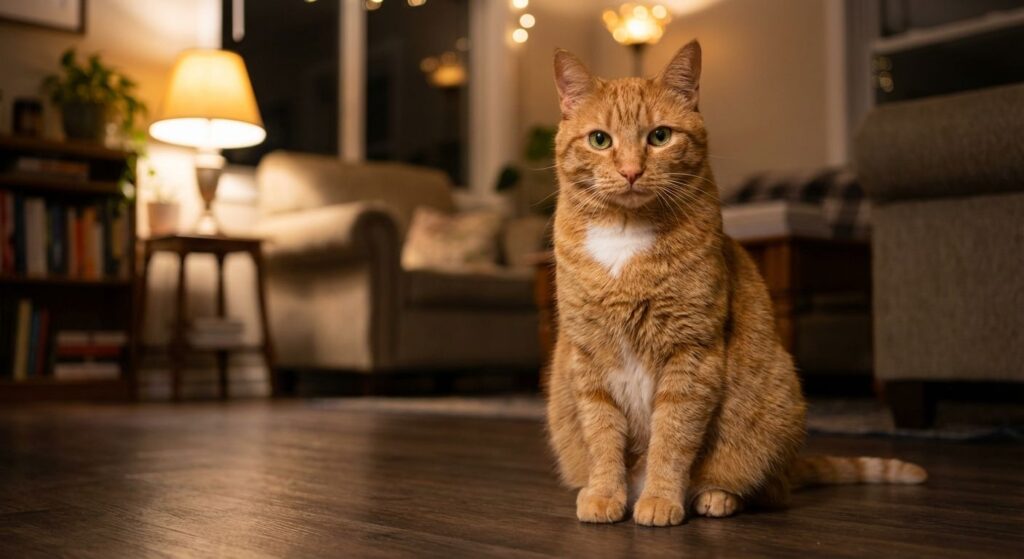
Every cat, from a Bengal to a barn cat to my round little Oliver, is wired to follow the same behavioral loop:
Stalk → Chase → Catch → Kill → Eat → Groom → Sleep
In the wild, this cycle repeats multiple times a day and naturally winds down at night after a successful hunt and meal. For indoor cats, the hunt portion is almost entirely absent. They’re handed food in a bowl at arbitrary times, and the nervous system never gets the satisfaction of completing the loop.
When you simulate the hunt with an interactive toy and follow it immediately with food, you’re not just tiring your cat out physically. You’re closing the behavioral loop their brain has been waiting all day to complete. The grooming and sleep that follow aren’t coincidental — they’re the neurological next step in a sequence that just got its missing pieces.
This is the same principle behind optimizing your cat’s broader environment — if you haven’t already thought about how your apartment layout supports or frustrates these natural behaviors, it’s worth a read: our full guide on indoor cat enrichment in small apartments.
The 15-Minute Pre-Bed Routine (Step by Step)
When it comes to how to tire out an indoor cat before bed, you don’t need elaborate equipment. You just need a wand toy, about 15 minutes of genuine presence, and a small portion of food ready to go. That’s it.
Do this at the same time every night — consistency is what transforms this from a one-off trick into a sleep reset. Oliver now starts following me to the living room around 9:45 PM because his body knows what’s coming.
Step 1: The Warm-Up (Minutes 1–3)
Start slow. I know it’s tempting to immediately start whipping the toy around, but jumping straight into high intensity doesn’t mirror how a hunt actually begins — and cats know the difference.
Move the toy like something cautiously alive:
- Drag it slowly along the baseboards, pausing every few seconds
- Let it “hide” under the edge of a rug or behind a chair leg
- Keep movements low to the ground — ground prey, not aerial acrobatics yet
Oliver usually starts with a crouched stalk at this point, pupils dilating, tail doing that slow side-to-side flick. That’s exactly what you want. You’re loading the spring.
Step 2: The High-Intensity Chase (Minutes 4–10)
Now escalate. This is the heart of the routine and where most of the physical exertion happens.
What good chase movement looks like:
- Sudden bursts of speed across the floor
- Erratic direction changes that mimic a panicked animal
- Occasional “flights” — letting the toy briefly go airborne before landing and running again
- Disappearing behind furniture, then reappearing
The key mistake people make here is moving the toy in predictable loops or figures-of-eight. Real prey doesn’t do that. If Oliver can predict where the toy is going, he loses interest. Keep him guessing. Keep him working.
Don’t worry if he takes a few breathers — cats naturally hunt in short explosive bursts, not sustained chases. Let him catch his breath, then restart. You’ll notice his breathing deepen and his movements become slightly less explosive as the session goes on. That’s the goal.
Step 3: The Catch (Minutes 11–13)
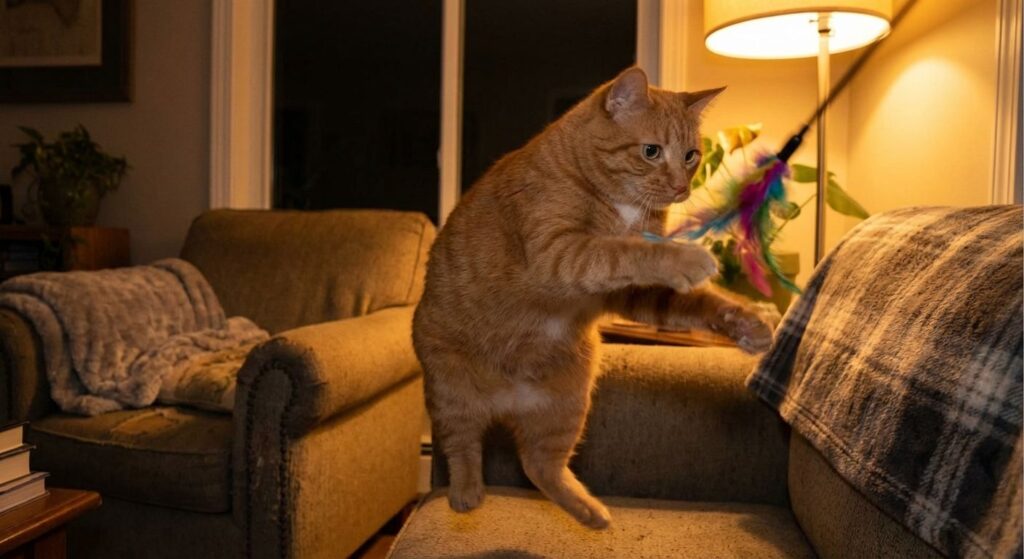
If you want to successfully learn how to tire out an indoor cat before bed, this step is non-negotiable and almost always skipped.Every hunt must end in a successful kill. Every single time.
Start slowing the toy down — make it “tire out.” Let it twitch weakly, stumble, slow to a crawl. Then let Oliver pin it. Let him bunny-kick it. Let him bite it and hold it. Do not yank the toy away.
Give him 60–90 seconds with the “kill.” This is not just play — it’s the psychological payoff the entire sequence has been building toward. Skipping this step is like serving someone a five-course meal and removing their plate before dessert. The loop stays open. The frustration remains.
When he’s done mauling it, set the toy aside calmly. Don’t wave it around again.
Step 4: The Cool-Down Meal (Immediately After)
The moment the toy is down — feed him. Not in five minutes. Right now.
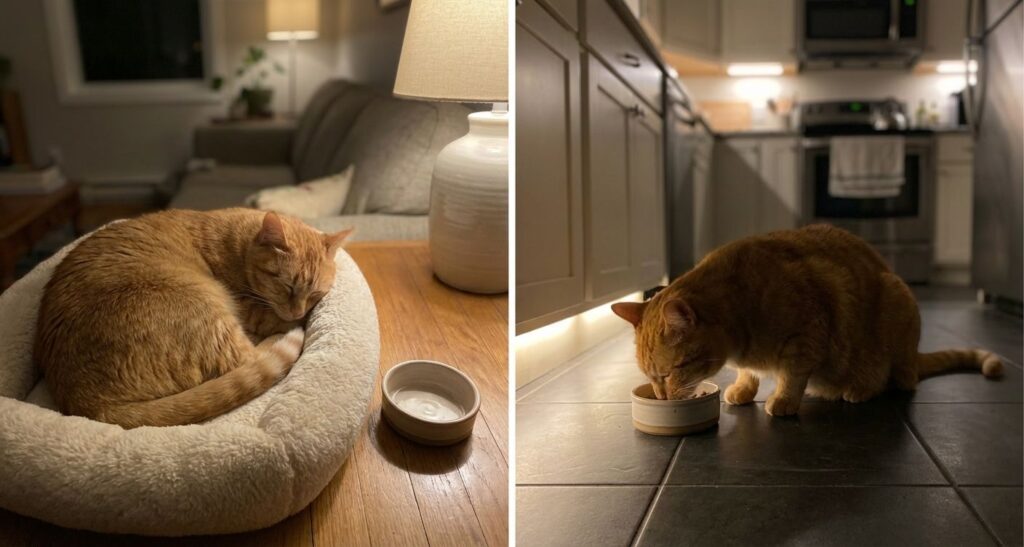
This timing is everything. The meal arriving immediately after the kill is what completes the hunt → eat transition in your cat’s nervous system. Even a small portion works: I give Oliver about a third of his evening meal at this point (the rest goes in his puzzle feeder for overnight foraging, which keeps him occupied without requiring me to be awake).
After eating, Oliver will almost always sit and groom himself for several minutes, then find a spot to curl up. I don’t have to do anything else. The biology takes over.
What to Do If Your Cat Ignores the Routine at First
Oliver didn’t immediately become a cooperative participant. The first three nights, he was mildly interested for about two minutes and then wandered off to stare at the wall.
Don’t give up before day five. Cats are skeptical of new patterns, especially adult cats who’ve already established their own nighttime routines (however inconvenient those routines are for you). Consistency across a week is what builds the conditioned response. By the way, keeping the litter clean before bed is crucial. Read my guide on how to keep litter box from smelling in small apartment spaces for my exact routine.
A few troubleshooting tips if you’re hitting resistance early:
- Try a different toy type. Some cats prefer feathers; some prefer fur or fabric textures; some go absolutely feral for a simple twist of crinkle paper. Oliver’s secret weapon is a long ribbon — not even a “cat toy,” just a ribbon.
- Play in a different room. The bedroom may carry “sleep” associations; the living room or hallway often produces more engaged play.
- Lower the lights. Dim lighting enhances the hunting atmosphere and tends to increase focus and intensity. Oliver is noticeably more engaged with the lights low than with the overheads on.
- Check the timing. If you’re trying this at 11 PM but your cat peaks at 8 PM, you’re fighting the rhythm instead of working with it. Observe when your cat naturally becomes most active and shift the routine to align with that window.
Building the Habit: What Week One Looks Like
Figuring out how to tire out an indoor cat before bed takes a little patience. Here’s what to expect realistically when you start:
| Night | What Usually Happens |
|---|---|
| 1–2 | Cat is skeptical, plays briefly, may still zoom at night |
| 3–4 | More engagement with the toy, some improvement in sleep |
| 5–7 | Play sessions become longer and more focused |
| Week 2+ | Cat starts anticipating the routine; midnight disruptions drop sharply |
Oliver was reliably sleeping through the night by day nine. Your timeline may vary slightly, but the direction is consistent if the routine is.
If you are constantly looking at your resting feline and wondering why does my cat sleep so much, understanding their biological clock is the first step to fixing their night zoomies.
Additional Tweaks That Helped Us
Beyond the core routine, a few smaller adjustments made a meaningful difference in Oliver’s overnight behavior:
- Puzzle feeder before I sleep. Leaving a puzzle feeder with a small kibble portion gives Oliver something to “hunt” independently at 2 AM instead of my feet. He solves it, eats, and goes back to sleep.
- Blackout curtains. Streetlights and early morning light were disrupting Oliver’s sleep cycles. Blackout curtains in the bedroom made a surprisingly significant difference.
- No rough play in the hour before the routine. Chasing him with my hand or letting him attack my feet before the session burns off the energy you need him to have during the structured play. Save the energy; spend it on your terms.
FAQ
What if my cat completely ignores the wand toy at night?
Some cats have strong toy preferences that aren’t immediately obvious. Try rotating through different toy types over the course of a week — feather attachments, fur mice, ribbon, crinkle material, even a balled-up piece of paper. If your cat responds to nothing, it may be worth ruling out an underlying health issue with your vet, as decreased play interest can sometimes signal pain or illness rather than pickiness.
👉 How long until I see results when learning how to tire out an indoor cat before bed?
Most cat owners see a meaningful reduction in nighttime disruptions within 7–10 days of consistent nightly routines. The key word is consistent — doing this three nights on and skipping two nights will slow the process significantly. Think of it less like a trick and more like resetting a sleep clock. That takes repetition.
Is it okay to do this routine with two cats?
Yes, but play them separately if possible — at least initially. Two cats in the same play session often shift from hunting-toy mode into playing-with-each-other mode, which changes the dynamic and makes it harder to guide the hunt → eat → sleep sequence for each individual cat. Once both cats know the routine, some households do fine playing them together. Oliver is an only cat, so I can’t speak from direct experience there, but this is the approach most behaviorists recommend.
References: Schwartz, S. (2002). Separation anxiety syndrome in cats. Journal of the American Veterinary Medical Association. | Dantas, L.M.S. et al. (2016). Food puzzles for cats: Feeding for physical and emotional wellbeing. Journal of Feline Medicine and Surgery. | Amat, M. et al. (2009). Potential risk factors associated with feline behaviour problems. Applied Animal Behaviour Science.Cats are crepuscular — naturally most active at dawn and dusk.
IndoorCatExpert.com — Real routines, real cats, real sleep.