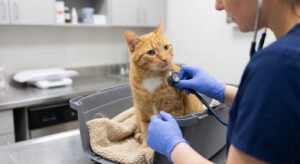
By a cat parent who once lost his cat inside his own furniture for two full days.
I will never forget the sound of Oliver’s claws tearing through the fabric underside of my box spring at 2 AM on the night of our first move. The chaos of that day — movers in and out, doors propped open, furniture disassembled around him, his entire known world dismantled into cardboard boxes — had overwhelmed him completely.
By the time I realized he’d disappeared, he had excavated a cavity inside the box spring and installed himself in it with the grim determination of someone who had found the only safe place left on earth. He stayed there for forty-eight hours. I slid water and food under the bed frame. I slept on the floor beside him. It was, genuinely, one of the most stressful experiences of both our lives.
If you are planning on moving apartment with cat and you want to do it without recreating that particular nightmare, I developed what I now call the Safe Room Protocol specifically so I would never have to hear that sound again. It has worked across two subsequent moves. Here is everything I learned.
Quick Answer
A successful experience moving apartment with cat requires strict territory management at every stage. Confine your cat to a designated safe room during packing in the old apartment. Transport them last, in a secure covered carrier. Set up an identical safe room in the new apartment — with their litter box, water, bedding, and a pheromone diffuser running — before they arrive. Expand their access only after they show consistent confident body language.
Why Moving Is Genuinely Traumatic for Cats
Before the protocol, I want you to understand what your cat is actually experiencing — because this context makes every step of the process make sense.
Cats are obligate territorial animals. Unlike dogs, whose sense of security is primarily social (centered on their pack), cats’ sense of security is fundamentally spatial. Their territory is not just where they live — it is a three-dimensional map of safety that they have built through months or years of scent marking, exploration, and environmental learning.
Standard soap isn’t enough. You need the best enzyme cleaners for cat urine to chemically eliminate the markers that drive your cat back to the same spot.
Every surface in your current home carries your cat’s scent. They have rubbed their facial glands on the doorframes, their paw pads on the carpet, their flanks on the furniture legs. They know every sound the building makes, every smell that drifts through the windows, every inch of the territory they have claimed. This is not decoration. This is their psychological foundation.
A move strips all of that away simultaneously. The result is a cat placed in a completely unscented, unknown, unmapped space — with no territorial context, no familiar olfactory anchors, and an acute awareness that they have no idea where the threats are or where the safe zones are.
The physiological stress response this triggers is real and measurable: elevated cortisol, suppressed immune function, disrupted appetite and elimination patterns. In severe cases, it can trigger feline idiopathic cystitis — a painful, stress-induced bladder inflammation — within the first week in a new environment.
You cannot prevent the stress entirely. You can manage it so completely that it remains subclinical — uncomfortable but not traumatic. That is the entire goal of the Safe Room Protocol.
Weeks Before the Move: The Desensitization Phase
The preparation phase is not optional. Done correctly, it means your cat arrives at moving day already partially adapted to the sensory environment of a move, rather than encountering it all at once.
Step 1: Introduce Moving Boxes Early
Start bringing boxes into your home two to three weeks before moving day.
Do not bring them in all at once. Introduce one or two at first, placed in the main living area. Leave them open. Leave them on their sides. Let Oliver investigate them on his own terms — which he will, because cats cannot resist an unexplained box.
This accomplishes two things:
- The boxes become scented with his smell through investigation and facial rubbing — they stop being novel threats and become familiar objects
- The gradual increase in box presence desensitizes him to the visual disruption of a packed apartment over weeks rather than hours
By the time the packing begins in earnest, the boxes themselves should feel ordinary.
Place treats, a familiar blanket, or his favorite toy inside boxes to create positive associations. Oliver now voluntarily sleeps in open moving boxes in the weeks before a move. This is not a coincidence — it is the result of two moves of deliberate conditioning.

Step 2: Update Identification — Now, Not Later
This is the administrative step that people consistently postpone and then desperately regret.
Before moving day:
- Confirm your cat’s microchip is registered and the contact information is current — particularly your new address and phone number once you have them
- Consider a GPS tracker collar for the transition period — these small, lightweight devices attach to a breakaway collar and allow real-time location tracking via your phone. In the event of an escape during the chaos of moving, the difference between a GPS tracker and no tracker is the difference between a recoverable situation and a devastating one
- Update your vet records with your new address and transfer medical records if you’ll be changing practices
- Photograph Oliver clearly from multiple angles — a current photo is essential for lost cat notices if the worst happens
The breakaway collar is non-negotiable. A cat who gets their collar caught in a crevice of an unfamiliar space needs to be able to release it. Attach your current contact information to the collar in addition to the GPS tracker.
Step 3: Establish the Carrier as Safe Territory
If your cat currently views the carrier as a threat signal — which many cats do, because they only see it before vet visits — now is the time to change that association.
Follow the permanent carrier protocol: leave it out in your cat’s living space, lined with a familiar blanket, with occasional treats placed inside. Do not use it for any travel during this period. Allow your cat to investigate, nap in, and claim it as theirs over the two to three weeks before the move.
A cat who enters the carrier voluntarily on moving day is a fundamentally different experience from a cat who has to be caught and inserted.
Step 4: Begin Pheromone Diffuser Use Now
Plug-in synthetic feline facial pheromone diffusers should be started one to two weeks before moving day in your current apartment — not saved for the new space.
Running the diffuser during the packing disruption helps maintain a lower baseline anxiety level during the environmental changes of that period. It also means you’re not introducing a new scent simultaneously with the new environment on arrival day.
Purchase two units: one for the final weeks in the old apartment, one to be the first thing plugged in at the new space.
Step 5: Schedule a Pre-Move Vet Consultation
This is worth a phone call if not a full visit, particularly if your cat:
- Has a history of stress-related illness (urinary issues, stress colitis)
- Becomes severely anxious during carrier or car experiences
- Has not had a wellness exam recently
Discuss the option of pre-move anti-anxiety medication — gabapentin is commonly used and well-tolerated for situational stress events in cats. A single dose given two hours before carrier loading on moving day can meaningfully reduce the peak stress response without sedating your cat to the point of compromising their awareness.
Moving Day Protocol: Managing the Old Apartment
Moving day is the highest-risk period of the entire process. It involves open doors, unfamiliar people, loud noises, complete environmental disruption, and repeated opportunities for escape. Your cat must be completely managed through this day — not left to cope independently.
The Old Apartment Safe Room
The morning before the movers arrive or packing begins in earnest, confine Oliver to a single room.
The ideal safe room in the old apartment is:
- A bathroom or bedroom — a room that will be packed last and disturbed least
- Contains his litter box, food and water bowl, carrier, and a piece of your worn clothing (your scent is an anchor)
- Has a pheromone diffuser running if there’s an outlet
- Has a clear sign on the door that every mover, helper, and family member can see: “DO NOT OPEN — CAT INSIDE”
Do not rely on verbal instruction alone. Tape a sign to the door. This is the step that prevents escape.
Everything else in the apartment can be managed — an escaped cat in a chaotic moving situation cannot be.
Let Oliver spend moving day in this room. Check on him periodically — briefly, calmly, without creating excitement or anxiety. Give him water, make sure the litter box is accessible, and then leave him alone. Cats manage stress better with darkness and quiet than with well-intentioned company during peak chaos.
Why Your Cat Travels Last
This is a rule I will not negotiate on, and here is why.
When movers are still in and out of both properties, doors are open and the situation is fluid. A cat in a carrier in the back of a car during this period is in a controlled, stable environment. A cat being loaded while furniture is still being moved is exposed to maximum chaos at maximum vulnerability.
Load Oliver after the movers have made their final trip and all doors are secured.
- Place the carrier in the footwell of the passenger seat or secured on the seat with a seatbelt through the handle — not in a van or truck with furniture
- Cover the carrier with a light blanket — visual reduction lowers stress for most cats during transport
- Drive smoothly and directly — no unnecessary stops
- Do not open the carrier in the car regardless of vocalization — this is the safety rule that prevents a terrified cat from escaping into traffic
If it’s a long drive, water can be offered through the carrier door at rest stops with the car doors fully secured.
Arrival at the New Apartment: The New Safe Room
This is where the Safe Room Protocol becomes its most precise, and where most people who attempt this intuitively get it wrong.
The instinct is to let your cat out to explore immediately. It feels kind. It feels like you’re giving them freedom after a stressful day. Please do not do this.
A cat released into a completely unscented, unknown, unmapped space with no territorial foundation will not explore with curiosity. They will either freeze in fear, bolt and hide in the most inaccessible location available, or panic in a way that sets their adaptation back by weeks.
What they need is a small, manageable territory first.
Setting Up the New Safe Room
This step must happen before your cat arrives. Send a person ahead, or complete this setup while the cat waits in the carrier.
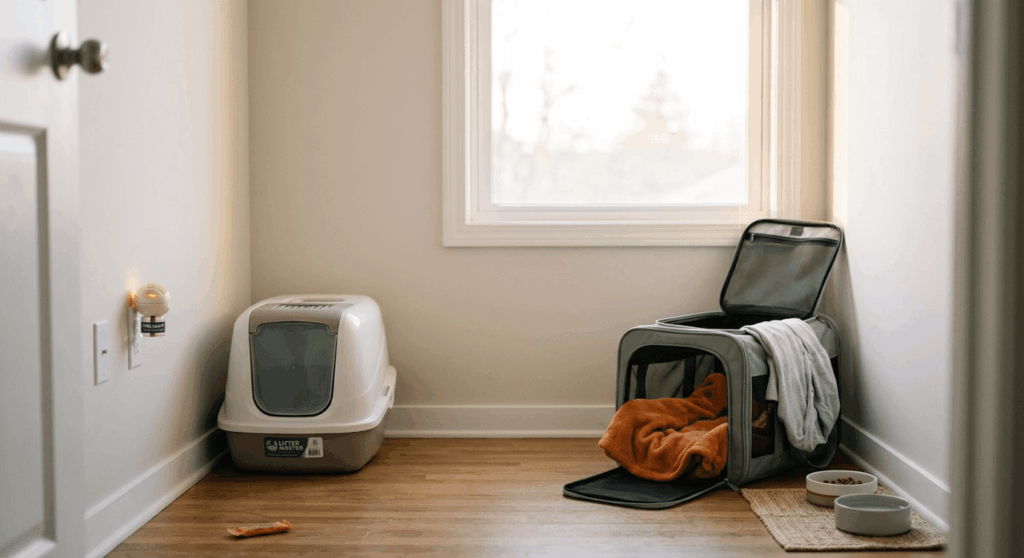
The new safe room should contain:
- ✅ Litter box — placed in a quiet corner, same relative position as in the old safe room if possible
- ✅ Water bowl and food — familiar bowls, not new ones
- ✅ Their bed or blanket — unwashed, carrying their existing scent
- ✅ A piece of your worn clothing — your scent is the most powerful single anchor available
- ✅ The carrier, open and accessible — it now smells familiar and represents safety
- ✅ Pheromone diffuser — plugged in and running for at least 30 minutes before the cat enters the room
- ✅ Temporary disposable litter boxes — during transition periods, having an extra disposable option available reduces the risk of inappropriate elimination if stress peaks
The pheromone diffuser running in an empty room for 30 minutes before cat arrival is not excessive. The pheromone needs time to disperse and create a scent environment before your cat’s nose enters it.
The Release Moment
When everything is in place:
- Close the safe room door before bringing the carrier inside
- Place the carrier on the floor of the safe room
- Open the carrier door and step back — do not reach in, do not coax
- Sit quietly on the floor if you want to be present; do not hover over the carrier
- Allow Oliver to emerge entirely on his own timeline
Some cats walk out immediately and begin investigating with visible curiosity. Oliver took four hours the first time I did this correctly. Both responses are completely normal.
Do not attempt to pet or interact significantly on emergence. Your presence is comfort enough. Let them smell the room, rub on objects, investigate the litter box and food. This is territorial claiming behavior — the beginning of the adaptation process.
Keep the safe room door closed for the first 24 hours minimum, and until you observe consistent calm body language.
The Gradual Release When Moving Apartment With Cat
The timeline for expanding territory is not based on days — it is based on your cat’s behavioral readiness. These are two different things, and conflating them is the most common mistake in post-move cat management.
Signs of Readiness to Expand Territory
Your cat is ready to explore beyond the safe room when you consistently observe:
- Normal appetite — eating with interest rather than picking nervously or ignoring food
- Litter box use — regular, normal elimination in the provided box
- Grooming — cats who are acutely stressed stop grooming; resumed self-grooming is a clear positive sign
- Seeking interaction — headbutting, approaching you voluntarily, vocalizing to engage you
- Exploratory posture — head up, ears forward, tail neutral or slightly raised; actively investigating the room rather than pressed into corners
- Slow blinking — a sign of relaxed, non-vigilant awareness
Signs They Need More Time in the Safe Room
Do not expand territory if you observe:
- Hiding continuously, refusing to emerge for food
- Flat ears, wide pupils, tail tucked or held low
- Hissing or swatting at you or family members without provocation
- Complete appetite loss lasting more than 24–36 hours (this warrants a vet call)
- Inappropriate elimination outside the litter box
- Excessive, distressed vocalization
The Expansion Process
When your cat is showing consistent readiness signals, begin expansion one room at a time:
Day 2–3 (if body language allows): Open the safe room door and allow access to the adjacent room or hallway. Do not force them through it. Let the door stand open and allow self-directed exploration. Return to the safe room when they choose.
Day 4–7: Allow access to the main living area during supervised periods, closing off rooms you want to introduce later.
Week 2 onward: Gradually open remaining rooms one by one, based on continued confident body language.
The physiological stress of navigating a completely new environment shares remarkable parallels with the stress of encountering an unfamiliar cat — and the scent-swapping and graduated exposure techniques that work so well here are the same foundational principles behind a successful second cat introduction. [Read our complete guide to introducing a second cat to your home here → How to Introduce a Second Cat in a Small Apartment (Step-by-Step Guide)]
Scent-Marking Support During Exploration
As Oliver begins exploring each new room, help him claim it by:
- Gently rubbing a soft cloth along his cheeks and then wiping it on furniture at his nose height in each new room — you are distributing his scent into the unmapped territory before he arrives
- Ensuring scratching posts and cat trees are placed in the new spaces before full access is granted — scratching is territorial claiming behavior, and having appropriate surfaces available directs that behavior productively
Once your cat is ready to expand beyond the safe room, strategically positioning cat trees near windows, scratchers at room entry points, and familiar perches in the main living area helps them physically claim the new territory through the normal behavioral repertoire of exploration and scent marking. [See our complete guide to setting up enriching vertical territory for indoor cats here → The Small Apartment Cat Survival Guide: 7 Pillars of Indoor Enrichment]
Special Situations: Managing Variables
If You Have Multiple Cats
The Safe Room Protocol applies to each cat individually in a multi-cat household — ideally in separate safe rooms, particularly if there is any existing tension between them.
- Moving disrupts established territory hierarchies between cats as much as it disrupts individual territorial security
- Cats who coexist peacefully in a familiar home sometimes show aggression in a new one, as they are both operating in an unknown, stressful environment with depleted coping resources
- Reintroduce them to the new space as separate individuals before reintroducing them to each other, using the scent-swapping protocol — exchanging their bedding between rooms before face-to-face contact
If Your Cat Has a History of Stress-Related Illness
Cats with histories of feline idiopathic cystitis, stress colitis, or over-grooming disorders need additional support during and after a move:
- Discuss a week-long course of anti-anxiety medication with your vet, not just moving day dosing
- Monitor litter box output particularly closely in the first two weeks — straining, blood in urine, or no urination for 24 hours warrants an emergency vet call
- Consider a probiotic during the transition — gut microbiome disruption under stress contributes to digestive symptoms
If Your New Apartment Has a Balcony
Treat all balcony access as an escape risk until your cat is fully adapted — typically four to six weeks minimum.
A cat who is not yet fully oriented to their territory may attempt to jump, fall, or escape through balcony spaces when startled. Balcony access should be supervised only, ideally with cat-proof netting installed before it becomes available.
The First Month: What to Expect on a Timeline
| Timeline | Expected Behavior | Your Response |
|---|---|---|
| Hours 1–24 | Hiding, minimal eating, litter box use variable | Quiet presence only; do not force interaction |
| Days 2–3 | Emerging in safe room, eating more normally | Begin gentle interaction; assess expansion readiness |
| Days 4–7 | Gradual exploration of adjacent areas | Supervised access to one additional room |
| Weeks 2–3 | Progressive territorial claiming, more confident posture | Continue gradual expansion room by room |
| Week 4+ | Normal behavior patterns largely restored | Full apartment access; monitor for any residual issues |
Some cats adapt in five days. Some cats need six weeks. Both are within normal range. The single most important factor in speed of adaptation is not rushing the expansion timeline.
FAQ
1. How long does it take for a cat to adjust to a new apartment?
Most cats show significant behavioral normalization within two to four weeks of a move when the Safe Room Protocol is followed. Full territorial confidence — where the cat is using all areas of the new apartment freely, sleeping in their preferred spots, and showing no residual anxiety behaviors — typically establishes between four and eight weeks.
Cats with pre-existing anxiety disorders, histories of multiple moves, or particularly strong territorial bonds may take longer. The most reliable indicator that adaptation is complete is the resumption of fully normal daily routine: consistent appetite, normal litter box use, regular grooming, and voluntary interaction — all at the frequency and pattern that was normal in the previous home.
2. What is the most important single thing I can do when moving apartment with cat to prevent escape?
When moving apartment with cat, the single most important escape prevention measure is the clearly signed safe room door. More cats escape during moves than in any other single circumstance — almost always because a well-meaning mover, helper, or family member opened a door they didn’t realize the cat was behind.
No amount of GPS tracking or collar identification compensates for the recovery process of finding a lost cat in an unfamiliar area. The sign on the door prevents the escape in the first place. Second most important: ensure the carrier is fully secured with no gaps during transport, and never open it in an unsecured space. Third: GPS tracker collar attached before moving day, not as an afterthought.
3. My cat was completely fine with the last move. Do I still need to do all of this?
Cats’ stress responses to moves can vary significantly based on age, health status, the specific sensory profile of the new space, and accumulated life experience. A cat who appeared to handle a previous move well may be more sensitive to a subsequent one — particularly if they are older, if the move involves a more dramatic environmental change (different floor, different ambient noise level, different smells), or if there have been other stressors in the intervening period.
The Safe Room Protocol takes approximately one hour to set up and costs almost nothing beyond a pheromone diffuser. The downside of implementing it unnecessarily for a cat who would have been fine is zero. The downside of skipping it for a cat who needed it is potentially weeks of stress-related illness and behavioral disruption. The protocol is worth running regardless of your cat’s move history.
References
- Kessler, M. R., & Turner, D. C. (1999). Socialization and stress in cats (Felis silvestris catus) housed singly and in groups in animal shelters. Animal Welfare, 8(1), 15–26. Universities Federation for Animal Welfare.
- Amat, M., Camps, T., & Manteca, X. (2016). Stress in owned cats: Behavioural changes and welfare implications. Journal of Feline Medicine and Surgery, 18(8), 577–586. https://doi.org/10.1177/1098612X15590867
Disclaimer: This article reflects the personal experience of a cat owner across multiple relocations and draws on published research in feline behavioral medicine and environmental stress. It is not a substitute for individualized veterinary or behavioral assessment. Cats with severe anxiety disorders, significant medical histories, or extreme stress responses should be managed in direct consultation with a licensed veterinarian or board-certified veterinary behaviorist during relocation.