Cat hates being brushed? Start by treating the reaction as useful information rather than stubbornness. A cat may resist grooming because the brush feels uncomfortable, the session lasts too long, a mat is pulling on the skin, touch has become frightening, or pain makes handling difficult. The safest solution is to rule out discomfort and then rebuild tolerance in tiny, voluntary steps.
Do not hold your cat down to finish the coat. Begin with a soft, appropriate tool, one brief touch, and a reward your cat values. Stop while the cat is still calm. Over time, those short experiences can teach the cat that the brush is predictable and that moving away is always allowed.
Quick Answer
If your cat hates being brushed, pause full grooming sessions and follow this sequence:
- Check for pain, skin problems, fleas, and mats.
- Choose a tool that suits the coat and does not scratch the skin.
- Let the cat see the brush without using it.
- Pair the brush with treats or another positive outcome.
- Start with one touch or one stroke in an easy area.
- Watch body language and stop at the earliest sign of tension.
- Increase only one part of the session at a time.
A young, healthy short-haired cat may need relatively little brushing. A Persian, another long-haired cat, a senior, or a cat that cannot groom effectively may need frequent coat maintenance. When necessary grooming cannot be performed without fear, aggression, or restraint, ask a veterinarian or qualified feline groomer for a safer plan.
Once handling is comfortable, use our indoor cat grooming guide to plan routine coat, nail, ear, eye, and skin checks without turning one session into an overwhelming checklist.
Important Grooming Safety Note
Do not brush through struggling, growling, biting, or repeated attempts to escape. Forced handling can intensify fear and may conceal pain.
Never cut a mat with ordinary scissors. Cat skin is thin, mobile, and easily pulled up inside a mat, where it can be cut without being visible. Tight, widespread, painful, wet, odorous, or skin-level mats should be assessed by a veterinarian or experienced cat groomer. Sedation may sometimes be the safest and least frightening option, but only a veterinarian should make that decision.
Arrange a veterinary examination when grooming resistance is new, rapidly worsening, limited to one body area, or accompanied by:
- flinching or crying when touched;
- reduced jumping or stiffness after rest;
- skin redness, scabs, dandruff, sores, or hair loss;
- excessive licking or chewing;
- fleas or flea dirt;
- a greasy, unkempt, or suddenly matted coat;
- appetite, weight, mobility, or behavior changes; or
- aggression that is unusual for your cat.
Training cannot make painful brushing comfortable. Treat the cause first.
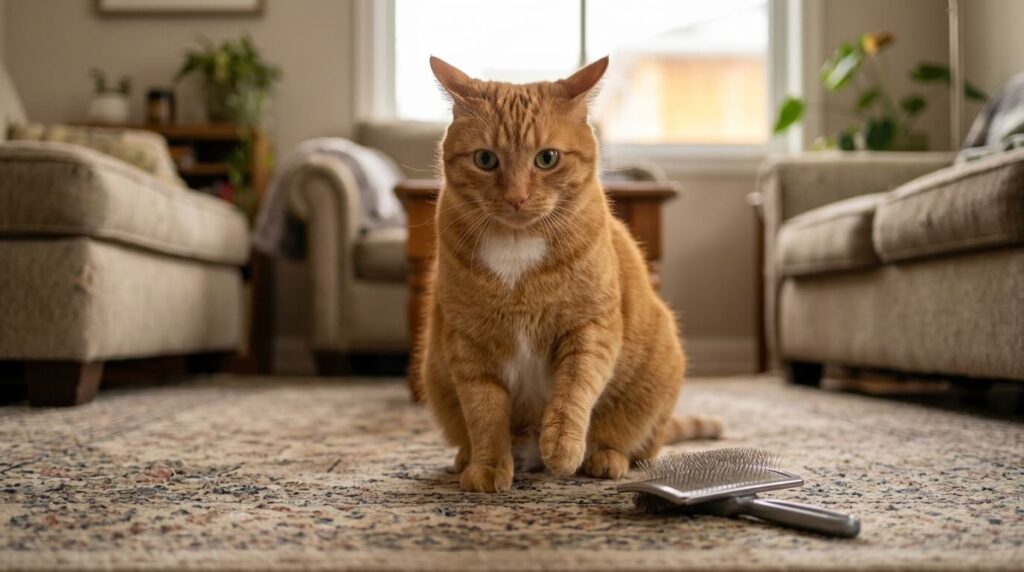
Table of Contents
Why a Cat Hates Being Brushed
The Brush Is Uncomfortable
A tool can be technically appropriate for a coat but still feel unpleasant to an individual cat. Metal pins may press too firmly. A slicker brush may catch tangles. A stiff brush may scratch thinly covered areas. A noisy self-cleaning mechanism may startle the cat. Even a soft tool can hurt when it pulls against a knot.
Test the tool lightly against the inside of your forearm. This does not reproduce feline skin sensitivity, but it can reveal sharp edges, bent pins, rough seams, or excessive pressure. Inspect the brush before each session and remove trapped fur.
The Session Exceeds the Cat’s Limit
Many cats tolerate several strokes and then suddenly turn, swat, or bite. The reaction may look unpredictable, but earlier signals often appeared:
- the tail tip begins flicking;
- skin ripples along the back;
- ears rotate sideways or backward;
- pupils enlarge;
- the cat looks repeatedly at the brush or your hand;
- the body becomes still or crouched;
- the head turns quickly toward the contact;
- grooming or lip licking interrupts the session; or
- the cat shifts away.
These are reasons to stop, not tests of whether the cat will “get over it.” When you consistently stop at the first mild signal, the cat no longer needs to escalate to biting.
A Mat Is Pulling on the Skin
Mats tighten as loose undercoat, moisture, and friction compact the hair. Common sites include behind the ears, armpits, chest, belly, groin, trousers, collar area, and anywhere a cat cannot reach easily.
Brushing the surface of a tight mat pulls the entire knot against the skin. Repeated attempts can create pain, bruising, irritation, or a stronger defensive response. Prevention through frequent, gentle combing is much easier than removal after a mat has tightened.
Pain Changes Tolerance
Arthritis, dental pain, injuries, skin disease, and other medical problems can make touch painful. Senior cats may resist brushing over the hips or spine and may also groom themselves less effectively. Overweight cats can struggle to reach the lower back and hindquarters. Dental pain may lower a cat’s general tolerance for handling.
If the reaction is new, do not assume the cat suddenly became difficult. Our guide to signs of cat arthritis can help you notice mobility changes, but diagnosis belongs to a veterinarian.
The Cat Learned That the Brush Predicts Restraint
If brushing has repeatedly involved being cornered, held, chased, or brushed past the point of discomfort, the brush itself can become a warning signal. The cat may leave when you open the grooming drawer before any contact occurs.
This learned association can be changed, but the first goal is not removing fur. The first goal is allowing the brush to appear without anything unpleasant happening.
Touch Preferences Differ
Cats have individual preferences about physical interaction. Cat-friendly handling guidance emphasizes choice, familiar locations, slow movement, and pausing to evaluate the cat’s response. Many cats accept touch around the cheeks, head, and neck more readily than the belly or area near the tail, but your cat’s response matters more than a generic body map.
Fear, Overstimulation, or Pain?
| Pattern | More consistent with | Best next step |
|---|---|---|
| Cat leaves when the brush appears but accepts normal petting | Learned fear of the tool or routine | Begin brush-at-a-distance desensitization |
| Cat accepts a few strokes, then tail-flicks or turns | Session exceeds tactile threshold | Shorten sessions and stop earlier |
| Cat reacts at one exact body location | Local pain, mat, wound, or skin problem | Stop and arrange examination |
| Cat previously enjoyed brushing but suddenly resists | Pain or medical change | Veterinary assessment before training |
| Long coat contains tight knots | Mat-related pulling and discomfort | Professional assessment or removal |
| Cat panics when restrained for any care | Handling fear | Cooperative-care plan with professional support |
| Cat bites without obvious warning | Warnings may be subtle or pain may be present | Stop, review video/body language, consult veterinarian |
A cat can have more than one cause. For example, arthritis can make brushing painful, and repeated painful sessions can then create learned fear of the brush.
What Is Grooming Desensitization?
Desensitization means exposing the cat to a version of grooming mild enough that it does not trigger a strong protective response. Counterconditioning means pairing that mild exposure with something the cat likes, such as a small treat, play opportunity, meal, or access to a favorite resting place.
The order matters. If the cat is already frightened, presenting food while continuing an overwhelming procedure does not automatically make the experience positive. Reduce the intensity first: increase distance, stop movement, shorten contact, or return to an earlier step.
Cooperative care adds choice. The cat can approach, remain, change position, or leave. A session that ends after one calm touch is productive because it protects trust and creates a repeatable starting point.
How to Desensitize a Cat to Grooming
Use the seven-step sequence below as the main training plan. Progress from comfortable brush presence to brief contact and then gentle strokes, changing only one aspect at a time:
- Make the current step easy enough for relaxed, voluntary participation.
- Increase only one factor—such as contact, number of strokes or body area—before reassessing the cat’s response.
If you simultaneously move closer, brush longer, add pressure, and touch a sensitive area, you cannot tell which change caused the reaction.
7 Safe Steps to Help a Cat Accept Brushing
Step 1: Rule Out Pain and Urgent Coat Problems
Before training, examine the coat visually without pulling it. Look for redness, wounds, parasites, hair loss, discharge, swelling, and mats. Notice whether the cat moves normally and whether one location produces a stronger response.
Do not manipulate a painful area for a home diagnosis. Photograph anything visible and record when the reaction occurs. A short video of normal walking, jumping, self-grooming, or a mild touch response can help a veterinarian, provided recording does not require provoking the cat.
If mats already prevent necessary grooming, address them professionally before starting a long desensitization program. Training beside a painful mat is unlikely to succeed.
Step 2: Choose the Least Intimidating Suitable Tool
For a touch-sensitive short-haired cat, a grooming mitt, silicone rubber brush, or very soft bristle brush may feel closer to petting. For a long-haired cat, a wide-toothed comb and an appropriate longer-pin tool may be needed to reach the coat safely. A tool that skims only the surface can leave tangles underneath.
Tool choice should reflect:
- coat length and density;
- presence of undercoat;
- skin sensitivity;
- the cat’s history with the tool;
- the body area;
- whether the goal is loose-hair removal, detangling, flea checking, or mat prevention.
Avoid using a sharp, damaged, rusted, or human hairbrush. Do not begin rehabilitation with a mat splitter, tight flea comb, or forceful de-shedding tool.
If your cat needs a new everyday tool, compare options in our guide to the best cat brushes for indoor cats.
Step 3: Make the Brush Predict Nothing Bad
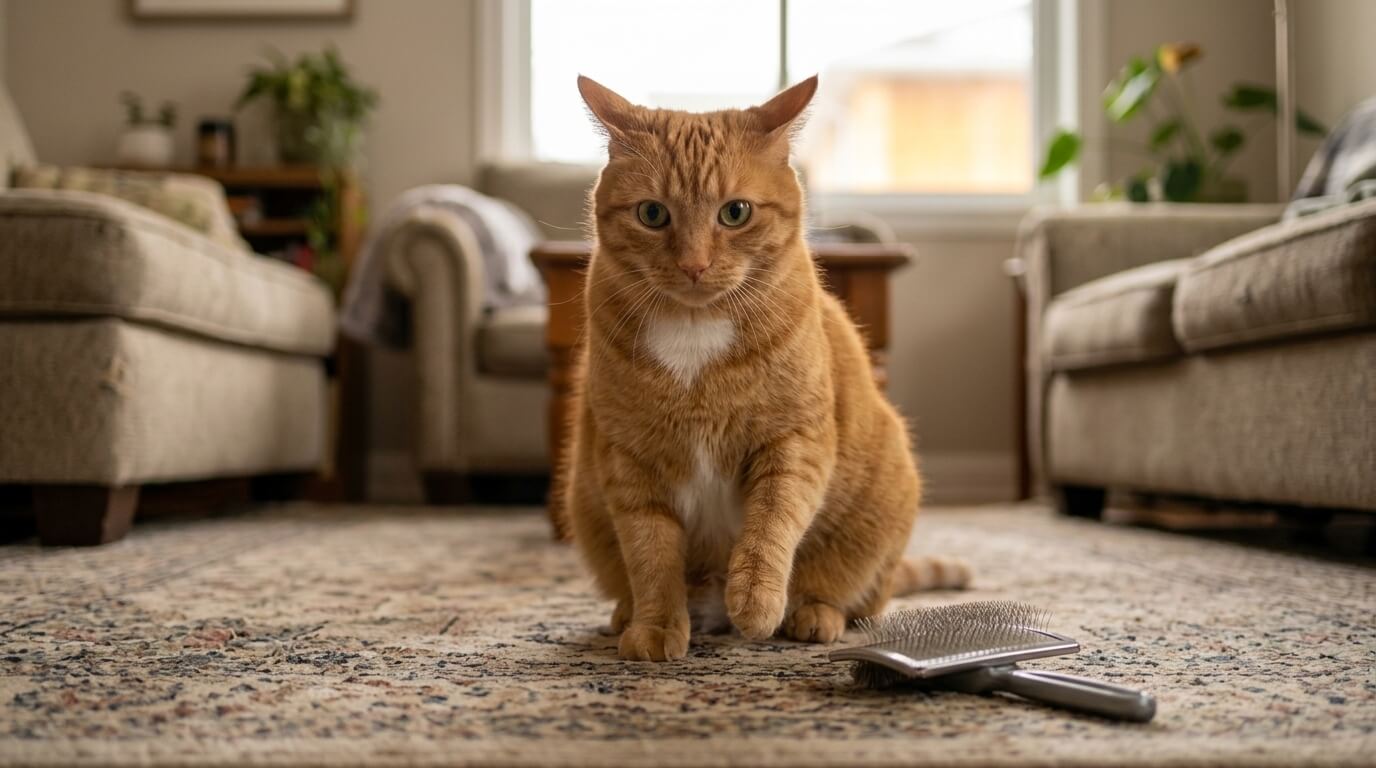
Place the clean brush on the floor several feet from the cat during a calm time. Do not move it toward the cat. Allow looking, sniffing, approaching, or ignoring.
If the cat stays relaxed, place a treat at a comfortable distance from the brush or begin a familiar play activity. The cat does not need to touch the tool. After a short period, put it away.
Repeat until the brush can appear without the cat freezing, hiding, leaving immediately, or refusing normal activity. Then hold the brush at a distance without approaching. Progress depends on the cat’s response, not a fixed number of days.
Do not smear food, broth, tuna water, pheromone product, or scented substance onto the bristles. Residue can spoil, irritate skin, change the coat, or make the tool unpleasant.
Step 4: Introduce Stationary Contact
When the cat remains comfortable around the visible brush, begin with contact that does not yet resemble a stroke.
Let the cat approach your relaxed hand. Touch the outside or smooth back of the brush briefly to an area the cat already enjoys having touched. Remove it immediately, then offer the reward.
A first session may contain only one contact. That is enough.
Good starting areas often include the cheek, side of the neck, shoulder, or upper back, but avoid assuming every cat likes the same locations. Do not begin at the belly, legs, tail, armpits, or a matted area.
Step 5: Add One Gentle Stroke
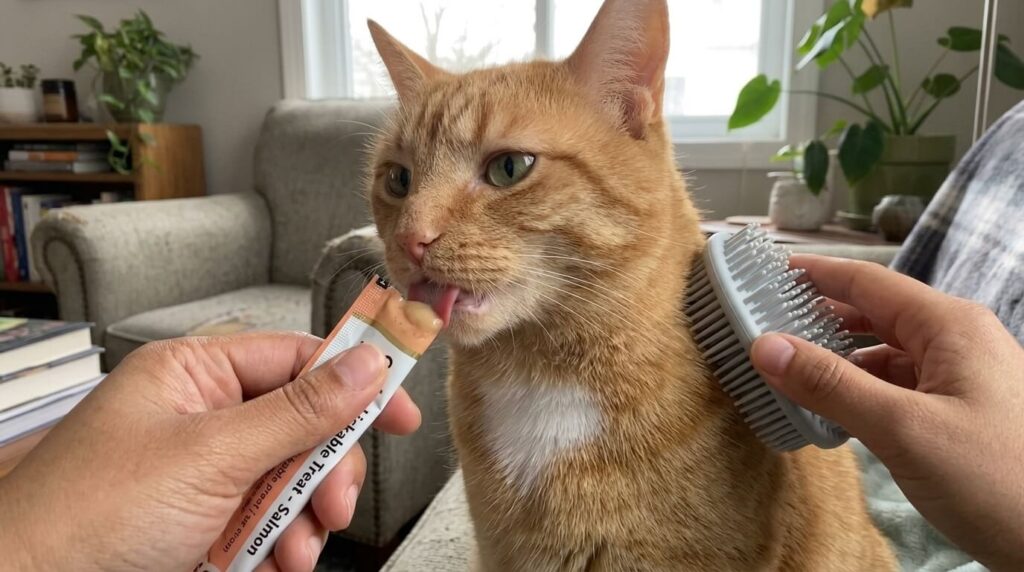
Use minimal pressure and move in the direction of hair growth. Lift the tool away after one short stroke. Pause and watch the whole cat.
Continue only when the cat remains loose and voluntarily stays. End the session if the cat moves away or shows early tension. Do not follow the cat with the brush.
Reward timing should be clear: gentle stroke, brush moves away, reward appears. A reward can be a tiny treat, a lick from a dish, access to a toy, or another outcome the individual cat values. Place food so the cat can choose it; do not use food to hold a frightened cat in place.
Step 6: Build Duration Slowly
Increase from one stroke to two, then pause. On another session, add a different easy body area while keeping the number of strokes low. Do not increase duration and difficulty together.
A simple progression might be:
- brush visible at a distance;
- stationary brush in your hand;
- one brief touch with the smooth side;
- one gentle stroke;
- two strokes with a pause;
- several strokes in one preferred area;
- a second tolerated area;
- short combing of a long coat; and
- gradual maintenance sessions.
Return to an easier step after illness, a painful mat, a stressful event, or a session that went badly. Regression is information that the current step was too difficult.
Step 7: End Before the Cat Needs to Escape
The most useful session often feels too short to the person. End while the body is still relaxed, deliver a final reward, and put the tool away. Do not add “just one more stroke.”
Your success measure is not the volume of fur in the brush. Track:
- whether the cat approached voluntarily;
- the closest comfortable brush distance;
- number of relaxed contacts;
- body areas accepted;
- earliest tension signal;
- whether the cat ate, played, or rested normally afterward; and
- whether recovery became faster.
When the cat repeatedly remains relaxed at a level, make the next change small.
Progress Checkpoints, Not a Weekly Deadline
Use these checkpoints to decide whether to repeat, progress or step back in the seven-step plan. They are not additional training stages or a promise of completion within four weeks. If the cat tenses or leaves, stop and make the next attempt easier.
Checkpoint 1: Comfortable Brush Presence
- The brush can be visible without the cat hiding, freezing or moving away.
Checkpoint 2: Voluntary Brief Contact
- The cat can choose brief contact and remain relaxed; otherwise return to brush presence.
Checkpoint 3: Relaxed Gentle Strokes
- The cat remains comfortable after a gentle stroke; do not add more while tension increases.
Checkpoint 4: Expand Only While Comfortable
- A small increase in duration or body area remains comfortable. Keep pauses and an easy exit.
If a long-haired coat will mat while training progresses, arrange professional maintenance rather than rushing the plan.
Reading Body Language During Grooming
Green-Light Signals
- loose muscles;
- normal ears and pupils;
- leaning gently toward contact;
- slow blinking;
- choosing to remain;
- rubbing against the tool;
- normal eating or play; and
- returning after a voluntary pause.
Green signals allow another repetition, not an unlimited session.
Yellow-Light Signals
- tail-tip movement;
- skin twitching;
- ears rotating;
- looking repeatedly at the brush;
- body becoming still;
- stopping eating;
- shifting weight away;
- sudden self-grooming; or
- lowering the body.
Pause or end at yellow. This is how you prevent red.
Red-Light Signals
- growling or hissing;
- rapid tail lashing;
- flattened ears;
- striking, grabbing, or biting;
- attempting to flee;
- urinating or defecating;
- open-mouth breathing; or
- prolonged hiding afterward.
Stop immediately and create distance. Do not punish. Review whether pain, restraint, tool choice, duration, or environment made the session too difficult.
How to Brush a Cat That Hates It
Set up the environment before bringing out the brush:
- choose a quiet, familiar room;
- provide stable footing;
- allow an open escape route;
- keep other pets away;
- prepare small rewards in advance;
- have only one suitable tool visible; and
- keep the session short enough that you do not need to rush.
Sit beside the cat rather than leaning over them. Move slowly. Brush with hair growth and use less pressure than you think necessary. Support long hair near the skin when working through a small, loose tangle so pulling does not transfer directly to the skin.
Never chase the cat after they leave. The ability to leave is part of what makes the next session safer.
Persian Cat Hates Grooming: What Changes?
If your Persian cat hates grooming, separate urgent coat maintenance from behavior training. Persian coats can tangle and mat quickly, so use short, low-pressure coat checks and arrange professional maintenance when needed while continuing desensitization at your cat’s pace. The goal is to prevent painful matting without turning every training session into a full-coat procedure.
Prioritize Prevention
Check high-friction areas daily without pulling:
- behind the ears;
- under the collar;
- armpits;
- chest;
- belly;
- groin;
- backs of the legs; and
- under the tail.
A few calm comb passes before tangles form are easier than removing a compact mat.
Use the Right Depth
A surface brush may make the top layer look smooth while knots develop near the skin. Use an appropriate wide-toothed comb and part the coat in small sections. Work from the end of the hair toward the body, supporting the hair at its base.
Do not repeatedly drag a comb through resistance. Stop and assess whether the tangle is loose enough for gentle professional guidance or needs a groomer.
Separate Training From Necessary Maintenance
Desensitization should stay easy and positive. Necessary coat maintenance may be more demanding. If the two cannot be combined safely, a feline groomer or veterinarian can manage the current coat while you continue easy training at home.
Consider Medical Contributors
Eye discharge, dental discomfort, skin disease, arthritis, obesity, and breathing difficulty can affect a Persian cat’s grooming tolerance. Flat-faced cats may also become distressed more quickly during restraint. Seek veterinary advice rather than forcing completion.
My Long-Haired Cat Hates Being Brushed
Long-haired cats need a plan that protects both coat health and emotional welfare.
- Check the coat frequently so problems are found while small.
- Divide the body into sections rather than attempting a full groom.
- Comb one easy section during each short session.
- Maintain the armpits, belly, trousers, and collar area with professional help if needed.
- Use a qualified groomer before mats tighten against the skin.
- Ask a veterinarian about pain, mobility, obesity, or reduced self-grooming.
Daily grooming may be recommended for many long-haired cats, but that does not mean a fearful cat should be restrained for a complete daily session. Several brief, voluntary contacts may be more sustainable, with professional assistance filling the gap.
Mats: What You Can and Cannot Do at Home
Small, Loose Tangle
If the tangle is clearly away from the skin, the cat is relaxed, and the coat can be supported at its base, you may gently separate the ends with fingers or a wide-toothed comb. Stop if the skin moves, the cat reacts, or resistance remains.
Tight Mat
Do not brush, pull, wet, bathe, or cut it. Water can tighten some mats as they dry. Scissors can cut folded skin hidden beneath the hair. Clippers can also injure skin when used without training.
Widespread Matting
Widespread matting can restrict movement, trap moisture, conceal wounds, and cause constant pulling. Contact a veterinarian or experienced cat groomer. A veterinarian is the better first contact when the skin looks abnormal, the cat is painful, medically fragile, elderly, or unable to tolerate handling.
Choosing Rewards Without Creating New Problems
Use very small portions so training does not add significant calories. Suitable rewards may include:
- a tiny piece of the cat’s usual treat;
- a lick of a familiar cat treat from a dish;
- a short wand-toy game;
- access to a favorite perch;
- opening a door to a preferred safe room; or
- stopping the session itself.
Avoid seasoned human food, salty broth, raw meat residue on tools, and anything your veterinarian has excluded from the diet. For a cat on a prescription diet, ask which rewards are compatible.
A cat that refuses a normally valued treat may be too worried to learn. Increase distance or end the session rather than offering increasingly exciting food while continuing.
Common Mistakes
Finishing the Job at Any Cost
Completing one coat by force can make many future sessions harder. Necessary urgent grooming belongs with a professional plan; training sessions should protect trust.
Waiting for a Bite Before Stopping
Biting is often a late signal. Learn the individual cat’s earlier tail, ear, eye, skin, and posture changes.
Starting on the Hardest Area
Do not begin with the belly, legs, tail, tight knots, or a painful lower back. Build a history of easy success first.
Using Treats to Distract Through Fear
Food does not cancel fear. If the body is tense or the cat is trying to escape, reduce the grooming challenge.
Changing Tools Constantly
A new brush can become another unfamiliar predictor. Select a suitable gentle tool and introduce it gradually rather than cycling through products during the same session.
Following the Cat
When the cat leaves, the session is over. Following removes control and can turn avoidance into defensive aggression.
Using Scented Anti-Static Products
Do not use dryer sheets, human hair products, essential oils, or household anti-static sprays on the cat or brush. If static appears to be a problem, use a humidifier safely, choose an appropriate natural-bristle or rubber tool, and ask a groomer about a feline-specific product.
When to Contact a Veterinarian
Contact your veterinarian before continuing training if:
- grooming aversion appeared suddenly;
- touching one place consistently causes a strong reaction;
- the cat no longer jumps, climbs, or self-grooms normally;
- skin or coat appearance changed;
- the cat has extensive or painful mats;
- appetite, weight, thirst, urination, or activity changed;
- the cat is a senior with new handling intolerance;
- open-mouth breathing or collapse occurs; or
- aggression creates a bite risk.
Cat bites can cause serious infection. Wash a bite immediately and obtain human medical advice, especially for a puncture wound, swelling, redness, pain, or reduced hand movement.
When to Use a Professional Cat Groomer
Look for a groomer experienced specifically with cats and low-stress handling. Ask:
- how cats are restrained;
- whether dogs and dryers are present nearby;
- how they respond when a cat becomes distressed;
- whether they coordinate with veterinarians;
- whether mat removal is within their experience;
- whether they use cage dryers; and
- what feline or Fear Free training they have completed.
A groomer should not promise that every cat can be finished without regard to stress. For a medically complex, painful, severely matted, or highly aggressive cat, veterinary grooming may be safer.
Frequently Asked Questions
Why does my cat hate being brushed?
The brush may pull, scratch, create too much stimulation, touch a painful area, or predict restraint from earlier experiences. Sudden resistance requires a pain and health check before behavior training.
How do I desensitize my cat to grooming?
Begin with the brush at a distance where your cat remains relaxed. Pair its presence with something positive, then progress to one stationary touch, one gentle stroke, and gradually longer contact. Change only one variable at a time and always allow the cat to leave.
How long should a grooming session last?
There is no required minimum. For a fearful cat, one calm touch may be the entire first session. End before tail flicking, skin twitching, ear rotation, freezing, turning, growling, or escape attempts.
Why does my cat bite when I brush the back?
The cat may be overstimulated, the brush may pull, or the back may be painful. Stop brushing that area. If the reaction is consistent, sudden, or accompanied by skin rippling, mobility change, or excessive grooming, arrange a veterinary examination.
Should I brush out a mat?
Do not force a brush through a tight mat and never use ordinary scissors. A small loose tangle may be gently managed if it is away from the skin and the cat is comfortable. Tight, painful, or widespread mats need professional attention.
How often should I brush a Persian cat?
Many Persians need daily coat checking and frequent combing to prevent knots, but sessions should be divided into tolerable sections. If the coat will mat before your cat can accept enough home grooming, use a qualified groomer or veterinarian while continuing desensitization.
What brush is best for a cat that hates brushing?
For short-haired touch-sensitive cats, a soft rubber tool, grooming mitt, or gentle bristle brush can be a low-intensity starting point. Long coats usually need a wide-toothed comb and a tool that reaches the undercoat without scratching. The best tool is both coat-appropriate and acceptable to the individual cat.
Is it okay not to brush my cat?
A healthy short-haired cat that self-grooms effectively may need only occasional brushing and coat checks. Long-haired cats, seniors, overweight cats, and cats with mobility or health problems often need more help. Ask your veterinarian or groomer what is necessary for your cat’s coat.
Can my veterinarian prescribe medication for grooming?
A veterinarian may recommend pain control, anxiety treatment, pre-visit medication, or sedation when medically appropriate. Never give human medication or another pet’s prescription. Medication should support a complete care plan, not enable repeated forced grooming at home.
Final Thoughts
When a cat hates being brushed, the goal is not to win a grooming contest. First make sure brushing does not hurt. Then reduce the task until your cat can remain comfortable and choose to participate.
One calm stroke, followed by freedom to leave, can be more valuable than completing half the coat through restraint. Select the right tool, read early body language, reward voluntary participation, and expand slowly. For a Persian or another long-haired cat, combine training with professional maintenance so the coat does not become painful while trust develops.
If progress stops, do not push harder. Reassess pain, mats, tool choice, session length, and the environment. Safe grooming protects both the coat and the relationship.
References
- Rodan I, Dowgray N, Carney HC, et al. “2022 AAFP/ISFM Cat Friendly Veterinary Interaction Guidelines: Approach and Handling Techniques.” Journal of Feline Medicine and Surgery, 2022. https://pmc.ncbi.nlm.nih.gov/articles/PMC10845437/
- Ellis SLH, Rodan I, Carney HC, et al. “AAFP and ISFM Feline Environmental Needs Guidelines.” Journal of Feline Medicine and Surgery, 2013. https://pmc.ncbi.nlm.nih.gov/articles/PMC11383066/
- RSPCA. “How and Why to Groom Your Cat.” Accessed July 2026. https://www.rspca.org.uk/adviceandwelfare/pets/cats/health/grooming
- International Cat Care. “Cat Caregiver Guide: Home Modifications.” Accessed July 2026. https://icatcare.org/resources/cat-caregiver-guide-home-modifications.pdf
- Barnes C, Llera R, Hunter T, Yuill C. “Grooming and Coat Care for Your Cat.” VCA Animal Hospitals. Updated February 13, 2026. https://vcahospitals.com/thumb-butte/know-your-pet/grooming-and-coat-care-for-your-cat