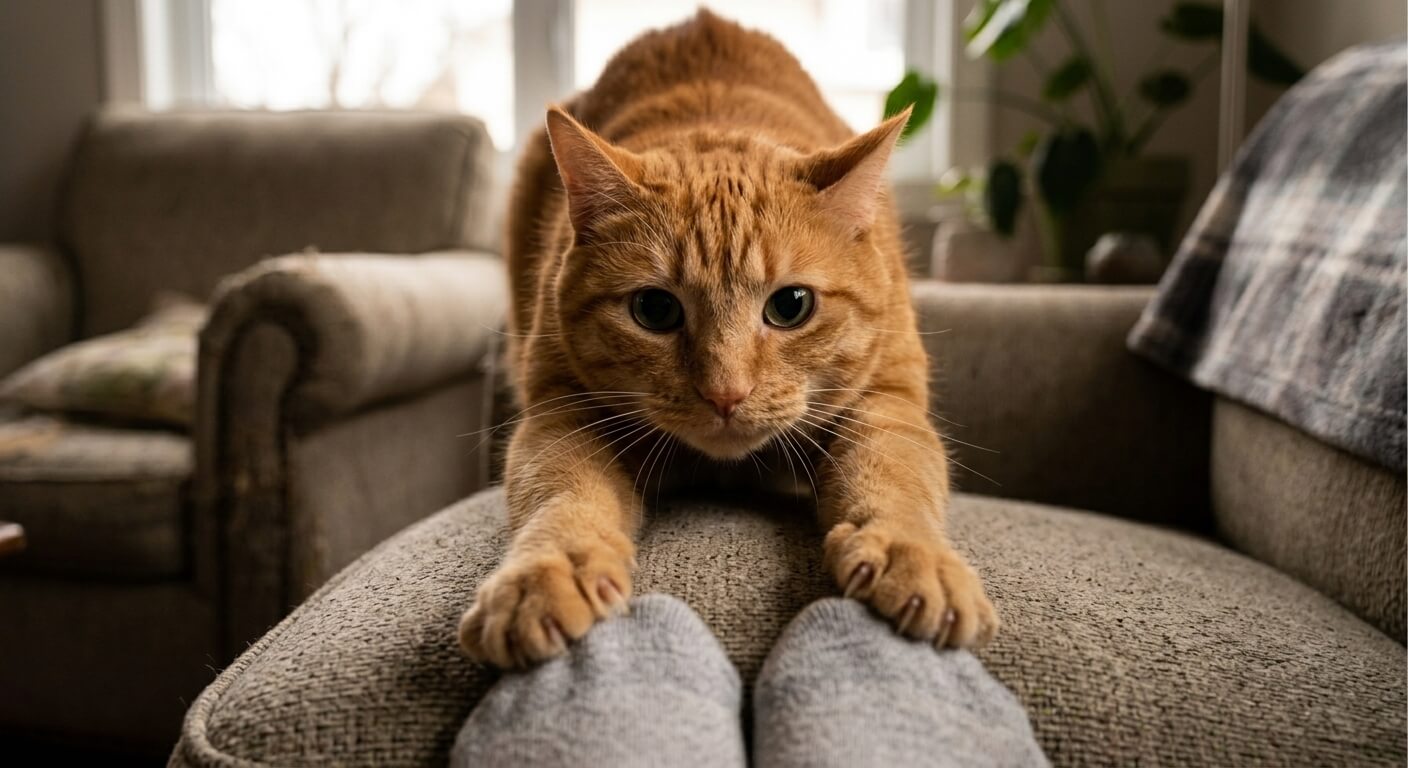
An indoor cat may suddenly pounce at a moving ankle or hand during play. The same bite can look surprising to a person even when the cat has been watching and stalking for several seconds.
If you are asking “why does my cat bite me,” the answer is usually not that your cat hates you. In indoor cats, biting often comes from play aggression, overstimulation, fear, redirected frustration, or pain. The key is learning which type of biting you are seeing before you try to stop it.
This guide explains how to tell playful biting from real aggression, how to redirect hunting energy safely, when to stop petting, and when a sudden change in biting means your cat needs a veterinary exam.
Quick Answer: Why Does My Cat Bite Me During Play?
Your cat may bite you during play because their hunting instinct is being redirected toward your hands, ankles, or moving feet. This is called play aggression, and it is common in indoor cats who do not get enough safe outlets for stalking, chasing, pouncing, grabbing, and biting toys.
Biting is only one part of the wider indoor behavior picture. For related guides on aggression, rough play, staring, hiding, and training, see our cat behavior guides for indoor cats.
However, not every bite is play. Cats may also bite because they are overstimulated during petting, frightened, redirected from another stressor, or painful. If the biting is sudden, severe, increasing, or linked to touching one body area, schedule a veterinary exam before treating it as a training problem.
Important Safety Note: Do not hit, scruff, chase, or punish a cat for biting; these responses can increase fear. If a bite breaks your skin, wash it promptly with soap and running water. Seek medical advice promptly for bites to the hand, foot, face, or head, or if you have a deep puncture, swelling, fever, or concerns about tetanus or rabies; a large or deep wound or uncontrolled bleeding needs urgent care. See the NHS animal-bite guidance.
This educational guide is prepared by the Indoor Cat Expert editorial team. It does not replace veterinary or veterinary behavior advice. If biting is sudden, severe, escalating, or accompanied by illness signs, consult a licensed veterinarian or qualified veterinary behavior professional.
Table of Contents
The Apex Predator in Your Living Room: Why Instinct Bites
Before we can meaningfully answer why does my cat bite me, we need to spend a moment genuinely reckoning with what a domestic cat actually is — because most of us, most of the time, relate to our cats as if they are small, fluffy companions who happen to be picky about food. The behavioral reality is considerably more complex and considerably more fanged.
The Predator That Domestication Didn’t Tame
Domestic cats share predatory behaviors with their wild ancestors, but the timing and pathway of domestication do not explain an individual bite. First determine whether the bite happens during play, handling, fear, pain, or redirected arousal.
Cats retain the ability to stalk and pounce, and moving toys can provide an appropriate outlet. This does not mean every bite is a result of an unmet hunting sequence.
What this means practically:
- Cats may stalk, chase, pounce, grab, and bite during play; the sequence varies and is not an explanation for every bite.
- Play and hunting behavior can be rewarding to cats, but a bite cannot be diagnosed from an assumed brain-chemical response.
- A well-fed cat may still chase a moving toy. Hunger alone does not determine whether a cat will play or bite.
- Let the cat catch a suitable toy when possible, without treating a full “kill” sequence as a medical or behavioral requirement.
Play-related pouncing at ankles or hands is one possible reason a cat may bite. Fear, pain, overstimulation, and redirected aggression require different responses.
The Hunting Sequence in Your Living Room
A play-related pounce can involve several stages of a predatory sequence:
- Stalk: The cat watches and crouches before rushing toward a moving target.
- Rush: The sudden explosive launch from the cat tree
- Pounce: Both forepaws making contact simultaneously to immobilize the “prey”
- Bite: The cat grabs or mouths the moving target during a play sequence.
- Release and retreat: Satisfied, the sequence complete
Moving hands and ankles can attract a playful cat’s attention. The goal is to redirect that activity to suitable toys while checking for fear, pain, or other causes.
Why Indoor Life Creates Biting Problems
Cats benefit from suitable opportunities to play, explore, and rest. The amount and type of activity vary by the individual; outdoor hunting frequency is not a useful prescription for indoor cats.
An indoor cat with few appropriate activities may seek moving hands or feet as play targets. Provide suitable toys, but investigate sudden or severe biting for medical or fear-related causes.
The practical answer depends on the context. Watch what happens just before the bite, and do not assume play is the cause when a cat may be fearful or in pain.
Play Aggression vs. Real Aggression: How to Tell the Difference
Not all cat biting is play aggression, and the distinction matters clinically. Misreading the type of aggression leads to inappropriate responses that either fail to address the real problem or, worse, escalate a genuinely dangerous situation.
Cat Biting Meaning Table
| Bite Pattern | Most Likely Meaning | What to Do First |
|---|---|---|
| Quick bite during play | Play aggression or hunting overflow | Stop hand play and redirect to a wand toy |
| Bite after several seconds of petting | Overstimulation | Stop touching earlier and watch body language |
| Bite with hissing, crouching, or pinned ears | Fear or defensive aggression | Give space and remove the trigger |
| Bite after seeing another cat outside | Redirected aggression | Do not touch the cat; separate and let them calm down |
| Sudden bite from a normally gentle cat | Pain, illness, or sensitivity | Schedule a veterinary check |
| Kitten bites hands and ankles | Normal predatory practice without boundaries | Use toys, not fingers, for all play |
| Bite followed by licking or staying nearby | Mixed arousal, not “revenge” | Lower excitement and use calmer interaction |
The important point is that biting is not one behavior. A cat who bites during chase play needs a different plan than a cat who bites because their back hurts, the room is too noisy, or another animal has frightened them.
When the biting comes from a young cat raised without another kitten, our single kitten syndrome guide explains how to redirect rough play without treating an informal label as a diagnosis.
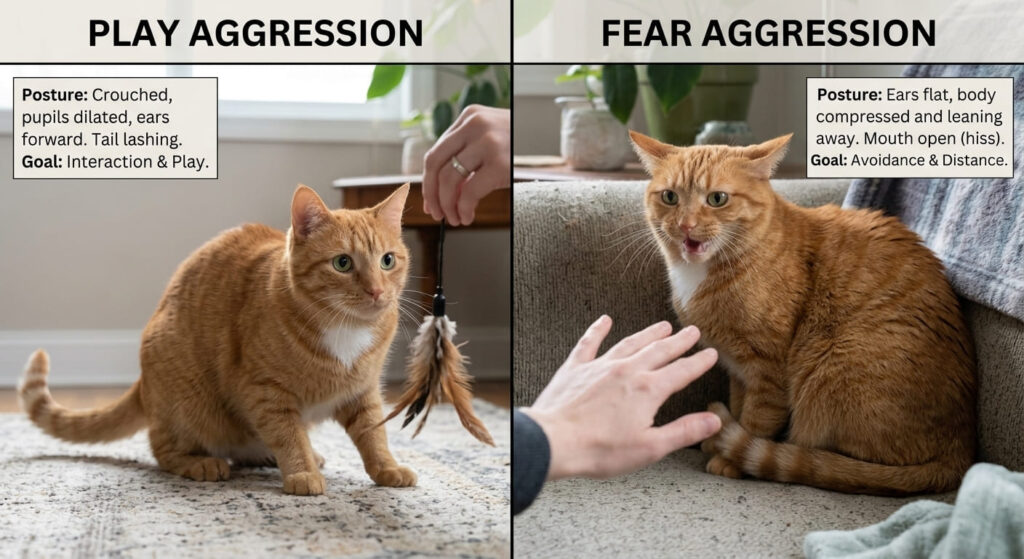
Play Aggression: The Characteristics
Play aggression is the type most commonly responsible for owners asking why does my cat bite me, and it has a recognizable behavioral profile:
Body language before the bite:
- Pupils dilated (high arousal, predatory focus)
- Ears forward or slightly to the side — not flat
- Body low and coiled — the “pounce posture”
- Tail lashing rhythmically
- Whiskers forward
- The cat may “chatter” at moving objects or wiggle their hindquarters before launching
The bite itself:
- Usually relatively brief — a grab-bite-release pattern rather than sustained clamping
- Directed at extremities in motion — ankles, feet, hands in movement
- May be accompanied by bunny kicking (both hind legs raking rapidly) — this is the “kill grip” of the predatory sequence
- The cat releases and retreats, or releases and immediately re-engages in a play pattern
After the bite:
- The cat is energized, not distressed
- They may immediately seek another target or redirect to a toy
- There is no sustained defensive posturing
- The cat’s overall demeanor is aroused but not aggressive in a sustained threat sense
What play aggression is NOT:
- A dominance challenge
- Hatred or dislike of the person bitten
- Random — it follows the predatory sequence logic of movement triggering response
Fear Aggression: When It’s Something Different
Fear aggression has a completely different behavioral signature and requires a completely different response:
Body language:
- Ears flat against the skull
- Pupils may be dilated but the overall body posture is defensive, not offensive
- Body low and compressed — shrinking away, not coiling to pounce
- Hissing, growling, spitting preceding the bite
- Tail tucked or puffed
- The cat is trying to create distance, not engage
The bite:
- Sustained and intended to cause maximal deterrence
- Accompanied by sustained vocalization
- The cat retreats immediately after and continues to display defensive posturing
Context:
- Triggered by a perceived threat — unfamiliar person, new environment, cornering
- The cat wants to escape, not engage
Redirected Aggression: The Dangerous Middle Ground
Redirected aggression is the most dangerous type and the one most commonly misidentified as play aggression:
What it is: The cat is aroused by an external stimulus they cannot access (a bird outside the window, another cat on the street, a loud noise) and redirects that arousal toward the nearest available target — which may be you.
Why it’s dangerous: Unlike play aggression, redirected aggression involves a fully aroused threat response displaced onto an available target. Bites are sustained, severe, and determined.
Key distinguishing features:
- Often preceded by an identifiable arousal trigger (the cat was watching something through the window, heard something alarming)
- The cat may not respond to your voice or name — they are in a fully aroused state
- Do not handle a highly aroused cat or put your hands between fighting cats. Give the cat space, remove the trigger if it is safe to do so, and resume contact only when the cat is calm; recovery time varies.
If your cat redirects chewing or biting toward wires, use this behavior plan alongside our guide on how to stop cat chewing cords safely.
Overstimulation Biting: The Petting-Induced Bite
The third common bite type that generates the question why does my cat bite me is Overstimulation biting — sometimes called “petting-induced aggression.” This is covered in detail in the FAQ section, but briefly:
Some cats have a neurological threshold for tactile stimulation beyond which they experience discomfort or sensory overload. The bite is a communication: “I have reached my limit.”
This is neither play nor fear — it is a sensory communication with a very short warning window.If the aggression appeared suddenly or feels more intense than normal play, read our guide to why an indoor cat suddenly becomes aggressive before assuming it is only play.— Learning to read the subtle pre-bite signals your cat sends before Overstimulation biting is one of the most valuable feline behavior skills you can develop, and our detailed guide on cat body language and petting signals walks you through the exact signals to watch for before they escalate to a bite.
Interestingly, a cat may stop purring right before an overstimulation bite. Understand the modular nature of feline sounds in our guide:A cat may still purr before an overstimulation bite, so learn what cat purring can mean in different emotional states.
5 Safe Ways to Stop Cat Play Biting
The following steps are general, low-pressure strategies for play-related biting. They require consistency and should be adapted to the individual cat; sudden or severe aggression needs veterinary assessment.
Step 1: Redirect the Bite Toward a Toy
For play-related biting, provide suitable toys that keep hands away from teeth and let the cat choose whether to engage. If biting is sudden, intense, or accompanied by illness signs, start with a veterinary assessment.
Redirection means intercepting the arousal before it lands on your skin and channeling it toward an appropriate target.
The timing of Redirection is critical:
- Before the pounce: Ideal. When you see the stalking posture — the low body, the dilated pupils, the wiggling hindquarters — introduce a toy immediately. You are redirecting an arousal that hasn’t yet committed to a target.
- During an approach: Throw a toy in the opposite direction from yourself. Do not reach toward the cat — your reaching hand becomes the target.
- After a bite: Too late for this episode. The sequence is complete. Focus on prevention for the next cycle.
The most effective toy types for Redirection:
For cats who need more hunting outlets when you are busy, compare the best interactive cat toys for solo play.
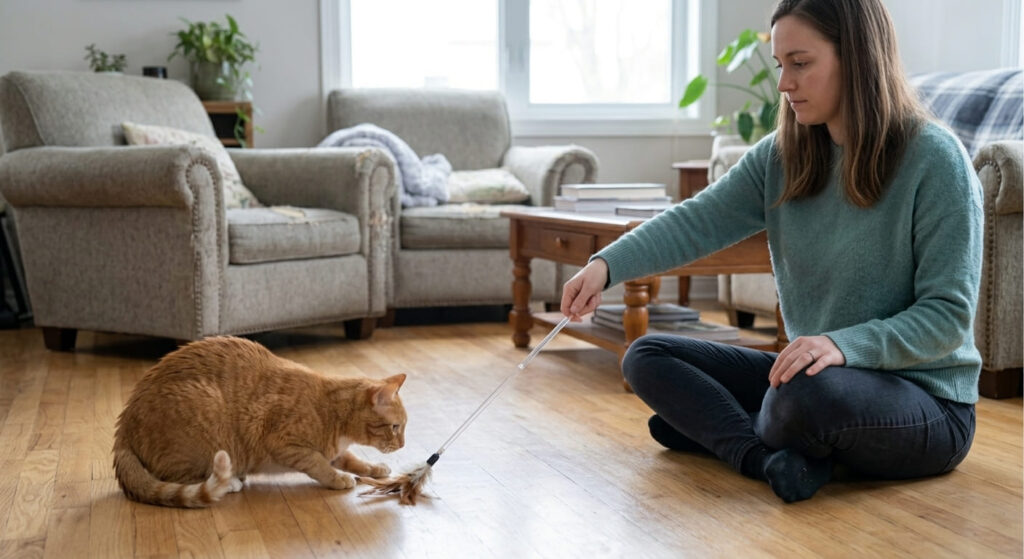
Wand toys with feather or fur attachments are the gold standard for active Redirection sessions because:
- They allow you to control the movement pattern (mimicking real prey: erratic, ground-level, pausing)
- They maintain safe physical distance between your hands and the cat’s teeth
- They allow the complete predatory sequence to execute: stalk → rush → pounce → bite → kill
- Let the cat catch and investigate the toy during play when safe. There is no proven rule that every session must end with a simulated “kill”; watch the cat’s interest and stop before play becomes rough.
Automatic/electronic toys serve a different but valuable function — they provide hunting stimulation during times when you’re not available for interactive play, preventing the accumulation of Predatory Drive frustration that leads to ankle ambushes.
Step 2: Make Hands Boring When Teeth Touch Skin
This is the single most important behavioral rule for anyone asking why does my cat bite me — and the one most reliably violated in the moment of a bite.
The rule: When a cat bites or mouths your hand, the hand becomes completely motionless and all human attention is immediately withdrawn.
Why it works:
Fast movement can increase a playful cat’s interest in a hand, but protect yourself first if a cat bites. Avoid rough pulling where possible and step away safely rather than following a rigid response script.
Pausing interaction may reduce stimulation for some cats, but it is not guaranteed to stop a bite. Move to safety and seek medical advice when a bite breaks skin as described in the safety note above.
The protocol:
- Cat makes contact with teeth
- Pause rough interaction and withdraw safely; do not keep your hand in reach if biting continues.
- Avoid yelling or punishing. Focus on safely ending the interaction and giving the cat space.
- Move away as soon as it is safe; no fixed waiting period is needed.
- Slowly and boringly withdraw — move the hand with the speed of something deeply uninteresting, not the speed of fleeing prey
- End the interaction calmly and give the cat space, while checking any wound and seeking medical advice when indicated.
What not to do:
- Yank your hand away (creates fleeing prey stimulus — escalates)
- Push toward the cat’s mouth (creates threat stimulus — may escalate to defensive bite)
- Say “no” or the cat’s name (social engagement)
- Spray water (creates negative association with you, not with the behavior; damages trust)
- Tap the cat’s nose (same problem — often escalates aggression)
The time-out for the owner:
Briefly ending an interaction can prevent further biting and give both cat and person space. Resume later with appropriate toys and reward gentle behavior; this is a management step, not a guaranteed learning mechanism.
Step 3: Use a Consistent Daily Play Routine
A lack of appropriate play can contribute to play-related biting in some cats, but biting also has other behavioral and medical causes. Offer suitable interactive play while checking for fear, pain, overstimulation, or redirected arousal.
The evidence-based protocol:
- Offer regular interactive play adjusted to your cat’s interest, age, and health.
- Offer short, interactive play opportunities adjusted to the cat’s age, health, and interest; stop if the cat becomes tired or distressed.
- Interactive wand toy — you control the movement; make it realistic (ground-level, erratic, with pauses)
- Allow the cat to catch the toy during play when safe, then stop while the cat is still comfortable. There is no universal need for a simulated “kill.”
- Feed a small meal after the evening play session — this mirrors the natural hunt → catch → kill → eat sequence and promotes satisfying, complete behavioral closure. Many cats who play before their evening meal show significantly reduced nighttime activity and ankle ambushing.
If your cat bites more at night, use this routine with our guide on how to tire out an indoor cat before bed. — Increasing total daily structured activity is the foundational intervention for reducing play aggression and all feline behavioral outbursts driven by excess energy. Our comprehensive guide to indoor cat exercise covers breed-specific activity requirements, apartment-friendly exercise protocols, and the specific play techniques that produce maximum behavioral benefit in minimum time.
Signs a play session was effective:
- Watch for the cat’s interest and signs of fatigue or overstimulation; end or pause the game accordingly.
- Cat grooms after the session (post-hunt grooming is a normal behavioral sequence)
- Cat seeks a resting spot and settles without redirecting to other targets
- Track whether biting becomes less frequent or less intense over time. If it persists, escalates, or starts suddenly, ask a veterinarian or qualified behavior professional for help.
Step 4: Reduce Boredom With Indoor Enrichment
A variety of safe activities can help an indoor cat stay engaged. For ideas suited to limited space, see our indoor cat enrichment in small apartments guide.
Enrichment may reduce boredom and offer a safer focus for play. It does not replace veterinary assessment for new or severe aggression.
The enrichment pyramid for apartment cats:
Tier 1 — Sensory stimulation (passive, always available):
- Window perch at a bird or squirrel-active window
- Bird feeder placed within visual range of the window
- “Cat TV” — dedicated streaming content featuring birds, fish, and small animals at low volume
- Rotating variety of textures in resting spots (different fabrics, temperatures, heights)
Tier 2 — Cognitive engagement (semi-active, refreshed regularly):
- Puzzle feeders for at least one meal daily — feeding from a puzzle requires problem-solving and physical engagement that mimics foraging behavior
- Food-dispensing toys that require batting and manipulation
- Rotate safe toys when the cat loses interest, while keeping familiar favorites available; no fixed rotation schedule works for every cat.
- Paper bags and boxes with unpredictable entry points
Tier 3 — Active engagement (daily, dedicated):
- The structured wand toy sessions from Secret #3
- Short, reward-based training can add variety for a willing cat; keep sessions comfortable and stop if the cat disengages.
- If using a laser pointer, avoid shining it in eyes and offer a physical toy or other rewarding activity; stop if the cat seems frustrated.
The rotation principle:
Rotate safe toys and activities when the cat loses interest, while keeping familiar options available. A puzzle feeder, wand toy, or window perch can add variety without making every day unpredictable.
Step 5: Reward Calm, Appropriate Play
The fifth and most sophisticated secret — and the one most owners implement last, if at all — is deliberately reinforcing behaviors that are incompatible with biting.
Positive Reinforcement means immediately rewarding desired behaviors with something the cat finds genuinely valuable (usually high-value treats, but also play access or affection for some cats).
What to reinforce:
- Gentle contact: When your cat approaches your hand and makes nose-contact or gentle cheek-rub contact without biting, mark the behavior immediately (a click if you use a clicker, or a distinct verbal marker like “yes”) and deliver a treat. You are teaching the cat that gentle contact produces reward; biting produces nothing.
- Toy engagement: When your cat redirects their hunting behavior to a toy rather than your skin, reinforce it immediately. You are making the toy interaction more rewarding than the human interaction.
- Calm proximity: When your cat is in close proximity to you with a relaxed body posture and no predatory arousal, reinforce it. You are building an association between calm presence and reward.
- “Four paws on the floor”: If ankle ambushing is a specific problem, reinforce all moments when the cat is near your feet but not engaging in predatory behavior.
Timing is everything in Positive Reinforcement:
Mark the desired gentle behavior as it happens with a consistent cue or clicker, then give the reward promptly. The exact timing depends on the training setup; the goal is to make it clear which behavior earned the reward.
What Positive Reinforcement is not:
- It is not bribery offered during bad behavior to stop it — this rewards the bad behavior
- It is not a single training session — behavioral change requires hundreds of reinforced repetitions across weeks
- It is not appropriate for every cat — some cats are not food-motivated enough for treat-based training, requiring alternative reinforcers
Giving the predator a job reduces frustration. For calm training sessions that reward better choices, start with our guide on how to clicker train a cat.
The ‘No Hands’ Rule: Why You Are Part of the Problem
Hand play can teach a kitten that fingers and wrists are acceptable targets. If this has happened, start using toys that keep hands at a distance and end play calmly when teeth touch skin.
Repeated hand play can reinforce biting human body parts during play. Changing the play setup consistently gives the cat a safer target.
How Hands Become Prey
The learning process is simple operant conditioning:
- Human wiggles fingers under blanket
- Cat pounces and bites fingers
- Human laughs; wiggling continues
- Cat learns: finger movement = hunting game = rewarding
- Cat generalizes: hand movement = hunting game
- Cat further generalizes: moving human extremities = hunting game
Kittens learn play boundaries through repeated interactions. If people regularly use hands and feet as play targets, those habits may continue as the cat grows. Use toys to give the kitten a safer target.
The Kitten Tax
A cat that has learned to chase hands or feet during play may keep doing so as an adult. Redirect play to appropriate toys consistently rather than assuming the behavior will disappear with age.
Implementing the No Hands Rule
- Household consistency: Ask everyone to use toys rather than hands during play. Occasional hand play can make the change harder, but progress differs between cats.
- Replace hands immediately: Keep a wand or other suitable toy near regular play areas so that a toy, rather than a hand, becomes the target.
- Redirect past hand play: Offer toys at a safe distance and respond consistently. Progress varies; if biting becomes more intense or injures someone, seek veterinary or qualified behavior advice.
When Biting Is a Medical Sign: Pain and Hyperesthesia
The behavioral interventions above address the most common answers to why does my cat bite me — play aggression, Predatory Drive, and Overstimulation. But there is an important medical dimension to feline biting that every owner should understand, because sometimes the bite is not a behavior problem at all. It is a pain communication.
Kneading can sometimes transition into an overstimulation bite. Understand the trance-like state and Kneading can sometimes shift into overstimulation, so it helps to understand why cats knead before the bite happens.
Pain-Induced Biting
Cats in pain bite. This is one of the most consistent findings in feline behavior medicine, and it represents the most important reason to consult a veterinarian when biting behavior changes suddenly or appears in a cat with no prior history of aggression.
Red flags suggesting pain as the cause of biting:
- Sudden onset in a cat with no prior biting history
- Biting when specific areas of the body are touched — particularly the back, tail base, abdomen, or joints
- Biting accompanied by vocalizations when handled
- Biting in a cat who has recently lost weight or shown other signs of systemic illness
- Biting accompanied by changes in grooming, posture, or gait
Conditions that commonly manifest as biting in cats:
- Arthritis: Touch to painful joints produces defensive biting
- Dental disease: Facial and head handling triggers pain response
- Abdominal pain: IBD, constipation, urinary issues — handling the abdomen produces biting
- Other illness: New irritability or discomfort may have a medical cause. A veterinarian can assess whether thyroid disease or another condition is relevant rather than assuming a diagnosis from biting.
Feline Hyperesthesia Syndrome (FHS)
Feline Hyperesthesia Syndrome — sometimes called “rolling skin disease” — is a poorly understood neurological condition characterized by extreme sensitivity of the skin, particularly along the dorsal midline (spine). Affected cats show:
- Sudden, dramatic skin rippling or rolling along the back
- Sudden turning to bite or scratch at the tail or back
- Dilated pupils and frantic, disorganized behavior during episodes
- Overstimulation responses to minimal touch along the spine
- Self-directed biting that may cause self-trauma
FHS is a diagnosis of exclusion — other causes of skin hypersensitivity (dermatitis, ectoparasites, spinal pain) must be ruled out first. If you observe these signs in your cat alongside biting behavior, a veterinary neurological assessment is warranted.
The Clinical Rule
A sudden or worsening bite response at any age deserves a veterinary assessment, especially if the cat also shows pain or other health changes. Address possible medical causes before treating the behavior as play alone.
Frequently Asked Questions
1. Why Does My Cat Bite Me When I Pet Him?
This is Overstimulation biting — one of the most common, most misunderstood, and most preventable causes of the why does my cat bite me question.
The physiological explanation:
Cats have a sensory stimulation threshold — a point at which continued tactile input shifts from pleasant to overwhelming. When that threshold is crossed, the cat bites. Not from aggression, not from dislike, but from sensory overload. The bite is a communication: “I have reached my limit.”
The preceding warning signals most owners miss:
Some cats show subtle changes before a petting-related bite, such as tail movement, ears turning back, skin twitching, or pulling away. Other bites may occur with little warning, so stop contact whenever the cat appears uncomfortable.
- Skin rippling or twitching along the back — the earliest and most subtle signal
- Tail movement: The tail begins to lash or thump — not the slow, lazy movement of contentment, but a rhythmic, increasingly rapid motion
- Ear rotation: Ears begin to rotate backward or flatten slightly
- Body tension: The cat becomes subtly stiffer; the relaxed melting quality of contentment disappears
- Head turning: The cat turns their head to look at your hand
- Bite
Most owners notice only step 6. The goal is to notice steps 1–2 and stop petting before the sequence progresses.
Practical management:
- Learn your cat’s specific threshold — some cats reach it after 30 seconds; others can be petted for 10 minutes. Individual variation is enormous.
- Begin with brief petting, pause, and let the cat choose whether to continue; no fixed number of seconds applies.
- Focus petting on areas of high receptivity: cheeks, chin, base of ears — avoid the belly and the lower back near the tail unless your specific cat has demonstrated tolerance
- Never restrain a cat for petting. Restraint eliminates their ability to communicate “stop” through body language, leaving the bite as the only available option.
2. How Do I Punish My Cat for Biting?
The direct answer: You don’t. Punishment, as humans typically apply it, does not effectively modify feline behavior — and in the context of biting, it actively makes the problem worse.
Here’s why punishment fails:
The timing problem: Reacting with punishment after a bite does not teach a cat the safer behavior you want and may increase fear. Instead, pause contact, give the cat space, and reward calm, appropriate play when it occurs.
The attribution problem: Cats do not experience punishment the way humans intend it. Spraying a cat with water, tapping their nose, or raising your voice does not teach “biting is wrong.” It teaches “this specific human does unpredictable, aversive things.” The result is a cat who is both more likely to bite (from stress and negative association with the handler) and more likely to show fear aggression.
The trust damage: Positive Reinforcement-based relationships with cats are built on the cat’s experience of the human as a reliable source of positive outcomes. Physical punishment damages or destroys that association — often permanently.
What actually works instead:
- The Hand Is a Statue Rule (Secret #2)
- Immediate disengagement and room exit
- Positive Reinforcement of incompatible behaviors
- Proactive enrichment that prevents the arousal build-up
The answer to why does my cat bite me is a Predatory Drive management question, not a discipline question. Approach it accordingly.
3. When should I worry that cat biting is medical, not behavioral?
You should worry when biting starts suddenly, becomes more intense, happens when you touch one body area, or appears with other changes such as hiding, weight loss, reduced appetite, limping, poor grooming, vocalizing, or litter box changes. Pain can make even a gentle cat bite defensively. Arthritis, dental pain, abdominal pain, urinary issues, skin sensitivity, and neurological problems can all change how a cat reacts to handling. If the biting pattern is new or escalating, schedule a veterinary exam before focusing only on training.
4. Will My Cat Grow Out of Play Aggression?
Partially — and only with consistent behavioral management.
The developmental trajectory of play aggression:
- Kittens: Rough play can be common as play skills develop. Use toys rather than hands and allow the kitten to stop or move away.
- Young adults: Some cats remain highly playful. Provide suitable outlets and monitor whether biting is changing or becoming more forceful.
- Adults: Play style varies between cats; an established habit of chasing hands may need a consistent change in play routine.
- Older cats: A new or worsening bite response may reflect pain or another health problem. Arrange a veterinary assessment rather than assuming it is ordinary play.
Some play-biting habits can persist unless the household consistently changes how it plays with the cat. Progress varies; if biting causes injury or continues despite safer play routines, consult a veterinarian or qualified behavior professional.
The question why does my cat bite me has an answer that empowers you as an owner — because understanding the mechanism means you can address the mechanism, rather than waiting for biology to take its course.
Final Thoughts
Play-related biting may lessen when a cat has appropriate toys, predictable play opportunities, and no encouragement to chase hands or feet. Progress varies; persistent, worsening, or unexplained biting warrants veterinary advice.
Understanding whether a bite is related to play, fear, overstimulation, redirected arousal, or pain is the first step toward a safer response.
Keep a suitable toy within reach so that hands and feet are not used as the play target.
References
- Cornell Feline Health Center. Feline Behavior Problems: Aggression. Read the veterinary guidance.
- NHS. Animal and human bites: wound care and when to seek medical help. Read the bite guidance.