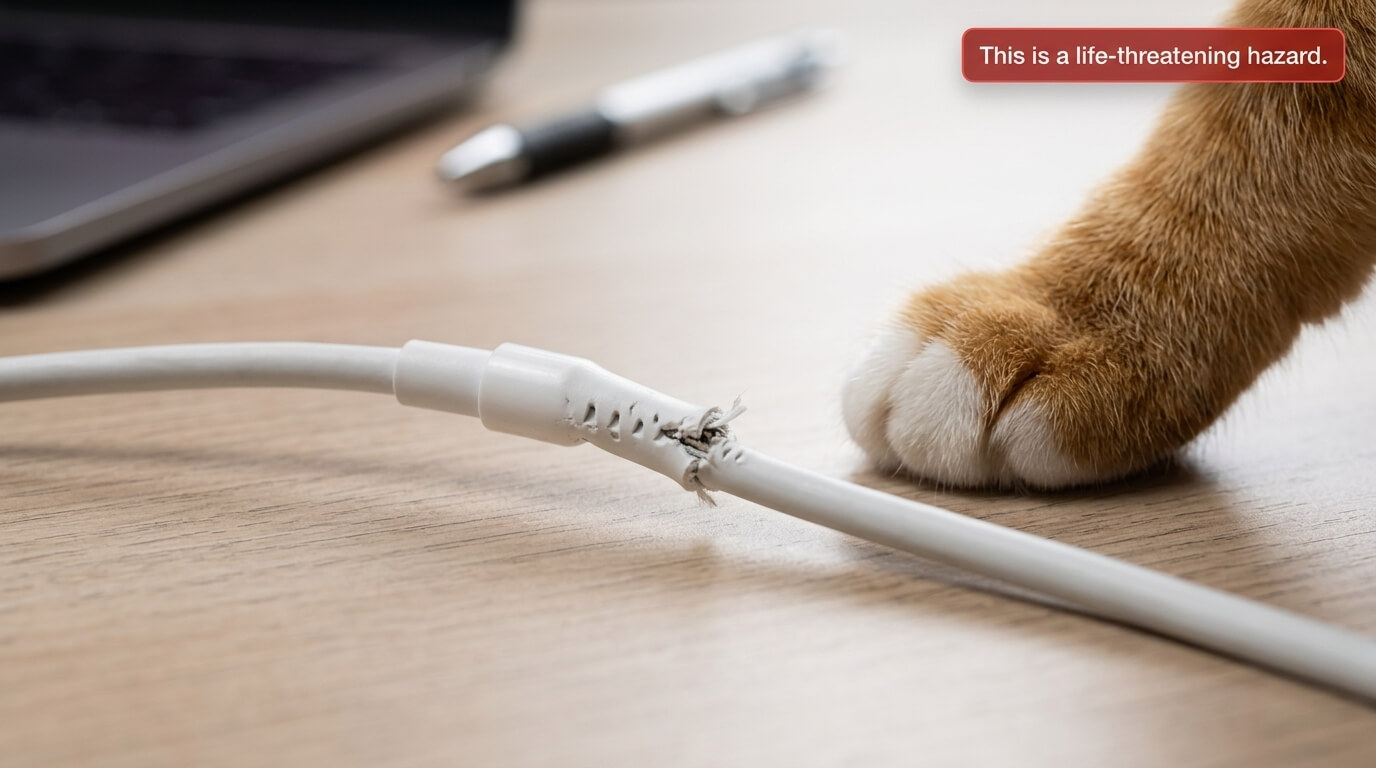
How to stop cat chewing cords starts with one rule: do not rely on training alone. Electrical cords are a real safety hazard, so the safest plan is to block access, cover exposed cables, remove damaged cords, offer safer chewing outlets, and check for medical or stress-related causes.
This guide shows you a practical cord-proofing system for apartments, plus the warning signs that mean your cat needs urgent veterinary care after possible electrical contact.
Quick Answer: How to Stop Cat Chewing Cords Effectively?
To stop cat chewing cords, first unplug and remove any damaged cord, then protect every accessible cable with cord covers, split-loom tubing, cable boxes, or furniture routing. Add a cat-safe bitter deterrent only as a backup, not as your main protection.
At the same time, give your cat safe chewing and hunting alternatives such as silvervine sticks, food puzzles, wand play, and chew-safe toys. If your cat is swallowing rubber or plastic, chewing suddenly, drooling, pawing at the mouth, or acting painful, ask your veterinarian to check for dental pain, pica, stress, or another medical cause.
Important Safety Note
If your cat may have bitten a live electrical cord, disconnect power first before touching the cord or your cat. Contact an emergency veterinarian the same day, even if your cat seems normal. Electrical injuries can cause mouth burns, abnormal heart rhythm, breathing trouble, collapse, or delayed fluid in the lungs.
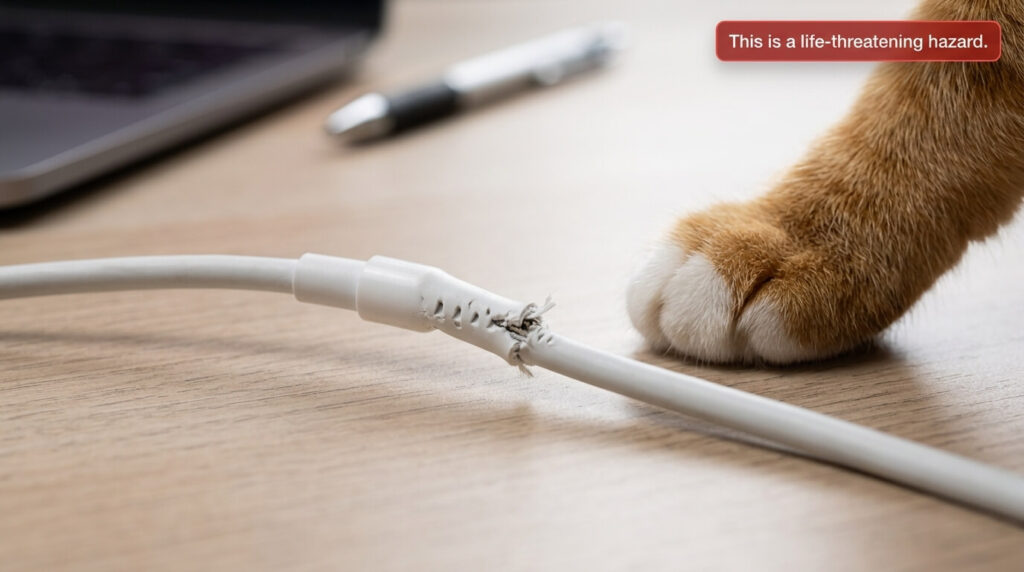
Table of Contents
Why Cats Chew Cords
Cord chewing can have more than one cause. Kittens may explore objects with their mouths, while adult cats may be attracted to a cord’s movement, texture, or location in a frequently used play area. Boredom, stress, and an established chewing habit can also contribute.
Do not assume every case is behavioral. New or persistent chewing can occur alongside dental pain, oral irritation, pica, gastrointestinal disease, or another health change. The reason matters because cable management protects the cat immediately, while medical or behavior care addresses why the chewing continues.
Electrical cords are a common apartment hazard because they often run along walls, hang from desks, or move when a device is handled. Treat every accessible live cord as a safety problem even if your cat has only mouthed it once. If you are preparing a home for a young cat, use this plan alongside our guide to kitten-proofing an apartment.
Medical vs. Behavioral: Ruling Out Pica and Dental Pain
Arrange a veterinary examination when cord chewing begins suddenly, becomes repetitive, or appears together with changes in eating, swallowing, weight, activity, grooming, or litter-box habits. A physical and oral examination can identify problems that environmental changes alone will not solve.
If you notice drooling, bad breath, bleeding gums, pawing at the mouth, food dropping, chewing on one side, or reluctance to eat, compare the signs with our indoor cat dental health guide and contact your veterinarian.
Is This Pica?
Pica describes persistent eating of non-food material. Cord chewing does not prove pica, but missing pieces of plastic or rubber, repeated swallowing, vomiting, reduced appetite, abdominal discomfort, or repeated attempts to eat other non-food objects require veterinary attention.
Swallowed cord covering or other material can cause a gastrointestinal obstruction. Do not pull string-like material from your cat’s mouth or rectum; contact a veterinarian because pulling can injure the digestive tract.
Is This Dental Pain?
Dental disease can be difficult to see at home, and some cats continue eating despite pain. New chewing, one-sided chewing, drooling, mouth odor, facial sensitivity, or a preference for softer food should prompt an oral examination rather than a harder chew toy.
5 Safe Steps to Stop Cat Chewing Cords
Use these five layers together. Physical protection comes first because deterrents and redirection can fail. The remaining steps reduce access, provide safer outlets, and make it easier to identify a medical or stress-related trigger.
Step 1: Use a Pet Deterrent Only as a Backup
A taste deterrent may discourage some cats, but it is not electrical protection and should never be the only barrier around a live cord. Choose a product whose current label specifically permits use around pets and on the cord’s outer material. Follow the label, test a hidden section, keep the product away from plugs and outlets, and allow the surface to dry before the cat can approach.
Do not improvise with essential oils, hot pepper, cleaning chemicals, or concentrated citrus products. These can irritate the mouth, eyes, skin, or airways, and some concentrated oils create additional exposure risks for cats. If the cord manufacturer prohibits liquids, skip sprays and use a physical cover instead.
Recheck the setup regularly. A determined cat may ignore a bitter taste, and any deterrent can wear off. Replace or remove a cord immediately when the outer insulation is cracked, punctured, sticky, or otherwise damaged.
Step 2: Cover Cords with Physical Cable Protection
Physical protection is the highest-priority layer because it does not depend on a cat responding to a taste deterrent. Unplug and replace any cord with cracked, punctured, frayed, melted, or exposed insulation. A sleeve or raceway is not a repair for damaged wiring.
For cords that must remain in use, choose a purpose-made cord cover, closed raceway, cable-management box, or furniture-routing system that fits the cable and can be installed according to the product and appliance instructions. Keep plugs, adapters, power strips, ventilation openings, and heat-producing components uncovered. Do not force a thick cable bundle into a small sleeve, sharply bend a power cord, or use a cover that becomes hot during operation.
Treat every cover as a barrier, not as a chew-proof guarantee. Inspect it regularly for tooth marks, gaps, loose fasteners, heat, and exposed ends. If your cat can still reach or open the barrier, reroute the cord behind a closed surface, move the device, or unplug and store the cable when it is not in use.
Prioritize cords your cat has already approached, dangling chargers, floor-level runs, and cables near play or resting areas. Keep cable boxes stable and ventilated, and use only installation methods approved for the wall, furniture, cord, and electrical device involved.

Step 3: Offer Safer Chewing and Hunting Outlets
Removing access to cords protects your cat immediately, but appropriate activities can reduce the chance that another household object becomes the next target. Choose alternatives that are made for cats, too large to swallow, free of loose string or detachable pieces, and already shown to be safe for your cat under supervision.
Useful options may include sturdy kicker toys, food puzzles filled with part of the normal daily food allowance, supervised cat grass, short interactive wand-play sessions, and cat-specific chew toys whose condition can be checked after use. Put wand toys, yarn, ribbon, elastic, rope-like pieces, and damaged toys away when play ends.
Introduce one option at a time and watch how your cat uses it. Stop using an item if pieces loosen, the cat tries to swallow it, vomiting occurs, or the behavior becomes frantic. Do not offer bones, raw animal parts, hard objects that could damage teeth, or human products as a home treatment for cord chewing.
There is no universal play schedule that every cat must follow. Use brief sessions suited to your cat’s age, mobility, health, and interest. If chewing is sudden, persistent, or accompanied by swallowing, drooling, mouth pain, appetite change, vomiting, weight loss, or chewing other non-food objects, arrange a veterinary examination rather than relying on enrichment alone.
Step 4: Reduce Stress Around Cord-Chewing Zones
Look for a pattern before assuming the behavior is random. Record the time, room, nearby activity, and what happened just before the cat approached a cord. Chewing that increases after schedule changes, conflict with another pet, long periods without play, or loss of a resting place may improve when those triggers are addressed.
Give the cat a predictable daily routine, short interactive play sessions, food puzzles when appropriate, stable hiding and resting places, and a way to leave busy areas without being chased or cornered. Move play away from desks and cable clusters so cords are not part of the hunting sequence.
A feline pheromone diffuser may support some stress-management plans, but it cannot make an exposed cord safe and should not replace medical assessment, cable covers, or environmental changes. Avoid scent-based home remedies and essential-oil diffusers around the cord area.
Step 5: Route Cords Where Your Cat Cannot Reach Them
The safest route is one your cat cannot enter, climb to, pull down, or open. Use closed raceways, enclosed cable boxes, fixed furniture routes, or storage that keeps the entire cable—including both ends—unavailable. A cord is not safely out of reach simply because it is four feet above the floor, under a desk, or behind movable furniture; cats can jump, climb, squeeze into gaps, and pull on dangling sections.
Walk through the apartment and check every charger, lamp, computer, entertainment system, extension cord, and small-appliance cable. Remove dangling loops, close gaps at the ends of covers, keep cords away from water and heated surfaces, and unplug and store nonessential cables when practical. Do not route a cord through a doorway, under a rug, across a walking path, or in any way the device manufacturer prohibits.
Recheck the setup after furniture moves, cleaning, travel, or the arrival of a new device. If tooth marks or other damage appear, disconnect power and replace the cord or have the equipment assessed; do not hide damage beneath a sleeve or tape.

Electrical Injury Warning: Signs of Shock in Cats
Biting a live cord can cause burns around the lips, tongue, gums, or palate, as well as abnormal heart rhythm, neurologic injury, collapse, and breathing problems. Merck Veterinary Manual notes that electrical injury in small animals commonly follows cord chewing and that respiratory distress may result from swelling around the face or upper airway or from neurogenic pulmonary edema.
If your cat may still be touching a live wire, do not touch the cat or cord. Disconnect power at the outlet only if you can do so without approaching the damaged area; otherwise use the circuit breaker and call emergency services if the area is unsafe. Once the electrical source is off, contact an emergency veterinarian immediately and follow their transport instructions, even if obvious burns or breathing changes are not yet visible. Do not apply creams, ice, food, water, or medication to a mouth injury unless the veterinary team instructs you to do so.
Emergency signs include difficulty breathing, open-mouth breathing, blue or gray gums, collapse, loss of consciousness, seizure activity, severe weakness, facial swelling, or visible mouth burns. Symptoms after electrical contact can be delayed, so the veterinary team—not a fixed online timeline—should decide the examination and monitoring plan.
After the cat is safe and veterinary care is arranged, keep the damaged cord unplugged and replace it or have the appliance assessed. A cover, deterrent spray, or tape does not make damaged insulation safe to reuse.
Frequently Asked Questions
1. Is there a spray that stops cats from chewing cords?
A pet-labeled taste deterrent may help some cats, but no spray makes an exposed live cord safe. Confirm that the label permits use on the cord material, keep liquid away from plugs and outlets, and combine the product with a rigid cover or inaccessible route.
2. Why is my cat suddenly chewing on wires?
A new behavior can reflect a changed play pattern, stress, dental pain, oral irritation, pica, gastrointestinal disease, or another health change. Protect the cords immediately and arrange a veterinary examination when the behavior is sudden, persistent, involves swallowing, or occurs with other symptoms.
3. What should I do first if my cat chewed an electrical cord?
Disconnect power before touching the cord or a cat that may still be in contact with it. If the cord was live or electrical contact is possible, call an emergency veterinarian immediately. Do not wait for coughing, breathing difficulty, mouth burns, weakness, or collapse to appear.
4. Are bitter sprays enough to stop cat chewing cords?
No. Cats may ignore the taste, and the product can wear off or be removed during cleaning. Use physical cable protection, safer routing, unplugging when practical, and removal of every damaged cord.
5. Is it safe to wrap cords in aluminum foil?
Foil is not a dependable cord guard. It can shift, tear, expose gaps, and create small pieces that a cat may swallow. It also does not repair damaged insulation or provide a verified barrier against a motivated chewer. Use a purpose-made cable cover, raceway, or inaccessible route instead.
Final Thoughts
How to stop cat chewing cords is mostly about design, not punishment. The safest setup makes cords physically hard to reach, removes damaged cables, adds safer chewing outlets, and treats sudden or compulsive chewing as a possible medical or stress signal.
Treat cord chewing as a preventable home-safety problem rather than disobedience. A layered setup protects the cat even when supervision, deterrents, or redirection fail.
If your cat needs movement-based alternatives, compare safer solo play options in our guide to the best interactive cat toys for solo play.
References
- Bradshaw, J. W. S., Neville, P. F., & Sawyer, D. (1997). Factors affecting pica in the domestic cat. Applied Animal Behaviour Science, 52(3–4), 373–379.
- Wismer, T. (2006). Electrical injuries in small animals. Veterinary Medicine, 101(10), 626–634.
- Merck Veterinary Manual. Lightning Strike and Electrical Injury in Animals.
- Merck Veterinary Manual. Pulmonary Edema in Cats.
- ASPCA. Keeping Your Foster Cats Out of Trouble.