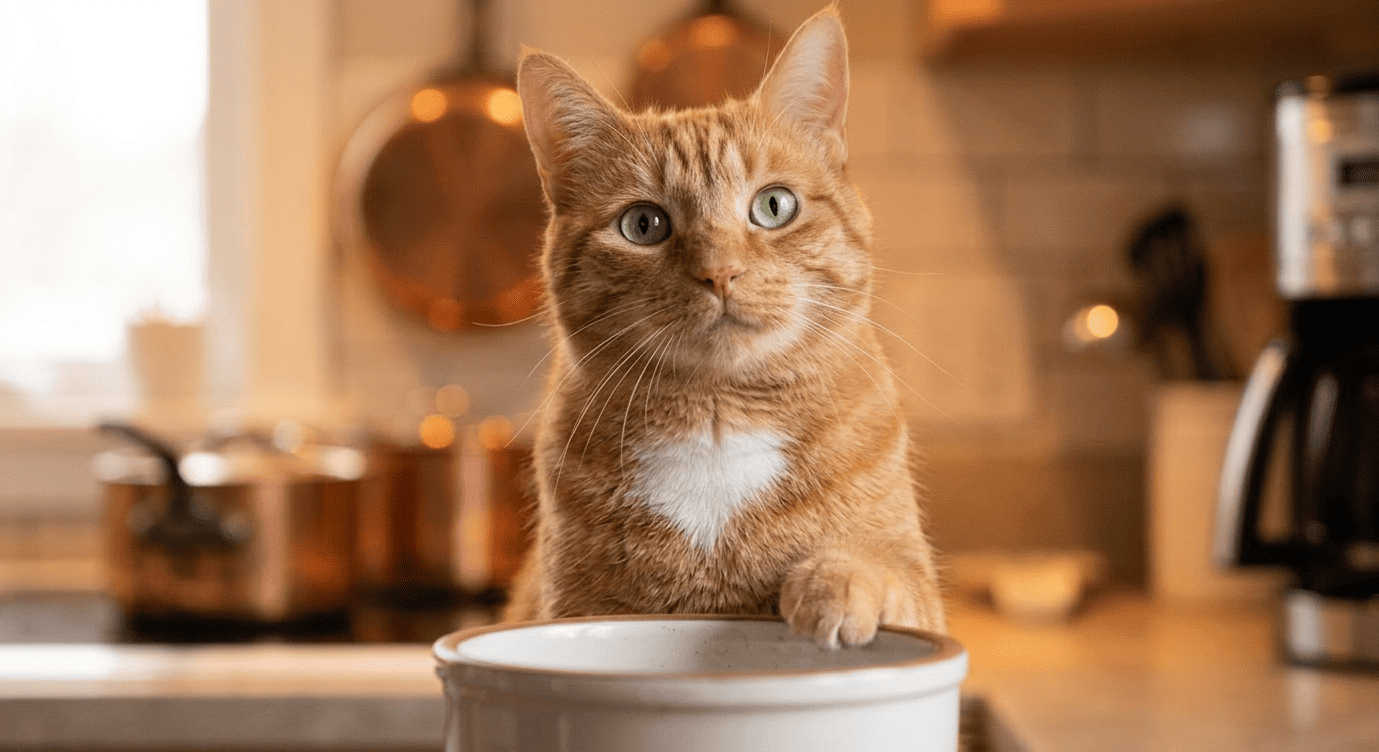
By the IndoorCatExpert.com, a cat who once staged a 4:30 AM hunger protest
There was a period of about eight months where my alarm clock was Oliver. Not an actual alarm clock — Oliver. Every morning, without fail, somewhere between 4:15 and 4:45 AM, he would plant himself directly on my chest, press one paw firmly into my cheek, and stare at me with the quiet intensity of someone who had been wronged. The reason? His dry food bowl was empty, and in his mind, that was a five-alarm emergency.
Switching to a structured indoor cat feeding schedule didn’t just fix his predawn breakfast campaign — it transformed his behavior, reduced his begging, stabilized his weight, and, not insignificantly, gave me my sleep back. What I didn’t realize until I made the change was how deeply a feeding routine affects almost every other aspect of a cat’s physical and psychological health.
Quick Answer
The best indoor cat feeding schedule consists of two to three measured meals per day, spaced 8 to 12 hours apart. For 9-to-5 workers, feeding at 7:00 AM, using a puzzle feeder at noon, and offering a final meal at 8:00 PM aligns with cats’ natural biological rhythms. Always measure portions by caloric target, never by guessing, and remove uneaten wet food within two hours.

The Free-Feeding Trap
Let’s start with the feeding method most cat owners default to — because it’s convenient, it seems kind, and it’s almost certainly making your cat’s life worse in ways that aren’t immediately obvious.
Free-feeding means leaving food out at all times, typically a bowl of dry kibble that gets topped up whenever it runs low. It’s the standard approach for millions of cat owners, and I used it with Oliver for two years without questioning it once.
Here’s what free-feeding actually does:
It Disconnects Food From Biology
In the wild, cats eat what they catch. A successful hunt produces a meal. No hunt, no meal. This creates a deeply ingrained neurological association between effort, reward, and satiety. Free-feeding completely removes this loop — food is simply always there, requiring nothing, meaning nothing, satisfying nothing beyond the immediate moment.
It Makes Portions Invisible
When food is always available, it’s essentially impossible to know how much your cat is actually eating. You’re refilling a bowl, not feeding a cat. This opacity makes weight management nearly impossible and means you often won’t notice a decrease in appetite — one of the earliest signs of illness — until it’s quite advanced.
It Creates the Exact Behavior You’re Trying to Avoid
This one surprised me most. I assumed free-feeding would reduce food-related begging because food was always available. The opposite turned out to be true. When Oliver’s bowl was constantly full, he treated it as background noise — and he learned to demand fresh food, topped-up food, my-attention-food at all hours. The bowl being full meant nothing. Only my active involvement with the food meant something.
Switching to scheduled meals made food meaningful again. Oliver now knows exactly when meals happen. He waits for them. He eats them properly. And then he moves on with his day.
It’s a Primary Driver of Feline Obesity
Research is consistent on this point: cats with access to unlimited food consume more calories than they need. Combined with the sedentary indoor lifestyle, free-feeding is one of the strongest predictors of overweight status in domestic cats. The Association for Pet Obesity Prevention estimates that over 60% of domestic cats in the United States are overweight or obese — and free-feeding is a central contributing factor.
How Many Times a Day Should You Feed an Indoor Cat?
This is where the science gives us a clear answer, even if the “right” number has some flexibility depending on your cat’s age, health status, and your own schedule.
The Veterinary Consensus: Two to Three Meals Per Day
The majority of feline veterinary nutritionists recommend two to three measured meals per day for healthy adult indoor cats. Here’s the reasoning:
- Two meals (morning and evening, roughly 12 hours apart) is the minimum effective schedule and works well for most working adults
- Three meals (morning, midday, evening) more closely mimics the natural multi-hunt rhythm and works better for cats prone to vomiting bile from an empty stomach
- Once daily feeding is not recommended — the gap between meals is too long, can cause gastric acid buildup, and doesn’t align with natural feline patterns
Age Changes the Equation
全屏复制
| Life Stage | Recommended Meals Per Day | Notes |
|---|---|---|
| Kittens (under 6 months) | 3–4 meals | Rapid growth requires frequent, consistent fuel |
| Adolescent (6–12 months) | 3 meals | Transitioning toward adult schedule |
| Adult (1–7 years) | 2–3 meals | Maintain consistent timing |
| Senior (7+ years) | 2–3 smaller meals | Smaller portions more frequently aids digestion |
| Medical conditions | Vet-directed | Diabetes, kidney disease, etc. require specific protocols |
The Portion Question: How Much Goes in the Bowl?
Portion size is where most well-intentioned feeding schedules fall apart. The answer is not “follow the bag instructions” — those recommendations are notoriously generous (for obvious commercial reasons) and don’t account for your specific cat’s size, age, or activity level.
The correct process:
- Get your cat’s ideal weight from your vet (not their current weight if they’re overweight)
- Calculate daily caloric needs — approximately 20 calories per pound of ideal body weight for a sedentary indoor cat (your vet can refine this)
- Check the caloric content of your specific food (kcal per can or per cup — this is on the label or manufacturer’s website)
- Divide the daily caloric allowance across your scheduled meals
This sounds more complicated than it is. Once you’ve done the math once and measured out the portions, it becomes a 30-second daily habit.
For exact caloric measurements and printable charts, use our ultimate calculator guide on exactly how much to feed indoor cat breeds.
What You’re Feeding Affects When You Feed
Before we look at specific schedule templates, it’s worth noting that your feeding schedule structure depends significantly on what you’re putting in the bowl. Wet food and dry food have very different handling requirements that affect how your schedule can realistically work.
Wet food spoils at room temperature within two hours, which means you can’t simply put it out at 7 AM and leave it sitting until noon. Dry kibble, by contrast, can safely sit in a bowl all day. This distinction matters enormously for working cat owners deciding how to structure their schedule. I’ve written a full breakdown of the nutritional differences, safety guidelines, and how to choose between formats in [Wet Food vs Dry Food for Indoor Cats: What Science Says] — it’s worth reading before you finalize your routine.

The Hunt-Eat-Sleep Connection: Why Timing Is Everything
Meal timing isn’t just logistical — it’s biological. And understanding this connection is what elevates a “feeding schedule” from a convenience tool to a genuinely health-optimizing routine.
Cats are hardwired for a specific behavioral sequence:
Hunt → Catch → Kill → Eat → Groom → Sleep
Every component of this loop has a neurochemical signature. The hunt phase triggers dopamine and cortisol (alertness, motivation). The catch-and-kill phase delivers a satisfaction response. The eating phase triggers the parasympathetic nervous system — the “rest and digest” mode. Grooming follows automatically. Then sleep.
When you align your feeding schedule with this loop, you’re essentially programming your cat’s entire daily rhythm.
The most powerful application of this: feed your cat their evening meal immediately after an interactive play session, 60–90 minutes before your bedtime. The play session simulates the hunt. The meal completes the loop. The groom-and-sleep phase follows naturally — and your cat is settled and calm exactly when you want to be asleep.
This single adjustment is why Oliver stopped waking me up at 4:30 AM. A cat who has properly completed their hunt-eat-sleep cycle in the evening is a cat who sleeps through the night.
3 Sample Feeding Routines for Different Lifestyles
Here’s where we get practical. These are templates — adjust the times to fit your actual life, because a schedule you can maintain consistently is always better than a perfect schedule you abandon after two weeks.
Routine 1: The 9-to-5 Worker Schedule
This is the most common scenario and the one that requires the most creative problem-solving for the midday gap.
← 可左右滑动查看更多内容 →全屏复制
| Time | Meal / Activity | Notes |
|---|---|---|
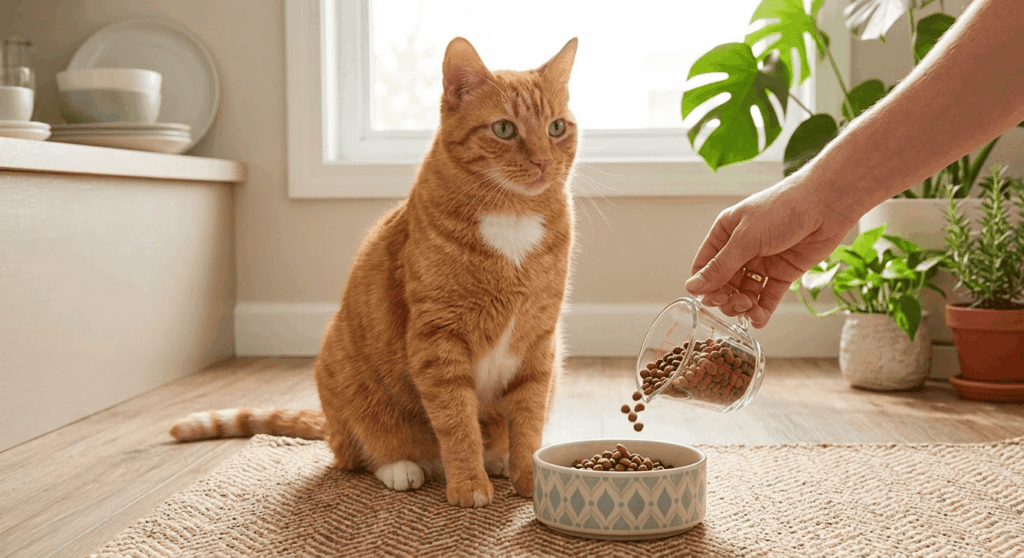
| 7:00 AM | Morning meal (50% of daily calories) | Immediately after a 10-minute wand toy session |
| 7:45 AM | Leave for work | Cat enters post-hunt grooming and sleep phase |
| 12:00 PM | Puzzle feeder with measured dry kibble portion (20% of daily calories) | Automatic feeder or timed puzzle — enrichment + midday nutrition |
| 6:30 PM | Evening play session (15 minutes, interactive wand toy) | Simulates the evening hunt |
| 7:00 PM | Evening meal (30% of daily calories) | Immediately after play — completes hunt-eat loop |
| 8:30–9:00 PM | Cat grooming and settling | Your quiet evening begins |
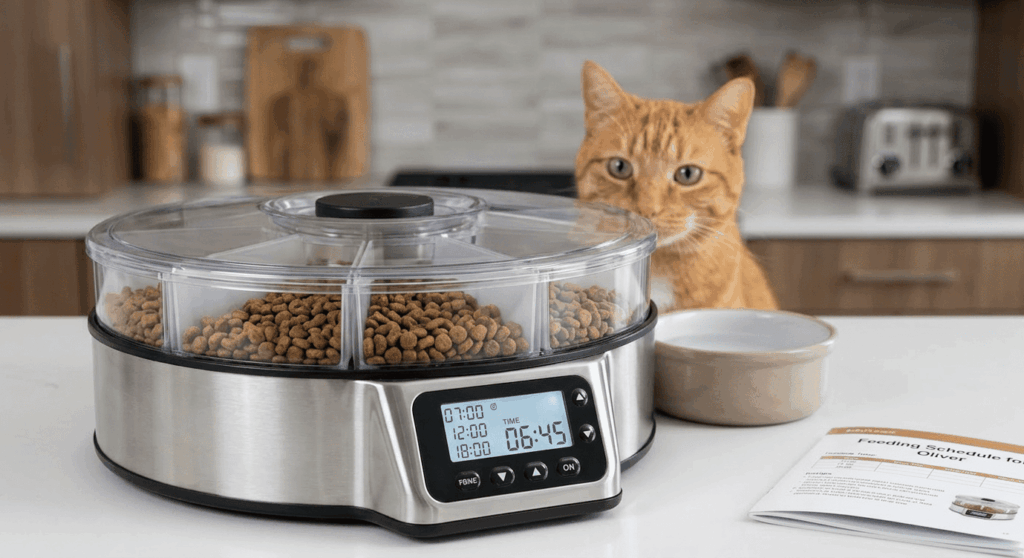
Key tool for this routine: An automatic timed feeder for the midday portion removes the dependency on someone being home. Set it to open at noon, pre-loaded with the measured dry kibble amount.
Using a puzzle feeder for the midday portion serves double duty — it delivers the calories your cat needs while also acting as a mental enrichment activity that prevents the boredom that builds up during a long day alone at home. For apartment cat owners especially, I’ve covered how to use puzzle feeders as part of a broader enrichment strategy in [The Small Apartment Cat Survival Guide: 7 Pillars of Indoor Enrichment].
Routine 2: The Work-From-Home Schedule
Working from home gives you more flexibility — and more opportunities for your cat to manipulate you into extra meals. Structure is still essential.
全屏复制
| Time | Meal / Activity | Notes |
|---|---|---|
| 7:30 AM | Morning meal (40% of daily calories) | After a brief morning play session |
| 7:45 AM–12:00 PM | Work period | Ignore begging. It will happen. Hold the line. |
| 12:00 PM | Midday meal (20% of daily calories) | Smaller meal — keeps hunger manageable without overfeeding |
| 12:15 PM–6:00 PM | Work period | A puzzle toy or snuffle mat can occupy them during afternoon |
| 6:00 PM | Evening play session (15 minutes) | Interactive wand toy — the day’s main hunt simulation |
| 6:30 PM | Evening meal (40% of daily calories) | Completes the hunt-eat-sleep loop |
| 7:00 PM onward | Cat grooming and sleeping | You can actually finish your work now |
The WFH trap to avoid: When you’re home all day, your cat knows you’re home all day. Oliver became an expert at the “starving orphan” performance around 3 PM every afternoon during my work-from-home period. The solution is treating your feeding schedule with the same firmness you would if you were at the office — the schedule exists regardless of your physical location.
Routine 3: The Senior or Medical Cat Schedule
Older cats and those with specific health conditions often do better with smaller, more frequent meals that are gentler on digestion and blood sugar regulation.
全屏复制
| Time | Meal / Activity | Notes |
|---|---|---|
| 7:00 AM | Morning meal (30% of daily calories) | Smaller portion, easier to digest |
| 12:00 PM | Midday meal (20% of daily calories) | Maintains stable energy levels |
| 5:00 PM | Afternoon meal (20% of daily calories) | Prevents late-day hunger and vomiting |
| 8:00 PM | Evening meal (30% of daily calories) | Final meal before overnight fast |
⚠️ Important: If your cat has diabetes, kidney disease, hyperthyroidism, or any chronic condition, do not use these templates without first consulting your veterinarian. Medical feeding schedules are highly individualized and must be designed around specific treatment protocols.
Tools That Make the Schedule Actually Work
A good feeding schedule lives or dies on execution. These are the tools that make consistency realistic:
Automatic Timed Feeders
For the 9-to-5 schedule, an automatic feeder for the midday portion is close to essential. Look for:
- Individual compartments with a sealed lid (keeps food fresh, prevents early access)
- Digital timer with multiple daily settings
- Appropriate for wet or dry food depending on your format — not all automatic feeders handle wet food safely
Top-rated options worth researching: PetSafe Six Meal Feeder, PETLIBRO Automatic Cat Feeder, Cat Mate C500.
A Kitchen Scale
Measuring cat food by weight rather than volume is dramatically more accurate — especially for dry kibble, where the size and density of individual pieces varies enormously by brand. A basic digital kitchen scale that reads in grams is a \$10–15 investment that makes portion control genuinely precise.
To automate this process and eliminate human error, check out my top picks for the best automatic cat feeders for indoor cats.
A Feeding Log (For the First Month)
For the first 4 weeks of a new schedule, track meals in a simple note on your phone: time fed, amount given, whether it was finished. This data is genuinely useful for spotting patterns — a cat who consistently leaves food at a particular meal may be getting too much at the previous one.
Handling the Transition: What to Expect
Switching from free-feeding to scheduled meals is not always a smooth process. Oliver’s first week on a schedule was an experience I can only describe as “theatrical.”
What commonly happens in the first 1–2 weeks:
- ✅ Increased vocalization at non-meal times (this is normal and will pass)
- ✅ Finishing meals extremely quickly (their body is adjusting to the new pattern)
- ✅ Begging behavior actually increases briefly before it decreases
- ✅ Possible initial weight loss as excess caloric intake normalizes
How to handle it:
- Do not give in to begging between scheduled meal times — even once. One capitulation teaches your cat that begging works, and you will be starting from scratch
- Offer puzzle toys during the times they’d previously have grazed to redirect the food-seeking behavior
- Stay consistent with timing — feed at the same times every day, including weekends. Your cat’s internal clock is surprisingly precise
- Monitor for genuine hunger vs. habit — a cat who is truly consuming less than their caloric needs will lose weight measurably; use monthly weigh-ins to confirm everything is calibrated correctly
Most cats fully adapt to a new feeding schedule within 2–3 weeks. The begging stops. The 4:30 AM wake-up calls stop. The frantic bowl-hovering stops. What replaces it is a cat who knows exactly when food is coming and is genuinely calm about it the rest of the time.

A Note on Water Alongside the Schedule
Feeding schedule optimization isn’t complete without addressing hydration, and the two are more connected than most owners realize.
Best practices for water alongside a structured feeding schedule:
- Place water sources away from the food bowl — cats in the wild would never find water next to a kill, and many cats drink more when water is in a separate location
- Water fountains dramatically increase water intake in most cats — the movement triggers their instinct to drink from running sources
- If you’re feeding dry food as any portion of the diet, hydration becomes even more important to monitor actively
- Consider adding a small amount of low-sodium broth to water occasionally to encourage drinking
Frequently Asked Questions
What is the best indoor cat feeding schedule for a kitten?
Kittens have significantly higher caloric needs relative to their body weight and smaller stomach capacity — which means they need more frequent, smaller meals rather than two large ones. From weaning to 6 months old, aim for 3–4 meals per day spaced evenly across your waking hours. A sample kitten schedule might look like this:
| Time | Meal | Notes |
|---|---|---|
| 7:00 AM | Meal 1 (25% of daily calories) | Morning feed after waking |
| 12:00 PM | Meal 2 (25% of daily calories) | Midday — automatic feeder if working |
| 5:00 PM | Meal 3 (25% of daily calories) | After-work feed |
| 9:00 PM | Meal 4 (25% of daily calories) | Final feed before your bedtime |
From 6–12 months, gradually consolidate to three meals per day as their stomach capacity grows and growth rate slows. By their first birthday, most cats can transition comfortably to the standard two-to-three meal adult schedule. Always use a kitten-specific food formula during this period — the higher protein and caloric density is not optional, it’s genuinely necessary for healthy development.
Should I feed my cat the same amount every day, or adjust based on activity?
For most healthy adult indoor cats, a consistent daily caloric target works well as a baseline — but yes, minor adjustments based on activity level make physiological sense. A cat who has had an unusually active day of play may genuinely need slightly more. A cat recovering from illness who has been sedentary for a week may need slightly less. The practical challenge is that these day-to-day variations are difficult to measure precisely at home.
The most realistic approach: set your baseline portion based on your vet’s recommended caloric target, feed that amount consistently, and adjust based on monthly weight and body condition trends rather than trying to recalibrate daily. If your cat is gaining weight on the current portion, reduce by 10% and reassess in four weeks. If they’re losing weight faster than 1% of body weight per week, increase slightly. Think monthly, not daily.
My cat is always hungry right after eating. Is my indoor cat feeding schedule working?
Almost certainly yes — and what you’re seeing is almost always habit and expectation rather than genuine hunger. Cats who transition from free-feeding to scheduled meals have spent months or years associating any food-seeking behavior with an immediate result. That conditioning doesn’t disappear the moment you implement a schedule.
A cat who finishes their measured meal and immediately looks for more is not necessarily underfed. Ask yourself:
- Are they maintaining a healthy body weight? If yes, they’re getting enough calories
- Are they finishing every meal completely? If they’re licking the bowl clean every time, the portion is appropriate or slightly low — not dangerously so
- Is the “hunger” behavior decreasing over time? Within 2–3 weeks of consistent scheduled feeding, most cats stop the post-meal begging as their body adapts to the new rhythm
If your cat is genuinely losing weight, becoming lethargic, or showing other signs of inadequate nutrition, consult your vet to recalibrate the caloric target. But if they’re simply performing their best “I am starving and have never been fed” theater immediately after a complete meal — that’s Oliver’s specialty, and it does get better with time.
To see how this fits into the big picture of feline nutrition, check out our master indoor cat diet guide.
References
- Courcier, E. A., Thomson, R. M., Mellor, D. J., & Yam, P. S. (2010). An epidemiological study of environmental factors associated with canine obesity. Journal of Small Animal Practice, 51(7), 362–367. — Referenced for free-feeding correlation with overweight status in companion animals.
- Deng, P., & Swanson, K. S. (2015). Gut microbiota of humans, dogs and cats: current knowledge and future opportunities and challenges. British Journal of Nutrition, 113(S1), S6–S17. https://doi.org/10.1017/S0007114514002943 — Referenced for feline digestive rhythm and meal frequency implications.
- Verbrugghe, A., & Bakovic, M. (2013). Peculiarities of one-carbon metabolism in the strict carnivore: the cat as a model for arachidonic acid and taurine biosynthesis. Nutrients, 5(7), 2333–2357. https://doi.org/10.3390/nu5072333 — Referenced for obligate carnivore nutritional requirements informing meal composition guidelines.
Oliver now sits by his bowl at exactly 7:00 AM and 7:00 PM with the calm confidence of someone who has read the schedule and trusts the process. The 4:30 AM wake-up calls are a distant, sleep-deprived memory. Routine, it turns out, is good for both of us.
Has switching to a feeding schedule made a difference for your cat? Drop your experience in the comments — especially if you’ve found creative solutions for the midday gap while working full-time. We’re all figuring this out together. 🐾