By the owner of Oliver, and a former resident of an apartment that smelled like a chemistry lab
My first year in a small apartment with Oliver was, in many ways, a masterclass in what not to do with cat litter. I cycled through what felt like every material available — clay, crystals, pine, paper, corn, coconut, something that claimed to be “revolutionary” and turned out to be neither — because my 600-square-foot living space had developed a persistent background note of ammonia that no amount of candles or open windows could fully address.
I was searching, in real time, for the best cat litter odor control apartment solution that actually worked in a small, poorly-ventilated space where the litter box was never more than fifteen feet from where I sat, slept, and ate. What I learned through that year of testing — combined with understanding the actual material science behind why certain litters control odor and others just mask it — is what this entire article is built on. No brand names. No affiliate recommendations. Just the honest chemistry of what works and why.
Quick Answer
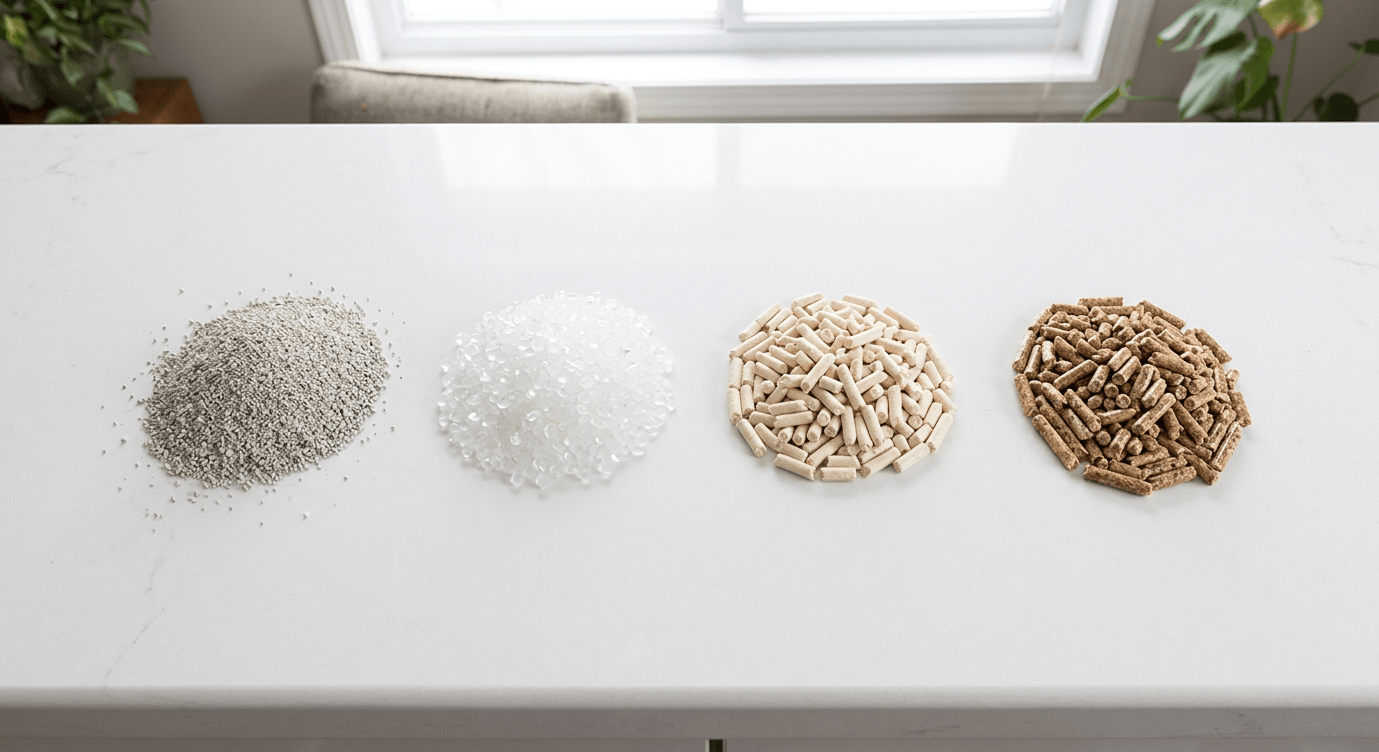
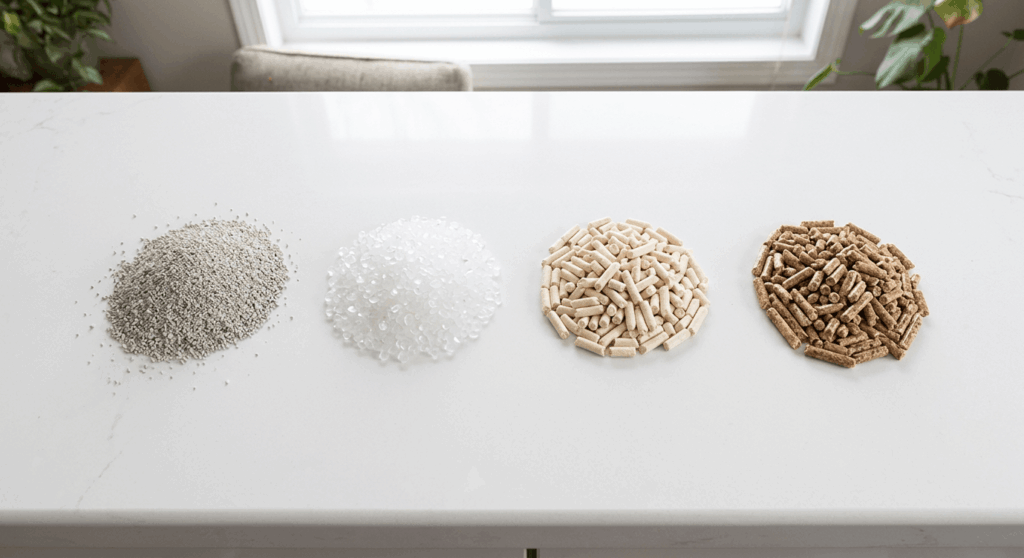
When searching for the best cat litter odor control apartment solution, the material matters far more than the brand. Unscented sodium bentonite clumping clay ranks first for sealing ammonia in tight clumps. Silica gel crystals rank second for moisture absorption capacity. Tofu and pea fiber litters rank third for low-dust, natural odor neutralization. Pine pellets rank fourth — effective but with limitations.
Why Apartment Odor Is Harder to Manage Than You Think
Before ranking materials, it helps to understand exactly why odor management is a fundamentally different challenge in an apartment compared to a house — because the solution that works in a large home with good ventilation may perform completely differently in a small, enclosed space.
The Physics of Small Spaces
In a house with multiple rooms, high ceilings, and natural airflow between spaces, litter box odor disperses and dilutes across a large volume of air. In a 500–800 square foot apartment, you are essentially sharing an enclosed air system with the litter box at all times. There is nowhere for the odor molecules to go.
The specific culprits:
- Ammonia (NH₃): Released as urine breaks down through bacterial action. Ammonia is volatile — it evaporates readily at room temperature and disperses through air extremely efficiently. It’s the sharp, eye-watering component of litter box odor
- Hydrogen sulfide and organic sulfur compounds: Released from fecal decomposition. These are the deeper, more complex odor components — lower threshold detection for humans, meaning we smell them at extremely low concentrations
- Volatile fatty acids: Released from bacterial breakdown of organic waste. These contribute the rancid, sour undertone that makes a neglected litter box smell distinctly different from a merely ammoniated one
In an apartment, all of these compounds accumulate in the same contained air volume you breathe. This is why odor control strategy — both material choice and cleaning frequency — matters so much more in a small space.
Ventilation Makes an Enormous Difference
Two apartments with identical litter setups will smell completely differently based on airflow:
- Cross-ventilation (windows on opposite sides of the apartment) dramatically accelerates odor dispersal
- Placing the litter box near a window or exhaust fan reduces ambient buildup meaningfully
- Enclosed litter boxes in cabinets or small closets concentrate odor in that space and release it in bursts when opened — often worse than an open box in a ventilated area
No litter material can fully compensate for zero ventilation. But the right material can significantly reduce the volume of volatile compounds released into the air between scoops — which is where the material science becomes important.
The Science of Litter Odor Control: What You’re Actually Fighting
There are three mechanisms by which cat litter controls odor, and different materials use different combinations of them:
1. Physical Encapsulation
The litter clumps around liquid waste, physically sealing the urine inside a solid mass and dramatically reducing the surface area available for ammonia evaporation. This is the primary mechanism of clumping clay and is why clumping materials consistently outperform non-clumping ones for ammonia control.
2. Moisture Absorption
By absorbing liquid before it can pool and sit, the litter reduces the duration of wet-litter contact with air — which is when bacterial breakdown and ammonia production accelerate. Silica gel crystals excel at this mechanism, absorbing moisture into their porous structure and locking it away from the air.
3. Chemical Neutralization
Some materials contain compounds that react with or adsorb odor molecules directly — not just covering the smell but chemically altering or binding the molecules responsible. Baking soda works this way (mild base neutralizing ammonia), as do the natural tannins in pine and the plant proteins in tofu-based litters.
The best odor control comes from materials that use multiple mechanisms simultaneously. Clumping clay with a natural baking soda addition, for instance, combines physical encapsulation with chemical neutralization — two mechanisms working together.
The ‘Scented Litter’ Trap
I want to address this directly and firmly before ranking the materials, because it’s the most common mistake apartment cat owners make when trying to solve a litter box odor problem.
Scented litter does not control odor. It competes with it.
Here is what actually happens when you use a heavily scented litter in a small apartment:
- The artificial fragrance — typically a synthetic lavender, “ocean breeze,” or “baby powder” compound — releases into the air continuously
- As waste accumulates, the ammonia and sulfur compounds release alongside the fragrance
- You now have both sets of volatile compounds in your enclosed air
- The result is not “fresh scent.” The result is ammonia plus artificial lavender — a combination that is arguably more unpleasant than the ammonia alone, and that most people recognize immediately as “cat litter smell”
There is a reason visitors can identify a cat home by scent even when the owner has become desensitized — and heavily scented litter is frequently the reason.
Additionally:
- Cats have noses 14 times more sensitive than humans. Many cats find heavily scented litters aversive and will avoid the box or eliminate outside it — which creates a far worse odor problem than the one you were trying to solve
- Synthetic fragrances in cat litter have been associated with upper respiratory irritation in cats, particularly in breeds prone to respiratory sensitivity
- The fragrance masks the odor cues you use to monitor your cat’s health through litter box observation — changes in urine smell are often early indicators of urinary tract issues or kidney disease
The solution to litter box odor in an apartment is not stronger fragrance. It is better material selection and more consistent cleaning. Speaking of which — the most advanced odor-controlling litter in the world will still produce noticeable smell if cleaning frequency is inadequate. I’ve covered the complete daily and deep-clean schedule — including exactly how often each type of litter needs attention — in [How Often Should You Clean a Litter Box? (The Real Answer)].
Ranking the Materials: Honest Pros, Cons, and Apartment Suitability
These rankings are based on three criteria weighted for apartment-specific use:
- Ammonia control (most important in small spaces)
- Dust and particulate matter (relevant in enclosed apartments without outdoor ventilation)
- Cat acceptance rate (a litter your cat avoids is worse than no litter at all)
#1: Sodium Bentonite Clumping Clay
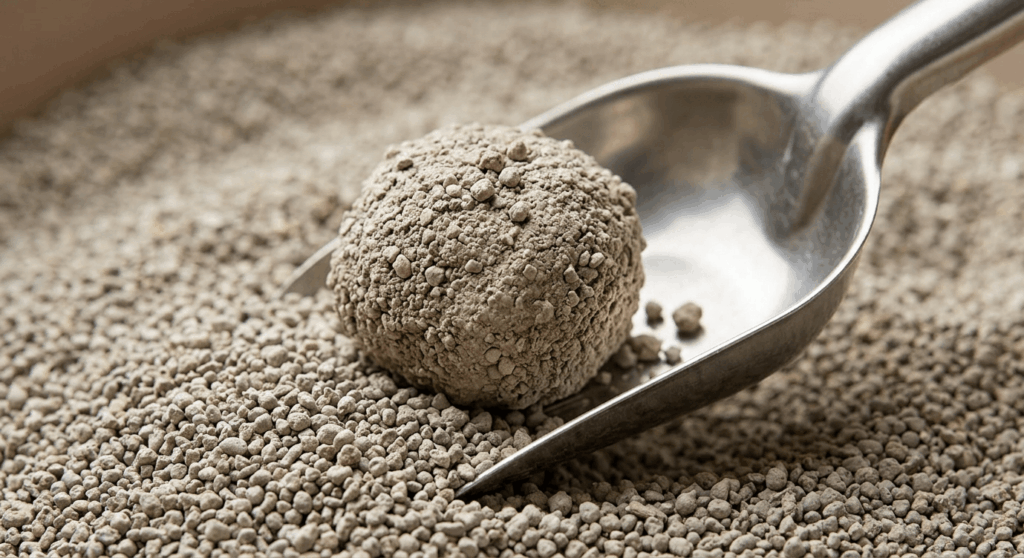
The science: Sodium bentonite is a naturally occurring swelling clay that absorbs 15–18 times its own weight in liquid. When urine contacts bentonite litter, the clay particles swell and bind together almost instantaneously, forming a firm, tight clump that physically seals the urine inside — dramatically limiting the surface area available for ammonia evaporation.
Why it ranks first for apartments: The encapsulation mechanism is simply the most effective single approach to ammonia control available in any litter material. A firm, complete clump removed during daily scooping takes the ammonia source with it rather than leaving it distributed through the litter bed.
The specific numbers:
- Moisture absorption: up to 18x its dry weight
- Clump integrity: holds firm for days without breaking down if scooped promptly
- Urine odor control duration between scoops: 12–24 hours with unscented formula
Pros:
- ✅ Best-in-class ammonia encapsulation
- ✅ Highest cat acceptance rate of any litter type — the texture closely matches natural soil and sand that cats instinctively prefer
- ✅ Easy to monitor waste output (clump count and size are clearly visible)
- ✅ Widely available and consistently the most affordable option per pound
- ✅ Unscented formulas are genuinely odorless when clean
Cons:
- ❌ Highest dust production of any litter type — particularly relevant in small apartments where particulates stay suspended in a contained air volume
- ❌ Heavy — a standard bag is 20–40 lbs, which is a consideration for apartment dwellers without elevator access
- ❌ Not biodegradable or flushable — goes to landfill
- ❌ Tracking — clay particles stick to paws and get carried across floors; a litter mat at the box entrance is essentially mandatory
Apartment suitability rating: 9/10
Best for: The majority of apartment cat owners, particularly those with one or two cats who scoop at least once daily. The dust issue is the main consideration — if your cat or anyone in your household has respiratory sensitivities, look at low-dust formulations specifically or consider silica gel crystals instead.
What to look for on the label: “Sodium bentonite” as the primary ingredient. “Unscented” or “fragrance-free.” “Low dust” or “99% dust-free” if respiratory sensitivity is a concern. Avoid formulations with added deodorizers, baking soda listed as the primary ingredient, or plant-based additives that reduce clumping strength.
#2: Silica Gel Crystals
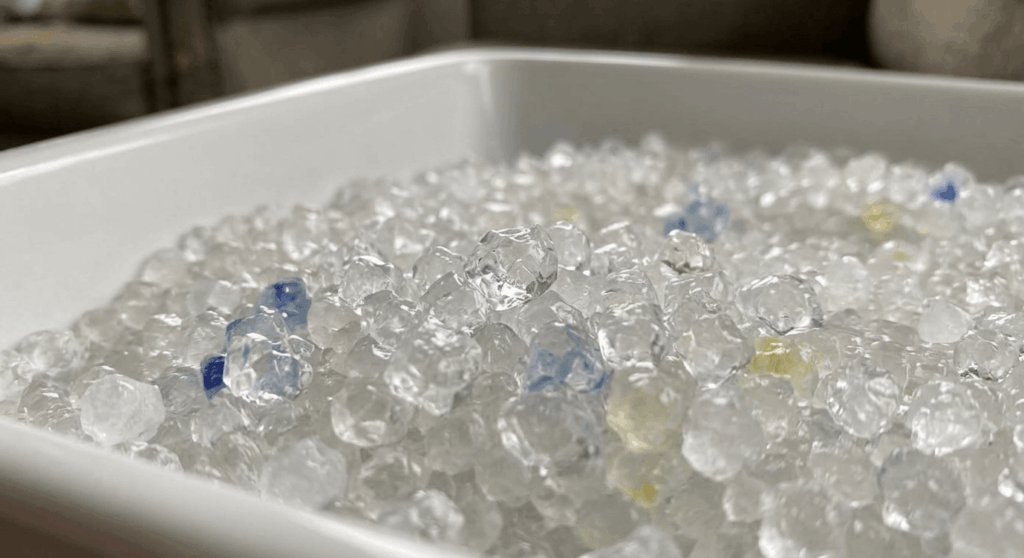
The science: Silica gel is silicon dioxide — essentially a porous, amorphous form of sand with an extraordinarily high internal surface area. A single teaspoon of silica gel crystals contains enough internal pore space to cover a tennis court if unfolded. This porous structure absorbs moisture rapidly and locks it inside the crystal matrix, preventing it from contacting air and decomposing into ammonia.
Why it ranks second: Silica gel doesn’t clump — it absorbs. This is both its greatest strength and its primary limitation. The moisture absorption capacity per unit weight is superior to clay, but the absence of clumping means urine is distributed through the litter bed rather than isolated in a removable mass.
The specific numbers:
- Moisture absorption: up to 40% of its own weight (higher than clay per gram)
- Effective odor control duration: 3–4 weeks for a single-cat household with daily stirring and solid waste removal
- Dust production: essentially zero — a significant advantage in enclosed spaces
Pros:
- ✅ Near-zero dust — the best option for cats or owners with respiratory sensitivities
- ✅ Exceptional moisture absorption locks ammonia inside crystal structure
- ✅ Lightweight — a fraction of the weight of equivalent clay
- ✅ Long interval between full litter changes (3–4 weeks vs. 2–3 weeks for clay)
- ✅ Minimal tracking — crystals are larger and don’t adhere to paw pads as readily
Cons:
- ❌ No clumping — urine is absorbed and distributed rather than isolated; this means you cannot remove urine during scooping, only solid waste
- ❌ Lower cat acceptance rate — the texture and feel of crystals underfoot is significantly different from natural soil; some cats refuse crystals entirely or require a slow transition
- ❌ Significantly more expensive per pound than clay (though the extended change interval partially offsets this)
- ❌ Must be stirred daily to distribute absorbed moisture and prevent saturation of individual crystals
- ❌ When fully saturated, odor can release suddenly rather than gradually — the “cliff edge” problem
Apartment suitability rating: 7.5/10
Best for: Single-cat apartments where the owner has respiratory sensitivities or genuinely cannot manage daily scooping. The low dust and light weight are real advantages. The cat acceptance variable is the significant wildcard — introduce slowly if transitioning from clay.
What to look for: “Silicon dioxide” or “amorphous silica gel” as the primary ingredient. Crystal size — larger crystals track less. Avoid formulations with added dyes (color-changing crystals that indicate saturation are useful; decorative coloring is not).
#3: Tofu / Pea Fiber Litter
The science: Tofu litter is made from compressed soybean pulp — the byproduct of tofu manufacturing. Pea fiber litter uses a similar compression process with pea plant fiber. Both materials form soft, dissolvable clumps through a combination of fiber absorption and physical binding. The plant proteins in these materials have mild natural deodorizing properties — they adsorb some odor compounds directly rather than simply containing them.
Why it ranks third: Genuinely impressive for a natural material, and improving rapidly as manufacturing processes mature. The odor control is real, the dust is minimal, and the environmental profile is excellent. It doesn’t quite match bentonite clay for raw ammonia encapsulation strength, but it closes the gap more than most people expect.
Pros:
- ✅ Excellent environmental profile — biodegradable, flushable in most plumbing systems, made from food-production byproducts
- ✅ Very low dust — comparable to silica gel
- ✅ Natural plant proteins provide genuine odor adsorption, not just physical containment
- ✅ Lightweight — easier for apartment dwellers to transport
- ✅ Soft texture — high acceptance rate among cats transitioning from clay
- ✅ Flushable convenience for apartment dwellers without outdoor trash access
Cons:
- ❌ Clump strength is lower than bentonite clay — clumps can break apart during scooping if not removed promptly, recontaminating the clean litter
- ❌ More expensive than clay, though less expensive than silica gel per effective use
- ❌ Shorter effective odor control window than clay if scooping is delayed — plant fiber doesn’t encapsulate ammonia as tightly as bentonite
- ❌ Some cats are initially skeptical of the texture and smell — the slight natural scent of compressed pea or soy fiber is unfamiliar
Apartment suitability rating: 7/10
Best for: Environmentally conscious apartment owners with one cat who scoop consistently and want a flushable, low-dust option. Also excellent for households where tracking is a particular problem — tofu litter tracks minimally compared to clay.
Important note on flushing: Check your local municipal sewage guidelines before flushing any cat litter, including biodegradable varieties. Some municipal systems request that no cat waste be flushed due to Toxoplasma gondii contamination concerns — water treatment systems do not reliably eliminate this parasite.
#4: Pine Pellets
The science: Pine pellets are compressed sawdust cylinders made from kiln-dried pine wood. The kiln-drying process removes the natural pine oils that are toxic to cats, leaving behind compressed wood fiber that absorbs moisture and breaks down into sawdust when wet. Pine contains natural tannins and phenolic compounds that have genuine antimicrobial and odor-neutralizing properties.
Why it ranks fourth: Pine’s natural chemistry is genuinely effective against certain odor compounds — particularly fecal odor — but its performance against ammonia from urine is more limited. The breakdown-to-sawdust mechanism creates a management challenge that makes it less practical for small apartments.
Pros:
- ✅ Natural pine scent provides genuine odor-masking that is less synthetic and aversive than artificial fragrances
- ✅ Excellent fecal odor control — the antimicrobial properties of pine tannins work well against sulfur compounds
- ✅ Very low dust when pellets are intact
- ✅ Environmentally friendly — made from lumber industry byproduct wood waste, biodegradable, and compostable (without cat waste) in most systems
- ✅ Affordable — typically priced similarly to or slightly above standard clay
Cons:
- ❌ The breakdown mechanism is the core management challenge: pellets dissolve into sawdust when wet, and that sawdust accumulates at the bottom of the box beneath intact pellets — you need either a sifting litter box (two-tray system) or you’re manually separating sawdust from intact pellets, which is genuinely tedious
- ❌ Lower ammonia control than clay or silica — urine breaks pellets down rather than being encapsulated, and the resulting damp sawdust still releases ammonia into the air
- ❌ Lowest cat acceptance rate of any material — the texture underfoot is dramatically different from natural soil, and the pine scent, while mild to humans, can be aversive to some cats
- ❌ Tracks as sawdust once pellets break down — the sawdust phase is fine-grained and spreads easily
- ❌ Requires a sifting box system to manage practically, which is an additional equipment cost
Apartment suitability rating: 5/10
Best for: Cat owners with specific reasons to avoid clay (dust sensitivity, environmental concerns) who haven’t found tofu or silica gel to be viable options. Works best in a dedicated sifting litter box system. Requires a cat with an unusually flexible texture preference or a very slow, patient transition period.
What to look for: “Kiln-dried pine” specifically — this is the process that removes the phenols toxic to cats. Avoid pine litters that don’t specify kiln-drying, and avoid any cedar-based litters entirely (cedar oils are more persistently toxic to cats than untreated pine).
Full Material Comparison: At a Glance
全屏复制
| Material | Ammonia Control | Dust Level | Cat Acceptance | Apartment Score |
|---|---|---|---|---|
| Sodium Bentonite Clay | ⭐⭐⭐⭐⭐ | High | ⭐⭐⭐⭐⭐ | 9/10 |
| Silica Gel Crystals | ⭐⭐⭐⭐ | None | ⭐⭐⭐ | 7.5/10 |
| Tofu / Pea Fiber | ⭐⭐⭐ | Very Low | ⭐⭐⭐⭐ | 7/10 |
| Pine Pellets | ⭐⭐ | Low–Medium* | ⭐⭐ | 5/10 |
Low when pellets are intact; medium-high as sawdust accumulates
The Diet Connection: Why What Goes In Affects What Comes Out
One factor that doesn’t appear on most litter comparison guides — and genuinely should — is how your cat’s diet affects the demands placed on your litter’s odor control capacity.
A cat eating a high-moisture diet produces significantly more urine volume than a cat on dry kibble, because their hydration intake is higher and their kidneys process more fluid. This is actually excellent for urinary tract health — dilute urine is far healthier than concentrated urine — but it does mean the litter box receives more liquid per day, and the litter’s absorption and encapsulation capacity is tested more frequently.
If your cat is on a high-protein wet food diet as part of a weight management plan, expect urine clump volume to increase noticeably — which makes your litter’s absorption capacity even more important to get right. I’ve covered the full dietary picture, including what to expect from litter box output during a food transition, in [How to Help Indoor Cat Lose Weight Without the Constant Meowing].
Practical adjustment: If you’ve recently transitioned your cat to wet food and noticed the litter box requiring more frequent attention, this is normal and expected. Increase scooping frequency accordingly — twice daily instead of once — rather than switching litter materials.
Optimizing Your Setup Beyond the Litter Itself
The material is one variable in a system. These additional factors interact directly with your litter choice to determine the actual odor experience in your apartment:
Box Size and Depth
- Use a box at least 1.5x the length of your cat from nose to tail base — larger boxes mean waste is distributed across more litter surface, reducing local saturation
- Maintain 3–4 inches of litter depth — too shallow and clumps reach the bottom and stick; too deep wastes litter without improving performance
- For clumping clay specifically, adequate depth is essential for complete clump formation — thin litter produces incomplete clumps that break apart and recontaminate
Covered vs. Open Boxes
This is more nuanced than it seems:
- Covered boxes trap odor inside the enclosure — good for the ambient room air, but the concentrated odor inside the box can deter cats from entering and can create a burst-release effect every time the lid is opened or the cat exits
- Open boxes in well-ventilated locations often perform better overall — odor disperses continuously at low levels rather than concentrating and releasing in bursts
- Top-entry boxes offer a practical compromise for apartment settings — odor disperses upward away from the living space, and they dramatically reduce litter tracking
Litter Mats
For clay users specifically — a textured litter mat extending at least 18 inches from the box entrance captures the majority of tracking particles before they reach your floors and furniture. In a small apartment, this single addition makes an outsized difference in overall cleanliness.
Activated Carbon Inserts
Some litter box enclosures and covers include activated carbon filter pads. These are genuinely effective at adsorbing volatile organic compounds — the same principle used in air purifiers. If you’re using a covered box, replacing the carbon filter monthly extends its odor adsorption capacity meaningfully.
Frequently Asked Questions
Is baking soda safe to mix into cat litter for extra odor control?
Yes — baking soda (sodium bicarbonate) is safe for cats and can provide a mild boost to odor control when mixed into unscented clumping clay. It works as a mild base that neutralizes acidic ammonia compounds chemically, rather than just masking them. The practical limitation is quantity: you need a meaningful amount to have a measurable effect — roughly 1–2 tablespoons mixed through the full litter depth — and the effect diminishes as the baking soda becomes saturated with odor molecules over time. Replace it with each full litter change rather than adding continuously. Avoid baking soda products that include added fragrances or essential oils — these negate the benefit of using unscented litter in the first place.
What is the best cat litter odor control apartment dwellers can use if they have respiratory sensitivities?
For anyone in the household — human or feline — with asthma, allergies, or chronic respiratory conditions, silica gel crystals are the clear first choice. They produce essentially zero airborne dust, which is the primary respiratory irritant from clay litter. The tradeoff is lower cat acceptance rate and higher cost, but the respiratory benefit is meaningful and immediate. If your cat refuses crystals after a slow transition attempt, tofu or pea fiber litter is the next best option — similarly low dust with a softer texture that most cats accept more readily than crystals. Both represent significant improvements over standard clay for respiratory-sensitive households. In either case, ensure the litter box is in a ventilated location and avoid any covered box design that concentrates particulates inside an enclosed space.
How do I know when my litter has stopped controlling odor effectively and needs a full change?
There are four reliable indicators that your litter has reached the end of its effective life — regardless of material type:
- The smell test at distance: A well-maintained box should be essentially odorless from more than three feet away. If you can smell it from across the room immediately after scooping, the litter bed itself is saturated
- Color change: Pale-colored litter that has turned uniformly gray, yellow, or dark indicates deep saturation beyond what scooping can address
- Clump quality degradation (clay): If fresh urine is no longer forming firm, discrete clumps — instead creating wet, crumbling masses or pooling at the bottom — the clay’s swelling capacity is exhausted
- Fresh litter immediately absorbs odor: The most definitive test — if newly added fresh litter takes on a smell within hours of being added to the box, the existing litter bed is contaminating it
When any of these indicators appear, no amount of additional scooping will restore odor control. A full litter replacement and deep box cleaning is the only solution. For clay in a single-cat household with twice-daily scooping, this point typically arrives at the two-to-three week mark. For silica gel, three to four weeks. For tofu and pine, one to two weeks depending on use intensity.
References
- Ellis, S. L. H., & Wells, D. L. (2010). The influence of olfactory stimulation on the behaviour of cats housed in a rescue shelter. Applied Animal Behaviour Science, 123(1), 56–63. https://doi.org/10.1016/j.applanim.2009.12.011 — Referenced for feline olfactory sensitivity and litter substrate preference behavior.
- Neilson, J. C. (2004). Feline house soiling: Elimination and marking behaviors. Veterinary Clinics of North America: Small Animal Practice, 34(1), 279–301. https://doi.org/10.1016/j.cvsm.2003.09.001 — Referenced for litter substrate preference data and behavioral responses to litter box conditions in domestic cats.
Oliver is currently on unscented sodium bentonite clay, twice-daily scooping, and a litter mat that catches approximately 70% of what he tracks. The apartment smells like an apartment. This took me an embarrassingly long time to achieve, and I hope this article saves you the year of experimentation it cost me.
Have you found a litter material that genuinely works in your apartment setup? Share your experience in the comments — particularly if you’ve successfully transitioned a clay-committed cat to crystals or tofu litter. That specific knowledge is genuinely useful to people who are trying. 🐾