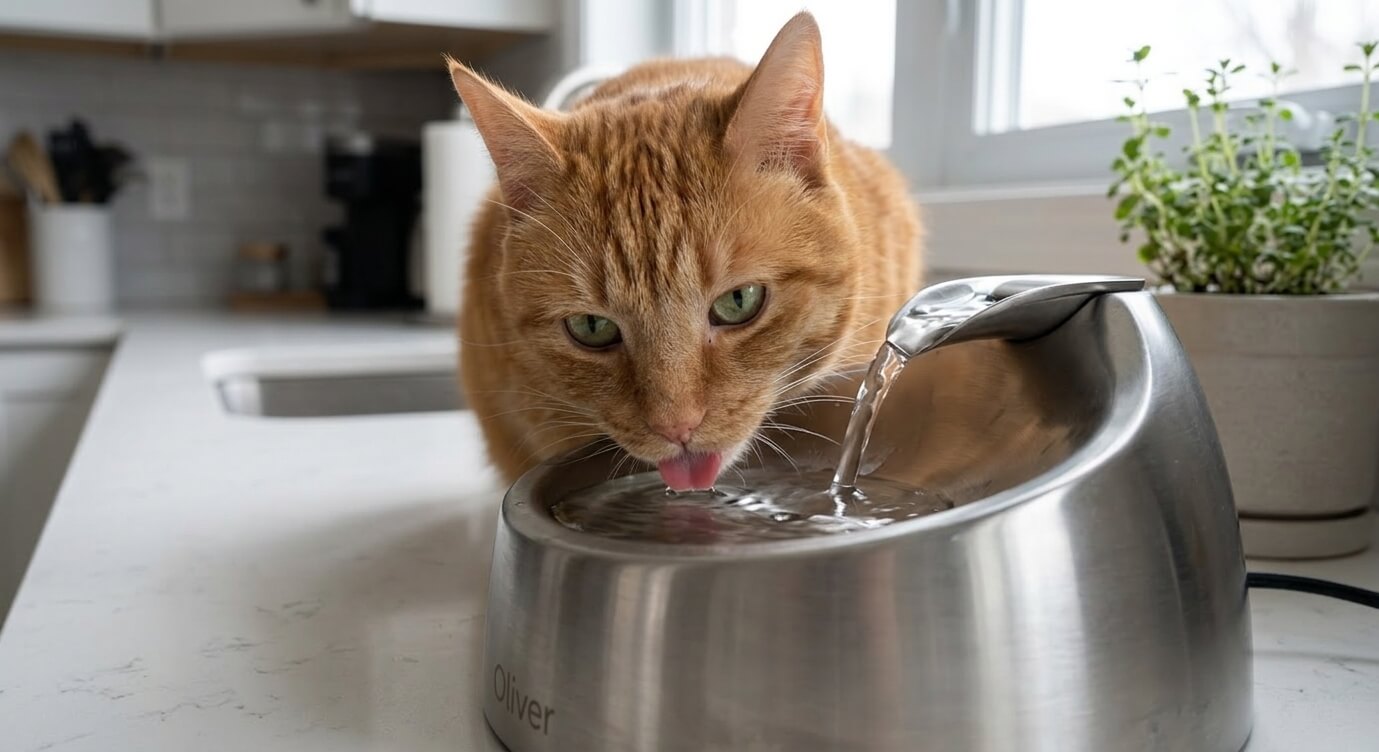
Best cat water fountains are not just about making water look more interesting. For indoor cats, the right fountain can support better hydration, reduce stale water problems, and make daily cleaning much easier. The material matters too: stainless steel and ceramic are usually safer long-term choices than plastic because they are smoother, easier to sanitize, and less likely to hold scratches where biofilm can build up.
Oliver made me take fountain materials seriously. For months, he had recurring black spots on his chin that kept coming back even after cleaning and food changes. The turning point was replacing his plastic fountain with a non-plastic one that was easier to wash thoroughly. His chin cleared, and I became much more careful about fountain materials, pump cleaning, and filter replacement.
This guide compares four cat water fountains based on material safety, cleaning difficulty, pump noise, filter design, capacity, apartment practicality, and whether stainless steel or ceramic is the better fit for your home.
Disclosure: This article may contain affiliate links. If you buy through these links, Indoor Cat Expert may earn a commission at no extra cost to you. We only recommend products based on material safety, ease of cleaning, hydration support, noise level, and practical indoor cat use.
Quick Answer: Stainless Steel or Ceramic?
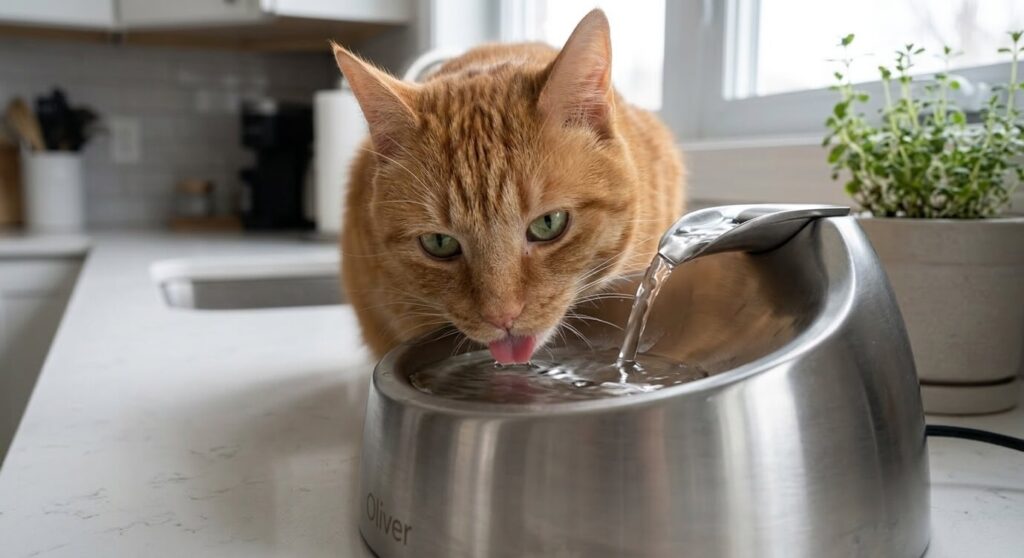
The best cat water fountains are usually made from stainless steel or ceramic rather than plastic. Stainless steel is the easiest to sanitize, more durable, and often dishwasher safe. Ceramic is heavier, quieter, and harder for cats to tip, but it can chip if dropped.
For most busy cat owners, stainless steel is the most practical choice. For noise-sensitive apartments or cats who push water bowls around, ceramic can be a better fit. Avoid plastic fountains when possible, especially for cats with chin acne, sensitive skin, or a history of dirty-water avoidance.
Cat Water Fountain Material Comparison
| Fountain Material | Best For | Key Benefit | Watch Out For |
|---|---|---|---|
| Stainless steel | Busy owners and easy cleaning | Durable, non-porous, often dishwasher safe | Can show water spots and may amplify pump noise |
| Ceramic | Quiet apartments and bowl-pushing cats | Heavy, stable, and naturally quiet | Can chip or crack if dropped |
| Plastic | Short-term budget use only | Lightweight and inexpensive | Scratches can hold biofilm and bacteria |
| Smart fountain | Multi-cat homes or monitoring | App reminders and water level alerts | Higher cost and more parts to maintain |
Why Plastic Cat Fountains Are Usually the Weakest Choice
I want to explain the microbiology here, because “plastic is bad” isn’t a sufficient explanation on its own—and understanding the mechanism will make you a much more informed buyer when evaluating the best cat water fountains stainless steel vs ceramic options available.
The Biofilm Problem
Biofilm is a structured community of bacteria enclosed in a self-produced polymer matrix. In plain terms: it’s a thin, often invisible layer of bacteria that adheres to surfaces and becomes increasingly difficult to remove over time.
All surfaces develop biofilm. The critical difference between materials is how easily that biofilm can be disrupted and removed through cleaning.
Plastic, even high-quality plastic, develops microscopic scratches through normal use—dishwashing, cat tongues making contact repeatedly, the pump mechanism creating internal abrasion. These micro-scratches create the ideal environment for biofilm:
- Increased surface area for bacterial adhesion
- Physical protection from mechanical cleaning (the scratch walls shield bacteria)
- Moisture retention within the scratch channels
- Reduced effectiveness of sanitizing agents that can’t penetrate into the scratch depth
In a water fountain context, this matters because your cat’s chin makes repeated daily contact with a surface that may be harboring Staphylococcus, Pasteurella, and various gram-negative bacteria in quantities that overwhelm the skin’s normal defenses.
The result in susceptible cats is chin folliculitis—clogged hair follicles, blackhead-like comedones, and in some cases, secondary bacterial infection requiring antibiotic treatment.
If you want the broader hydration science behind moving water, read our guide to cat water fountain benefits.
The BPA and Additive Concern
Beyond biofilm, plastic manufacturing involves chemical additives—including BPA (bisphenol-A) and related compounds—that can leach into water over time, particularly when plastic is:
- Exposed to repeated temperature changes (dishwashing)
- Degraded by UV light
- Scratched (which accelerates leaching from damaged areas)
While the clinical significance of BPA exposure in cats specifically is still being studied, the precautionary principle is clear: when BPA-free, non-porous alternatives exist and perform better on every other metric, the choice isn’t complicated.
My professional position: I do not recommend plastic cat water fountains regardless of marketing claims. “BPA-free plastic” is better than standard plastic, but it still develops biofilm-harboring scratches. It remains the inferior material choice when compared to either stainless steel or ceramic.
Stainless Steel Cat Water Fountains: Pros and Cons
When evaluating the best cat water fountains stainless steel vs ceramic, stainless steel earns its position as the most practical choice for most cat owners through a combination of genuine material advantages.
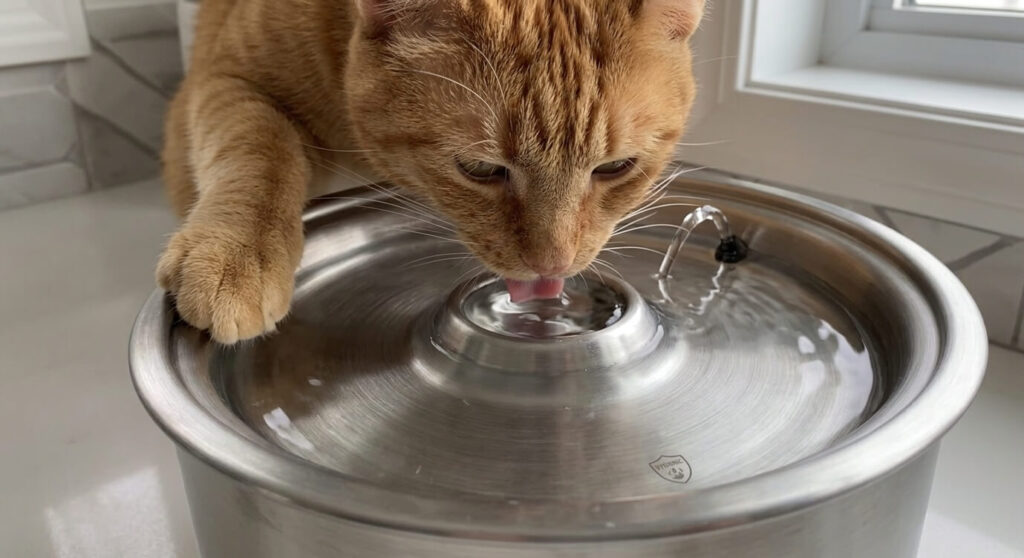
The Material Science of Food-Grade Stainless
Not all stainless steel is equal. For pet fountains, look for 304 stainless steel (also called 18/8 stainless), which contains:
- 18% chromium (creates the passive oxide layer that resists corrosion)
- 8% nickel (enhances corrosion resistance and surface stability)
This specific alloy is the same standard used in food preparation equipment, surgical instruments, and medical devices. It is non-porous at a microscopic level—meaning bacteria have no scratch channels to colonize, and the passive oxide layer resists chemical degradation.
Why this matters for biofilm: Biofilm still forms on stainless steel surfaces (it forms on nearly all surfaces in wet environments), but the adhesion is weaker, the structure is less protected, and standard dishwashing with hot water and appropriate detergent removes it effectively. You cannot achieve equivalent biofilm removal from scratched plastic regardless of cleaning method.
Maintenance for the Best Cat Water Fountains Stainless Steel vs Ceramic
Stainless steel fountain maintenance is genuinely straightforward:
- Dishwasher safe: Most stainless components are fully dishwasher safe—the most effective home sanitization method available
- Hot water tolerance: Can handle sanitizing temperatures that would warp plastic components
- Non-reactive: Doesn’t absorb odors or flavors from cleaning agents
- Visible cleanliness: You can actually see whether the surface is clean
Weekly maintenance I recommend:
- Disassemble completely (pump, filter housing, all components)
- Run all stainless components through dishwasher on heated dry cycle
- Clean pump impeller with small brush under running water
- Replace or rinse filter (depending on filter type and age)
- Reassemble and refill with fresh water
Stainless Steel Cons: Being Honest
Tipping risk: Stainless steel is lighter than ceramic. Some fountain designs have a relatively small base footprint, and a determined cat or a bumped surface can tip lighter stainless models. Look for stainless fountains with weighted bases or wide-footprint designs.
Pump noise amplification: In some fountain designs, the metal housing can act as a resonance chamber, amplifying pump motor noise. Quality matters significantly here—a good stainless fountain with a quality pump is quieter than a cheap one with the same pump.
Aesthetic limitations: Brushed stainless has a specific aesthetic that doesn’t suit all interiors. It’s clinical and functional, which is exactly what it should be—but if your apartment design skews warm or maximalist, ceramic may integrate more naturally.
Pros:
- Non-porous surface resists biofilm formation
- Fully dishwasher safe for effective weekly sanitization
- BPA-free by material nature (no plastic additives)
- Extremely durable—won’t chip or crack under normal use
- Lighter weight for repositioning
- Available in numerous designs and sizes
Cons:
- Lighter weight creates tipping risk in some designs
- Can amplify pump noise in lower-quality constructions
- Brushed finish shows water spots in hard water areas
- Less aesthetic variety than ceramic options
- Some cats are initially cautious about reflective surfaces
Ceramic Cat Water Fountains: Pros and Cons
Ceramic occupies a specific and legitimate niche in the best cat water fountains stainless steel vs ceramic comparison—one defined by mass, noise reduction, and interior design compatibility.
The Material Properties That Matter
High-quality glazed ceramic used in cat fountains shares key properties with food-grade ceramics:
- Non-porous glaze surface: Prevents bacterial penetration into the material itself
- Chemical inertness: Does not leach compounds into water
- High mass: A significant engineering advantage for fountain stability
- Glaze durability: Resists scratching under normal use
The mass advantage is real and clinically meaningful. A ceramic fountain weighing 3-4 lbs when empty, and 6-8 lbs when filled, is essentially impossible for most cats to tip during drinking. For cats who are enthusiastic drinkers or who paw at their water before drinking (a normal feline behavior), this stability is important.
The Noise Advantage
Water fountains generate noise from two sources: the pump motor and the water movement itself.
Ceramic’s density provides natural acoustic dampening that stainless steel doesn’t offer. In side-by-side comparison with equivalent pump systems, ceramic-housed fountains consistently produce lower ambient noise levels—a meaningful factor for studio apartment owners or light sleepers who keep the fountain in the bedroom.
The Chipping Problem: A Real Limitation
I won’t minimize this. Chipping is a genuine concern with ceramic cat fountains, and it’s more consequential than it first appears.
A chipped ceramic edge creates:
- A sharp surface that can injure a cat’s sensitive tongue and gums
- A potentially porous breach in the glaze where bacteria can access the underlying ceramic
- A compromised structural point that may propagate cracking
My recommendation: Inspect ceramic fountains monthly for chips, particularly around the rim and base edges. Any chip that creates a sharp edge or exposes the raw ceramic beneath the glaze is a replacement trigger—not a “we’ll manage” situation.
Increasing water intake is one of the most important things you can do for your cat’s urinary health, and a fountain your cat actually uses comfortably—without sharp edges—is the foundation of that effort. If your cat has urinary issues or drinks very little, also read our guide to indoor cat urinary health before changing your setup.
Pros:
- Heavy base prevents tipping—exceptional stability
- Natural acoustic dampening reduces pump noise
- Aesthetically versatile—available in beautiful designs
- Non-porous glaze surface resists biofilm
- BPA-free by material nature
- Feels natural and “cool” to cats who prefer non-reflective surfaces
Cons:
- Chips under impact—requires careful handling
- Chips can create sharp edges and glaze breaches
- Heavier weight makes repositioning less convenient
- Not all ceramic fountains are dishwasher safe (check manufacturer specifications)
- Generally more expensive than equivalent stainless options
- Fewer design options in the premium segment
Top 4 Cat Water Fountains for Indoor Cats
When evaluating these products, I applied the same criteria I’d use clinically: material safety, biofilm resistance, pump quality, noise level, and filter system effectiveness.
Best Overall Ceramic Fountain: Ceramicpet Cat Water Fountain
Price: $85 – $110
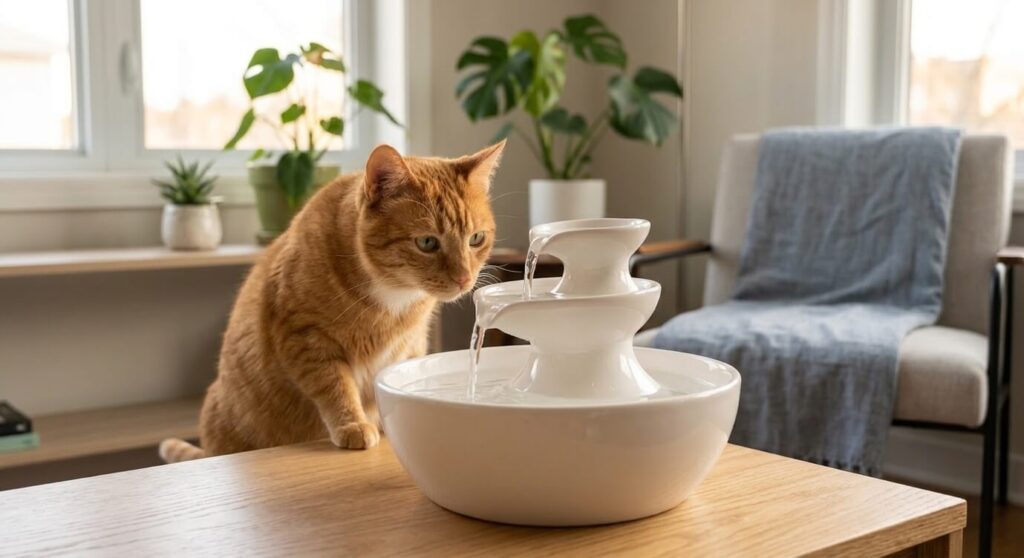
This is the fountain I switched to after Oliver’s plastic fountain disaster, and the one I recommend most frequently to clients asking about the best cat water fountains stainless steel vs ceramic options.
Technical specifications:
- Material: High-fire glazed ceramic
- Capacity: 68 oz (2 liters)
- Weight filled: Approximately 7.5 lbs (exceptional tip resistance)
- Pump noise level: Approximately 30-35 dB at maximum flow
- Filter system: Dual-stage (mechanical foam + activated carbon)
- Dishwasher safe: Ceramic components yes; pump no (standard)
The weight alone is worth discussing. At 7.5 lbs when filled, this fountain requires deliberate force to tip. Oliver has pawed at the edge, bumped it while drinking, and on one occasion attempted to stand in it (a different problem entirely). It has never moved meaningfully from its position.
The dual-stage filtration captures hair, debris, and sediment in the mechanical foam stage before the activated carbon stage addresses dissolved compounds and odor. This two-stage approach extends filter effectiveness and keeps the water genuinely clean between weekly cleanings.
Oliver’s chin acne has not returned since switching to this fountain fourteen months ago.
Pros:
- Heavy ceramic base—exceptional stability
- Beautiful design suits modern and traditional interiors
- Quiet pump suitable for bedroom placement
- Dual-stage filtration is effective and accessible
- Non-porous glaze is BPA-free and biofilm-resistant
- Reasonable price for ceramic quality
Cons:
- Pump requires hand-cleaning (not dishwasher safe)
- Ceramic chips if dropped
- 68 oz capacity requires more frequent refilling for multi-cat homes
- Flow adjustment is limited (one speed)
Best Stainless Steel Fountain: Pioneer Pet Raindrop
Price: $55 – $75
The Pioneer Pet Raindrop is the stainless steel fountain I recommend most confidently when clients want the easiest maintenance routine possible.
Technical specifications:
- Material: 304 food-grade stainless steel
- Capacity: 60 oz (1.8 liters)
- Weight filled: Approximately 4.5 lbs
- Pump noise level: Approximately 38-42 dB
- Filter system: Replaceable charcoal filter
- Dishwasher safe: All stainless components dishwasher safe
The fully dishwasher safe stainless components are the defining feature here. Every surface that contacts water or your cat’s face goes in the dishwasher on a weekly basis. The sanitization effectiveness of a heated dishwasher cycle—water temperature, detergent chemistry, mechanical action—is substantially higher than hand washing, and the BPA-free 304 stainless handles those temperatures without degradation.
The Raindrop design creates a free-falling stream that many cats find stimulating. Cats who avoid still water frequently accept this fountain more readily than bowl-style designs—which has real hydration implications for cats prone to urinary issues.
If you notice a sudden obsession with the fountain, it could be one of the earliest chronic kidney disease cats signs. Learn why early detection is critical for senior cats.
Pros:
- Fully dishwasher safe—the simplest maintenance routine available
- 304 stainless is genuinely BPA-free and non-porous
- Free-falling stream design appeals to cats who prefer moving water
- Wide, stable base reduces tipping risk for stainless
- Excellent long-term durability
- Very competitive price point
Cons:
- Pump noise slightly higher than premium ceramic models
- Water spots visible on brushed stainless in hard water areas
- Single-stage filtration (charcoal only)
- 60 oz capacity is adequate for one cat; borderline for two
Best Smart Fountain: Catit PIXI Smart Fountain
Price: $90 – $120
The Catit PIXI Smart occupies an interesting position in the best cat water fountains stainless steel vs ceramic conversation: its bowl components are stainless steel, but the fountain body incorporates a smart app system that provides genuine health monitoring value.
Technical specifications:
- Material: Stainless steel bowl + ABS plastic body (note: body plastic does not contact water directly)
- Capacity: 2 liters
- App features: Water consumption tracking, filter replacement reminders, pump health monitoring
- Pump noise level: Approximately 35-40 dB
- Filter system: Triple-stage
- Dishwasher safe: Stainless bowl components dishwasher safe
The plastic body concern is legitimate, and I want to address it directly: the plastic components on the Catit PIXI do not contact the water that your cat drinks. The water path runs entirely through stainless steel and filter media. The plastic body houses the pump and electronics but doesn’t have direct water contact in the drinking stream.
For multi-cat households, the app’s water consumption tracking across multiple cats provides the kind of individual intake monitoring that’s genuinely valuable for cats with urinary history.
Pros:
- Smart app tracks consumption per cat
- Stainless water-contact surfaces are dishwasher safe and BPA-free
- Triple-stage filtration is the most comprehensive on this list
- Filter replacement reminders prevent the most common maintenance failure
- Good capacity for multi-cat use
- Pump health alerts notify of impending failure before complete breakdown
Cons:
- Plastic body (though non-water-contact) may concern some buyers
- App requires consistent smartphone engagement
- Higher price point
- App connectivity requires Wi-Fi setup
For non-fountain strategies, see our guide on how to get an indoor cat to drink more water.
Best Budget Stainless Steel Fountain: Veken 95 oz Fountain
Price: $35 – $50
For owners who are transitioning away from plastic and need a budget-accessible entry into quality materials, the Veken 95 oz stainless offers genuine material safety without a premium price tag.
Technical specifications:
- Material: 304 stainless steel
- Capacity: 95 oz (2.8 liters)—largest capacity on this list
- Pump noise level: Approximately 40-45 dB
- Filter system: Triple-layer (cotton mesh, activated carbon, ion exchange resin)
- Dishwasher safe: Stainless components dishwasher safe
The 95 oz capacity is the standout feature for the price. For multi-cat households or owners who travel occasionally and need to extend time between refills, this capacity is genuinely useful.
The triple-layer filter system is surprisingly comprehensive for the price point—ion exchange resin is typically found in more expensive fountain filter systems and helps address hard water mineral content.
Pros:
- Largest capacity on this list at 95 oz
- 304 stainless is BPA-free and non-porous
- Triple-layer filtration including ion exchange resin
- Accessible price point for quality material
- Dishwasher safe stainless components
- Good pump reliability record
Cons:
- Higher noise level than premium models (40-45 dB)
- Build quality is functional but not refined
- Pump may require replacement within 12-18 months
- Less aesthetic refinement than premium options
- Customer support infrastructure is limited
How Often Should You Change a Cat Fountain Filter?
Manufacturer recommendations for filter replacement are almost universally optimistic. Here’s my clinical perspective.
The Standard Recommendation vs. Reality
Most fountain manufacturers recommend filter replacement every 2-4 weeks. This is reasonable under ideal conditions that rarely exist:
- One cat using the fountain
- Cat with no health issues
- Soft municipal water
- Weekly thorough cleaning maintained consistently
In real-world conditions, filters need more frequent attention.
My Filter Replacement Framework
| Factor | Adjustment |
|---|---|
| Each additional cat | Replace 1 week sooner per additional cat |
| Hard water | Replace 1 week sooner (minerals saturate carbon faster) |
| Cat with urinary history | Replace on the shorter end of manufacturer range |
| Missed cleaning week | Replace filter when resuming cleaning schedule |
| Visible debris or discoloration | Replace immediately, regardless of age |
My personal schedule with Oliver: I replace the filter every 2 weeks. I clean the fountain completely every week. I consider this the minimum standard for a single healthy adult cat.
The Filter Rinse Question
Some owners rinse and reuse filters to extend their life. My position:
- Mechanical foam filters: Rinsing is appropriate and extends life
- Activated carbon filters: Rinsing does not restore adsorption capacity; carbon that is saturated remains saturated regardless of water rinsing
When the carbon is done, it’s done. Rinsing a spent carbon filter gives you false confidence that filtration is occurring when it isn’t.
Filter Failure Symptoms
- Water smells despite recent filter change (suggests bacterial growth—clean and replace)
- Visible algae (green tint on components)—full disassembly, sanitization, and filter replacement
- Cat reducing water intake from a previously accepted fountain—may indicate taste or odor change from filter failure
- Pump moving visibly slower (debris clogging impeller, often associated with filter breakthrough)
FAQ
Is stainless steel or ceramic better for cats with the best cat water fountains stainless steel vs ceramic comparison?
Both are significantly better than plastic, and the choice between them depends on your priorities. If ease of maintenance is paramount, stainless steel wins—fully dishwasher safe components and exceptional durability make it the lowest-maintenance option. If noise level and stability are your priorities, ceramic wins—its mass prevents tipping and its density dampens pump noise.
For cats with confirmed feline acne or chin folliculitis, either material will likely improve symptoms compared to plastic; ceramic was the solution for Oliver specifically, but quality stainless is equally non-porous.
Why did my cat get black spots on their chin?
Those black spots are feline chin folliculitis—a condition where hair follicles on the chin become clogged with sebum, debris, and bacteria, creating comedones (blackheads). In cats, the most common contributing factor is repeated chin contact with a porous plastic surface harboring biofilm bacteria.
Other contributing factors include stress, hormonal influences, and immune system differences. The first intervention should always be material change: switch to stainless steel or ceramic for both food and water vessels. If symptoms persist after 4-6 weeks with non-plastic materials, a veterinary evaluation for secondary bacterial infection or underlying hormonal causes is warranted.
Increasing water flow isn’t just a preference; it’s the #1 defense for indoor cat urinary health. For a full prevention plan, read our guide to indoor cat urinary health and FLUTD prevention.
How do I prevent biofilm in my cat’s fountain?
Biofilm prevention requires consistent physical disruption through regular cleaning—biofilm cannot be eliminated through filtration or water additives alone. My recommended protocol: complete disassembly and dishwasher cleaning of all components weekly, with particular attention to the pump impeller and housing using a small cleaning brush.
Use hot water and standard dishwasher detergent for stainless components. For ceramic components that aren’t dishwasher safe, a diluted white vinegar soak (1:10 vinegar:water for 10-15 minutes) followed by thorough rinsing is effective. Replace filters on schedule, and never allow the fountain to run dry or sit empty with residual moisture—stagnant moist conditions accelerate biofilm formation significantly.
Are plastic cat water fountains bad for cats?
Plastic cat water fountains are not automatically dangerous, but they are usually the weakest long-term choice. Plastic can develop small scratches that are difficult to clean fully, and those scratches may hold biofilm, food residue, and bacteria. If your cat has chin acne, sensitive skin, or recurring dirty-water issues, switching to stainless steel or ceramic is usually a better option.
How often should I clean a cat water fountain?
Most cat water fountains should be cleaned at least once per week. The pump should be taken apart and brushed during cleaning because hair, minerals, and biofilm often collect around the impeller. Filters should usually be replaced every two to four weeks, depending on the number of cats, water hardness, and manufacturer instructions.
Final Thoughts
The best cat water fountain is the one your cat will actually use and the one you can keep clean every week. Stainless steel is usually the easiest material for daily life because it is durable, non-porous, and often dishwasher safe. Ceramic is a strong choice for cats who tip bowls, noise-sensitive apartments, or owners who want a heavier and quieter fountain.
I would avoid plastic for long-term use, especially if your cat has chin acne, sensitive skin, or a history of refusing stale water. Material, cleaning routine, and pump maintenance matter more than fancy design.
For most indoor cats, a simple stainless steel or ceramic fountain with weekly cleaning is enough to make water fresher, more appealing, and easier to manage.
References
Grant, D. C. (2010). Effect of water source on intake and urine concentration in healthy cats. Journal of Feline Medicine and Surgery, 12(6), 431-434.
Vestby, L. K., Grønseth, T., Simm, R., & Nesse, L. L. (2020). Bacterial biofilm and its role in the pathogenesis of disease. Antibiotics, 9(2), 59.
Cornell Feline Health Center. Feline Lower Urinary Tract Disease.