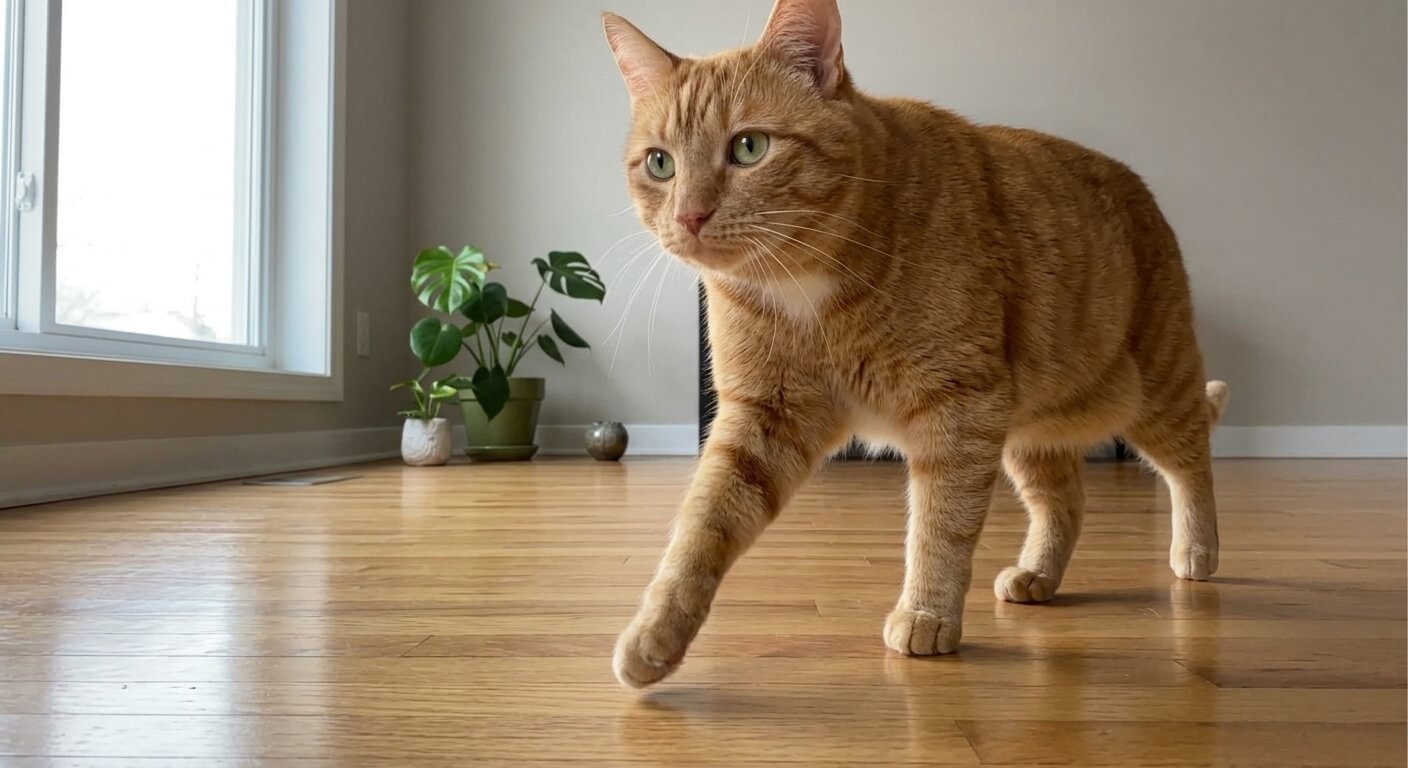
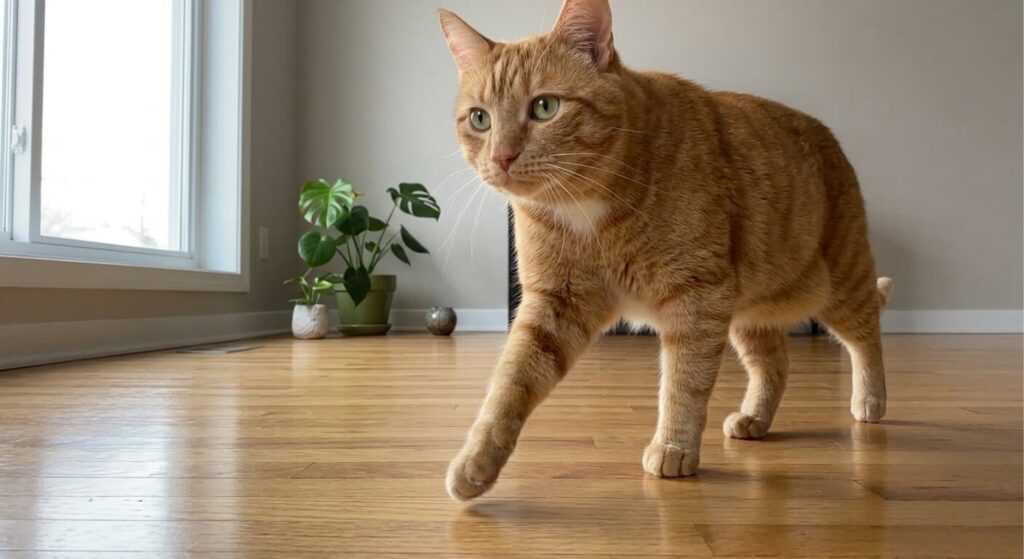
The morning after I mopped my studio with a popular pine-scented cleaner, I noticed Oliver walking differently.
Not dramatically—not a limp, not a cry. Just a subtle reluctance to step normally that I might have missed if I weren’t someone who observes animal locomotion professionally. When I picked him up and examined his paws, his pads were mildly red and slightly warm to the touch. By midday, he was licking his front legs with the focused, repetitive quality that I recognize clinically as a response to localized irritation.
As a veterinary technician, the connection was immediately clear to me. Pine-oil cleaners contain phenols—specifically phenolic compounds that are genuinely toxic to cats. The route of exposure wasn’t ingestion from the bottle. It was the floor itself: Oliver had walked across the still-damp surface, the phenolic residue had absorbed through his paw pads and collected between his toes, and then he’d groomed it directly into his system.
The paw-to-mouth pipeline is the mechanism that most apartment cat owners don’t think about. We childproof cabinets and put away medicines, but we mop the floor—the surface our cat contacts with bare skin dozens of times per day—with products we’d never let them drink directly.
Finding a genuinely cat safe floor cleaner became non-negotiable after Oliver’s paw incident. This guide reflects two years of clinical research and product testing that I wish I’d done before I ever bought that pine cleaner.
Quick Answer: What Is the Best Cat Safe Floor Cleaner?
The best cat safe floor cleaner is free from phenols, bleach, ammonia, and phthalates. Look for plant-based, pH-neutral formulas or enzymatic cleaners that break down organic matter without leaving toxic residues on surfaces. For apartments with hard floors, a quality steam mop using only water is the most definitively chemical-free option available for cat households.
The Paw-to-Tongue Pipeline: Why Floor Safety Is Critical
The route from floor cleaner to cat toxicity follows a path that most people don’t visualize clearly. Walking through it step by step explains why the standard “safe when dry” guidance that appears on many cleaning product labels is genuinely insufficient for cat households.
The Exposure Pathway
Step 1: Mopping
Cleaner is applied to floor. Even with thorough rinsing or drying, chemical residues remain on the floor surface. Volatile compounds begin off-gassing into the air.
Step 2: Cat Walking
A cat’s paw pads are not the thick, impermeable structures many people imagine. They contain:
- Highly vascularized tissue (abundant blood flow close to the surface)
- Eccrine sweat glands (the only location where cats sweat)
- A thin epithelial layer that is more permeable than many body surfaces
When a cat walks across a floor with chemical residue, that residue adheres to the moist paw pad surface and collects in the interdigital spaces between the toes.
Step 3: Grooming
Cats groom their paws repeatedly throughout the day. The accumulated residue from floor contact transfers directly to the tongue, oral mucosa, and gastrointestinal tract.
Step 4: Systemic Exposure
Compounds absorbed through the oral mucosa or GI tract enter circulation. Compounds still on the paw pads continue absorbing transcutaneously with each grooming cycle.
Why Cats Are Specifically Vulnerable
Beyond the paw-to-mouth pathway, cats have several biological factors that amplify their sensitivity to chemical exposure:
Hepatic glucuronidation deficiency: Cats lack the UDP-glucuronosyltransferase enzyme pathway that most mammals use to metabolize phenolic compounds, certain essential oil components, and other aromatic compounds. Compounds that dogs and humans can detoxify and eliminate efficiently simply accumulate in cats until toxic concentrations are reached.
High grooming frequency: The average cat spends 30-50% of their waking hours grooming—far more than most mammals. This grooming behavior, which is healthy and normal in a clean environment, becomes a toxicity delivery mechanism in a chemically contaminated environment.
Small body mass: Toxic dose thresholds are weight-dependent. The same residue concentration on a floor is proportionally more significant for a 10-lb cat than for a 150-lb adult human.
The “Toxic Trio” to Avoid (Phenols, Ammonia, and Phthalates)
These are the three ingredient categories that I screen for before any cleaning product enters my apartment. Understanding what each does and where it appears helps you read labels critically rather than relying on “natural” or “safe” marketing claims.
Phenols and Phenolic Compounds
What they are: Aromatic compounds derived from benzene, including phenol itself and derivatives like cresols, xylenols, and thymol.
Where they appear: Pine-oil cleaners (Pine-Sol), Lysol (original formulation), many “disinfecting” products, some herbal cleaners that use thyme or oregano oil as active agents.
The toxicity mechanism: Phenols are directly toxic to cats through multiple pathways—hepatic accumulation (glucuronidation deficiency), direct GI irritation, and dermal absorption causing Paw Pad Dermatitis and systemic effects.
Signs of phenol exposure: Drooling, vomiting, ataxia, weakness, reddened paw pads, behavioral changes, liver enzyme elevation on bloodwork.
My rule: Any cleaner containing phenol, pine oil, thymol (from thyme), or carvacrol (from oregano) does not enter my apartment.
Ammonia
What it is: A nitrogen-hydrogen compound used for its grease-cutting and disinfecting properties.
Where it appears: Glass cleaners, multi-surface cleaners, some floor cleaners marketed as “powerful” degreasers.
The toxicity concern for cats: Two distinct mechanisms.
First, ammonia is a direct respiratory irritant that causes mucosal inflammation—in cats with existing respiratory compromise (asthma, herpesvirus), even low-level ammonia exposure can trigger acute respiratory episodes.
Second, and subtly important: ammonia smells like urine to cats. Cleaning a spot where a cat has inappropriately eliminated with an ammonia-based product actually reinforces the cat’s assessment of that location as an appropriate elimination site. This is precisely the opposite of what’s intended.
Phthalates
What they are: Chemical plasticizers used in fragrance formulas to extend scent longevity.
Where they appear: “Fragrance” listed as an ingredient on virtually any scented cleaning product. Phthalates are not required to be individually disclosed under fragrance trade protection laws.
The toxicity concern: Phthalates are endocrine disruptors—they interfere with hormonal signaling. In cats, who have limited detoxification capacity for many compounds, chronic low-level phthalate exposure from fragranced cleaning product residues on floors has been associated with thyroid disruption and reproductive health effects.
My rule: Any product listing “fragrance” as an ingredient without specifying phthalate-free formulation gets evaluated with skepticism. I prefer fragrance-free formulations for floor cleaning specifically.
The “Natural” Trap
I want to specifically flag a misconception: natural ingredients are not automatically cat safe floor cleaner ingredients.
Tea tree oil: Natural, antimicrobial, genuinely toxic to cats even at low concentrations.
Eucalyptus oil: Natural, commonly used in cleaning products, a documented feline toxin.
Citrus oils: Natural, often used for fragrance and cleaning, cause GI and neurological effects in cats at sufficient doses.
Pine oil: Natural, entirely derived from trees, the compound that caused Oliver’s paw incident.
The word “natural” on a cleaning product label tells you nothing about its safety for cats. Read the ingredient list. Research unfamiliar compounds before they contact your floor.
Top 5 Recommendations: Best Cat Safe Floor Cleaner (2025)
🥇 The Best Plant-Based All-Rounder: Branch Basics Concentrate
Price: $49 (concentrate; dilutes to multiple products)
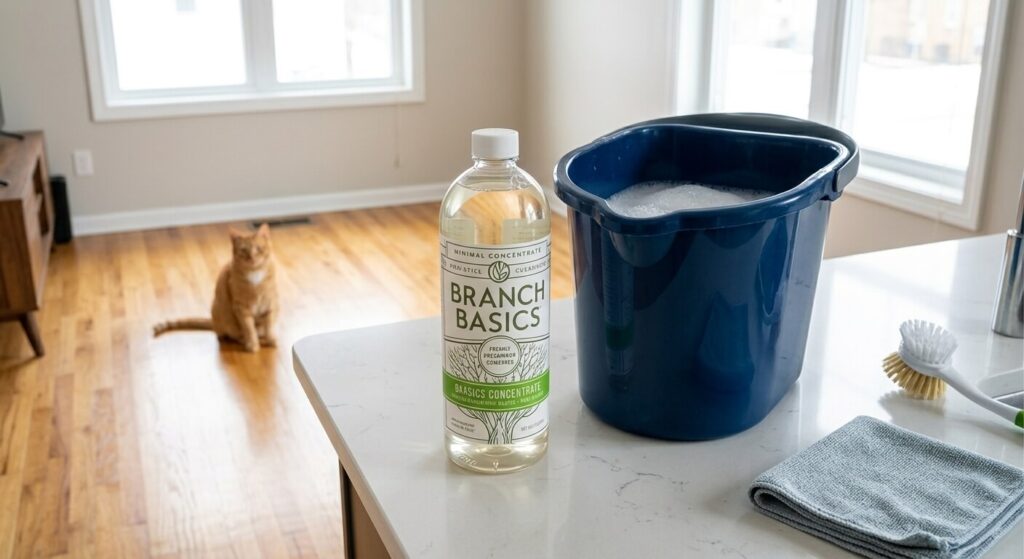
Branch Basics has earned the top position in my cat safe floor cleaner recommendations through a combination of ingredient transparency that is genuinely exceptional in the cleaning product industry and formulation that has been specifically reviewed by toxicologists.
Technical specifications:
- Active cleaning agents: Coco-glucoside (coconut-derived), sodium citrate, sodium bicarbonate, lauryl glucoside
- Phenol-free: Yes
- Ammonia-free: Yes
- Phthalate-free: Yes (fragrance-free formulation)
- Bleach-free: Yes
- pH: Approximately 8.5 (mildly alkaline; safe for most sealed floor types)
- Floor dilution: 1 capful per 32 oz water (highly economical)
- Certifications: Made Safe certified (third-party toxicological screening)
What “Made Safe” certification means:
The Made Safe program screens every ingredient in a product against databases of known and suspected toxic compounds, endocrine disruptors, reproductive toxins, and environmental persistence concerns. Products that pass this screening are verified ingredient-safe, not just “safe at recommended use levels”—a distinction that matters for the chronic low-level exposure that floor contact represents.
The concentration economics:
One $49 bottle dilutes to approximately 64 32-oz bottles of floor cleaner at the recommended dilution rate. The per-cleaning cost is approximately $0.75—competitive with standard grocery store floor cleaners while delivering dramatically superior cat safe floor cleaner safety credentials.
Choosing the right floor solution is the foundation of a truly cat-safe cleaning routine that extends beyond just floor safety to the whole apartment environment. [How to Stop Cat Litter Tracking All Over Your Apartment]
Pros:
- Made Safe certification provides third-party toxicological verification
- Completely fragrance-free (no phthalate risk)
- Highly concentrated (excellent value per use)
- Works on hardwood, tile, laminate, and vinyl
- Leaves no residue when properly diluted
- Full ingredient transparency (no “fragrance” catch-all)
Cons:
- Higher upfront cost than single-use bottles
- Requires dilution calculation (slightly more preparation than ready-to-use)
- Mildly alkaline pH not appropriate for unsealed stone floors (use pH-neutral option instead)
- No disinfecting claims (doesn’t kill bacteria or viruses)
Best for: Primary floor cleaner for all cat households; owners who prioritize ingredient verification; hardwood, tile, and laminate floors
🧪 The Professional Enzymatic Pick: Puracy Natural Multi-Surface Cleaner
Price: $14 – $18 (25 oz ready-to-use)
For floor cleaning that combines everyday maintenance with enzymatic breakdown of organic matter (urine residue, food debris, pet dander), Puracy Natural Multi-Surface Cleaner earns its position as my enzymatic recommendation for cat safe floor cleaner use.
Technical specifications:
- Cleaning mechanism: Plant-based surfactants + enzyme complex
- Enzyme types: Protease, amylase (breaks down protein and starch-based soils)
- Phenol-free: Yes
- Ammonia-free: Yes
- Phthalate-free: Yes (plant-derived fragrance from green tea/vanilla only)
- pH: 7.0-7.5 (neutral; safe for all sealed floor types)
- USDA Biobased: Yes (certified plant-derived)
Why enzymatic matters for cat households:
Standard surfactant-based cleaners remove visible soiling but don’t break down the invisible organic residues—particularly uric acid from urine that a cat’s olfactory system detects long after human perception of the smell is gone. Enzymatic floor cleaners break down these residues at the molecular level, eliminating the scent markers that can lead to repeat inappropriate elimination.
The pH neutrality is clinically significant for apartments with mixed floor types—hardwood, tile grout, laminate, and vinyl can all be cleaned with a pH-neutral formula without risk of surface damage or finish degradation.
Pros:
- Enzymatic action addresses organic residues beyond visible dirt
- pH neutral (safe for all sealed floor types)
- Plant-derived fragrance only (no synthetic phthalate-containing fragrances)
- USDA Biobased certification
- Ready-to-use (no dilution required)
- Works for walls, surfaces, and floors (multi-purpose)
Cons:
- Plant-derived fragrance (green tea) may be mildly irritating to extremely sensitive cats—ventilate during use
- Ready-to-use format costs more per use than concentrates
- Enzyme activity requires brief dwell time for best results on set-in stains
- Not a disinfectant
Best for: Apartments with occasional urine spot cleaning needs; owners who want enzymatic action for comprehensive organic matter breakdown; mixed floor type apartments
🤖 The Best for Robot Mops: Bissell CrossWave Multi-Surface Pet Floor Cleaner Formula
Price: $15 – $20 (32 oz)
Robot mop use in cat households has increased significantly, and with it a specific concern: robot mops apply cleaning solution continuously across the floor surface, meaning any toxic residue from the cleaning formula accumulates in high concentrations on the floor your cat contacts throughout the day.
Technical specifications:
- Formulation: Specifically designed for CrossWave robot mop and wet vac systems
- Phenol-free: Yes
- Ammonia-free: Yes
- Phthalate-free: Yes (fragrance-free option available)
- pH: Neutral
- Residue profile: Engineered to dry without sticky residue (critical for continuous robot mop application)
- Floor compatibility: Hardwood (sealed), tile, vinyl, laminate
The robot mop-specific concern:
Standard floor cleaners applied by robot mop accumulate differently than manually mopped floors. The robot applies solution continuously as it moves—meaning the solution doesn’t have the same evaporation time as a manual mop pass. The result is a higher residue concentration on the floor surface than manual mopping with the same formula typically leaves.
A cat safe floor cleaner for robot mop use must have not just a safe ingredient profile but a low-residue formulation specifically—because your cat is walking through a floor that has received continuous chemical application rather than a single manually distributed pass.
Pros:
- Formulated specifically for robot mop residue characteristics
- Neutral pH
- Leaves minimal residue (critical for continuous robot mop application)
- Fragrance-free option available
- Safe for sealed hardwood (not all robot mop formulas are)
Cons:
- Designed for specific robot mop systems (compatibility varies)
- Fragrance version contains some synthetic components (choose fragrance-free)
- Not enzymatic (doesn’t address organic matter breakdown)
- Limited availability outside robot mop accessory channels
Best for: Robot mop households; owners who automate floor cleaning and want verified cat safe floor cleaner formulation for continuous application
♨️ The Chemical-Free Steam Option: Bissell PowerFresh Steam Mop (Water Only)
Price: $80 – $120 (mop; ongoing cost: zero for cleaning solution)
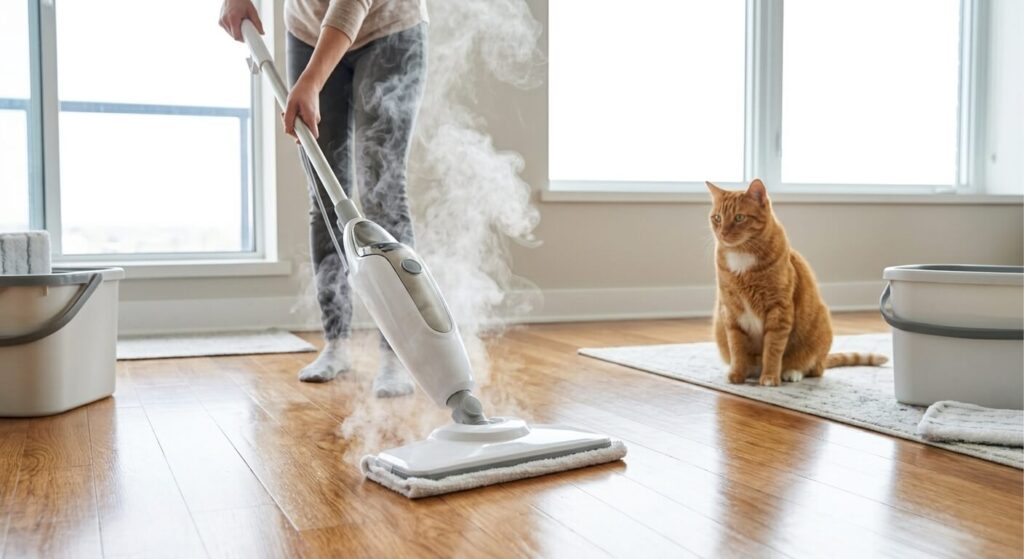
The most definitively cat safe floor cleaner approach is no cleaning chemicals at all—and for sealed hard floors, a quality steam mop achieves genuinely effective sanitization using only water.
Technical specifications:
- Cleaning mechanism: 212°F steam (kills bacteria, dust mites, and most pathogens without any chemical)
- Chemical-free: Completely (water only)
- Floor types: Sealed hardwood, tile, vinyl, laminate (not appropriate for unsealed wood, wax-finished floors, or some delicate materials)
- Cat safety: Complete—water vapor has no toxicological concern
- Tank capacity: Varies by model (Bissell PowerFresh: 13.5 oz)
- Heating time: Approximately 30 seconds
The steam sanitization mechanism:
At 212°F, steam effectively kills:
- Bacteria (including common pathogens)
- Dust mites and their eggs
- Mold and mildew
- Flea eggs and larvae (relevant for cat households)
No chemical residue remains because no chemical is applied. The floor surface is sanitized by heat and moisture only.
The critical caveat:
Steam mops are not appropriate for:
- Unsealed hardwood (moisture damage)
- Wax-finished floors (steam strips wax)
- Some laminate with inadequate moisture resistance
- Grout that is cracked or unsealed
Verify your floor manufacturer’s guidelines before steam mopping. Most modern sealed hardwood and tile installations are steam-mop compatible.
Pros:
- Zero chemicals (definitively cat safe floor cleaner for all chemical concerns)
- Kills bacteria, dust mites, and flea eggs without any toxicological risk
- No ongoing cleaning product cost
- Sanitizes to 212°F (higher than most chemical disinfectants achieve at room temperature)
- No residue of any kind
Cons:
- Not appropriate for all floor types (verify suitability before purchase)
- Initial equipment investment
- Doesn’t address organic matter residues the way enzymatic cleaners do
- Requires water refilling during large-area cleaning
- Steam moisture can warp poorly sealed hardwood over time if overused
Best for: Tile and well-sealed hardwood floors; owners who want complete chemical elimination; households with cats with confirmed chemical sensitivities or respiratory conditions
💰 The Budget DIY Safe Mix: Castile Soap + Water Solution
Price: $8 – $12 (Dr. Bronner’s Baby/Unscented Castile Soap, lasting months)
For budget-conscious owners who want a verified cat safe floor cleaner without ongoing product purchases, unscented castile soap diluted in water is a clinically appropriate option for routine floor maintenance.
The formula:
- 2-3 drops of unscented castile soap per gallon of warm water
- Apply with traditional mop, wring very thoroughly (minimal water on floor)
- No rinsing required at this dilution
Why unscented castile soap specifically:
Castile soap is saponified olive oil—historically the simplest soap formulation. Unscented versions (I specifically recommend Dr. Bronner’s Baby formula, which uses no essential oils) contain:
- Saponified olive oil
- Coconut oil
- Hemp seed oil
- Water
- Citric acid
- Vitamin E
None of these ingredients appear on any feline toxicology concern list. The soap itself is BPA-free in any relevant sense (there’s no plastic in the formula at all), and at the recommended floor-cleaning dilution of 2-3 drops per gallon, it leaves no meaningful residue.
The essential oil warning:
Scented castile soaps—including popular lavender, peppermint, and eucalyptus varieties—contain essential oils that are not cat safe floor cleaner appropriate. Use unscented or baby formula exclusively.
Standard industrial cleaners and even “natural” scented products are among the hidden triggers for the feline skin allergies and respiratory sensitivities I see regularly in clinical practice. [How to Get Cat Hair Off Furniture (Fast, Easy Methods That Work)]
Pros:
- Extremely low cost per use (cents per mopping session)
- Simple, verifiable ingredient list
- No phenols, ammonia, phthalates, or essential oils (unscented)
- Available everywhere
- Works on tile, vinyl, sealed laminate, and sealed hardwood
Cons:
- No enzymatic action (doesn’t address organic residues)
- No disinfecting properties
- Incorrect dilution (too much soap) leaves a sticky residue
- Not appropriate for stone floors (pH may affect unsealed stone)
Best for: Budget-conscious owners; regular maintenance cleaning between enzymatic deep cleans; tile and vinyl floors
Vet Tech Pro-Tips: How to Safely Mop with a Cat in the Room
The safest cat safe floor cleaner is still most effective when the application process is managed thoughtfully. Here’s my room-by-room protocol.
The Room Sequencing Strategy
Never mop a floor and immediately let the cat back on it. Establish a clear sequencing protocol:
- Secure the cat in a room you’re not cleaning (close the door)
- Mop the first zone, working toward the door
- Open windows for maximum ventilation (accelerates drying and volatile compound dissipation)
- Allow complete drying: Minimum 15 minutes for most formulas; 30 minutes for scented or higher-concentration products
- Visual and tactile check: The floor should feel dry, not tacky
- Allow cat access to dried rooms while moving to the next zone
The Ventilation Protocol
Even with a cat safe floor cleaner, ventilation during and after mopping is good practice:
- Open windows on opposite ends of the apartment for cross-ventilation
- Run a ceiling fan if available
- In winter, brief window opening (5-10 minutes) is preferable to no ventilation
The “Tacky Test”
Before allowing Oliver back on any mopped surface, I run my palm lightly across the floor. If it feels tacky or slightly sticky, the cleaner hasn’t fully dried or has left a residue—a sign to either ventilate longer or, if residue persists, consider whether your dilution ratio was correct.
A properly applied and dried cat safe floor cleaner leaves the floor feeling exactly like an unmopped clean floor—smooth, dry, with no surface resistance.
Product Storage
Store all cleaning products—including cat safe floor cleaner options—in secured cabinets. Concentrated versions are more hazardous before dilution than after, and any liquid container is an exploration target for curious cats.
FAQ
Is vinegar a cat safe floor cleaner?
White vinegar diluted in water (1:1 to 1:10 dilution depending on application) is generally considered cat safe floor cleaner appropriate—it contains acetic acid that dissipates quickly and has no known feline toxicological concerns at typical use concentrations.
However, two practical limitations apply: first, vinegar’s acidity (pH approximately 2.5) can damage natural stone, wax-finished floors, and some hardwood finishes over time; second, the strong smell during application (which dissipates as it dries) can be irritating to cats with respiratory sensitivity during mopping.
Allow complete drying and dissipation before cat access. At dried, diluted concentrations, residue is not a concern.
Can I use a steam mop with only water?
Yes—and for cats, this is my most recommended approach for compatible floor types. Steam mops using only water are the most definitively cat safe floor cleaner option because there is literally no chemical to leave residue, accumulate on paw pads, or enter the paw-to-mouth pathway.
The 212°F steam sanitizes effectively without any chemical application. Verify your floor type is steam-compatible (sealed hardwood, tile, and vinyl are generally appropriate; unsealed or wax-finished floors are not) before use.
How long should I wait for the floor to dry before letting my cat walk on it?
The minimum I recommend is 15 minutes for most plant-based formulas at proper dilution, with complete visual dryness confirmed. For stronger formulations, scented products, or heavily applied solutions, I recommend 30 minutes minimum with good ventilation.
The tacky test (palm across the floor surface feels smooth and dry, not adhesive) is more reliable than time alone—it confirms the actual surface condition rather than an average. In my apartment, I sequence rooms so Oliver always has dry-floor access to at least one area while I’m mopping elsewhere.
Ultimately, choosing a cat safe floor cleaner is about more than just shiny tiles—it’s about protecting the long-term hepatic health of your indoor cat.
Scientific References
- Wismer, T. A. (2003). Household toxins: Pet exposure risks and clinical management. Veterinary Medicine, 98(2), 140-148. This clinical veterinary reference documents the dermal and mucous membrane absorption pathways for common household chemical exposures in companion animals, specifically establishing the feline paw pad contact and subsequent grooming behavior as a primary toxicity route—the clinical basis for prioritizing cat safe floor cleaner selection in cat-containing households.
- Berny, P. J., Caloni, F., Croubels, S., Sachana, M., Vandenbroucke, V., Davanzo, F., & Guitart, R. (2010). Animal poisoning in Europe. Part 2: Companion animals. The Veterinary Journal, 183(3), 255-259. https://doi.org/10.1016/j.tvjl.2009.03.034. This European toxicological surveillance study documents the prevalence and sources of companion animal poisoning, with household cleaning products and floor treatments consistently appearing among the most common non-intentional toxicity sources—supporting the clinical and epidemiological basis for careful cleaning product selection in feline environments.