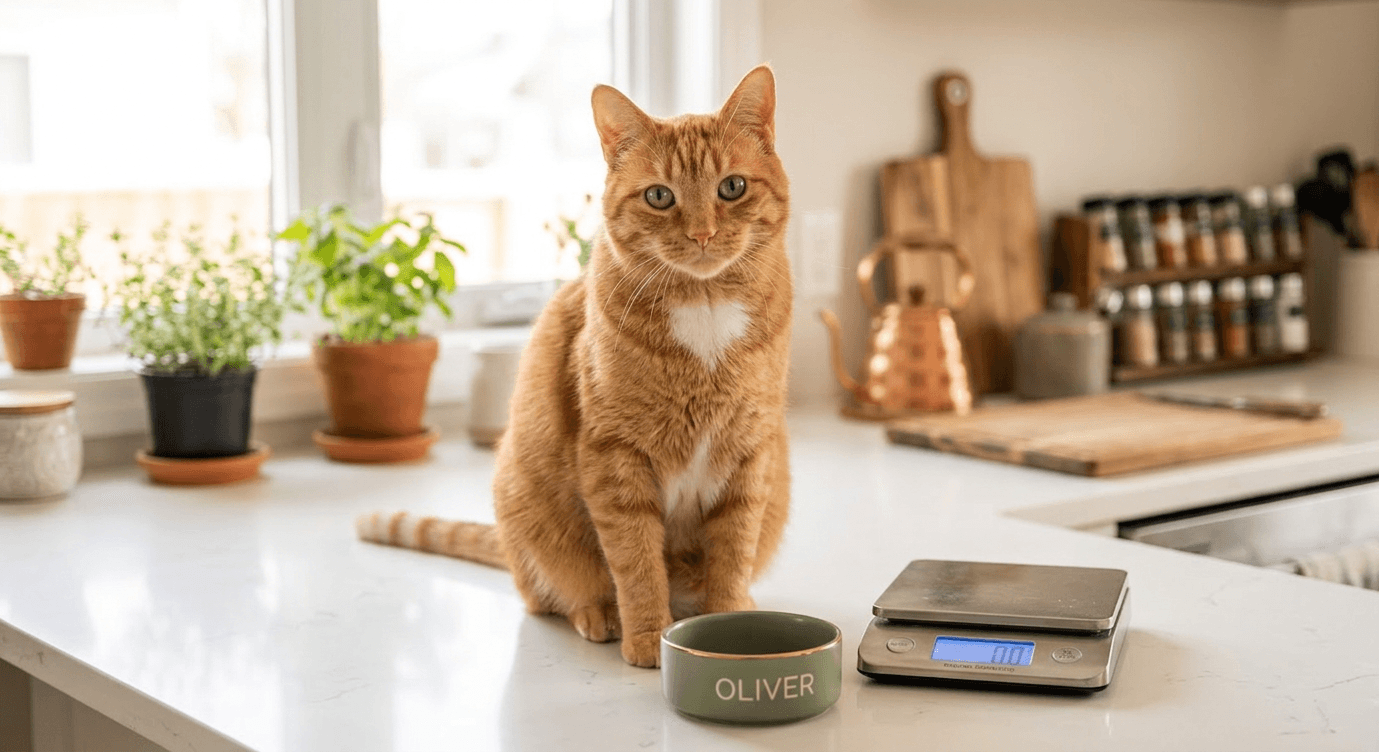
By a cat parent who learned the hard way — with Oliver, my orange tabby, as living proof.
I made a classic mistake the moment I brought Oliver home. I flipped the bag of dry kibble over, read the feeding instructions, and followed them to the letter. Seemed responsible, right? Within twelve months, my vet placed Oliver on the exam table, looked at me with sympathetic eyes, and told me he’d gained three pounds — nearly 30% more body weight.
That’s when I started obsessing over exactly how much to feed indoor cat sizes based on real science, not the marketing guidelines printed on a food bag. Those label recommendations are written for the average active cat, not a neutered, apartment-dwelling tabby who naps eighteen hours a day. The difference matters enormously.
Quick Answer:how much to feed indoor cat
When calculating how much to feed indoor cat residents, aim for approximately 20 calories per pound of body weight per day for a lean, spayed/neutered adult. A standard 10-pound indoor cat needs roughly 200 kcal daily. Ignore the bag’s generalized serving size. Use a digital kitchen scale, know your food’s caloric density, and always adjust based on your individual cat’s condition score.
The “Bag Label” Trap (And Why I Fell Right Into It)
Let me be honest about what happened with Oliver.
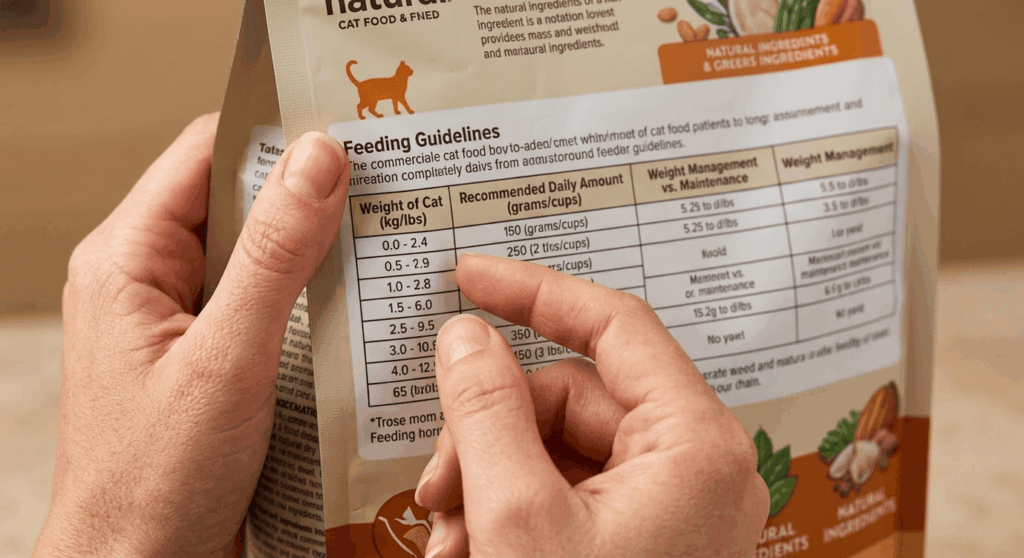
The bag I was using recommended ½ to ¾ cup of dry kibble per day for a cat his size. I went with the middle range — about 2/3 cup daily. It felt reasonable. It even felt generous, which probably should have been my first warning sign.
Here’s the problem: cat food manufacturers write those guidelines for entire demographics of cats, including:
- Intact (unspayed/unneutered) cats with faster metabolisms
- Highly active cats with outdoor access
- Cats in multi-cat households who compete for food and naturally self-regulate
- Kittens and young adults still in growth phases
Oliver was none of those things. He was neutered, four years old, lived in a two-bedroom apartment, and his most intense physical activity was sprinting to his food bowl.
Neutering alone reduces a cat’s metabolic rate by 20–30%, according to research published in the Journal of Nutrition. So feeding Oliver what the bag suggested was like telling a sedentary office worker to eat like a marathon runner because they’re both human adults.
The bag isn’t lying. It’s just not talking to your cat.
The Calorie Math: How to Actually Calculate Your Cat’s Daily Portion
This is the part that changed everything for me. Once you shift from measuring by cups to measuring by calories, you get precise, repeatable results.
Step 1: Find Your Cat’s Resting Energy Requirement (RER)
The RER formula used by most veterinary nutritionists is:
RER (kcal/day) = 70 × (body weight in kg)^0.75
This sounds intimidating, but you can find free RER calculators online, or use the simplified version below for average indoor cats.
Step 2: Apply a Life Stage Multiplier
| Life Stage | Multiplier Applied to RER |
|---|---|
| Intact adult cat | 1.4× |
| Neutered/spayed adult | 1.2× |
| Overweight adult (weight loss) | 0.8× |
| Senior cat (7+ years) | 1.1–1.2× |
| Active indoor/outdoor adult | 1.4–1.6× |
For Oliver, a neutered adult, his Maintenance Energy Requirement (MER) = RER × 1.2.
Step 3: Know Your Food’s Caloric Density
This is where most people stop short. Caloric density is printed on the food packaging — usually listed as kcal/cup for dry food or kcal/can for wet food.
- Typical dry kibble: 300–500 kcal per cup
- Typical wet food (3 oz pouch): 70–100 kcal
- Typical wet food (5.5 oz can): 150–200 kcal
Once you know your cat’s daily caloric target AND your food’s caloric density, the math is simple division.
Daily calories needed ÷ food’s kcal per cup = exact daily portion
Indoor Cat Portion Guide by Weight
Use this as your starting reference point. These figures assume a healthy, spayed/neutered adult indoor cat with no medical conditions.
| Ideal Weight (lbs) | Ideal Weight (kg) | Daily Calories (kcal) | Approx. Dry Food (cups/day)* | Approx. Wet Food (oz cans/day)** |
|---|---|---|---|---|
| 6 lbs | 2.7 kg | ~120 kcal | ~⅓ cup | ~¾ of a 5.5 oz can |
| 8 lbs | 3.6 kg | ~160 kcal | ~⅓–½ cup | ~1 small 5.5 oz can |
| 10 lbs | 4.5 kg | ~200 kcal | ~½ cup | ~1–1.25 small cans |
| 12 lbs | 5.4 kg | ~240 kcal | ~½–⅔ cup | ~1.25–1.5 small cans |
| 14 lbs | 6.4 kg | ~280 kcal | ~⅔ cup | ~1.5–2 small cans |
| 16 lbs | 7.3 kg | ~320 kcal | ~¾ cup | ~2 small cans |
*Based on a dry food density of ~380 kcal/cup. Check your specific brand.
**Based on a wet food density of ~180 kcal per 5.5 oz can. Check your specific brand.
⚠️ These are starting estimates, not prescriptions. Monitor your cat’s body condition score monthly and adjust in 10% increments.
Wet vs. Dry Portions: Which One Is Actually Better for Indoor Cats?
This question generates more passionate debate in cat parent communities than almost anything else. Here’s what the evidence actually shows.
The Case for Wet Food
Wet food is my first recommendation for indoor cats, and here’s why:
- Higher moisture content (70–80%) supports urinary tract health — a real concern for sedentary indoor cats
- Higher protein, lower carbohydrate profile aligns better with feline physiology
- Lower caloric density per gram means your cat eats a larger physical volume of food, which promotes satiety
- Cats are not physiologically driven to drink water; they evolved to get moisture from prey
Oliver transitioned to a primarily wet food diet after his weight gain episode, and the improvement in his coat, energy, and litter box habits was noticeable within six weeks.
The Case for Dry Food
Dry food has real practical advantages:
- Cost: Significantly cheaper per calorie
- Convenience: Can be left out longer without spoiling
- Dental friction: Some evidence suggests it provides mild mechanical cleaning (though not a substitute for actual dental care)
- Caloric density: Useful for underweight cats who need more calories in smaller volumes
The Hybrid Approach
Many veterinary nutritionists, including the team at my local feline specialty clinic, recommend a 60/40 wet-to-dry split for indoor cats. This gives you the hydration benefits of wet food while keeping costs manageable.
When doing a hybrid approach:
- Calculate your cat’s total daily calorie budget first
- Decide on your ratio (e.g., 60% wet, 40% dry)
- Calculate the grams/portions for each independently
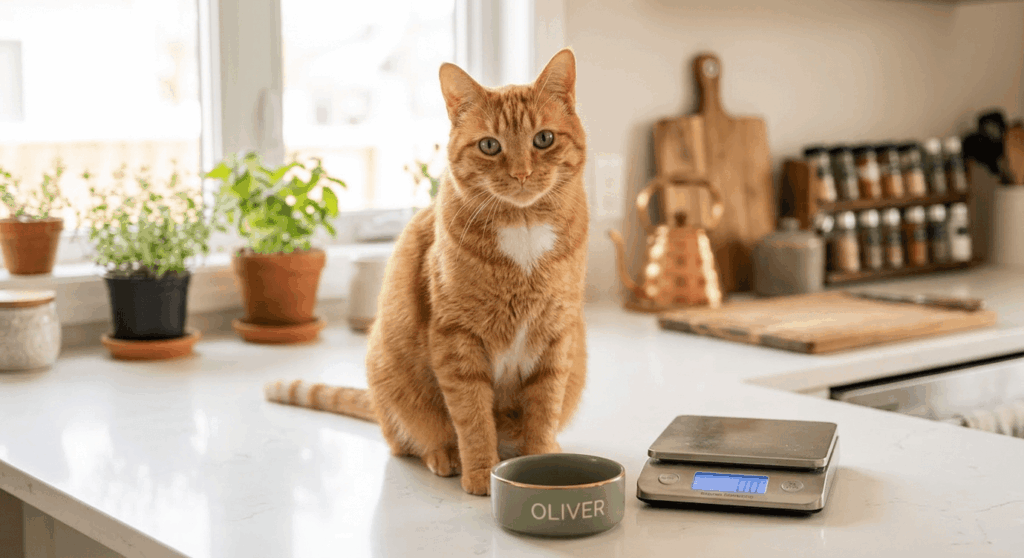
- Weigh both portions on a kitchen scale before serving
Once you calculate the total daily portion, you must divide it into a structured feeding schedule rather than serving it all at once — splitting meals prevents blood sugar spikes, reduces begging behavior, and helps with weight management. [Read our complete guide to structuring your cat’s daily meal schedule here → Best Indoor Cat Feeding Schedule (Vet-Backed Routines)]
A Note on Body Condition Score: Don’t Just Trust the Scale
Weight alone doesn’t tell the full story. A 10-pound cat might be perfectly lean or significantly overfat depending on their frame size.
Veterinary professionals use a 9-point Body Condition Score (BCS) system:
- BCS 1–3: Underweight. Ribs are easily visible, spine prominent, no fat reserves.
- BCS 4–5: Ideal. Ribs easily felt but not seen. Waist visible from above. Slight abdominal tuck.
- BCS 6–7: Overweight. Ribs require pressure to feel. Waist less defined. Rounded abdomen.
- BCS 8–9: Obese. Ribs very difficult to feel. No waist. Prominent fat deposits.
Check your cat’s BCS monthly by running your hands gently along their ribcage. You should feel each rib with light pressure but not see them.
If your cat is already overweight, feeding them maintenance calories won’t work — you need a specific caloric deficit plan to help them lose weight safely without triggering dangerous hepatic lipidosis (fatty liver disease). [See our complete overweight cat weight loss feeding plan here → How to Help Indoor Cat Lose Weight Without the Constant Meowing]
The Metabolism Factor: Why Indoor Cats Are In a Category of Their Own
Indoor cats are not simply outdoor cats who happen to live inside. Their entire physiological reality is different.
- Less movement: The average indoor cat walks a fraction of the distance an outdoor cat covers daily
- Neutering effects: Reduces metabolic rate by up to 30%, as noted earlier
- Thermoregulation ease: Indoor cats don’t burn extra calories staying warm in winter
- Reduced stress-based caloric burn: No territorial patrolling, hunting, or fleeing predators
- Age-related metabolic decline: Begins around age 7, compounds with indoor sedentary lifestyle
All of this adds up to an animal that needs significantly fewer calories than their wild or outdoor counterparts — but still has the same instinctive drive to eat everything placed in front of them.
Indoor cats have incredibly slow metabolisms compared to their outdoor cousins, which is exactly why environmental enrichment and vertical space are mandatory to help them burn off their daily meals and maintain healthy muscle mass. [Explore our complete guide to enrichment and activity for indoor cats here → The Small Apartment Cat Survival Guide: 7 Pillars of Indoor Enrichment]
Practical Tools You Need (I Use All Three)
After everything I went through with Oliver, these are the non-negotiables in my feeding routine:
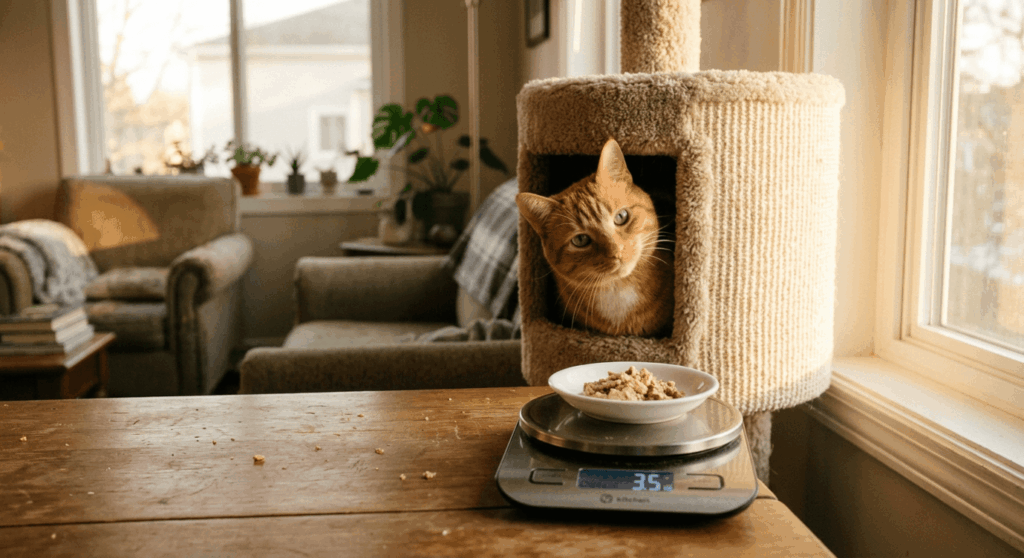
- Digital kitchen scale — Measure in grams, not cups. A quarter-cup measurement can vary by 15–20% depending on how tightly the kibble is packed. A scale eliminates guesswork entirely.
- Calorie tracking app or spreadsheet — I track Oliver’s daily intake in a simple Google Sheet. Takes thirty seconds per meal.
- Monthly weigh-ins — I weigh Oliver every four weeks and log the number. Even a half-pound change triggers a portion reassessment.
Brands of kitchen scales I’d recommend: OXO Good Grips, Ozeri Pronto, or any scale with a 0.1g precision reading in grams mode.
FAQ
1. Do spayed or neutered cats need less food than intact cats?
Yes, significantly less. Neutering and spaying reduce a cat’s metabolic rate by approximately 20–30%. An intact cat might require a multiplier of 1.4× their resting energy requirement, while a spayed or neutered cat typically only needs 1.2×. If you’re using bag label instructions, they almost certainly aren’t accounting for this difference — which is exactly how Oliver gained three pounds in twelve months.
2. What is the right answer to how much to feed indoor cat sizes that are senior (7+ years)?
Knowing exactly how much to feed indoor cat seniors is genuinely tricky because it goes in two directions. Cats aged 7–10 often continue to gain weight as metabolism slows further, so portions may need a 10–15% reduction from their adult maintenance level.
Cats aged 11+, however, frequently begin losing muscle mass and weight, and may actually need more calories and higher protein to maintain healthy body condition. A senior-specific veterinary checkup with bloodwork is the most reliable guide here — metabolism and organ function both shift significantly in this life stage.
3. Can I free-feed (leave food out all day) an indoor cat?
For the vast majority of indoor cats, free-feeding is not recommended. The research is consistent: free-fed cats consume significantly more calories than cats fed structured meals. This is especially true with dry food, which is calorie-dense and highly palatable. The easiest way to maintain a 100% consistent schedule is by using a reliable automatic cat feeder for indoor cats.
Some cats can self-regulate, but most cannot — particularly neutered indoor cats with low activity levels. The only exception I’d consider is for underweight cats who need caloric support. For everyone else, two to three measured meals per day is the standard of care.
To see how this fits into the big picture of feline nutrition, check out our master indoor cat diet guide.
References:
- Bermingham, E.N. et al. (2010). Energy requirements of adult cats. British Journal of Nutrition.
- WSAVA Global Nutrition Committee: Calorie Needs for an Average Healthy Adult Cat.
Disclaimer: This article is written from the perspective of an experienced cat owner and is informed by published veterinary nutrition research. It does not replace the advice of a licensed veterinarian or board-certified veterinary nutritionist. Always consult your vet before making significant changes to your cat’s diet, especially if they have underlying health conditions.