By IndoorCatExpert.com | Indoor Cat Safety & Apartment Living
It happened in about half a second. I slid the balcony door open on a warm Saturday morning to let some air in, a pigeon landed on the railing three feet away, and Oliver — who had been asleep on the sofa approximately four seconds earlier — launched himself toward it with a velocity I didn’t know he possessed.
I caught him by his back leg. He was already past the threshold, front paws scrabbling at the railing, entirely indifferent to the six-story drop below him. The pigeon left. Oliver seemed annoyed. I sat on the floor for a while and thought carefully about my life choices.
That incident was the moment I stopped treating the balcony as a relaxing outdoor space and started treating it as a safety problem that needed solving. If you’re searching for how to cat proof apartment balcony, there’s a good chance you’ve had your own version of that moment — or you’re smart enough to address it before it happens. Either way, this guide covers everything you need to create a genuinely safe, renter-friendly enclosed balcony setup without drilling a single hole.
Once your balcony is completely secured, it’s time to make it fun. Check out our curated list of the best catio ideas apartment cats will absolutely love.
Quick Answer
To cat proof an apartment balcony without drilling, install heavy-duty transparent netting secured to existing railings and a ceiling beam or tension rod using zip ties, carabiner hooks, and adjustable bungee cords. Ensure netting covers all gaps including the floor-to-railing space. Remove any toxic plants and climbable furniture near edges, and never leave the balcony accessible unsupervised.
The Real Danger of High-Rise Syndrome — What Every Cat Owner Needs to Know
Before the practical steps, this section matters too much to skip.
There is a documented veterinary condition called High-Rise Syndrome — the term used by veterinarians for injuries sustained by cats falling from significant heights. It is not rare. A landmark study published in the Journal of the American Veterinary Medical Association examined cats brought to a New York City veterinary clinic after falls from buildings and found that the majority survived — but with serious injuries including chest trauma, jaw fractures, and limb injuries requiring surgical intervention.
The most dangerous myth about cats and heights is that they always land on their feet. The righting reflex — the ability to orient the body feet-downward during a fall — is real and impressive. What it does not do is prevent injury on impact from a multi-story fall. Cats may land feet-first and still sustain fractures, ruptured bladders, and internal bleeding. From balconies above the third floor, falls are frequently fatal.
There is a second, counterintuitive finding in the High-Rise Syndrome research: cats falling from intermediate heights — roughly the third to sixth floor — sometimes sustain worse injuries than cats falling from greater heights. The proposed explanation is that cats reach terminal velocity and relax their muscles after approximately five stories, which distributes impact forces across a wider body area. Below that height, the body is still tensed for impact. This means a sixth-floor balcony is not “safer” than a tenth-floor balcony in the way we’d assume.
Oliver is not reckless. He is a predator with 10,000 years of hunting instinct who genuinely cannot predict the consequences of a six-story fall. That is our job to manage, not his.
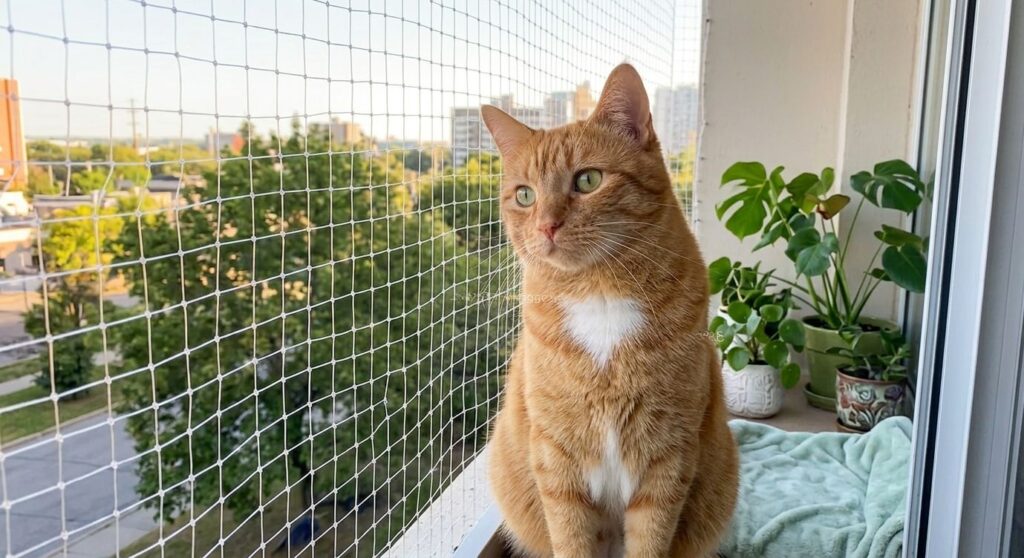
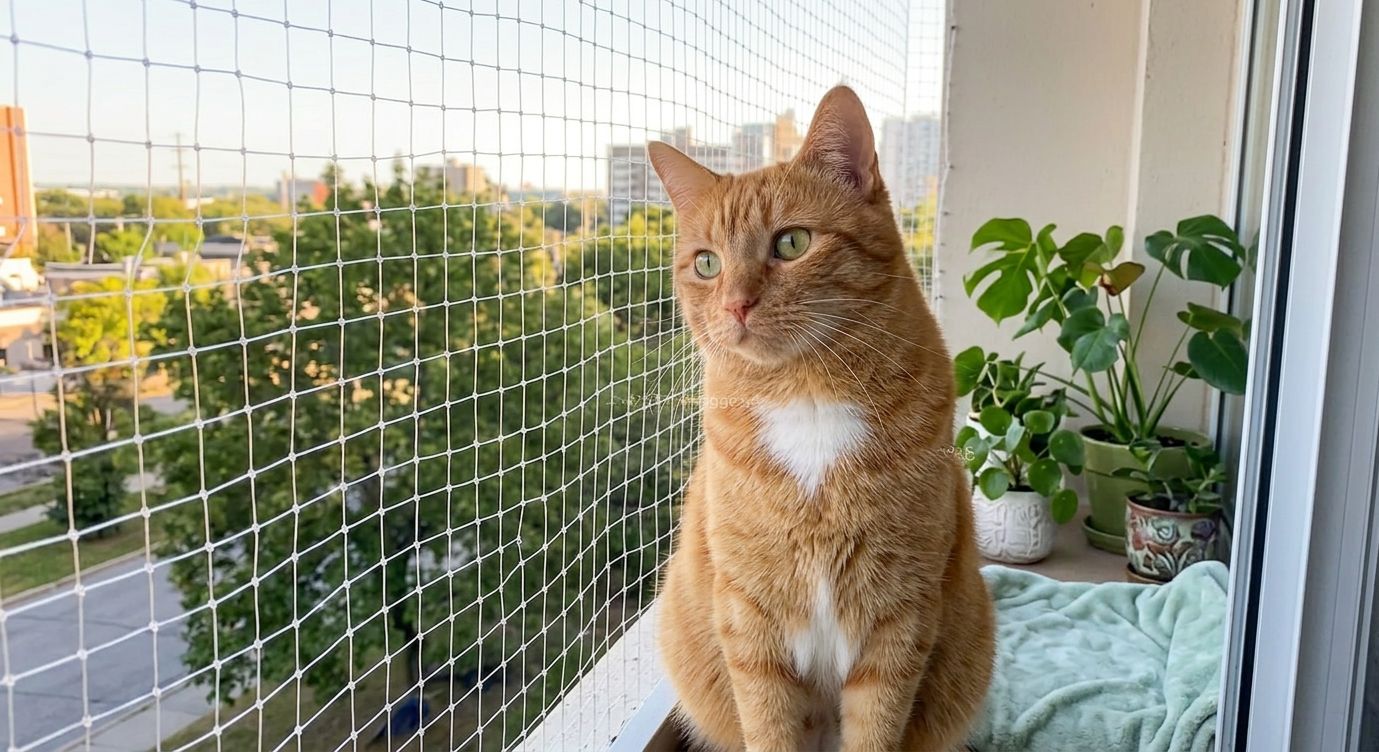
Step 1: The No-Drill Netting Method — The Foundation of Balcony Safety
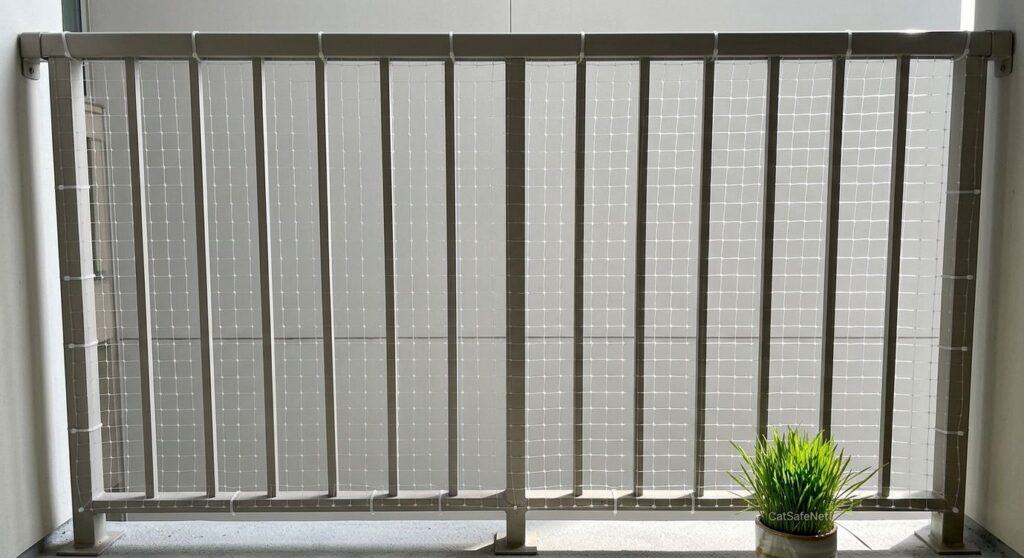
For renters, the no-drill constraint eliminates most permanent structural solutions and makes netting the practical standard. Done correctly, netting provides complete perimeter containment without a single hole in the wall, no risk to your security deposit, and full reversibility when you move.
Choosing the Right Netting
Not all netting is appropriate for this application. The material and mesh size matter considerably.
What to look for in balcony cat netting:
- Knotted polyethylene or nylon construction — knotted mesh holds its shape under tension and resists deformation; knotless mesh can stretch and develop gaps over time
- Maximum 1.5-inch (4cm) mesh opening — smaller is better; standard cat-specific netting uses 1–2 inch mesh which prevents both body passage and paw-through leverage points a cat could use to climb
- UV-stabilized material — balcony netting is exposed to direct sunlight year-round; non-stabilized polyethylene degrades and weakens within one to two seasons
- Black or dark green coloring — dark netting is significantly less visible from inside the apartment and from the street, providing safety without visual intrusion; clear polypropylene netting is also available and nearly invisible when installed correctly
Sizing: Measure your balcony’s full perimeter, the height from floor to ceiling or overhead structure, and any open sides. Buy 15–20% more netting than your measurements — you’ll need overlap at connection points, and it’s far easier to trim excess than to splice a gap.
Installation Without Drilling: The Tension Rod and Zip Tie Method
This system works for the vast majority of apartment balcony configurations:
What you need:
- Heavy-duty adjustable tension rods (rated for outdoor use) spanning the balcony width at ceiling height
- Industrial-strength zip ties, minimum 50lb rated
- Stainless steel carabiner clips (for quick-release sections if you want a door function)
- Bungee cords or elastic rope for securing the lower edge to floor-level railing balusters
- A rubber mallet for tension rod installation
Installation sequence:
- Install tension rods horizontally across the top of the balcony opening at ceiling height, tightened firmly against the ceiling and door frame — these serve as your upper anchor points
- Drape netting over the tension rods and secure with zip ties at 6-inch intervals across the top edge
- Pull the netting taut down to the railing level and zip-tie to each baluster at 6-inch intervals
- Continue down from the railing to the balcony floor, securing the lower edge with bungee cords threaded through the mesh and around the base of the railing posts or anchored to heavy potted plants
- For the door side, leave a section secured with carabiner clips rather than fixed zip ties — this creates a panel you can unclip to walk through, then re-secure behind you
Test the installation by pressing firmly on the netting at multiple points — it should have minimal give and return to position without sagging. Walk the entire perimeter looking for any gap wider than an inch at corners, floor junctions, or around any railing posts that interrupt the net line.
Step 2: Securing the Floor Gap — The Most Overlooked Vulnerability
Most balcony cat-netting setups fail at the floor. Standard apartment balcony railings have a gap between the bottom baluster and the floor surface — sometimes as large as 4–6 inches — that is entirely sufficient for a determined cat to squeeze through or, worse, fall through headfirst while investigating something below.
This gap must be addressed as a separate step from the main netting installation.
Solutions for the Floor Gap
- Extended netting run — when installing your main netting, extend it past the bottom rail down to the floor surface and secure it there. This is the simplest solution if your netting is long enough.
- Corrugated plastic sheeting — rigid corrugated plastic panels cut to the height of the gap and zip-tied to the lower railing balusters create a solid barrier that netting alone can’t provide at floor level
- Foam pipe insulation threaded through the lower netting edge and resting on the floor — this prevents the netting from developing a floor-level gap as it shifts in wind
- Heavy potted planters positioned at floor level against the railing — these serve double duty as gap blockers and as the beginning of your catio planting (see Step 4), provided the planters are heavy enough that your cat cannot move them
Check the floor gap after the first rainstorm or strong wind event — netting that was perfectly secured can develop slack and floor-level gaps with weather exposure, and periodic checks should be part of your routine.
Step 3: Remove Toxic Plants — Auditing Your Balcony for Hidden Dangers
If you’re creating an enclosed catio space, your cat will have access to any plants on the balcony for extended periods. Many common balcony and container plants are significantly toxic to cats — and the relaxed, exploratory behavior cats display in an outdoor space often includes chewing on foliage.
Plants to remove from any cat-accessible balcony immediately:
- Lilies — all species of true lily (Lilium and Hemerocallis genera) are severely toxic to cats; even small ingestion can cause acute kidney failure. This is a non-negotiable removal.
- Oleander — all parts are toxic; cardiac glycosides cause severe cardiovascular effects
- Sago palm — extremely toxic; causes liver failure
- Geranium / Pelargonium — moderate toxicity causing vomiting, anorexia, and depression
- Lavender — mildly toxic in large amounts; linalool and linalyl acetate cause nausea
- Foxglove — severely toxic cardiac glycosides throughout the plant
- Ivy (most varieties) — triterpenoid saponins cause severe gastrointestinal distress
When in doubt, check the ASPCA Animal Poison Control Center’s plant database before leaving any plant accessible to your cat. The list of toxic species is considerably longer than most people expect.
Cat-Safe Plants to Keep or Add
- Cat grass (wheat grass or oat grass) — actively beneficial; provides digestive fiber and a natural chewing outlet that satisfies the foliage-chewing instinct
- Catnip — safe and enriching; fresh growing catnip is significantly more potent than dried and will make your catio extremely popular
- Valerian — stimulating for most cats; similar behavioral response to catnip
- Spider plant — non-toxic and unfazed by most weather conditions
- Rosemary and thyme — both non-toxic, aromatic, and useful for cooking; the scent provides sensory enrichment
Step 4: Creating the Catio Experience — Turning Safety Into Enrichment
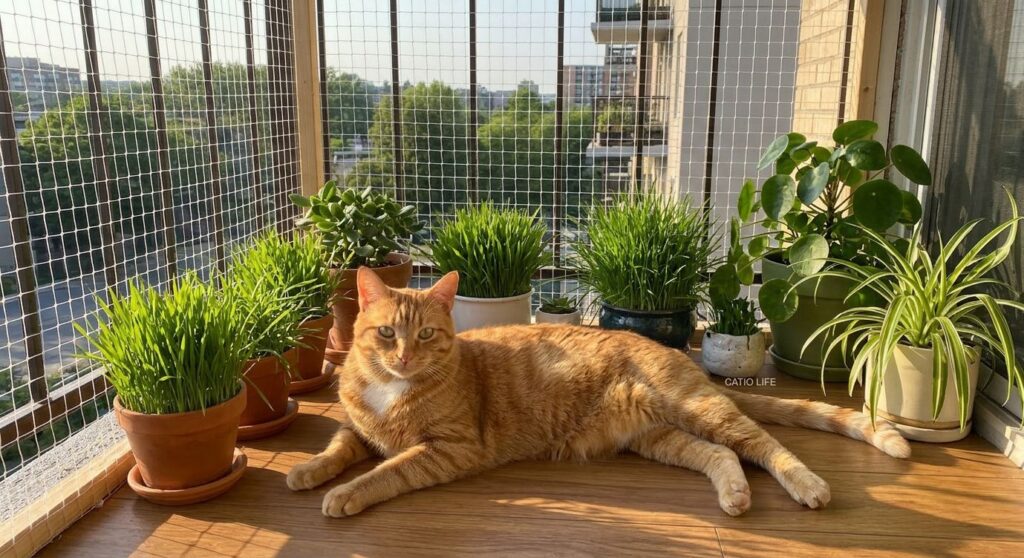
An enclosed balcony is not just a safety measure. For an indoor cat, a properly set-up catio — the portmanteau term for a cat patio — is one of the most enriching environments you can create. The combination of fresh air, direct sunlight, outdoor sounds, complex scent profiles, and new visual stimulation provides a sensory experience that no indoor environment fully replicates.
A safely enclosed balcony is genuinely the holy grail of vertical and territorial enrichment for an indoor cat — it extends their perceived territory outdoors and gives them access to stimuli that are categorically unavailable inside: indoor cat enrichment in small apartments.
Elements of a Good Catio Setup
Elevated resting surfaces:
- A weather-resistant cat shelf or small cat tree on the balcony gives your cat a vantage point above the railing level — they can observe the outdoor environment from an elevated and secure position
- A hammock or hanging bed strung between two wall-mounted hooks (if your lease permits) at railing height gives a swaying, warm resting spot that many cats love
Sensory enrichment elements:
- Cat grass planted in several containers provides chewing material, scent, and texture variation
- A shallow ceramic dish with fresh water — cats often drink more willingly from outdoor water sources
- A wind chime or hanging feeder positioned so birds and insects visit the outer side of the netting — your cat gets the visual and auditory stimulation of watching wildlife without any access to them
Sun and shade management:
- Direct afternoon sun on a balcony can produce dangerously high temperatures for a cat — ensure there’s always a shaded area available
- A UV-filtering outdoor shade sail can reduce heat while still allowing light and air to pass through
The Supervision Rule — Non-Negotiable
One point that cannot be overstated: a cat-proofed balcony is for supervised outdoor time only. Even the most carefully installed netting can develop a gap after strong wind, heavy rain, or a determined cat working at a join point over multiple sessions. The balcony should never be left accessible when you’re not home.
This is especially important to remember on workdays. When you leave in the morning, the balcony door locks — and your cat’s enrichment for the day comes from the indoor environment you’ve set up instead: how to entertain an indoor cat while at work.
Build a habit of doing a quick netting check each time you open the balcony door — run your eye along the top edge, both sides, and the floor perimeter. Thirty seconds of checking prevents the incident that requires an emergency vet visit.
Before placing any greenery in your newly secured outdoor space, make sure you cross-reference them with our ultimate list of cat safe plants apartment owners and balcony gardeners must know.
Renter-Specific Considerations: Talking to Your Landlord
Some landlords have explicit policies about balcony modifications, and a netting installation — even a no-drill one — is technically a modification of your use of the space. It’s worth a brief conversation before installation.
Framing the conversation:
- Emphasize that the installation uses no drilling, adhesive, or permanent attachment
- Offer to provide photos of the installation method to confirm no damage will occur
- Note that the netting protects both your cat and the landlord’s property from liability associated with a cat falling from the balcony
Most landlords, once they understand the installation is fully reversible and damage-free, have no objection. Some have explicitly approved it. If your lease contains a blanket prohibition on any modifications, get written confirmation before proceeding — a paper trail protects you if there’s a dispute at move-out.
FAQ
👉 Can my cat chew through balcony netting?
Heavy-duty knotted polyethylene or nylon netting resists most casual chewing. Cats occasionally mouth or paw at netting from curiosity, but sustained chewing with intent to escape is uncommon in cats who are not acutely stressed or trapped. The higher risk is not chewing through netting but finding a gap at a connection point — zip tie joints, corner overlaps, and the floor perimeter are where most failures occur. Inspect these points regularly and retighten or replace any zip ties that have stretched or cracked. If your individual cat is an intense chewer, look for coated wire mesh rather than fabric netting — it provides the same containment with significantly higher chew resistance.
👉 What floor height is too dangerous for a catio without netting?
There is no floor height at which an unnetted balcony is safe for an unsupervised cat. The high-rise syndrome research documents serious injuries from falls as low as two stories, and the instinctive prey-drive response that caused Oliver’s lunge toward the pigeon operates regardless of floor height — a cat doesn’t assess the drop before reacting to a bird or a blowing leaf. Even a second-floor balcony has a fall distance sufficient to cause broken bones on hard surfaces. Netting is the standard regardless of height.
👉 How to cat proof apartment balcony setups with glass panels instead of railings?
Yes, with some adaptation. Solid glass panels eliminate the baluster anchor points used in the standard zip-tie method, but several alternatives work well. Tension rods installed at the top of the glass panel span and secured against the ceiling create the upper anchor, and the netting can be weighted or fixed at the floor with heavy planters along the inner edge of the glass.
Some cat owners use large suction-cup hooks rated for outdoor use on the glass panel itself as intermediate anchor points — these hold well on clean, dry glass and remove without marks. For balconies where the glass panel forms the full enclosure height with no railing above, ceiling-to-floor tension rod systems that create a freestanding enclosed frame are also available as a complete unit from specialist catio suppliers.
References: Whitney, W.O. & Mehlhaff, C.J. (1987). High-rise syndrome in cats. Journal of the American Veterinary Medical Association, 191(11), 1399–1403. | ASPCA Animal Poison Control Center: Toxic and Non-Toxic Plants List (aspca.org/pet-care/animal-poison-control/toxic-and-non-toxic-plants). | Ellis, S.L.H. et al. (2013). AAFP and ISFM Feline Environmental Needs Guidelines. Journal of Feline Medicine and Surgery, 15(3), 219–230.
IndoorCatExpert.com — For the cats who see a sixth-floor balcony as a hunting platform, and the humans who love them enough to install the netting.