By IndoorCatExpert.com | Indoor Cat Behavior & Apartment Living
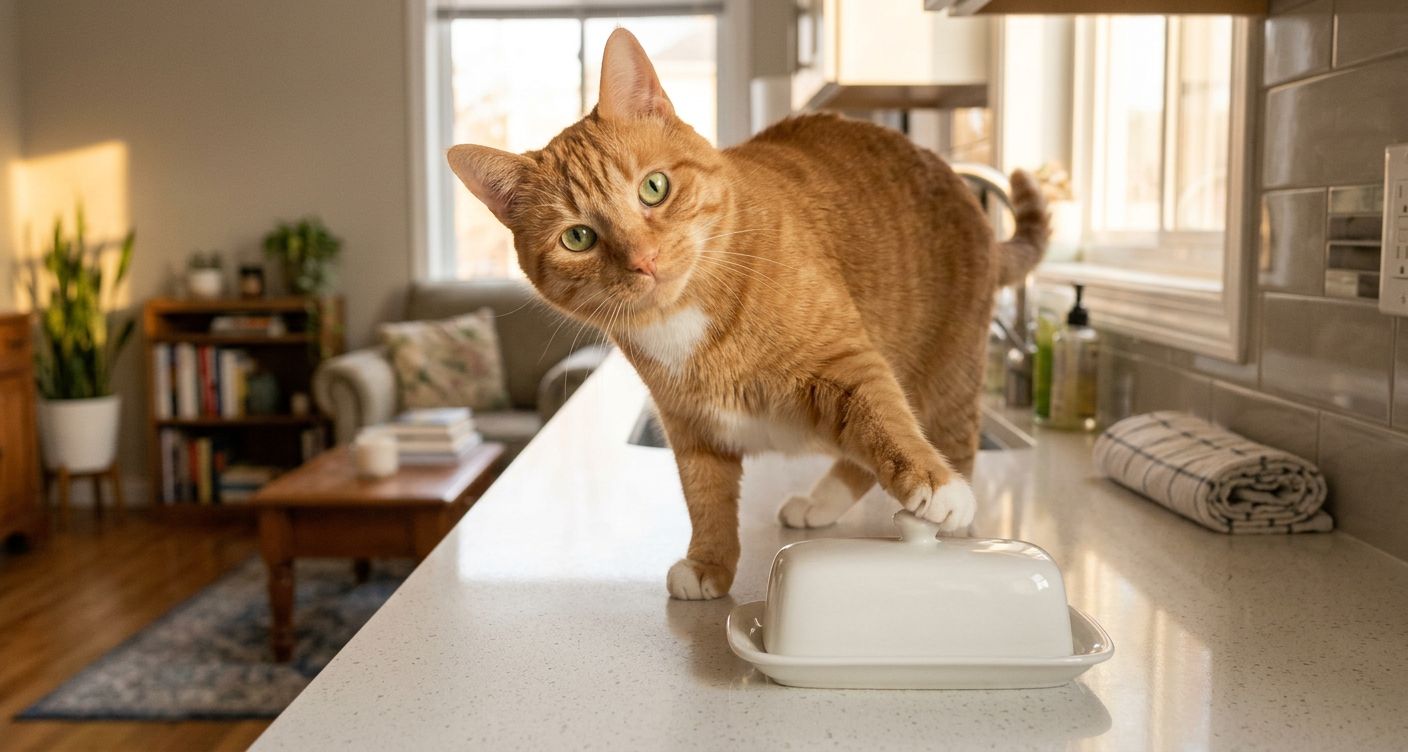
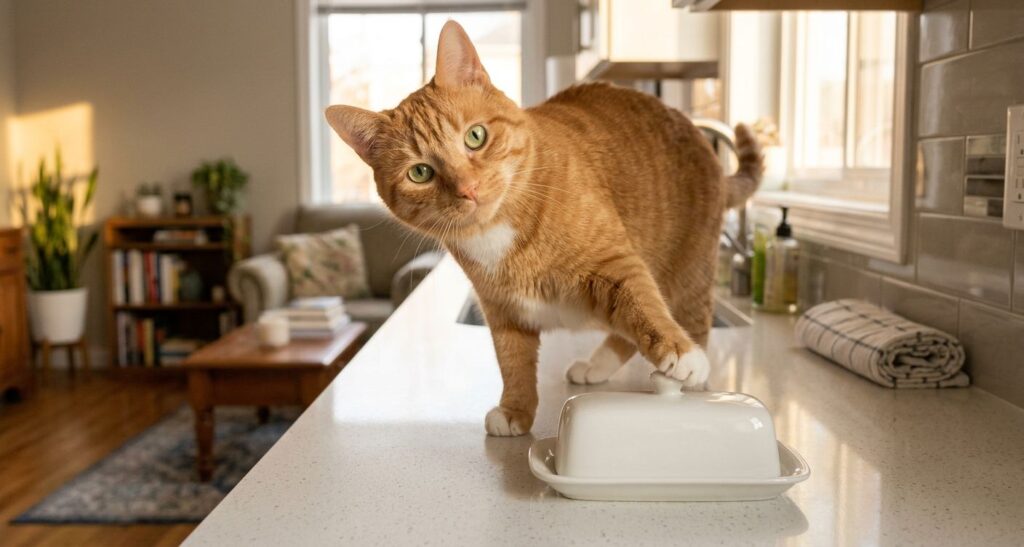
It was 7 AM on a Tuesday. I had just wiped down the kitchen counter, set out a stick of butter to soften for toast, and turned around to start the coffee. When I turned back, Oliver was standing on the counter in the precise center, one paw resting proprietarily on the butter dish, sniffing it with the calm, unhurried focus of a chef inspecting ingredients.
He looked at me. I looked at him. He continued sniffing the butter.
For anyone living in a small apartment with an open-plan kitchen — no door to close, no physical barrier between the cooking surface and the rest of the living space — the question of how to keep cat off kitchen counters is not an abstract training problem.
It is a daily, ongoing negotiation with an animal who is fast, motivated, and operating on an entirely different set of priorities than food safety regulations. Oliver’s priorities are: height, warmth, interesting smells, and butter. Not necessarily in that order.
Here is the five-step system that actually changed the dynamic in our kitchen — and why most of the advice you’ve probably tried already hasn’t worked.
Quick Answer
To keep a cat off kitchen counters, first eliminate all food rewards and wipe surfaces thoroughly to remove odor traces. Provide an equally appealing elevated alternative directly nearby — a tall cat tree or bar stool positioned at counter height. Apply temporary deterrents like double-sided tape while the new habit forms, and use clicker training to actively reward your cat for choosing the correct surface. Address the height need directly; don’t just block it.
Why Cats Jump on Counters — And Why “No” Alone Never Works
Before the five steps, the most important thing to understand: your cat is not jumping on the counter to annoy you or assert dominance. Oliver has no interest in my feelings about food safety. He has very strong interests in three things that the kitchen counter reliably delivers — elevation, warmth (from the stove or oven residual heat), and the concentrated smell of food.
These are all legitimate, instinct-driven needs. A cat denied access to a counter without being given something equivalent will simply keep trying to access the counter, because the needs driving the behavior haven’t been addressed. This is why shouting “no” and lifting your cat off the counter repeatedly produces a cat who waits until you’re not looking — not a cat who stops wanting to be up there.
The fix is a combination of making the counter less rewarding, making an alternative more rewarding, and using training to build a genuine behavioral preference. All five steps work together. Skipping any one of them is why most people find partial success and then plateau.
And if they get up there just to push your glasses onto the floor, you’ll definitely want to read our fun science breakdown on why does my cat knock things over.
Step 1: Remove the Reward — Make the Counter Boring
Every time Oliver successfully finds something interesting on the counter — a crumb, a smell, a warm spot near the stove, the butter dish — the counter-jumping behavior is reinforced. Before any other step can work reliably, the counter needs to stop paying out.
The counter must become, from your cat’s perspective, the least interesting elevated surface in the apartment.
Eliminating Food Rewards Completely
- No food left on counters, ever — not cooling baked goods, not defrosting meat, not a half-eaten snack left for five minutes while you answer a text. Every instance of accessible food is a jackpot reward that sets back training by days.
- Wipe counters with an enzyme-based cleaner after every meal prep — cats have scent detection capabilities approximately 14 times more sensitive than ours. A counter that smells clean to you may smell intensely of last night’s chicken to Oliver. Enzyme-based cleaners break down protein odor compounds; standard surface sprays mask them temporarily.
- Remove the butter dish from the counter entirely — I say this specifically because this was, in our household, the single most significant change. The butter dish was Oliver’s primary motivation. Its removal from the counter removed his most compelling reason to be there.
If your cat is currently on a calorie-restricted diet or a structured weight management plan, be aware that their counter-scavenging motivation will be significantly higher than baseline — a food-motivated cat in a caloric deficit is extremely driven to find supplemental sources: how to help indoor cat lose weight.
Address the Warmth and Height Needs Separately
Once food reward is removed, some cats lose interest in counters almost immediately. Most don’t, because the warmth and elevation needs remain. Steps two through four address these.
Step 2: The Alternative Height Strategy — Give Them Somewhere Better to Be
This is the step most counter-jumping guides skip, and it’s the reason most counter-jumping guides don’t produce lasting results. You cannot successfully train a cat away from a behavior driven by a genuine physical need without providing an equally satisfying alternative for that need.
Cats seek elevation for safety, information (better vantage point), social signaling, and warmth. The kitchen counter delivers all of these. Your job is to deliver them via a surface you’re actually comfortable with your cat using.
The Proximity Rule
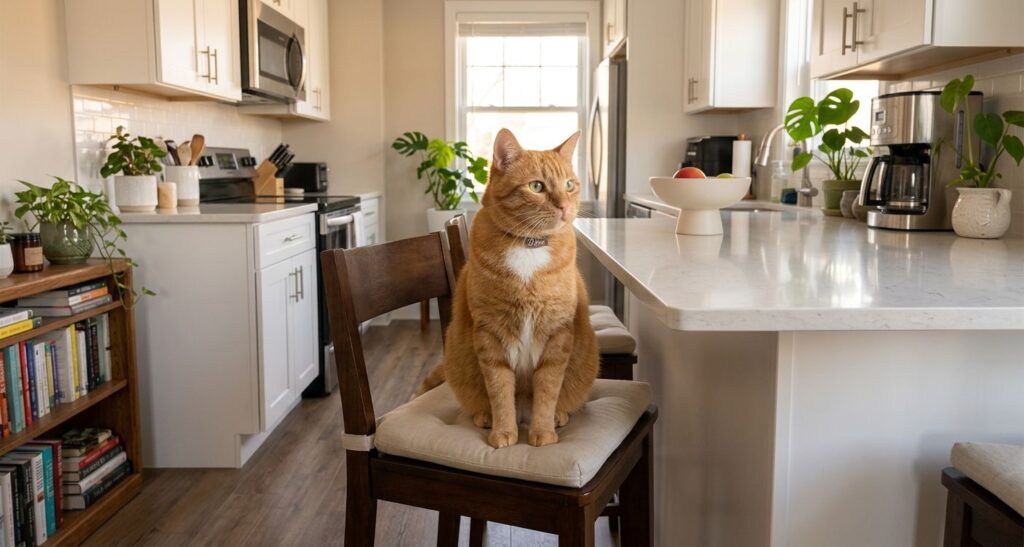
The alternative must be positioned directly adjacent to or immediately near the counter — not in another room, not across the apartment, not in the bedroom. Cats choose the closest viable option for height. If the closest option to the kitchen is the counter, they’ll use the counter. If there’s a tall cat tree or a bar stool with a pad two feet from the counter, they’ll frequently choose that instead — especially once the counter stops delivering food rewards.
Specific options for small apartments with open-plan kitchens:
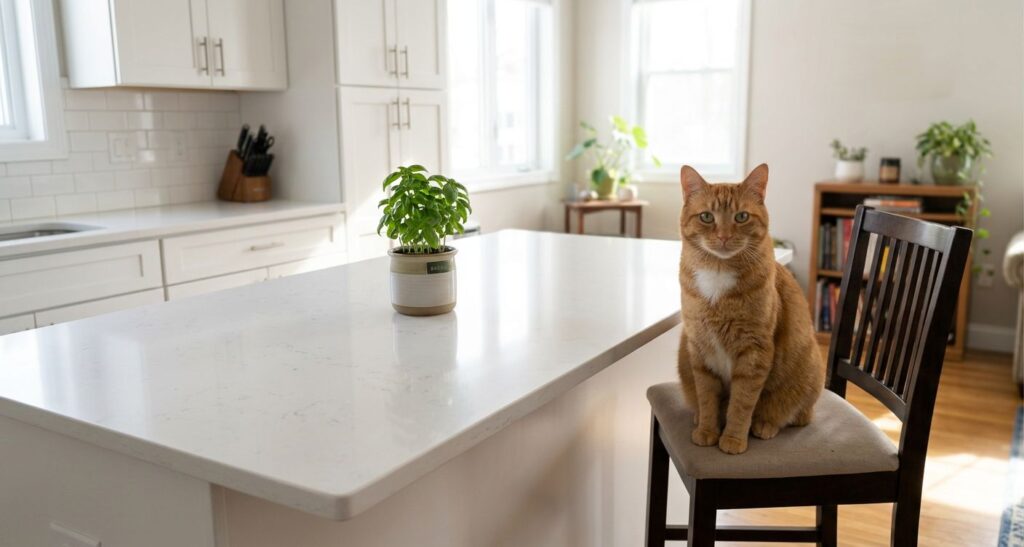
- A tall bar stool with a non-slip padded top positioned at kitchen island height gives your cat an equivalent elevation with a designated, acceptable surface
- A cat tree positioned at the kitchen’s edge with a top platform at or above counter height becomes the obvious high-point choice
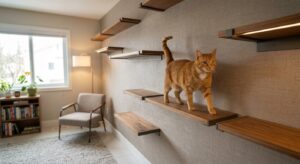
- A wall-mounted cat shelf at counter height along the kitchen wall offers the elevation and vantage point with no floor space cost
Building out the vertical dimension of your apartment — not just for counter management but for your cat’s overall territorial satisfaction — is one of the highest-leverage things you can do in a small space: indoor cat enrichment in small apartments.
Make the Alternative Actively Appealing
Place your cat on the alternative surface yourself and reward them with a treat. Leave a piece of bedding with their scent on it there. Feed them a high-value treat on the bar stool or cat tree top once daily to build positive association. The alternative needs active promotion, not just passive availability.
Step 3: Temporary Deterrents — Make the Counter Uncomfortable to Land On
Once the alternative is in place and food rewards are gone, add temporary physical deterrents to the counter surface itself. These don’t need to be permanent — they need to be present long enough for the new behavioral pattern (use the cat tree/stool, not the counter) to become habitual.
The goal is mild, harmless sensory displeasure — not fear or pain. If a deterrent frightens your cat or causes any distress, it’s the wrong tool.
Deterrents That Work
- Double-sided cat tape laid along the counter edge and surface — cats strongly dislike the sticky sensation on their paws and will avoid landing on it. This is particularly effective on counter edges where cats typically first land when jumping up. Use tape specifically formulated for this purpose; it’s gentler on surfaces and removes without residue.
- A crinkled aluminum foil layer over the counter surface — the noise and texture on landing is aversive without being harmful. Inexpensive and easy to remove when cooking. Oliver stepped onto foil-covered counter exactly twice before consistently redirecting to the bar stool.
- Textured plastic carpet runners placed upside down — the raised plastic nubs are uncomfortable underfoot and effective for cats who aren’t deterred by tape.
Deterrents That Don’t Work (And Why)
Motion-activated compressed air canisters — these work in the short term but create anxiety rather than behavioral learning. Your cat learns the counter is dangerous when the can is present, not that the counter is an inappropriate surface in general.
Placing objects on the counter (pots, trays, cookie sheets) — this is displacement, not training. It works only while the objects are present and requires you to maintain the arrangement indefinitely.
All temporary deterrents should be removed once your cat has stopped attempting the counter consistently for three to four weeks. The goal is a cat who chooses differently, not a cat who’s being perpetually physically blocked.
Step 4: Clicker and Reward Training — Build the Behavior You Actually Want
Steps one through three reduce the problem. Step four builds the solution. Passive deterrence tells your cat where not to go. Active reward training tells your cat where to go instead — and makes going there genuinely desirable.
The Basic Counter-Alternative Training Protocol
You’ll need a clicker (or a consistent verbal marker like “yes”), high-value treats — small pieces of cooked chicken or commercial cat treats your cat finds genuinely exciting — and three to five minutes twice a day.
The sequence:
- With your cat nearby, walk to the alternative surface (bar stool, cat tree) and encourage them toward it
- The moment all four paws are on the alternative surface, click (or say “yes”) and deliver a treat immediately
- Repeat five to eight times per session
- Over the following days, add a cue word (“up” or “place”) as they’re moving toward the surface
- Gradually reward only the fastest, most direct approaches to the alternative — shaping the behavior toward the response you want
Within two to three weeks of consistent twice-daily sessions, most cats develop a strong preference for the trained surface. Oliver now frequently goes directly to his bar stool and looks at me expectantly when I’m cooking — he’s learned that the stool is where treats come from, not the counter.
Timing Is Everything
The click or verbal marker must arrive within two seconds of the correct behavior — ideally within one. If the treat arrives late, your cat is being rewarded for whatever they happen to be doing at treat delivery, not for the counter-alternative choice. This is the single most common reason clicker training underdelivers for people trying it for the first time.
Step 5: Ditch the Spray Bottle — Why It Doesn’t Work and What to Do Instead
This deserves its own section because the spray bottle is the most universally recommended tool for counter management, and it is also one of the least effective training tools available for this specific problem.
Here is precisely why:
The spray bottle teaches location-based avoidance, not behavioral learning. What Oliver learns from being sprayed is not “counters are inappropriate surfaces.” What he learns is “counters are dangerous when my human is present and holding the bottle.” The behavior doesn’t generalize; it simply becomes nocturnal or happens when you leave the room — which is why cats who get spray-bottle corrections reliably return to counters the moment their owner’s back is turned.
It damages trust. Your cat associates an unpleasant startle experience with your presence. This creates avoidance of you, anxiety around the kitchen, and a more cautious, less trusting cat — none of which is the outcome you’re after.
It doesn’t address the underlying need. The spray bottle tells your cat “not here” with no information about “then where.” Without an alternative, the behavior resurfaces because the need — height, warmth, interesting smells — is still unmet.
What to Do Instead When You Catch Your Cat on the Counter
- Calmly redirect without drama. Pick your cat up, place them on the alternative surface, and immediately offer a treat there. The sequence is: remove from counter → place on alternative → reward the alternative. No raised voice, no spray, no extended interaction about the counter incident.
- Do not chase your cat off the counter. The chase is stimulating and accidentally fun for many cats — it becomes a game, which means the counter-jumping behavior is being intermittently reinforced with play.
- Be consistent every single time. The counter needs to produce the same outcome — calm removal and redirection — on every occasion, including at 11 PM when you’re tired and would rather just ignore it.
Realistic Timeline: What to Expect
| Week | What You’re Doing | Expected Cat Behavior |
|---|---|---|
| 1 | Remove food rewards; wipe counters; introduce alternative surface | Cat still attempting counter; beginning to investigate alternative |
| 2 | Add deterrents; begin clicker sessions daily | Counter attempts decrease slightly; first voluntary alternative surface use |
| 3–4 | Continue clicker training; maintain deterrents | Regular voluntary use of alternative; counter attempts reducing |
| 5–6 | Fade deterrents gradually; continue occasional treat rewards | Strong preference for alternative established; minimal counter attempts |
| 6–8 | Deterrents removed; maintenance treat rewards occasionally | Counter no longer preferred surface; behavior largely resolved |
Cats who are highly food-motivated — Oliver is firmly in this category — may take the full eight weeks. Cats with lower food drive who are primarily seeking elevation often respond within three to four weeks once the alternative is in place.
FAQ
👉 Why does my cat jump up at night, and how to keep cat off kitchen counters while I sleep?
This is the spray bottle problem in action. If your cat has ever been startled, shouted at, or spray-corrected on the counter, they have learned that the counter is only “unsafe” when you’re present and watching. The behavior doesn’t disappear — it shifts to times when the perceived risk is lower. The solution isn’t escalating deterrence; it’s the passive deterrents in Step 3 (tape, foil) which work regardless of whether you’re present, combined with the clicker training in Step 4 to build genuine alternative surface preference. Once the alternative surface is more rewarding than the counter across all conditions, the nocturnal counter visits stop.
👉 My cat uses the cat tree all day but still gets on the counter at night. What am I missing?
The most common cause is that the counter is still delivering something the cat tree isn’t — usually residual food smell after dinner, or warmth from a recently used stove or oven. Do a thorough enzyme-cleaner wipe-down of the entire counter surface after every evening meal, and check whether the stove area is particularly targeted (indicating warmth-seeking behavior). Adding a self-warming cat pad to the cat tree top can remove the warmth differential that’s making the counter more appealing at night. Also verify that the cat tree top is positioned at least as high as the counter — if the counter is taller, it will remain the preferred elevation point regardless of how appealing the tree is otherwise.
👉 Is there anything that’s genuinely unsafe about cats being on kitchen counters?
Yes, on a few fronts. Beyond the food hygiene concerns (cat paws carry litter box bacteria onto food preparation surfaces), the most significant safety risk is the stove. A cat walking across a gas burner that isn’t fully extinguished or stepping onto a still-warm electric coil can suffer paw pad burns — these are painful, slow to heal, and unfortunately not rare in households where counter access is unrestricted. This is the safety argument for counter training that goes beyond preference — a cat who has been trained off counters is a cat who won’t accidentally walk across a hot cooking surface. It’s worth the training investment on those grounds alone.
References: Herron, M.E. & Buffington, C.A.T. (2010). Environmental Enrichment for Indoor Cats. Compendium: Continuing Education for Veterinarians. | Overall, K.L. (2013). Manual of Clinical Behavioral Medicine for Dogs and Cats. Elsevier. | Ellis, S.L.H. et al. (2013). AAFP and ISFM Feline Environmental Needs Guidelines. Journal of Feline Medicine and Surgery, 15(3), 219–230.
IndoorCatExpert.com — For the cats who consider your kitchen counter prime real estate, and the humans who disagree.