Finding the best strategies for indoor cat urinary health became my personal mission after Oliver’s emergency.
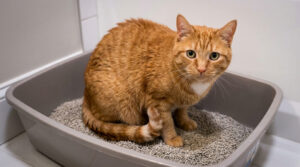
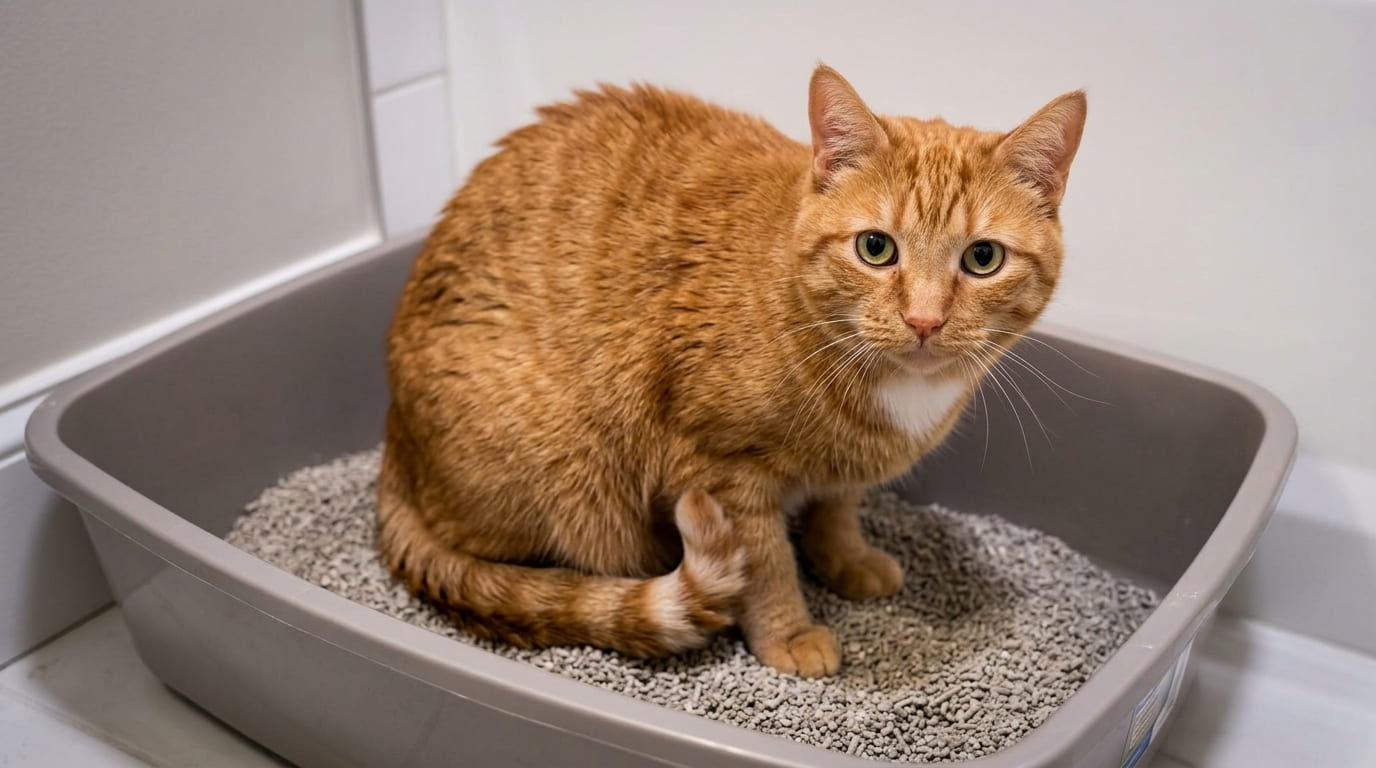
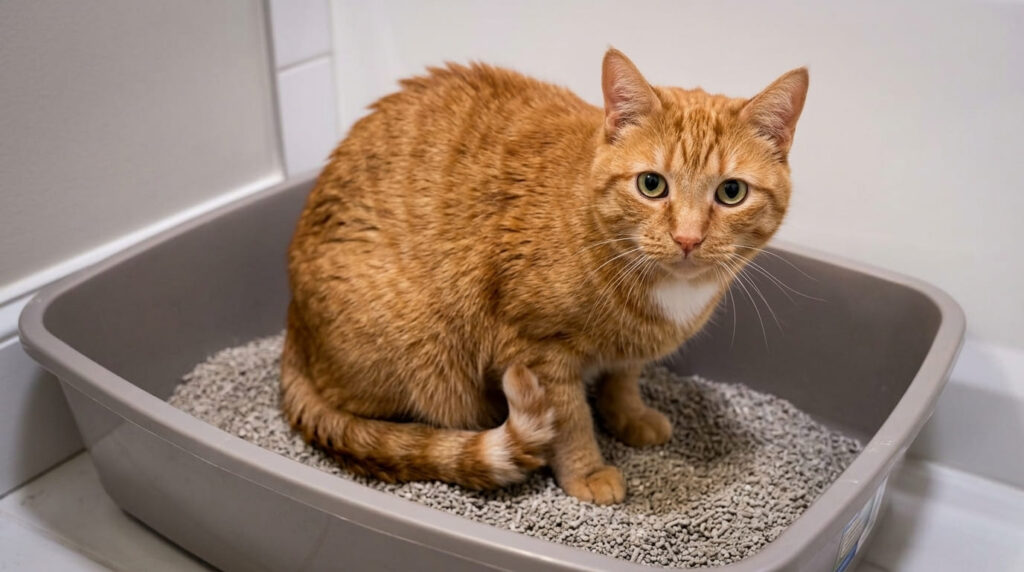
It was 6:47 in the morning when I counted Oliver’s sixth trip to the litter box in ten minutes. Not six casual visits — six urgent, hunched, straining attempts that produced nothing but a low, guttural howl that I had never heard from him before and hope to never hear again. As a veterinary technician, I knew immediately what I was looking at: a potential urethral obstruction.
A genuine, life-threatening emergency that can kill a cat within 24 to 48 hours if left untreated. We were in a taxi to the emergency animal hospital within four minutes of that sixth trip. Oliver was catheterized, hospitalized for two days, and came home wearing a cone and a look of profound personal betrayal. That morning restructured everything I thought I knew about indoor cat urinary health — and as someone who works in veterinary medicine, that humility was significant.
Indoor cat urinary health is consistently the number one medical concern I see in apartment-dwelling cat owners, and the reason is not coincidental: the confined, sedentary, often stress-saturated environment of indoor life is a near-perfect incubator for the constellation of conditions we call Feline Lower Urinary Tract Disease.
Quick Answer: How to Maintain Indoor Cat Urinary Health?
Optimizing indoor cat urinary health requires a three-pronged approach: increasing hydration through wet food and water fountains, maintaining pristine litter box hygiene to prevent urine holding, and reducing environmental stress through multimodal environmental modification. Early recognition of FLUTD signs — straining, frequent trips, or licking the urogenital area — is critical to prevent life-threatening urethral obstructions.
What is FLUTD? (Breaking Down FIC, Crystals, and Stones)
FLUTD stands for Feline Lower Urinary Tract Disease — and it is not a single diagnosis. It is a clinical umbrella covering several distinct conditions that share overlapping symptoms but have meaningfully different causes, treatments, and risk profiles.
Understanding what is actually happening inside your cat’s bladder and urethra is the foundation of protecting their indoor cat urinary health long-term.
Feline Idiopathic Cystitis (FIC)
FIC is the most common diagnosis within the FLUTD umbrella, accounting for approximately 55–65% of all FLUTD cases in cats under 10 years old. “Idiopathic” means we cannot identify a specific physical cause — no bacteria, no crystals, no stones. The bladder is inflamed, painful, and dysfunctional, and the primary driver in most cases is stress.
The bladder wall in a cat with FIC becomes hyper-permeable during stress events. Stress hormones alter the protective glycosaminoglycan (GAG) layer that normally lines the bladder, allowing irritating urinary components direct contact with the bladder wall tissue. The result is inflammation that looks identical to a bacterial infection — but does not respond to antibiotics, because bacteria are not the cause.
This is the mechanism that makes indoor cat urinary health so specifically tied to environmental factors. A cat experiencing chronic low-grade stress from a sedentary indoor environment, resource competition, or disrupted routine is a cat whose bladder wall is perpetually compromised.
Urinary Crystals
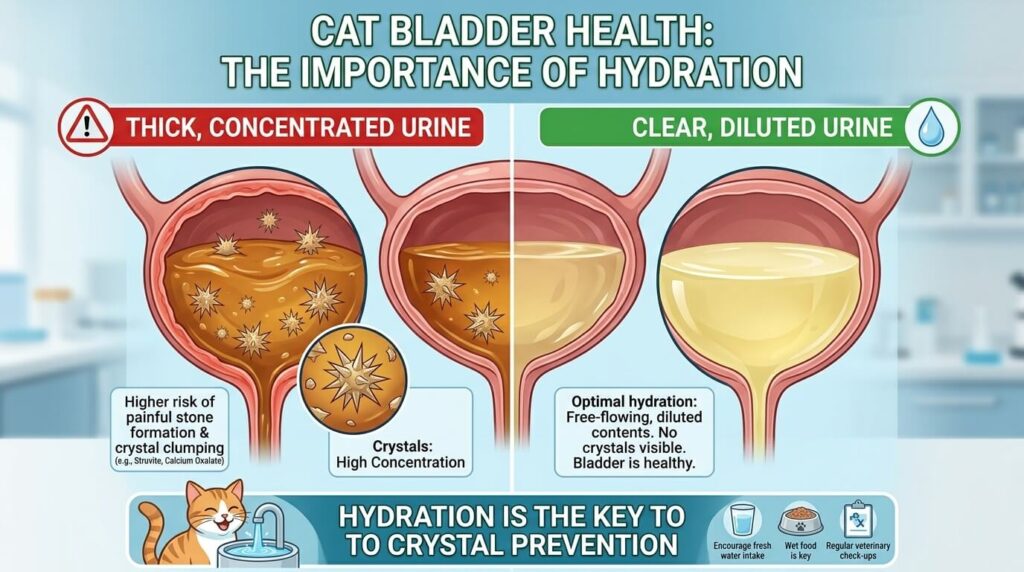
Struvite and calcium oxalate are the two most clinically relevant crystal types in cats. Crystals form when urine becomes supersaturated with minerals — a direct consequence of insufficient water intake and overly concentrated urine.
Struvite crystals form in alkaline urine and are strongly associated with dry food-heavy diets and low hydration. Calcium oxalate crystals form in acidic urine and are more common in older cats and certain breeds including Persians, Himalayans, and Ragdolls.
Crystals are not always directly pathological in small amounts, but they are an indicator that indoor cat urinary health is compromised — and they create the irritating physical environment in which inflammation, blockage risk, and stone formation all increase.
Urinary Stones (Uroliths)
Uroliths are mineralized concretions that form in the bladder or, critically, in the urethra. They are less common than FIC but more mechanically dangerous — a stone lodged in the narrow male cat urethra causes complete obstruction, which is the emergency Oliver experienced.
Struvite stones can often be dissolved through dietary management. Calcium oxalate stones cannot, and require surgical or endoscopic removal. Neither type appears overnight — they represent the endpoint of a urinary health trajectory that had warning signs for months or years.
Bacterial Urinary Tract Infections (UTIs)
True bacterial UTIs are actually uncommon in cats under 10 years old — occurring in only about 2% of young cats presenting with FLUTD symptoms. They become more prevalent in senior cats, diabetic cats, and cats with chronic kidney disease.
This is clinically important because it means that treating a young cat’s straining and frequent urination with antibiotics alone, without ruling out FIC, crystals, or stones, frequently fails — because the underlying cause is not bacterial.
The “Indoor Trap”: Why Stress and Sedentary Life Hurt the Bladder
Oliver lives in my apartment. He does not hunt. He does not patrol a territory. He does not interact with other cats, weather, or the full sensory environment his biology was designed to navigate. And while this keeps him safe from cars, predators, and infectious disease, it creates a specific and well-documented stress profile that directly damages indoor cat urinary health.
This is what I think of as the Indoor Trap — and it operates through three interconnected mechanisms.
The Stress-Urinary Axis
The hypothalamic-pituitary-adrenal (HPA) axis — the body’s primary stress response system — is directly implicated in FIC development. Buffington and colleagues demonstrated in landmark research that cats with FIC show abnormal HPA axis reactivity, with blunted cortisol responses but heightened sympathetic nervous system activation during stressors.
In practical terms: an indoor cat experiencing chronic stress from environmental inadequacy does not just feel anxious. Their bladder wall chemistry changes. The protective mucus layer thins. Inflammation follows. The bladder becomes the organ that bears the physiological cost of psychological stress.
Common indoor stressors that compromise indoor cat urinary health include:
- Changes in household routine — a new work schedule, a new partner, travel
- Multi-cat household tension — resource competition even between cats who appear to “get along”
- Insufficient vertical space and environmental complexity
- Outdoor cat visibility through windows — watching cats they cannot access or retreat from
- Loud or unpredictable noise — construction, frequent parties, building hallway chaos
Sedentary Behavior and Obesity
Indoor cats move dramatically less than their outdoor counterparts. Reduced activity directly correlates with reduced water consumption — a cat that is not moving is not panting, not seeking water, and not producing the volume of dilute urine that flushes the lower urinary tract of accumulated minerals and debris.
Obesity, which affects an estimated 35–63% of domestic cats in developed countries, compounds this through hormonal dysregulation that further reduces mobility and increases systemic inflammation — both of which worsen the conditions that damage indoor cat urinary health.
Dry Food Dependency
A mouse, which constitutes approximately 70% of a wild cat’s natural diet, is about 70% water by weight. A bowl of dry kibble is approximately 10% water. A cat whose primary or sole nutrition source is dry food is operating in a state of chronic mild dehydration — and their kidneys and bladder are managing that deficit every single day.
This biological mismatch between feline evolution and modern feeding practices is one of the most significant and underappreciated factors in indoor cat urinary health decline.
Red Flags: Signs Your Cat Needs an Emergency Vet Visit
This section is the one I most need you to read carefully and remember. The difference between a cat with manageable FIC and a cat dying of urethral obstruction can be a matter of hours, and the early signs look deceptively similar.
Signs That Require a Same-Day Emergency Vet Visit
- Straining without production — visiting the litter box repeatedly and producing no urine or only drops
- Crying or vocalizing during urination attempts
- Blood in urine (hematuria) — can range from pink-tinged to frank red
- Licking the urogenital area excessively, particularly after litter box visits
- Urinating outside the litter box, especially in small amounts in unusual locations
Signs That Indicate an Active Urethral Obstruction — Call an Emergency Hospital Immediately
Urethral obstruction is a medical emergency with no safe “wait and see” window. Signs include:
- Complete absence of urine production despite repeated straining
- Distended, painful abdomen — the bladder fills rapidly during obstruction and can be felt or seen as a hard mass in the lower belly
- Lethargy, collapse, or unresponsiveness — these indicate systemic toxicity from urinary waste buildup
- Vomiting combined with straining
- Open-mouth breathing in a cat — always an emergency regardless of context
- Cold extremities or gums that are pale, white, or grayish
A male cat who has not produced urine in 12 hours and is straining should be treated as an emergency until proven otherwise. The urethra in male cats is significantly narrower than in females, making them dramatically more vulnerable to life-threatening obstruction. Male cats are approximately six times more likely to experience urethral obstruction than females.
Do not wait for morning. Do not call to schedule an appointment. Go directly to an emergency animal hospital.
The Prevention Protocol: MEMO (Multimodal Environmental Modification)
MEMO — Multimodal Environmental Modification — is the evidence-based framework developed by veterinary internist Dr. C.A. Tony Buffington at Ohio State University specifically for managing and preventing FIC in indoor cats. It is the current gold standard for addressing the environmental drivers of indoor cat urinary health compromise, and it works.
Buffington’s research demonstrated that implementing comprehensive MEMO reduced signs of sickness behavior (which includes urinary signs) in indoor cats by 75–80% — more effectively than any single pharmaceutical intervention.
MEMO operates across five environmental domains:
1. Safe Spaces and Vertical Territory
Cats under stress seek elevation and concealment. In an apartment without adequate vertical options, a stressed cat has no healthy coping behavior available to them — and that stress load goes somewhere, and that somewhere is often the bladder.
Implementation:
- Install cat trees or wall-mounted shelving at multiple heights
- Provide at least one enclosed hiding space per cat (a cardboard box works as well as any commercial product)
- Ensure every cat has a resting location that other pets and people cannot access without their consent
2. Litter Box Optimization
An aversive or dirty litter box causes cats to hold their urine — and chronically concentrated, held urine is a direct risk factor for crystal formation, bladder wall irritation, and indoor cat urinary health deterioration. As we detail in our complete guide to optimal litter box setup and hygiene, the specific variables of box number, size, substrate type, and cleaning frequency all have measurable impacts on a cat’s willingness to use the box consistently.
The baseline rules:
- One box per cat, plus one — minimum requirement in multi-cat households
- Scoop at least once daily, ideally twice
- Full litter replacement and box washing monthly
- Unscented litter — scented litters are aversive to most cats
- Box large enough for the cat to turn around completely (1.5× the cat’s body length)
- Uncovered preferred — covered boxes trap ammonia odors that deter use
3. Play and Predatory Activity
Indoor cats need structured opportunities to express predatory behavior. Play is not a luxury in indoor cat management — it is a physiological necessity. Regular play reduces the chronic low-level sympathetic nervous system activation that drives FIC.
Implementation:
- Two structured play sessions daily of 10–15 minutes each
- Wand toys that mimic prey movement patterns — linear-moving toys are less engaging than erratic, prey-like movement
- Puzzle feeders that require problem-solving for food access
- Rotate toys weekly to maintain novelty
4. Positive Social Interaction
This variable is cat-specific and requires observation rather than assumption. Some cats benefit from increased human interaction; others find it intrusive. The key is offering interaction on the cat’s terms — allowing the cat to initiate contact, terminate contact, and choose proximity.
Forced holding or restraint is a measurable acute stressor for cats and should be minimized outside of necessary veterinary handling.
5. Consistent Routine
Cats are extraordinarily routine-dependent animals. Feeding, cleaning, play, and human schedules that are predictable reduce the background stress load that compromises indoor cat urinary health. This is particularly relevant during life transitions — moving, new family members, schedule changes — which are among the most reliable triggers for FIC episodes.
Diet and Hydration: The Wet Food Advantage
If I could make one single change to the standard indoor cat care protocol that would have the largest positive impact on indoor cat urinary health, it would be transitioning from dry-food-primary feeding to wet-food-primary feeding. The evidence for this is not subtle.
The Hydration Argument
A cat consuming wet food as their primary diet ingests approximately 180–230ml of water per day through food alone. A cat on a dry-food-only diet needs to compensate for roughly 170ml per day through voluntary drinking — and cats are notoriously poor voluntary drinkers whose thirst drive evolved to function through prey consumption rather than standing water sources.
The result is that dry-food-fed cats consistently produce more concentrated urine with a higher specific gravity — urine that is more supersaturated with minerals, more irritating to the bladder wall, and more likely to form crystals. As we cover extensively in our full breakdown of feline hydration needs and water intake optimization, the relationship between dietary moisture content and lower urinary tract health is one of the most consistently supported findings in feline nutrition research.
Practical wet food transition guidelines:
- Transition gradually over 7–10 days to avoid gastrointestinal upset
- Mix increasing ratios of wet to dry across the transition period
- Warm wet food to approximately body temperature (38°C) — this enhances aroma and palatability
- Divide daily intake into 2–3 meals rather than free-feeding
Water Fountains: Moving Water Preference
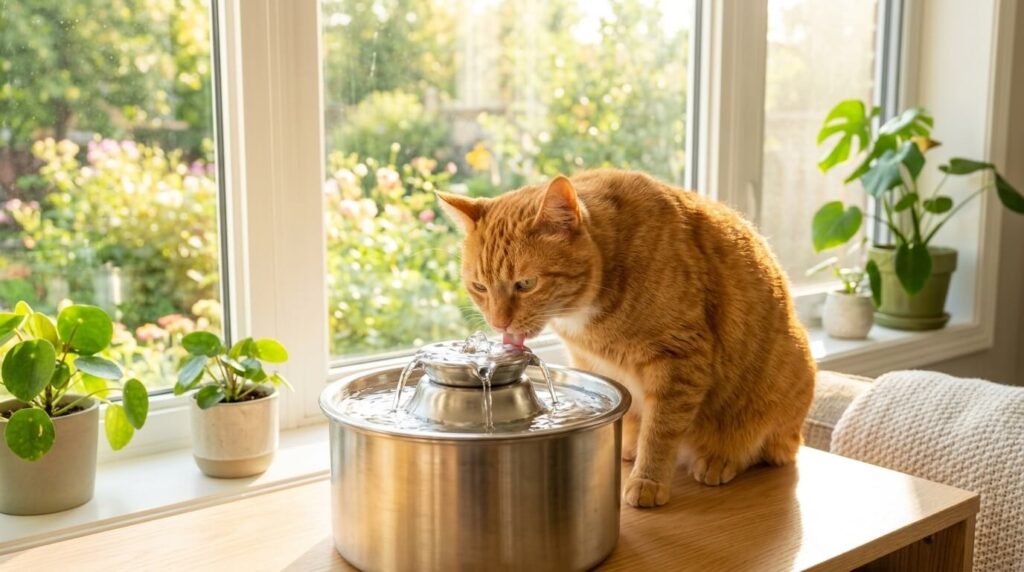
Cats show a documented preference for moving water over still water — an evolutionary preference likely linked to the relative safety and freshness of running water sources in nature. Stationary water bowls, particularly in locations near food or litter boxes, are frequently avoided even by cats who are mildly dehydrated.
As we discuss in our guide to the best stainless steel cat water fountains, a quality recirculating fountain can meaningfully increase a cat’s daily voluntary water intake — with some studies showing increases of 40–60% over bowl-drinking baselines in cats who showed initial preference for moving water.
Fountain selection criteria for indoor cat urinary health:
- Stainless steel or ceramic — plastic fountains develop biofilm in scratches that plastic cleaning cannot fully eliminate
- Multiple flow settings — some cats prefer a trickle; others prefer a stream
- Filter replacement capacity — charcoal and foam filters should be replaceable at 2–4 week intervals
- Quiet motor — a loud motor deters use in acoustically sensitive cats
- Size appropriate for household cat number — larger reservoir for multi-cat households to maintain consistent water level
Prescription Urinary Diets
For cats with a confirmed history of struvite crystals, calcium oxalate crystals, or recurrent FIC, a veterinary prescription urinary diet is often indicated. These diets are specifically formulated to:
- Produce urine pH within an optimal range (6.0–6.5 for struvite prevention)
- Restrict specific minerals based on crystal type
- Increase dietary moisture content (in wet formulations)
- Include ingredients that support the GAG layer of the bladder wall
Prescription urinary diets should only be used under veterinary guidance — the mineral restriction profiles that protect cats with one crystal type can create risk for cats predisposed to a different type.
FAQ
Can stress cause urinary problems in cats?
Yes — and this is one of the most important and most underappreciated facts in feline medicine. Feline Idiopathic Cystitis, the most common cause of FLUTD in young to middle-aged cats, is directly linked to stress through the HPA axis and sympathetic nervous system.
Stress hormones alter the protective mucus layer of the bladder wall, causing inflammation that produces all the clinical signs of a urinary problem — straining, frequent trips to the litter box, blood in urine — without any bacterial or crystalline cause. Managing indoor cat urinary health therefore requires managing the cat’s psychological environment, not just their diet and hydration.
What is the best food for indoor cat urinary health?
The most evidence-supported dietary approach for indoor cat urinary health is wet food as the primary or sole diet, because of its dramatically higher moisture content compared to dry food. If wet food is not feasible as the sole diet, a mixed feeding approach — wet food at least once daily with reduced dry food — is significantly better than dry-only feeding.
For cats with a history of crystals or FIC, a veterinary prescription urinary diet in wet formulation represents the highest level of dietary intervention. Water intake through a moving fountain source should accompany any diet choice.
How do I know if my cat has a urinary blockage?
A urethral obstruction is distinguished from uncomplicated FIC or cystitis by the complete absence of urine production despite repeated, urgent straining. A cat with FIC or mild cystitis typically produces small amounts of urine — possibly blood-tinged, possibly very small volumes — during their frequent litter box visits.
A cat with a urethral obstruction produces nothing, or only a drop or two, despite visible straining effort. Additional signs of obstruction include a visibly distended or hard lower abdomen, vocalizing in pain during straining, progressive lethargy, and eventually collapse.
Any male cat who appears to be straining without producing urine should be taken to an emergency veterinary hospital immediately — this is not a condition that can be safely monitored at home overnight.
References
- Buffington, C. A. T., Westropp, J. L., Chew, D. J., & Bolus, R. R. (2006). Clinical evaluation of multimodal environmental modification (MEMO) in the management of cats with idiopathic cystitis. Journal of Feline Medicine and Surgery, 8(4), 261–268. https://doi.org/10.1016/j.jfms.2006.02.002
- Westropp, J. L., & Buffington, C. A. T. (2004). Feline idiopathic cystitis: Current understanding of pathophysiology and management. Veterinary Clinics of North America: Small Animal Practice, 34(4), 1043–1055. https://doi.org/10.1016/j.cvsm.2004.03.002
Oliver came home from the emergency hospital on a prescription urinary wet food, with a water fountain order already placed on my phone, and a litter box that I now scoop with the dedication of someone who has seen what happens when indoor cat urinary health is treated as a secondary concern. He is fine. He is better than fine — his last urinalysis showed a specific gravity of 1.030, a perfect pH, and no crystals. He is wearing his usual expression of dignified indifference. I am wearing the expression of someone who learned the hard way and will not be learning it again.