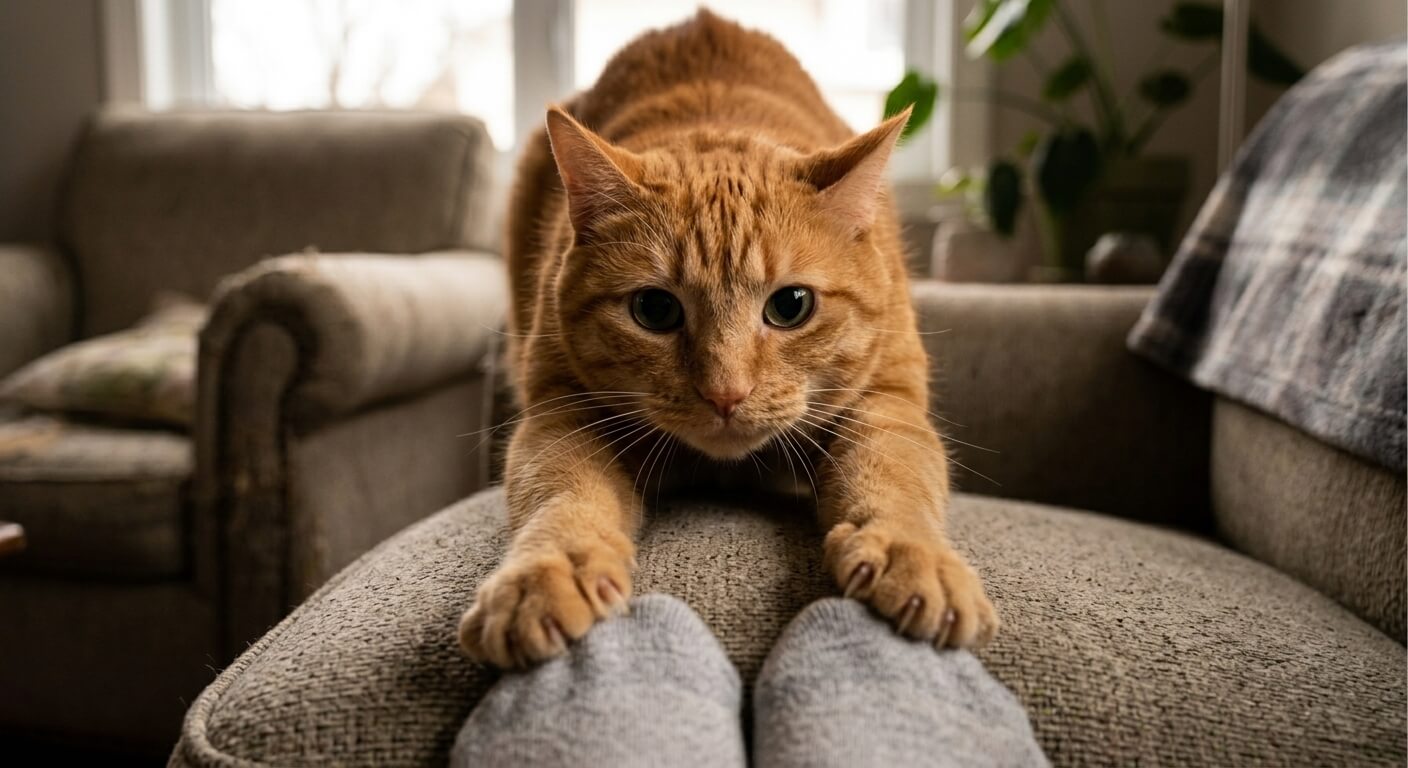
It was a peaceful Tuesday evening until Oliver launched himself at my ankle from behind the sofa. The bite was quick, committed, and confusing. One second he looked relaxed; the next, my foot had apparently become prey.
If you are asking “why does my cat bite me,” the answer is usually not that your cat hates you. In indoor cats, biting often comes from play aggression, overstimulation, fear, redirected frustration, or pain. The key is learning which type of biting you are seeing before you try to stop it.
This guide explains how to tell playful biting from real aggression, how to redirect hunting energy safely, when to stop petting, and when a sudden change in biting means your cat needs a veterinary exam.
Quick Answer: Why Does My Cat Bite Me During Play?
Your cat may bite you during play because their hunting instinct is being redirected toward your hands, ankles, or moving feet. This is called play aggression, and it is common in indoor cats who do not get enough safe outlets for stalking, chasing, pouncing, grabbing, and biting toys.
Biting is only one part of the wider indoor behavior picture. For related guides on aggression, rough play, staring, hiding, and training, see our cat behavior guides for indoor cats.
However, not every bite is play. Cats may also bite because they are overstimulated during petting, frightened, redirected from another stressor, or painful. If the biting is sudden, severe, increasing, or linked to touching one body area, schedule a veterinary exam before treating it as a training problem.
Important Safety Note: Do not punish, yell at, hit, scruff, or chase a cat for biting. Punishment can increase fear and defensive aggression. If a bite breaks skin, wash the wound well and contact a medical professional if you notice swelling, redness, warmth, pus, fever, or increasing pain.
Disclaimer: This article is written by a certified veterinary technician and feline behavior enthusiast for educational and informational purposes only. It does not constitute veterinary or veterinary behavior advice. If your cat’s biting behavior is severe, sudden in onset, or accompanied by signs of illness, please consult a licensed veterinarian or certified veterinary behaviorist.
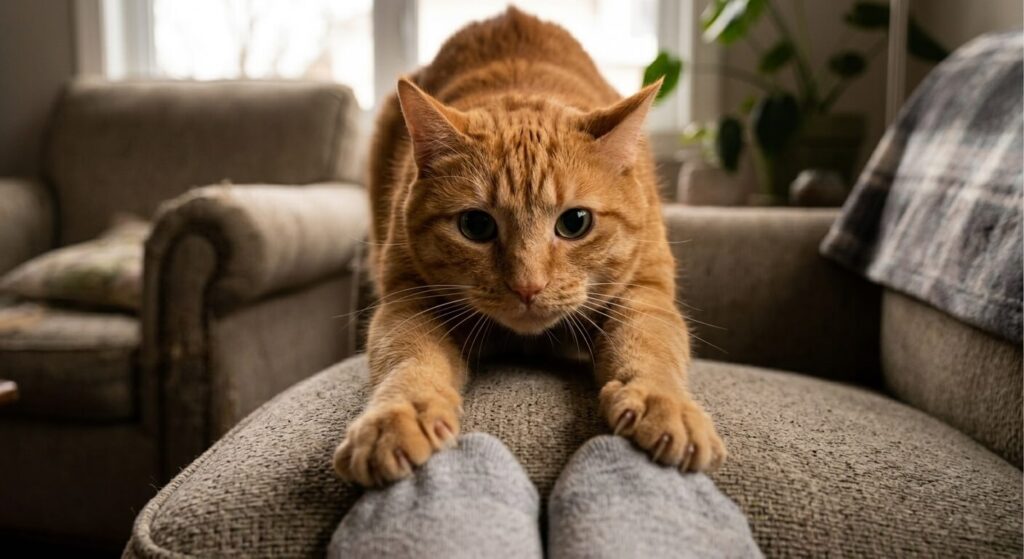
Table of Contents
The Apex Predator in Your Living Room: Why Instinct Bites
Before we can meaningfully answer why does my cat bite me, we need to spend a moment genuinely reckoning with what a domestic cat actually is — because most of us, most of the time, relate to our cats as if they are small, fluffy companions who happen to be picky about food. The behavioral reality is considerably more complex and considerably more fanged.
The Predator That Domestication Didn’t Tame
Felis catus — the domestic cat — diverged from its wild ancestor Felis silvestris lybica approximately 10,000 years ago. In the context of evolutionary time, this is extraordinarily recent. Dogs have been selectively bred for human companionship for 15,000–40,000 years, with deliberate human selection pressure shaping temperament, social behavior, and impulse control across hundreds of generations.
Cats, by contrast, largely self-domesticated — moving toward human settlements for the reliable rodent populations that accompanied grain storage, rather than being selectively bred for behavioral modification. The result is an animal whose social behavior and communication style has been modified by proximity to humans, but whose core Predatory Drive is essentially intact.
What this means practically:
- A domestic cat retains the full predatory sequence of their wild ancestor: stalk → rush → pounce → bite → kill
- This sequence is neurologically hardwired — it produces genuine dopaminergic reward at each stage, meaning hunting feels good at a neurochemical level
- The sequence is not triggered by hunger — it is triggered by movement. A well-fed cat with a full bowl will still hunt, because hunting and feeding are controlled by separate neural circuits.
- The sequence demands completion. An animal that stalks without being able to pounce, or pounces without being able to bite, accumulates frustration that eventually redirects.
That redirected frustration — toward your ankles, your hands, your feet as they move under the duvet — is the most common answer to why does my cat bite me.
The Hunting Sequence in Your Living Room
When Oliver ambushed my ankle, he wasn’t being random. He was executing an abbreviated but complete predatory sequence:
- Stalk: Forty minutes of stillness, pupils widening, weight shifting — I missed all of it
- Rush: The sudden explosive launch from the cat tree
- Pounce: Both forepaws making contact simultaneously to immobilize the “prey”
- Bite: The killing bite to the back of my ankle — targeting the simulated “nape of the neck” of a small prey animal
- Release and retreat: Satisfied, the sequence complete
My ankle was, to Oliver’s nervous system, a mouse. A very large, surprisingly vocal mouse — but the behavioral sequence doesn’t require accurate prey identification. It requires movement.
Why Indoor Life Creates Biting Problems
Outdoor cats complete the predatory sequence dozens of times per day — stalking insects, birds, small mammals, and each other. The neurological reward is earned and the Predatory Drive is continuously discharged.
Indoor cats — particularly those in apartments without access to outdoor spaces — may go entire days without a single opportunity to complete the sequence. The drive accumulates. The frustration builds. And then you walk past in socks.
This is the foundational answer to why does my cat bite me: not malice, not dominance, not affection inversion. Biology, expressing itself through the most available outlet.
Play Aggression vs. Real Aggression: How to Tell the Difference
Not all cat biting is play aggression, and the distinction matters clinically. Misreading the type of aggression leads to inappropriate responses that either fail to address the real problem or, worse, escalate a genuinely dangerous situation.
Cat Biting Meaning Table
| Bite Pattern | Most Likely Meaning | What to Do First |
|---|---|---|
| Quick bite during play | Play aggression or hunting overflow | Stop hand play and redirect to a wand toy |
| Bite after several seconds of petting | Overstimulation | Stop touching earlier and watch body language |
| Bite with hissing, crouching, or pinned ears | Fear or defensive aggression | Give space and remove the trigger |
| Bite after seeing another cat outside | Redirected aggression | Do not touch the cat; separate and let them calm down |
| Sudden bite from a normally gentle cat | Pain, illness, or sensitivity | Schedule a veterinary check |
| Kitten bites hands and ankles | Normal predatory practice without boundaries | Use toys, not fingers, for all play |
| Bite followed by licking or staying nearby | Mixed arousal, not “revenge” | Lower excitement and use calmer interaction |
The important point is that biting is not one behavior. A cat who bites during chase play needs a different plan than a cat who bites because their back hurts, the room is too noisy, or another animal has frightened them.
When the biting comes from a young cat raised without another kitten, our single kitten syndrome guide explains how to redirect rough play without treating an informal label as a diagnosis.
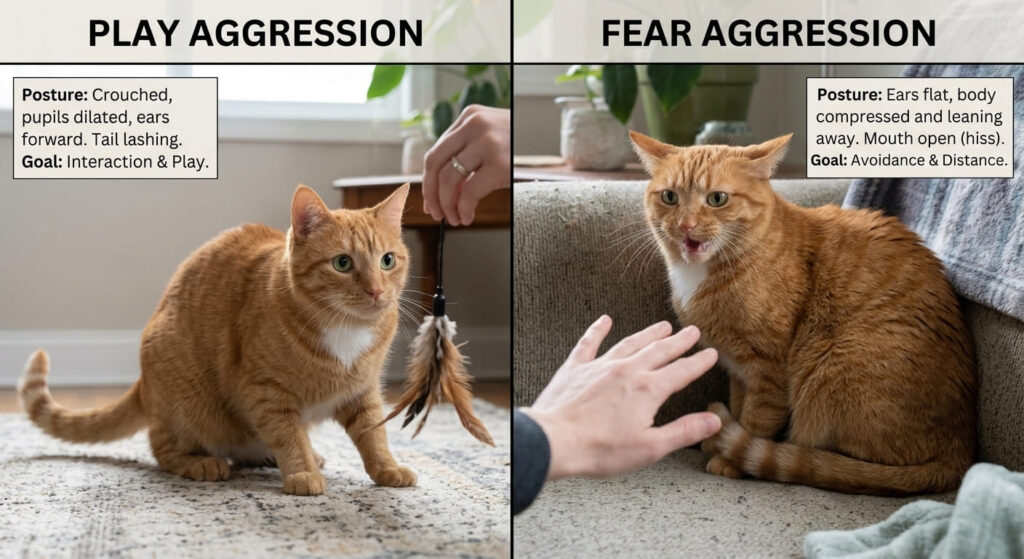
Play Aggression: The Characteristics
Play aggression is the type most commonly responsible for owners asking why does my cat bite me, and it has a recognizable behavioral profile:
Body language before the bite:
- Pupils dilated (high arousal, predatory focus)
- Ears forward or slightly to the side — not flat
- Body low and coiled — the “pounce posture”
- Tail lashing rhythmically
- Whiskers forward
- The cat may “chatter” at moving objects or wiggle their hindquarters before launching
The bite itself:
- Usually relatively brief — a grab-bite-release pattern rather than sustained clamping
- Directed at extremities in motion — ankles, feet, hands in movement
- May be accompanied by bunny kicking (both hind legs raking rapidly) — this is the “kill grip” of the predatory sequence
- The cat releases and retreats, or releases and immediately re-engages in a play pattern
After the bite:
- The cat is energized, not distressed
- They may immediately seek another target or redirect to a toy
- There is no sustained defensive posturing
- The cat’s overall demeanor is aroused but not aggressive in a sustained threat sense
What play aggression is NOT:
- A dominance challenge
- Hatred or dislike of the person bitten
- Random — it follows the predatory sequence logic of movement triggering response
Fear Aggression: When It’s Something Different
Fear aggression has a completely different behavioral signature and requires a completely different response:
Body language:
- Ears flat against the skull
- Pupils may be dilated but the overall body posture is defensive, not offensive
- Body low and compressed — shrinking away, not coiling to pounce
- Hissing, growling, spitting preceding the bite
- Tail tucked or puffed
- The cat is trying to create distance, not engage
The bite:
- Sustained and intended to cause maximal deterrence
- Accompanied by sustained vocalization
- The cat retreats immediately after and continues to display defensive posturing
Context:
- Triggered by a perceived threat — unfamiliar person, new environment, cornering
- The cat wants to escape, not engage
Redirected Aggression: The Dangerous Middle Ground
Redirected aggression is the most dangerous type and the one most commonly misidentified as play aggression:
What it is: The cat is aroused by an external stimulus they cannot access (a bird outside the window, another cat on the street, a loud noise) and redirects that arousal toward the nearest available target — which may be you.
Why it’s dangerous: Unlike play aggression, redirected aggression involves a fully aroused threat response displaced onto an available target. Bites are sustained, severe, and determined.
Key distinguishing features:
- Often preceded by an identifiable arousal trigger (the cat was watching something through the window, heard something alarming)
- The cat may not respond to your voice or name — they are in a fully aroused state
- Do not attempt to handle or redirect a cat in a redirected aggression episode. Leave the room. Give the cat 20–30 minutes to de-arouse. Approach only when all arousal signals have resolved.
If your cat redirects chewing or biting toward wires, use this behavior plan alongside our guide on how to stop cat chewing cords safely.
Overstimulation Biting: The Petting-Induced Bite
The third common bite type that generates the question why does my cat bite me is Overstimulation biting — sometimes called “petting-induced aggression.” This is covered in detail in the FAQ section, but briefly:
Some cats have a neurological threshold for tactile stimulation beyond which they experience discomfort or sensory overload. The bite is a communication: “I have reached my limit.”
This is neither play nor fear — it is a sensory communication with a very short warning window.If the aggression appeared suddenly or feels more intense than normal play, read our guide to why an indoor cat suddenly becomes aggressive before assuming it is only play.— Learning to read the subtle pre-bite signals your cat sends before Overstimulation biting is one of the most valuable feline behavior skills you can develop, and our detailed guide on cat body language and petting signals walks you through the exact signals to watch for before they escalate to a bite.
Interestingly, a cat may stop purring right before an overstimulation bite. Understand the modular nature of feline sounds in our guide:A cat may still purr before an overstimulation bite, so learn what cat purring can mean in different emotional states.
5 Safe Ways to Stop Cat Play Biting
These are the behavioral interventions I use with Oliver and recommend to every owner who comes into the clinic asking why does my cat bite me. They work — but they require consistency. Feline behavioral modification is not a single conversation; it is a protocol applied repeatedly until new patterns replace old ones.
Step 1: Redirect the Bite Toward a Toy
The most immediately effective intervention for play aggression is also the most intuitive once you understand the predatory drive framework: give the predator an appropriate outlet for the complete hunting sequence.
Redirection means intercepting the arousal before it lands on your skin and channeling it toward an appropriate target.
The timing of Redirection is critical:
- Before the pounce: Ideal. When you see the stalking posture — the low body, the dilated pupils, the wiggling hindquarters — introduce a toy immediately. You are redirecting an arousal that hasn’t yet committed to a target.
- During an approach: Throw a toy in the opposite direction from yourself. Do not reach toward the cat — your reaching hand becomes the target.
- After a bite: Too late for this episode. The sequence is complete. Focus on prevention for the next cycle.
The most effective toy types for Redirection:
For cats who need more hunting outlets when you are busy, compare the best interactive cat toys for solo play.
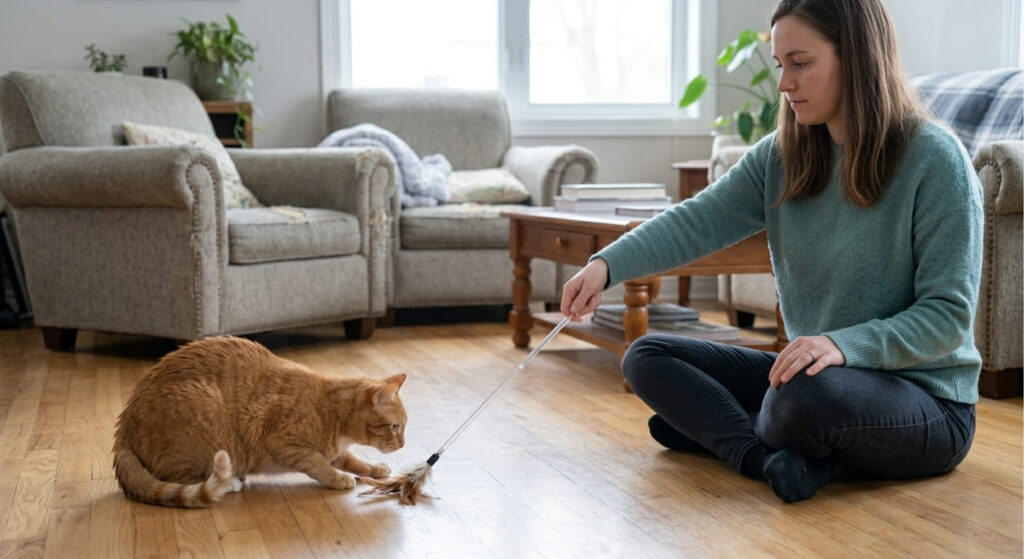
Wand toys with feather or fur attachments are the gold standard for active Redirection sessions because:
- They allow you to control the movement pattern (mimicking real prey: erratic, ground-level, pausing)
- They maintain safe physical distance between your hands and the cat’s teeth
- They allow the complete predatory sequence to execute: stalk → rush → pounce → bite → kill
- The kill must be “completed” — allow the cat to capture and bite/kick the toy at the end of the sequence, then let it go still. Ending a play session without a “kill” leaves arousal unresolved.
Automatic/electronic toys serve a different but valuable function — they provide hunting stimulation during times when you’re not available for interactive play, preventing the accumulation of Predatory Drive frustration that leads to ankle ambushes.
Step 2: Make Hands Boring When Teeth Touch Skin
This is the single most important behavioral rule for anyone asking why does my cat bite me — and the one most reliably violated in the moment of a bite.
The rule: When a cat bites or mouths your hand, the hand becomes completely motionless and all human attention is immediately withdrawn.
Why it works:
The predatory sequence is triggered and maintained by movement. A hand that moves — even to pull away — extends the prey stimulus. A hand that yanks back rapidly creates a fleeing-prey stimulus that escalates the engagement.
A hand that stops moving is no longer prey. It is an uninteresting object. The neurological reward for biting it evaporates.
The protocol:
- Cat makes contact with teeth
- Complete stillness — freeze the hand entirely, no pulling, no pushing
- No vocalization — do not say “ow,” “no,” or the cat’s name. Vocalization is social engagement; any response keeps the interaction active.
- Allow 3–5 seconds of complete stillness
- Slowly and boringly withdraw — move the hand with the speed of something deeply uninteresting, not the speed of fleeing prey
- Stand and leave the room — disengage completely for 1–2 minutes (the “time-out” for yourself, not the cat)
What not to do:
- Yank your hand away (creates fleeing prey stimulus — escalates)
- Push toward the cat’s mouth (creates threat stimulus — may escalate to defensive bite)
- Say “no” or the cat’s name (social engagement)
- Spray water (creates negative association with you, not with the behavior; damages trust)
- Tap the cat’s nose (same problem — often escalates aggression)
The time-out for the owner:
Leaving the room is not punishment for the cat in the way punishment is understood for humans. Cats do not experience the absence of a person as a consequence associated with a specific behavior. What leaving the room does is remove your moving body parts from the environment — eliminating the stimulus. Over many repetitions, the cat begins to associate biting with the sudden and complete disappearance of the interesting moving human. This is operant conditioning, not punishment.
Step 3: Use a Consistent Daily Play Routine
If the question why does my cat bite me has a single root cause in the majority of indoor cat households, it is insufficient daily predatory outlet. The solution is a structured, consistent play protocol that proactively discharges Predatory Drive before it redirects toward your extremities.
The evidence-based protocol:
- Two dedicated play sessions per day — morning and evening
- 10–15 minutes per session for adult cats; 15–20 minutes for kittens and young adults
- Interactive wand toy — you control the movement; make it realistic (ground-level, erratic, with pauses)
- The session must end with a “kill”: Allow the cat to catch, bite, and bunny-kick the toy. Hold it still. Let them “finish” it.
- Feed a small meal after the evening play session — this mirrors the natural hunt → catch → kill → eat sequence and promotes satisfying, complete behavioral closure. Many cats who play before their evening meal show significantly reduced nighttime activity and ankle ambushing.
If your cat bites more at night, use this routine with our guide on how to tire out an indoor cat before bed. — Increasing total daily structured activity is the foundational intervention for reducing play aggression and all feline behavioral outbursts driven by excess energy. Our comprehensive guide to indoor cat exercise covers breed-specific activity requirements, apartment-friendly exercise protocols, and the specific play techniques that produce maximum behavioral benefit in minimum time.
Signs a play session was effective:
- Cat engages intensely for the first 5–7 minutes then naturally disengages
- Cat grooms after the session (post-hunt grooming is a normal behavioral sequence)
- Cat seeks a resting spot and settles without redirecting to other targets
- Ankle ambushes and hand-biting frequency decreases over 1–2 weeks of consistent sessions
Step 4: Reduce Boredom With Indoor Enrichment
Predatory Drive doesn’t only discharge through active hunting. It can be meaningfully addressed through a broader enrichment strategy that keeps the feline mind engaged throughout the day.If your apartment setup feels too boring or predictable, use this behavior plan alongside our indoor cat enrichment in small apartments guide.
A cat whose environment provides continuous, varied, low-level stimulation is a cat who accumulates less behavioral frustration — and therefore a cat less likely to redirect onto your ankles when you walk through the living room.
The enrichment pyramid for apartment cats:
Tier 1 — Sensory stimulation (passive, always available):
- Window perch at a bird or squirrel-active window
- Bird feeder placed within visual range of the window
- “Cat TV” — dedicated streaming content featuring birds, fish, and small animals at low volume
- Rotating variety of textures in resting spots (different fabrics, temperatures, heights)
Tier 2 — Cognitive engagement (semi-active, refreshed regularly):
- Puzzle feeders for at least one meal daily — feeding from a puzzle requires problem-solving and physical engagement that mimics foraging behavior
- Food-dispensing toys that require batting and manipulation
- Rotating toy selection — a toy that has been available for 3 weeks is invisible to a cat; rotating toys back into availability every few days restores novelty interest
- Paper bags and boxes with unpredictable entry points
Tier 3 — Active engagement (daily, dedicated):
- The structured wand toy sessions from Secret #3
- Training sessions — yes, cats can be clicker-trained, and brief Positive Reinforcement training sessions (5 minutes, twice daily) provide significant cognitive engagement and strengthen the human-cat relationship
- Chase games with a laser pointer (always end with a physical toy “catch” to prevent frustration)
The rotation principle:
Environmental enrichment loses effectiveness when it becomes static. I rotate Oliver’s enrichment elements on a weekly basis — new puzzle feeder, different toy selection, repositioned window perch. The goal is a cat who encounters something worth investigating every day, reducing the accumulated boredom that contributes to play aggression.
Step 5: Reward Calm, Appropriate Play
The fifth and most sophisticated secret — and the one most owners implement last, if at all — is deliberately reinforcing behaviors that are incompatible with biting.
Positive Reinforcement means immediately rewarding desired behaviors with something the cat finds genuinely valuable (usually high-value treats, but also play access or affection for some cats).
What to reinforce:
- Gentle contact: When your cat approaches your hand and makes nose-contact or gentle cheek-rub contact without biting, mark the behavior immediately (a click if you use a clicker, or a distinct verbal marker like “yes”) and deliver a treat. You are teaching the cat that gentle contact produces reward; biting produces nothing.
- Toy engagement: When your cat redirects their hunting behavior to a toy rather than your skin, reinforce it immediately. You are making the toy interaction more rewarding than the human interaction.
- Calm proximity: When your cat is in close proximity to you with a relaxed body posture and no predatory arousal, reinforce it. You are building an association between calm presence and reward.
- “Four paws on the floor”: If ankle ambushing is a specific problem, reinforce all moments when the cat is near your feet but not engaging in predatory behavior.
Timing is everything in Positive Reinforcement:
The reward must arrive within 1–2 seconds of the target behavior for the cat to make the associative connection. A treat delivered 10 seconds after gentle contact is a treat for whatever the cat was doing 10 seconds later — not for the gentle contact. If you use a clicker or verbal marker, you can mark the exact moment of correct behavior and deliver the treat within the 2-second window.
What Positive Reinforcement is not:
- It is not bribery offered during bad behavior to stop it — this rewards the bad behavior
- It is not a single training session — behavioral change requires hundreds of reinforced repetitions across weeks
- It is not appropriate for every cat — some cats are not food-motivated enough for treat-based training, requiring alternative reinforcers
Giving the predator a job reduces frustration. For calm training sessions that reward better choices, start with our guide on how to clicker train a cat.
The ‘No Hands’ Rule: Why You Are Part of the Problem
I say this with complete compassion, because I have been part of the problem myself. Before Oliver ambushed my ankle that Tuesday, I had spent years occasionally wiggling my fingers under a blanket to make him pounce, letting him grab my wrist during play “because it was cute,” and using my hand to rough-house with him when a toy wasn’t nearby.
Every single one of those interactions was training. And what they trained was the answer to why does my cat bite me: they taught Oliver that human body parts are legitimate prey targets.
How Hands Become Prey
The learning process is simple operant conditioning:
- Human wiggles fingers under blanket
- Cat pounces and bites fingers
- Human laughs; wiggling continues
- Cat learns: finger movement = hunting game = rewarding
- Cat generalizes: hand movement = hunting game
- Cat further generalizes: moving human extremities = hunting game
This generalization happens faster in kittens, whose social and behavioral boundaries are established through play during the sensitive developmental period (2–7 weeks). A kitten who is routinely played with using hands and feet will have deeply ingrained hand-as-prey associations by the time they reach adulthood — associations that become increasingly problematic as their bite strength increases.
The Kitten Tax
People who have played rough with their kittens using hands almost universally become owners asking why does my cat bite me when that kitten reaches 1–2 years of age and their bite force, reaction speed, and predatory commitment reach adult levels. The behavior hasn’t changed — the consequences of the behavior have.
Implementing the No Hands Rule
- No exceptions: Every member of the household must follow the rule. One person who continues to use their hands as toys undermines the behavioral modification completely — intermittent reinforcement of hand-as-prey is, paradoxically, more powerful than consistent reinforcement.
- Replace hands immediately: When the urge to play with your cat arises and no toy is immediately available — keep a toy near every regular sitting area. I have a wand toy beside the sofa, beside my desk, and beside my bed. Availability eliminates the excuse.
- Redirect historical hand-players: If your cat has years of reinforced hand-targeting behavior, expect the extinction process to take 4–8 weeks of consistent no-hands application. The behavior will likely intensify briefly before it decreases (the “extinction burst”) — this is normal and means the protocol is working.
When Biting Is a Medical Sign: Pain and Hyperesthesia
The behavioral interventions above address the most common answers to why does my cat bite me — play aggression, Predatory Drive, and Overstimulation. But there is an important medical dimension to feline biting that every owner should understand, because sometimes the bite is not a behavior problem at all. It is a pain communication.
Kneading can sometimes transition into an overstimulation bite. Understand the trance-like state and Kneading can sometimes shift into overstimulation, so it helps to understand why cats knead before the bite happens.
Pain-Induced Biting
Cats in pain bite. This is one of the most consistent findings in feline behavior medicine, and it represents the most important reason to consult a veterinarian when biting behavior changes suddenly or appears in a cat with no prior history of aggression.
Red flags suggesting pain as the cause of biting:
- Sudden onset in a cat with no prior biting history
- Biting when specific areas of the body are touched — particularly the back, tail base, abdomen, or joints
- Biting accompanied by vocalizations when handled
- Biting in a cat who has recently lost weight or shown other signs of systemic illness
- Biting accompanied by changes in grooming, posture, or gait
Conditions that commonly manifest as biting in cats:
- Arthritis: Touch to painful joints produces defensive biting
- Dental disease: Facial and head handling triggers pain response
- Abdominal pain: IBD, constipation, urinary issues — handling the abdomen produces biting
- Hyperthyroidism: Skin sensitivity and hyperirritability from elevated thyroid hormone
Feline Hyperesthesia Syndrome (FHS)
Feline Hyperesthesia Syndrome — sometimes called “rolling skin disease” — is a poorly understood neurological condition characterized by extreme sensitivity of the skin, particularly along the dorsal midline (spine). Affected cats show:
- Sudden, dramatic skin rippling or rolling along the back
- Sudden turning to bite or scratch at the tail or back
- Dilated pupils and frantic, disorganized behavior during episodes
- Overstimulation responses to minimal touch along the spine
- Self-directed biting that may cause self-trauma
FHS is a diagnosis of exclusion — other causes of skin hypersensitivity (dermatitis, ectoparasites, spinal pain) must be ruled out first. If you observe these signs in your cat alongside biting behavior, a veterinary neurological assessment is warranted.
The Clinical Rule
Any sudden change in biting behavior — particularly in a cat over age 7, or a cat with no prior history of biting — warrants a veterinary examination before behavioral modification is attempted. Attempting to behavior-modify a cat in pain is both ineffective and unfair.
Frequently Asked Questions
1. Why Does My Cat Bite Me When I Pet Him?
This is Overstimulation biting — one of the most common, most misunderstood, and most preventable causes of the why does my cat bite me question.
The physiological explanation:
Cats have a sensory stimulation threshold — a point at which continued tactile input shifts from pleasant to overwhelming. When that threshold is crossed, the cat bites. Not from aggression, not from dislike, but from sensory overload. The bite is a communication: “I have reached my limit.”
The preceding warning signals most owners miss:
The bite is almost never the first signal. It is the last. In the 10–30 seconds before the bite, most cats display a sequence of escalating signals:
- Skin rippling or twitching along the back — the earliest and most subtle signal
- Tail movement: The tail begins to lash or thump — not the slow, lazy movement of contentment, but a rhythmic, increasingly rapid motion
- Ear rotation: Ears begin to rotate backward or flatten slightly
- Body tension: The cat becomes subtly stiffer; the relaxed melting quality of contentment disappears
- Head turning: The cat turns their head to look at your hand
- Bite
Most owners notice only step 6. The goal is to notice steps 1–2 and stop petting before the sequence progresses.
Practical management:
- Learn your cat’s specific threshold — some cats reach it after 30 seconds; others can be petted for 10 minutes. Individual variation is enormous.
- Pet in short sessions (30–60 seconds), pause, and observe the response before continuing
- Focus petting on areas of high receptivity: cheeks, chin, base of ears — avoid the belly and the lower back near the tail unless your specific cat has demonstrated tolerance
- Never restrain a cat for petting. Restraint eliminates their ability to communicate “stop” through body language, leaving the bite as the only available option.
2. How Do I Punish My Cat for Biting?
The direct answer: You don’t. Punishment, as humans typically apply it, does not effectively modify feline behavior — and in the context of biting, it actively makes the problem worse.
Here’s why punishment fails:
The timing problem: Effective behavioral consequence requires delivery within 1–2 seconds of the behavior. By the time most owners react to a bite — process the event, formulate a response, execute it — 3–10 seconds have passed. The cat has no neurological mechanism for connecting a consequence delivered 5 seconds later to the behavior 5 seconds ago.
The attribution problem: Cats do not experience punishment the way humans intend it. Spraying a cat with water, tapping their nose, or raising your voice does not teach “biting is wrong.” It teaches “this specific human does unpredictable, aversive things.” The result is a cat who is both more likely to bite (from stress and negative association with the handler) and more likely to show fear aggression.
The trust damage: Positive Reinforcement-based relationships with cats are built on the cat’s experience of the human as a reliable source of positive outcomes. Physical punishment damages or destroys that association — often permanently.
What actually works instead:
- The Hand Is a Statue Rule (Secret #2)
- Immediate disengagement and room exit
- Positive Reinforcement of incompatible behaviors
- Proactive enrichment that prevents the arousal build-up
The answer to why does my cat bite me is a Predatory Drive management question, not a discipline question. Approach it accordingly.
3. When should I worry that cat biting is medical, not behavioral?
You should worry when biting starts suddenly, becomes more intense, happens when you touch one body area, or appears with other changes such as hiding, weight loss, reduced appetite, limping, poor grooming, vocalizing, or litter box changes. Pain can make even a gentle cat bite defensively. Arthritis, dental pain, abdominal pain, urinary issues, skin sensitivity, and neurological problems can all change how a cat reacts to handling. If the biting pattern is new or escalating, schedule a veterinary exam before focusing only on training.
4. Will My Cat Grow Out of Play Aggression?
Partially — and only with consistent behavioral management.
The developmental trajectory of play aggression:
- Kittens (2–6 months): Play aggression is at peak intensity and frequency. The predatory sequence is being practiced, refined, and reinforced constantly. This is the critical period for establishing the No Hands Rule.
- Young adults (6–18 months): Peak bite force and commitment. Many owners are blindsided by how much more “serious” the biting has become even though the behavior itself hasn’t changed — just the physical consequence.
- Adults (2–7 years): Play aggression typically moderates somewhat as Predatory Drive intensity naturally decreases with age. However, cats who were reinforced for hand-targeting as kittens maintain strong associative patterns that do not self-resolve.
- Senior cats (8+ years): Significant natural reduction in play aggression as prey drive decreases with age. However, an increase in biting in a senior cat should always prompt a medical evaluation — it is more likely to indicate pain than Predatory Drive.
The honest answer: Without behavioral intervention, most cats do not fully “grow out of” play aggression — they grow into a moderated version of it that remains a source of injury and frustration. With consistent application of the five secrets above, the vast majority of cats show significant improvement within 4–8 weeks and substantial resolution within 3–6 months.
The question why does my cat bite me has an answer that empowers you as an owner — because understanding the mechanism means you can address the mechanism, rather than waiting for biology to take its course.
Final Thoughts
My ankle healed in about four days. Oliver’s behavioral management protocol — structured twice-daily play sessions, rotating enrichment, absolute No Hands Rule — has been in place for eight months now. The ankle ambushes have not disappeared entirely, because Oliver is a cat and I am, fundamentally, a person who lives in the territory of a small apex predator. But they happen far less frequently, and when they do happen, I know exactly what they mean and exactly what to do.
The answer to why does my cat bite me was never about Oliver not loving me. It was about Oliver being exactly what he is — and me finally doing the work to meet his nature appropriately.
The wand toy beside the sofa is worn down to a stub. I consider that evidence of success.
References
- Delgado, M. M., Han, B. S. G., & Bain, M. J. (2022). Domestic cats (Felis catus) prefer freely available food over food that requires effort. Animal Cognition, 25(1), 95–102. https://doi.org/10.1007/s10071-021-01530-3
- Amat, M., Manteca, X., Mariotti, V. M., Ruiz de la Torre, J. L., & Fatjó, J. (2009). Aggressive behavior in the English cocker spaniel and the domestic cat: A review. Journal of Veterinary Behavior, 4(2), 48–55. https://doi.org/10.1016/j.jveb.2008.08.005