Best space saving cat toy setups should enrich your cat’s day without drilling into walls, damaging doors, leaving adhesive marks, or filling every open area with permanent equipment. For renters, the goal is not simply to buy the smallest toy. It is to create useful play zones that can be assembled, supervised, stored, and moved without altering the apartment.
This guide focuses on nine renter-friendly setups:
- A fold-away hunting lane
- A removable doorway play station
- A closed-window observation and play zone
- A collapsible tunnel corner
- A washable puzzle-feeding station
- A cardboard-box rotation
- A quiet nighttime toy kit
- Separate play zones for multiple cats
- A three-bin toy rotation and storage system
If you are looking for specific products rather than room setup ideas, see our guide to the best space saving cat toy options for apartments. This article explains how to use and store those types of toys in a rental home.
Best Space Saving Cat Toy for Renters: Quick Answer
The best cat toys for renters are removable, easy to inspect, and simple to store. Start with one supervised wand or wire toy, one compact batting toy, one soft kicker, and one food puzzle. Add a collapsible tunnel when you have enough temporary floor space.
Our best space saving cat toy strategy combines compact products with removable play stations and secure storage, so the same apartment space can serve both the cat and the renter.
Avoid making permanent alterations before checking your lease. Products described as “no-drill,” “removable,” or “damage-free” can still mark paint, compress weather stripping, scratch doors, or leave adhesive residue.
Before installing a door-mounted or suction-mounted toy:
- Read the current product instructions.
- Check your lease.
- Test the surface in an inconspicuous area.
- Confirm that the toy will not obstruct a door, window, or exit.
- Supervise play with strings, cords, feathers, elastic, or detachable parts.
- Remove the setup if the surface or hardware begins to change.
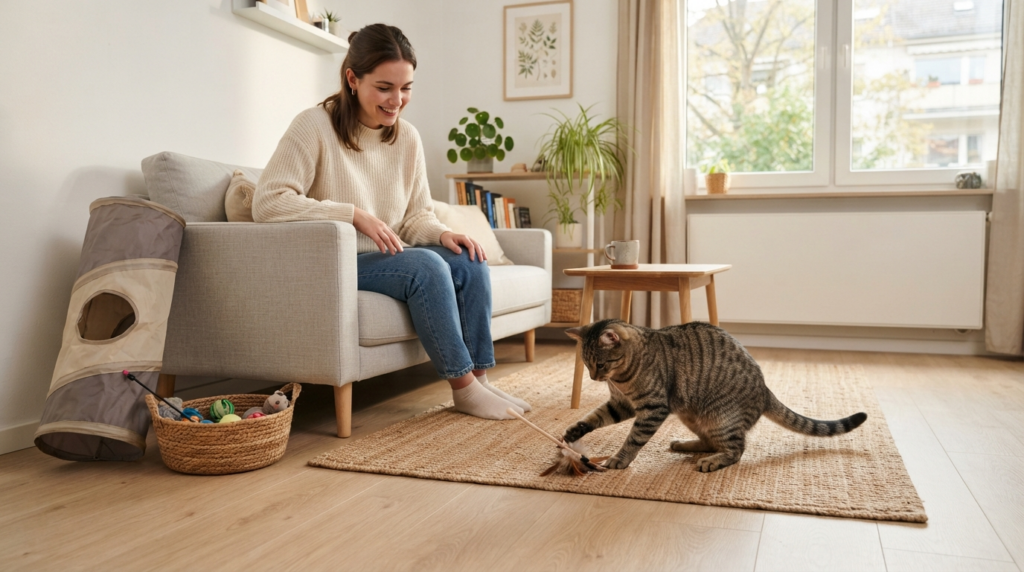
Table of Contents
Why the Best Space Saving Cat Toy Needs a Renter Strategy
Cat play advice often assumes that owners can drill shelves into studs, attach hardware permanently, or dedicate an entire room to enrichment. Renters may have limits on all three.
Common rental constraints include:
- No holes in walls, doors, trim, or window frames
- Restrictions on adhesive hooks and tape
- Limited storage
- Shared walls and downstairs neighbors
- Narrow walking routes
- Small or unusually shaped rooms
- Frequent moves
- Paint and flooring that damage easily
These restrictions do not prevent good enrichment. Cats benefit from opportunities to stalk, chase, pounce, capture, forage, scratch, hide, and observe. Those opportunities can be created with a small rotating set of toys and a predictable routine.
The Feline Veterinary Medical Association’s environmental-needs guidance emphasizes play, predatory behavior, safe places, vertical space, and separated resources. The Ohio State University Indoor Pet Initiative also recommends toy variety and rotation rather than leaving every toy available continuously.
Renter-Friendly Play Setup at a Glance
| Setup | Uses floor space permanently? | Installation | Best for | Main caution |
|---|---|---|---|---|
| Fold-away hunting lane | No | None | Interactive chase play | Clear slippery floors and hard edges |
| Removable doorway station | No | Product-dependent clamp or door attachment | Vertical batting | Strings and door damage |
| Closed-window play zone | Minimal | Removable perch or toy attachment | Watching and short batting play | Window must remain secure |
| Collapsible tunnel corner | No | None | Hiding, chasing, ambush play | Inspect internal frame and fabric |
| Puzzle-feeding station | Temporary | None | Foraging and slower eating | Count food in daily intake |
| Cardboard-box rotation | Temporary | None | Exploration and hiding | Remove staples, tape, and damaged cardboard |
| Quiet nighttime kit | Minimal | None | Apartments with shared walls | Avoid noisy motorized toys |
| Separate multi-cat zones | Temporary | None | Reducing competition | Do not force cats to share |
| Three-bin rotation | No | None | Clutter control | Supervised toys need closed storage |
1. Create a Fold-Away Hunting Lane
Best for: Daily interactive play in studios and one-bedroom apartments
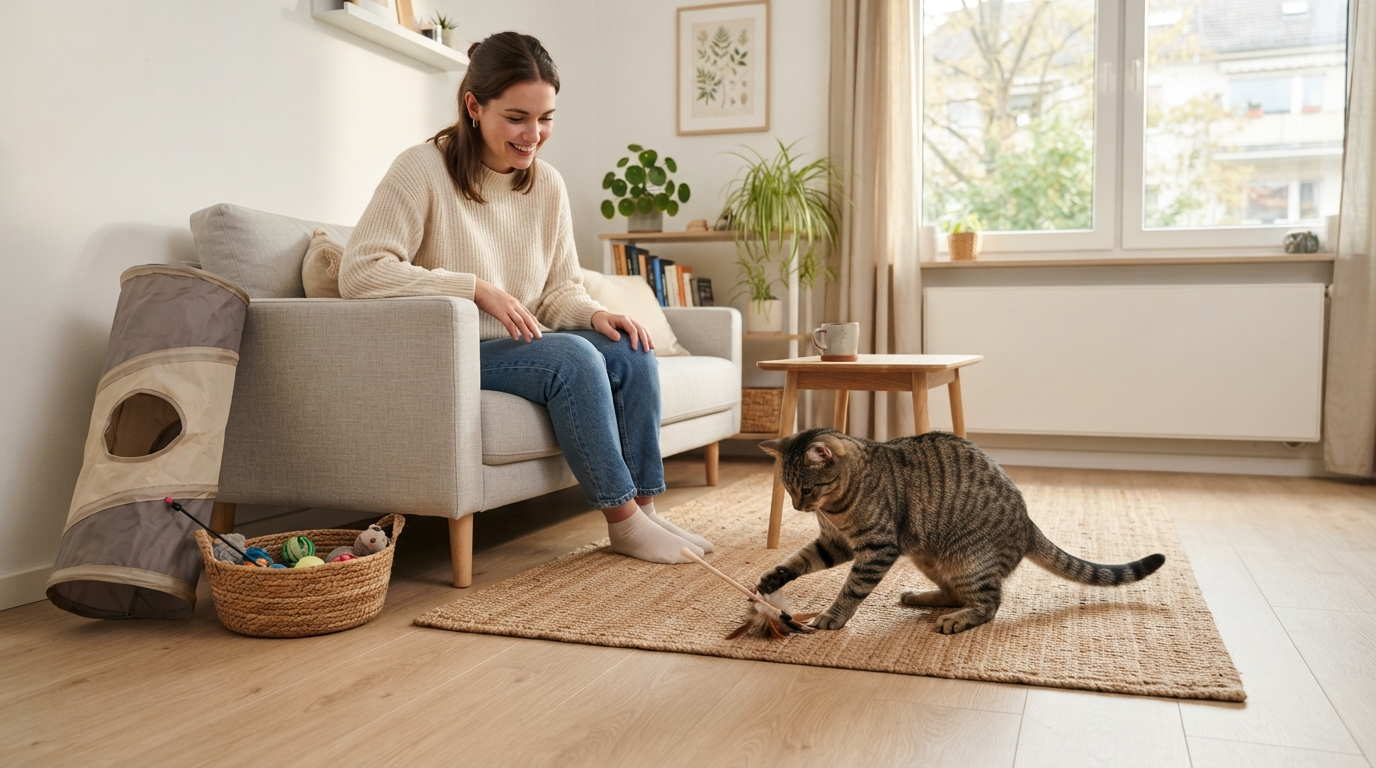
A hunting lane is not a permanent structure. It is a short, safe route where you use a wand, wire toy, or another owner-controlled teaser.
Choose a section of floor that:
- Has good traction
- Is away from glass and televisions
- Does not lead toward an open exterior door
- Has no sharp furniture corners
- Allows the cat to slow down safely
You can create temporary cover with a cardboard box, a chair draped with a blanket, or a collapsible tunnel. When play ends, the props return to storage.
How to use it
Move the toy away from your cat with irregular pauses. Let it disappear behind safe cover, reappear, and slow down. Give your cat frequent opportunities to catch it.
Keep most movements low to the ground. A small apartment does not require repeated high jumps to create satisfying play.
Why it works for renters
- No installation
- No wall or floor attachment
- Can use furniture already in the home
- Packs away immediately
- Works with inexpensive interactive toys
Safety and damage prevention
Store string, wire, elastic, and feather toys in a closed location after every session. The ASPCA warns that swallowed string-like material can cause a gastrointestinal foreign body and may require emergency treatment.
If you use a rug for traction, add a renter-appropriate nonslip pad only if it is compatible with your flooring. Some rubber or latex backings can discolor certain finishes.
2. Build a Removable Doorway Play Station
Best for: Using vertical space without adding a floor base
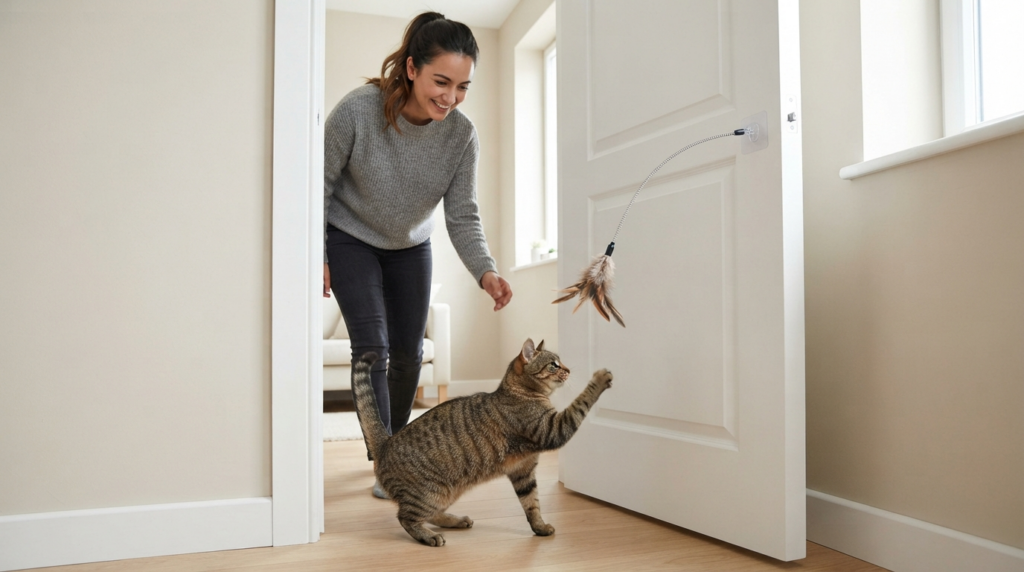
Door-mounted toys can turn unused vertical space into a temporary batting station. Designs vary: some clamp to the lower edge of a door, some loop over the top, and others use removable brackets.
“Door-mounted” does not automatically mean damage-free. A clamp can dent a soft door, scrape paint, compress a seal, or prevent the door from closing correctly.
Before installation
- Check the door material and thickness.
- Read the product’s compatible-door measurements.
- Inspect painted surfaces and weather stripping.
- Confirm that the attachment will not be trapped when the door closes.
- Choose a door that is not a required exit during play.
How to protect the rental
- Use only protective pads supplied or approved by the manufacturer.
- Do not add improvised adhesive or screws.
- Remove the setup after play.
- Check for pressure marks and paint transfer.
- Stop using it if the door, frame, or hinge alignment changes.
Cat safety
Hanging cords and elastic attachments require supervision. Remove the toy if the cord frays, stretches, tangles, or begins to separate from its connector.
Never hang a toy from a doorknob and then close the cat alone in the room. Door movement can change the cord length or trap the attachment.
3. Make a Closed-Window Observation and Play Zone
Best for: Cats motivated by birds, movement, and outdoor sounds
A secure closed window can provide visual enrichment without using much floor space. Pair it with a stable freestanding perch, a manufacturer-approved removable perch, or short supervised play near the window.
The window must remain a secure boundary. A suction toy or perch is not fall protection, and an ordinary insect screen should never be treated as reliable cat containment.
A renter-friendly setup
- Keep the window closed and locked during play unless a separate cat-safe system is installed.
- Position a stable perch without blocking blinds, cords, or an exit.
- Keep pull cords secured and inaccessible.
- Use suction-mounted toys only on a compatible, clean surface.
- Check every suction cup before each session.
- Remove the toy if it pulls, twists, or marks the surface.
Avoid adhesive surprises
Glass is generally easier to clean than painted trim, but adhesives and suction cups can still leave residue or create pressure points. Follow the manufacturer’s removal instructions.
Do not attach toys to window film, damaged glass, loose panes, or a surface the product does not list as compatible.
For product-style seating options, see our guide to the best cat window perches.
4. Use a Collapsible Tunnel Corner
Best for: Temporary hiding, chasing, and ambush play
A collapsible tunnel provides a much larger play experience than its stored size suggests. Place it in an open corner during play and fold it afterward.
The corner location helps prevent a lightweight tunnel from rolling across the entire room. It can also create a predictable ambush point during wand play.
Setup steps
- Clear the tunnel’s entry and exit.
- Inspect the internal frame ends and fabric.
- Place it on a surface with reasonable traction.
- Keep a full exit available.
- Move a toy past the opening rather than trapping the cat inside.
Rental advantages
- No screws or adhesives
- Fits behind a door or inside a closet when folded
- Can move between rooms
- Doubles as a hiding space during play
- Easy to take to a new apartment
Noise consideration
Crinkle tunnels can be loud at night. If sound travels easily through your building, use the tunnel during daytime or early evening and store it before quiet hours.
Inspect all hanging balls or feathers. Remove the entire tunnel from use if the attachment, fabric, or internal support becomes damaged.
5. Set Up a Washable Puzzle-Feeding Station
Best for: Food-motivated cats and renters who need quiet enrichment
A puzzle feeder can provide foraging activity without drilling, hanging, or creating high-impact noise. It is also easier to contain than scattering small toys around the apartment.
Place the puzzle on a washable nonslip mat approved for your flooring. The mat should extend far enough to collect crumbs but not create a trip hazard.
How to introduce it
- Begin with easy, visible food access.
- Use part of the cat’s measured meal.
- Increase difficulty gradually.
- Observe whether the cat becomes interested or frustrated.
- Clean the puzzle according to its label.
Do not repeatedly add treats without accounting for them. Food enrichment should fit the cat’s normal nutritional plan.
Protecting floors
Food, saliva, and trapped crumbs can affect wood, laminate, and carpet. Pick up the station after use, clean spills promptly, and let the mat dry before putting it away.
If you need help selecting an appropriate product, compare our best cat puzzle feeders.
6. Use a Cardboard-Box Rotation
Best for: No-cost exploration that can be recycled
Cardboard boxes can become temporary hiding places, ambush points, tunnels, or foraging stations. They require no installation and can be flattened when the cat loses interest.
The Ohio State University Indoor Pet Initiative includes boxes and other novel objects among enrichment ideas for indoor cats.
Prepare the box safely
- Remove staples.
- Remove plastic tape, labels, ties, and loose glue.
- Avoid boxes contaminated by chemicals, food spills, or unknown substances.
- Cut openings smoothly without sharp edges.
- Make every enclosed setup easy to exit.
Four renter-friendly games
Peek-and-pounce: Cut two large openings and move a supervised wand past them.
Paper hide: Place loosely crumpled plain paper inside and hide a large toy where it remains visible enough to retrieve.
Box maze: Place two open boxes near each other without taping them permanently together.
Foraging box: Place a few pieces of measured dry food in open paper compartments that cannot trap the cat’s head or paws.
When to recycle it
Remove a box when it becomes wet, heavily chewed, soiled, unstable, or difficult to clean. Cardboard should remain enrichment, not permanent clutter.
7. Assemble a Quiet Nighttime Toy Kit
Best for: Apartments with shared walls, downstairs neighbors, or light sleepers
The most exciting toy may not be the most considerate toy at midnight. Hard plastic balls, motorized toys, crinkle tunnels, and track toys can transfer sound through floors and walls.
Create a nighttime kit containing quieter options:
- One soft kicker
- One large soft toy without loose attachments
- A fabric mat or bed for resting
- A quiet food puzzle, if appropriate
- A cardboard box without noisy paper
Reduce impact noise
Use play rugs or mats only when they are safe for the flooring and do not slide. Keep active daytime play away from shared bedroom walls when possible.
Schedule an interactive hunting session earlier in the evening. Consistent daytime and evening activity may be more useful than leaving a noisy automatic toy running overnight.
What not to leave out
Do not leave wand toys, elastic cords, ribbons, yarn, feathers, or a damaged electronic toy available while you sleep.
If your cat’s nighttime activity suddenly changes or includes distress, vocalization, disorientation, or other new behavior, discuss it with your veterinarian rather than assuming another toy will solve the problem.
8. Create Separate Play Zones for Multiple Cats
Best for: Small homes where one cat controls toys or pathways
Two cats do not automatically want to share one toy at the same time. In a small apartment, a single exciting play station can become a guarded resource.
The Feline Veterinary Medical Association recommends multiple and separated key resources so cats have choice. Apply that principle to play.
A simple two-zone setup
- Play with one cat in the living area.
- Give the other cat a puzzle or quiet toy at a comfortable distance.
- Switch activities later.
- Store the most competitive toy between sessions.
Watch for subtle blocking
Competition does not always look like a fight. One cat may:
- Sit in the doorway
- Stare at the other cat
- Occupy the tunnel exit
- Rush toward every toy
- Stop the other cat from approaching
- Chase the other cat after play
Do not place all toys in one narrow corner. Separate them so each cat has a route away.
For a fuller plan, read our guide to cat resource guarding in multi-cat homes.
9. Use a Three-Bin Toy Rotation and Storage System
Best for: Preventing clutter without buying more furniture
Toy rotation helps maintain novelty while keeping the apartment manageable. The Ohio State University Indoor Pet Initiative recommends offering variety and rotating toys rather than leaving every item out.
You do not need three literal plastic bins. Use three categories:
Bin 1: Available toys
Keep three or four durable toys accessible:
- One batting toy
- One soft toy
- One kicker
- One appropriate puzzle or independent toy
Bin 2: Rotation toys
Store clean, inspected toys that will return next week. Keep them dry and separated from damaged items.
Bin 3: Supervised toys
This must be closed and inaccessible. Store:
- Wands
- Strings and elastic toys
- Feather attachments
- Door-mounted toys
- Suction toys
- Electronic toys and charging cables
The five-minute weekly check
Once a week:
- Inspect seams, strings, clips, plastic, and batteries.
- Clean toys according to their labels.
- Remove damaged items.
- Put away toys that have been ignored.
- Reintroduce one or two stored toys.
The system reduces clutter because every toy has a status: available, rotating, supervised, or retired.
How to Choose the Best Space Saving Cat Toy Without Drilling
Suction cups
Suction products depend on the material, cleanliness, temperature, cup condition, and load. Test them before every play session.
Use only on a surface listed by the manufacturer. A suction cup attached to glass does not make an open window safe.
Door clamps
Check the door material, thickness, paint, and clearance. Protective padding supplied with the product should remain clean and correctly positioned.
Do not force a clamp onto an incompatible door.
Adhesive hooks
Read both the toy and adhesive instructions. “Removable” does not mean safe for every paint, wallpaper, wood finish, or humid room.
Do not exceed the stated load or attach a dynamic cat toy to a hook intended only for a static lightweight object.
Tension systems
Pressure-mounted systems can leave marks, loosen, or damage weak surfaces. Confirm that both contact surfaces are compatible and inspect tension regularly.
Do not treat a tension-mounted toy or structure as fall protection.
Freestanding setups
Freestanding toys avoid wall attachment but still need stability. Place them on a level surface, keep them away from exits, and check whether enthusiastic play makes them slide or tip.
A Room-by-Room Renter Setup
Living room
- Fold-away hunting lane
- Compact batting toy
- Collapsible tunnel during scheduled play
- Closed storage for wands
Bedroom
- Quiet kicker
- Soft toy
- Stable resting area
- No loose string available overnight
Kitchen
- Washable puzzle-feeding station away from cooking hazards
- Closed storage for food puzzles after cleaning
- No toy placed where it creates a trip hazard
Home office
- Short supervised wand break
- Compact solo toy away from cables
- Charging cords secured when electronic toys are not in use
Window area
- Secure closed window
- Stable observation spot
- Blind cords inaccessible
- Removable suction toy used only as directed
Move-Out Inspection for Cat Play Areas
Do not wait until moving day to discover marks.
Every month, check:
- Door edges and paint
- Window glass and trim
- Adhesive residue
- Floor discoloration beneath mats
- Scratches under track toys
- Moisture under puzzle-feeding mats
- Wall marks behind play routes
- Carpet pulls near tunnels
Photograph the area before installing a removable attachment and after removal. Follow the lease and product instructions when cleaning residue; an aggressive solvent can cause more damage than the adhesive.
Common Mistakes
Buying a second product page’s worth of toys
This page is about building a system, not purchasing nine more objects. Start with the toys you already own.
Leaving supervised toys available
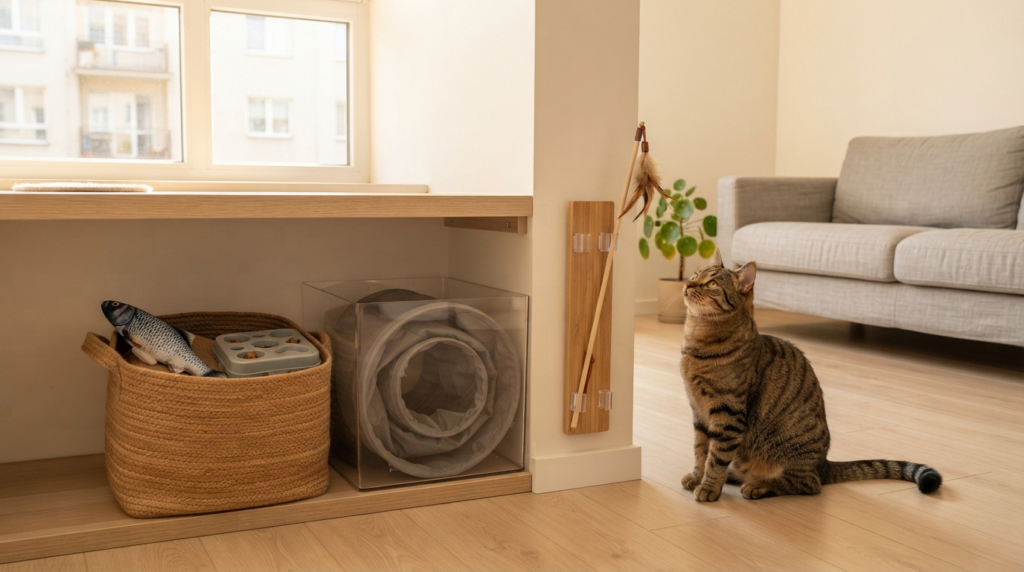
A storage basket is not secure if the cat can pull out string or feathers. Use a closed location.
Treating “no-drill” as “no-damage”
Pressure, adhesive, friction, moisture, and movement can all affect rental surfaces.
Filling every vertical surface
Cats need usable pathways and rest areas, not an apartment covered in dangling toys.
Forcing one play style
Some cats prefer batting, others prefer stalking, kicking, food puzzles, or short chase sessions. Observe your cat’s response.
Ignoring neighbor noise
Schedule louder play appropriately and use quiet nighttime options.
Using hands as toys
Use an object as the play target. The Ohio State University Indoor Pet Initiative advises against teaching cats to bite or scratch hands during play.
Frequently Asked Questions
What are the best cat toys for renters?
The best cat toys for renters are removable, easy to store, and compatible with the rental surfaces. A supervised wand, compact batting toy, soft kicker, puzzle feeder, and collapsible tunnel cover several play behaviors.
What is the best space saving cat toy for renters?
For interactive play, choose a slim wand or wire toy that stores securely after each session. For independent play, use a compact contained-ball track or a flat puzzle feeder. The right choice depends on your cat’s preferred play style and the apartment surfaces you need to protect.
What are the best no-drill cat toys?
Freestanding track toys, kickers, puzzles, wands, cardboard boxes, and collapsible tunnels require no wall installation. Door- and suction-mounted toys are also no-drill, but they can still mark incompatible surfaces.
Can adhesive cat toys damage apartment walls?
Yes. Results depend on paint, wallpaper, finish, humidity, surface preparation, load, and removal method. Follow both the adhesive and toy instructions and test an inconspicuous area.
Are suction-cup cat toys renter-friendly?
They can be removable, but use them only on compatible surfaces and test the suction before play. They are toys—not window-security devices.
Can I hang a toy from a rental door?
Only if the product fits the door and does not affect its surface, alignment, weather seal, or operation. Remove hanging cord toys after supervised play.
How many cat toys should a renter keep?
There is no required number. A small group of toys that support different behaviors is more useful than many duplicates. Keep three or four appropriate toys available and rotate the rest.
How do I store cat toys in a studio apartment?
Use a closed drawer, lidded container, closet organizer, or under-bed box. Separate washable food puzzles from fabric toys and keep string toys securely inaccessible.
What cat toys are quiet enough for an apartment?
Soft kickers, fabric toys, some food puzzles, and supervised low-impact wand play are quieter than hard balls, crinkle tunnels, and motorized toys. Flooring and building construction affect noise.
Can I leave automatic toys running while I am away?
Follow the product label. Inspect batteries, charging ports, seams, attachments, and moving parts. Toys with strings, cords, detachable parts, or known damage should not be left available unsupervised.
Are cardboard boxes safe cat toys?
They can be useful when clean and prepared safely. Remove staples, plastic tape, ties, and loose material, and recycle boxes that become wet, heavily chewed, or unstable.
What if my cat ignores every toy?
Try changing the movement, location, timing, and toy category. If your cat’s activity or interest changes suddenly—especially with changes in appetite, mobility, grooming, or behavior—contact your veterinarian.
Final Thoughts
The best space saving cat toy is most useful when it becomes part of a flexible renter-friendly system:
- Use a fold-away route for interactive hunting play.
- Create temporary door or window stations only on compatible surfaces.
- Add a collapsible tunnel or cardboard box during scheduled play.
- Use a washable puzzle-feeding area for quiet enrichment.
- Separate play resources in multi-cat homes.
- Rotate toys and store strings, feathers, cords, and electronics securely.
You do not need to choose between protecting the apartment and enriching your cat. A small number of well-managed toys, used in predictable ways, can provide varied play without permanent modifications or constant clutter.
References
- Feline Veterinary Medical Association. “Meeting the Physical and Emotional Needs of Owned Indoor Cats.” Position statement on feline environmental and behavioral needs.
- Feline Veterinary Medical Association and International Society of Feline Medicine. “AAFP/ISFM Environmental Needs Guidelines.” Framework covering safe places, separated resources, play, human interaction, and the sensory environment.
- The Ohio State University Indoor Pet Initiative. “Toys.” Guidance on play behavior, toy types, inspection, variety, and rotation.
- The Ohio State University Indoor Pet Initiative. “Increasing the Activity.” Interactive-play ideas, controlled play, daily routine, and toy rotation.
- The Ohio State University Indoor Pet Initiative. “Environmental Enrichment.” Food-based enrichment, novel objects, sensory enrichment, and predictable interaction.
- ASPCA. “Keeping Your Foster Cats Out of Trouble.” String-ingestion and electrical-cord safety information.
-300x169.png)