By a cat parent who discovered that “independent” cats can break your heart just as thoroughly as clingy ones.


For two and a half years of working from home, Oliver and I existed in a state of what I can only describe as mutually reinforced codependence. He was on my lap during morning calls, on my desk during afternoon work sessions, and pressed against my leg every evening. We had developed a complete shared routine down to the hour.

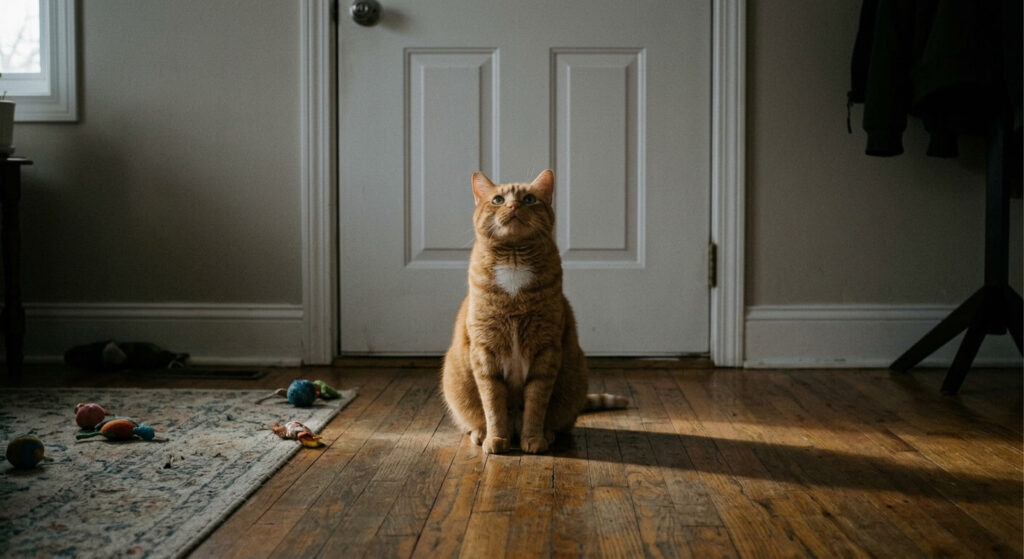
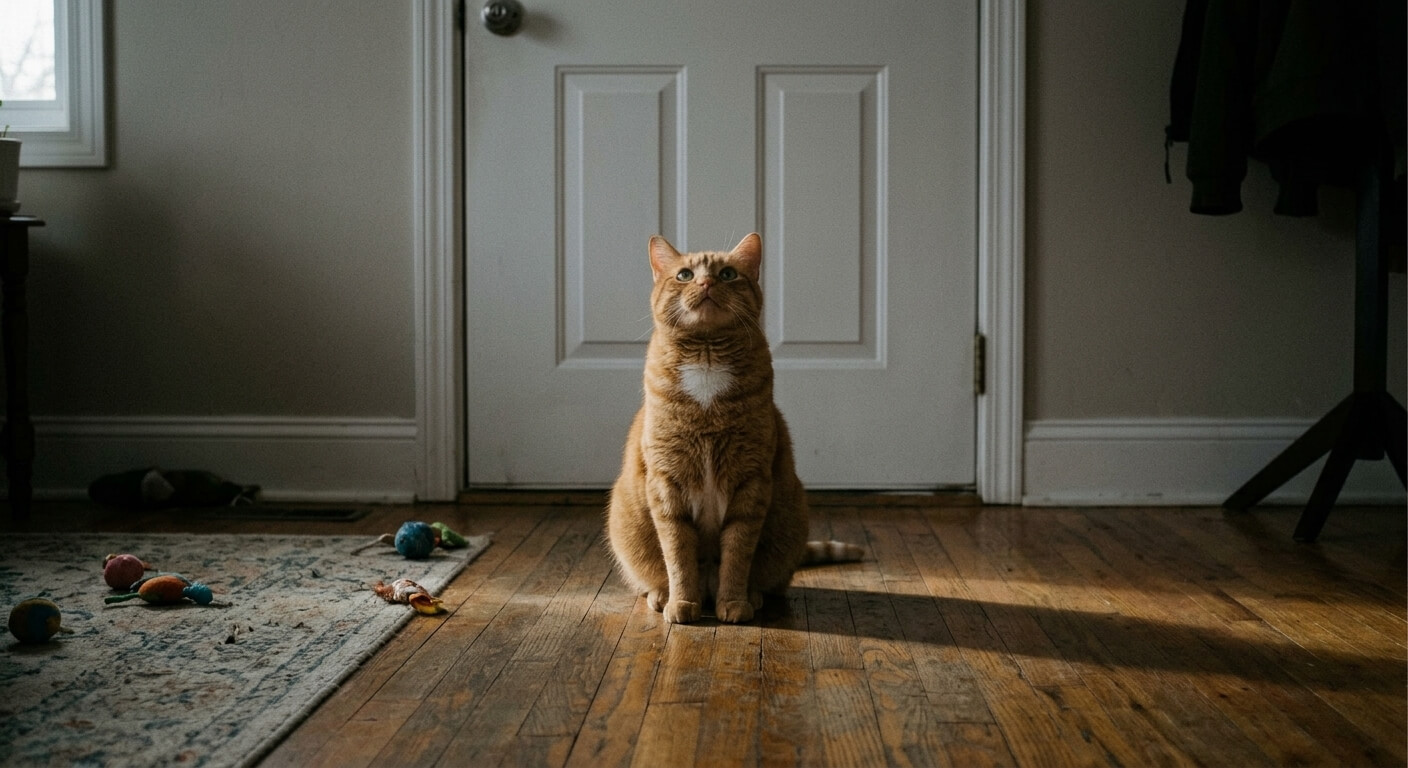
When my company called everyone back to the office full-time, I installed a pet camera mostly out of curiosity. What I saw during my first week back crushed me. Oliver paced the length of the apartment repeatedly. He sat at the front door and cried — a specific, sustained vocalization I had never heard him produce before. He ignored his food bowl for the full eight hours I was gone. His water intake dropped visibly.

I had been operating on the comfortable assumption that Oliver was an independent cat who happened to enjoy my company, and the camera dismantled that assumption completely. Cat separation anxiety is real, it is more common than most cat owners realize, and the pandemic-era work-from-home period created conditions for it in thousands of cats who had previously been perfectly fine alone. If what I just described sounds familiar, this guide is for you.


Quick Answer

The most common signs of cat separation anxiety include excessive vocalization when you leave, inappropriate elimination outside the litter box, destructive behavior directed at exit points, and refusal to eat while alone. Treatment involves desensitizing departure cues (keys, shoes, coat), establishing a predictable routine, introducing high-value interactive enrichment for alone time, and using calming pheromone products — with medication available for severe cases.


The WFH Hangover: Why Independent Cats Get Attached

The widespread assumption that cats are solitary, self-sufficient animals who prefer their own company is not supported by behavioral science — and the pandemic years created a natural experiment that exposed just how deeply incorrect this assumption can be.

The Attachment Science

Research on cat-human attachment — including landmark work from Oregon State University published in 2019 — established that domestic cats form genuine attachment bonds with their human caregivers that mirror the attachment styles documented in human infant-caregiver relationships. Approximately 64% of cats in studied populations showed secure attachment to their owners, using them as a safe base in novel environments and showing distress at separation.

The “independent cat” stereotype partially reflects cats’ capacity to manage their anxiety silently — hiding distress rather than displaying it overtly, as prey-animal neurology drives them to do. A cat who appears unbothered by your departure may be experiencing genuine stress that simply doesn’t manifest as visible behavior in your presence.

Why WFH Specifically Created This Problem

Before the pandemic, most cats had a daily experience of owner departure followed by owner return — a predictable cycle they had adapted to and found manageable. This cycle included:

  • A learned understanding that departure predicts return
  • Environmental enrichment they had developed independent coping strategies around
  • A daily rhythm of alone time that maintained their capacity for independent function

Cats who were adopted during lockdown, or whose owners transitioned to full-time home working during it, had a fundamentally different experience: continuous human presence became their baseline normal. Their nervous systems calibrated to a world in which their primary attachment figure was always present, always accessible, always available as a safe base.

When that baseline suddenly changed — when the departure cues reappeared after two years of absence — these cats had no adapted coping framework to draw on. The distress was genuine, immediate, and often severe.

Distinguishing between a cat who simply loves your company and a cat whose attachment has crossed into hyper-dependence that produces genuine distress is an important clinical distinction — and we explored exactly where that line is in our guide to cats who always want attention. [Read our complete guide to cat attention-seeking behavior and what it tells you here → Why Does My Cat Always Want Attention? (And Is It Normal?)]


7 Hidden Signs of Cat Separation Anxiety

The reason separation anxiety goes undiagnosed in cats so frequently is that most of the signs occur only in the owner’s absence — precisely when the owner cannot observe them. A pet camera, or reports from neighbors, often provides the first documentation.

Here are the seven signs, organized from the most commonly observed to the most subtle:

Sign 1: Vocalization During Absence

What it looks like: Continuous or repeated meowing, yowling, or crying that begins when you leave and continues for an extended period. The vocalization is specifically triggered by your departure — not by hunger, not by an outdoor stimulus, but by your absence.

How to identify it: A pet camera with audio recording will document this unambiguously. Neighbor reports of “your cat crying all day” are another common first alert.

Distinguish from: A cat who vocalizes for a few minutes after you leave and then settles is likely expressing mild frustration that self-resolves. Continuous vocalization lasting hours is the concerning pattern.

Sign 2: Inappropriate Elimination at Exit Points

What it looks like: Urination or defecation outside the litter box, specifically near the front door, on items that carry your scent (worn clothing, your side of the bed), or in locations associated with your departure.

The mechanism: Stress-triggered urinary inflammation (feline idiopathic cystitis) can cause genuine inability to reach the litter box in time. Additionally, elimination on owner-scented items appears to be a comfort-seeking behavior — commingling scents.

Critical note: Any inappropriate elimination warrants a veterinary visit to rule out urinary tract disease before attributing it to behavioral anxiety.

Sign 3: Destructive Behavior at Boundaries

What it looks like: Scratching at doors, particularly the front door or the last door they saw you close. Pulling at carpet at door thresholds. Batting or chewing at window blinds near the entrance.

What it communicates: Your cat is physically trying to get to you — or to remove the barrier separating them from you. This is exit-seeking behavior driven by genuine distress.

Sign 4: Appetite Suppression During Absence

What it looks like: Full food bowl at your return after a full workday, despite the cat appearing healthy and hungry once you’re home.

The mechanism: Anxiety activates the sympathetic nervous system, which suppresses the digestive drive. A cat in genuine separation distress is physiologically unable to eat normally in your absence — not choosing not to, but neurologically incapable of it.

Why it matters: Cats who don’t eat for more than 24–36 hours are at risk for hepatic lipidosis regardless of the cause. Consistent appetite suppression during absences is a medical concern as well as a behavioral one.

Sign 5: Over-Grooming or Self-Soothing Behaviors

What it looks like: Bald patches from repetitive licking, particularly on the lower belly, inner thighs, or accessible flanks — developing during the period of increased alone time.

The mechanism: Grooming releases endorphins and provides brief anxiety relief. A chronically stressed cat uses grooming as a self-soothing behavior beyond its coat maintenance function.

Sign 6: Excessive Pre-Departure Clinginess

What it looks like: Unusual following behavior, vocalizing, and physical contact-seeking in the hour before you leave — as though your cat knows what’s coming.

The mechanism: Cats are exquisitely routine-sensitive and learn to recognize departure cues (alarm sound, coffee maker, shower, shoe-putting-on) with remarkable accuracy. The pre-departure anxiety begins when they recognize the sequence, not when you actually leave.

Sign 7: Hyper-Greeting on Return

What it looks like: Unusually intense, extended greeting behavior — not just the “hello” chirp, but sustained vocalization, frantic physical contact-seeking, and visible relief that continues for an extended period after your return.

The mechanism: A cat who has been in genuine distress for eight hours experiences your return as a profound relief event. The intensity of the greeting is proportional to the distress of the absence.


The Departure Cue Desensitization Method

This is the most clinically supported behavioral intervention for separation anxiety in cats, and it is the one I implemented for Oliver with the most measurable results.

The core principle: your cat is not anxious about your absence as an abstraction. They are anxious about the departure cues that predict your absence. The alarm sound, putting on shoes, picking up keys, putting on a coat — each of these has been classically conditioned to predict the devastating event (your leaving) through thousands of repetitions.

By breaking the predictive relationship between these cues and actual departure, you lower your cat’s pre-departure anxiety and consequently lower the overall distress arc of the entire absence.

The Desensitization Protocol

Phase 1: Identify the trigger sequence

Write down every action you take from waking up to leaving — in order. For me, it was: alarm, shower, coffee, shoes, work bag, keys, coat, door. Oliver’s anxiety behavior (following, vocalizing) began consistently at the shoes stage.

Phase 2: Perform cues without departure

  • Pick up your keys. Sit down on the sofa for ten minutes. Put them back.
  • Put on your shoes. Make coffee. Take them off.
  • Put on your coat. Watch television. Take it off.
  • Repeat each cue multiple times per day, never followed by actual departure

The goal: your keys become “sometimes dad picks up keys and then watches TV” rather than “departure is imminent.” The predictive power of the cue is diluted through non-reinforcement.

Phase 3: Graduated short absences

Once cue presentation no longer triggers obvious anxiety behavior:

  • Walk out the door and return in thirty seconds
  • Walk out and return in two minutes
  • Progressively extend to five minutes, fifteen minutes, thirty minutes, one hour
  • Never progress to a longer absence until the previous duration is completely calm on camera

Timeline: This protocol typically requires four to eight weeks of consistent practice before significant improvement is visible. Do not rush the graduated absence phase.


How to Keep Them Calm While You’re Gone

Environmental management during your absence is the parallel track that supports the desensitization work.

Two-Way Pet Cameras with Treat Dispensers

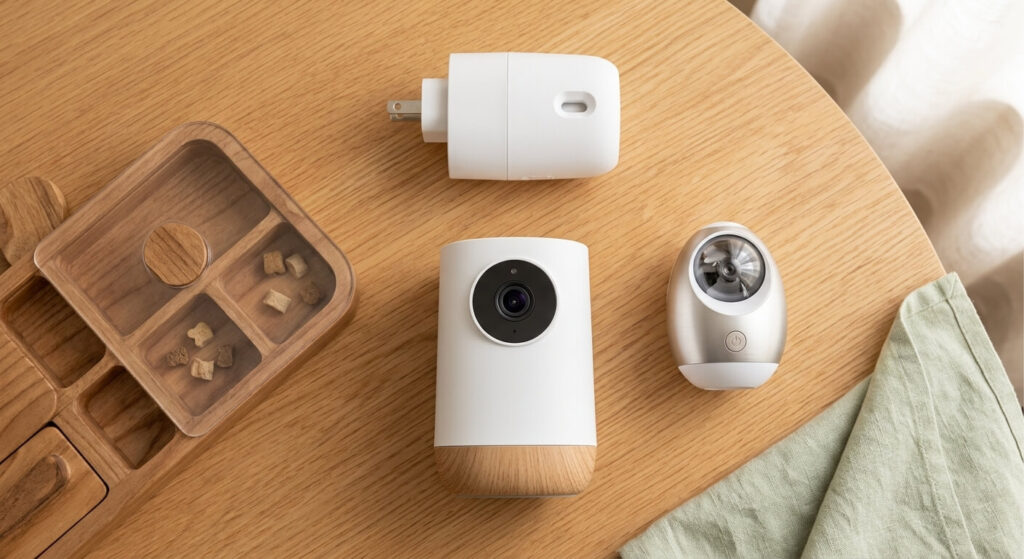
two-way audio pet camera with a remote treat dispenser serves two distinct functions:

  • Monitoring function: You can observe Oliver’s behavior in real time, confirm whether interventions are working, and identify specific high-distress periods in the day that need additional support
  • Interaction function: The ability to speak to your cat through the camera’s speaker and dispense treats remotely allows brief positive interactions during the absence that disrupt the distress arc

Use the two-way audio judiciously: For some cats, hearing your voice without your physical presence increases rather than decreases distress — it confirms you exist but aren’t accessible. Test this on camera before making it a regular practice. If Oliver’s distress visibly increases after a remote interaction, the audio component is not helpful for his specific profile.

High-Value Interactive Puzzle Feeders

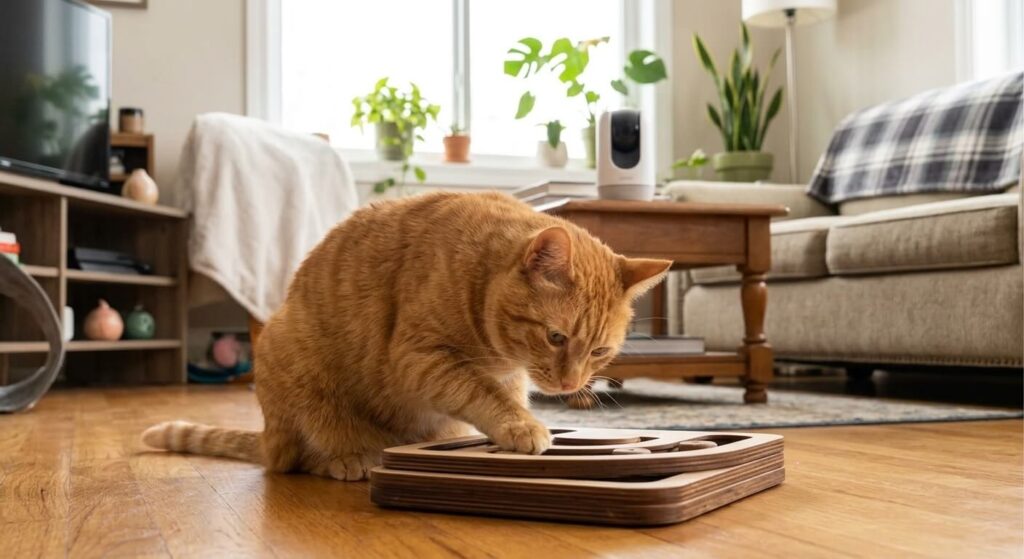
The pre-departure routine should include a high-value feeding puzzle that is exclusively available when you leave — never at other times. This creates a positive association with your departure (puzzle appears = high-value food) while providing fifteen to forty-five minutes of cognitive engagement during the highest-distress period of the absence (immediately after you leave).

Effective puzzle options for anxiety management:

  • Automated timed feeders that release a small portion of wet food or high-value treats at intervals throughout the day — multiple feeding events maintain engagement and prevent appetite suppression
  • Electronic interactive toys with randomized motion patterns that activate on a timer during the absence — the unpredictability maintains novelty across multiple days
  • Kong-style food puzzles loaded with lickable treats — the sustained licking behavior is mildly self-calming through repetitive oral motor activity

Pheromone Diffusers

Synthetic feline facial pheromone diffusers should be running continuously in the primary room Oliver occupies during the absence, and ideally near the front door where distress behavior concentrates.

For separation anxiety specifically, run the diffuser at least two weeks before implementing the absence desensitization protocol — the baseline anxiety reduction the pheromone provides makes the behavioral work more effective by lowering the starting cortisol level your cat is working from.

Auditory Environment

The auditory environment during your absence matters more than most owners realize:

  • Television on a talk-based channel (not action-heavy content with loud sound effects) provides ambient human voice presence that some anxious cats find grounding
  • Specific “cat calming” music (music composed around frequencies known to engage feline auditory processing) has some limited evidence supporting reduced stress indicators — available on several streaming platforms in extended playlist format
  • Your recorded voice playing softly through a small Bluetooth speaker has worked for some owners; test on camera to assess your specific cat’s response

You must completely resolve the daily absence distress before you can reasonably consider leaving your cat alone for a weekend or longer period — an unsupported anxious cat left for two or three days without the coping framework in place is a welfare concern, and we covered the planning required for that situation in our complete guide. [Read our complete guide to leaving your cat alone for a weekend here → How to Leave a Cat Alone for the Weekend (Safe 48-Hour Guide)]


The “Low-Key” Hello and Goodbye Rule

This is the intervention that feels the most counterintuitive, and the one that owners most consistently resist — because it feels cold toward a cat they love.

The rule: Your departures and arrivals should be emotionally neutral events — no extended goodbye rituals, no dramatic greetings, no “Mommy loves you, be a good boy” conversations at the door.

Why Emotional Departures Make Anxiety Worse

When you make your departure a significant emotional event — prolonged petting, specific phrases delivered in a particular tone, visible distress on your own face — you are signaling to your cat that departure is something worth being anxious about. Cats read human emotional states with remarkable accuracy. Your anxiety about leaving makes them anxious about your leaving.

The departures that precede a happy absence feel neurologically different to your cat than the departures that precede an anxious one.

The departure protocol:

  1. Complete your pre-departure routine normally
  2. Place the departure-exclusive puzzle feeder
  3. Leave without making eye contact with Oliver, without speaking departure phrases, and without extended physical contact at the door
  4. Close the door. Done.

The arrival protocol:

  1. Enter the apartment
  2. Put down your bag, remove your shoes, change if needed
  3. Wait for Oliver to settle before initiating interaction — do not respond to hyper-greeting behavior with immediate intense reciprocal greeting
  4. Once Oliver has reduced intensity — typically five to fifteen minutes — greet him calmly and normally

By not responding to hyper-greeting with hyper-greeting in return, you are not reinforcing the distress behavior as a reliable method of producing intense human attention. Over weeks, the arrival intensity typically reduces as the greeting behavior stops producing a dramatic response.


When to Discuss Medication with Your Vet

Behavioral modification and environmental management are the foundation of separation anxiety treatment. For some cats — those with severe presentations, those who are not improving after six to eight weeks of consistent behavioral intervention, or those whose distress is producing medical complications (not eating, stress cystitis) — pharmacological support is an appropriate and welfare-improving option, not a last resort.

Medication Options Your Vet May Consider

Daily anti-anxiety medication (for chronic cases):

  • Fluoxetine (Prozac equivalent) — the most commonly prescribed daily anxiolytic for cats with separation anxiety; takes four to six weeks to reach therapeutic effect; significantly reduces baseline anxiety
  • Buspirone — an anxiolytic with a different mechanism than SSRIs; some cats respond better to this than fluoxetine
  • Clomipramine — a tricyclic antidepressant with anxiolytic properties; licensed for separation anxiety in some countries

Situational support:

  • Gabapentin — used for particularly high-stress situations; not appropriate for daily separation anxiety management but useful for specific high-stress events
  • Trazodone — short-acting anxiolytic that can be used for specific anticipated high-stress periods

The important framing: Medication in this context is not a behavior suppressor. It is a neurological support that reduces the baseline anxiety level enough for behavioral modification to take effect — something that may be neurologically impossible in a severely anxious cat without pharmacological support.

Bring the following to your vet conversation:

  • Specific behaviors observed on pet camera with timestamps and frequency
  • Timeline of when the behavior began and what environmental change preceded it
  • Documentation of what behavioral interventions you have tried and for how long
  • Any medical symptoms that may be related (inappropriate elimination, appetite changes)


FAQ

1. What are the most reliable ways to tell if my cat genuinely has cat separation anxiety versus just being unhappy about my schedule change?

True cat separation anxiety is distinguished from general unhappiness about schedule change by three specific characteristics: the distress is specifically triggered by departure cues and absence (not present when you’re home), it continues throughout your absence rather than resolving after a brief period, and it produces behavioral or physical symptoms beyond simple preference expression (appetite suppression, inappropriate elimination, vocalization lasting hours).

A cat who greets you enthusiastically when you return from work but is clearly fine while you’re gone — sleeping, eating normally, playing — is not anxious; they just enjoy your company. A cat who shows the symptom cluster described in this article, documented on camera during your absence, meets the clinical behavioral criteria for separation-related disorder.

2. Should I get a second cat to help with my cat’s separation anxiety?

This is one of the most frequently asked questions, and the honest answer is: sometimes yes, often no, and never as a first intervention. A second cat can provide genuine social companionship that reduces alone-time distress for some cats — particularly those who are socially oriented and would benefit from a feline companion.

However, introducing a second cat to an already anxious cat’s territory carries real risk: the stress of a new cat introduction can significantly worsen an anxious cat’s behavioral presentation, at least temporarily. The introduction process itself takes weeks to months. And some anxious cats’ distress is specifically human-attachment-based — they want you, not a cat — meaning a second cat provides no relief and adds additional stress.

If you are considering a second cat, resolve the separation anxiety using the methods in this guide first, consult with a veterinary behaviorist about whether a companion is appropriate for your specific cat’s profile, and implement a proper gradual introduction protocol if you proceed.

3. How long does it realistically take to see improvement from the departure cue desensitization protocol?

Realistic timelines for separation anxiety behavioral modification are six to twelve weeks for meaningful improvement in cats with moderate presentations. The departure cue desensitization phase alone typically requires three to four weeks before cues reliably lose their predictive power.

The graduated absence phase adds another four to six weeks of progressive work. Cats with severe presentations — those who begin distress immediately at departure and maintain it for the full absence — often need pharmacological support alongside behavioral modification to achieve meaningful improvement within this timeline.

The most important variable is consistency: the protocol requires daily practice of departure cue desensitization, not occasional sessions. Irregular implementation extends the timeline proportionally and can produce confusing mixed signals for your cat’s conditioning process.


References

  1. Schwartz, S. (2002). Separation anxiety syndrome in dogs and cats. Journal of the American Veterinary Medical Association, 220(1), 41–45. https://avmajournals.avma.org/view/journals/javma/220/1/javma.2002.220.41.xml
  2. Machado, D. S., et al. (2020). Identification of separation-related problems in domestic cats. PLoS ONE, 15(4), e0230999. https://journals.plos.org/plosone/article?id=10.1371/journal.pone.0230999

Disclaimer: This article reflects the personal experience of a cat owner and draws on published veterinary behavioral medicine research. It is not a substitute for individualized assessment by a licensed veterinarian or board-certified veterinary behaviorist. If your cat is showing physical symptoms alongside behavioral distress — including appetite loss lasting more than 24 hours, inappropriate elimination, or self-injury — please contact your veterinarian promptly.

Share this post

Subscribe to our newsletter

Keep up with the latest blog posts by staying updated. No spamming: we promise.
By clicking Sign Up you’re confirming that you agree with our Terms and Conditions.

Related posts