By Oliver’s Owner | Last Updated: February 2026
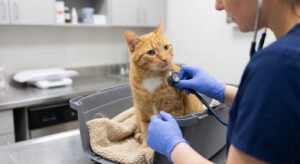
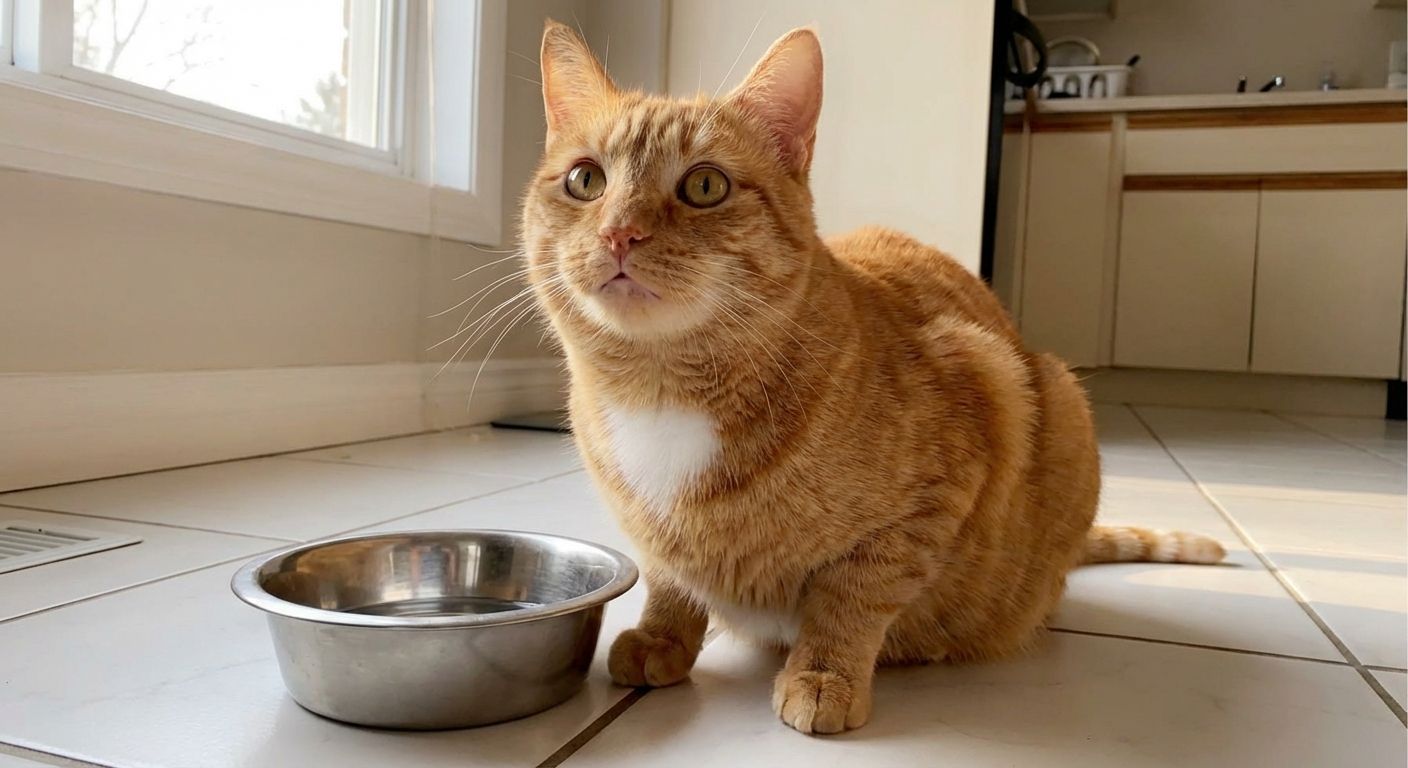
I never thought I’d be writing about how to help indoor cat lose weight — until my veterinarian slid a chart across the examination table and pointed to the section labeled “obese.” My orange tabby, Oliver, was staring up at me with those enormous golden eyes, and I felt like the worst cat parent alive. For two years, I had fallen completely for his act. The dramatic flop by the food bowl. The 3 a.m. yowling. The slow, accusing blink whenever his dish wasn’t overflowing. Oliver was a con artist in a fur coat, and I was his easiest mark.
Getting him from 16.5 pounds down to a healthy 10.8 pounds took about eight months, a lot of patience, and more than a few sleepless nights. But it absolutely worked — and I’m going to walk you through exactly what we did.
Quick Answer
To help an indoor cat lose weight, stop free-feeding immediately. Calculate their ideal caloric intake using your vet’s guidance, switch to high-protein wet food, and use a digital kitchen scale to measure every meal precisely. Introduce puzzle feeders to slow eating and add daily interactive play sessions to increase calorie burn safely.
The “Free-Feeding” Trap (And How I Fell Right Into It)
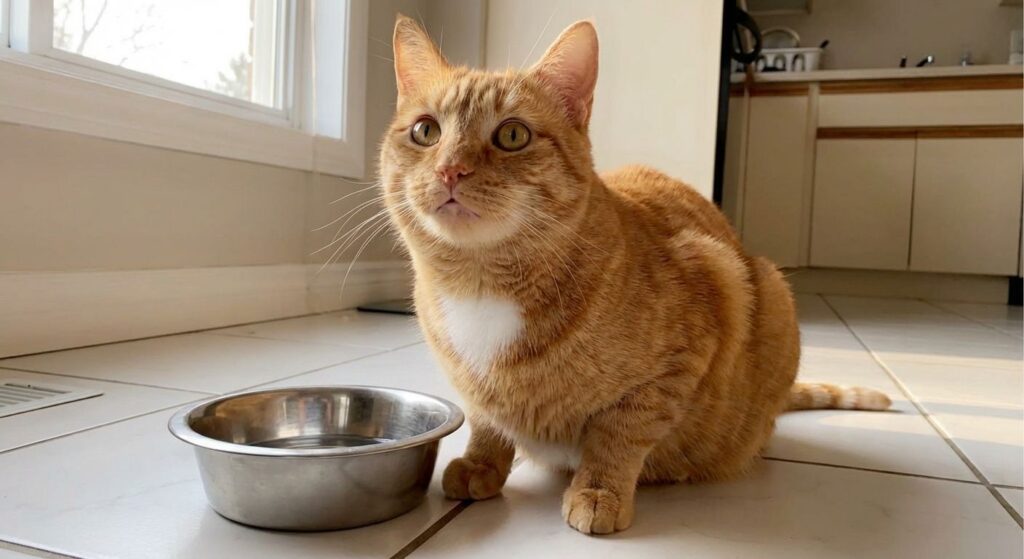
For the first two years of Oliver’s life, I did what a lot of well-meaning cat owners do: I kept his dry food bowl full. All day. All night. The logic seemed sound — cats are grazers, right? They’ll self-regulate.
Spoiler: Oliver did not self-regulate.
Free-feeding works for exactly zero percent of the food-obsessed cats I’ve ever met. When food is always available, many indoor cats — particularly those who are bored, anxious, or just enthusiastically food-motivated — will eat well past the point of hunger. Without the natural hunting and movement of an outdoor life, those extra calories have absolutely nowhere to go.
Why Indoor Cats Are Especially Vulnerable
- Minimal movement. No hunting, no territory patrol, no chasing prey.
- Chronic boredom. A bored cat is often an eating cat.
- Spayed/neutered metabolism. This can lower caloric needs by up to 30%.
- Our guilt. We interpret begging as starvation. It almost never is.
The first thing our veterinarian told me to do was pick up that food bowl and put it away. It felt cruel. Oliver acted like it was cruel. But it was the single most important change we made.
Calculating How Much Oliver Actually Needed to Eat
Before I changed what Oliver ate, I needed to understand how much he should be eating. This step is non-negotiable, and I’d strongly encourage you to do it with your vet rather than guessing.
The general framework works like this:
- Determine your cat’s ideal body weight — not their current weight, but where they should be. Your vet can assess their body condition score (BCS) to establish this target.
- Calculate their Resting Energy Requirement (RER). The common formula is:
RER = 70 × (ideal body weight in kg)^0.75 - Apply a weight-loss factor. For most cats on a controlled weight-loss plan, this is roughly 80% of their RER.
- Divide across meals. We settled on three small meals per day for Oliver, which helped manage his begging significantly.
A typical healthy adult cat needs roughly 20 calories per pound of ideal body weight per day, but this varies. Please treat this as a starting point, not gospel, and always loop in your veterinarian.
The Slow and Steady Rule
Rapid weight loss in cats is genuinely dangerous. It can trigger a serious liver condition called hepatic lipidosis (fatty liver disease). The safe target is roughly 0.5–2% of body weight lost per month. Oliver lost about half a pound per month, which felt agonizingly slow but was exactly right.
If you aren’t sure where your cat currently stands, learn how to perform the at-home physical checks in our guide: is my cat overweight?
Wet Food vs. Dry Food: What Actually Made the Difference
This was the change that surprised me the most in terms of impact.
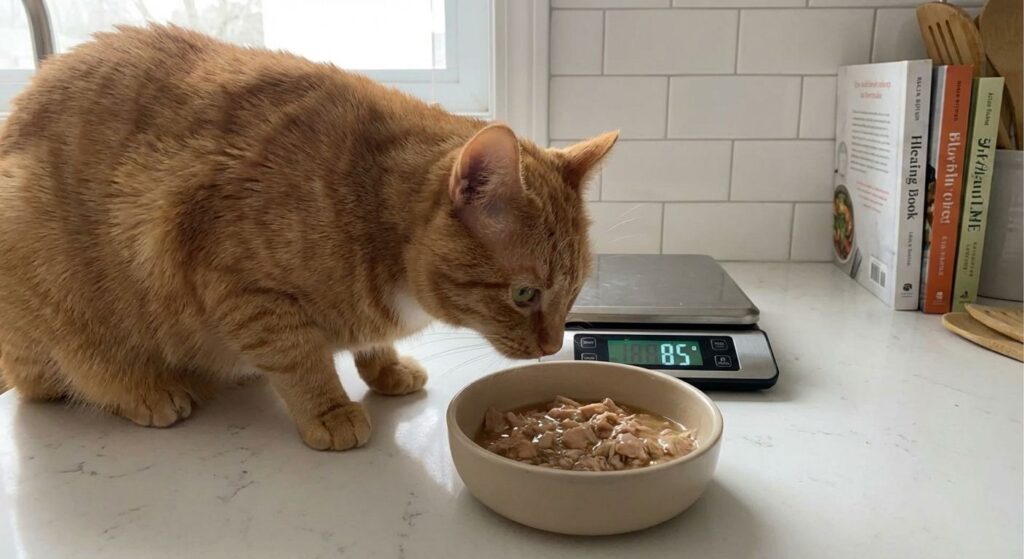
I switched Oliver from a free-fed dry food diet to scheduled, portioned wet food meals, and the difference in his weight loss trajectory was significant. Here’s why wet food tends to work better for weight management:
- High moisture content (75–80%) means more volume per calorie. Oliver felt fuller.
- Typically higher in protein and lower in carbohydrates than most dry foods.
- Lower caloric density — you’re feeding a lot of water weight, which cats in the wild would get from prey.
- Eating speed naturally slows down compared to crunching kibble.
As an added bonus, switching to wet food is the absolute best strategy if you’re trying to figure out how to get an indoor cat to drink more water.
But What About Dental Health?
The “dry food cleans teeth” claim is largely a myth — or at best, a minor benefit that doesn’t justify the caloric trade-off for an overweight cat. Regular tooth brushing or dental treats (factored into the daily calorie budget) are far more effective.
If your cat absolutely refuses wet food, a high-protein, low-carbohydrate dry food fed in precisely measured portions can still work. But wet food made our journey significantly easier.
The Kitchen Scale Secret (This Changed Everything)
I cannot overstate how important this one tool was.
Before I started weighing Oliver’s food, I was estimating by eye — scooping what “looked like” the right amount. When I finally put his food on a digital kitchen scale, I discovered I had been overfeeding him by 20–30% at every single meal. I had genuinely no idea.
How to Do It Right
- Weigh in grams, not cups or tablespoons. Volume measurements for cat food are notoriously inaccurate because kibble shape and density vary wildly.
- Weigh the food, not the bowl. Tare the scale with the bowl on it, then add food.
- Track it in a simple notebook or app. Patterns become visible quickly.
- Measure every meal, every day. This is not a “sometimes” thing. Consistency is what produces results.
Key takeaway: If you do nothing else on this list, buy a digital kitchen scale and start weighing your cat’s food today.
Oliver’s meals went from roughly 220 calories per day (what I thought I was feeding) down to 165 calories (what he actually needed for weight loss). That gap was the entire problem.
Dealing With the Begging — Without Losing Your Mind
Let me be direct with you: the begging gets worse before it gets better.
When I first switched Oliver to scheduled meals, he staged what I can only describe as a protest campaign. He yowled at 5 a.m. He sat on my keyboard. He knocked things off shelves with deliberate, sustained eye contact. For about two weeks, meal times were preceded by a 45-minute opera performance.
Here’s what helped us get through it.
Strategies That Actually Work
- Ignore the begging completely. Any response — even a firm “no” — teaches your cat that noise produces attention. Walk away. Do not look at him. This is hard. Do it anyway.
- Feed on a strict schedule. Cats are creatures of routine. Once Oliver understood that food appeared at 7 a.m., noon, and 6 p.m. — and only then — his anxiety around food visibly decreased within three weeks.
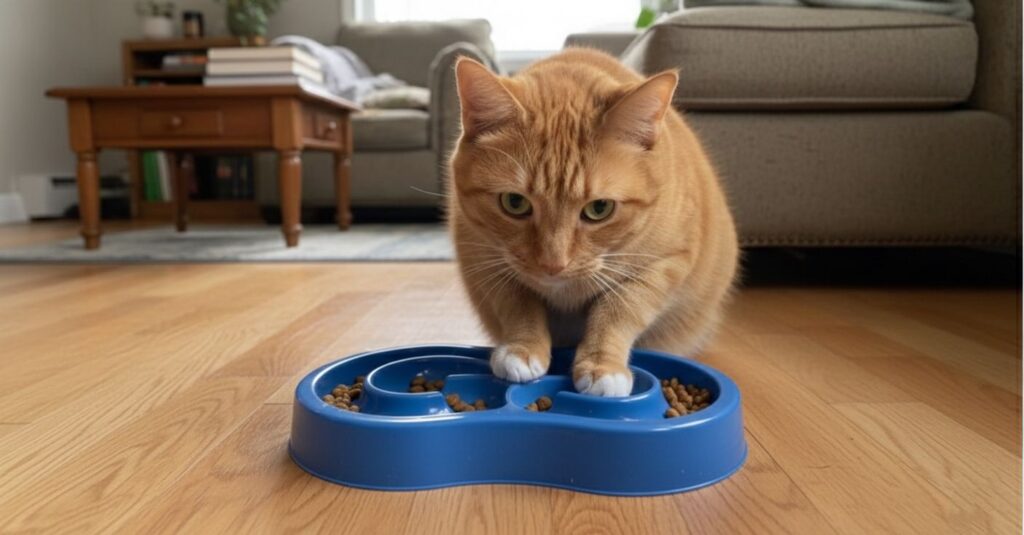
- Use puzzle feeders. These slow eating dramatically and give your cat something to do with their food drive. Often cats eat out of boredom as much as hunger, so using puzzle feeders solves both problems simultaneously — and if you’re looking for more ways to keep a home-alone cat mentally stimulated, how to entertain an indoor cat while at work has some excellent options that we also use with Oliver.
- Don’t feed in response to begging. Even once. Even on a hard day. It resets the behavior completely.
- Provide a small fiber-based “filler.” Some veterinarians recommend a tiny portion of plain cooked pumpkin or a vet-approved fiber supplement to help cats feel fuller between meals. Ask your vet before trying this.
Exercise: The Half of the Equation People Forget
Diet alone will get you so far. But indoor cats are sedentary by default, and burning additional calories through play accelerates everything — and more importantly, it addresses the boredom that drives so much of the excessive eating in the first place.
Diet is only half the battle; burning calories through play is the other half, and if you need structured ideas for tiring out your cat in the evening hours, how to tire out an indoor cat before bed is worth reading alongside this one.
Making Play Count for Weight Loss
- Two 10–15 minute active play sessions per day minimum. Use wand toys, laser pointers, or crinkle balls — anything that gets your cat moving at a near-sprint.
- Play before meals, not after. This mimics the hunt-catch-eat sequence cats are wired for and can significantly reduce post-meal begging.
- Rotate toys regularly. Cats habituate quickly. What was irresistible on Monday is furniture by Wednesday.
- Use a cat wheel if your cat will accept it. Not every cat takes to them, but for the ones that do, the calorie burn is substantial.
For a step-by-step daily plan on getting a lazy cat moving, check out our complete guide on building an indoor cat exercise routine.
Tracking Progress: How to Know It’s Working
Weight your cat every two weeks, at the same time of day, ideally before a meal. A simple baby scale or a postal scale works well at home; most vet offices will also let you come in just for a weigh-in between appointments.
What to track:
- Weight in pounds or kilograms (be consistent)
- Body Condition Score — learn to do this by feel, not just numbers
- Energy levels and coat quality (both should improve as weight drops)
- Litter box habits (any changes warrant a vet call)
If your cat is losing weight faster than 2% of body weight per month, reduce portions slightly and consult your vet. If nothing is moving after six weeks of careful measurement, it’s time for a veterinary check — thyroid issues, diabetes, and other conditions can affect weight management.
A Note on Veterinary Partnership
Everything we did with Oliver was guided by his veterinarian. I’m sharing our experience because it might give you a starting point and some comfort, but please do not put your cat on a calorie-restricted diet without a professional assessment first. Blood work to rule out underlying conditions is an important first step, particularly in cats over seven years old.
Frequently Asked Questions
Is my cat actually starving, or just begging?
Almost certainly just begging. A cat receiving a properly calculated daily calorie allowance is not starving. Cats are extraordinarily good at communicating food-want in ways that feel like food-need — the dramatic collapse, the urgent meowing, the accusatory stare. These are learned behaviors that get reinforced when we respond to them. If you are feeding the right number of calories for your cat’s ideal weight (verified by your vet), your cat is not starving. They are lobbying, and they are very good at it.
👉 How long does the process take when learning how to help indoor cat lose weight?
At the recommended rate of 0.5–2% body weight loss per month, a cat who needs to lose 4–5 pounds (as Oliver did) is typically looking at 6–12 months. This feels agonizingly slow, but it’s the safe range. Faster weight loss puts significant stress on the liver. Trust the process, track consistently, and celebrate the small milestones.
Can I still give my cat treats during weight loss?
Yes, with discipline. Treats should make up no more than 10% of your cat’s daily caloric budget, and they need to be counted — not added on top of regular meals. Weigh them just like you weigh meals. Low-calorie options like small pieces of cooked plain chicken or vet-approved dental treats work well. The moment treats become “bonus” calories outside the budget, the math stops working.
Oliver is now a lean, energetic 10.8 pounds. He still performs his pre-meal monologue every single day. Some things don’t change — but his bloodwork, his joints, and his energy levels are dramatically better, and that makes every minute of that opera worth it.
Disclaimer: This article reflects personal experience and general nutritional knowledge. Always consult a licensed veterinarian before making significant dietary changes for your pet.