By IndoorCatExpert.com | Indoor Cat Safety & Care
My closest friend’s wedding was in Vermont. Friday night ceremony, Saturday reception, drive home Sunday afternoon — roughly 42 hours from the moment I locked my apartment door to the moment I unlocked it again. Beautiful event, genuinely happy occasion, and the source of approximately three weeks of preparatory anxiety on my part because I had never left Oliver alone overnight before.
I am aware that many cat owners would read “48 hours alone” and shrug. Cats are independent. Cats sleep most of the day. Cats don’t care. And in one narrow sense, that’s true — Oliver’s emotional architecture is not built for the kind of separation distress a dog would experience.
But how to leave a cat alone for the weekend safely is genuinely more involved than it sounds, and the difference between “fine” and “emergency vet visit upon return” often comes down to the preparation done in the 48 hours before you leave.
This guide covers everything I did, everything I wish I’d known sooner, and the non-negotiables that apply to any solo weekend trip with a cat at home.
Oliver was perfectly fine, by the way. He was asleep on my suitcase when I got back, which I choose to interpret as affection rather than commentary.
Quick Answer
To safely leave a cat alone for the weekend, automate the essentials before you leave: a programmable automatic feeder with at least 48 hours of food pre-loaded, two separate water sources including a running fountain, and a second temporary litter box added to your regular one. Cat-proof the apartment thoroughly, set up a pet camera you can check remotely, and leave enrichment available. Anything beyond 72 hours requires a pet sitter.
Before you even think about a weekend trip, you must ensure your feline doesn’t suffer from daily workday stress. Read our complete guide to recognizing and solving cat separation anxiety first.
The 48-72 Hour Rule — What’s Actually Safe
Before the preparation checklist, the honest answer to how long is too long:
Most healthy adult cats can be safely left alone for up to 48 hours with proper preparation. Some can manage 72 hours if the food, water, and litter setup is airtight. Beyond 72 hours, the risks — medical emergency with no one present, water running out, litter box becoming unusably soiled, psychological stress from prolonged isolation — accumulate to a point where a pet sitter or trusted neighbor is no longer optional.
Cats who should not be left alone even for 48 hours without a check-in:
- Kittens under one year old
- Senior cats over 12 years old
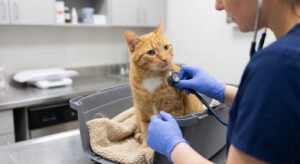
- Cats with any active medical condition, current medication, or recent health changes
- Cats with documented anxiety or stress-related behaviors
- Cats who have never been alone overnight before (a 24-hour trial run is strongly advisable before a full 48-hour absence)
Oliver is six, healthy, and had previously been alone for 20-hour stretches without incident before this trip. I still did a full 24-hour trial run three weeks before the wedding, mostly for my own peace of mind. He spent it sleeping.
Leaving a cat for 48 hours requires substantially more preparation than a standard workday absence — it’s a different category of planning, not just a scaled-up version of the same approach: https://indoorcatexpert.com/how-to-entertain-an-indoor-cat-while-at-work/how to entertain an indoor cat while at work.
Step 1: Automating Food — The Non-Negotiable Starting Point
Manual feeding is not an option when you’re not home. If you free-feed dry food, you might consider topping up the bowl and leaving — but this is less reliable than it sounds for one specific reason: a cat who eats all their food in the first twelve hours due to stress, boredom, or simply their normal appetite now has 36 hours without food, which causes genuine distress and can trigger hepatic lipidosis (fatty liver disease) in cats who go without food for extended periods.
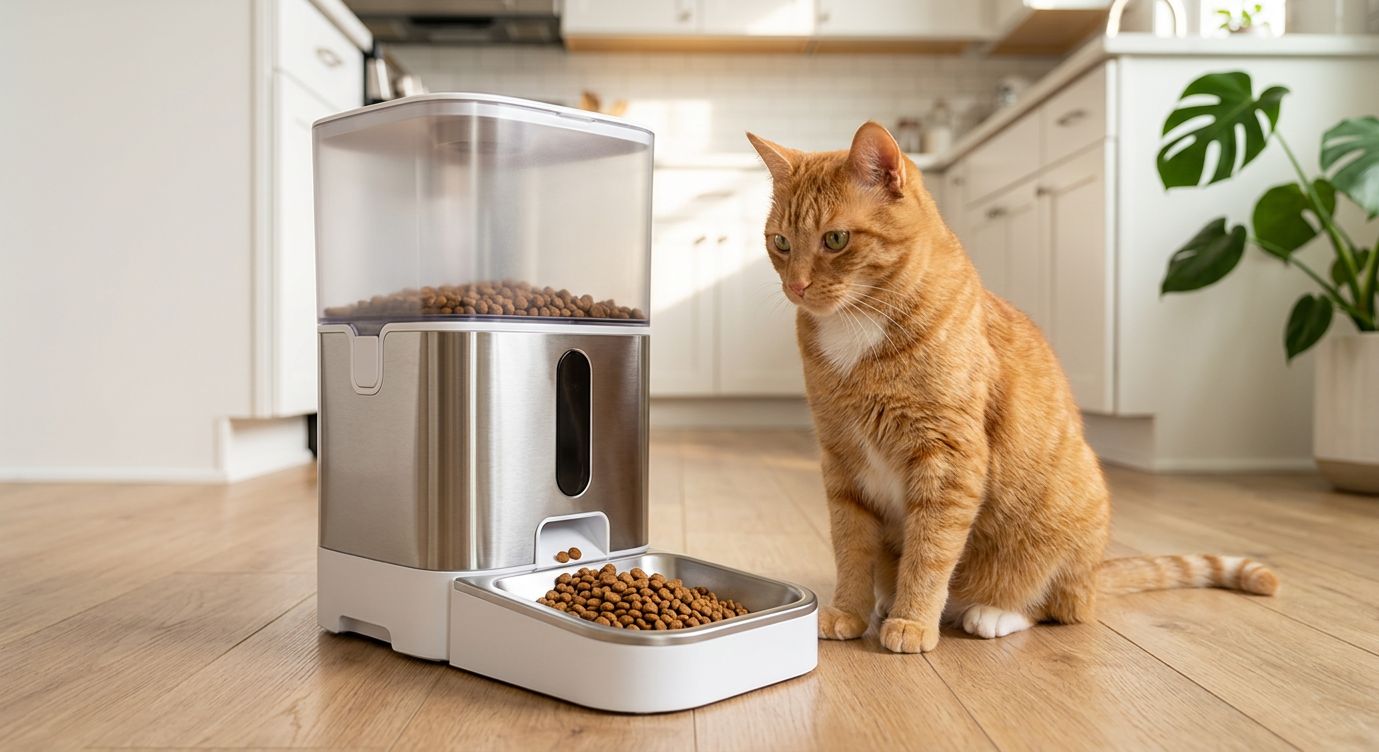
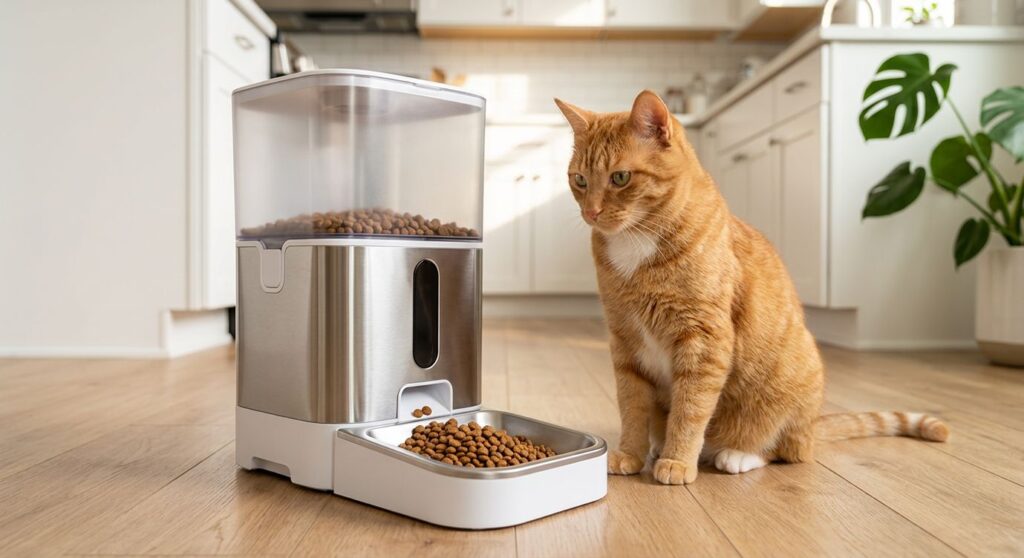
A programmable automatic feeder solves this by dispensing measured portions at set times throughout your absence — the same feeding schedule your cat already expects.
Setting Up an Automatic Feeder Correctly
- Set it to your cat’s normal schedule — if Oliver eats at 7 AM and 6 PM, the feeder runs at 7 AM and 6 PM. Disrupting meal timing adds stress on top of your absence.
- Load at least 25% more food than required — mechanical feeders can occasionally miscycle. Extra food in the hopper means a failed dispense cycle doesn’t become a missed meal.
- Test it for 48 hours before you leave — run a complete two-day cycle while you’re home to confirm timing, portion size, and mechanical reliability. A feeder that jams on day two of your wedding weekend is a serious problem.
- Position it away from the water fountain — food and water in close proximity can cause access aversion in some cats (see the behavior explanation in the hydration article).
- Opt for a feeder with a backup battery — a power outage that kills a wired feeder kills your cat’s meal schedule. Battery backup is not a luxury feature for this use case.
Step 2: Water Security — Two Sources, Always
Water failure during a 48-hour absence is the highest-stakes single-point failure in this entire setup. A cat who goes without adequate water for two days risks urinary crystal formation and the early stages of kidney stress — particularly male cats, who are already more vulnerable to urinary issues.
The rule is two independent water sources, positioned in different rooms.
Dehydration is the most serious health risk during a solo weekend, which is exactly why a continuously flowing water fountain is non-negotiable rather than a nice-to-have addition — still water becomes stale within hours and many cats reduce their intake dramatically when they find their water unpalatable: how to get an indoor cat to drink more water.
The Two-Source Setup
Source 1: The primary water fountain. A recirculating fountain with a freshly cleaned filter handles most of your cat’s weekend water needs. Before leaving, clean the fountain thoroughly, replace the filter, and fill it to maximum capacity. A full fountain running continuously for 48 hours should not run dry in normal operation, but check the water level when you return — if it was significantly lower than expected, the fountain may need a larger reservoir for future trips.
Source 2: A wide, heavy ceramic backup bowl. Position this in a different room from the fountain. Wide and heavy matters — a knocked-over water bowl that empties in hour two is not a backup source. Fill it to the brim before you leave. The redundancy here is critical: if the fountain malfunctions, your cat still has access to standing water.
Do not leave only a single water bowl and consider it sufficient. Bowls go stale, get accidentally knocked over, and evaporate faster than you expect in a warm apartment.
Step 3: Litter Box Math for the Weekend
The standard rule for litter boxes is one per cat plus one. For a solo-cat apartment where one box is the normal setup, a 48-hour absence changes the calculation. One litter box that fills up over 48 hours without scooping will often be refused by your cat — cats have strong preferences against soiled elimination surfaces, and a box used by a single cat for two days without cleaning can hit the threshold of avoidance.
The solution is simple: add a second litter box before you leave.
Two boxes used by one cat over 48 hours distribute the load such that neither box crosses the avoidance threshold before you return. Position the second box in a different location from the first — not adjacent to it, which your cat may treat as a single large station.
Pre-Departure Litter Preparation
- Scoop both boxes thoroughly the morning you leave — ideally within an hour of departing
- Add a generous fresh layer of litter to each box, slightly deeper than normal
- Consider a larger litter box as the second option — the more surface area, the more uses before avoidance kicks in
- For particularly conscientious preparation: ask a neighbor or building contact to scoop once on Saturday if the trip extends to 48+ hours
Clean boxes before departure mean clean boxes for longer. The 90 seconds this takes before you leave for the airport is genuinely worth it.
Step 4: Apartment Hazard Proofing — The Pre-Departure Walkthrough
A cat alone in an apartment for 48 hours is a cat without supervision during any accident, mishap, or exploratory decision. The apartment that’s safe enough for daily supervised living is not automatically safe enough for 48 hours of unsupervised access.
Do a systematic walkthrough with this checklist before you leave:
Physical Hazards
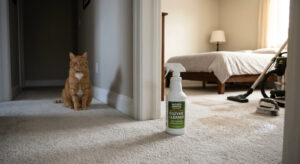
- Unplug any non-essential appliances — slow cookers, heating pads, electric blankets, and any device that produces heat or has exposed cord lengths that could be chewed. Oliver once spent fifteen minutes methodically batting at a phone charger cable. Unplugged, it’s a toy. Plugged in, it’s a risk.
- Close all toilet lids — a cat that falls into a closed toilet cannot easily exit; open toilets are a drowning risk for small or panicked cats. Close them before leaving.
- Secure any cabinets containing cleaning products or medications — cats who are bored or stressed investigate spaces they normally ignore. Child-proof cabinet latches are an inexpensive precaution.
- Remove any rubber bands, hair ties, small plastic items, or twist ties from surfaces — these are common foreign body ingestion risks and cause intestinal blockages requiring emergency surgery.
- Close any interior rooms you don’t want your cat accessing — if the spare bedroom has items you’d prefer undisturbed, close the door.
Environmental Safety
- Set your thermostat to a consistent temperature — don’t leave the heating or cooling off for the weekend to save money. Cats are stressed by temperature extremes; maintain the apartment at their normal comfortable range.
- Leave some ambient light — complete darkness for 48 hours is unusual and mildly stressful for most cats. A lamp on a timer, or simply leaving a low-wattage bulb on in one room, maintains a more normal light environment.
- Leave a worn item of your clothing accessible — your scent is genuinely calming for a cat who is already stressed by your absence. An old t-shirt on the sofa costs nothing and does something real.
Step 5: The Pet Camera Advantage — Eyes on Oliver from Vermont
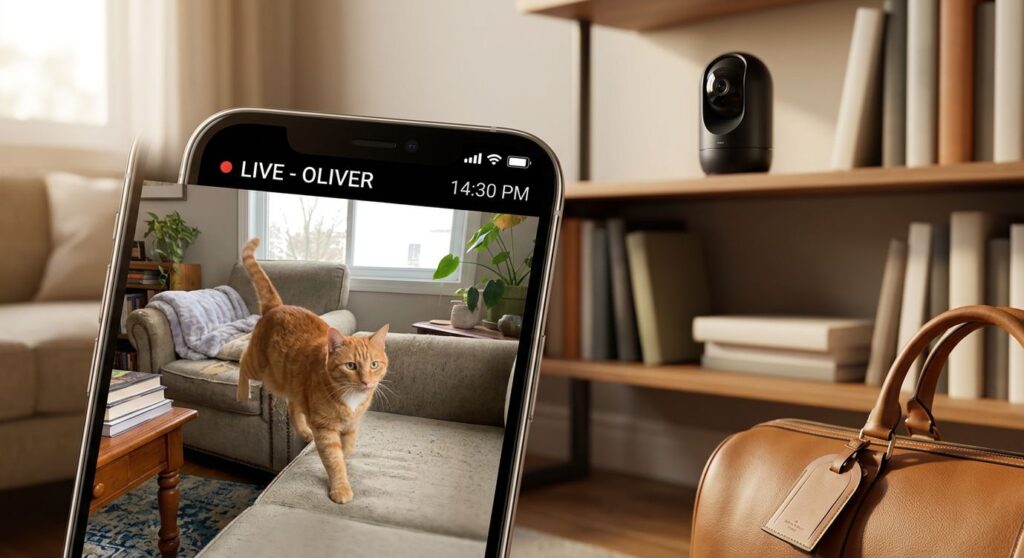
A smart pet camera is not a vanity purchase for the anxious pet owner — it is practical risk management for a 48-hour absence. The ability to visually confirm your cat is moving normally, eating, and not in distress at any point during your absence is the single most valuable tool for managing the psychological component of leaving a pet alone.
What a Good Pet Camera Setup Provides
- Motion-activated alerts — most smart cameras send a phone notification when movement is detected in the frame. A cat moving through the kitchen at normal intervals is a cat who is awake, active, and behaving normally. No alerts for a 12-hour stretch is information worth having.
- Remote viewing on demand — check the camera when you land, when you wake up, during the reception if you need to. Oliver’s Saturday morning appearance on my phone screen while I was eating breakfast in Vermont was genuinely reassuring.
- Two-way audio on some models — the ability to speak through the camera is reportedly comforting for some cats who are particularly bonded with their owner’s voice. Oliver is largely indifferent to disembodied voices from small devices, but many cats respond positively.
Position the camera with a clear view of the feeding area and main living space. This captures the two highest-information data points: whether your cat is eating normally and whether they’re moving around the apartment.
Who to Call If the Camera Shows a Problem
Before you leave, put two contacts in your phone: a trusted neighbor or friend with a spare key who can physically check on Oliver if the camera shows something concerning, and your vet’s emergency after-hours number. Having these contacts identified in advance means you’re not scrambling in a hotel lobby trying to find a locksmith and a vet simultaneously.
Enrichment for the Weekend — Keeping Oliver from Redecorating
A cat who is bored for 48 hours is a cat who will find entertainment, and not all of that entertainment will be things you’re happy about on return. Setting up passive enrichment before you leave reduces both behavioral stress and the likelihood of finding something destroyed.
Pre-departure enrichment setup:
- Rotate toys — put away the toys that have been out all week and leave a different set, including at least one crinkle ball, one spring toy, and if Oliver is interested in them, a battery-operated automatic toy set to run in short intervals
- Scatter a portion of dry food — leave a small amount of kibble in three or four spots around the apartment to activate foraging behavior during the first morning
- Leave a paper bag or cardboard box open on the floor — these are hours of investigation for most cats and cost nothing
- Set up cat TV — a tablet or laptop propped securely with a looping bird video playlist queued is genuinely effective enrichment during daylight hours; set it on a timer if possible to preserve battery
The Return Home — What to Expect
Cats respond to owner returns in ways that vary considerably by individual. Oliver typically greets me at the door with approximately three seconds of nose contact and then returns to the sofa as if I never left. Some cats are visibly more affectionate for a day or two after a longer absence; some are demonstrably cool for a day in what behaviorists describe as “social distance regulation.”
Whatever your cat’s response, resist the urge to over-correct by being excessively attentive or changing their routine. The fastest route back to normal is re-establishing normal — same feeding times, same play schedule, same evening routine. Disrupting the routine with an “I missed you” overhaul of their day adds stimulation on top of an already slightly disrupted period.
FAQ
👉 Will my cat think I abandoned them?
No — but not because cats don’t notice your absence. They do. Research on cat cortisol levels shows measurable stress hormone elevation during owner absences, indicating cats are aware of and respond to your departure. What cats don’t have is a human-style cognitive framework for “abandonment” — a narrative about the permanence of the departure and its implications for the relationship. A well-prepared 48-hour absence doesn’t damage your bond with your cat. They may be slightly more clingy on return, or slightly more aloof as stress regulation, but within 24 hours of your return the relationship returns to baseline. The preparation you do before leaving — food, water, enrichment, your scent on the sofa — communicates care even in your absence.
👉 Is 3 days too long when figuring out how to leave a cat alone for the weekend?
For a 48-hour absence with a healthy adult cat, a check-in is reassuring but not strictly necessary if the food, water, and litter setup is solid. For a 60-72 hour absence, a single mid-trip check-in from a trusted person with a spare key — even just a 10-minute visit to confirm food and water are running, scoop the litter once, and confirm your cat is moving normally — takes the risk profile significantly lower. If your cat has any health history or is a senior, a check-in visit is not optional regardless of trip length. The small ask to a friend or neighbor is worth making.
👉 What if my automatic feeder malfunctions while I’m gone?
This is why testing the feeder for a full 48-hour cycle before your trip is mandatory, not suggested. For additional redundancy: leave a small amount of dry food in a secondary bowl as a fail-safe — enough to sustain your cat for one day if the feeder fails on day two. A pet camera with motion alerts lets you notice quickly if your cat is spending unusual amounts of time near the feeding area (a potential sign of an empty feeder). And a contact with a spare key who can do an emergency food drop is the final safety net — identify this person before you leave, not after the feeder jams.
References: Schwartz, S. (2002). Separation anxiety syndrome in cats. Journal of the American Veterinary Medical Association, 221(2). | Stella, J.L. et al. (2013). Evaluation of associations between lifestyle and housing factors and the occurrence of feline interstitial cystitis. Journal of the American Veterinary Medical Association, 242(8). | Ellis, S.L.H. et al. (2013). AAFP and ISFM Feline Environmental Needs Guidelines. Journal of Feline Medicine and Surgery, 15(3), 219–230.
IndoorCatExpert.com — For the cats who sleep on your suitcase, and the humans who feel guilty about it anyway.