Why do cats like boxes? For many indoor cats, a cardboard box is not just packaging. It is a warm hiding spot, a scent-safe retreat, an ambush zone, and a low-cost enrichment tool that gives them control over their space.
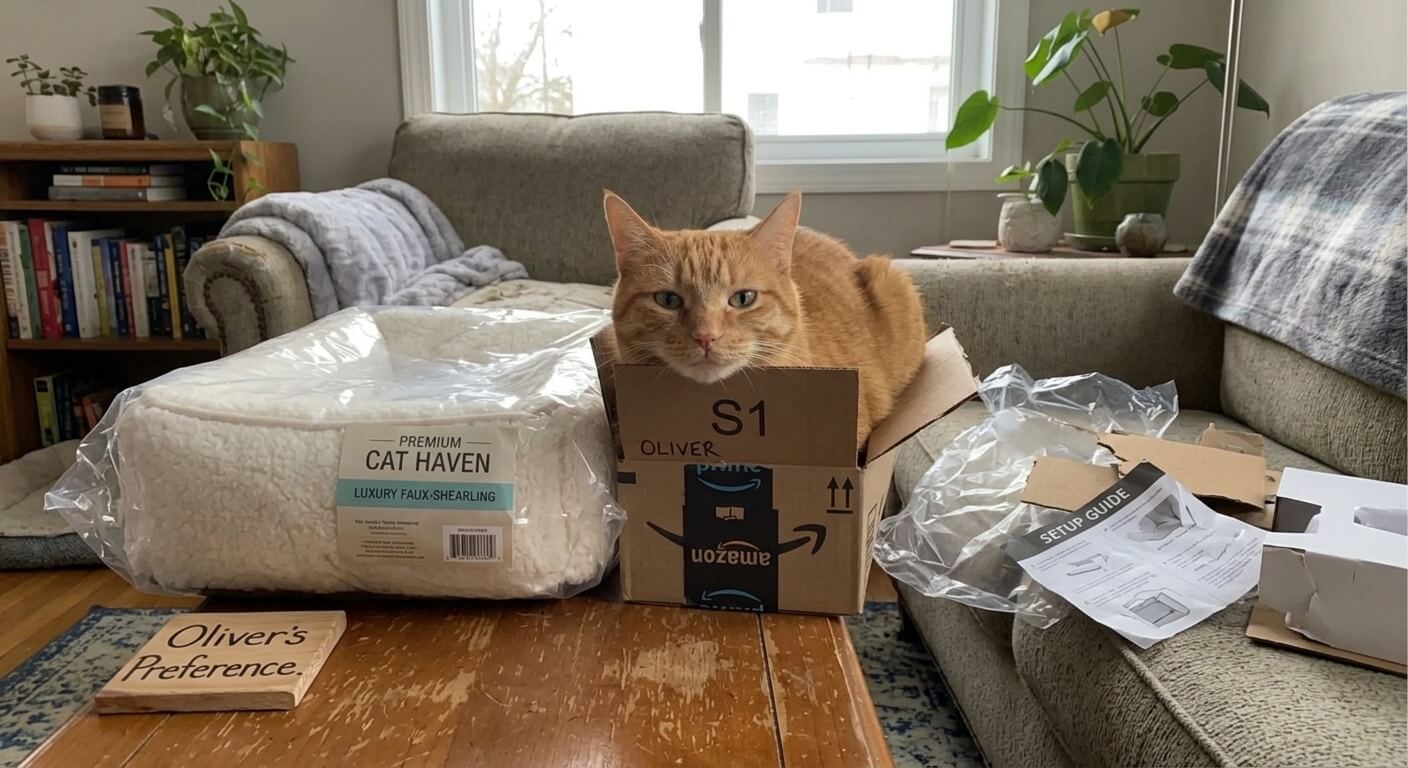
Oliver taught me this after ignoring a new orthopedic cat bed and moving into the shipping box it arrived in. At first, I thought he was just being stubborn. Then I started looking more closely at feline stress, hiding behavior, thermoregulation, and indoor enrichment.
This guide explains five safe reasons cats like boxes, how to use cardboard boxes for enrichment, and what to remove before offering a box to your cat.
Quick Answer: Why Do Cats Like Boxes?
Cats like boxes because boxes provide safety, warmth, scent familiarity, hiding access, and play opportunities. A box gives an indoor cat enclosed walls, a controlled entry point, and a place to observe the room without feeling exposed.
For enrichment, the best box is plain, clean, stable, and large enough for your cat to enter and turn around comfortably. Remove tape, staples, plastic, labels, foam, rubber bands, and any sharp or loose pieces before use.
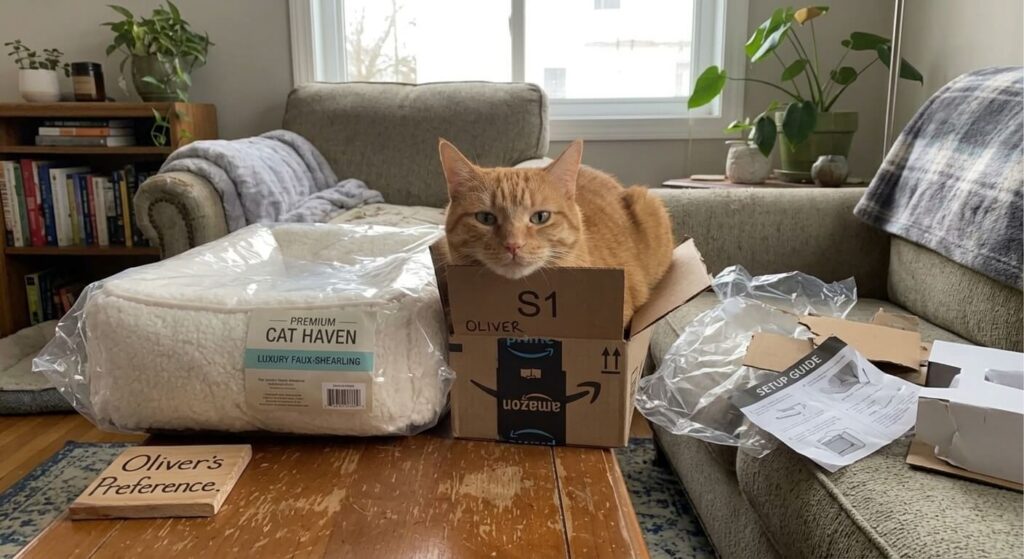
Table of Contents
The ‘Security-Vantage’ Principle: Why Box Walls Mean Peace
Here’s something I explain to cat owners almost every week at the clinic: cats are what behaviorists call “solitary stalkers.” They are simultaneously predator and prey in the wild, and that dual biological identity never fully switched off when they moved onto our couches.
A box solves a very specific evolutionary problem.
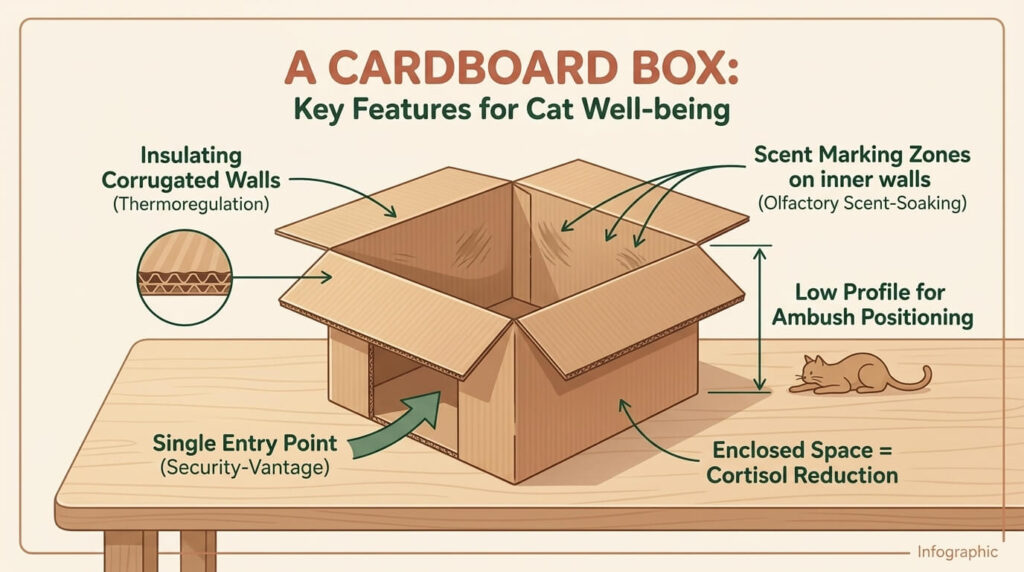
When a cat sits inside a box, they gain what I call the Security-Vantage advantage:
- Walls on three or four sides eliminate the threat of being approached from behind or the flanks.
- One primary entry point means they can monitor all incoming threats from a single direction.
- Low profile concealment means they can watch the world without the world easily watching them.
This is fundamentally why do cats like boxes at a neurological level — the box mimics a den, a rocky crevice, or a hollow log. It whispers to their nervous system: “You are safe here. You can relax.”
Think about Oliver in that Amazon box. My living room is perfectly safe. But Oliver’s brain doesn’t know that with the same certainty I do. A box gives him Environmental Agency — the ability to choose a safe zone and control his immediate environment. That choice is enormously powerful for feline psychological wellbeing.
Pro Tip: This is why cats who seem “anxious” or skittish often gravitate toward boxes even more intensely. The need is higher, so the draw is stronger.
5 Reasons Cats Like Boxes
Let’s get into the good stuff. Here are the five science-backed reasons why do cats like boxes — and why you should be deliberately providing them as part of your indoor enrichment strategy.
Reason 1: Boxes Help Cats Feel Less Exposed
This one is close to my heart because I watched it work in real time at a shelter where I volunteered during my vet tech training.
A landmark study by Vinke et al. (2014) divided newly admitted shelter cats into two groups: one group received hiding boxes, and the other did not. The results were striking. Cats with hiding boxes showed significantly lower stress scores and adapted to the shelter environment much faster than those without.
Why? Because Cortisol Reduction is directly linked to a cat’s ability to hide and retreat. When a cat cannot escape a stressor, their hypothalamic-pituitary-adrenal (HPA) axis fires up, flooding their system with cortisol. Chronic cortisol elevation suppresses immune function, causes digestive upset, and contributes to behavioral problems.
A box interrupts that stress cycle.If your cat hides more than usual, stops eating, or avoids normal routines, compare the behavior with our guide to signs an indoor cat is stressed. It tells the nervous system: “Threat is managed. Stand down.”
This is one of the most important answers to why do cats like boxes — it’s literally medicine.
Reason 2: Cardboard Helps Cats Stay Warm
Here’s something most cat owners don’t realize: cats run warm.
A cat’s Thermoneutral Zone — the ambient temperature range in which they don’t need to expend metabolic energy to maintain body temperature — is approximately 30–38°C (86–100°F). Your apartment is probably around 20–22°C (68–72°F). That’s actually on the cooler side for your cat’s preference.
Enter cardboard.
Cardboard is a surprisingly effective insulator. It traps air in its corrugated channels and reflects your cat’s own body heat back toward them. A cardboard box creates a microclimate that is noticeably warmer than the surrounding room.
This is a key reason why do cats like boxes that gets overlooked in favor of behavioral explanations — sometimes, it’s just physics and warmth. Oliver’s Amazon box? Sitting in a patch of afternoon sunlight. The man knew exactly what he was doing.
Checklist: Maximizing Thermoregulatory Box Benefits
- Place boxes in naturally sunny spots near windows
- Line the bottom with a fleece blanket for extra insulation
- Choose boxes with higher walls to trap warm air
- Avoid placing boxes near air conditioning vents or drafty doors
Reason 3: Boxes Hold Familiar Scent
This one always delights people when I explain it at the clinic.
Cats have scent glands in their cheeks, paws, and forehead. When Oliver rubs his face along the inner walls of a box, he isn’t being cute (well, he is, but that’s secondary). He is actively depositing pheromones onto the surface — a process I call Olfactory Scent-Soaking.
A marked box smells like the cat. And something that smells like the cat is, by definition, part of the cat’s territory. It’s safe. It’s theirs.
This is also why a new box is initially interesting (novel smells to investigate) but a used box becomes preferred (it’s been claimed and secured). Cardboard is particularly good at absorbing and retaining these pheromone signals compared to plastic or metal.
This is one of the subtler but deeply satisfying answers to why do cats like boxes — they are literally building a scent-safe zone from scratch.
Reason 4: Boxes Create Safe Ambush Spots
I cannot tell you how many enrichment consultations I’ve done where a cat’s “behavior problem” was really just frustrated predatory instinct.
Cats are obligate hunters. They are neurologically wired to: stalk → crouch → wait → pounce. In an indoor environment with no prey to hunt, that wiring doesn’t just… turn off. It redirects — sometimes onto ankles, sometimes onto other pets, sometimes into destructive play.
A box provides the perfect ambush architecture.
When Oliver sits in his Amazon box with just his eyes visible over the rim, he is in full predatory crouch mode. He can watch the hallway. He can wait for the toy I’m about to drag past him. He can pounce from a position of concealment.
This is why do cats like boxes from a play-behavior perspective — the box is a hunting blind, a tactical position, and a launchpad all in one.
Enrichment Idea: Drag a wand toy past the opening of a box slowly. Watch what happens. You’re welcome.
Reason 5: Familiar Boxes Reduce Novelty Stress
New environments are stressful for cats. New objects are suspicious. New people are threats until proven otherwise.
Cardboard boxes often arrive carrying a fascinating, complex cocktail of smells — warehouse smells, shipping smells, the smell of whatever was inside. This is actually a feature, not a bug, from a feline enrichment perspective.
Your cat investigating a new box is engaging in olfactory enrichment — processing new sensory information from a safe position. Once the novelty is processed and the box is scent-marked (see Secret #3), it transitions from “suspicious new object” to “familiar safe zone.”
Olfactory Familiarity is a profound comfort mechanism for cats. The familiar smell of cardboard they’ve lived in becomes a psychological anchor point — especially important in multi-pet households or homes with frequent changes in routine.
This is also why moving house is so stressful for cats,If you are preparing for a move, use these boxes alongside our moving with a cat to a new apartment guide so your cat has familiar scent and safe hiding access before the new space becomes overwhelming. and why providing a box from your old home in a new space can genuinely help with the transition. Their scent is already there. Some safety transferred.
Vet Tech DIY: How to Turn a Simple Box into an Enrichment Maze
Now here’s the part I genuinely love. Because understanding why do cats like boxes is step one — but leveraging that understanding to build real enrichment is where the magic happens.
You don’t need to spend $150. You need boxes, scissors, and about 20 minutes.
The Basic Enrichment Box (Level 1)
What you need:
- 1 medium cardboard box
- Box cutter or scissors
- Optional: catnip, crinkle paper, or a small fleece square
Steps:
- Cut a circular or arched entry hole large enough for your cat to pass through comfortably (err on the generous side)
- Cut a smaller “peephole” on the opposite side — this gives the dual security of entry monitoring AND a visual escape route
- Place a fleece square or old t-shirt inside (your scent = bonus comfort)
- Sprinkle dried catnip along the inner bottom seam
- Place near a wall, slightly elevated if possible (a step stool works perfectly)
Oliver approved this setup in approximately 45 seconds. That’s practically an endorsement.
The Multi-Box Enrichment Maze (Level 2)
This is where it gets fun. This is also a brilliant strategy for redirecting boredom-driven destructive scratching — Providing cardboard outlets is a useful way to redirect boredom-driven scratching; for more low-cost projects, see our guide to DIY cat enrichment ideas for small apartments.
What you need:
- 3–5 boxes of varying sizes
- Packing tape (for structural joins only — not accessible to your cat)
- Box cutter
- Cat-safe rope or sisal twine (optional)
How to Build It:
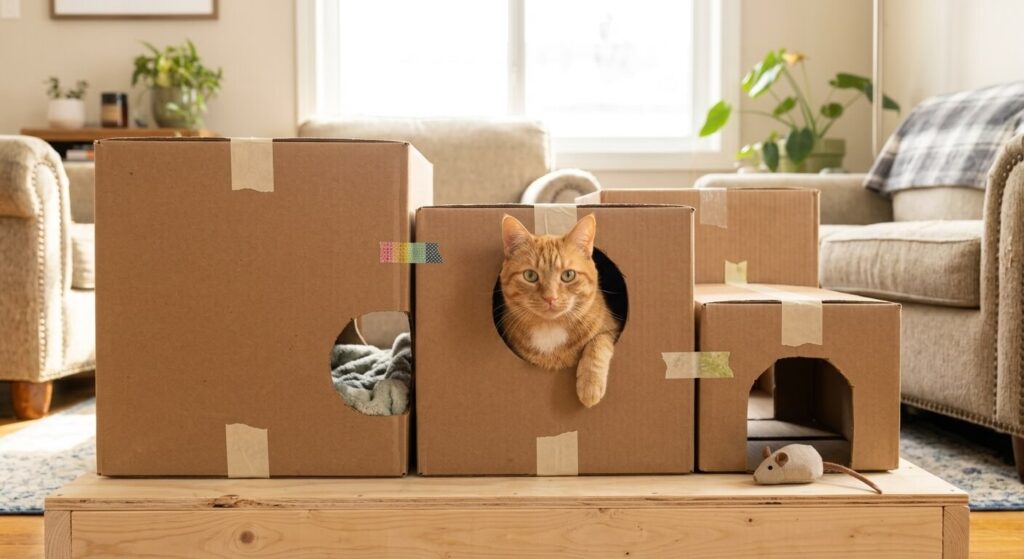
- Connect boxes side-by-side or stacked (one on top of another) using tape on the outside joins only
- Cut connecting tunnels between boxes — these should be circular and just wide enough for your cat (measure your cat’s shoulder width + 2 inches)
- Vary the entry heights — some at floor level, one elevated — to create a vertical dimension
- Add texture variety: leave one box plain cardboard, line one with fleece, add crinkle paper to another
- Create a “lookout tower”: the topmost box should have a wide, open top so your cat can sit on the roof and survey their domain
- Rotate toy placement inside different chambers to keep the maze unpredictable and engaging
Pro Tips for the Maze:
- Replace individual boxes as they wear out without dismantling the whole structure
- Spray a tiny amount of Feliway (synthetic feline facial pheromone) on new boxes being integrated to reduce suspicion
- Move the maze periodically to a new location to renew interest
- Hide treats in different chambers each morning for food-motivated cats
Quick Enrichment Sprinkles (5-Minute Ideas)
Sometimes you just have five minutes and a box. Here’s what you can do right now:
- The Treat Hunt: Toss 5–10 small treats into an empty box and let your cat fish them out
- The Crinkle Pit: Fill a box 3/4 full of scrunched packing paper and hide a toy underneath
- The Sock Tunnel: Cut both ends off a box to create a cardboard tunnel, tie a toy to a string coming out the far end
- The Sniff Box: Place items with novel smells (a pine cone, a piece of bark, dried lavender) inside a box with holes cut in the sides — olfactory enrichment without ingestion risk
Safety Warning: Tape, Staples, and Ingestion Risks
I want to be very clear here because I’ve seen ingestion cases at the clinic that could have been avoided.
Boxes are generally safe. The things on boxes often aren’t. Here’s your safety checklist before giving any box to your cat:
Remove Before Offering:
- Packing tape — adhesive is a gastrointestinal hazard; the sticky surface can trap whiskers and cause distress
- Staples — metal staples used to close box seams are sharp and can lacerate the mouth, esophagus, or GI tract
- Plastic strapping or binding — strangulation and ingestion risk
- Foam peanuts — choking and blockage hazard
- Rubber bands — linear foreign body risk (can cause intestinal plication)
- Labels with sharp edges or plastic laminate — can cause oral lacerations
- Printed inks with heavy metal dyes — avoid boxes with large areas of brightly colored, heavily saturated printing; stick to plain brown cardboard or lightly printed boxes where possible
Watch for These Behaviors:
Some cats don’t just sit in boxes — they chew them. While occasional light chewing is generally harmless, persistent cardboard chewing can be a sign of:
- Pica (compulsive ingestion of non-food materials)
- Underlying dental discomfort or gum disease driving oral stimulation
- Nutritional deficiency (less common)
- Anxiety-driven compulsive behavior
If your cat is actively eating cardboard pieces rather than just mouthing or batting at the box, please consult your veterinarian. This may be connected to oral discomfort, stress, or compulsive chewing, so persistent cardboard eating is worth discussing with your veterinarian. For mouth-related warning signs, read our guide to indoor cat dental health.
Ongoing Safety Monitoring:
- Check boxes weekly for structural degradation — a collapsing box can trap a cat. For a broader room-by-room enrichment audit, use our indoor cat enrichment checklist.
- Look for sharp cardboard edges that develop as boxes are chewed or worn
- If you stack boxes, ensure the structure is stable and cannot tip
- Never leave plastic bags or wrapping anywhere near the box setup
Frequently Asked Questions
1. Why does my cat sit in a box that is too small?
This is one of my favorite questions because it seems counterintuitive — and yet I see it constantly (Oliver is guilty of this with a shoebox he has absolutely no business being inside).
The answer connects directly to why do cats like boxes in the first place. A tighter fit means more contact with the walls — more pressure on multiple body surfaces simultaneously. This multi-point contact appears to be deeply soothing for many cats, similar in principle to why some anxious dogs respond well to compression wraps.
A smaller box also means:
- Maximum concealment — less of the cat is visible from outside
- More body heat reflected back — higher efficiency of the thermoregulatory benefit
- Stronger scent concentration — the space fills with the cat’s own pheromones more quickly
So when your cat folds themselves origami-style into a box that is objectively too small, they’re not being silly. They’re optimizing for maximum safety and comfort signals. The pressure, the warmth, the enclosure — they want all of it.
2. Can cardboard boxes replace cat trees or shelves?
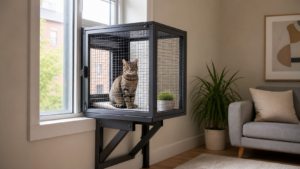
No. Boxes are useful enrichment, but they do not replace vertical space. Boxes provide hiding, warmth, scent familiarity, and ambush play, while cat trees and wall shelves provide climbing, height, and territory control. A strong indoor setup usually includes both: at least one safe hiding box and at least one elevated resting option.
3. Is it okay for cats to chew cardboard?
Short answer: Light chewing and mouthing? Generally fine. Eating cardboard? That needs veterinary attention.
Plain cardboard is not toxic. An occasional nibble won’t harm your cat, and many cats find the texture satisfying (it mimics the resistance of prey bones in a rudimentary way). The risk comes from:
- Ingesting large pieces that can cause GI obstruction
- Swallowing the fibrous material that can accumulate and cause compaction
- The behavior escalating into true Pica — a compulsive eating disorder that requires behavioral and sometimes medical intervention
My clinical rule of thumb: if the box is getting smaller because your cat is eating it, it’s time for a vet visit. If the box has a few teeth marks and is otherwise intact, monitor it but don’t panic.
Always remove boxes that have been significantly chewed along edges, as the frayed cardboard can create sharp points.
4. Should I leave boxes out all the time?
Yes — with some strategic rotation.
Permanent box access is genuinely good for your cat’s wellbeing. Remember, Environmental Agency — the ability to choose when and where to retreat — is a core component of feline psychological health. Removing hiding spots increases chronic stress, particularly in multi-cat households or homes with frequent visitors.
However, novelty matters for enrichment value. Here’s my recommended approach:
- Keep 1–2 boxes permanently available in your cat’s preferred resting areas — these become their stable “home base” boxes
- Rotate “enrichment boxes” every 1–2 weeks — new boxes bring new smells and renewed investigative interest
- Retire worn boxes promptly — a degraded, collapsing box creates stress rather than alleviating it
- Seasonal variation — a box placed near a sunny winter window versus a cool shadowed summer corner gives your cat agency over thermoregulation
The bottom line: yes, leave boxes out. Refresh them periodically. Let your cat decide when they want to use them. That choice is the enrichment.
Final Thoughts
Oliver is currently asleep in a medium-sized Priority Mail box that arrived yesterday. The luxury bed — that $150 investment in his comfort — is across the room, unused.
And honestly? I’m not even a little bit bothered anymore.
Understanding why do cats like boxes transformed my frustration into appreciation. That box is giving him Cortisol Reduction, warmth within his Thermoneutral Zone, Olfactory Scent-Soaking security, a predatory ambush position, and Environmental Agency over his own safe space. He’s not ignoring my gift. He’s just already an expert in feline enrichment.
The cardboard box is not a consolation prize. It is, in many ways, the whole point.
So the next time an Amazon delivery arrives, don’t break it down immediately. Set it on the floor. Step back.
Watch what happens.
References
- Vinke, C. M., Godijn, L. M., & van der Leij, W. J. R. (2014). Will a hiding box provide stress reduction for shelter cats? Applied Animal Behaviour Science, 160, 86–93.
https://doi.org/10.1016/j.applanim.2014.09.001 - Kry, K., & Casey, R. (2007). The effect of hiding enrichment on stress levels and behaviour of domestic cats (Felis sylvestris catus) in a shelter setting and the implications for adoption potential. Animal Welfare, 16(3), 375–383.
https://doi.org/10.1017/S0962728600027573