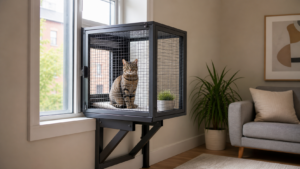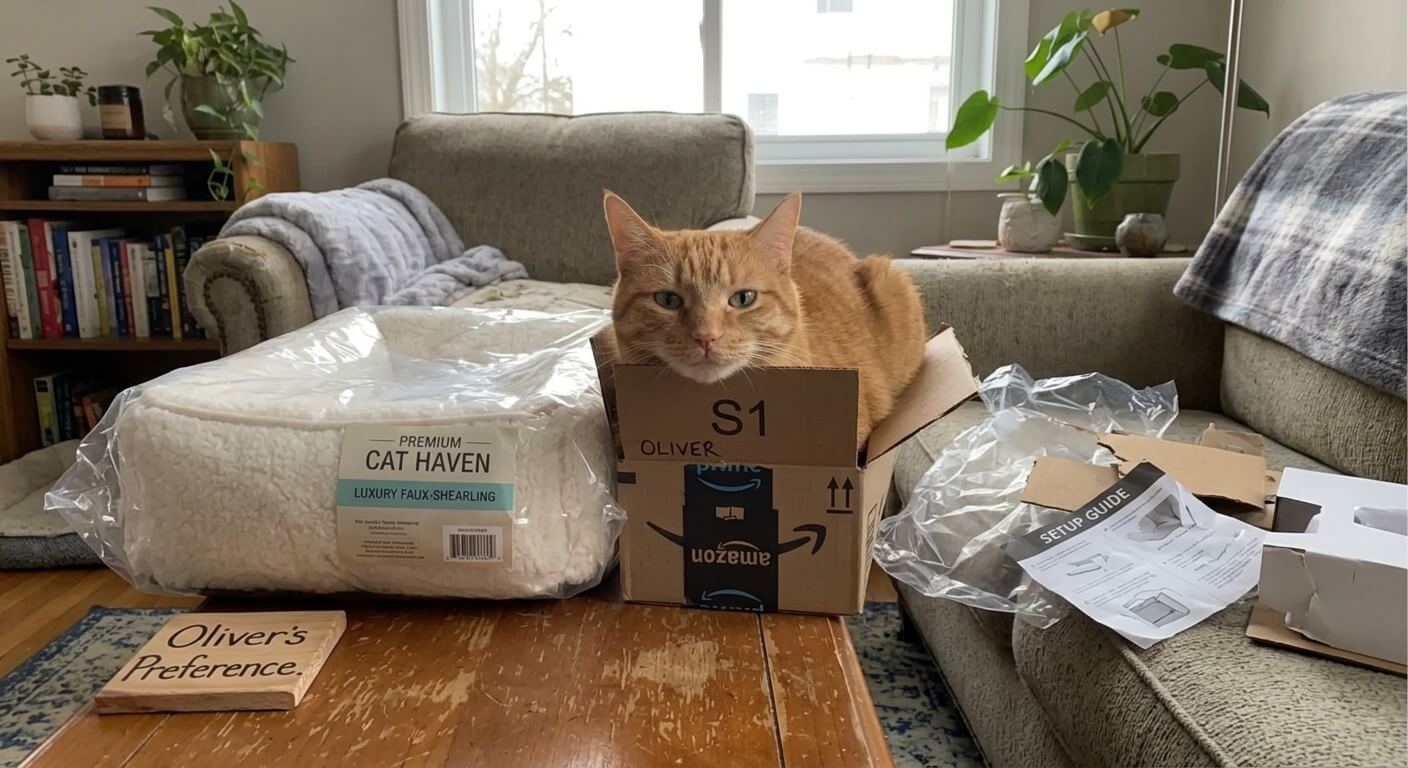
Why do cats like boxes? For many indoor cats, a cardboard box can be a hiding place, resting spot, or play area. It is a low-cost way to offer another choice of retreat.
Boxes are a low-cost way to offer a cat a choice of hiding place. The strongest direct evidence comes from shelter settings, so a box should be treated as one useful option rather than a treatment for stress or a guarantee that every cat will use it.
This guide explains five safe reasons cats like boxes, how to use cardboard boxes for enrichment, and what to remove before offering a box to your cat.
Quick Answer: Why Do Cats Like Boxes?
Many cats use boxes as enclosed hiding places, resting spots, or play cover. Individual preferences vary: some cats prefer an open box, while others choose a covered space or a different quiet retreat.
For enrichment, the best box is plain, clean, stable, and large enough for your cat to enter and turn around comfortably. Remove tape, staples, plastic, labels, foam, rubber bands, and any sharp or loose pieces before use.
Table of Contents
Why a Hiding Place Can Help a Cat Feel Secure
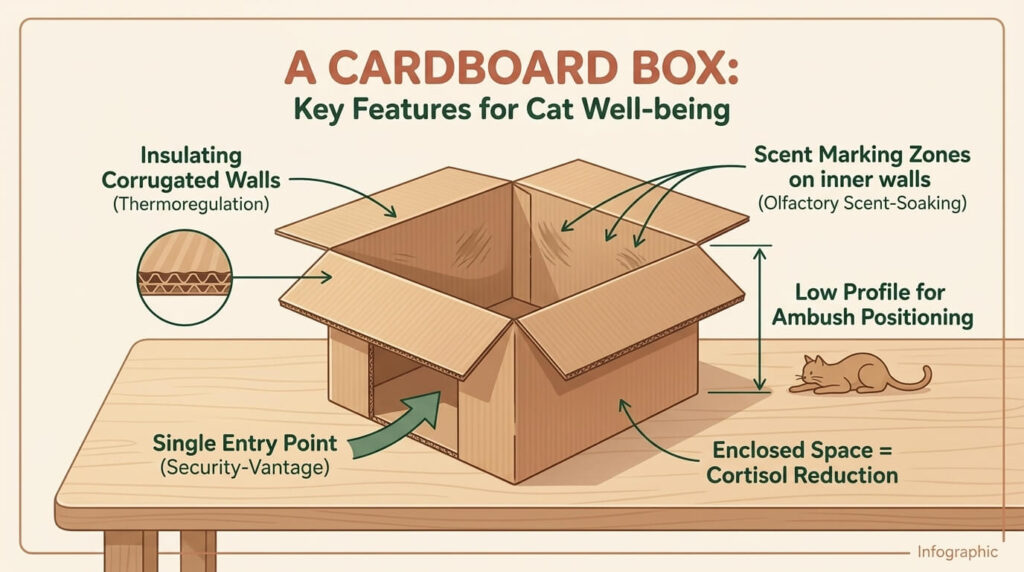
Cats often seek places where they can retreat and watch their surroundings. Feline environmental-needs guidance recommends providing safe places, including hiding options, so a cat can choose when to withdraw.
A cardboard box can be one practical way to provide that choice.
The enclosed sides can give a cat partial concealment while leaving an entrance it can use freely:
- Enclosed sides can block some sights and let the cat withdraw from activity.
- An accessible opening lets the cat enter and leave freely; never block the exit.
- Partial concealment may allow the cat to observe the room from cover.
This is a plausible reason some cats choose a box, but we cannot infer what an individual cat is feeling from the box alone. Watch for relaxed body language and give the cat another way to leave.
The useful feature is choice: a cat can enter, leave, and select a different resting place. Keep multiple suitable retreat options available rather than forcing a cat into a box.
Practical note: Some cats seek more cover when their environment changes. If hiding increases suddenly or accompanies reduced appetite, pain signs, or other changes, contact a veterinarian.
5 Reasons Cats Like Boxes
These five sections separate evidence for hiding from possible reasons a particular cat might choose a box. The shelter studies discussed below do not prove every proposed mechanism in a home setting.
Reason 1: Boxes Help Cats Feel Less Exposed
Shelter-cat studies provide the clearest direct evidence for the value of a hiding place.
In a small study of newly admitted shelter cats, Vinke and colleagues (2014) found lower behavioral stress scores in cats given hiding boxes during the first few days; the groups were similar by day 14. This result concerns shelter adjustment and should not be presented as a measured benefit for every cat at home.
The study assessed behavior rather than demonstrating a specific cortisol or immune-system effect from cardboard boxes. A box may help by offering a place to retreat, but its effect depends on the cat and the situation.
A box is not a substitute for investigating a sudden change in behavior. If your cat hides more than usual, stops eating, or avoids normal routines, read our guide to signs an indoor cat is stressed and contact a veterinarian when the change is marked or persistent.
A safe hiding place is useful environmental support, not medicine or a proven treatment for illness.
Reason 2: Cardboard Helps Cats Stay Warm
Some cats seek warm resting spots, but warmth is not the only reason a cat may choose a box.
Cardboard can reduce drafts around a resting cat. There is no reliable household temperature threshold that proves a particular cat prefers a box for warmth, and a closed box should never be used to trap heat.
A box is one option.
A dry box with a comfortable liner may feel sheltered and warm. Provide other resting places as well, and let your cat move away if the location becomes too hot.
Warmth may be one factor when a box sits in a comfortable spot, but it should not be treated as a measured effect or the explanation for every cat.
Checklist: Comfortable Box Placement
- Place the box in a comfortable, draft-free spot, away from overheating and from any unsecured window.
- Line the bottom with a fleece blanket for extra insulation
- Choose a box that is stable and easy for this cat to enter and leave.
- Avoid placing boxes near air conditioning vents or drafty doors
Reason 3: Boxes Hold Familiar Scent
Scent can influence how cats investigate and use familiar objects.
Cats may rub their cheeks against objects and leave familiar scent cues. That does not prove a particular box is preferred because of pheromones; watch what your cat actually chooses.
A familiar-smelling box may be easier for some cats to explore after a change in the home. Keep it clean and dry.
A new box may attract investigation while another cat may prefer an older, familiar box. The claim that cardboard retains feline scent better than plastic or metal has not been established here.
Offer a familiar retreat alongside other choices, especially after a move or household change.
Reason 4: Boxes Create Safe Ambush Spots
A box can also be used as cover during supervised play.
Stalking and pouncing are normal play behaviors for cats. During indoor play, a cat may watch a moving toy from behind cover and then choose to chase it.
A box can provide simple play cover.
Move a supervised wand toy past an open box and give the cat space to decide whether to watch, pounce, or leave. Keep strings and detachable pieces out of reach afterward.
A box may support play for a cat that enjoys hiding and ambushing; it is not a diagnosis of a behavioral problem.
Enrichment Idea: Drag a wand toy past the opening of a box slowly. Watch what happens. You’re welcome.
Reason 5: Familiar Boxes Reduce Novelty Stress
Some cats are cautious around unfamiliar objects or household changes. Introduce a new box without forcing interaction.
Shipping materials can contain unfamiliar odors as well as tape, plastic, or residues. Remove packaging hazards and use a clean, dry box.
A cat may sniff and investigate a new box at its own pace. If it avoids the box, provide another hiding option.
Keeping a familiar, safe resting item can be helpful during a move, but there is no evidence here that a particular box becomes a psychological anchor for every cat.
During a move, keep familiar, safe hiding options available in a quiet room. See our guide to moving with a cat to a new apartment for a fuller transition plan.
DIY: How to Turn a Simple Box into an Enrichment Maze
A simple box can become an enrichment activity without buying a new product. Use a clean, stable box and supervise any toy or treat game.
Choose a plain box, smooth any cut edges, and make an opening wide enough for the cat to enter and leave without squeezing.
The Basic Enrichment Box (Level 1)
What you need:
- 1 medium cardboard box
- Box cutter or scissors
- Optional: catnip, crinkle paper, or a small fleece square
Steps:
- Cut a circular or arched entry hole large enough for your cat to pass through comfortably (err on the generous side)
- If adding another opening, make it large and smooth enough to avoid trapping a paw or head.
- Place a fleece square or old t-shirt inside (your scent = bonus comfort)
- Sprinkle dried catnip along the inner bottom seam
- Place the box securely on the floor, away from doors and walkways.
Let your cat investigate on its own. If it ignores the box, try another location or retreat option rather than putting the cat inside.
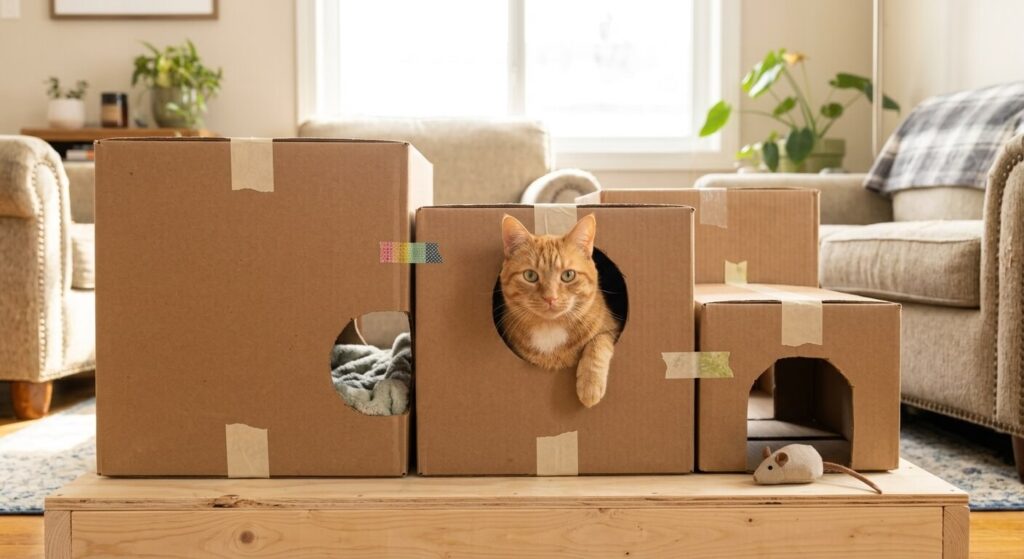
The Multi-Box Enrichment Maze (Level 2)
For a larger setup, keep boxes at floor level and stable. A box maze may add variety, but it is not a proven treatment for scratching. For other ideas, see our guide to DIY cat enrichment ideas for small apartments.
What you need:
- 3–5 boxes of varying sizes
- Avoid tape, glue, rope, string, or fasteners where the cat can reach them.
- Box cutter
- Do not add rope or twine that the cat could chew or swallow.
How to Build It:
- Place boxes side by side on the floor; do not create a stack that could collapse.
- Cut roomy openings with smooth edges so the cat can turn around and leave easily.
- Keep entries at floor level, especially for kittens, seniors, or cats with reduced mobility.
- Add texture variety: leave one box plain cardboard, line one with fleece, add crinkle paper to another
- Do not use cardboard as an elevated platform unless it is designed and tested to support the cat safely.
- Rotate toy placement inside different chambers to keep the maze unpredictable and engaging
Pro Tips for the Maze:
- Replace individual boxes as they wear out without dismantling the whole structure
- Avoid applying scented products to boxes without veterinary advice; many cats prefer familiar, unscented materials.
- Change one box or toy at a time and let the cat explore voluntarily
- Use a few pieces of the cat’s usual food in an accessible box, counted within the daily allowance
Quick Enrichment Sprinkles (5-Minute Ideas)
Sometimes you just have five minutes and a box. Here’s what you can do right now:
- The Treat Hunt: Place a few pieces of the cat’s usual food in an open box, counting them within the daily food allowance.
- The Crinkle Pit: Fill a box 3/4 full of scrunched packing paper and hide a toy underneath
- The Tunnel: Use a clean, open-ended box as a tunnel; keep string toys in your hand and put them away after play.
- The Familiar-Scent Box: Try a familiar, clean cloth or a cat-safe toy; avoid loose plant material, essential oils, and strongly scented items.
Safety Warning: Tape, Staples, and Ingestion Risks
Before offering any shipping box, remove packaging materials that could be swallowed, entangle a cat, or leave a sharp edge.
Boxes are generally safe. The things on boxes often aren’t. Here’s your safety checklist before giving any box to your cat:
Remove Before Offering:
- Packing tape — adhesive is a gastrointestinal hazard; the sticky surface can trap whiskers and cause distress
- Staples — metal staples used to close box seams are sharp and can lacerate the mouth, esophagus, or GI tract
- Plastic strapping or binding — strangulation and ingestion risk
- Foam peanuts — choking and blockage hazard
- Rubber bands — linear foreign body risk (can cause intestinal plication)
- Labels with sharp edges or plastic laminate — can cause oral lacerations
- Choose a clean, dry box without loose printing, wet ink, residue, or materials your cat chews or swallows.
Watch for These Behaviors:
Some cats chew cardboard. If a cat repeatedly swallows pieces, remove the box and discuss the behavior with a veterinarian; do not assume the cause is boredom or a specific deficiency.
- Pica (compulsive ingestion of non-food materials)
- Underlying dental discomfort or gum disease driving oral stimulation
- Nutritional deficiency (less common)
- Anxiety-driven compulsive behavior
If your cat is actively eating cardboard pieces rather than just mouthing or batting at the box, please consult your veterinarian. This may be connected to oral discomfort, stress, or compulsive chewing, so persistent cardboard eating is worth discussing with your veterinarian. For mouth-related warning signs, read our guide to indoor cat dental health.
Ongoing Safety Monitoring:
- Check boxes weekly for structural degradation — a collapsing box can trap a cat. For a broader room-by-room enrichment audit, use our indoor cat enrichment checklist.
- Look for sharp cardboard edges that develop as boxes are chewed or worn
- Avoid stacking boxes that a cat can climb into or onto; use a stable floor-level setup instead
- Never leave plastic bags or wrapping anywhere near the box setup
Frequently Asked Questions
1. Why does my cat sit in a box that is too small?
Some cats choose a snug-looking box, but a box must still permit comfortable entry, turning, and exit.
We cannot know from size alone why a cat chooses a particular box. Do not interpret a tight fit as proven therapeutic pressure, and offer a roomier alternative.
When evaluating a smaller box, check:
- A smaller opening may provide more cover, but the cat must still be able to exit easily.
- A sheltered spot may feel warmer than an exposed floor; avoid overheating.
- A familiar resting item can make a space easier to investigate; this is not a measured pheromone effect.
If your cat repeatedly squeezes into a small box, provide a larger, stable option as well. Replace any box that collapses or traps the cat.
2. Can cardboard boxes replace cat trees or shelves?
No. Boxes are useful enrichment, but they do not replace vertical space. Boxes provide hiding, warmth, scent familiarity, and ambush play, while cat trees and wall shelves provide climbing, height, and territory control. A strong indoor setup usually includes both: at least one safe hiding box and at least one elevated resting option.
3. Is it okay for cats to chew cardboard?
Short answer: Light chewing and mouthing? Generally fine. Eating cardboard? That needs veterinary attention.
Plain cardboard is not a food. Chewing can create loose pieces that may be swallowed, so remove a damaged box and ask a veterinarian about persistent ingestion.
- Swallowed pieces may irritate or obstruct the digestive tract; contact a veterinarian if ingestion is suspected.
- Watch for vomiting, reduced appetite, straining, lethargy, or other signs of illness after ingestion.
- Persistent non-food ingestion needs veterinary assessment rather than a home diagnosis of pica.
If the box is getting smaller because your cat is swallowing cardboard, remove it and contact your veterinarian. A few tooth marks still call for inspection and replacement if loose pieces develop.
Always remove boxes that have been significantly chewed along edges, as the frayed cardboard can create sharp points.
4. Should I leave boxes out all the time?
You can leave a safe hiding place available and replace a cardboard box when it becomes dirty or damaged.
Keep at least one safe, accessible hiding option available. It need not be cardboard, and there is no evidence here for a fixed number of boxes or a guaranteed effect on chronic stress.
However, novelty matters for enrichment value. Here’s my recommended approach:
- Keep a suitable hiding option available in a location your cat uses.
- Replace a box when it becomes dirty or damaged, and offer new enrichment gradually.
- Retire worn boxes promptly — a degraded, collapsing box creates stress rather than alleviating it
- Seasonal variation — a box placed near a sunny winter window versus a cool shadowed summer corner gives your cat agency over thermoregulation
The bottom line: yes, leave boxes out. Refresh them periodically. Let your cat decide when they want to use them. That choice is the enrichment.
Final Thoughts
A cardboard box can be a practical, low-cost hiding choice when it is clean, stable, and free of packaging hazards.
Cats vary in where they prefer to rest. Let the individual cat choose among several safe places.
The strongest evidence in this article supports access to a hiding place for newly admitted shelter cats. Warmth, scent, and play may matter for some cats, but they should not be presented as measured physiological outcomes of offering a box at home.
A box is one enrichment option alongside a comfortable bed, elevated space, play, and access to other resources.
Before reusing a delivery box, remove tape, staples, plastic, and loose materials. Place the clean box in a quiet spot with an easy exit.
Observe whether your cat chooses it, and keep an alternative retreat available.
References
- Vinke, C. M., Godijn, L. M., & van der Leij, W. J. R. (2014). Will a hiding box provide stress reduction for shelter cats? Applied Animal Behaviour Science, 160, 86–93.
https://doi.org/10.1016/j.applanim.2014.09.001 - Kry, K., & Casey, R. (2007). The effect of hiding enrichment on stress levels and behaviour of domestic cats (Felis sylvestris catus) in a shelter setting and the implications for adoption potential. Animal Welfare, 16(3), 375–383.
https://doi.org/10.1017/S0962728600027573 - AAFP/ISFM Feline Environmental Needs Guidelines (2013). Guidance on providing safe places, including hiding options. Read the guideline.