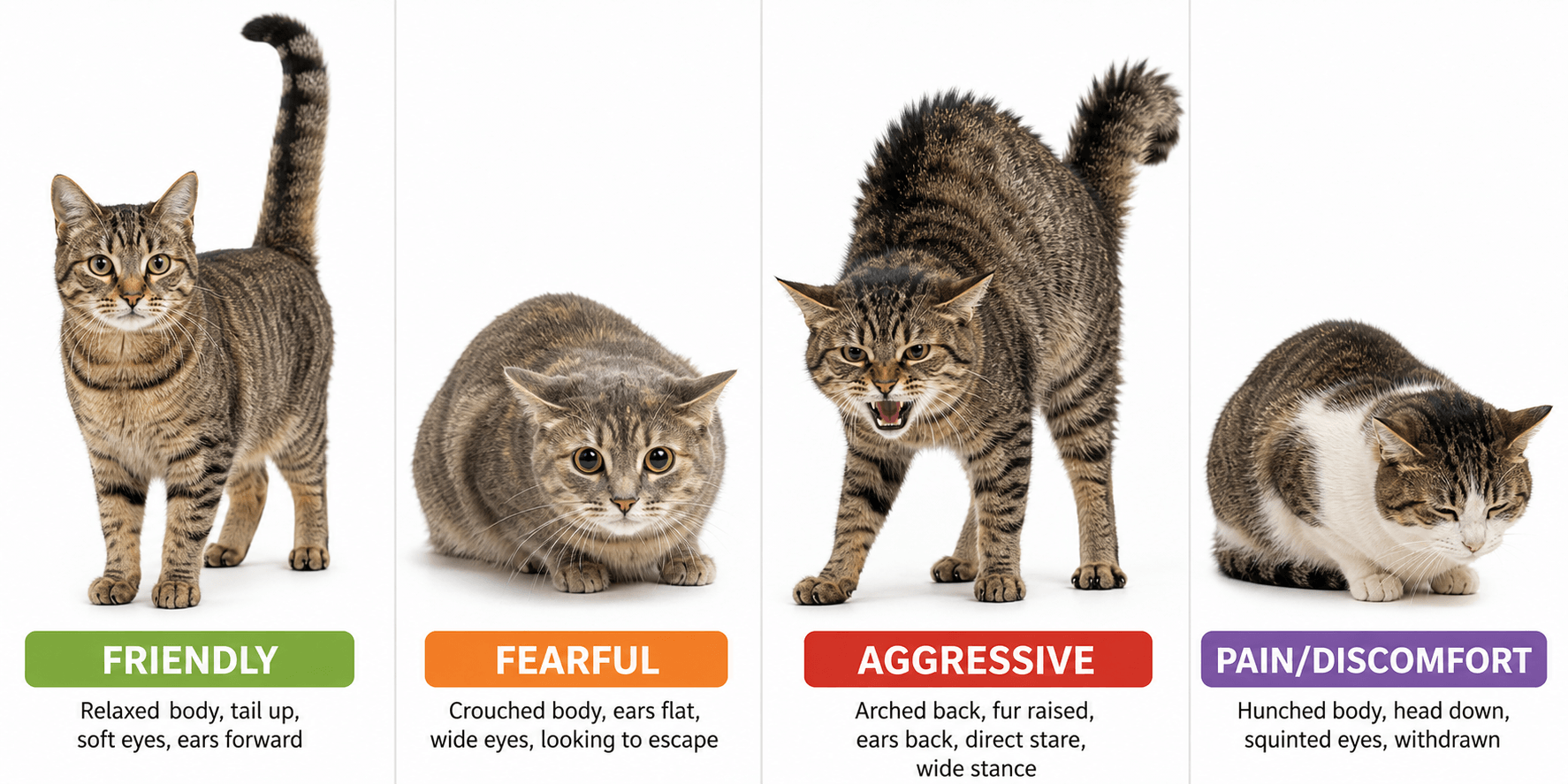
Cat body language meaning is easiest to read when you look at the whole cat, not just one tail flick, ear position, or pupil change. Eyes, ears, tail, posture, whiskers, and context all work together.
I learned this in clinic exam rooms, where misreading a lashing tail or flattened ears can turn a routine visit into a defensive scratch. At home, Oliver taught me the quieter side of the same language: slow blinks, soft posture, tail wraps, and the difference between relaxed loafing and a hunched pain posture.
This guide breaks cat body language into 15 practical signs you can use at home, including when to give your cat space and when a posture may need a veterinary check.
Quick Answer: What is the Most Important Cat Body Language Meaning?
Cat body language meaning depends on the full signal: eyes, ears, tail, posture, whiskers, movement, and context. A vertical tail with relaxed ears usually suggests a friendly greeting, while dilated pupils with flattened ears, a crouched body, and a lashing tail suggest fear, stress, or defensive arousal.
Never judge one body part alone. A twitching tail can mean play focus, irritation, or overstimulation depending on the rest of the body. A hunched loaf with squinted eyes and low head carriage may signal discomfort rather than relaxation.
Body language is the foundation for understanding many indoor cat behavior problems. For related guides on biting, hiding, aggression, staring, and stress, visit our cat behavior guides for indoor cats.
Table of Contents
The ‘Composite Signal’ Rule: Decoding Cat Body Language Meaning
Before we break down each individual signal, I need to establish the single most important principle in reading cat body language meaning: you must never interpret one body part in isolation.
Cats communicate in composite — meaning the meaning of any single signal is entirely dependent on what every other body part is doing simultaneously. This is what I call the Composite Signal rule, and it’s the framework that separates genuine feline literacy from dangerous guesswork.
Here’s a simple example that demonstrates why this matters:
Dilated Pupils alone could mean:
- Low light conditions (physiological, not emotional)
- High excitement during play (positive arousal)
- Fear (negative arousal)
- Pain (neurological response)
- Drug effect or medical condition
Dilated Pupils + ears rotated backward + tail lashing + crouched posture = active fear-aggression state — do not approach.
Dilated Pupils + ears forward + vertical tail + approaching you = excited, friendly arousal — a cat who wants to play.
The pupils alone told you almost nothing. The Composite Signal told you everything.
The Four Channels of Feline Communication:
| Channel | What It Signals |
|---|---|
| Eyes (pupil size, blink rate, gaze direction) | Arousal level, trust, threat assessment |
| Ears (position, rotation, tension) | Emotional state, sound attention, defensive readiness |
| Tail (position, movement speed, piloerection) | Confidence level, arousal, social intention |
| Posture (body height, muscle tension, orientation) | Confidence vs. fear, pain, social invitation |
Reading cat body language meaning fluently means scanning all four channels simultaneously — building a composite picture in real time. This is exactly what I do the moment a cat carrier opens in my exam room, and it’s what I’ll teach you to do by the end of this guide.
The Eyes: Pupils, Blinks, and Stares
The eyes are often called “the window to the soul” — in cats, they are genuinely the window to emotional state. Understanding the eye component of cat body language meaning requires examining three distinct elements: pupil size, blink rate, and gaze direction.
Eye contact is a deep topic in itself. For a full breakdown of staring, eye contact, and attention-seeking gaze, read our guide to why your cat stares at you.
Visual Clue #1: Pupil Size
Dilated Pupils (large, round, black pupils):
When a cat’s pupils expand beyond what the ambient light level would explain, this signals elevated arousal. The critical distinction is what kind of arousal:
- Fear arousal: Dilated pupils + flattened ears + crouched or frozen posture
- Aggressive arousal: Dilated pupils + direct stare + tense, forward-leaning posture
- Playful arousal: Dilated pupils + forward ears + relaxed body + tail up or slowly moving
- Pain response: Dilated pupils + hunched posture + squinted eyes + reluctance to move
In the clinic, Dilated Pupils in a cat who walked in appearing calm is one of my first indicators of rapidly escalating stress. I see it, I slow down, I give space, I lower my voice.
Constricted Pupils (narrow, slit-like pupils):
- In bright light: normal physiological response, no emotional significance
- In normal or dim light: can indicate contentment and relaxation in a cat who is drowsy and comfortable
- Combined with a hard direct stare and tense posture: can actually indicate offensive aggression — a highly aroused cat preparing to attack, not a relaxed one
- Combined with signs of pain: some pain states cause pupillary constriction rather than dilation
The light-check habit: Before interpreting pupil size for emotional meaning, always check the ambient light level. A cat with wide pupils in a sunny room is telling you something. A cat with wide pupils in a dim room may simply be seeing in low light. Context is everything in cat body language meaning.
Visual Clue #2: The Slow Blink
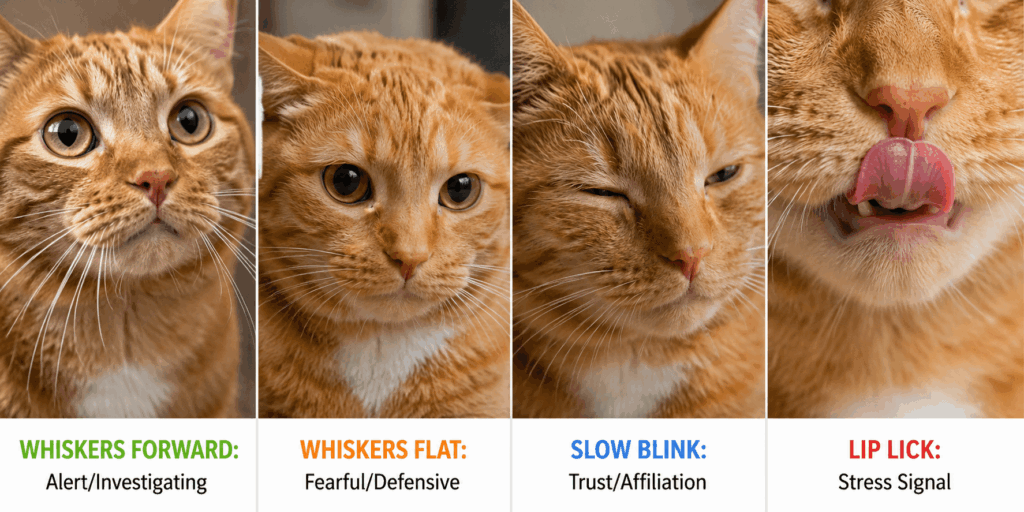
The Slow Blink is one of the most beautiful and well-documented Affiliative Signals in the feline communication repertoire — and one of the most practically useful things you can learn.
What it is: A slow, deliberate closing and reopening of both eyes — sometimes described as a “cat kiss” or “eye kiss.” The cat’s eyes partially or fully close, hold for a moment, and reopen softly.
What it means: “I am comfortable. I am not a threat. I trust this environment and the individuals in it.” The Slow Blink is a deliberate withdrawal of the direct gaze — which in cat communication is a threat signal — and its replacement with a soft, non-threatening eye movement.
The extraordinary part: Research by Humphrey et al. (2020) demonstrated that humans can reciprocate the slow blink to cats, and cats respond to human slow blinks with increased approach behavior and slow blink responses of their own. It is a genuine cross-species communication tool.
How to use it:
- Sit at or below the cat’s eye level
- Make soft, non-direct eye contact (look slightly to the side of the cat’s face rather than directly into their eyes)
- Slowly close your eyes halfway, hold for 2–3 seconds, and slowly reopen
- Wait and observe — many cats will reciprocate within 30–60 seconds
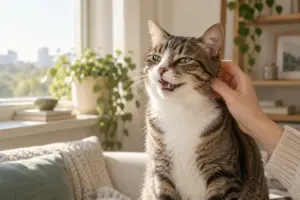
Oliver initiates slow blinks at me from across the room when he’s settled and content. If that relaxed signal appears with soft purring and loose posture, our guide to why cats purr explains how to read purring alongside the rest of the body.It is, genuinely, one of my favorite communications in our relationship.
Visual Clue #3: The Hard Stare
The direct, unblinking, hard stare is the communicative opposite of the Slow Blink — and understanding this contrast is essential to cat body language meaning.
In feline social communication, prolonged direct eye contact is a threat signal. It says: “I am assessing you as a challenge. I am not going to look away. Your move.”
- A cat who holds a direct, unblinking stare at another cat or a person is issuing a social challenge
- In the clinic, a cat who locks eyes with me and does not look away is telling me very clearly: “I am not comfortable and I am prepared to defend myself”
- Staring combined with a low body posture, Dilated Pupils, and flattened ears = imminent defensive aggression
What to do when a cat hard-stares at you: Look away. Slowly avert your gaze to the side. This is the feline equivalent of saying “I’m not a threat — I’m standing down.” It can de-escalate a tense situation meaningfully.
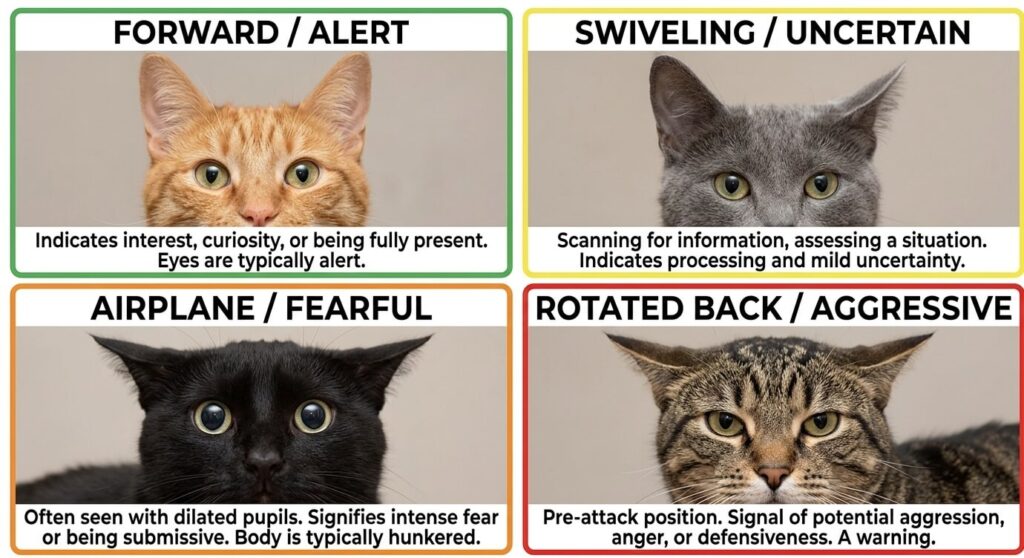
The Ears: From ‘Radar’ to ‘Airplane Mode’
A cat’s ears have 32 muscles controlling their movement — compared to the 6 muscles humans have. This extraordinary mobility makes ears one of the most expressive and information-rich channels in cat body language meaning.
Visual Clue #4: Forward-Facing ‘Radar’ Ears
Position: Ears upright, facing forward, slightly tilted toward a sound or object of interest.
Meaning: Alert, curious, engaged, and positively aroused. This is the “I’m interested in this” signal.
- During play: forward ears + Dilated Pupils + crouched stalking posture = active predatory engagement (appropriate and positive)
- During a social greeting: forward ears + vertical tail + approaching posture = friendly, confident social advance
- During investigation of a new object: forward ears + whiskers fanned forward + slow approach = cautious positive curiosity
Forward ears are generally a good sign — they indicate a cat who is engaged with their environment from a position of reasonable confidence rather than fear.
Visual Clue #5: Rotated or ‘Swiveling’ Ears
Position: One or both ears rotated to the side, angled backward, or actively swiveling between positions.
Meaning: This is a transitional state — the cat is processing conflicting information or experiencing mixed emotional states.
- Ears rotating rapidly between forward and backward = high arousal with undecided emotional valence — this cat is on the edge of a decision (engage or retreat)
- One ear forward, one ear rotated back = divided attention (tracking two stimuli simultaneously, or monitoring a potential threat while appearing to face something else)
- In the clinic, rapidly swiveling ears are a reliable early warning sign that a cat is approaching their stress threshold
Visual Clue #6: Flattened ‘Airplane Mode’ Ears
Position: Ears flattened against the skull, rotated backward and downward — often described as “airplane ears” because they resemble wings pressed flat.
Meaning: This is one of the clearest and most urgent signals in all of cat body language meaning. Flattened ears communicate:
- Fear: Ears flat + crouched posture + tucked tail = active fear state
- Defensive aggression: Ears flat + hissing + arched back or piloerection = “I will defend myself”
- Offensive aggression (subtle): Ears pressed very flat and rotated to face slightly backward + direct stare + stiff forward-leaning posture = pre-attack offensive state
Piloerection (the raising of the fur along the spine and tail) often accompanies fully flattened ears in high-arousal fear or aggressive states.
Clinical rule: Flattened ears = stop what you are doing. Give space. Do not reach into the carrier, do not attempt to touch the cat, and do not make direct eye contact. This signal is the cat’s clearest possible statement that they are at or beyond their threshold.
Learning to spot early ear rotation — before the full flatten occurs — is one of the most valuable skills in reading cat body language meaning proactively rather than reactively.
The Tail: The Feline Mood Meter
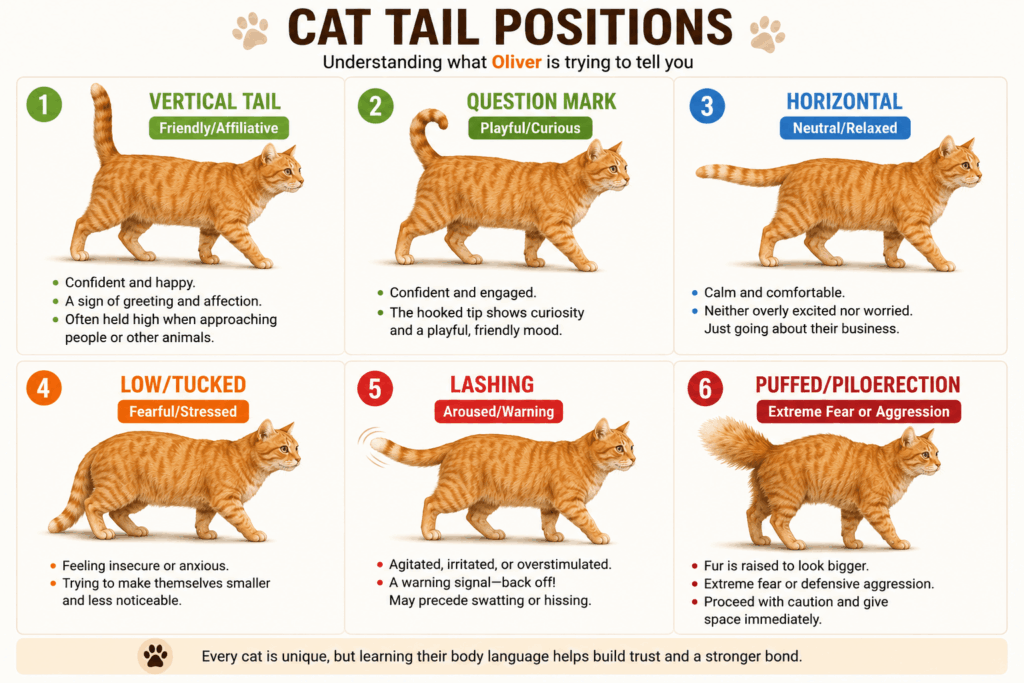
The tail is the most visually dramatic channel of cat body language meaning — and the one most consistently misread by owners who apply dog-behavior frameworks to feline signals. Here are the key tail positions that form the core of feline tail literacy.
Visual Clue #7: The Vertical Tail
Position: Tail held straight up, perpendicular to the ground, sometimes with a slight curl at the very tip.
Meaning: This is the gold-standard Affiliative Signal in cats. A fully vertical tail directed at you or another cat means: “I am approaching you with friendly, non-threatening intent. I consider you a trusted social partner.”
- Kittens raise their tails vertically when approaching their mother — it’s a behavior retained into adulthood for trusted social interactions
- Oliver greets me with a vertical tail every single morning — it is his “good morning, I like you” flag
- When two cats approach each other with vertical tails, they are signaling mutual positive social intent
This is one of the few unambiguous signals in cat body language meaning — a vertical tail in an approaching cat is almost invariably friendly.
Visual Clue #8: The Question Mark Tail
Position: Tail vertical with the top third hooked forward into a question mark or shepherd’s crook shape.
Meaning: An Affiliative Signal with a slight overlay of playful curiosity. This is “I want to interact, and I might want to play.”
- Common in cats approaching for morning greetings with a bouncy, investigative energy
- Often precedes head-bunting or cheek-rubbing social contact
- The “question” in the question mark seems almost intentionally apt — the cat is literally checking: “Are you available for interaction right now?”
Visual Clue #9: The Horizontal Neutral Tail
Position: Tail held roughly parallel to the ground, neither raised nor lowered, without active movement.
Meaning: Neutral, relaxed emotional state. The cat is neither particularly excited nor stressed — they’re simply moving through their environment in a baseline state.
This is the resting default of a content, unstressed cat who isn’t engaged in a particular social interaction. It’s the tail equivalent of a neutral facial expression.
Visual Clue #10: The Low or Tucked Tail
Position: Tail held below the level of the spine, or tucked tightly between the hind legs and against the belly.
Meaning: The degree of lowering correlates with the degree of emotional suppression:
- Slightly lowered: Mild uncertainty or mild submission — “I’m not entirely sure about this situation”
- Held low, parallel to ground: Active stress or anxiety — the cat is managing a perceived threat
- Fully tucked against belly: Significant fear or submission — this cat feels genuinely threatened and is attempting to make themselves appear smaller and less provocative
When low tail carriage appears with withdrawal, hiding, or avoidance, compare the pattern with our guide to why your cat is hiding.
In senior cats, a persistently lowered head and tail carriage can indicate chronic pain rather than emotional suppression — a distinction worth exploring with your veterinarian.In older cats, stiff body language or a lowered head position can reflect pain, stress, or cognitive changes. For broader stress patterns, read our guide to signs your indoor cat is stressed.
Visual Clue #11: The Lashing or Thrashing Tail
Position: Tail moving in wide, rapid, forceful sweeps from side to side — sometimes involving the full length of the tail, sometimes just the tip moving with sharp, decisive snaps.
Meaning: This is the signal most commonly confused with canine happiness — and the confusion causes more cat scratches than almost anything else I can think of.
A lashing tail means escalating arousal — and crucially, it is the speed and force that determines valence:
- Slow, wide sweeps: Mild frustration or moderate arousal — “I am noticing something that is activating me”
- Rapid, forceful thrashing: High arousal, frustration, or active aggression — “I am at or near my threshold and you should give me space”
- Sharp tip-only snapping: Early-stage frustration or overstimulation — a common signal during petting that owners miss before the scratch occurs
Understanding this arousal is the first step in preventing overstimulation bites; if biting is already happening, read our guide to why your cat bites you.
In the clinic, a lashing tail during an examination is my cue to slow down, check in, and consider whether continuing is advisable without additional support.
Visual Clue #12: The Slow, Gentle Sway
Position: Tail moving slowly and loosely from side to side — relaxed, unhurried movement without tension.
Meaning: Relaxed engagement. This is completely different from the rapid lash — the gentle sway indicates a cat who is mildly interested or tracking something without stress.
- Common when a cat watches birds from a window — the tail sways gently as attention follows the movement
- During light play engagement before predatory arousal escalates
- In a half-asleep cat whose tail is moving slightly in response to a sound
Visual Clue #13: The Puffed or Piloerection Tail
Position: Tail fur standing fully erect, making the tail appear 2–3 times its normal width — the classic “bottle brush” or “raccoon tail” appearance.
Meaning: Piloerection of the tail is an involuntary response driven by the autonomic nervous system — it cannot be faked or voluntarily controlled. It signals extreme emotional arousal, almost always in the context of:
- Intense fear: Tail puffed + arched back + sideways body orientation (making the cat appear larger) = maximum fear display
- Intense aggression: Tail puffed + direct stare + forward-leaning posture = offensive aggression with maximum arousal
- Sudden shock or startle: A cat who is startled by a loud noise may briefly puff their tail even without an ongoing threat
Piloerection extending along the spine (not just the tail) is called a “Halloween cat” posture — and in clinical settings, it tells me the cat has experienced a severe acute stress response.
Visual Clue #14: The Vibrating or Quivering Tail
Position: Tail held vertically or near-vertically, vibrating rapidly with a fine, subtle tremor.
Meaning: Context determines everything here:
- Against a vertical surface while backing up: Territorial spray marking — the classic pre-spray quiver we’ve discussed in our cat spraying guide
- While approaching a trusted person without backing toward a surface: Intense positive excitement and affection — the cat is so pleased to see you that their tail literally vibrates with it
- During greeting rituals between bonded cats: Mutual positive excitement
Oliver’s tail vibrates intensely when I get home after a long shift — it is one of the most genuinely touching cat body language meanings I know, because it’s involuntary. He cannot choose not to vibrate. He’s just that glad I’m back.
Visual Clue #15: The Tail Wrap
Position: Cat sits beside or near you and wraps their tail around their own body, or presses the tip of their tail against your leg or foot.
Meaning: A quiet, understated Affiliative Signal — the feline equivalent of a gentle hand on the arm.
- Tail wrapped around own body while sitting near you: “I am content here, in your proximity. I am not going anywhere.”
- Tail tip pressed lightly against your leg or foot: “I am acknowledging your presence and choosing to remain close to you.”
This is one of the subtlest signals in cat body language meaning, and one of the most meaningful. It’s easy to miss — but once you know to look for it, you’ll see it regularly in cats who feel genuinely secure.
The Posture: The Meatloaf, The Belly Roll, and The Arched Back
Whole-body posture provides the broadest contextual framework for cat body language meaning — it’s the canvas on which all the finer signals are painted.
The Meatloaf Position
What it looks like: Cat sitting with all four paws tucked neatly beneath their body, forming a compact loaf shape. Eyes may be half-closed or fully closed. Ears in neutral or slightly relaxed position.
What it means: This is one of the most reliable comfort indicators in cat body language meaning. A cat in meatloaf position has made a deliberate choice to tuck their most vulnerable areas (feet and belly) beneath their body in a way that is only possible when they feel safe enough to do so.
- Full meatloaf with eyes closed: deep comfort and relaxation
- Meatloaf with eyes half-open and ears tracking sound: resting but maintaining environmental awareness — normal and healthy
The clinical exception: A cat in a rigid, hunched meatloaf with a lowered head, squinted eyes, and reluctance to move may be in pain rather than comfort. The distinction is muscle tension — a comfortable meatloaf has soft, relaxed body contours; a pain meatloaf has visible tension and a “braced” quality to the posture. Learning to spot early stress and pain signals matters because some cats show discomfort through small posture changes long before they become obvious.
The Belly Roll and Exposure
What it looks like: Cat rolls onto their side or back, exposing the belly fully, often combined with a slow blink or relaxed, half-closed eyes.
What it means: This is the most commonly misinterpreted signal in all of cat body language meaning — and misreading it causes more startled owners than almost any other behavior.
The belly exposure is NOT an invitation to touch the belly.
It is an expression of profound trust and comfort — the cat is showing you their most vulnerable anatomy (where all the vital organs are accessible) and saying: “I feel safe enough in your presence to expose my most vulnerable area.” It is a compliment of the highest order.
It is not a request for belly rubs. Most cats have a highly sensitive ventral abdomen with a strong defensive reflex — sudden contact there triggers the “grab and rabbit-kick” response that many owners have experienced firsthand.
How to respond appropriately: Acknowledge the trust with a Slow Blink or soft verbal response. If you want to touch the cat, offer your hand for them to scent-check and let them direct the contact. Some cats genuinely enjoy gentle belly contact — but they will tell you this by actively pressing into your hand, not simply by rolling over.
The Arched Back
What it looks like: Spine curved dramatically upward, often combined with Piloerection along the dorsal surface, sideways body orientation, and puffed tail.
What it means: The arched back is a display behavior — the cat is maximizing their apparent body size as a deterrent signal.
- Fear-based arched back: Sideways body orientation (presenting maximum apparent size) + flattened ears + puffed tail + hissing = “Please do not come closer, I am very frightened and will defend myself”
- Play-based ‘crab walk’: Arched back + bouncy sideways movement + Dilated Pupils + forward ears = playful arousal in a young or playful cat — this looks dramatic but is accompanied by loose, bouncy movement rather than the rigid tension of genuine fear
The distinction between a fear arch and a play arch lies entirely in the accompanying signals — tension versus looseness, flattened versus forward ears, frozen versus bouncy movement.
The Loaf with Hunched Shoulders and Lowered Head
What it looks like: Cat sitting in a compressed, hunched position with shoulders raised and head held lower than normal, eyes squinted or half-closed, movement reduced or absent.
What it means: This posture is a significant pain indicator and should not be interpreted as relaxation. Key distinguishing features:
- Raised, tense shoulder blades (the “vulture shoulder” position)
- Head carried lower than the shoulder line
- Reluctance to move or jump
- Reduced response to stimuli that would normally provoke a reaction
- Squinted eyes that don’t soften into a slow blink
If Oliver ever sits in this posture, it goes straight to the top of my priority list — because this is the position of a cat who is experiencing discomfort and trying not to move in a way that makes it worse.
Micro-Signals: The Subtlest Cat Body Language Meaning
The final layer of cat body language meaning exists in the micro-signals — the subtle details that are easily overlooked but enormously informative to a trained eye.
Whisker Position
Whiskers are attached to deep follicles with rich sensory innervation — their position reflects both environmental sensing and emotional state:
- Fanned forward, spread wide: Active interest, investigation, or predatory focus — the whiskers are gathering maximum environmental information
- Neutral position (roughly parallel to the face): Relaxed, comfortable state
- Pressed flat against the face: Fear or defensive state — the cat is streamlining their profile and protecting their whiskers from potential injury
- Bunched and slightly drooping: Mild relaxation or drowsiness — common in a cat who is settling in to sleep
Mouth and Lip Signals
- Slow, deliberate lip lick (not after eating): A classic stress signal — the “displacement lick” occurs when a cat is experiencing anxiety or conflict. In veterinary settings, a single slow lip lick during an examination tells me the cat’s stress level just increased.
- Chattering: The rapid jaw-quivering “chatter” sound made when a cat watches prey they cannot reach — an expression of predatory frustration
- Open-mouth hissing or spitting: A clear, unambiguous defensive warning — “I am prepared to bite. This is your only warning.”
- Slow jaw relaxation and mouth slightly parted: Deep relaxation or the beginning of a satisfied sleep — sometimes seen with a tiny drool in very content cats
Skin Twitching (Feline Hyperesthesia Signal)
Rippling or twitching skin along the back — most visible along the lumbar region — is one of the most important micro-signals to learn to identify. It can indicate:
- Mild irritation or overstimulation (a common signal during petting that the cat is reaching their tolerance threshold)
- Presence of external parasites (particularly flea hypersensitivity)
- Feline Hyperesthesia Syndrome — a complex condition involving hypersensitivity of the skin, sometimes with a behavioral and neurological component
- Early chronic stress — the skin twitching as part of a broader pattern of physical stress responses
Learning to spot micro-signals like skin twitching can help you notice stress earlier; if the pattern appears with clinginess, vocalizing, or restlessness, compare it with our cat attention-seeking behavior guide.
Frequently Asked Questions
1. What does it mean when a cat shows its belly?
As I explained in the posture section — and this genuinely cannot be emphasized enough — a belly display is an expression of trust, not an invitation for touch.
When a cat rolls over and exposes their ventral abdomen to you, they are communicating one of the most profound statements available in their vocabulary: “I feel secure enough in your presence to expose my most vulnerable anatomy.” The belly contains all the major organs, and exposing it is instinctively risky for a prey animal. A cat who does this in your presence is paying you an extraordinary compliment.
The confusion arises because the behavior looks like an invitation — it’s visually similar to how a dog might roll over requesting a belly rub, and dogs do indeed enjoy this. But cats have a highly sensitized belly with a powerful defensive reflex, and uninvited contact there typically triggers the “grab-and-bunny-kick” response — not because the cat is “mean,” but because you triggered an automatic defensive reflex in a sensitive zone.
What to do: Slow blink back. Say something soft. Let the cat redirect contact by rubbing their own face on your hand if they choose to. If a cat has previously shown they enjoy belly contact, they’ll actively guide your hand there — but let them lead.
2. What cat body language means “give me space”?
Give your cat space if you see flattened or rotated ears, wide pupils, a crouched body, a lashing tail, skin twitching, growling, hissing, or repeated head turns toward your hand. These signals often mean your cat is stressed, overstimulated, fearful, or preparing to defend themselves. Stop touching, look away, and let your cat choose distance.
3. Can cat body language show pain?
Yes. Cats often hide pain, so the signs can be subtle. A hunched loaf, lowered head, squinted eyes, tense whiskers, reduced jumping, reluctance to move, hiding, or sudden aggression may suggest discomfort. Body language cannot diagnose pain at home, but these changes are a good reason to schedule a veterinary exam.
4. Why do cats vibrate their tails?
Tail vibration in cats has two distinct contexts with very different meanings — and cat body language meaning depends entirely on which context you’re observing:
Context 1 — Spray Marking:
When a cat backs toward a vertical surface with their tail raised and vibrating, they are in the preparation phase of urine spraying. The tail vibration is part of the hormonal and territorial arousal response associated with scent marking. This is involuntary and is driven by territorial or social stress triggers.
Context 2 — Intense Positive Excitement:
When a cat approaches a trusted person (or a beloved bonded cat companion) with their tail raised and vibrating — without backing toward any surface — this is an expression of intense positive social excitement. It is the feline equivalent of jumping up and down with joy. The vibration is involuntary, driven by positive arousal, and is one of the most unambiguous positive signals in cat body language meaning.
The distinction is straightforward: direction matters. Approaching you with a vibrating tail = joy. Backing toward your wall with a vibrating tail = territory marking.
5. Does a twitching tail always mean anger?
No — and this is one of the most important nuances in cat body language meaning because conflating “twitching” with “angry” leads to misread signals in both directions.
Tail movement type and meaning:
- Slow, gentle sway: Relaxed engagement or mild interest — not anger
- Tip-only twitching (small, sharp snaps of just the tail tip): Early-stage frustration, mild overstimulation, or concentration during hunting — a warning signal worth noticing, but not full-blown aggression
- Moderate lashing (wider, more forceful sweeps): Building frustration or arousal — a clear signal to give space and reduce stimulation
- Full thrashing (large, rapid, forceful full-tail sweeps): High arousal, significant frustration, or active defensive aggression — this cat is at or past their threshold
The key variable is speed and force, not movement alone. A gently swaying tail is a cat tracking a bird outside the window. A violently thrashing tail is a cat telling you the petting session needs to end right now.
Learn to read the escalation pattern — the tip twitch comes before the moderate lash, which comes before the full thrash. Catching the tip twitch early and responding (by withdrawing, giving space, ending the petting) prevents the escalation to full aggression. This is the proactive, literacy-based approach to cat body language meaning that keeps both cats and owners safer.
Final Thoughts
Cat body language meaning is not about memorizing one tail position or one ear angle. It is about reading the whole cat in context: eyes, ears, tail, posture, whiskers, movement, location, and what happened right before the signal appeared.
The biggest lesson Oliver taught me is that clear communication is often quiet. A slow blink, a soft tail wrap, a relaxed loaf, or a tiny tail-tip twitch can tell you when to approach, when to stop petting, and when to give space.
If your cat’s body language suddenly changes, especially with hiding, appetite loss, reduced movement, aggression, or signs of pain, treat it as information worth taking seriously and talk with your veterinarian.
References
- Bradshaw, J. W. S., & Cameron-Beaumont, C. (2000). The signalling repertoire of the domestic cat and its undomesticated relatives. In D. C. Turner & P. Bateson (Eds.), The Domestic Cat: The Biology of its Behaviour (2nd ed., pp. 67–93). Cambridge University Press.
https://doi.org/10.1017/CBO9780511542992 - Humphrey, T., Proops, L., Forman, J., Spooner, R., & McComb, K. (2020). The role of cat eye narrowing movements in cat–human communication. Scientific Reports, 10, 16503.
https://doi.org/10.1038/s41598-020-73426-0 - Cornell Feline Health Center. Feline Behavior Problems: Aggression. https://www.vet.cornell.edu/departments-centers-and-institutes/cornell-feline-health-center/health-information/feline-health-topics/feline-behavior-problems-aggression
- RSPCA. Understanding cat body language. https://education.rspca.org.uk/web/rspca/adviceandwelfare/pets/cats/behaviour/understanding
- Evangelista, M. C., Watanabe, R., Leung, V. S. Y., et al. (2019). Facial expressions of pain in cats: the development and validation of a Feline Grimace Scale. Scientific Reports, 9, 19128.