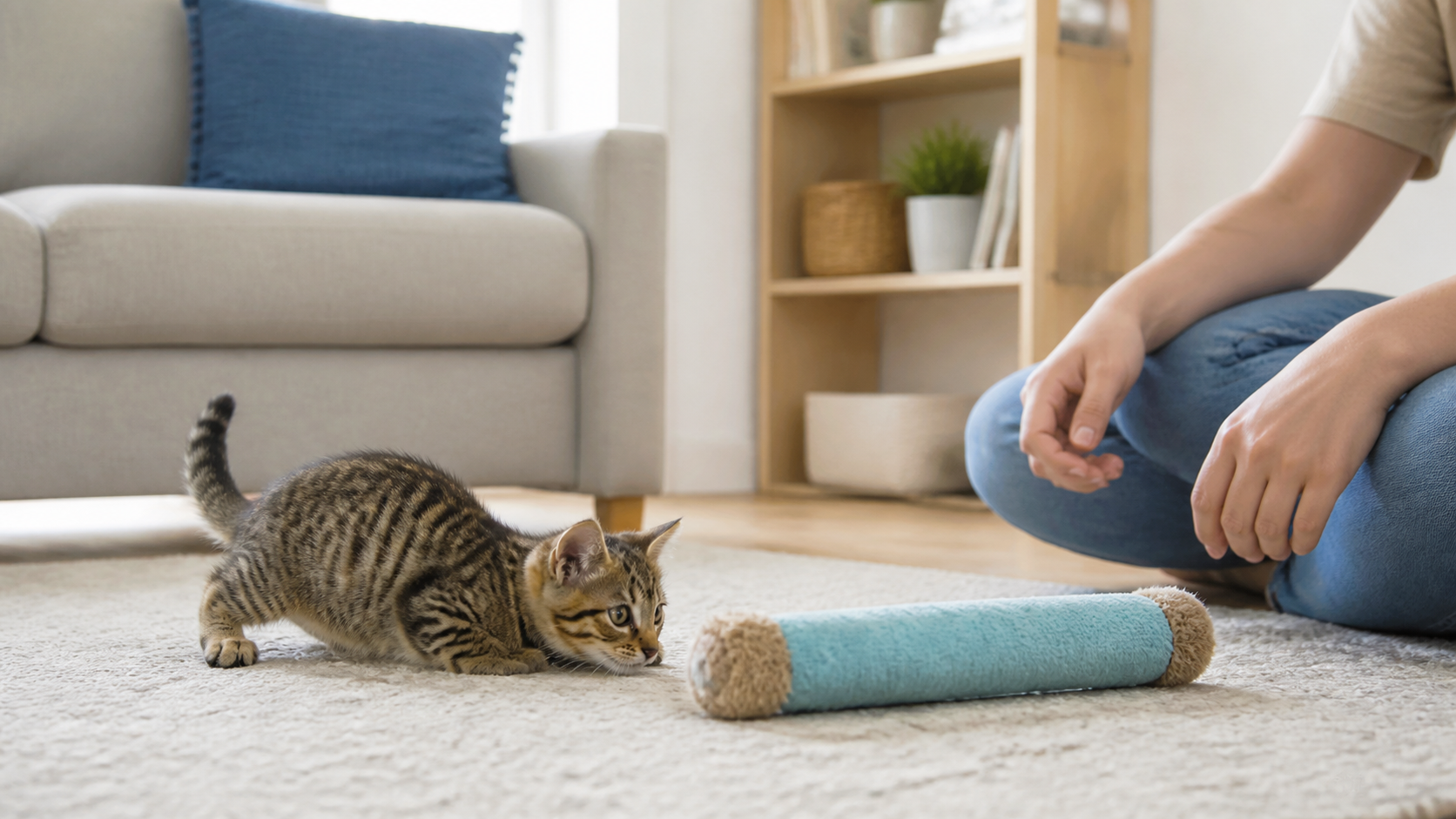
Single kitten syndrome is an informal label people use for rough biting, ankle attacks, demanding play, or poor play boundaries in a kitten raised without another young cat. It is not a veterinary diagnosis, and it does not mean a lone kitten is damaged or destined to become aggressive.
Kittens normally stalk, chase, pounce, grab, kick, and bite during play. Another kitten may help provide reciprocal play and immediate feedback, but people can also teach safer boundaries through appropriate toys, predictable play, reward-based training, and a well-designed indoor environment. The first step is to decide whether you are seeing normal but misdirected play, fear, pain, or a more serious behavior change.
This guide gives you five practical ways to protect hands and ankles, meet a kitten’s play needs, and build calmer habits. It also explains when a second kitten may be a reasonable choice—and why adopting another cat is not a universal treatment.
Quick Answer
If a lone kitten bites or ambushes people during play, stop using hands and feet as toys. Redirect the kitten to a long wand toy, tossed toy, or sturdy kicker before contact occurs; provide at least two short interactive play opportunities each day; reward calm choices; rotate safe enrichment; and track the situations that trigger rough play.
Do not hit, scruff, yell at, spray, or chase the kitten. Punishment can increase fear, stress, and defensive behavior without teaching an acceptable alternative. Arrange a veterinary examination if the behavior starts suddenly, occurs when one body area is touched, causes significant injury, or appears with hiding, appetite changes, limping, illness, or other unusual signs.
Important safety note: Wand toys, string, ribbon, yarn, elastic, and small detachable toy parts require supervision and should be stored securely after play. Never encourage a kitten to bite bare hands, even if the bites seem gentle now.
Table of Contents
What Does “Single Kitten Syndrome” Actually Mean?
The phrase is commonly used by shelters, foster caregivers, and cat owners, but it has no single clinical definition. People may use it to describe one or more of the following:
- biting hands, feet, or clothing during play;
- pouncing on ankles from behind furniture;
- grabbing and kicking arms;
- difficulty ending an exciting play session;
- persistent requests for interaction;
- destructive behavior when under-stimulated; or
- play that seems too intense for people or other pets.
These behaviors do not prove that growing up alone caused the problem. Age, early social experience, genetics, health, fear, the home environment, previous reinforcement, and the amount and style of play can all affect a kitten’s behavior. A kitten may also repeat ankle attacks because moving feet reliably produce an exciting human reaction.
Other kittens can provide a kind of feedback humans cannot perfectly copy. Social play is reciprocal: one kitten chases, then may become the one being chased; one pounces, then the other disengages or responds. According to the Feline Veterinary Medical Association’s behavior guidance, kittens may learn to temper play through interaction with their mother and littermates. That does not establish a simple rule that every lone kitten will develop behavior problems or that every kitten needs a feline companion.
Treat the label as a prompt to assess the whole situation—not as a diagnosis and not as a reason to adopt another cat immediately.
Normal Kitten Play or a Warning Sign?
Play can look dramatic. A kitten may crouch, wiggle, sprint, pounce, wrestle a toy, kick with the back feet, pause, and re-engage. During healthy play, the body often remains loose and bouncy, the kitten can shift attention to a suitable toy, and the interaction ends without ongoing fear or injury.
Use the pattern below as a guide rather than relying on one signal.
| What you observe | More consistent with play | More reason for concern |
|---|---|---|
| Body movement | Loose, bouncy, with pauses | Stiff, frozen, persistently crouched, or unable to disengage |
| Target | Moving toys, sometimes misdirected to ankles | A specific person or animal who is cornered or trying to escape |
| Vocalization | Often quiet | Repeated growling, hissing, screaming, or distressed vocalizing |
| After the event | Returns to normal activity | Hides, guards, stalks persistently, or remains highly aroused |
| Touch | Biting occurs during exciting play | Biting begins when a specific area is touched or handled |
| Change over time | Predictable around play times | Sudden, severe, escalating, or accompanied by health changes |
Tail movement, ears, pupils, and vocalization must be read together with context. Large pupils alone, for example, can occur during play, fear, or excitement. If you are unsure, stop the interaction calmly, create distance, and note what happened just before the behavior.
If the kitten breaks skin, wash the wound promptly. Deep punctures, bites to the hand or face, increasing pain, redness, swelling, warmth, drainage, fever, or bites involving a person with higher medical risk warrant prompt advice from a healthcare professional.
1. Make Hands and Feet Boring—and Toys Worth Chasing
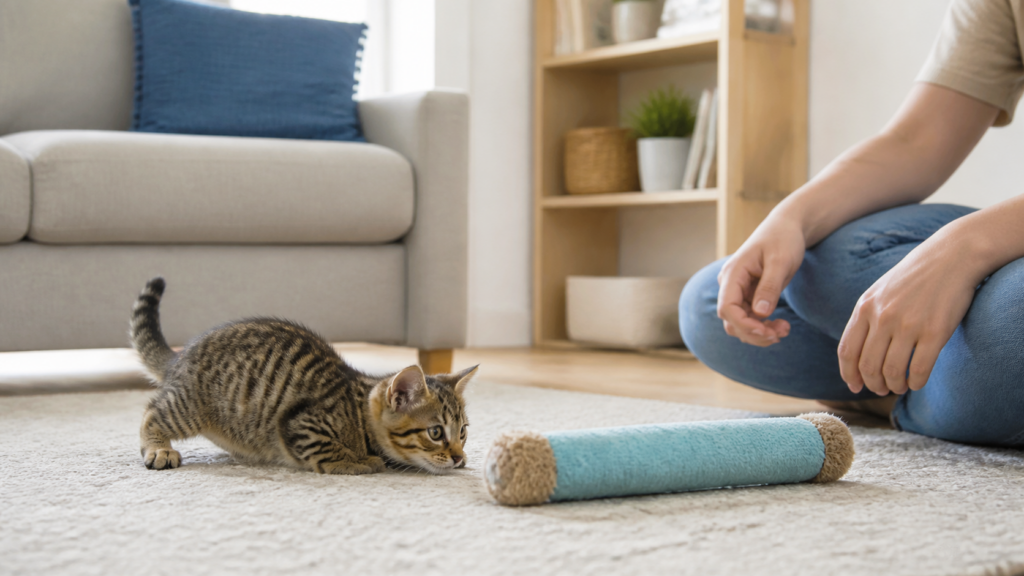
The clearest household rule is simple: skin is never prey. Do not wiggle fingers under blankets, wrestle with bare hands, tap the kitten’s belly to start a game, or allow playful hand biting because the kitten is still small. A behavior that is harmless at twelve weeks may be painful when the cat is larger and stronger.
Keep appropriate toys within reach in the rooms where ambushes happen. Good options include:
- a long wand toy used by an attentive person;
- a soft tossed toy large enough not to swallow;
- a sturdy kicker toy the kitten can grab and kick;
- a lightweight ball that cannot splinter; and
- a cardboard box or tunnel with more than one exit.
Redirect before teeth or claws touch you. Watch for the crouch, fixed attention, hindquarter wiggle, or route toward your ankles. Move the wand or toss the toy away from your body so the kitten chases the correct target. The toy should travel like prey—away from the kitten, around a corner, or briefly out of sight—rather than being pushed into the kitten’s face.
If the kitten makes contact with skin, freeze the targeted hand or foot instead of jerking it away. Sudden movement can make the “prey” more exciting. End access briefly and quietly: stand up, step behind a barrier if safe, or stop interaction for a short reset. Then offer an appropriate activity after arousal has dropped. The lesson is consistent: biting people makes the game stop; engaging with toys makes play continue.
Avoid loud squeals if they make your kitten more excited. Some kittens pause when they hear a brief neutral sound; others treat it as part of the game. The meaningful consequence is the calm end of interaction, not frightening the kitten.
2. Use Short, Predictable Interactive Play
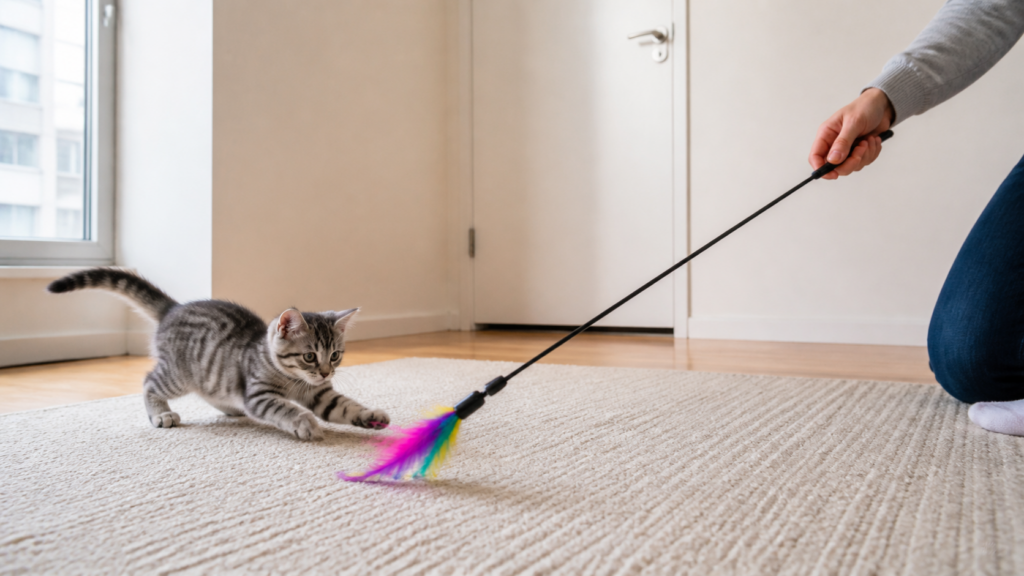
A pile of toys on the floor is not the same as interactive play. Young cats often respond most strongly when a person makes a toy hide, flee, pause, and move again. The Feline Veterinary Medical Association recommends replacing hand play with interactive toys such as a fishing-pole toy or a tossed toy and providing this type of play at least twice daily. Individual kittens may need more frequent opportunities, but there is no universal number of minutes that guarantees calm behavior.
Start with short sessions your kitten can finish successfully. A practical sequence is:
- move the toy slowly to invite stalking;
- add short escapes or changes of direction;
- allow several catches instead of creating endless frustration;
- reduce the speed near the end; and
- put the toy away when the kitten disengages or before behavior becomes frantic.
The kitten should be allowed to catch the toy periodically. Do not force nonstop jumping, sharp twisting, or high leaps, especially on slippery floors. Use a rug for traction and keep the route away from stairs, hot appliances, fragile objects, and other pets’ resting areas.
Schedule play before predictable trouble periods. If ankle attacks occur while you prepare dinner, play shortly before entering the kitchen. If the kitten races across the bed at night, offer an evening play opportunity followed by the normal meal or bedtime routine. The goal is not to exhaust the kitten completely; it is to provide a legal outlet before the behavior is rehearsed on people.
Store wand toys after each session. A string, ribbon, feather cluster, elastic loop, or detachable piece can create an ingestion or entanglement hazard when left unattended. Check toys for fraying, loose bells, exposed wire, cracked plastic, or pieces small enough to swallow.
3. Reward Calm Choices Instead of Punishing Mistakes
Reward-based training tells a kitten what to do. Punishment only interrupts behavior and may make the person, room, or handling situation feel unsafe. The Feline Veterinary Medical Association states that positive reinforcement should be used for desired behavior and that aversive methods can contribute to fear, stress, and aggression.
Choose one easy behavior that is incompatible with attacking ankles. For example, teach the kitten to:
- touch a target stick with the nose;
- step onto a small mat;
- follow a tossed toy away from the doorway;
- sit briefly before a toy is released; or
- climb onto a stable perch while you move through the room.
Mark the desired action with a clicker or a short consistent word such as “yes,” then provide a tiny food reward or begin the toy game. Keep sessions brief and voluntary. If the kitten walks away, hides, stops eating, or becomes overexcited, end the session rather than pushing for another repetition.
Training is especially useful at transition points. Before opening a closet, carrying laundry, or walking through the hallway where ambushes occur, cue the mat or target behavior and reward it. With repetition, the kitten has a predictable job that pays better than chasing feet.
Every person in the home must follow the same rules. If one person redirects biting but another encourages hand wrestling, the kitten receives conflicting information. Children should interact only with close adult supervision and use distance toys rather than fingers. Visitors should not be asked to “test” whether the kitten still bites.
Do not use spray bottles, alpha rolls, scruffing, nose tapping, shouting, or physical restraint as a behavior lesson. If you need to move an aroused kitten, use a door, gate, or object as a safe barrier and allow time to settle. Do not pick up a kitten who is actively grabbing, hissing, or trying to escape.
For a step-by-step marker-training method, see our guide to clicker training a cat.
4. Build an Apartment Environment That Supports Kitten Behavior
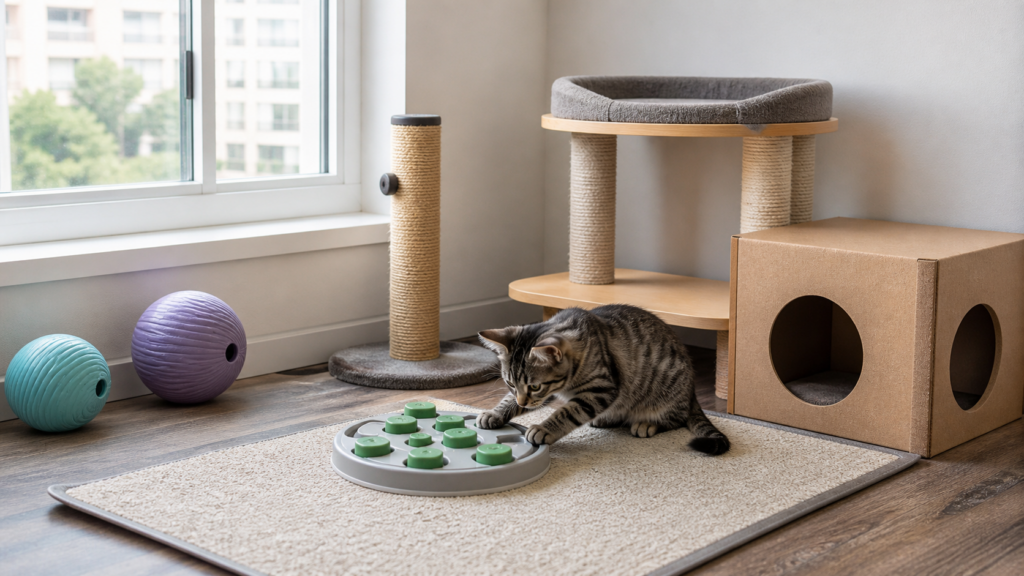
Rough play can become more frequent when a kitten has few safe ways to climb, scratch, hide, explore, forage, and watch the environment. Enrichment does not require a large home, but the available space should offer choices.
Create a simple activity zone with:
- a stable scratching surface that matches the kitten’s preferred orientation;
- an anchored cat tree or low climbing route;
- a hiding box with a safe entrance and exit;
- a secure window-viewing place if outside activity does not cause fear;
- several durable solo toys rotated rather than displayed all at once; and
- a food puzzle suitable for the kitten’s age, size, and diet.
Introduce food puzzles at an easy level. Use part of the kitten’s measured daily food, not unlimited extra treats, and confirm that the kitten can obtain the food without distress. Wash food-contact toys regularly and discard damaged items. A kitten who guards food, eats poorly, or has a medical diet may need an individualized plan from a veterinarian.
Rotation matters more than quantity. Leave out a few safe items and exchange them every several days. A cardboard box placed in a new orientation, a paper bag with handles removed, or a familiar ball moved to a different safe room can restore interest without constant purchases.
Kitten-proof the enrichment area. Secure unstable furniture, blind cords, electrical cables, screens, toxic plants, medication, needles and thread, hair ties, foam pieces, and small objects. A tall perch is useful only if it cannot tip and the kitten can access and leave it without a dangerous jump.
When you are away, provide activities that do not contain strings, elastic, feathers that detach easily, or pieces the kitten can swallow. Solo toys must be large enough, durable enough, and appropriate for the individual kitten. Inspect them often rather than assuming a product is safe forever.
For a wider safety check, use our kitten-proof apartment guide, and review the signs an indoor cat may be bored before assuming every unwanted behavior is aggression.
5. Track Triggers and Adjust the Routine
“The kitten attacks randomly” often becomes a more specific pattern once the household records it. Keep a simple log for one or two weeks. Do not try to document every movement; record only the details that help you change the environment.
| Date and time | What happened just before | Target and behavior | Body language | What you did | What happened next |
|---|---|---|---|---|---|
Useful patterns may include attacks before meals, after long quiet periods, when someone walks through one hallway, during petting, when the kitten sees an outdoor animal, or when the home becomes noisy. Each pattern suggests a different response.
- Before meals: schedule a play opportunity before food rather than feeding extra calories for every attack.
- At ankles in one hallway: place a safe toy station nearby and cue an alternate behavior before walking through.
- During petting: shorten contact and stop at the earliest sign the kitten wants distance.
- After seeing another animal: block or reduce the visual trigger and allow the kitten to settle before interaction.
- During noisy activity: provide a quiet hiding area and do not pull the kitten out.
Change one or two variables at a time. If you simultaneously change food, play schedule, furniture, toys, and household access, you will not know which change helped or whether the kitten is stressed by too much novelty.
Measure realistic outcomes: fewer skin contacts, shorter episodes, easier redirection to a toy, or more voluntary calm behavior. Progress is rarely perfectly linear. Teething, growth, changes in the home, and missed routines may temporarily affect behavior. If the pattern worsens or remains unsafe despite consistent management, ask a veterinarian for help rather than simply increasing stimulation.
Does a Lone Kitten Need a Second Kitten?
Not automatically. A compatible young companion may give some kittens more reciprocal play and social contact, and adopting an already-bonded pair can make sense for a household prepared for two cats. However, another kitten adds responsibility; it does not guarantee that biting, nighttime activity, or rough play with people will stop.
Before adopting, consider:
- whether the lease and household permit another cat;
- the lifetime cost of food, veterinary care, insurance, litter, and emergency treatment;
- enough separated food, water, litter, rest, hiding, scratching, and vertical resources;
- the resident kitten’s health, temperament, play style, and response to cats;
- the new kitten’s health, age, energy, and social history; and
- whether you can separate the cats and complete a gradual introduction.
Similar age and compatible play style can be helpful, but “get any second kitten” is not a safe rule. A timid kitten may be overwhelmed by a relentless wrestler. An adult cat who values solitude may not appreciate being assigned the job of teaching a kitten manners. The Feline Veterinary Medical Association emphasizes social compatibility and gradual introductions because adding a cat can create tension when resources, space, and relationships are not managed well.
Ask the shelter or foster caregiver what they have observed rather than relying on a short meeting. Questions about reciprocal play, recovery after excitement, food behavior, fear, and known relationships are more useful than color or sex alone. An already-bonded pair or a foster-to-adopt arrangement may reduce uncertainty where available.
If you proceed, do not place the cats together and let them “work it out.” Prepare a separate basecamp, begin with scent and controlled access, provide duplicate resources, and move at the pace of the more cautious cat. Our small-apartment second-cat introduction plan explains the staged process.
If a second cat is not practical, do not assume your kitten cannot thrive. Consistent toy boundaries, interactive play, training, enrichment, health care, and a predictable home can meet many needs. The plan should fit the individual kitten and household rather than the label.
A Practical 7-Day Reset for Rough Play
This one-week reset is an observation and setup period, not a promise that behavior will disappear in seven days.
Day 1: Remove mixed messages
Stop all hand and foot play. Put a safe redirect toy in the rooms where attacks occur. Remove damaged toys and store string-based toys in a closed location.
Day 2: Map the pattern
Start the trigger log. Note the time, location, activity immediately before the event, and whether the kitten could redirect to a toy.
Day 3: Schedule play before the problem
Add short interactive sessions before the most predictable high-energy periods. Allow catches, slow the game near the end, and store the wand safely.
Day 4: Teach one alternate behavior
Choose a mat, perch, or target behavior. Practice for a few calm repetitions and reward the exact behavior you want. Do not practice while the kitten is already attacking.
Day 5: Improve one activity zone
Add or reposition one stable scratcher, hiding box, perch, or beginner food puzzle. Keep escape routes open and remove nearby hazards.
Day 6: Check household consistency
Confirm that everyone uses the same response: freeze, end skin contact calmly, redirect at the next safe opportunity, and reward appropriate play. No wrestling and no punishment.
Day 7: Review, do not guess
Compare the week’s entries. Keep the changes linked to fewer or easier-to-redirect incidents. If bites are severe, unpredictable, touch-associated, or accompanied by other changes, arrange veterinary care instead of continuing a home experiment.
When to Contact a Veterinarian or Behavior Professional
Behavior and health overlap. Pain, illness, fear, and sensory changes can alter tolerance and make a kitten react during touch or handling. Contact a veterinarian when you notice:
- a sudden or marked increase in biting or aggression;
- biting linked to touching one body area;
- limping, stiffness, skin sensitivity, mouth discomfort, or reluctance to move;
- appetite, drinking, litter-box, sleep, or grooming changes;
- repeated hiding, fear, growling, or inability to settle;
- wounds to people or other animals; or
- behavior that cannot be managed safely with distance and barriers.
Record a video only if you can do so without provoking the kitten or delaying safety. Bring your trigger log and explain what happens before, during, and after the event. A veterinarian can assess health contributors and refer you to a qualified veterinary behaviorist or reward-based behavior professional when appropriate.
Do not deliberately recreate an attack for a video or examination. Safety and an accurate history are more important than capturing the most dramatic moment.
Frequently Asked Questions
Is single kitten syndrome a real diagnosis?
No. It is an informal description, not a defined veterinary diagnosis. It may point to rough play, insufficient outlets, inconsistent boundaries, early social experience, fear, or another issue. Assess the kitten rather than treating the phrase as a medical conclusion.
Will a lone kitten always become aggressive?
No. Many lone kittens develop into well-adjusted adult cats. Appropriate social experience, health care, safe play, enrichment, consistent handling, and individual temperament all matter. A kitten who bites during play is not automatically becoming an aggressive adult.
Should I adopt two kittens instead of one?
A compatible pair may be a good choice for a household with the space, finances, resources, and long-term commitment for two cats. It is not a requirement for every home. If adopting two, an observed bonded or compatible pair is more informative than assuming any two kittens will match.
How do I stop my kitten from biting my hands?
End hand play completely, keep skin still if contact occurs, stop interaction calmly, and provide legal biting and kicking targets. Redirect at the earliest stalking signal rather than waiting for the bite. Reward appropriate toy engagement and make sure everyone follows the same rule.
Is it okay to let a kitten bite gently?
It is safer not to teach that hands are toys. A gentle bite can become harder as arousal rises or as the kitten grows. Use a toy for wrestling, grabbing, and kicking, and reserve hands for calm handling the kitten accepts.
How much play does a kitten need?
There is no single duration for every kitten. Provide at least two interactive play opportunities daily and adjust frequency and length to age, health, response, and household routine. Several short successful sessions may work better than one prolonged session that ends in overarousal.
Why does my kitten attack ankles at night?
Moving feet are easy prey-like targets, especially after a quiet period. Add interactive play before the usual attack time, keep a redirect toy nearby, avoid rewarding attacks with an exciting chase, and maintain a predictable evening routine. Sudden nighttime agitation with other health changes needs veterinary assessment.
Can clicker training stop rough play?
Clicker or marker training can reinforce an alternate behavior such as going to a mat or touching a target. It is one part of the plan, not a cure. The kitten still needs suitable play, a safe environment, consistent boundaries, and medical assessment when warning signs are present.
Will my kitten simply grow out of biting?
Activity and play style often change with maturity, but waiting does not teach a safer target. Prevent rehearsal on people now. Consistent redirection and reinforcement protect the household and help the kitten practice behavior you can live with later.
Final Takeaway
Single kitten syndrome should be treated as an informal description, not a verdict. Rough kitten play becomes safer when people stop offering hands and feet, provide predictable interactive play, reward calm alternatives, build an enriching environment, and track the situations that trigger attacks.
A second kitten can be a thoughtful choice for some homes, especially when compatibility and long-term resources are clear, but it is not mandatory and should not be adopted as a quick behavior fix. When biting is sudden, painful, escalating, or linked to other changes, veterinary assessment comes before more training.
References
VCA Animal Hospitals: Kitten Play and Investigative Behaviors
Feline Veterinary Medical Association: Feline Behavior Guidelines
Feline Veterinary Medical Association: Positive Reinforcement of Cats—Position Statement
Feline Veterinary Medical Association: Training Techniques for Addressing Undesirable Behaviors
Feline Veterinary Medical Association: 2024 Intercat Tension Guidelines
Feline Veterinary Medical Association: Getting Another Cat—Client Brochure

-300x169.png)