By IndoorCatExpert.com | Indoor Cat Health & Nutrition
The vet said it almost as a footnote at the end of Oliver’s annual checkup: “His hydration is on the low side. With male cats his size and age, that’s something we want to watch — urinary blockages and early kidney disease are both strongly linked to chronic low fluid intake.”
I drove home thinking about it the entire way. Oliver had a water bowl. He walked past it daily. I had genuinely never asked whether he was actually drinking enough from it. That appointment became the beginning of a months-long education in how to get an indoor cat to drink more water — and the uncomfortable discovery that almost everything I assumed about cats and hydration was wrong. The water bowl sitting on the kitchen floor wasn’t the solution. It was barely even a starting point.
Here’s what actually worked for Oliver, every trick backed by feline nutrition research and direct vet guidance.
Quick Answer
To get an indoor cat to drink more water, start by switching from dry kibble to wet food, which contains 70–80% moisture compared to dry food’s 10%. Replace standing water bowls with a stainless steel cat water fountain, move water sources away from the food bowl, and add a splash of unseasoned low-sodium bone broth to meals. These changes compound — combined, they can double your cat’s daily fluid intake within weeks.
Why Indoor Cats Are Chronically Dehydrated (And Don’t Even Know It)
This is the part that genuinely surprised me: cats evolved in arid desert environments, which means their thirst drive is naturally and deliberately low. Unlike dogs, cats don’t feel a strong biological compulsion to seek out water proactively. In the wild, they obtained nearly all their fluid from prey — a freshly caught mouse is approximately 70% water.
An indoor cat eating dry kibble is receiving roughly 10% moisture from food, when their biology expects 70%. The thirst mechanism simply doesn’t compensate for this gap. Cats on dry-food-only diets frequently exist in a state of mild chronic dehydration that produces no obvious symptoms — until organ stress from concentrated urine accumulates over months or years into something serious.
For male cats specifically, the stakes are higher. The male urethra is longer and narrower than the female’s, making urethral blockages from mineral-concentrated low-volume urine a genuine medical emergency — painful, potentially fatal, and one that adequate hydration dramatically reduces the risk of. This is exactly what Oliver’s vet was flagging. This is why I stopped treating it as a minor detail.

Trick 1: The Wet Food Foundation — Fix Moisture at the Source
If there is one change that will have the single greatest impact on your cat’s hydration, it is this. Switching from a dry-food-only diet to wet food — or replacing even half of daily dry food with wet — is the most powerful hydration intervention available, by a wide margin.
Premium wet cat food contains between 70% and 80% moisture. A cat eating two standard 85g pouches of wet food per day receives approximately 120ml of water from food alone, before drinking a single drop from any bowl. A cat eating the equivalent caloric intake in dry kibble receives fewer than 10ml from food. That gap is the entire problem, and wet food closes most of it in one move.
Making the Transition Without a Food Strike
Cats are famously resistant to dietary changes. A cold-turkey swap frequently results in outright refusal and digestive upset — especially for cats who’ve eaten dry food their whole lives. Transition gradually over 10 to 14 days:
- Days 1–3: Add a small teaspoon of wet food alongside the usual dry portion
- Days 4–7: Roughly half wet, half dry by volume
- Days 8–10: Primarily wet food with a small amount of dry mixed in
- Day 11 onward: Full wet food, or your target wet-to-dry ratio
Warming wet food slightly to just below body temperature increases its aroma and palatability significantly. Oliver initially sniffed his first pouch with the withering skepticism of a food critic who wasn’t asked. Within a week he was circling his bowl at mealtimes like a very round, very orange moon in orbit.
What to Look for in Wet Food for Hydration
Not all wet food is equally useful for fluid intake:
- Gravy-based or broth-based formulas over pâté — the liquid component in these adds direct fluid intake with every meal
- Named protein source listed first (chicken, salmon, turkey — not vague “meat derivatives” as the lead ingredient)
- Low sodium — excess salt is counterproductive for the kidney health you’re trying to protect
- Minimal added carbohydrates — cats have limited ability to metabolize carbs and derive no hydration benefit from them
The wet food switch does double duty beyond hydration. Higher moisture content increases satiety per calorie, which is precisely why wet food also sits at the foundation of any sound feline weight loss plan: how to help indoor cat lose weight.
Trick 2: Move the Water Bowl Away From the Food
This sounds almost too simple to matter, and yet it produced a noticeable change in how often Oliver visited his water source within the first week. Placing the water bowl directly beside the food bowl — which most cat owners do — actually suppresses drinking in many cats.
The reason is instinctual rather than arbitrary. In nature, cats avoid water sources located near prey carcasses. Decomposing prey contaminates nearby water, and cats evolved to recognize proximity of food and water as a contamination signal. The food bowl, however clean, can trigger the same avoidance response when the two are adjacent.
Strategic Water Placement That Actually Works
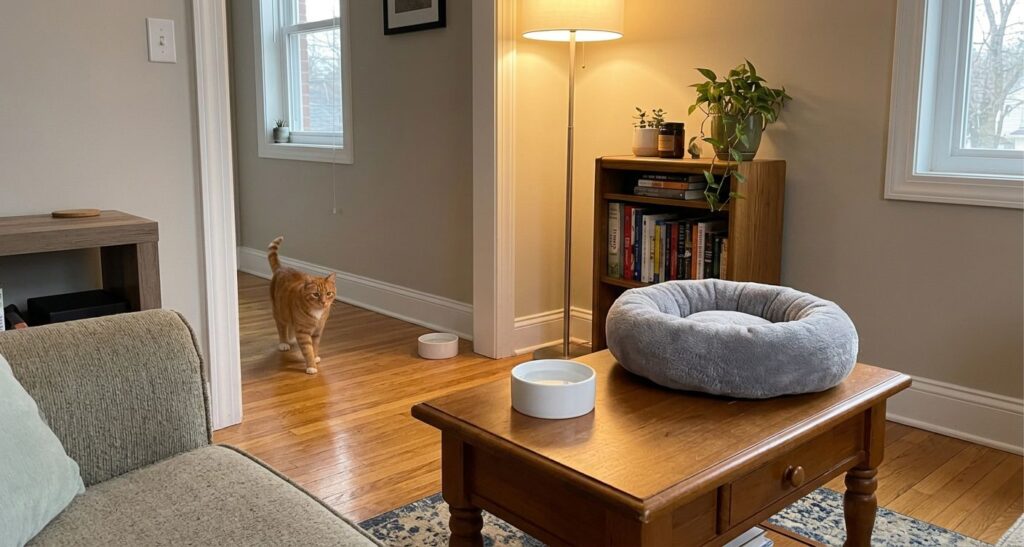
- Different rooms entirely — Oliver’s main water fountain lives in the living room; his food bowl is in the kitchen. The physical separation is deliberate.
- Multiple water stations — two or three water points around a small apartment dramatically increases incidental drinking. Cats drink more when water is simply near where they already are.
- Away from the litter box — cats instinctively avoid drinking near elimination areas, for the same contamination-avoidance logic
- Near favored resting spots — a water source beside a napping area means your cat encounters it naturally during the after-nap stretch that often precedes drinking
The goal isn’t just making water technically available — it’s making water feel safe and uncontaminated within your cat’s behavioral instincts.

Trick 3: Flowing Water Over Standing Water — Why Fountains Change Everything
Oliver’s relationship with his water bowl was, at best, indifferent. His relationship with running tap water, however, was something else entirely. The moment I turned on the kitchen faucet, he would appear from wherever in the apartment he was and attempt to drink directly from the stream.
This is not quirky cat behavior. It is biology. Cats are instinctively attracted to moving water because, in nature, moving water is fresher, less contaminated, and safer to drink than stagnant water. A still bowl registers as a potential risk; flowing water registers as a reliable, clean source.
The Case for a Cat Water Fountain
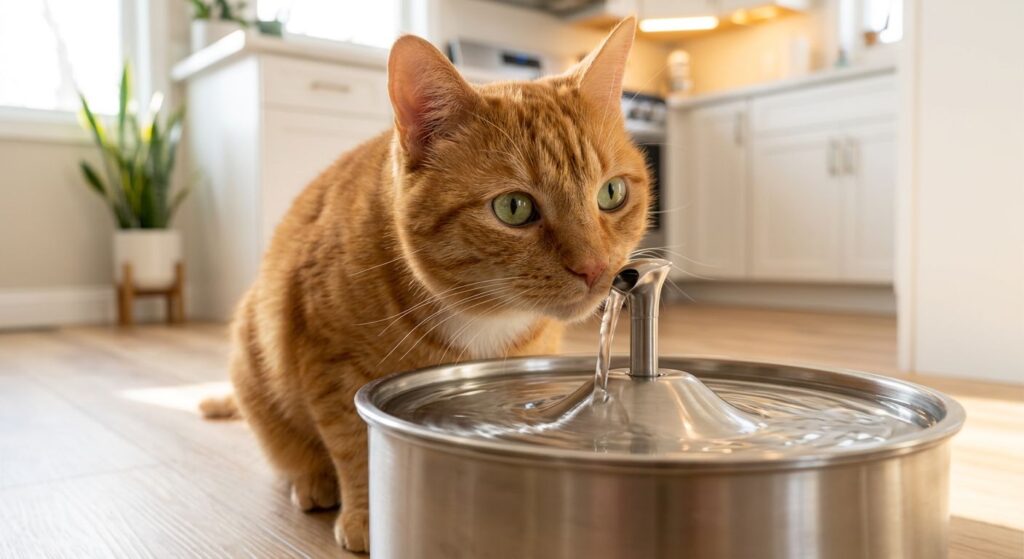
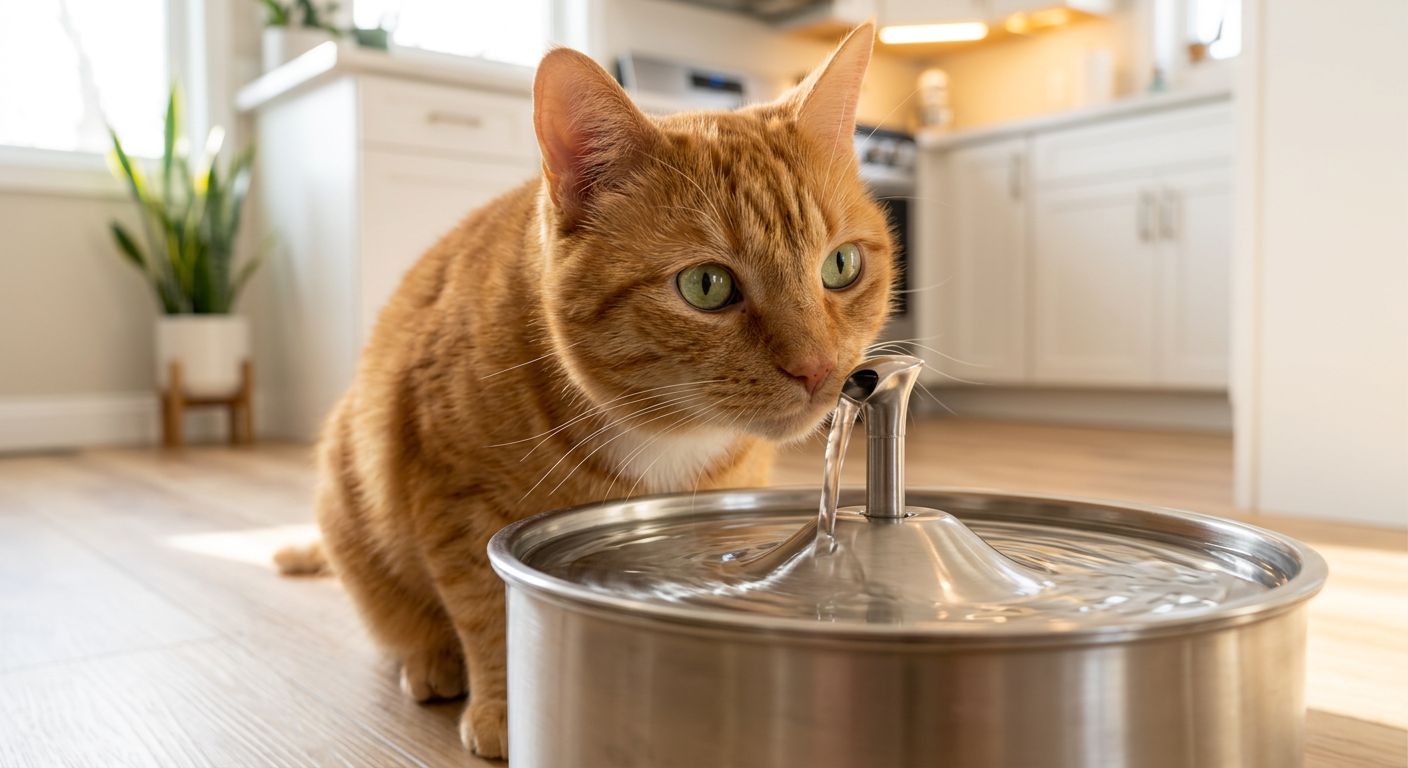
A recirculating cat water fountain replicates the flowing water preference in a practical, low-maintenance format. The benefits compound:
- Increased drinking frequency — multiple studies on feline fluid intake document that cats drink meaningfully more from fountains than from standing bowls
- Fresher water — continuous circulation and filtration reduces bacterial buildup that occurs in standing water within hours at room temperature
- Oxygenation — flowing water picks up oxygen, which many cats appear to prefer based on consistent behavioral preference for moving sources
What to look for in a fountain:
- Stainless steel or ceramic construction — plastic fountains develop micro-scratches that harbor bacteria and can cause feline acne; stainless steel is the hygiene-first choice
- Carbon filter included — removes chlorine and taste compounds that may deter drinking
- Multiple flow settings — some cats prefer a gentle trickle; others want a full stream; having options helps you find what works for your individual cat
- Easy disassembly for cleaning — a fountain you can’t clean easily won’t get cleaned, which defeats the purpose entirely
Clean the fountain thoroughly every one to two weeks — don’t just top off the water. Biofilm accumulates on the interior surfaces and creates exactly the contamination signal you’re trying to eliminate.
If you’re still on the fence about buying one, read our deep dive into the medical research and proven cat water fountain benefits.
Trick 4: Add Moisture Toppers — The Easiest Win
If the fountain and food transition feel like big changes to implement simultaneously, this trick requires almost no effort and can be started today. Adding a moisture-rich topper to your cat’s existing meals increases fluid intake without requiring any behavioral change from your cat at all.
The most effective options:
Unseasoned Low-Sodium Bone Broth
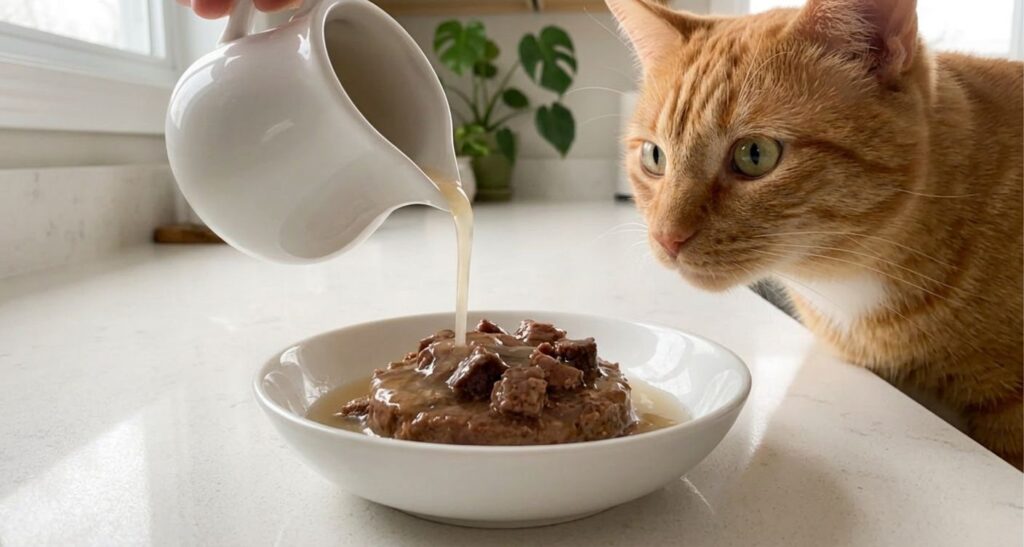
A tablespoon of unseasoned, low-sodium chicken or fish bone broth stirred into wet food — or poured over dry food as a transition strategy — adds direct fluid while making the meal significantly more aromatic and palatable. Most cats respond enthusiastically.
Critical requirement: it must be unseasoned and very low sodium. Standard human bone broth often contains onion, garlic, or salt levels that are toxic or harmful to cats. Use broth specifically formulated for pets, or make your own by simmering plain chicken or fish bones in water with no additives for several hours.
Water Added Directly to Wet Food
Less glamorous but equally effective: add one to two tablespoons of plain room-temperature water directly to wet food and mix it in. Many cats accept this without noticing, particularly if the food is slightly warmed. Over the course of a day, this adds 30–60ml of fluid with zero friction.
Goat’s Milk (Occasional Use)
A small amount of goat’s milk — formulated for cats, which is lower in lactose than cow’s milk — can be offered as an occasional high-palatability fluid boost. This is a supplement, not a daily staple, but it’s useful during hot weather or if your cat is recovering from illness and reluctant to drink.

Trick 5: Address Bowl Material and Freshness — The Details That Derail Everything
You’ve switched to wet food. The fountain is running. The bowls are positioned strategically. And yet Oliver still seems indifferent to the water. Before concluding that your cat is simply not a drinker, check these two variables — they’re responsible for more unexplained drinking avoidance than most owners realize.
Bowl Material: Plastic Is Working Against You
Plastic bowls develop micro-scratches with normal use. Bacteria colonize these scratches and create a biofilm that is detectable to a cat’s considerably more sensitive nose long before you can smell or see anything. Many cats develop a preference against plastic bowls specifically because of this — not stubbornness, but genuine sensory aversion.
Switch to stainless steel, ceramic, or glass for both food and water. These materials are non-porous, don’t harbor bacteria in surface scratches, and don’t leach taste compounds into water the way plastic does. This single change resolves “picky drinker” behavior in a meaningful number of cats.
Water Freshness: How Often Are You Actually Changing It?
Standing water in a bowl goes stale within hours at room temperature. Dust settles into it. Saliva from the cat’s previous drink contaminates it. Cats — with their significantly more sensitive sense of smell — detect this degradation reliably and avoid water they perceive as non-fresh.
Change water bowls completely at least once per day, rinsing the bowl rather than just topping it off. During hot weather, twice daily is better. If you’re already running a fountain, clean it fully every one to two weeks — not just refilling, but disassembling and scrubbing the interior components.
One practical bonus worth acknowledging: better hydrated cats produce more dilute urine and larger wet clumps in the litter box. That’s good for their kidneys — and it means staying consistent with your daily scooping routine becomes even more important to keep the box fresh and functional: how to keep litter box from smelling in small apartment.
Oliver’s Hydration Upgrade: What Changed and What Happened
To make this concrete, here’s exactly what I changed after that vet appointment, and the outcome three months later:
| Change Made | When Implemented | Observed Result |
|---|---|---|
| Transitioned to 80% wet food | Week 1–2 | Immediate increase in fluid from food |
| Moved water bowl to living room | Day 3 | Oliver visited water 2–3x more per day |
| Added stainless steel fountain | Week 2 | Replaced the bowl entirely within a week |
| Started adding broth topper | Week 3 | Visibly more enthusiastic about mealtimes |
| Switched to ceramic bowls | Week 3 | Eliminated suspected plastic aversion |
At the three-month follow-up, Oliver’s vet noted improved hydration markers and no concerns about urinary concentration. He also informed me that Oliver had gained 200 grams, which was a separate conversation — but the kidney risk had meaningfully receded.
FAQ
👉 What is the daily goal when figuring out how to get an indoor cat to drink more water?
The general guideline is approximately 60ml of water per kilogram of body weight per day — so a 4kg cat needs roughly 240ml of total fluid daily. Critically, this total includes moisture from food, not just water from drinking.
A cat eating wet food may meet most of this requirement through meals alone and drink relatively little from a bowl, which is entirely normal and healthy. The concerning pattern is a cat on a dry-food-only diet who also drinks very little — that combination is where chronic dehydration builds.
👉 My cat walks to the water bowl, sniffs it, and walks away. Why?
This typically points to one of three issues: the water is stale and detectable as such to your cat’s more sensitive nose, the bowl is plastic and carrying a biofilm or taste compound your cat finds off-putting, or the bowl’s location near the food bowl is triggering the instinctive contamination-avoidance response.
Start by changing the water completely, switching to a stainless steel or ceramic bowl, and moving it to a different room from the food source. In most cases, one of these three changes resolves the avoidance behavior within a few days.
👉 Is it safe to add flavoring to my cat’s water?
The safest and most effective additions are unseasoned low-sodium broth (chicken or fish, specifically formulated for pets or made at home without additives) and small amounts of the liquid from canned tuna in water (not oil, and not brine). These are palatable, non-toxic, and reliably increase intake. What to avoid: anything containing salt, onion, garlic, or sweeteners; cow’s milk (most adult cats are lactose intolerant to varying degrees); and any human-grade broth unless you’ve verified it contains zero additives or sodium. When in doubt, a plain broth made by simmering plain chicken in water for a few hours and straining it is the safest, most accepted option.
References: Buckley, C.M. et al. (2011). Effect of dietary water intake on urinary output, specific gravity and relative supersaturation for calcium oxalate and struvite in the cat. British Journal of Nutrition, 106(S1). | Zanghi, B.M. et al. (2018). Associating water intake and urine measures as noninvasive indicators of kidney health in cats. Journal of Veterinary Internal Medicine. | Buffington, C.A.T. et al. (2014). The Five Pillars of a Healthy Feline Environment. Journal of Feline Medicine and Surgery.
When selecting a vessel, the material is as important as the flow. See our comparison of the best cat water fountains stainless steel vs ceramic to avoid bacterial biofilm.
IndoorCatExpert.com — For the cats who would rather tip over the water glass than drink from their bowl, and the humans trying to keep their kidneys healthy anyway.