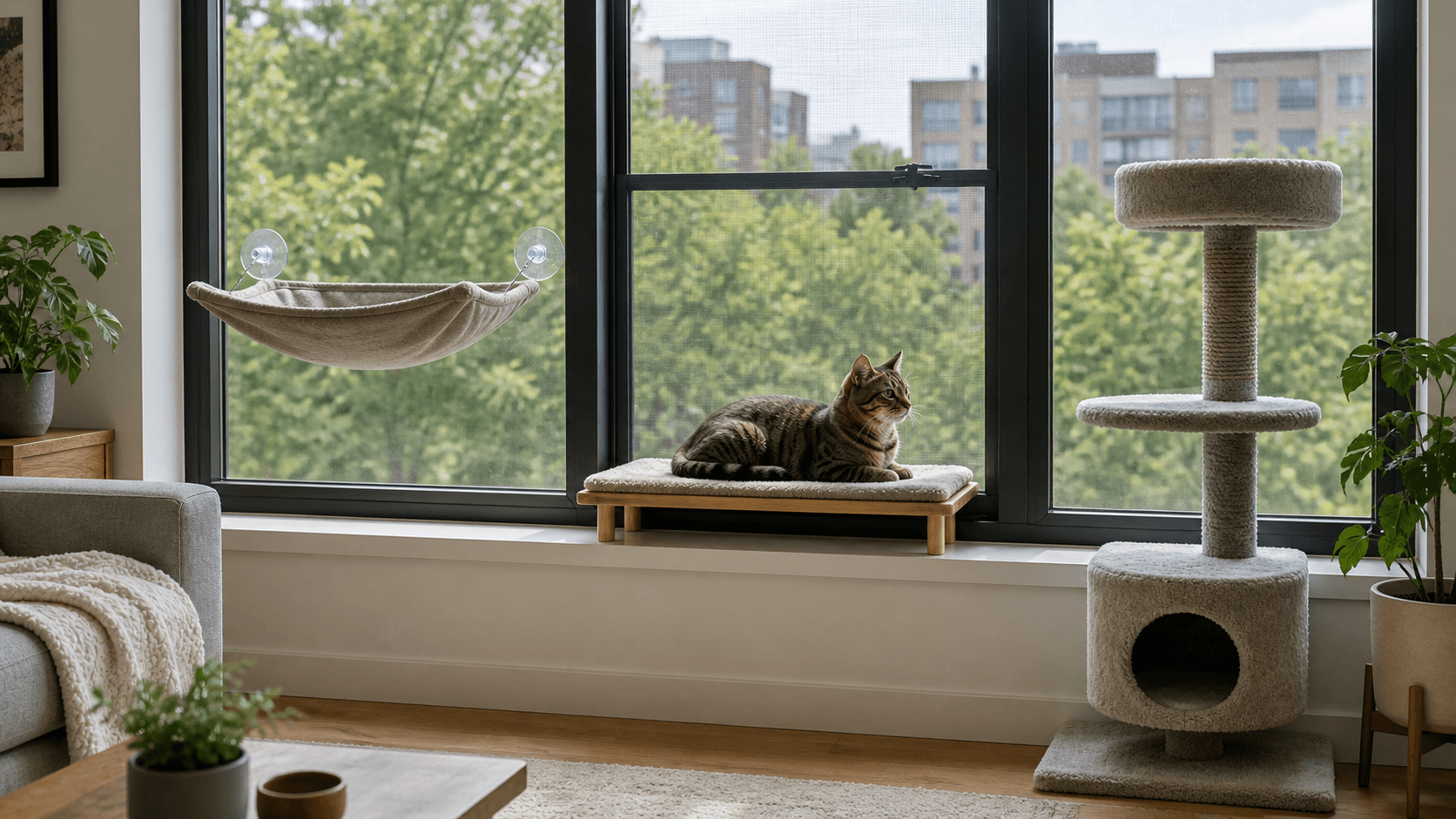
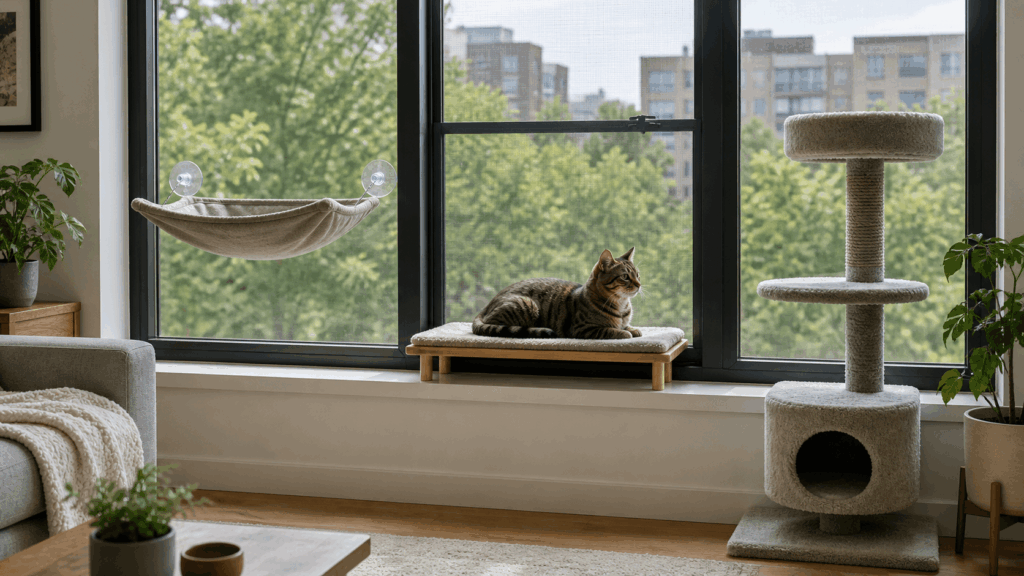
A cat window perch apartment setup can give an indoor cat valuable vertical territory without taking over the floor. The three practical no-drill options are a suction-mounted hammock for compatible glass, a sill-mounted platform for a suitable window ledge, and a stable freestanding tree or step route placed beside the window.
The best choice is not automatically the perch with the highest advertised weight limit or the smallest footprint. It is the one that matches the window, the product instructions, the cat’s body size and movement, and the rules of the rental. A secure setup also needs a safe route up and down, protection from excessive heat, and regular inspection after installation.
This guide explains how the three setups differ, what to measure before buying, how to introduce a perch without forcing the cat, and when a freestanding alternative is more appropriate than attaching anything to the window.
Quick Answer
For most renters, the best cat window perch apartment option is the one that can be installed exactly as its manufacturer directs on the available window. Choose a suction hammock only for compatible, smooth glass; choose a sill-mounted platform only when the sill shape and clearance match the product; or use a stable freestanding tree when the window cannot safely accept a mounted perch.
Measure the platform and approach route, confirm the current model’s stated limits, protect every open window with a snug and sturdy screen, and inspect the setup regularly. Stop using the perch immediately if it shifts, rattles, cracks, loosens, or makes the cat hesitate.
Safety Note Before Installing a Window Perch
Keep the approach and landing area clear of unstable furniture, blind cords, breakable objects, and other hazards. Follow the instructions for the exact perch model, confirm that the window or sill is compatible, and stop using the perch if any cup, bracket, cable, seam, or platform shifts or shows damage.
A snug, sturdy screen can help reduce the risk of a fall through an open window, but the screen must not support the perch or the cat’s weight. If the screen is loose, damaged, or poorly fitted, keep the window closed until it is repaired. Make sure the cat has a controlled route onto and off the perch without a hazardous jump.
Disclaimer: This article provides general educational information and does not replace the product manufacturer’s instructions or veterinary advice. If your cat falls or shows pain, breathing difficulty, bleeding, weakness, or other signs of injury, contact a veterinarian promptly.
Table of Contents
Why a Window View Can Help an Indoor Cat
A window gives an indoor cat changing sights, sounds, light, and movement. Birds, people, leaves, rain, and passing shadows can provide low-effort observation throughout the day. A raised resting place may also help a cat monitor the room while remaining away from normal household traffic.
Window access is only one part of a healthy indoor environment. Cats also need opportunities to scratch, hide, rest, play, explore, and interact on their own terms. The indoor cat enrichment in small apartments guide explains how to combine vertical space with play and resource placement when floor area is limited.
A perch is especially useful when the existing sill is too narrow for comfortable resting. It creates a defined surface instead of encouraging the cat to balance on trim, push against blinds, or stand among fragile objects. However, a window perch should not be the cat’s only elevated or resting option. Provide another comfortable place away from direct sun, drafts, noise, and outdoor triggers.
Not every cat finds outdoor activity relaxing. Some become tense, vocal, or frustrated when they see unfamiliar cats or wildlife. Watch the whole body rather than assuming every minute at the window is beneficial. A loose posture, normal grooming, resting, and the ability to walk away are different from hard staring, tail lashing, repeated vocalizing, redirected aggression, or an inability to disengage. If the view consistently increases stress, partially block the lower window or offer a quieter observation place.
The 3 Best No-Drill Cat Window Perch Apartment Setups
There is no universal winner. Each setup solves a different window and rental problem. A well-fitted freestanding route is better than forcing a mounted product onto an incompatible surface, while a compact suction perch can be useful when the glass and instructions genuinely match.
1. Suction-Mounted Window Hammock
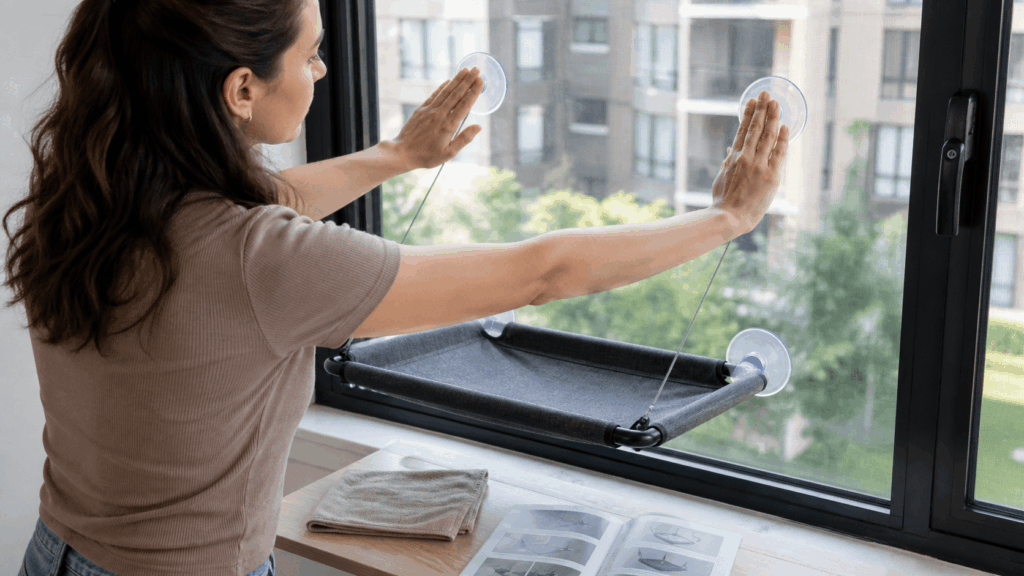
A suction-mounted hammock uses almost no floor space and keeps the cat close to the glass. It can work well when the exact product is designed for the available smooth glass and every suction cup, cable, frame component, seam, and contact point is intact.
Before buying, measure the usable glass rather than the full window opening. Locks, handles, frames, mullions, film, blinds, and trim may reduce the mounting area. Check whether the manufacturer excludes textured, frosted, coated, filmed, cracked, or unusually shaped glass. Do not assume a suction product will attach correctly simply because the listing photograph shows a similar window.
Compare the platform dimensions with the cat’s normal resting posture. The cat needs enough room to enter, turn around, settle, and leave without hanging over the edge. A high advertised weight limit does not prove that a platform is large enough for a long or broad-bodied cat.
The access route matters as much as the bed. A cat that steps from a nearby sofa creates a different load from a cat that runs across the room and launches onto the hammock. If the cat approaches with a hard jump, reposition the route or select a floor-supported option. Never place unstable furniture beneath the perch as an improvised step.
Follow the product’s preparation and attachment directions exactly. Do not add glue, tape, oil, household hooks, or replacement suction cups unless the manufacturer specifically approves them. Instructions from a similar-looking product may not apply to the model in your hands.
After installation, supervise the first uses with the window closed. Watch the cat step on, turn, rest, and climb down. Stop use if the perch changes angle, slides, stretches, creaks, loses contact, or shows damage. Repeated loss of suction is a compatibility or condition problem, not something to solve with improvised adhesive.
For a product-focused comparison of sizes and mounting styles, see the guide to the best cat window perches. Always verify the current manufacturer specifications before purchasing because product details can change.
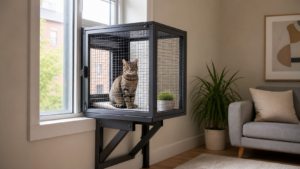
2. Sill-Mounted Window Platform
A sill-mounted platform rests on or attaches around part of the window ledge. Some models use padded brackets, pressure, or another model-specific mechanism. This category avoids relying entirely on suction, but it is not automatically compatible with every apartment window.
Measure the sill depth, edge shape, trim profile, window clearance, and available platform space. Confirm that the platform will not interfere with opening, closing, locking, or cleaning the window. Blinds and curtains must be able to move without catching on brackets or creating loops within the cat’s reach.
The platform should remain level and resist rotation when the cat enters, turns, and leaves. A loose cushion can slide or bunch beneath a jumping cat, so use only a thin, secured cover that does not interfere with the attachment system. Follow the cleaning instructions for both the platform and any removable fabric.
A sill-mounted product is a poor choice when the ledge is too shallow, rounded, damaged, obstructed, or outside the manufacturer’s stated requirements. Do not wedge a generic shelf into the frame and assume friction alone will support repeated movement.
“No drill” does not mean “no effect on the rental.” Pressure points, brackets, pads, or repeated movement may still mark paint or trim. Review the lease, inspect the window condition, and use only the protective parts supplied or approved for the product. Avoid unapproved foam, adhesive strips, and makeshift spacers that could change how the mount carries the load.
3. Freestanding Cat Tree or Step Route
A freestanding tree, bench, or low step route is often the most forgiving renter option because it does not ask the glass, screen, or window frame to carry the cat’s weight. It can work beside unusual windows, sliding windows, deep trim, or glass that is incompatible with suction products.
Choose a wide, stable base and place it on a level, nonslip surface. The top platform should provide a useful view without pressing against the glass, trapping curtain cords, blocking a heater, or preventing the window from operating normally. Leave enough room for the cat to turn and descend without jumping into a table, plant, breakable object, or narrow human walkway.
A freestanding route is often easier to adapt for a kitten, senior cat, overweight cat, or cat with limited mobility. Use smaller changes in height, broad landing surfaces, and reliable traction. A low step or ramp can connect the floor to a bench and then to a window-level platform without requiring one large jump.
For stable floor-supported options, compare the best cat trees for small apartments. Measure the full use zone rather than only the base. A narrow tree may still require clear space around it for entering and descending.
Freestanding furniture still needs maintenance. Inspect the base, platforms, posts, seams, fasteners, covers, and scratching material. Tighten parts only as the product directs, and stop using anything that rocks, twists, exposes a staple, or has a damaged load-bearing component.
-2-1024x576.png)
What to Measure Before Choosing a Perch
Product photographs can make a perch look smaller and a window look simpler than they are. Record the real measurements before comparing models.
Measure the usable glass width and height, not just the overall window. Note the position of frames, handles, locks, film, screens, blinds, and curtains. For a sill product, measure the depth, edge shape, trim, and clearance needed to operate the window. For a freestanding route, measure the floor footprint, total height, platform dimensions, and the human walking space around it.
Measure the area where the cat will approach and land. Look at the route from the floor, sofa, chair, or shelf. Remove rolling chairs, folding tables, decorative stands, and other temporary objects that could shift when used as a step.
Consider the cat’s body as well as weight. Compare platform width and depth with the cat’s length and resting style. A cat that curls tightly may fit differently from one that sleeps stretched out. Large paws, a broad body, reduced vision, stiffness, or poor balance may make a narrow hammock inappropriate even when the stated weight limit appears sufficient.
Record nearby heat sources, direct afternoon sun, cold drafts, electrical cords, blind loops, breakables, and plants. Confirm that every plant within reach is safe for cats and that a curious paw cannot pull a heavy pot from the sill.
Finally, check the current product manual. Use the stated cat-weight limit, surface requirements, maintenance instructions, and replacement criteria for the exact model. Do not rely on a retailer summary when it conflicts with the manufacturer’s documentation.
How to Choose Between the Three Setups
Choose a suction hammock when the glass is fully compatible, floor space is extremely limited, the platform fits the cat, and the cat can step onto it without a forceful launch.
Choose a sill-mounted platform when the ledge and trim match the product requirements, the window can still operate safely, and the attachment does not violate the lease.
Choose a freestanding route when the window is unusual, the mounting surface is uncertain, the cat needs wider or lower platforms, the household wants easy repositioning, or any mounted product would require improvisation.
If two options appear equally suitable, favor the one with the simpler inspection routine and the clearer route down. A compact installation has little value if it is difficult to check, blocks window access, or encourages a hazardous leap.
Furniture should also fit the room instead of looking like an accidental obstacle. The cat friendly interior design guide shows how to combine cat routes with human furniture while preserving clear walkways and access to windows.
Installation and First-Use Check
Read the manual before assembling the perch. Confirm that every required part is present and undamaged. Do not substitute fasteners, cables, cups, brackets, or fabric components from another product.
Prepare the surface only in the way the manufacturer specifies. Some products may require a particular cleaning method, drying period, temperature range, or sequence. Avoid universal internet instructions such as soaking every suction cup, using a particular household chemical, pressing for a fixed number of seconds, or waiting a standard number of hours. Those details can differ by material and model.
Once installed, look at the perch from the front and side. It should sit in the intended orientation without visible twisting or uneven tension. Make sure the window closes and locks, the screen remains undisturbed, and no cord or curtain is trapped by the mount.
Keep the window closed during the first introduction. Allow the cat to investigate voluntarily from a stable lower surface. Do not lift the cat onto a high perch or lure a hesitant cat into a jump. Reward calm investigation near the route, then let the cat decide whether to climb.
Observe more than the first step. Watch entry, turning, resting, grooming, standing, and descent. A platform that seems steady under a cautious paw may move when the cat changes direction. Stop at the first change in angle, contact, tension, sound, or cat confidence.
An improvised test using a rice bag, water jug, or other hanging object cannot reproduce the direction and force of a cat’s movement and may damage the window or product. It is not a substitute for correct installation, the stated product limits, and supervised observation.
Ongoing Inspection and Maintenance
Check the setup before routine use. Look for movement, a changing angle, damaged fabric, stretched cables, loose hardware, cracked plastic, deformed suction cups, worn traction, exposed staples, and anything blocking the route.
Inspect again after cleaning, moving furniture, window maintenance, a hard landing, or a major seasonal temperature change. Removing and washing a cover may alter how parts are seated, so reassemble only according to the care instructions.
Keep the window glass, sill, and surrounding area dry and free from buildup, but use only compatible cleaners. Some chemicals can damage coatings, plastic, rubber, fabric, or adhesive components. Never assume that a product safe for household glass is safe for every perch material.
Replace damaged load-bearing parts rather than sewing, gluing, or combining components unless the manufacturer approves the repair. Retire the entire perch when required parts are unavailable or the frame, mount, cable, seam, or platform can no longer be trusted.
Window Screen and Fall Safety
A window perch does not make an open window safe by itself. The ASPCA advises cat owners to use snug and sturdy screens because cats can lose their footing or push through a poorly fitted screen. Inspect the mesh, frame, edges, and fit before giving the cat access to an open window.
The screen should never carry the perch or the cat’s weight. Do not rest a bracket, platform, cable, or cat body against the mesh. If the screen shifts, bows, tears, or has a loose edge, close the window and repair it before the cat returns to the area.
Some windows tilt inward or create narrow gaps that can trap an animal. If a window opens in an unusual way, has damaged glass, lacks a secure screen, or cannot remain safely locked around the setup, use a freestanding observation point with the window closed.
Keep the space below and around the perch free of sharp furniture corners, glass objects, unstable lamps, and hard clutter. A lower controlled route reduces both the force of entry and the consequences of a missed step.
Temperature, Sun, and Draft Safety
Windows can become much warmer or colder than the center of a room. Check the surface at different times of day and in different seasons. A location that feels comfortable in the morning may receive intense afternoon sun.
Provide another resting place in shade so the cat can leave the window voluntarily. Do not use curtains or blinds in a way that traps the cat on the perch or creates reachable loops. If window film is being considered, confirm that it is compatible with the glass and lease before installation.
Watch for panting, drooling, weakness, unusual restlessness, vomiting, or difficulty breathing in warm conditions. Move the cat to a cooler area and seek veterinary advice promptly when overheating is suspected. Do not force cooling with ice water.
In cold weather, check for drafts and condensation. Use only a thin, secured, washable cover that does not interfere with the perch structure. Avoid electric heating pads, unsecured thick bedding, and anything that creates a cord or fire hazard at the window.
Helping a Cat Use the Perch Voluntarily
Some cats investigate new furniture immediately, while others need time. Place the approach route near an area the cat already uses and allow observation from below. A familiar washable cover may make the surface easier to recognize, provided it is thin, secured, and permitted by the product instructions.
Use calm rewards on the lower approach rather than placing food at the far edge of a high platform. A wand toy can encourage movement near the route, but never pull the cat into a risky leap or leave the string toy unattended.
Do not place the cat on the perch. Forced placement can create fear and gives you no information about whether the cat can climb down independently. If the cat repeatedly approaches and then withdraws, reassess stability, platform size, route difficulty, outdoor triggers, and temperature.
A cat that suddenly stops using a previously familiar perch may be responding to movement, noise, heat, conflict, pain, stiffness, vision change, or another health issue. Inspect the equipment first. If the avoidance is accompanied by reduced jumping elsewhere, limping, hiding, irritability, or changes in appetite or grooming, contact a veterinarian.
Making the Window Area More Enriching
The safest enrichment starts with choice. Keep at least one quiet resting place away from the window and let the cat decide when to watch outside. Avoid making every meal, toy, and comfortable bed dependent on using the perch.
Rotate a few safe toys in the room instead of crowding the platform. Store string, feathers, elastic, and detachable toy parts after supervised play. A cardboard scratcher or stable scratching post near the approach can add another activity without placing loose objects on the perch.
Outdoor bird activity can be interesting, but feeders must comply with building rules and local wildlife guidance. Positioning wildlife directly against the glass may frustrate or over-arouse some cats. Stop or move the attraction if the cat begins hard staring, striking the window, vocalizing continuously, or redirecting aggression toward people or other pets.
For cats that spend part of the day alone, combine the window with several small activities rather than expecting the view to provide all enrichment. The guide on how to entertain an indoor cat while at work includes toy rotation, food activities, resting options, and short owner-led sessions.
Apartment Layout Examples
In a studio, place one compact observation route near the window without blocking the main path between the bed, kitchen, bathroom, and exit. A sill or suction perch may save floor space, but a narrow freestanding tree can be the better choice when the window is incompatible.
In a one-bedroom apartment, spread resources across rooms. The window perch can occupy the social living area while a quiet bed and another elevated surface remain in the bedroom. This gives the cat options when the window becomes sunny, noisy, or busy.
In a multi-cat apartment, one prized window seat can become a guarded resource. Provide more than one elevated resting place and more than one route through narrow areas. A second cat should not have to pass directly beneath or beside the perch to reach food, water, litter, or another room.
For a senior cat, create a gradual route using stable furniture or a purpose-built ramp with firm traction. Keep landing areas broad and well lit. Do not assume reluctance is simply a preference change; altered jumping can be a subtle sign of discomfort.
Common Window Perch Mistakes
Choosing by Weight Rating Alone
The stated limit is important, but it does not describe platform size, window compatibility, route difficulty, or the force of a hard jump. All of those factors matter.
Copying Another Product’s Installation Method
Similar-looking cups and brackets may use different materials and procedures. Follow the instructions supplied for the exact model.
Allowing the Screen to Carry Load
A screen may help prevent passage through an open window, but it is not a shelf, bracket, or structural support for the perch.
Creating a Route Up With No Safe Route Down
Cats need enough space to turn and descend. A high platform reached by one dramatic leap may be unsuitable for a kitten, senior, large cat, or cat with mobility changes.
Ignoring Seasonal Changes
Direct sun, cold drafts, condensation, and changes in materials can affect comfort and equipment condition. Recheck the setup throughout the year.
Forcing a Hesitant Cat
A cat’s hesitation is useful information. Inspect the surface, movement, temperature, route, and surroundings instead of placing the cat on the perch.
Continuing After Damage or Repeated Loosening
Repeated movement is not normal maintenance. Stop use and consult the manufacturer or select a different setup rather than adding improvised repairs.
Key Takeaways
- Choose between suction, sill-mounted, and freestanding designs based on the actual window and cat.
- Measure the platform, mounting area, access route, landing space, and surrounding hazards.
- Follow the exact product instructions instead of universal online installation tricks.
- Keep open windows protected by snug, sturdy screens that do not carry perch load.
- Supervise first use and stop immediately if the setup or the cat’s confidence changes.
- Provide shade, another resting place, and protection from drafts, cords, and excessive heat.
- Use broad, lower, grippy routes for cats with changing mobility.
- Replace damaged structural parts instead of improvising repairs.
Frequently Asked Questions
Are suction-cup cat window perches safe in apartments?
They can be appropriate when the exact product is compatible with the glass, the cat is within the stated limit, every part is intact, installation follows the manual, and the mount is inspected regularly. They are not appropriate on excluded surfaces or when parts repeatedly loosen or lose contact.
Can a window screen hold a cat perch?
No. A snug and sturdy screen may help prevent a cat from passing through an open window, but it must not support the perch or the cat’s weight. Keep the window closed when the screen is loose, damaged, or poorly fitted.
What is the best no-drill perch for a large cat?
Compare the exact model’s platform dimensions, stated weight limit, mounting requirements, and approach route. A stable freestanding tree beside a closed window may be more suitable than a small mounted hammock, especially when the cat jumps forcefully.
What is the best window setup for a senior cat?
A lower freestanding route with broad, nonslip steps is often easier than a high jump. Any new reluctance to climb, slipping, stiffness, or change in normal movement deserves a veterinary discussion.
Will a suction perch damage a rental window?
No product can guarantee that it will never mark every surface. Compatibility depends on the glass, coatings, film, product materials, installation, cleaning, and removal method. Follow the manufacturer’s directions and the lease, and do not use a product on an excluded surface.
Should a cat window perch be placed in direct sun?
Some sun may be comfortable, but the cat must be able to leave easily and use a cooler resting place. Check the surface during the warmest part of the day and move or close access if the area becomes hot.
How often should I inspect a window perch?
Check it before routine use and after cleaning, a hard landing, window work, moving furniture, or a major temperature change. Follow any more specific interval stated in the product manual.
How do I encourage my cat to use a new perch?
Provide a stable lower approach, allow voluntary investigation, and reward calm interest. Do not lift the cat onto the perch or lure the cat into a difficult jump. Reassess the setup if hesitation continues.
Is a cat tree beside the window still a window perch?
It provides the same observation benefit even though it is not attached to the window. For many rentals, unusual windows, large cats, or cats with mobility needs, a stable floor-supported route is the most practical solution.
Final Thoughts
A good cat window perch apartment setup fits the real window, the real cat, and the real rental. Suction hammocks save the most floor space, sill platforms can provide direct window access without relying entirely on suction, and freestanding routes offer the greatest flexibility when mounting conditions are uncertain.
Measure before buying, follow the exact instructions, supervise the first uses, and inspect the setup throughout its life. Keep screens secure without asking them to carry weight, provide protection from heat and drafts, and choose an easier route whenever the cat’s size, confidence, or mobility makes a high jump inappropriate.
The best setup is not the one with the strongest marketing claim. It is the one that remains stable, can be checked easily, lets the cat enter and leave voluntarily, and adds useful window enrichment without creating a new household hazard.
References
AAFP and ISFM Feline Environmental Needs Guidelines
ASPCA: High-Rise Syndrome—Lifesaving Tips for Cat Parents
FelineVMA: Meeting the Needs of Indoor Cats—Position Statement