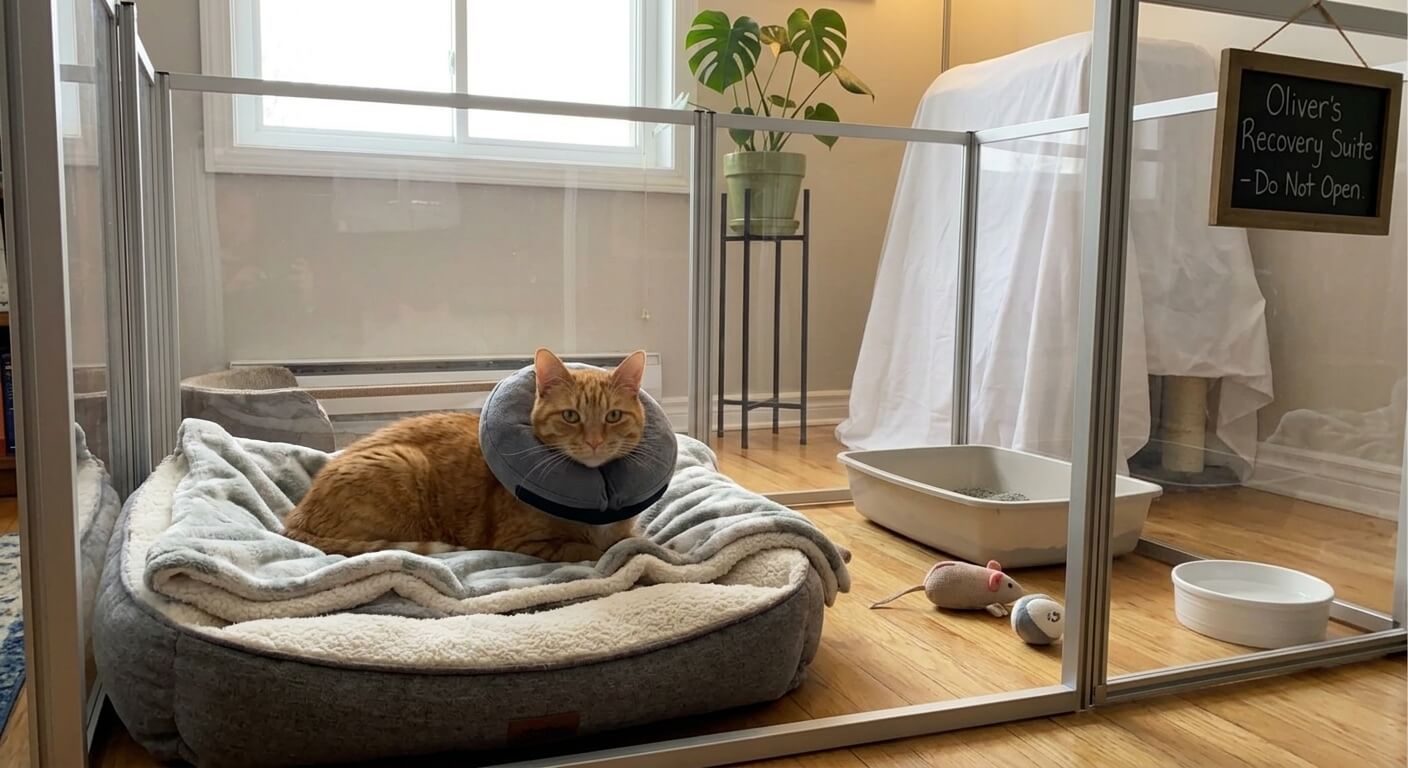
My heart was in my throat the entire drive home from the clinic. Oliver was in his carrier, half-sedated, pupils still dilated from anesthesia, occasionally letting out the kind of slow, confused meow that tells you the anesthetic fog hasn’t fully lifted yet.

I carried him inside, set the carrier gently on the floor, unzipped the door — and before I could even reach in to help him out, he walked directly to the base of his six-foot cat tree and began sizing it up with the focused intent of a cat who had absolutely no memory of the last four hours. I said words I will not repeat in print.

This is the reality of cat post surgery care in a small apartment: you are dealing with a creature of extraordinary athletic ambition, zero short-term surgical memory, and an intimate knowledge of every vertical surface in your shared 600 square feet — all of which suddenly represent a potential catastrophe.

In a large house, you can close off rooms, block stairways, and create distance. In a studio, the cat tree is six feet from the recovery area, the bed is two feet from the floor, and your cat knows every inch of the terrain. Restricting movement after surgery in a small space requires deliberate strategy, and that strategy starts the moment you pull out of the clinic parking lot.

The best way to manage post-op stress is to remove financial stress. Read our guide on [Is Pet Insurance Worth It for Indoor Cats? 5 Reasons You Need It] is pet insurance worth it for indoor cats to prepare for future procedures.


Quick Answer: How to Manage Cat Post Surgery Care in a Small Apartment?

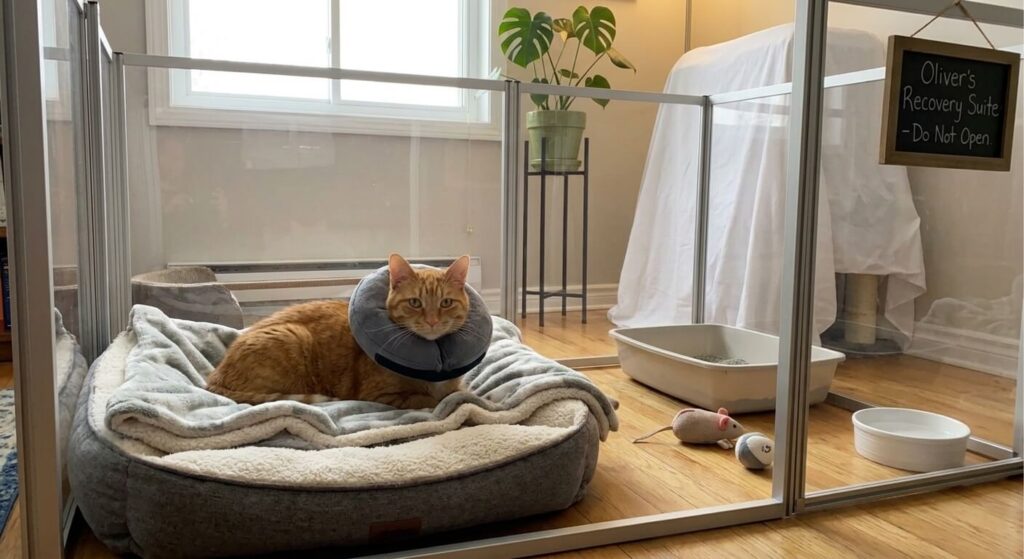
Effective cat post surgery care in small apartments requires creating a ‘Recovery Suite’ — a confined area at floor level using an exercise pen or a large dog crate. This prevents dangerous jumping on high furniture, keeps the litter box within short reach, and allows you to monitor the Incision Site without the cat hiding under the bed.


The High-Jump Danger: Why Apartments Pose a Post-Op Risk

Before we get into the practical solutions, I want to explain exactly why the small apartment environment creates specific, elevated risks during the post-operative period — because understanding the why makes you a better advocate for your cat’s recovery.

The Physics of a Post-Op Jump

A typical domestic cat can jump five to six times their body length from a standing start. Oliver, at approximately ten pounds, can clear his six-foot cat tree from a standing position on the floor. This is remarkable under normal circumstances. After abdominal surgery, orthopedic repair, or any procedure requiring internal sutures, it is a potential disaster.

Here’s what happens physiologically during a landing impact:

  • Abdominal procedures: The impact of landing transmits a significant compressive force through the abdominal wall. Internal sutures holding closed fascia, muscle, or intestinal tissue experience sudden, extreme tension. This can cause suture dehiscence — the tearing open of internal repairs — which is a surgical emergency.
  • Orthopedic procedures: Bone pins, plates, and repaired tendons or ligaments are not load-bearing immediately post-surgery. A misjudged jump landing can displace hardware, re-fracture healing bone, or rupture repaired soft tissue.
  • Limb amputations or soft tissue repairs: Landing asymmetrically on a healing limb or flap can disrupt the delicate vascular supply to healing tissue.

Why Apartments Amplify the Risk

In a larger home, space itself provides some degree of natural restriction — the cat has room to roam at ground level without immediately encountering every piece of furniture in the home. In a studio apartment:

  • High-value furniture is within immediate reach: Cat trees, beds, sofas, windowsills — all within a few body lengths in every direction
  • There are no “safe rooms” that naturally exclude all furniture without deliberate setup
  • The cat knows every jump in the space by instinct and habit — they will attempt familiar routes on autopilot, even under residual anesthesia
  • You cannot always supervise — sleeping, showering, and working from home all create unsupervised windows

The post-anesthetic period (first 12–24 hours) is the highest risk window, because the cat’s coordination is compromised while their impulse to attempt familiar movements is not. A sedated cat attempting a jump they’d normally clear easily is a cat at serious risk of a fall injury on top of their surgical recovery.

The Timeline of Risk

Understanding the recovery timeline helps calibrate how long restrictions need to be maintained:

Recovery PhaseTimeframePrimary Risk
Immediate post-op0–24 hoursFall from impaired coordination; suture strain
Early recoveryDays 1–3Incision disruption; pain-masking (cats hide pain)
Active healingDays 4–10Seroma formation; licking Incision Site
Late healingDays 10–14Premature return to activity before full tissue healing
Full recovery14+ days (procedure-dependent)Reinjury from overexertion

Your veterinarian will give you a procedure-specific timeline. Take it seriously — and add a buffer for apartment life.


Setting Up the ‘Recovery Suite’ in a Studio (Pens vs. Crates)

The Recovery Suite is the cornerstone of effective cat post surgery care in a small apartment. This is a deliberately prepared, confined, floor-level area that gives your cat everything they need within a space that eliminates all dangerous vertical movement opportunities.

I had Oliver’s Recovery Suite ready before I left for the clinic. Here’s exactly how to build one.

Option A: The Exercise Pen Setup (My Top Recommendation)

A freestanding pet exercise pen — the kind designed for puppies — is my preferred recovery containment solution for cats in apartments for several reasons:

  • Configurable shape: Can be arranged as a rectangle, hexagon, or custom shape to fit your available floor space
  • Sufficient size: 8-panel pens create approximately 16–20 square feet of space — enough for a bed, litter box, food, and water without feeling punishingly cramped
  • Visibility: Your cat can see you and the familiar environment; you can observe them continuously without entering the pen
  • Ventilation: Open-sided design maintains airflow, which matters if your cat runs warm post-surgery
  • Easy access for you: Most pens have a door panel that allows you to reach in for care without dismantling the setup

What to look for in a recovery pen:

  • Minimum 36-inch height (cats can scale lower pens even post-surgery — do not underestimate them)
  • Stable base that doesn’t tip when leaned against
  • A cover or roof panel if your cat is a determined climber even in their current state
  • Non-toxic powder-coated finish — your cat will mouth and chew the bars

Option B: The Large Dog Crate

A 42–48 inch wire dog crate is an excellent alternative, particularly for the first 24–48 hours when maximum restriction is needed:

Advantages:

  • Complete enclosure eliminates any jumping/climbing possibility
  • Secure and escape-proof
  • Easy to cover with a sheet for a calm, dark environment in the immediate post-anesthetic period

Disadvantages:

  • Less space than an exercise pen — not ideal for longer recovery periods
  • Cat must be removed for supervised exercise periods
  • Can feel punitive and increase stress if used exclusively for extended periods

My recommendation: Use the crate for the first night (maximum restriction during the highest-risk anesthetic recovery window), then transition to the larger exercise pen for days 2 onward.

Furnishing the Recovery Suite

Everything in the Recovery Suite serves a functional purpose:

Essential items:

  • ✅ Orthopedic or memory foam pet bed — at floor level, never elevated. Post-surgery joints and muscles are sore; a quality supportive surface reduces discomfort and promotes rest.
  • ✅ Low-sided litter box — standard litter boxes require a leg-lift that can strain abdominal incisions. Use a shallow storage tote or cut a low entry in an existing box. Line the bottom with unscented, non-clumping litter (pine pellets or paper litter) — particulate clay litter can adhere to and contaminate a fresh Incision Site.
  • ✅ Water bowl at floor level — hydration is critical for anesthetic clearance and healing. Use a wide, low bowl to accommodate the E-Collar if worn.
  • ✅ Food bowl at floor level — small, frequent offerings initially; see Tip #4 on appetite monitoring.
  • ✅ One or two familiar comfort items — a worn T-shirt of yours, a familiar blanket. Your scent is genuinely calming for an anxious post-op cat.

Items to keep out of the Recovery Suite:

  • ❌ Toys that encourage jumping, spinning, or vigorous play
  • ❌ Elevated platforms or steps of any kind
  • ❌ Catnip (it stimulates activity — the opposite of what you need)
  • ❌ Multiple bowls that require maneuvering — keep the layout simple and accessible

Blocking the Rest of the Apartment

While the Recovery Suite contains your cat during unsupervised periods, you’ll need to manage the broader apartment environment for supervised time outside the pen:

  • Cover or block the cat tree entirely: A fitted sheet thrown over the entire structure removes it as a visual target and physical option
  • Block under-bed access: Use bed risers to eliminate the space under the bed, or use bed rail blockers — a cat hiding under the bed after surgery is a cat you cannot monitor or retrieve safely
  • Move the sofa cushions to the floor temporarily to eliminate jump height
  • Close all interior doors to limit the space the cat can navigate during supervised out-of-pen time


5 Essential Protocols for Cat Post Surgery Care (2025)

These are the five protocols I follow — both as a veterinary technician and as Oliver’s owner — for every post-operative recovery period. Together, they form a comprehensive cat post surgery care system for small apartment living.


🏥 Tip #1: The Two-Finger E-Collar Rule

The E-Collar (Elizabethan collar — colloquially, the “cone of shame”) is your primary tool for preventing your cat from accessing and traumatizing their Incision Site. And the single most common cat post surgery care mistake I see owners make is fitting it incorrectly.

The Two-Finger Rule:

A correctly fitted E-Collar should allow you to comfortably slide two fingers between the collar and your cat’s neck — no more, no less.

  • Too loose: The cat can rotate their head and reach the Incision Site by bending their neck within the cone — which they will absolutely attempt and frequently achieve
  • Too tight: Restricts breathing, causes skin irritation at the contact points, and creates unnecessary discomfort

Checking the fit daily:

Post-operative fluid shifts and changes in eating/drinking can affect neck circumference slightly over the recovery period. Check the fit every day and adjust as needed. Also check:

  • That the cone extends at least 2–3 inches past the tip of the nose — cats can reach surprisingly far with a short cone
  • That the edges are smooth and not abrading the facial skin
  • That your cat can eat and drink from floor-level bowls without the cone rim preventing access (wide, shallow bowls solve this)

The adaptation period:

Most cats hate the E-Collar for the first 2–4 hours. This is normal. Do not remove it because your cat is unhappy — they are unhappy because they can’t lick the wound, which is exactly the point. The discomfort of the cone is objectively preferable to the complications of wound contamination or dehiscence.

After 4–6 hours, the majority of cats adapt well enough to sleep, eat, drink, and use the litter box with the cone in place.


🏥 Tip #2: The Litter Box Protocol

Litter box management is one of the most overlooked elements of cat post surgery care, and getting it wrong creates both medical and behavioral complications.

The primary concerns:

  1. Contamination of the Incision Site: Standard clay or clumping litter is particulate — small granules can adhere to a moist or healing wound, introducing bacteria and causing infection
  2. Physical strain during entry/exit: Stepping over a high-sided litter box strains abdominal sutures and causes pain in orthopedic recovery cases
  3. Posturing discomfort: Squatting to eliminate requires core muscle engagement — painful after abdominal procedures

The post-surgical litter box setup:

  • Use paper litter or pine pellets for the duration of healing (typically 10–14 days) — these materials are non-adhesive and far less likely to contaminate wounds
  • Provide the lowest-sided option possible — a disposable aluminum baking tray works excellently as a temporary low-entry litter box; the sides are 1–2 inches high
  • Place the litter box within 3 feet of the sleeping area in the Recovery Suite — a groggy or painful cat should not have to travel
  • Increase monitoring frequency: Check the litter box contents at least twice daily. Lack of urination for 24+ hours post-surgery is a veterinary emergency — it may indicate urethral obstruction, dehydration, or pain-related retention.

What to look for in post-surgical elimination:

  • ✅ Normal urine color (pale yellow to amber)
  • ✅ Soft to normal stool consistency
  • ⚠️ Absence of urination for > 24 hours — call your vet
  • ⚠️ Blood in urine (beyond minimal pink tinge immediately post-urinary procedure)
  • ⚠️ Straining without production — emergency

For senior or post-op cats, we recommend using the best high-sided litter box with a low-entry cut-out to prevent abdominal strain.


🏥 Tip #3: The Incision Site Monitoring Protocol

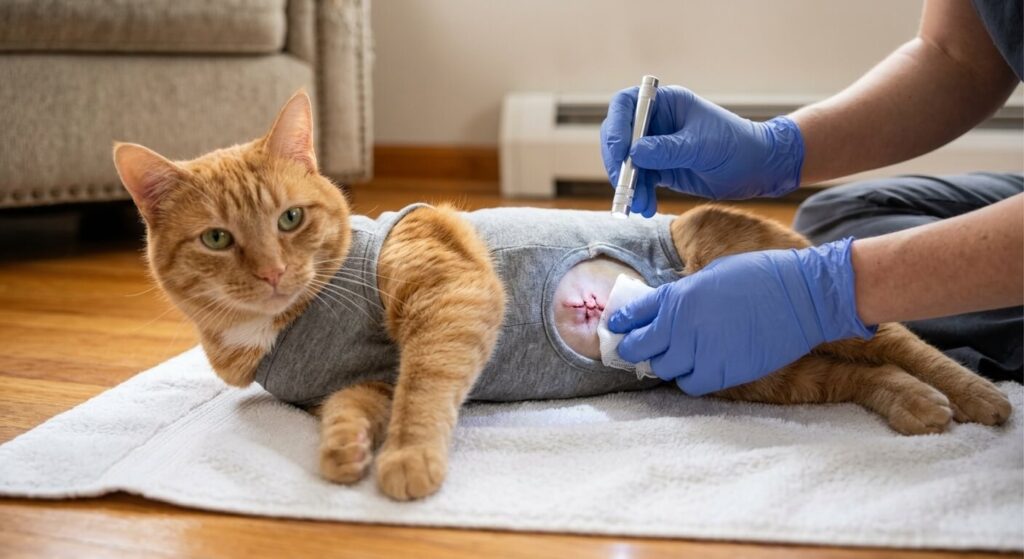
Twice-daily Incision Site assessment is the most important active monitoring task in cat post surgery care. Complications that are caught at 48 hours are manageable. Complications caught at day 7 may require surgical intervention.

How to perform an Incision Site check:

  1. Gentle restraint in a calm, familiar position — do not force a stressed cat into an uncomfortable position for inspection
  2. Good lighting — use a small LED flashlight or position near a lamp
  3. No touching the wound directly — visual assessment only unless instructed otherwise by your vet
  4. Photograph daily — the camera doesn’t lie, and serial photos allow you to detect subtle changes that your memory might rationalize away

The normal healing progression:

Days Post-OpNormal Appearance
Day 1–2Mild redness at wound edges; possible slight swelling; sutures/staples intact
Day 3–5Redness fading; edges beginning to approximate (draw together); slight itching begins
Day 6–10Continued approximation; possible minor dried crusting at wound edges; sutures still intact
Day 10–14Wound edges fully closed; suture removal typically scheduled here

Red flag findings requiring immediate veterinary contact:

  • Seroma formation: A Seroma is a collection of fluid beneath the skin surface that presents as a soft, fluctuant swelling at or near the Incision Site. Small seromas may resolve independently; larger ones require veterinary drainage. They are more common after extensive tissue dissection (oncological surgery, hernia repair).
  • Dehiscence: Wound edges separating — visible gap in the incision line. This is a surgical emergency.
  • Purulent discharge: Yellow, green, or thick discharge indicating infection
  • Excessive redness, warmth, or hard swelling: Signs of active inflammation or infection
  • Exposed sutures pulling through tissue: Indicates the wound is under tension it cannot handle

🏥 Tip #4: Appetite Monitoring and the Return to Eating

Post-operative appetite management is nuanced, and it’s an area where I’ve seen well-meaning owners both under-react and over-react. Good cat post surgery care requires understanding what’s normal and what isn’t.

Normal post-anesthetic appetite pattern:

  • First 4–6 hours home: Offer only water. Eating too soon after anesthesia commonly triggers nausea and vomiting — which involves abdominal straining incompatible with fresh abdominal surgery.
  • 6–12 hours: Offer a small amount (1–2 tablespoons) of highly palatable, easily digestible food. Warmed wet food works well — the aroma stimulates appetite in a cat whose olfactory sense is muted by anesthetic drugs.
  • 12–24 hours: If the small offering was tolerated, gradually increase toward the normal portion. Do not push full portions until you’ve confirmed tolerance of smaller amounts.
  • 24–48 hours: Return to normal portions if appetite is present and vomiting has not occurred.

When appetite loss becomes a concern:

TimeframeStatusAction
First 12 hoursNot eatingNormal — expected
12–24 hoursEating minimallyAcceptable; monitor
24–48 hoursNot eating at allCall your vet
48+ hoursStill not eatingVeterinary assessment required

Appetite stimulation strategies:

  • Warm wet food to just below body temperature — the warmth releases aroma compounds that bypass the suppressed appetite
  • Offer favorite foods: this is the time to use the premium options your cat loves
  • Hand-feed small amounts — some cats will eat from a hand even when disinterested in a bowl
  • Add a small amount of low-sodium tuna water or chicken broth as a palatability enhancer

Do not use appetite stimulants without veterinary guidance — some compounds (mirtazapine, for example) are very effective but have dose-sensitive side effects in cats.


🏥 Tip #5: Pain and Stress Management — Reading What Your Cat Cannot Say

Cats are stoic to a degree that genuinely complicates cat post surgery care — they are evolutionarily hardwired to mask pain, because in the wild, displaying pain signals vulnerability. The result is that by the time most cats show obvious pain signs, they are in significant discomfort.

The Feline Grimace Scale — a practical pain assessment tool:

The Feline Grimace Scale (FGS) was developed as a validated clinical pain assessment tool and is genuinely useful for home monitoring. Score your cat on each of five facial action units:

Action Unit0 (Absent)1 (Moderate)2 (Present)
Orbital tighteningEyes wide openSlightly squintedPartially or fully closed
Muzzle tensionRelaxed, roundedSlightly tenseTense, pronounced
Ear positionForward-facingSlightly back/apartFlattened back
Whisker positionRelaxed, curvedSlightly straightStraightened, forward-pulled
Head positionAbove shoulder levelAt shoulder levelBelow shoulder level

A score of 4 or above suggests moderate to severe pain — contact your veterinary clinic for analgesic guidance.

Managing post-operative stress:

The frustration of confinement in a small space is real and significant for an active cat. Post-op frustration can manifest as signs that closely mimic feline anxiety. [How to Train Your Cat to Like Their Carrier (Stress-Free Vet Trips)] — Managing the stress of restricted movement is an essential component of post-operative care, as the behavioral signs of post-op frustration overlap significantly with clinical anxiety presentations we’ve explored in detail. Recognizing the difference prevents misinterpretation and inappropriate responses.

Practical stress reduction in the Recovery Suite:

  • Your presence is the most powerful calming tool available. Work near the pen, read beside it, rest your hand through the bars. Your proximity genuinely reduces cortisol levels in bonded cats.
  • Pheromone diffusers placed near the Recovery Suite (Feliway Classic) have solid evidence for reducing confinement-related anxiety
  • Gentle auditory enrichment — soft classical music or species-appropriate nature sounds at low volume
  • Short, calm interaction periods — 5–10 minute gentle petting sessions (avoiding the surgical area) several times daily provide social stimulation without physical exertion
  • Appropriate analgesia: Never skip prescribed pain medication. Under-treated pain increases stress hormones, impairs immune function, and slows healing. If your cat seems to be in pain despite medication, call your vet — dose adjustments are always possible.

A note on senior cats:

[Signs Your Indoor Cat Is Stressed (And How to Help)] — For older cats, the post-operative recovery timeline is significantly extended, and the comfort requirements are more complex. The specialized environmental modifications and monitoring protocols we’ve detailed in our senior cat support guide are directly applicable to post-surgical recovery in cats over 10 years of age, where baseline mobility limitations and organ function changes affect both anesthetic clearance and tissue healing rates.


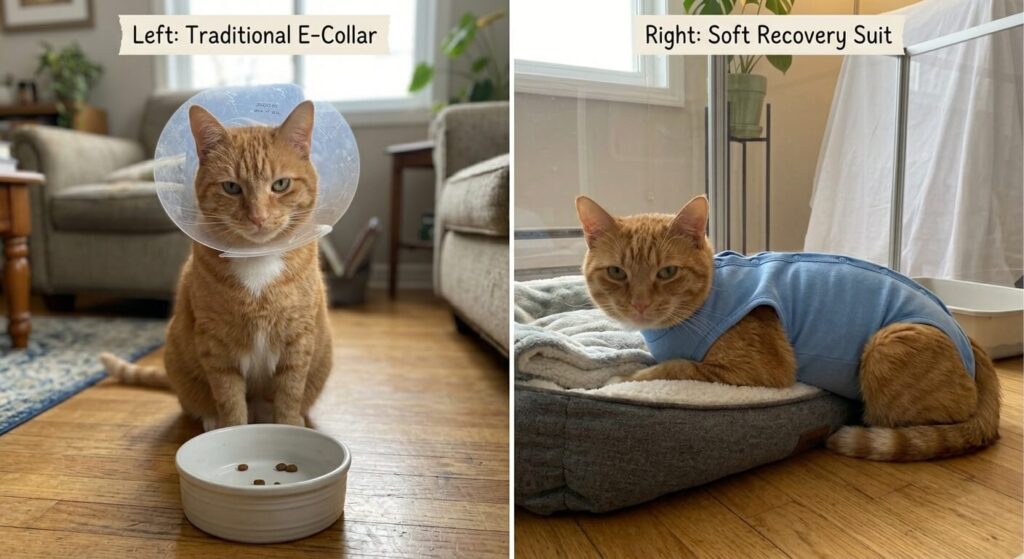
Cone of Shame vs. Recovery Suits: The Vet Tech’s Honest Take

This is the question I get asked more than almost any other in the context of cat post surgery care“Do I really have to use the cone? Can’t I just use one of those soft suits instead?”

Here is my honest, clinical answer — not the comfortable one, the accurate one.

The Traditional E-Collar (Hard Plastic Cone)

Advantages:

  • Most effective barrier against wound access in most cases
  • Creates a physical obstacle that most cats cannot circumvent
  • Durable and easy to clean
  • Clear plastic allows vision in front (though peripheral vision is blocked)

Disadvantages:

  • Impairs peripheral vision — cats may bump into walls and furniture, increasing fall risk
  • Can cause significant distress in some cats
  • Makes eating, drinking, and grooming the unaffected areas difficult
  • Notorious for being used as a battering ram against your ankles at 2 AM

The Soft Fabric E-Collar

Advantages:

  • More comfortable; less distressing for many cats
  • Better peripheral vision
  • Lighter weight; less likely to cause neck strain in smaller cats

Disadvantages:

  • Less effective as a barrier. Soft cones are compressible — a determined cat can often flatten the collar enough to reach mid-body and hindquarter incisions by bending at the waist. I have seen this firsthand.
  • Not appropriate for ventral abdominal incisions or hindlimb surgeries where the cat’s flexibility allows wound access even with a collar in place

Recovery Suits (Post-Surgical Body Suits)

Recovery suits — fabric garments that cover the torso and/or hindquarters — have become increasingly popular and have genuine clinical utility in the right context.

When recovery suits work well:

  • ✅ Flank or dorsal incisions (top of back, side of the body) where fabric coverage physically blocks access
  • ✅ Cats who are severely distressed by collar use and at high risk of self-injury from collar-related panic
  • ✅ As a complement to the E-Collar — layer both for maximum protection during high-risk periods

When recovery suits are not adequate:

  • ❌ Ventral midline abdominal incisions — the suit must be removed for elimination, creating repeated windows of wound exposure
  • ❌ Hindlimb surgeries where the cat can access the wound from the open leg portions of the suit
  • ❌ Cats who are highly motivated wound-lickers and will find a way to access any gap in coverage

My clinical recommendation:

Use the hard plastic E-Collar for the first 48–72 hours when wound-licking risk is highest and healing is most fragile. After day 3, reassess with your veterinarian — a recovery suit may become appropriate as an alternative or complement depending on the incision location and your individual cat’s behavior.

Never remove the E-Collar or recovery suit without veterinary guidance, regardless of how pitiful your cat looks. I say this with complete compassion — and the knowledge that every veterinary technician has made the same momentary lapse and regretted it.


Red Flags: When the Healing Goes Wrong

Knowing when to call your clinic is as important as knowing how to manage recovery at home. Good cat post surgery care means monitoring not just for expected recovery milestones, but for the signs that something is moving in the wrong direction.

The “Call Your Vet Today” Red Flags

Contact your veterinary clinic during business hours if you observe:

Incision-related:

  •  Seroma developing (soft, fluid-filled swelling at the incision)
  •  Wound edges beginning to separate
  •  Significant bruising spreading beyond the immediate incision area
  •  Persistent oozing beyond day 2 post-op
  •  Incision Site appearing increasingly red and warm rather than improving

Behavioral/systemic:

  •  Cat not eating at all beyond 48 hours post-surgery
  •  Vomiting more than twice in 24 hours
  •  Persistent hiding combined with refusal to engage
  •  Feline Grimace Scale score of 4+ despite prescribed analgesia
  •  Pronounced limping or non-weight-bearing worsening rather than improving (orthopedic cases)
  •  Litter box non-use beyond 24 hours (urination) or 48 hours (defecation)

The “Go to Emergency” Red Flags

Go directly to an emergency veterinary clinic if you observe:

  • 🚨 Wound dehiscence — visible gap or opening in the incision with visible tissue beneath
  • 🚨 Profuse bleeding from the Incision Site that does not slow with gentle pressure within 5 minutes
  • 🚨 Complete collapse or inability to stand
  • 🚨 Labored breathing or open-mouth breathing in a cat at rest
  • 🚨 Seizure activity
  • 🚨 Extreme vocalization suggesting acute, severe pain
  • 🚨 Pale, white, or blue-tinged gums — indicates cardiovascular compromise
  • 🚨 Swollen, hard, painful abdomen — potential internal bleeding or herniation

The Post-Op Emergency Kit: What to Have Ready

Before you bring your cat home, ensure you have:

  • ✅ Your veterinary clinic’s emergency after-hours number
  • ✅ The nearest 24-hour emergency veterinary clinic address and phone number
  • ✅ All prescribed medications clearly labeled and correctly dosed
  • ✅ A clean white or light-colored towel (for wound assessment — shows blood and discharge clearly)
  • ✅ A secure, easily accessible carrier for emergency transport
  • ✅ A written list of all medications administered with times (medication log)
  • ✅ A phone charged and within reach during the first 48 hours

Frequently Asked Questions

❓ How Do I Stop My Cat from Jumping After Surgery in a Small Apartment?

This is the central challenge of cat post surgery care in small spaces, and the honest answer is: physical prevention is far more reliable than behavioral deterrence.

Physical prevention strategies:

  • The Recovery Suite (exercise pen or crate) is your primary tool — use it for all unsupervised periods without exception
  • Cover or physically block all elevated surfaces: Throw a sheet over the cat tree, push furniture against the wall, and place chair cushions on the floor to eliminate jump height
  • Block under-bed access — a hiding cat under the bed cannot be monitored and may attempt to jump onto the bed from below
  • Baby gates can be helpful in apartments with distinct zones, though most adult cats will scale a standard baby gate — use a gate with a door panel rather than relying on height alone

Behavioral management:

  • Engage your cat at ground level with interactive wand toys during supervised periods to redirect activity energy downward rather than upward
  • Never chase a post-op cat — the stress of being pursued triggers a flight response that includes jumping. If your cat escapes the recovery area, move calmly and use food rewards to entice them back.
  • Discuss sedation with your vet if your cat is particularly active and resistant to confinement — mild pharmaceutical sedation during the first 48–72 hours is a legitimate and humane option for cats at high fall risk

A recovering cat may instinctively try to conceal themselves. Distinguish between recovery and pain-driven withdrawal by reading about [Why Is My Cat Hiding? 5 Surprising Reasons & When to Worry] why is my cat hiding after medical procedures.


❓ Can I Leave My Cat Alone After Surgery?

Yes — but with significant precautions and time limitations, particularly in the first 48 hours.

The risk period breakdown:

  • First 12 hours: Ideally, someone should be home. This is the period of residual anesthesia, peak disorientation risk, and highest probability of a dangerous fall or wound disruption event.
  • 12–48 hours: Short absences (2–3 hours) are acceptable if the cat is secured in a properly furnished Recovery Suite
  • 48+ hours: Normal work-day absences become manageable with the Recovery Suite setup, provided the cat is medically stable

Before leaving your cat alone:

  •  Confirm the cat is fully alert and responsive (no residual anesthetic effects)
  •  Ensure the Recovery Suite is fully stocked (water, food, litter box)
  •  Administer any due medications before leaving
  •  Set up a camera (a basic pet camera like Wyze or Furbo) so you can monitor remotely
  •  Confirm your cat cannot access the E-Collar buckle and remove the collar independently — some cats develop impressive dexterity with clasps

When you should not leave:

  • In the first 12 hours post-anesthesia
  • If your cat is showing signs of pain or distress
  • If your cat has not yet urinated post-surgery
  • If any wound concern has not yet been evaluated by a veterinarian

❓ How Long Does a Cat Need the Cone On?

The standard guidance is 10–14 days — which corresponds with the typical suture removal timeline and the point at which wound healing has progressed to the point that licking, while inadvisable, is unlikely to cause catastrophic wound disruption.

However, cone duration is procedure-dependent:

Procedure TypeTypical E-Collar Duration
Spay / neuter (routine)7–10 days
Abdominal surgery (soft tissue)10–14 days
Orthopedic surgery10–21 days (bone healing is slower)
Wound repair / laceration10–14 days or until sutures removed
Oncological surgery14+ days (larger incisions)
Dental extractions5–7 days

Never remove the cone before your veterinarian has:

  1. Examined the Incision Site and confirmed adequate healing
  2. Explicitly cleared the cat from cone requirements

The single most common cause of post-operative wound complications I see in clinical practice is owners removing the E-Collar a few days early because “the cat seemed fine.” A wound that looks healed on the surface may have incompletely healed deeper tissue layers — and a single determined licking session can undo ten days of careful healing in minutes.

If the cone is causing your cat significant distress, discuss alternatives with your vet — but make that call rather than making the decision independently.


Scientific References

  1. Grubb, T., Lobprise, H. (2020). Local and regional anaesthesia in dogs and cats: Overview of concepts and drugs (Part 1). Veterinary Medicine and Science, 6(2), 209–217. https://doi.org/10.1002/vms3.219
  2. Steagall, P. V., Monteiro, B. P. (2019). Acute pain in cats: Recent advances in clinical assessment. Journal of Feline Medicine and Surgery, 21(1), 25–34. https://doi.org/10.1177/1098612X18803129

A Final Word from Oliver’s Highly Stressed Owner

Oliver did not make it to the cat tree that first day. I got there first — which required a lunge that I am not proud of from a physical grace standpoint but am very proud of from a veterinary technician standpoint. He spent the next ten days in his Recovery Suite, which I set up beside the couch so I could rest my hand on the pen bars while I watched television at night.

He was furious about the cone for approximately six hours, resigned about it for two days, and then appeared to forget it existed entirely. He ate from his shallow bowl with the focused determination of a cat who has decided that food is non-negotiable regardless of circumstances. His Incision Site healed cleanly. His sutures came out on day eleven.

On day twelve, I moved the sheet off his cat tree. He sat and stared at it for a full sixty seconds, then scaled it in one fluid motion and looked down at me from the top platform with an expression of pure, vindicated satisfaction.

That’s the goal of good cat post surgery care: getting your cat safely back to exactly where they want to be.


Disclaimer: This article is written by a certified veterinary technician for educational and informational purposes only. It does not constitute veterinary medical advice and is not a substitute for consultation with a licensed veterinarian. Always follow the specific post-operative instructions provided by your cat’s surgical team.


Tags: cat post surgery care | cat recovery apartment | post op cat care | cat surgery recovery tips | e-collar cat | cat incision care | feline post operative care | small apartment cat health 2025

Share this post

Subscribe to our newsletter

Keep up with the latest blog posts by staying updated. No spamming: we promise.
By clicking Sign Up you’re confirming that you agree with our Terms and Conditions.

Related posts