By IndoorCatExpert.com | Indoor Cat Behavior & Wellness
Every morning, it’s the same scene. I grab my bag, check my keys, and turn around to find Oliver sitting three feet away, staring at me with the quiet, unblinking intensity of a sentient throw pillow who knows exactly what’s about to happen. I say goodbye. He blinks slowly. I close the door. And for the next nine hours, he’ll be alone in a 650-square-foot apartment while I’m sitting in meetings and pretending to pay attention.
If you’re noticing destructive behavior or excessive sleeping when you return, check out our guide on the 10 signs indoor cat is bored to see if under-stimulation is the root cause.
If you’ve ever Googled how to entertain an indoor cat while at work at 7:55 AM with one shoe on, you’re in the right place. That particular flavor of pet parent guilt — the one that sits in your chest all day while you wonder if your cat is okay — is something I know intimately. The good news is that with a little setup the night before, you can transform your apartment into a genuinely stimulating environment that keeps your cat engaged, calm, and mentally healthy while you’re gone.
If you find yourself constantly worrying about how to keep cat entertained while at work, you are not alone.
If you are wondering how to keep cat stimulated while at work, the secret lies in passive environmental enrichment.
Oliver isn’t anxious anymore. He’s actually pretty good at being alone now. Here’s everything I did to get there.
Quick Answer
The best way to entertain an indoor cat while at work is by creating passive environmental stimulation before you leave. This means setting up window perches with an outdoor view, distributing puzzle feeders in multiple locations, rotating safe independent toys, and using cat TV or ambient sound. Combine these and your cat has a full, enriched day — no supervision required.
If you’re worried about these items taking up too much of your limited floor plan, explore our curated list of the best cat toys small apartment setups that easily hide away.
First, Reframe What “Entertainment” Means for a Cat
Here’s something that took me too long to understand: Oliver doesn’t need me to entertain him the way a dog might. He doesn’t need constant stimulation or companionship every hour. What he needs is an environment rich enough to support his natural solo behaviors — exploring, foraging, watching, and resting — on his own schedule.
Cats sleep 12–16 hours a day on average. When figuring out how to entertain an indoor cat while at work, the goal isn’t to keep Oliver busy for nine straight hours.
It’s to make sure the 3–4 hours he’s awake and active are genuinely satisfying rather than restless and frustrated.
That distinction changes everything about how you approach the problem.
Category 1: Food Puzzles & Foraging Games
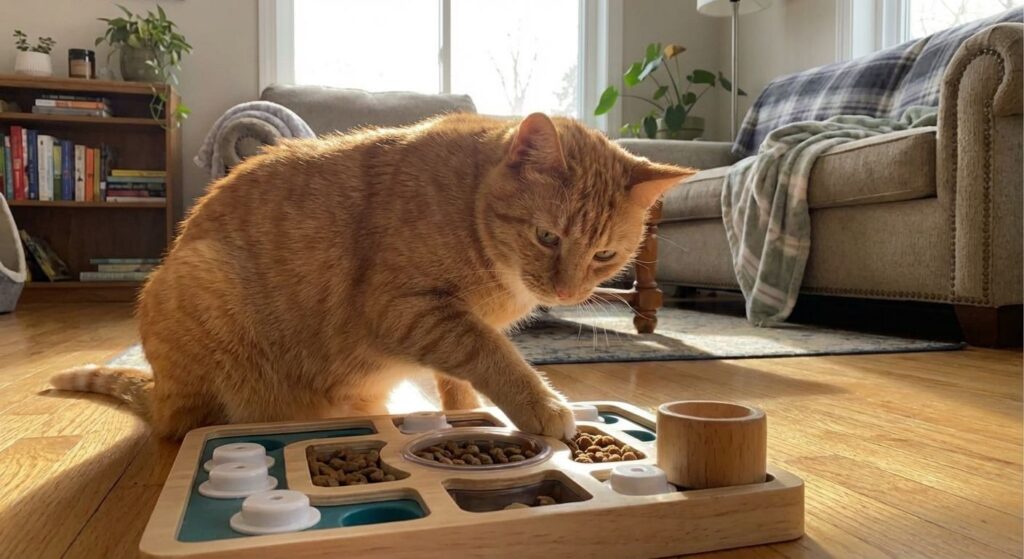
Transforming how your cat accesses food is one of the single highest-impact changes you can make for a cat who spends long hours alone. It converts a passive, two-minute bowl interaction into an extended, cognitively demanding foraging session that mirrors natural hunting behavior.
Idea 1: Distributed Puzzle Feeders
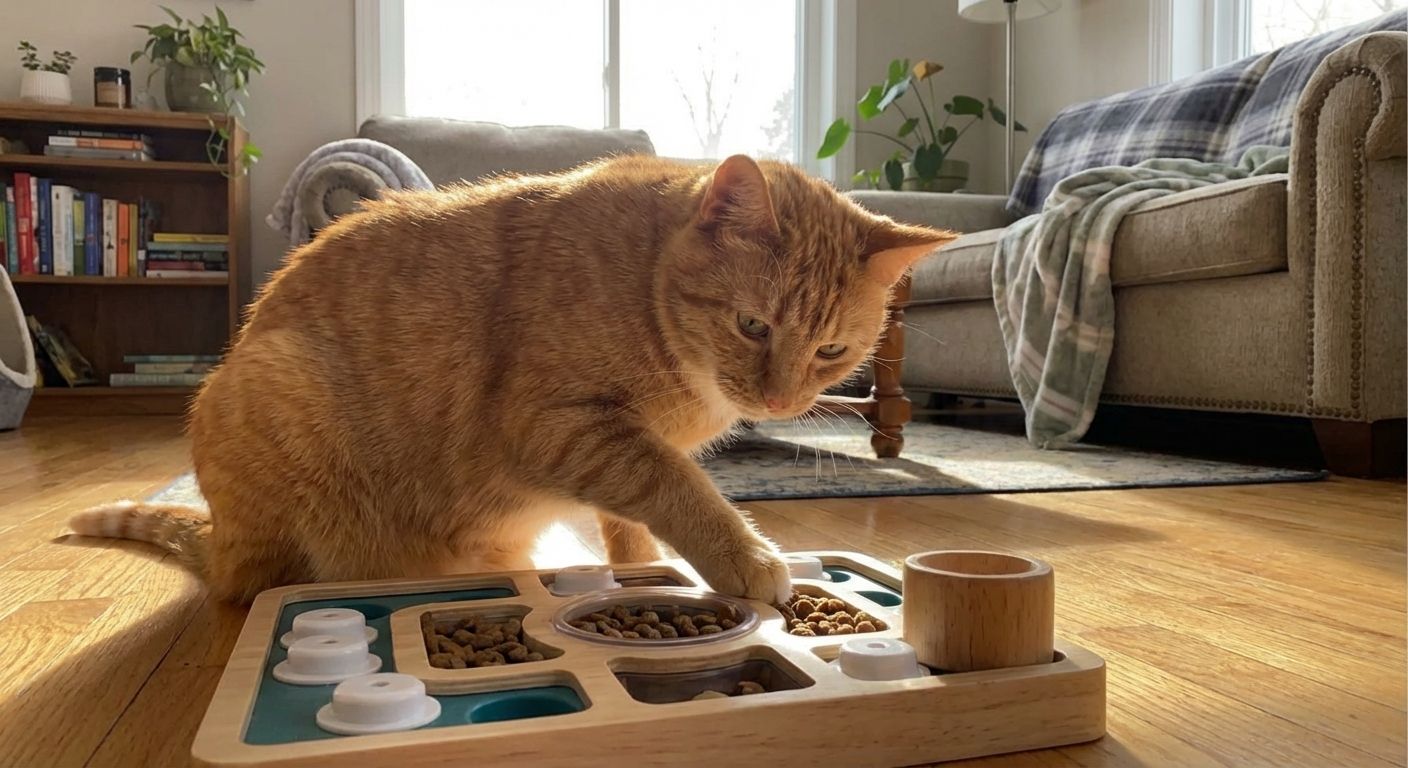
Instead of leaving Oliver’s full morning meal in one bowl, I split it across two or three different puzzle feeders placed in different rooms. He has to find them, work them, and move on — which can stretch a meal into 20–30 minutes of active engagement rather than 90 seconds of inhaling kibble. Using puzzle feeders isn’t just for fun; it’s also a key strategy if you need to know how to help indoor cat lose weight.
How to start if you’re new to puzzle feeders:
- Begin with a simple flat maze or rolling ball feeder — the learning curve matters
- Gradually increase difficulty as your cat masters each level
- Never make it so hard they give up; the goal is satisfying challenge, not frustration
You don’t need to spend money to try this. A muffin tin with kibble in each cup, covered by tennis balls, works perfectly as a starter puzzle feeder.
Idea 2: Hidden Kibble Scatter
On days when I’m really pressed for time, I scatter a portion of Oliver’s dry food in six or eight different spots around the apartment — tucked behind a chair leg, placed on a low shelf, left on the corner of his cat tree platform. This triggers scent-led foraging behavior, which is deeply satisfying for cats and requires no equipment at all.
The apartment suddenly becomes a map he has to navigate and solve. From his perspective, he’s hunting. That’s exactly the point.
Idea 3: The Ice Cube Treat Block
This one is underrated and costs almost nothing. Freeze a few cat-safe treats or a small amount of wet food in an ice cube, then leave it in Oliver’s bowl before I head out. It takes him a while to work through it, the texture keeps him engaged, and it doubles as light hydration on warm days.
Category 2: Visual Stimulation & Window Entertainment
If you’re wondering how to entertain an indoor cat while at work, the window is your most powerful ally when you’re not home. For a cat, a well-positioned window with active outdoor scenery is the equivalent of a television, a nature documentary, and a workout for the predator brain — all in one.
Idea 4: The Window Perch Setup
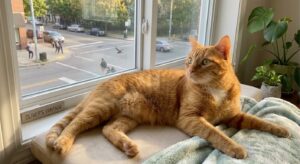
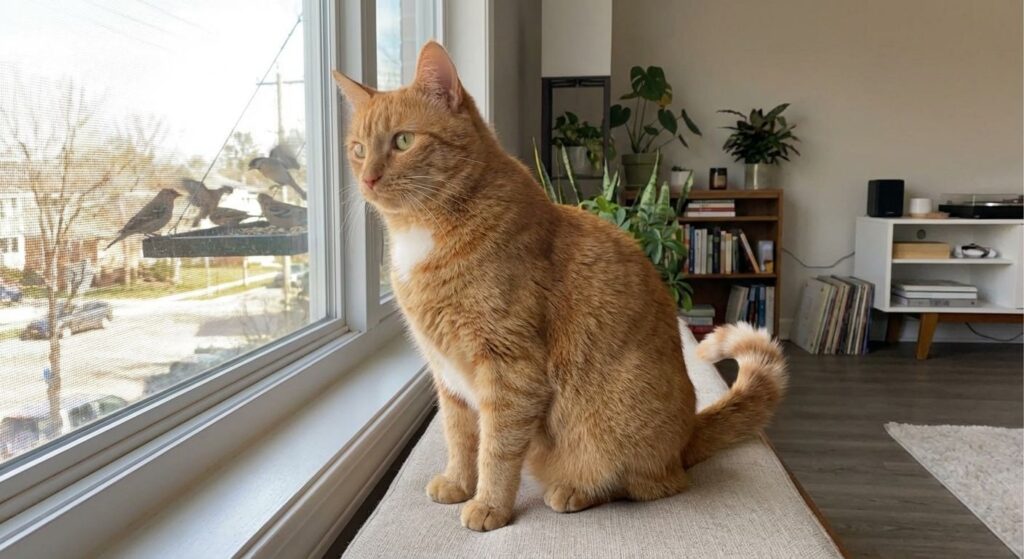
If Oliver only has one dedicated enrichment spot in the apartment, this is it. A suction-cup window perch costs almost nothing and gives him a comfortable, stable platform to spend hours in focused observation. The placement matters as much as the perch itself — face a street, a garden, a courtyard, anywhere with movement.
Things that make a window perch more effective:
- Position it at a height where Oliver can see both sky and ground level
- Add a small piece of fleece or a folded towel for comfort on longer sessions
- Make sure the window lets in direct light at some point during the day — cats use sunlight patches for warmth and relaxation
Idea 5: The Outdoor Bird Feeder
If your building allows it, a suction-cup bird feeder mounted on the outside of the window glass is one of the most effective passive enrichment tools available for an indoor cat. The birds that come and go throughout the day — their movement, sounds, and unpredictable behavior — provide a level of live stimulation that no screen or toy can replicate.
Oliver has a small feeder on our kitchen window. On a busy day, it draws finches, sparrows, and the occasional pigeon. I’ve watched the footage on my phone camera and he genuinely stations himself there for two-to-three-hour stretches. He comes away from those sessions calm and satisfied rather than restless.
Idea 6: Cat TV and Ambient Audio
For the hours when the window view is quiet — overcast days, no street traffic, slow bird activity — a tablet or laptop propped on a low surface playing bird and squirrel footage serves as a reliable backup. Choose dedicated cat video playlists that loop continuously, and test them with your cat present first to ensure the content engages rather than startles.
Note: Looking out the window is great, but never leave your balcony door open when you aren’t home, even if you follow our guide on how to cat proof apartment balcony setups.
The audio dimension matters too. Many cats settle well with low-volume classical music, nature soundscapes, or even a talk radio station left on quietly. The presence of human voices, in particular, appears to reduce stress responses in cats who are closely bonded with their owners. Experiment and observe.
Category 3: Scent Enrichment & Independent Toys
Scent is a dimension of enrichment that almost every apartment cat owner under-uses. A cat’s sense of smell is roughly 14 times more sensitive than a human’s, and novel scent experiences engage their investigative behaviors for extended periods — often longer than visual stimulation does.
Idea 7: The Rotating Scent Bag
Before leaving for work, I sometimes leave a small cloth bag or an old sock containing a few fresh herb leaves — mint, valerian, dried catnip, or silver vine — tucked in a corner Oliver will find during his morning exploration. The key is rotation: if the same scent is available every day, it loses its novelty within a week. Cycle through different options and reintroduce them after a two-week gap.
You can also bring in natural outdoor scent objects — a pine cone, a handful of dried leaves, a small piece of bark. These carry complex, layered outdoor scent profiles that indoor cats rarely encounter and find genuinely absorbing.
Idea 8: Safe Independent Toys — Left Out Strategically
Not all toys are created equal for solo play. Wand toys and laser pointers require a human operator and should be put away when you leave. The toys that work for independent play have specific characteristics:
Good solo toys for when you’re away:
- Crinkle balls — lightweight, make sound when batted, move unpredictably
- Foil balls — cost nothing, wildly effective for many cats
- Spring toys and wobble balls — self-righting movement triggers prey response
- Cardboard boxes — left open on the floor, they become tunnels, hiding spots, and ambush platforms simultaneously
Rotate which toys are available each day. Novelty is what drives engagement — the crinkle ball that’s been on the floor for two weeks is invisible to Oliver; the same ball that reappears after ten days is suddenly fascinating again.
Idea 9: The Cardboard Box City
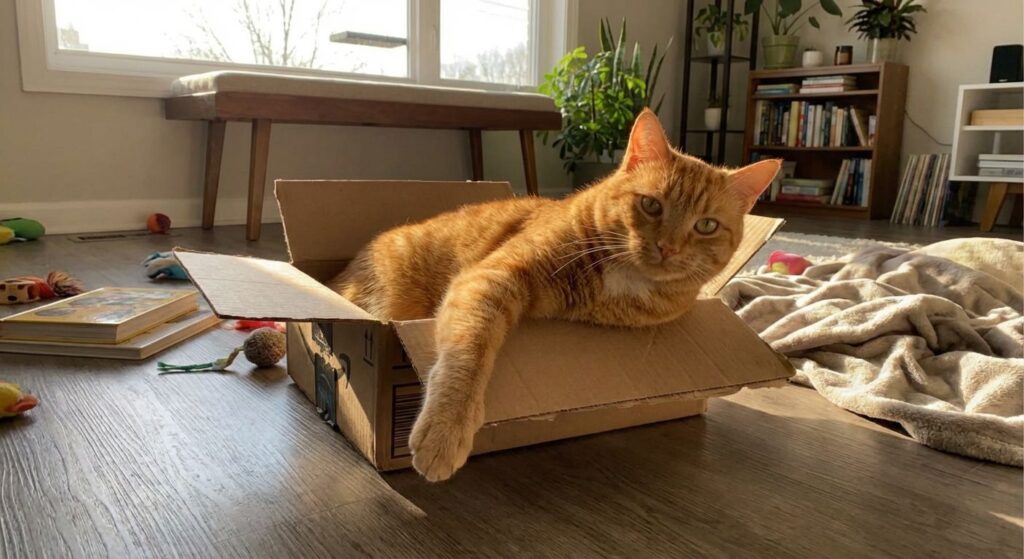
This sounds too simple to work. It isn’t. Before particularly long work days, I leave two or three cardboard boxes of different sizes open on the floor — some on their sides, some upright with a hole cut in the panel, sometimes one stacked loosely on top of another.
Oliver investigates them, sleeps in them, ambushes invisible prey from inside them, and generally treats the whole arrangement as an architectural wonder. A cardboard box is to a cat what a good book is to a person on a rainy afternoon. It costs nothing and keeps him occupied in a calm, self-directed way for hours.
The Night Matters As Much As the Day
Here’s the part most daytime enrichment advice leaves out: what happens when you get home is just as important as what you set up before you leave.
If Oliver has spent much of the day sleeping — which, being a cat, he will — he’s going to have stored energy that needs somewhere to go. A good environment during the day reduces anxious behavior, but it doesn’t replace an active, structured play session in the evening.
This is why the pre-bed routine I use every night is a non-negotiable companion to all of this daytime setup. If your cat is wired at midnight even after a well-enriched day, a 15-minute structured hunt-and-feed session before you sleep is the missing piece: how to tire out an indoor cat before bed.
The daytime setup and the nighttime routine work together. One without the other is half a solution.
Putting It Together: Oliver’s Typical Workday Setup
If you want an exact blueprint on how to entertain an indoor cat while at work, here’s exactly what I do on a standard workday morning before I leave:
The night before:
- Rotate which toys are left out on the floor
- Prepare the ice cube treat block and put it in the freezer
Morning of (takes about 5 minutes):
- Split morning meal across two puzzle feeders in different rooms
- Place the ice cube treat in Oliver’s bowl
- Scatter a small handful of kibble in three or four spots around the apartment
- Check that the window perch is clear and unobstructed
- Leave a fresh scent bag in a spot he hasn’t checked recently (I rotate the location)
- Put on a looping cat TV video or low background audio
What I don’t do:
- Leave every toy out at once — too much at once becomes white noise
- Leave the TV on full volume — ambient, not stimulating, is the goal
- Feel guilty about leaving — because I know his environment is set up to support him
The guilt doesn’t entirely go away. But it gets a lot quieter when you know you’ve done the work.
A Note on Vertical Space
All of the passive enrichment above works significantly better when your apartment gives your cat places to go — different elevations, vantage points, and routes to explore. A well-set-up vertical environment gives a cat the sense of owning and navigating a territory even within four walls.
If your apartment is still mostly flat from your cat’s perspective, that’s worth addressing alongside these daily strategies: indoor cat enrichment in small apartments.
FAQ
Should I leave the radio or TV on for my cat while I’m at work?
Yes, with some nuance. Low-volume ambient audio — nature soundscapes, classical music, or a talk radio station with calm voices — can meaningfully reduce stress responses in cats who are closely bonded with their owners. Avoid anything with sudden loud sounds (action movies, news alerts, advertisements), as these can cause repeated startle responses throughout the day. Test your chosen audio with your cat present first to observe how they respond.
Is it okay to leave my cat alone for 9–10 hours every day?
Most healthy adult cats tolerate this well when their environment is properly enriched. Cats are not dogs — they are not pack animals, and solitude doesn’t carry the same inherent distress for them. The key is quality of environment, not simply duration of absence. Kittens under one year and elderly cats with health conditions may need more check-ins; for these cats, a mid-day visit from a trusted pet sitter can make a real difference.However, if you are planning a trip from Friday to Sunday, the rules change entirely. Read our complete guide on how to leave a cat alone for the weekend for the 48-hour safety protocol.
My cat seems fine when I leave but destroys things while I’m gone. What’s happening?
Destructive behavior during your absence — knocking things over, scratching furniture, pulling items off shelves — is almost always a sign of under-stimulation rather than spite or separation anxiety. (Cats do not plot revenge. They’re opportunists, not strategists.) Start by adding more physical and cognitive outlets: puzzle feeders, more toy rotation, better window access. If the behavior continues or is accompanied by elimination outside the litter box, it’s worth a conversation with your vet to rule out anxiety-based conditions.
Can you crate a cat while at work?
No, you should not crate a cat for 8-9 hours while at work. Unlike dogs, cats are not den animals and do not feel secure locked in a small crate for extended periods. Confinement causes severe distress, prevents them from using the litter box comfortably, and completely eliminates their ability to express natural behaviors. Instead of a crate, “cat-proof” a single room (like a bedroom) or follow our 9 entertainment ideas to give them safe, free roam of your apartment.
References: Ellis, S.L.H. et al. (2013). AAFP and ISFM Feline Environmental Needs Guidelines. Journal of Feline Medicine and Surgery, 15(3), 219–230. | Buffington, C.A.T. (2011). Idiopathic cystitis in domestic cats — beyond the lower urinary tract. Journal of Veterinary Internal Medicine. | Dantas, L.M.S. et al. (2016). Food puzzles for cats: Feeding for physical and emotional wellbeing. Journal of Feline Medicine and Surgery.
IndoorCatExpert.com — For the cats who wait by the door, and the people who feel bad about it.