By IndoorCatExpert.com| Last Updated: March 2026
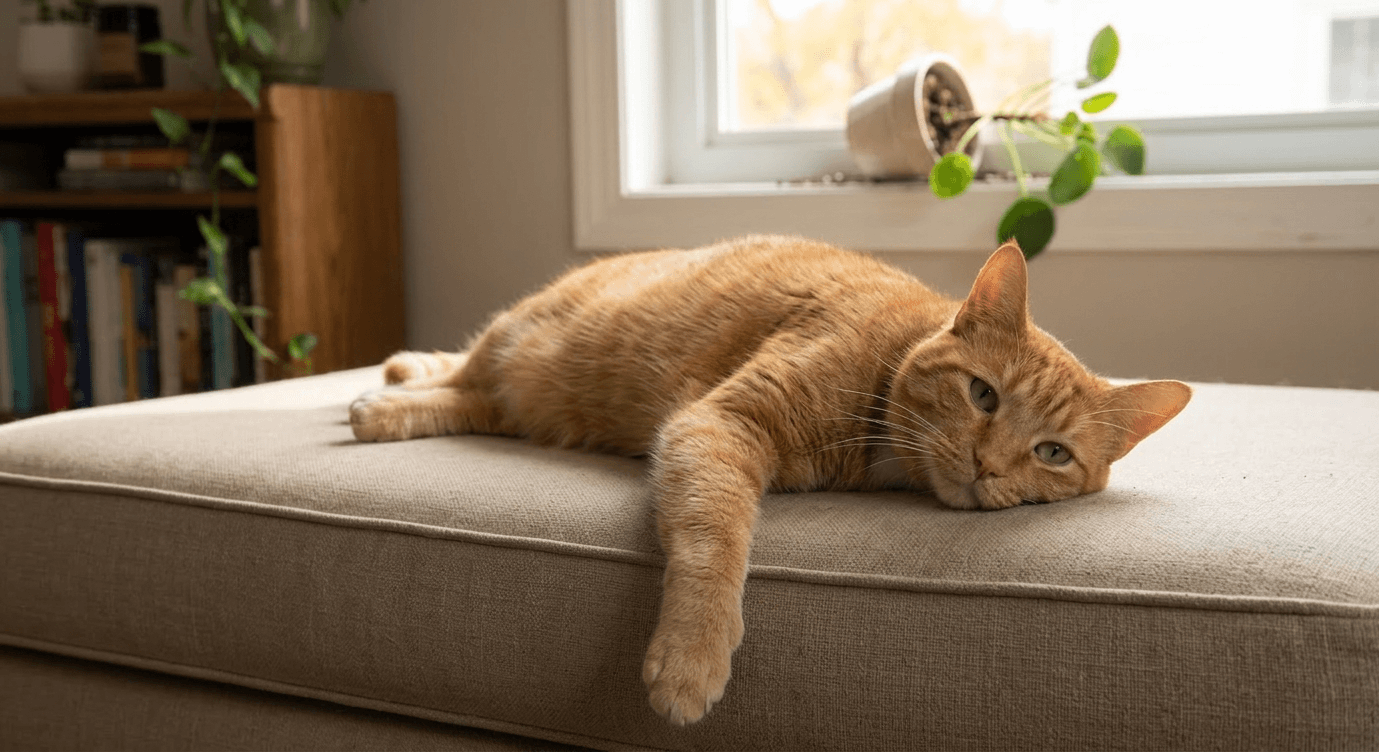
I still remember the morning I noticed Oliver — my ridiculous, lovable orange tabby — had licked a perfectly smooth bald patch onto his belly. At first, I thought it was allergies. Then he knocked my trailing pothos off the windowsill for the third time that week, looked me dead in the eyes, and walked away. I panicked. I scooped him into his carrier, drove to the vet fully convinced something was seriously wrong, and sat there bracing for a scary diagnosis.
What I got instead completely blindsided me. The vet smiled, handed me a pamphlet, and told me Oliver was the picture of physical health. The real problem? He was bored out of his mind. It turns out the signs indoor cat is bored are surprisingly easy to miss — until they become impossible to ignore.
That visit changed everything about how I care for Oliver. And it’s exactly why I’m writing this today — because if it happened to us, it’s happening in thousands of other homes right now.
Quick Answer
The most common signs your indoor cat is bored include destructive scratching, over-grooming to the point of bald patches, excessive meowing, extreme lethargy, and sudden changes in eating habits. You can fix feline boredom by introducing daily interactive play sessions, puzzle feeders, window perches, and vertical climbing spaces that give your cat mental and physical stimulation every single day.
If these behaviors are accompanied by hiding or litter box issues, you are no longer dealing with boredom. You need to immediately review the critical signs indoor cat is stressed to prevent a medical emergency.
Why Indoor Cats Get Bored So Easily
Before we get into the specific signs, it helps to understand why this happens in the first place.
Domestic cats — even the laziest, floofiest ones like Oliver — are hardwired predators. Their brains are built around a cycle of hunting, catching, eating, grooming, and sleeping, repeated multiple times a day. Outdoors, that cycle happens naturally. Indoors, with no prey to stalk and nothing new to explore, that drive just… sits there. Unspent. Restless.
Think of it like this: imagine being put in a comfortable but completely unstimulating room with no phone, no books, and no windows. You’d go a little stir-crazy too.
The good news? Once you know what to look for, the signs are clear — and the fixes are genuinely straightforward.
10 Signs Your Indoor Cat Is Bored
1. Over-Grooming and Unexplained Bald Patches
This was Oliver’s big red flag, and it’s one of the most commonly misdiagnosed signs out there.
When cats are under-stimulated, they often redirect their energy into excessive self-grooming. It starts as a stress-relief behavior — licking feels calming — but it can escalate into a compulsive habit called psychogenic alopecia.
What to look for:
- Symmetrical bald patches, often on the belly, inner thighs, or base of the tail
- Skin that looks raw, pink, or irritated
- You rarely catch them doing it because it often happens when you’re asleep or away
Always rule out allergies, parasites, or skin conditions with your vet first. If the physical checks come back clean, boredom and anxiety are the next stop.
2. Destructive Scratching (Beyond Normal Scratching)
Scratching is a completely normal cat behavior — it’s how they stretch, mark territory, and maintain their claws. But destructive scratching has a different quality to it.
When Oliver started going after the corner of my couch with a kind of frantic, almost manic energy, it wasn’t maintenance scratching. It was outlet-seeking.
Signs it’s boredom-driven scratching:
- Targeting new surfaces they previously ignored (walls, door frames, carpet)
- Scratching with unusual intensity or duration
- Happening most frequently when you first get home after being away all day
3. Excessive Meowing or Vocalization
Some cats are naturally chatty. Siamese owners, I see you. But there’s a difference between conversational meowing and the kind of loud, persistent, almost demanding vocalization that seems to have no clear cause.
Bored cats meow to create stimulation. They’re essentially talking to hear something happen.
Ask yourself:
- Is the meowing happening at specific times (3 a.m., the moment you sit down)?
- Does it stop when you engage with them, then start again the moment you turn away?
- Have you ruled out hunger, pain, and hyperthyroidism with your vet?
If the answer to all three is yes — your cat is bored and asking you to do something about it.
4. Knocking Things Off Surfaces
Yes, this is a meme. But it’s also a legitimate behavioral signal.
Cats knock things over for a few interconnected reasons: to test cause and effect, to get your attention, and because movement triggers their prey drive. A bored cat will push your coffee mug off the counter just to watch it fall — and to watch you react.
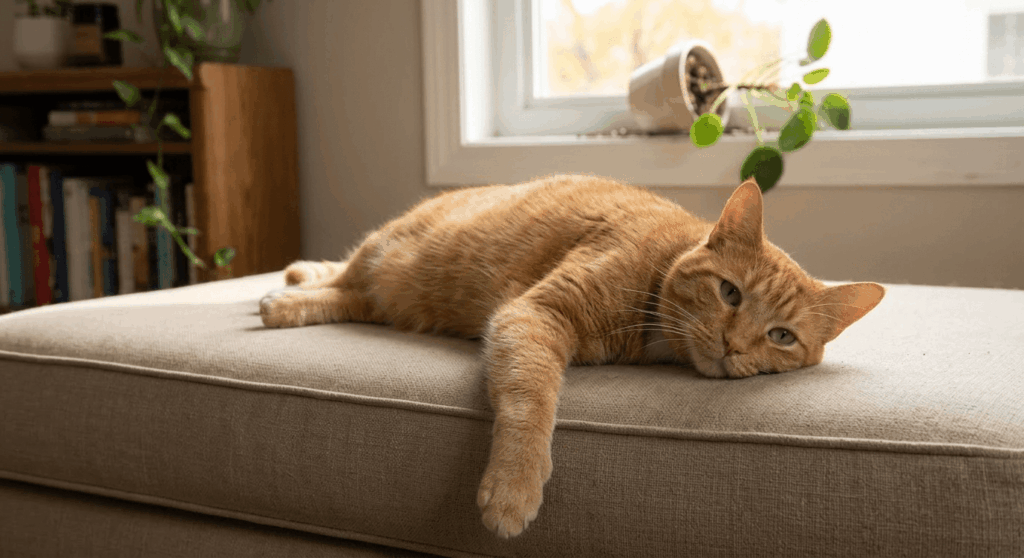
Oliver’s window plant phase lasted about two weeks before I finally understood what he was telling me.
Key distinction: If it’s happening constantly across multiple surfaces and objects, it’s a behavioral pattern, not occasional curiosity.
5. Lethargy and Sleeping Far More Than Usual
Okay — cats sleep a lot. We know this. The average adult cat sleeps 12 to 16 hours a day, which still shocks me every time I type it.
But boredom sleep is different from healthy rest. A bored cat isn’t sleeping because they’re content and spent from activity. They’re sleeping because there is simply nothing else to do.
Boredom sleep tends to look like:
- Sleeping in the same spot, in the same position, for most of the day
- Waking up and immediately looking listless rather than alert
- No burst of the “zoomies” or playful behavior at dawn or dusk (when cats are naturally most active)
6. Aggressive Play Behavior Toward You
If your cat has started ambushing your ankles the second you walk to the kitchen, or biting your hands during what was supposed to be gentle petting — don’t take it personally.
This is redirected predatory energy, and it’s one of the clearest signs that a cat has too much pent-up drive with nowhere healthy to send it.
This often looks like:
- Stalking and pouncing on your feet
- Biting that breaks skin without much warning
- “Play” that escalates quickly and feels aggressive rather than playful
The fix here is almost always the same: more structured, intentional play with appropriate toys — before the ankle attacks start.
7. Increased Clinginess or Social Anxiety
This one surprises people because we often assume bored cats act out, not cling on.
But some cats respond to under-stimulation by becoming anxious and hyper-attached. Oliver went through a phase where he’d follow me from room to room, sit outside the bathroom door, and yowl if I left his sight for more than a few minutes.
Signs of boredom-driven clinginess:
- Velcro behavior that’s new or suddenly intensified
- Visible distress when you leave the house (pacing, crying, destructive behavior while you’re gone)
- Over-attachment to one person in the household
Much of this boredom builds up while we are away for 8+ hours, so setting up passive entertainment during the workday is absolutely critical — and I cover exactly how to do that in this guide: how to entertain an indoor cat while at work.
If your cat won’t leave your side, dive into our full behavioral guide on cat attention seeking behavior to understand the difference between love and anxiety.
8. Changes in Appetite — Eating More or Less Than Usual
Boredom and stress affect the gut more than most people realize.
Some cats eat more when bored — food becomes entertainment when nothing else is available. Others lose interest in eating because their overall engagement with the world has just… dimmed.
Watch for:
- Sudden increased begging or food obsession with no change in food brand
- Leaving full bowls that were previously always cleaned
- Weight gain or loss that your vet can’t attribute to a medical cause
This one always warrants a vet visit first. But if you get a clean bill of health, food enrichment — using puzzle feeders, lick mats, and scatter feeding — can address both the boredom and the abnormal eating pattern simultaneously.
9. Repetitive or Compulsive Behaviors
These are the behaviors that tend to alarm owners the most, and rightly so — they can tip from boredom into genuine anxiety disorders if left unaddressed.
Examples include:
- Pacing back and forth along the same path
- Obsessive tail-chasing
- Wool sucking or fabric chewing (especially common in cats weaned too early)
- Staring at walls or blank spaces for extended periods
If you’re seeing any of these, please involve your vet or a certified feline behaviorist. These behaviors exist on a spectrum, and you want professional eyes on them sooner rather than later.
10. A General “Flatness” — Losing Interest in Things They Used to Love
This is the subtlest sign, and honestly the one I find the most heartbreaking.
Oliver used to sprint to the window every morning to watch the birds. Then one month, he just… stopped. The birds were still there. He just didn’t care anymore.
When a cat stops engaging with activities, toys, or spots they previously loved — that’s a flag. It’s the feline equivalent of anhedonia, a loss of pleasure in previously enjoyable things, and it tells you the enrichment deficit has been going on for a while.
Ask yourself: When did my cat last truly play? When did they last sprint across the apartment for no reason? If you can’t remember, that’s your answer.
How to Fix Cat Boredom: A Practical Action Plan
The great news is that feline boredom is almost entirely reversible. Here’s exactly where to start.
Start With a Daily Interactive Play Session
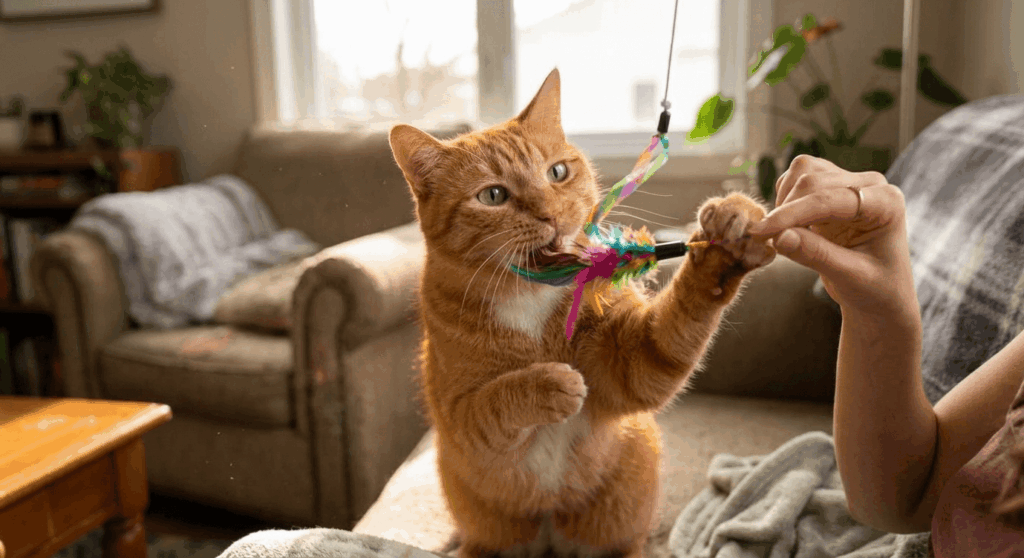
This is non-negotiable. 10 to 15 minutes of focused, wand-toy play, twice a day — once in the morning and once before you sleep — replicates the hunt cycle and burns mental and physical energy.
Key things to get right:
- Move the toy like prey: erratic, low to the ground, with pauses
- Always end with a “kill” — let them catch and bite the toy so the hunt cycle completes
- Follow the play session with a small meal to complete the hunt-eat-groom-sleep sequence
Introduce Puzzle Feeders and Food Enrichment
Replace at least one regular meal per day with a puzzle feeder, lick mat, or snuffle mat. This gives your cat’s brain a job to do and extends mealtime from 30 seconds to 5–10 minutes of engaged problem-solving.
Good starting options:
- Nina Ottosson puzzle feeders (levels 1–4 based on your cat’s experience)
- Lick mats with wet food or plain meat baby food
- Scatter feeding dry kibble across a snuffle mat
Add Vertical Space and Climbing Opportunities
Cats feel safest and most stimulated at height. If your cat has nowhere to climb, they’re missing a massive source of environmental enrichment.
Vertical enrichment ideas:
- Cat trees and towers near windows
- Wall-mounted cat shelves (a series of shelves creates a “cat highway”)
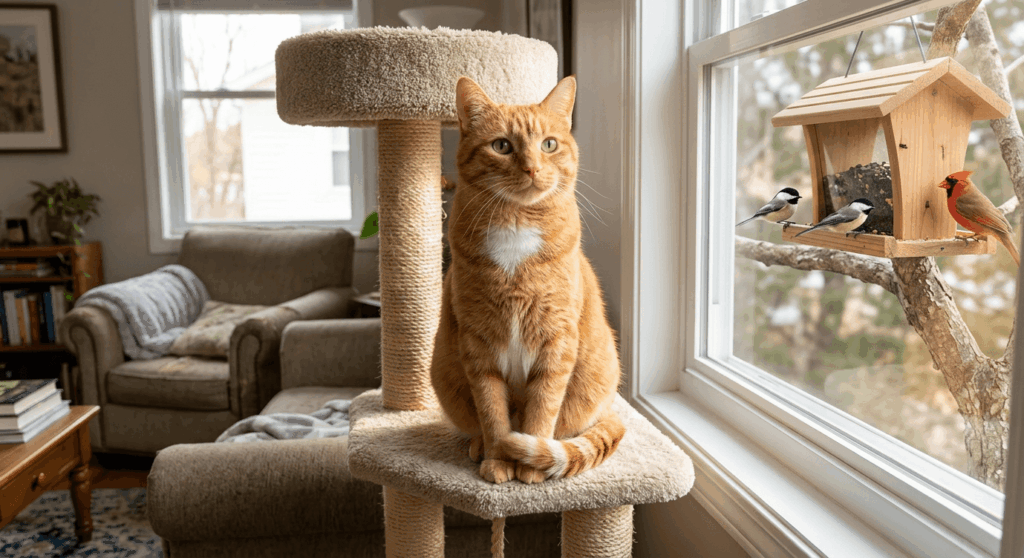
- Window perches — especially ones that overlook bird feeders
To permanently address boredom, you really need to look at your home’s layout with fresh eyes and add vertical enrichment wherever possible — I break down exactly how to do this for smaller spaces in my guide: indoor cat enrichment in small apartments.
Set Up a Bird Feeder Outside a Window
This is one of the cheapest, most effective enrichment tools available, and I wish someone had told me about it years ago.
Position a bird feeder directly outside a window your cat can comfortably reach. Add a window perch or cat tree below the window so they can watch comfortably for hours. Oliver went from ignoring that window to spending three hours a day glued to it.
“Cat TV” — YouTube channels featuring birds, squirrels, and fish — works as a supplement when the weather is bad.
Rotate Toys Regularly
Novelty is stimulating. A toy your cat has ignored for two weeks becomes exciting again after a week in the closet.
Divide your cat’s toys into three groups and rotate them weekly. Keep only one group out at a time. This is a completely free enrichment strategy that makes a genuinely noticeable difference.
Consider a Cat Companion (Thoughtfully)
For some cats, another feline companion is the single best solution. For others — particularly independent or territorial cats — it causes more stress than it relieves.
Talk to your vet or a feline behaviorist before adding a second cat. If your vet gives the green light, proper slow introductions (2–4 weeks minimum) are essential.
Key Takeaways
- Boredom in indoor cats is a genuine welfare issue, not a personality quirk
- The signs range from obvious (destructive scratching) to subtle (losing interest in favorite activities)
- Daily interactive play is the single most impactful change you can make
- Environmental enrichment — vertical space, window access, food puzzles — addresses boredom at its root
- Always rule out medical causes with your vet before attributing behavioral changes to boredom alone
Frequently Asked Questions
👉 Do bored cats sleep more than usual?
Yes — and it’s one of the most overlooked signs. While cats naturally sleep 12–16 hours a day, boredom-driven sleep looks different. A bored cat sleeps because there’s nothing else to do, not because they’re rested and content. They’ll typically wake up looking flat and disengaged rather than alert and ready to play. If your cat sleeps all day, wakes briefly, then immediately goes back to sleep without any playful burst of energy — that pattern is worth addressing.
👉 Are changes in appetite one of the signs indoor cat is bored?
Absolutely — but they need consistent human interaction and a rich environment to thrive. Many cats prefer to be the only pet in the household. What they can’t thrive without, regardless of whether they have a companion, is daily engagement, stimulation, and play. A single indoor cat with daily interactive play, puzzle feeders, and a window perch will almost always be happier than a two-cat household with no enrichment provided to either cat.
👉 How long does it take to see improvement after adding enrichment?
Most owners notice a meaningful change within one to two weeks of consistently implementing daily play and at least one or two environmental enrichment upgrades. Some behavioral signs — like the ankle attacks and excessive vocalization — tend to improve fastest. Over-grooming and compulsive behaviors may take longer (four to eight weeks) to fully resolve, particularly if they’ve become established habits. Be patient, be consistent, and celebrate the small wins.
Did this post help? Share it with another cat owner who might be wondering why their cat is staging a one-feline protest against boredom. And if Oliver’s story sounds familiar — you’re not alone, and your cat is going to be just fine.
Disclaimer: This article is written from personal experience and general behavioral knowledge. It is not a substitute for professional veterinary advice. Always consult your vet if you notice sudden changes in your cat’s behavior or physical health.