There was a period, about eighteen months into life with Oliver, when I looked around my 500-square-foot studio and counted twenty-three cat toys on the floor, a scratching post in each corner, two cat trees, several treat puzzles, and a basket of accessories I could barely identify.
Oliver was lying in the middle of all of it, staring at the ceiling like a cat who had everything except something interesting to do.
That was when I realized the problem was not that I had bought too little. I had bought too much without a system.
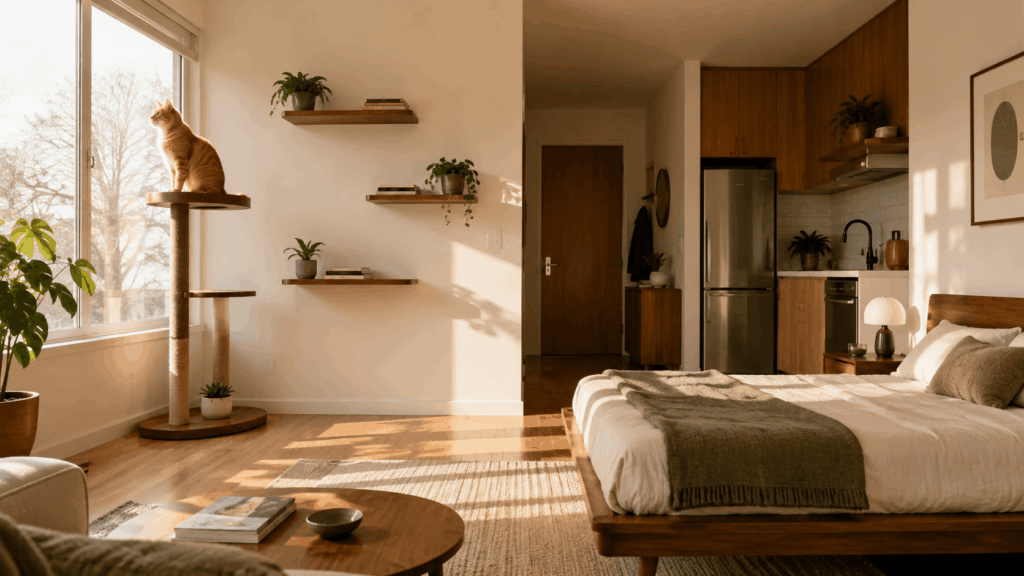
Becoming a minimalist cat owner does not mean giving your cat a bare apartment. It means choosing fewer, better items that support real feline needs: vertical space, scratching, hiding, food enrichment, clean litter access, safe resting places, and daily interaction. A cleaner setup is easier to sanitize, easier to manage, and often more engaging than a floor covered in ignored toys.
Minimalist Cat Owner: Quick Answer
A minimalist cat owner keeps only the cat items that serve a clear biological or practical purpose: one reliable scratching setup, vertical space, comfortable resting spots, clean food and water stations, a safe litter area, a small rotating toy system, and daily interactive play.
The goal is not fewer things for the sake of aesthetics. The goal is less clutter and more intentional enrichment. In a small apartment, that usually means vertical-first furniture, washable materials, hidden storage, toy rotation, and a simple rule: every cat item should either support health, safety, hygiene, play, scratching, rest, or stress reduction.
The Clutter Trap: Why Your Cat Doesn’t Need 50 Toys
The pet product market is enormous, and apartment cat owners are often told that more gear means a happier indoor cat. The marketing message is consistent: more toys, more accessories, more gear equals more happiness for your cat.
Feline behavior research and enrichment guidelines point to a more useful idea: cats need the right resources, used in the right way, not endless objects left on the floor.
The Novelty Habituation Problem
Cats habituate to static objects rapidly. A new toy placed on the floor produces investigative behavior for approximately 15–30 minutes on day one. By day three, it has been fully incorporated into the environmental background and produces essentially zero behavioral engagement. By day ten, it is furniture — present, invisible, ignored.
Twenty-three toys on the floor don’t produce twenty-three times the enrichment of one toy. They produce a cluttered environment where nothing is novel, nothing demands attention, and the cat lies in the middle of all of it staring at the ceiling.
The enrichment paradox: A single toy used for short interactive play sessions can be more engaging than a permanent pile of twenty toys — because novelty, not quantity, is what drives engagement.
What the Clutter Actually Costs
Beyond the enrichment failure, excessive gear creates specific problems that the minimalist cat owner approach solves:
- Hygiene surface area: Every toy on the floor is a bacteria and allergen collection surface. Every fabric accessory can collect hair, dander, dust, and odor if it is not cleaned regularly. Less gear means fewer surfaces to sanitize and a genuinely healthier environment.
- Scent landscape complexity: A cluttered floor creates multiple overlapping scent territories and visual noise that can actually elevate baseline arousal in anxious cats. A clean, open floor plane produces a calmer baseline neurological state.
- Owner mental load: The cognitive weight of managing, cleaning, replacing, and organizing extensive pet gear is a real contributor to dog owner burnout-equivalent fatigue in cat owners — and a cluttered space produces ongoing low-level stress in the human that the cat reads and reflects.
7 Essential Tips: How to Excel as a Minimalist Cat Owner
Tip 1: Multifunctional Furniture — The Investment Principle
The first and most transformative minimalist cat owner principle is the elimination of “cat-only” furniture in favor of Multifunctional Furniture that serves both human aesthetic purposes and feline behavioral needs simultaneously.
The end-table cat tree:
The majority of commercial cat trees are visually intrusive, covered in carpet that degrades within months, and serve only one function. The minimalist cat owner replaces this with a cat tree designed to function as a piece of furniture:
- The Tuft & Paw Mau Lifestyle Cat Tree — mid-century modern aesthetic in walnut, works as a side table or bookshelf end piece
- The Catastrophic Creations wall shelf systems — wall-mounted, don’t occupy floor space, integrate into gallery wall aesthetics
- The CLEO cat furniture range — designed by architects to pass as minimalist furniture while providing all vertical territory functions
The multifunctional rule: Before purchasing any cat item, ask: “Does this serve more than one function? Does it work for the human space as well as the cat?” If the answer is no, the item either doesn’t get purchased or gets replaced with an alternative that meets both criteria.
The bowl situation:
Single-use decorative cat bowls in a matching set of four scattered across the kitchen represent the opposite of minimalist cat owner philosophy. Replace with:
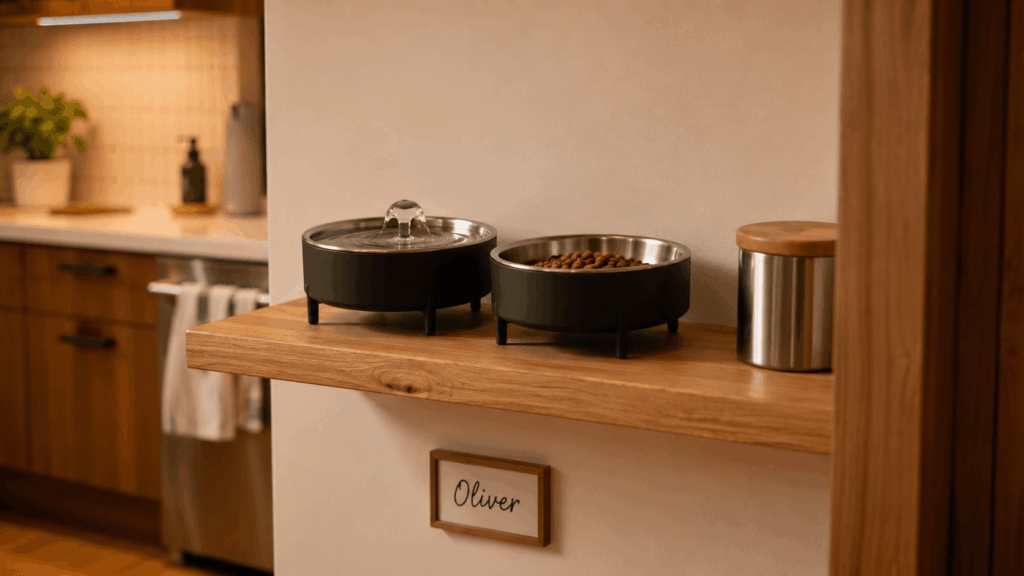
- Two elevated stainless steel bowls (one food, one water) that stack for storage when not in use
- One water fountain that serves as the visual centerpiece of the feeding area rather than a utilitarian intrusion
Tip 2: The Vertical-First Rule — Cubic Space Over Floor Space
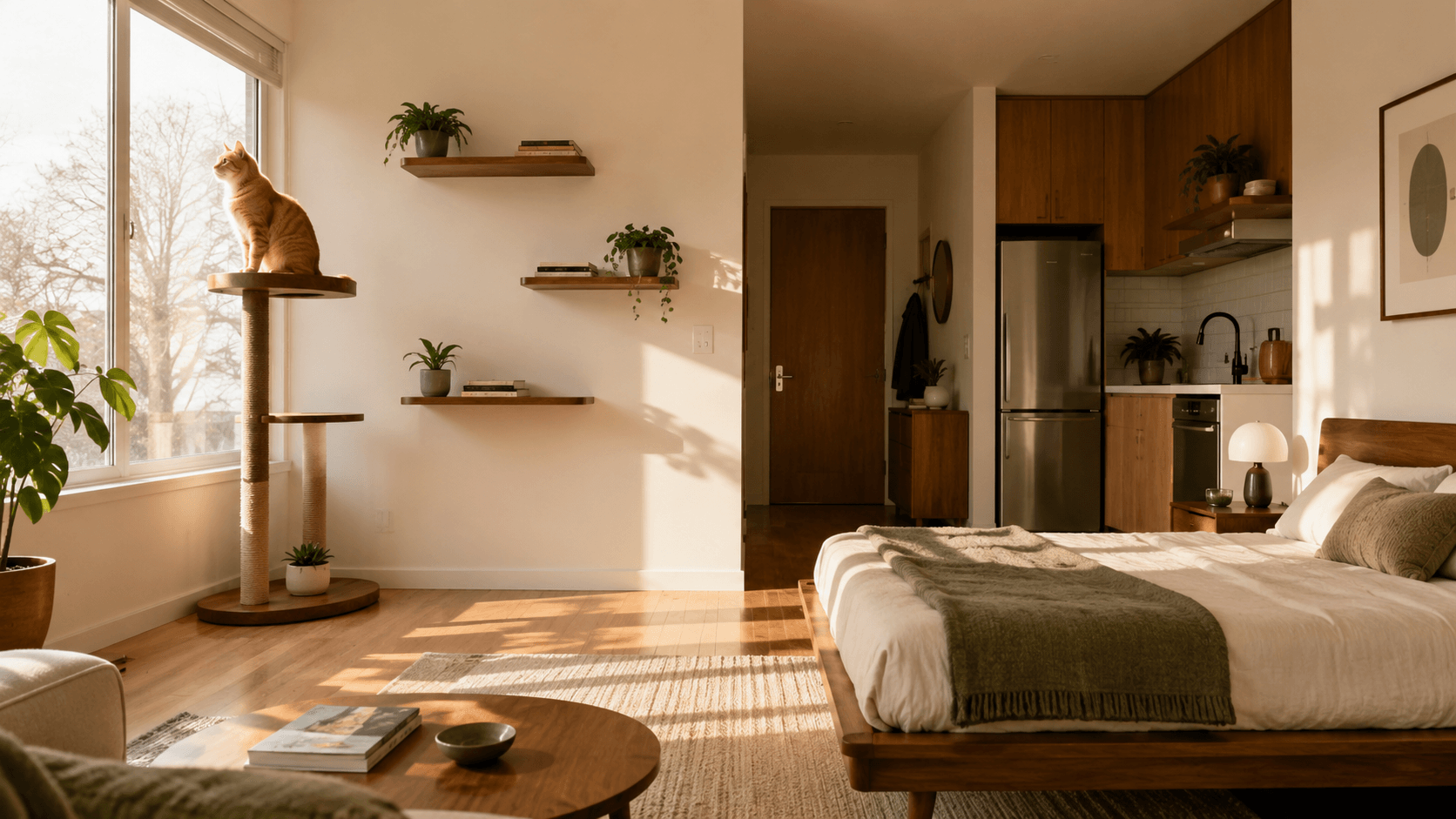
The minimalist cat owner never uses floor space for cat enrichment when wall space is available — because floor items create clutter, while wall-mounted elements create Cubic Real Estate without consuming the floor plane that makes a small studio feel spacious.
The vertical-first audit:
Walk through your studio and identify everything cat-related that is currently on the floor. For each item, ask: “Can this function be moved to the wall?”
- Scratching post on the floor → wall-mounted sisal panel at shoulder height
- Cat bed in the corner → wall-mounted sleeping shelf at 4 feet
- Cat tree taking up 4 square feet of floor → floor-to-ceiling tension pole with integrated platforms
- Toy basket → wall-mounted hook with a single hanging toy replaced weekly
The floor-clearing standard:
The minimalist cat owner floor should have exactly two cat-related items: the feeding station (two bowls) and the litter box. Everything else belongs on a wall, a shelf, or inside a closed drawer.
If you want one high-impact item instead of several small cat accessories, a stable cat tree for small apartments can add climbing, scratching, and resting space without cluttering every corner.
A minimalist environment still needs active play. If you want toys that do not take over the floor, use our guide to the best cat toys for small apartments and choose a small rotation instead of a permanent pile. The vertical-first rule compensates for floor simplicity with spatial complexity at height.
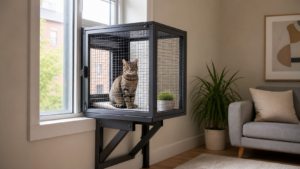
For renters or small rooms where floor space is limited, wall-mounted options can work well when installed safely; compare depth, traction, brackets, and load ratings in our guide to the best cat wall shelves.
Tip 3: The Rotation System — One-In, One-Out Novelty Management
The rotation system is the minimalist cat owner solution to the enrichment paradox described above — it maintains novelty without accumulation.
If you want fewer toys that still earn their space, start with our guide to the best space saving cat toy options for renters instead of building a large toy basket.
The rotation protocol:
- Keep a maximum of five toys in total (for a single cat like Oliver)
- At any given time, only one or two toys are “in play” — accessible in the apartment
- The remaining three or four are stored in a closed container (a single drawer, a small lidded basket)
- Every five to seven days: one toy goes into storage, one comes out of storage
The result: Oliver interacts with a “new” toy every week without any new toy ever being purchased. The rotation restores novelty to previously habituated items — the toy that was invisible on day thirty becomes genuinely interesting again on day forty-five after two weeks in storage.
The one-in-one-out rule:
Any new toy or cat item that enters the apartment requires the exit of an existing item. This rule, applied consistently, prevents the accumulation cycle from restarting.
What to do with outgoing items:
- Donate to a local shelter (most shelters accept clean, gently used toys)
- Pass to a friend with a cat
- Compost if biodegradable (cardboard, natural fiber items)
- Recycle packaging components
Tip 4: Aesthetic Integration — Make Cat Gear Fit the Room
The minimalist cat owner holds their cat’s environment to the same design standard as the rest of their home — because inconsistent aesthetics are what create the “pet store outlet mall” appearance that originally drove my own declutter.
The aesthetic integration checklist:
Color palette discipline:
- Choose one color family for all cat items (neutrals — white, grey, black, natural wood tones work universally)
- Avoid the rainbow of multicolored cat toys scattered across a neutral apartment floor
- If Oliver’s items are all in the same tonal range as my apartment, they read as deliberate design choices rather than clutter
Material consistency:
- Natural materials (sisal, wood, cotton, linen) age better aesthetically and integrate more naturally into mid-century modern or Scandinavian apartment aesthetics
- Avoid cheap carpet-covered items that degrade visibly within months
The contained clutter principle:
- One dedicated storage vessel (a lidded basket, a closed drawer, a cabinet) houses all cat items not currently in use
- The storage vessel itself is chosen for aesthetic value — a beautiful woven basket or a mid-century modern side table with drawer is functional storage and a design element simultaneously
The cat furniture audit:
Every six months, photograph your apartment and look at it with fresh eyes. Is the cat furniture integrated or intrusive? Does each item serve a function clearly enough to justify its visual presence? Items that fail this audit get replaced with better-integrated alternatives or eliminated entirely.
If you want the apartment to feel designed instead of cluttered, use our cat friendly interior design guide to choose washable materials, hidden litter zones, vertical routes, and furniture that works for both humans and cats.
Tip 5: The Paper Bag Secret — Low-Cost Enrichment Still Counts
This is the minimalist cat owner tip that most surprises people — and the one that most directly challenges the “more gear equals more enrichment” assumption. Minimalist enrichment works best when you audit the whole room, not just the toy basket. For a broader setup plan, use our guide to indoor cat enrichment in small apartments.
The paper bag:
A standard paper grocery bag, laid on its side, provides:
- Novel texture investigation (paper rustles differently than carpet or fabric)
- Enclosed hiding space that satisfies the concealment drive
- A surface that accepts and transmits the cat’s own scent rapidly — becoming “claimed” quickly
- Predatory play opportunity — the paper responds to paw pressure and bat attacks with satisfying sound and movement
Oliver engages with a new paper bag for 20–40 minutes on day one. I replace it when it becomes a habituated background item — usually after four to five days. Cost: zero. Storage footprint when not in use: zero.
The zero-cost enrichment toolkit of the minimalist cat owner:
- Paper bags (delivered groceries, shopping)
- Cardboard boxes (Amazon deliveries — left for three to five days, then recycled)
- Crumpled aluminum foil balls — inexpensive, intensely stimulating Tactile Preference for cats who like firm, reactive textures
- Empty paper towel rolls with a few treats inside — foraging enrichment with zero purchase required
- A sunbeam (position a small mirror to direct sunlight across the floor — creates an unpredictable, moving light spot that produces genuine predatory play)
The principle behind the secret:
Environmental Enrichment is not about objects. It is about novelty, unpredictability, and behavioral engagement. The cardboard box that arrived with your new minimalist cat bowl provides more enrichment than the elaborate puzzle toy you paid $35 for — because it is new, it is textured differently from the apartment’s usual surfaces, and it disappeared after five days before returning four weeks later with a different smell.
Tip 6: Sustainable Gear — Quality Over Quantity
The minimalist cat owner buys once, buys well, and never buys the same category of item twice. This is both the most economically efficient and most environmentally responsible approach to cat ownership — and it produces a cleaner, less cluttered space than the cycle of buying cheap gear that degrades and requires replacement.
The sustainable investment framework:
Litter box: One high-quality, large-format litter box (not five inadequate ones) in a material that doesn’t absorb odors (glazed ceramic insert or stainless steel tray). Replace never — these last for the cat’s lifetime if maintained.
Food and water bowls: Stainless steel or ceramic — dishwasher safe, non-porous (doesn’t harbor bacteria like plastic), doesn’t leach compounds into food. Replace never.
Scratching surfaces: Wall-mounted sisal panels (replace the sisal, not the mounting hardware, when worn) or a single high-quality sisal cat tree (Tuft & Paw quality, not mass-market carpet). Replace the consumable component, not the infrastructure.
Carrier: One high-quality, size-appropriate hard carrier (not three soft carriers for different occasions). The carrier that is comfortable enough for daily habituation training is also the emergency evacuation carrier and the vet transport carrier. One carrier, multiple functions.
The ‘cost-per-day’ calculation:
A $200 cat tree that lasts 8 years costs $0.07/day.
A $40 cat tree that lasts 8 months costs $0.17/day — and goes to landfill.
The minimalist cat owner makes the investment calculation before purchase and buys at the higher quality tier. The total lifetime spend is lower, the waste is dramatically reduced, and the aesthetic quality of the apartment is consistently higher.
Tip 7: Mental Load Management — Training Takes Almost No Space
The final and most philosophically complete minimalist cat owner tip: the best enrichment tool in your apartment takes up zero physical space and produces more behavioral benefit than any object you could purchase.
Clicker training is one of the most space-efficient enrichment tools because it fits in a drawer and gives your cat a structured way to think, move, and earn rewards. For physical setups that save space, pair training with our guide to cat furniture for small apartments. A clicker and a small bag of freeze-dried treats fit in a kitchen drawer. The mental stimulation they produce is equivalent to or greater than any puzzle toy on the market.
The mental load management toolkit of the minimalist cat owner:
Clicker training (zero space):
- 5-minute daily sessions teaching new behaviors (sit, touch, spin, fetch)
- Cognitive engagement that produces measurable tiredness — a trained cat is a calm cat
- Deepens the human-cat bond through positive interaction
Structured play (minimal space):
- One wand toy stored in a drawer (not on the floor)
- 15-minute daily aerobic play sessions that produce the Metabolic Discharge that reduces destructive behavior
Foraging feeding (replaces a toy with a meal):
- Scatter-feeding one meal per day across a snuffle mat (stored rolled up in a drawer)
- Eliminates the need for multiple puzzle feeders while providing superior foraging stimulation
Window enrichment (zero cost, zero space):
- A bird feeder mounted outside the window (the enrichment is external to the apartment)
- A window perch (one shelf, wall-mounted — already within the vertical system)
The mental load principle: Ten minutes of active engagement with you is worth more to Oliver’s behavioral health than ten hours alone with a pile of toys. The minimalist cat owner invests in time and intentional interaction rather than gear accumulation — and the apartment, the cat, and the owner are all better for it.
Minimalist Cat Owner Essential Gear List
| Item | Keep One? | Why It Earns Space | Minimalist Tip |
|---|---|---|---|
| Scratching surface | Yes | Supports scratching, stretching, and scent marking | Choose one tall vertical option and one small horizontal option |
| Vertical perch or shelf | Yes | Adds territory without using floor space | Put it near a window or quiet resting zone |
| Interactive wand toy | Yes | Supports daily hunting-style play | Store it in a drawer and use it on schedule |
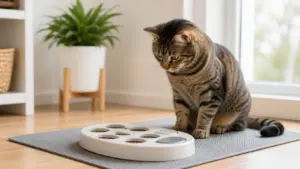
| Food puzzle or snuffle mat | Yes | Adds mental work to meals | Keep one easy-clean option, not a full collection |
| Washable bed or blanket | Yes | Gives a familiar resting scent | Choose machine-washable fabric |
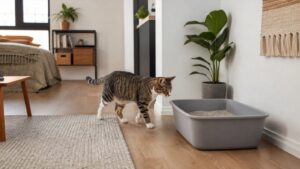
| Litter setup | Yes | Hygiene and behavior depend on access | Keep the area simple, visible, and easy to clean |
| Decorative duplicate toys | Usually no | Often become background clutter | Rotate a few toys instead of displaying all of them |
| Damaged fabric toys | No | Can collect odor or become ingestion hazards | Retire damaged toys promptly |
After my own declutter and five years of refining this list through clinical work, here is what I consider the non-negotiable gear for a single indoor apartment cat:
Keep: The Essential 12
- One large litter box (ideally enclosed for odor management)
- One stainless steel food bowl (elevated if your cat has megaesophagus or neck arthritis)
- One water fountain (circulating water increases hydration)
- One carrier (hard-sided, size-appropriate, habituation-trained)
- One cat tree OR wall shelf system (not both — choose the approach that suits your wall permissions)
- One wand toy (stored in a drawer, not on the floor)
- One snuffle mat (stored rolled)
- One clicker (in a kitchen drawer)
- One high-value treat supply (freeze-dried protein, in the refrigerator)
- One nail trimmer (in the bathroom cabinet)
- One brush (appropriate for coat type, in the bathroom cabinet)
- One carrier/travel food bowl (foldable silicone, stores flat)
Toss: What Doesn’t Earn Its Space
- Toy piles with more than five items
- Multiple cat trees when one wall system would suffice
- Fabric toys that cannot be sanitized (dander and bacteria accumulation)
- Decorative ceramic bowls that cannot go in the dishwasher
- Catnip toys that have lost their potency (most do after three months)
- Cardboard scratchers that have been destroyed and not replaced — broken-down scratchers provide no function and significant visual clutter
- Any item that has not been used by the cat in 30 days
Hygiene Benefits: Why Less Stuff Means a Healthier Cat
The connection between a minimalist cat owner environment and genuine feline health outcomes is one that I discuss with clients regularly — because the hygiene argument is more compelling than the aesthetic one for many people. Less fabric clutter can also make dander and hair easier to control. If air quality is a major concern in your apartment, compare filter types and placement in our guide to the best air purifiers for cat hair and odor.
For a coordinated routine that covers grooming, washable fabrics, floors, furniture, laundry, and filtration, follow our guide to controlling cat hair in a small apartment.
A low-clutter room is easier to maintain only when the remaining beds, blankets, and furniture are cleaned consistently. If upholstered surfaces collect loose fur, follow these methods to get cat hair off furniture using tools that match the material.
Surface Area and Bacterial Load
Every surface in a cat’s environment is a potential site for bacterial colonization, allergen accumulation, and pathogen transmission. A studio with twenty cat toys, four fabric beds, two carpet cat trees, and a collection of fabric accessories has dramatically more surface area for bacterial growth than the same studio with one stainless steel bowl, one wall shelf, and one stored-when-not-in-use snuffle mat.
The specific hygiene risks of excessive cat gear:
- Fabric toys: Staphylococcus and other bacteria colonize fabric surfaces rapidly in the presence of cat saliva and environmental moisture
- Carpet-covered cat trees: Impossible to sanitize to pathogen-elimination standard; harbor flea eggs and larvae in carpet fibers
- Plastic food bowls: Develop micro-scratches that harbor bacteria even after washing — a known cause of feline chin acne
- Multiple fabric beds: Each additional fabric sleeping surface is an additional dander accumulation and allergen source affecting both cat and owner respiratory health
The Cleaning Frequency Equation
A minimalist cat owner apartment can be thoroughly cleaned in significantly less time than a cluttered one — which means cleaning happens more frequently, which means the hygienic standard is consistently higher.
Oliver’s current cleaning schedule:
- Daily: Stainless steel bowls washed, water fountain topped up, litter box scooped
- Weekly: Water fountain fully cleaned, wall shelves wiped, floor vacuumed and mopped
- Monthly: Water fountain deep-cleaned, litter box fully emptied and washed, carrier wiped
This schedule is achievable in approximately 45 minutes of weekly maintenance — because there is nothing to move, nothing to work around, and every surface is cleanable with standard products.
Frequently Asked Questions
Does a minimalist cat owner have bored cats?
A poorly implemented minimalist approach can result in an under-enriched cat — but a well-implemented one produces more engaged, better-stimulated cats than cluttered environments typically do. The key distinction is what fills the space that gear used to occupy.
When you remove the pile of ignored toys and replace them with three intentional enrichment strategies — daily structured play, clicker training, and rotation-based novelty management — you are providing richer engagement than the toys ever did. The clutter wasn’t enrichment. It was guilt management.
The minimalist cat owner compensates for reduced environmental object complexity with increased interaction quality and intentional enrichment scheduling. A cat who receives 15 minutes of focused wand toy play and a 5-minute clicker session daily is receiving more genuine behavioral enrichment than a cat who has access to 20 toys that they have fully habituated to.
Can a minimalist cat owner still provide enough enrichment?
Yes. A minimalist cat owner can provide excellent enrichment if the setup includes the essentials: vertical space, scratching surfaces, hiding spots, safe resting places, food enrichment, and daily interactive play. The goal is not to remove stimulation. The goal is to remove unused clutter and replace it with intentional routines. A rotated toy drawer, one good wand toy, a window perch, and a stable scratching setup can be more useful than twenty toys permanently scattered across the floor.
What should a minimalist cat owner avoid removing?
Do not remove resources your cat relies on for basic welfare: litter access, scratching options, food and water stations, hiding places, resting spots, vertical territory, and play opportunities. Minimalism becomes harmful when it removes choice. If your cat uses a bed, scratcher, perch, or hiding box regularly, it has earned its space. Remove duplicates, damaged items, and ignored clutter first.
What are the must-have items for a small apartment cat?
The true must-have list for a single indoor apartment cat is shorter than most people expect. Based on my veterinary technical experience and personal practice as a minimalist cat owner, the non-negotiable items are:
Survival tier (non-negotiable):
- One large litter box with appropriate litter
- One stainless steel food bowl (elevated for comfort)
- One water source (fountain preferred for hydration encouragement)
- One carrier (for vet visits and emergency evacuation)
Behavioral health tier (strongly recommended):
- One vertical structure (cat tree or wall shelf minimum)
- One wand toy for interactive play
- One scratching surface (sisal panel or high-quality post)
Everything beyond this list is either a quality-of-life enhancement (water fountain over bowl, wall shelf system over single tree) or a preference rather than a requirement. The minimalist cat owner starts with the survival and behavioral health tiers and adds selectively beyond them — only when a genuine behavioral need is identified that isn’t being met.
How do I declutter my cat’s old toys?
The declutter process is straightforward but requires a decision framework rather than pure intuition — because the guilt of “but what if Oliver misses it?” can make every toy feel unjettifiable.
The 30-day rule: Any toy that Oliver has not voluntarily interacted with in 30 days goes into a donation bag. Not “well, he played with it once three months ago” — 30 days of active non-use means it has been habituated to zero behavioral value.
The hygiene filter: Any fabric toy that cannot be sanitized in the washing machine at high temperature is automatically retired — regardless of Oliver’s apparent attachment. Hygiene takes priority over sentiment.
The condition filter: Any toy with structural damage that could create an ingestion hazard (loose catnip filling, detached small parts, fraying that could be swallowed) is retired immediately regardless of use frequency.
Where the retired toys go:
- Local animal shelter (call first — most accept clean, structurally sound toys)
- A fostering network in your city (foster cats often have nothing)
- Neighborhood buy-nothing group
- Compost if natural materials and fully degraded
The post-declutter commitment: Implement the one-in-one-out rule from day one of the minimalist cat owner approach. Every new toy that enters requires a departing toy. This prevents the accumulation from restarting — which it will, if the rule isn’t in place.
Final Thoughts
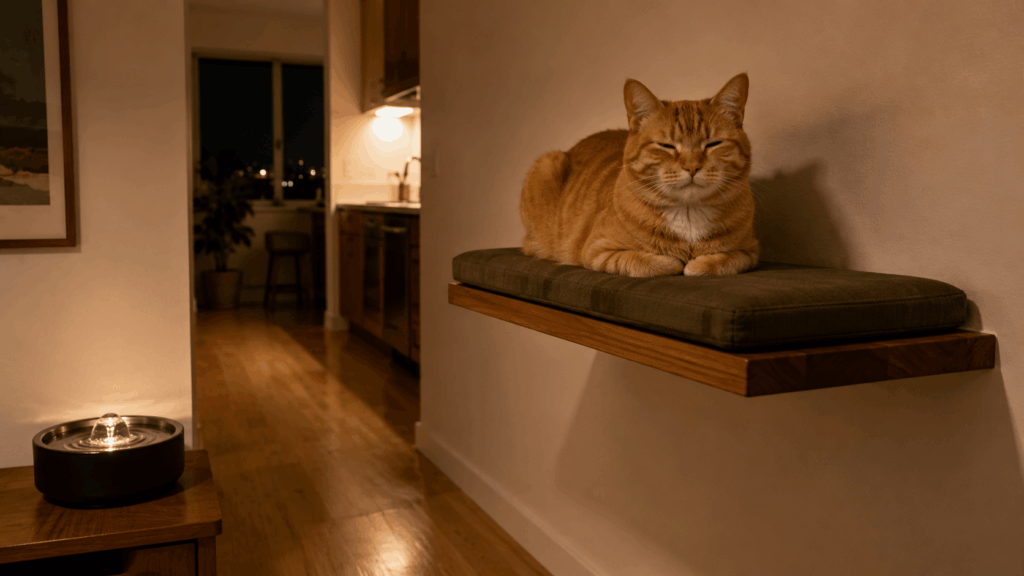
Oliver is currently asleep on his wall shelf. Below him, the floor is clear. His wand toy is in a drawer. His clicker is beside the treat container. His snuffle mat is rolled behind the pantry door.
He is not bored because the apartment has fewer cat objects. He is calmer because the objects that remain are useful, clean, familiar, and used with intention.
That is the real minimalist cat owner approach: not deprivation, not guilt, and not an empty room. It is a home where every cat item has a job, every routine has a purpose, and your cat’s needs are met without turning a small apartment into a storage unit.
Industry References
- American Pet Products Association (APPA). (2023–2024). National Pet Owners Survey. APPA.
(Referenced for pet product spending data and cat owner purchasing behavior) - Bradshaw, J. W. S. (2016). Sociality in cats: A comparative review. Journal of Veterinary Behavior, 11, 113–124.
(Referenced for feline environmental habituation and enrichment efficacy) - Ellis, S. L. H., Rodan, I., Carney, H. C., Heath, S., Rochlitz, I., Shearburn, L. D., Sundahl, E., & Westropp, J. L. (2013). AAFP and ISFM Feline Environmental Needs Guidelines. Journal of Feline Medicine and Surgery, 15(3), 219–230.
- Herron, M. E., & Buffington, C. A. T. (2010). Environmental enrichment for indoor cats. Compendium: Continuing Education for Veterinarians.